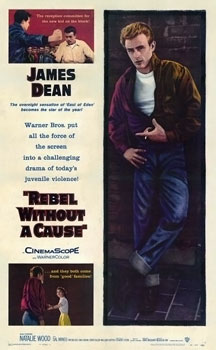
Rebel Without a Cause (1955)

A film starring James Dean, Natalie Wood, and Sal Mineo,  with direction by Nicholas Ray, Rebel Without a Cause follows three teenagers, who are confused and conflicted about their lives. 

The initial sequence rolling behind the opening credits has the inebriated Jim Stark lying in the street fiddling with a toy monkey. Then, he is brought into juvenile hall, and simultaneously the story gives us a glimpse of not only the rowdy Jim, but discontented Judy, and the distant boy Plato. Each one has their own personal pain, and thus this film from the beginning really focuses on three rebels, who embody the adolescent generation. James Dean is Jim Stark: the new kid on the block, who is constantly moving with his parents. In the station when his parents retrieve him, there is obvious tension on all fronts, which include heated arguments, and outbursts on the part of Jim.

The morning after being brought in he meets Judy only to get mixed up with her friends. Stark however also befriends the isolated loner Plato, who was in the station the night before. The trouble with the other teens starts with a switchblade contest during a school excursion to Griffith Observatory, but the stakes get bigger when they compete in a “Chickie Run” over a cliff. Stark lives but the other boy, Buzz, dies in the accident. Everyone flees the scene before the police arrive.

Stuck between a rock and a hard place, Dean and Wood’s characters gravitate towards each other. Their parents seemingly do not understand them, and so they find comfort in each other instead. Their new found friend Plato tags along as they hold up in an abandoned mansion for the night. They spend the evening lounging around, making light of their parents and just talking. 

However, all does not bode well when some of the high school thugs come looking for Stark. Plato flees the scene with a gun, and soon he has policemen on his tail. Plato is in a paranoid and unstable state. Jim tries to console him and bring him out peacefully. But despite his best efforts, tragedy strikes one final blow.  All is not wasted, however, because Jim’s father (Jim Bachus) vows to be a better and stronger parent than he was before. 

Following his breakthrough in East of Eden, Rebel would be the movie that defined Dean’s short but iconic career. His line “you’re tearing me apart!” would further define the angst felt by many teens at the time. There is a certain aura around this film for some reason, maybe because of Dean’s portrayal that is at times so moody, and at other times so subtle, but powerful nonetheless.

I think part of the credit must go to director Nicholas Ray, who gave Dean free reign to improvise and develop his character in the way he saw fit. The film is tragic in another sense because all the primary stars died at an early age. Dean’s is the most remembered, but Mineo and Wood, both died extremely young as well. In Rebel Without a Cause, they all gave memorable performances and there are other notable players in this film including the usually comedic Jim Bachus and a very young Dennis Hopper.

I think Rebel ultimately survives today because it tells a universal tale of a generational divide and a divide between young people fighting peer pressure. In the heads of teenagers the world can become jumbled and between school, fitting in, and home life it can be a struggle. This film dramatically illustrates that fact. So maybe the kids look different, the cars are older and such, but the struggles of Jim Stark, Judy, and Plato are still relatively the same.  I must say this film really makes me want to visit the Griffith Observatory too, because it became such an integral part of this film’s story, and it is still around to this day.

James Dean only had three major film performances and you could make a case for which was the best. I think it is safe to say that this role was his most iconic. It’s hard not to identify him with his red jacket, blue jeans, and the ubiquitous cigarette. He was the Rebel Without a Cause.

 
5/5 Stars

Out of the Past (1947) – Film-Noir

13659-outofthepastStarring Robert Mitchum, Jane Greer, and Kirk Douglas, this classic has every element of a good film noir.   Jeff Bailey (Mitchum) makes his living in a small town working at a gas station. He has an honest living and a girl. However, soon his past catches up with him when a man from his former life comes to see him, and he must explain it all to his innocent girlfriend.

Once he was a private investigator, who got mixed up with a powerful man named Whit (Douglas). He wanted some money found, but most importantly he wanted a deadly girl brought back to him. Pretty soon Jeff’s searching leads him down to Mexico. He has a chance meeting with the beautiful woman (Greer), and he understands why Whit wanted her back.

However, Kathie is not eager to go back, and they are attracted to each other. She and Jeff agree to run off together to San Francisco — away from the searching of Whit. They are nearly found out, but they get away. San Francisco is not a nice place, but they make do, until the day where Jeff is spotted by his old partner. He must split up with Kathie and they set a rendezvous. Only there is a hitch in the plan that Jeff did not foresee. He tries to deal with it in his own way, but Kathie takes more drastic measures. She left him there and went out of his life, or so Jeff thought. He had tried to forget his past dealings, and yet they creep back into his life. With a murder pinned on him, Bailey can do nothing but go along with Whit and Kathie. Soon he becomes embroiled in more treachery and backstabbing, which all has to do with the manipulative femme fatale.

With one last entreaty, she urges him to flee with her since they both have dark pasts. In the end, Kathie’s fanciful plan to escape is foiled by Bailey and it soon turns fatal. One last time she tried to control the situation, but this final time Jeff, or at least fate, got the best of her. After his violent death, Jeff’s girl wishes to know once and for all if he was running off with Kathie. A mute boy (Dickie Moore), who knew Jeff well lies so that the girl can continue her life. Because in Jeff’s case the past came back to haunt him. The kid goes back to the station, but not before looking up at Bailey’s name on the sign, because he did what Jeff would have wanted.

With its dialogue, extended flashback, voice over, and femme fatales played by Jane Greer and Rhonda Fleming, there are not many noir experiences better than this one. Obviously, the chiaroscuro cinematography is a major aspect of this film. Except for the shots in Bridgeport, it seems like every scene is veiled in shadow whether it takes place in Acapulco or San Fran, at day, night, inside, or out. Shadows are perpetual and they seem to reflect not only these characters but also the story. They are not easy to figure and none of them can ever be fully trusted.

Mitchum is perfect in the role of Jeff Bailey, thanks to his demeanor, his fitting voice, and the constant attire of a trench coat and fedora, with a cigarette clenched in his teeth. He is a man who looks like a saint compared to his acquaintances, and yet he is a man who can show a complex set of traits ranging from avarice, cruelty, love, and sometimes heroism. Kirk Douglas is great in his role as the crooked Whit, who acts the nice guy only to be cruel at heart. Every character from the henchman Joe, to the mute boy, the accomplice Meta  Carson, and even the loyal taxi driver are all memorable in the scenes they show up in. Jane Greer stands out, however, because she is one of the most notorious femme fatales in any noir. I think she toys with the audience as much as she does with Jeff. We find ourselves starting to believe her, then we have our doubts, and then we go on believing her again. It is a fine performance.

5/5 Stars

“She can’t be all bad. No one is.”
“She comes the closest.”
~ Ann and Jeff talking about Kathie

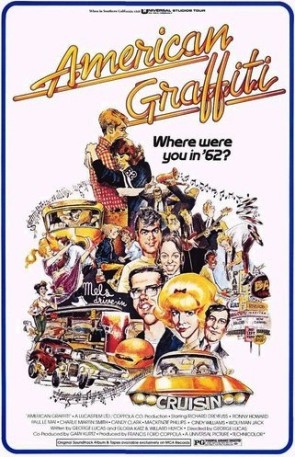
American Graffiti (1973)

Starring Ron Howard and Richard Dreyfuss with a host of others, this George Lucas directed film follows the lives of young people in California during the early 60s. It is the night before Curt and Steve are going off to college. They both want to make the most of the time left. However, Steve spends all his time trying to strengthen his relationship with his girlfriend (Cindy Williams). Curt, on the other hand, finds himself out in the town talking with girls and proving himself to a group of thugs. The rest of the film consists of the hot rodding antics of two other characters. A tough speedster (Paul Le Mat) finds himself driving around a 12-year-old girl. “Toad” the nerdy one (Charles Martin Smith), finds himself spending a wild night with a nice but peculiar girl.

With its classic music accompanied by Wolfman Jack and the vintage cars, American Graffiti is a blast of nostalgia that allows us to remember simpler times. It takes this important day in the life of these young individuals and it allows us to be a part of it. Each character has his own experiences that cause them to grow. Toad matures, Curt realizes he must experience college, Steve learns the importance of his girlfriend, and Milner realizes he really does not want to be “The King” anymore.

This film may have slower parts but that just makes it more enjoyable because then the night kicks into high gear when Toad loses the car, Milner beats up the thugs, or Curt has visions of a blonde in a T-Bird. Fittingly as he flies away to his unknown future he sees her white car cruising down the road. It was something that I had wanted to see the first time around but I had seemingly missed it. It made the ending even better.

5/5 Stars

UP (2009)

This Pixar film, starring Ed Asner and Jordan Nagai, follows a retired gentleman, who keeps his promise to his deceased wife by traveling to South America. Carl Frederickson met the love of his life in Ellie, and they got married. However,  pretty soon they were in their later years and Ellie died. Carl wants to keep his promise, and so he heads to South American in his balloon-propelled house. Along the way, he has an energetic boy named Russell thrust upon him. Over time they become friends as Russell tries to help Carl so he can earn a Wilderness Explorer badge. Russell befriends a talking dog named Dug and a giant bird called Kevin, while Mr. Frederisckson accepts their company begrudgingly. But they do run into trouble, and so they have to rally in order to save Kevin from his captors. Although this story seems sad at first, it quickly becomes heartwarming with the addition of Russell. He helps to breathe new life into Mr. Frederickson, and more importantly, they form a relational bond. This is probably the best Pixar film since Finding Nemo.

It always strikes me how wonderfully unassuming this film is. If you told me that a film about an old man traveling to South America in a balloon-propelled house would be this gripping, funny, and heartwarming, I certainly would not believe you. But time after time UP is a joy to watch.

It has one of the moving opening sequences in recent memory, and it does it with pithiness. This is the first sign that this is something special. Each and every time I always find the score so whimsical, and it seems to fit so perfectly with the concept. Another marvel of this film is Russell, the spunky Asian-American kid in pursuit of his assisting the elderly badge. He is a hilarious little boy with a lot to say, and he says it with such expression and energy, which really shows through the Pixar animation. A shout-out must also be given to Kevin and Dug because Russell is the standout, but the film would not be the same without this pair of quirky creatures.

Most importantly, the younger generation learns from the older generation, and in turn, I think Carl learns valuable lessons from his young companion. It is very important to never forget our past, but perhaps more important is making something of our future and living in the present. It is a new type of buddy film that reminds us that friendship, as well as adventure, are out there, we just need to go and find it.

5/5 Stars

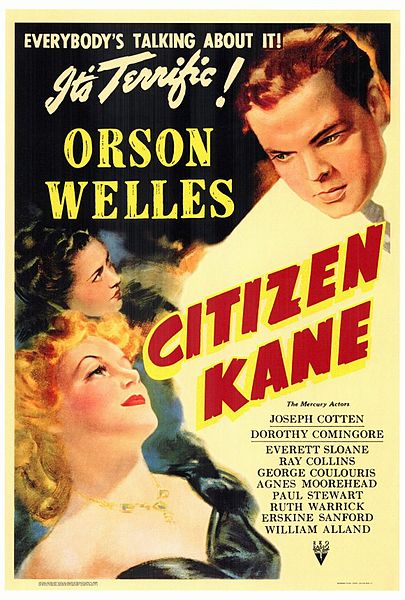
Citizen Kane (1941)

The first time I ever saw the film, I actually wrote Citizen Kane off because my hopes were so high thanks to its major critical acclaim. Those hopes were soon dashed after viewing it once, but over time I realized I needed a second viewing. This second chance allowed me to see the minute details, which can be easily overlooked or forgotten. Now I can truthfully say I have a new found respect for this film.

The brainchild of Orson Welles, Citizen Kane opens somewhat unimpressively, however it is certainly very moody and atmospheric. As the camera closes in on a great mansion, we are given a first-hand view of a dying man followed by his mysterious final word “Rosebud.” In the following newsreel, we learn the man was Charles Foster Kane (Welles), a millionaire tycoon and newspaperman. A journalist (William Alland) is enlisted to find out anything he can about Kane. First, he scours the memoirs of Kane’s deceased childhood guardian (George Coulouris). Then, he talks with Mr. Bernstein (Everett Sloane), who worked with Kane’s paper the Inquirer. He gets around to talking to Kane’s unstable former friend Jedediah Leland (Joseph Cotten), as well as Kane’s second wife (Dorothy Comingore). We learn from these accounts about Kane’s early years, his success with yellow journalism, the evolution of his first marriage, and the rise and fall of his political career. Furthermore, we find out about Kane’s unhappy second marriage that ultimately left him loveless after looking for affection his whole life. Fittingly, we are again left with the bleak view of his fortress Xanadu, and we now have the knowledge that “Rosebud” was in fact utterly trivial.

Obviously, Greg Toland’s black and white cinematography using deep focus and low camera angles is noteworthy. The framing of the narrative with different points of view and flashbacks was unique at the time. The actors age in front of us showing the progression of time and montage is used to effectively condense time. There are the overlapping and fragmentation of dialogue to create a realistic feel throughout the film. Bernard Hermann puts together a score that slowly changes along with Kane. And of course, you have the supposed basis of Kane on William Randolph Hearst. Historically, Citizen Kane may, in fact, be the most important film of all time, and artistically it is certainly up there with the best of them. I will let others decide if that makes it the very best film, period.

4.5/5 Stars

Casablanca (1942)


Considered one of the greatest films of all-time, this well-loved classic deserves to be here. It is the hallmark of Humphrey Bogart and Ingrid Bergman’s careers. It has one of the greatest scripts of all time, and it has achieved legendary status over the years. Many consider it purely the best film ever made and in all honesty, I would never try to refute that.
The film opens quickly, and we are immersed in a world that is at the height of the Nazi terror, and many people are fleeing Europe by way of Casablanca. It is a treacherous place full of pickpockets, corrupt authorities, refugees, and some tourists as well. Two German couriers have been murdered, and some invaluable letters of transit have been stolen. That’s when we are first introduced to Rick’s Café Americain along with its cynical proprietor Rick Blaine (Bogart). A shady fellow named Ugarte (Peter Lorre) comes to him with the letters and asks Blaine to keep them for him. However, later that night Ugarte is taken into custody and things get even more complicated. 

Wanted resistance leader Victor Laszlo (Paul Henreid) is now in Casablanca, however, a Major Strasser (Conrad Veidt) has arrived from Germany to take him in. To top it off Laszlo’s wife Ilsa (Bergman) was Blaine’s old flame in Paris and it didn’t end well. Laszlo desperately needs the letters of transit to escape and he inquires about them. Soon he is led to Blaine but as he often admits Rick sticks his neck out for nobody. Laszlo shows his defiance against his enemies by leading the people in a round of “La Marseillaise” and as a result, Rick’s is shut down. 

All the memories of Paris begin flooding back, and then Ilsa confronts Rick in order to get the letters. This is possibly the most critical point in the film because the tense altercation ultimately renews the relationship between Rick and Ilsa. Rick asks her to trust him and he begins to take things into his own hands. The results of his actions created one of the great romantic and cinematic moments in the history of film. The whole film leading up to this point hints at it, but Rick truly is a sentimentalist at heart. He can live with the notion that they will always have Paris and that leads him to commit a selfless act of love.
This film holds such a tremendous presence in movie history it is quite extraordinary. Upon seeing the movie it made complete sense what all the hype was about. What more could you want than Bogey, Bergman, Casablanca, and some of the greatest quotes ever said? Do not forget the French Captain Louis played by Claude Rains or the immortal tune of As Time Goes By sung by Dooley Wilson. However, you also gain an appreciation for the other interesting characters of Casablanca, some comical, some sympathetic, and others mysterious. We have a rogue gallery of everybody under the sun from Peter Lorre, Sidney Greenstreet, German soldiers, various guests, and all the staff at Rick’s place. 

This movie has conflict and the uncertainty of war practically in every scene because at the time World War II was in full force. There are a broken romance and a forlorn hero who shows his courage in the end. As an audience, we realize the transformation of Rick into a truly great man. Ilsa, on her part, has the most radiant face I have ever seen! If you take into consideration when this movie was made, it truly is wonderful to watch. You do not need explosions and violence, only great characters and a story with both drama and humor. Up until the final moments of the movie you are captivated the entire time. Then, fittingly you are left with the two men walking off into the night with the words, “Louis I think this is the beginning of a beautiful friendship.”

 In fact, with this film, my thoughts always go back to the script. Lines like “Here’s looking at you kid,” “We’ll always have Paris,” and “Round up the usual suspects” are so rampant that you cannot possibly remember them all, and I doubt there will ever be another film that is so entrenched in American culture. Many of my favorite lines in the film are those that get overshadowed by the more famous ones. That is the sign of an amazing film that never grows old. Even those who have not seen this classic film like to think they have because the influence of Casablanca reaches everywhere.

5/5 Stars