They Drive By Night (1940)

They_Drive_by_NightThis is a surprisingly nice little film-noir that follows two brothers (George Raft and Humphrey Bogart) who make their meager living transporting loads of produce by night on a big rig. Despite the seemingly mundane topic, They Drive by Night has some juicy bits of drama as the brothers struggle to survive and make their way in life. Along the way there is disaster and treachery. Ida Lupino is absolutely psychotic in her role opposite George Raft and Alan Hale. Then Ann Sheridan plays the nice girl role. I wouldn’t say that this is a great Noir but it certainly is far from boring.

Raoul Walsh proves just how adept he was at making entertaining melodramas and Humphrey Bogart is yet one step closer to his breakthrough with The Maltese Falcon (1941).  The truck drivers can always be found at the local diner getting their burger, talking up the waitress and maybe playing some pinball. When there time is up, it’s a long night ahead hauling fruit crates. The film is a slice of Americana reflecting a bygone era, at least for most of us.

3.5/5 Stars

The Long Goodbye (1973)

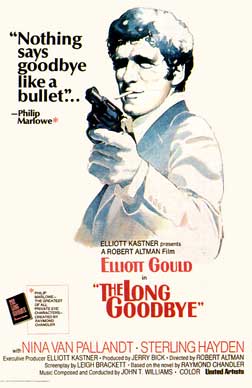
LongposterIn the storied tradition of film-noir comes another film in the canon and yet another depiction of Raymond Chandler’s Phillip Marlowe. However, the world with which Robert Altman places his private eye is far different than any place the character has ever inhabited before. Whereas another neo-noir such as Chinatown followed the storied tradition of noir in many ways, The Long Goodbye is often more of a satire than a new addition to the genre.

Elliott Gould as Phillip Marlowe has the smoking down like Bogart or Dick Powell, the garb, and even the car, but his environment is the 1970s, making him quite anachronistic, and that seems to be just fine with Altman. He subverts the genre by placing Marlowe in a world he does not seem to fit in and yet he himself does not seem to question it.

The girls next door are hardly your typical girls-next-door. The police station looks like it could be out of The Rockford Files. John Williams and Johnny Mercer’s title song pops up in all places from the elevator to the car radio. His tail Harry is an incompetent joke. Passing cars give the security guard time to practice his best movie star impressions. Marlowe as well proves he is not much of an animal guy with a cat that he loses and a dog that hates him.

The drama is not much better in that regard. Two murders take place (including the death of a friend), which are later followed by a man’s suicide and his beautiful wife fleeing the country. All the while, on the case Marlowe is scrounging around and coming up mostly empty. The cops bring him in, an unhappy thug roughs him up over some money, and he can get very little out of the drunken writer Roger Wade (Sterling Hayden) or his wife (Nina van Pallandt) before she disappears.

By now we know better than to compare this Marlowe to any predecessor. He gets smashed about by the waves trying to stop a suicide and ends up in the hospital after getting bowled over by a car. He seemingly does his best detective work in a stupor, and he somehow escapes a chilling confrontation where everyone is removing their clothes. All these scenarios make little sense and even with the twisted conclusion to the mystery, there still is no explanation for the way things are. Altman gives us a surprising end but no answers as we watch Gould dance off into the distance playing a mini harmonica. Marlowe can often be heard saying, “It’s okay with me.” It’s the story of his life and if he is fine with it, I suppose his audience will just have to accept it too, even if they do not quite like it.

4/5 Stars

The Petrified Forest (1936)

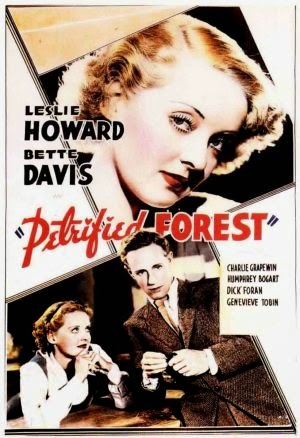
The Petrified Forest (1936)If I dare say this film begins as a rather dull budding love story between a philosophical drifting author (Leslie Howard) and a inquisitive young server (Bette Davis) at a roadside gas station in Arizona. It looks like it’s not to be as he is intent on moving on but then comes murderer Duke Mantee (Humphrey Bogart) with his thugs and things heat up a little bit. His arrival brings up some interesting points of contention and Leslie gains some new found conviction. But that’s not the half of it.

This film comes from the stage with Bogart reprising his star making role as a gangster. It is often talky and sometimes stagnant but the supporting characters and Bogart have enough personality to at least make it passable and a tad interesting. I was never a great fan of Davis, but I have to admit at least she does not look scary in this one. She’s still young and on the rise when this film came out. Leslie Howard is enjoyable with his pleasant delivery but Bogart really lights it up. His glowering face and growling voice are hard to clear from your mind. That’s for sure.

The film also has immense commentary on the survival of the fittest, women, the mythical Old West and fascist ideology that are a sign of the times.

3.5/5 Stars

Review: Murder, My Sweet (1944)

e30de-murdermysweet1Ann Grayle: You know, I think you’re nuts. You go barging around without a very clear idea of what you’re doing. Everybody bats you down, smacks you over the head, fills you full of stuff…and you keep right on hitting between tackle and end. I don’t think you even know which side you’re on.

Phillip Marlowe: I don’t know which side anybody’s on. I don’t even know who’s playing today.

Now after seeing the original Dick Powell as a crooner in light song and dance flicks, his re-imagined image as Chandler’s Phillip Marlowe is that much more surprising. This film quickly dropped being the potential musical Farewell my Lovely and ultimately became a hard-boiled Noir called Murder, My Sweet. To Powell’s credit, his new alter ego works and he brings his own spin to the role. Perhaps he has a little more humor than Bogart but there is still enough of the tough guy in his role to make it work. He’s also deliciously cheeky which is perfectly illustrated by a scene where he lights his match on the butt of a statue. It’s great.

Edward Dmytryk gave us a film that has often been credited with helping to define the film-noir style of the 1940s. It makes perfect sense since his film brims with many of the major hallmarks of the genre. The powder-burned Marlowe’s initial narration carried through a flashback lends a wry and cynical commentary to the entire story. The screen itself is cloaked in shadows, filled with billows of cigarette smoke, and is often superimposed with disorienting images.

Early on one man named Marriot is dead, Marlowe gets clocked over the head, roughed up several times, not to mention drugged up. He gets hired, used, thrown off, and seduced more than once. All because of an expensive jade necklace. As Anne (Anne Shirley) notes, Marlowe goes charging into his case not quite knowing what is going on or who he is dealing with. That ambiguity is one of the strengths of this film because we are never allowed the comfort of knowing who to side with.

By default, we begin the film from the point of view of Marlowe, and so he is our anti-hero who we track with the entire film. He gets the giant thug Moose (Mike Mazurki) tossed his way first. Marlowe meets the pretty Anne who hides her true intentions, introducing him to her wealthy father (Miles Mander) and seductive stepmother (Claire Trevor). Next up is quack doctor Jules Amthor (Otto Kruger) who appears to be our most clear cut villain and yet nothing is for sure.

It takes a late night confrontation at a beach house for things to straighten themselves out. Yet even up until that point, we do not know Marlowe’s true intentions, and he does not find out the resolution of the case until well after, thanks to the powder burns to the face.

Aside from Dick Powell’s anchoring performance, Claire Trevor is a tantalizing femme fatale, while Anne Shirley plays the guardian angel rather well. The juxtaposition of a morally questionable woman and an innocent girl develops the tension, not to mention that they are step-daughter and step-mother. When it’s all said and done, Marlowe got a sweet deal. He didn’t even need the jade necklace.

4/5 Stars

The Roaring Twenties (1939)

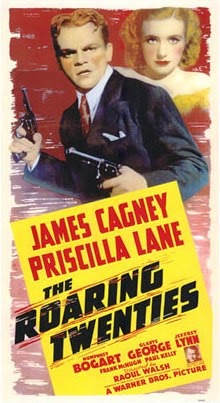
e08f7-the-roaring-twentiesHere is a retrospective gangster film reminiscing about the Jazz Age and Roaring Twenties extending from the post WWI period  of prohibition to the election of FDR.
Two mainstays of the genre including the original gangster James Cagney and hard-boiled Humphrey Bogart star as two men in a group of three soldiers who meet during World War I. In the ensuing years Eddie Bartlett (James Cagney) initially has difficulty getting back into society, but after meeting Speakeasy owner Panama Smith (Gladys George) he finds himself climbing the ranks in the bootlegging business. Soon through grit and a ruthless drive Eddie makes good racketeering by utilizing taxis with booze to make it big. 

Through it all Eddie becomes smitten with a young singer he used to know when she was a young girl (Priscilla Lane), except she does not share his affection. Pretty soon his ol’ buddy George (Bogart) comes back into the picture, with a some shifting dealings of his own. Eddie practically runs the town now but when the Crash happens he gets pushed out by George and now Jean is off and married to her lawyer beau. Eddie is a washed-up taxi driver still hanging around Panama and he has time to do one last favor for Jean.

This is one of the last great gangster films of the 1930s following in the wake of other Cagney classics like The Public Enemy and Angel with Dirty Faces. Raoul Walsh directs this film and it develops as another dynamic, action packed film with a lot of drama and heart thanks to Cagney and George. It is however different from previous gangster flicks in that it plays out as a history although it keeps the nitty-gritty look of the previous films. Like Angel with Dirty Faces especially, there are also some sentimental moments because Cagney is not a complete scoundrel, just mostly. Not wanting to continue being typecast Cagney took a break from the genre not coming back until White Heat in 1949. He did pretty well for himself during the 1940s though with performances in The Stawberry Blonde and Yankee Doodle Dandy. There was another fellow who did not do too bad in that interim period either, new found leading man Humphrey Bogart.

“What was his business?”
“He used to be a big shot.”
 
4/5 Stars

To Have and Have Not (1944)

1b537-to_have_and_have_not_1944_film_posterStarring Humphrey Bogart, Lauren Bacall, Walter Brennan, Hoagy Carmichael, and with director Howard Hawks, this film is very reminiscent of Casablanca. On the small Vichy-controlled island of Martinique, a hardened seaman spends his days steering his boat and his nights at the local hotel. The French resistance stir up his life by asking for his help but he refuses. Everything changes however when he meets a mysterious young woman (Bacall). Their playful banter eventually leads them to a mutual affection. Wanting to help his new found girl get home, Harry Morgan finally does agree to help the French and in the process he shows his true colors. Cementing Bogey and Bacall as a star couple, and immortalizing a certain line about how to whistle, this film is a good one. It has everything you come to expect with Bogart and it gives you something special in Bacall.

4/5 Stars

In honor of Lauren Bacall

Dark Passage (1947) – Film-Noir

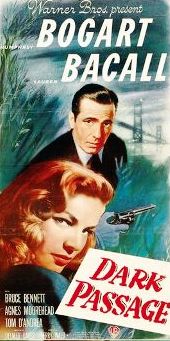
74b1d-dark_passage_film_posterStarring Humprey Bogart and Lauren Bacall, the film opens with a man escaping San Quentin prion for supposedly killing his wife. Along the way he is helped by a sympathetic young artist, a friendly cabbie, and a plastic surgeon. He must evade the police while getting mixed up with another murder and some nosy people. Ultimately, he does find the actual killer but he has no way of proving it. He flees to South America where he is finally reunited with his love. This film is memorable for being shot from Bogart’s perspective early on. It makes good use of San Francisco scenery and some of the supporting characters are enjoyable to watch. However, the film’s ending seemed anticlimactic and abrupt without any real closure.

3.5/5 Stars

In honor of Lauren Bacall

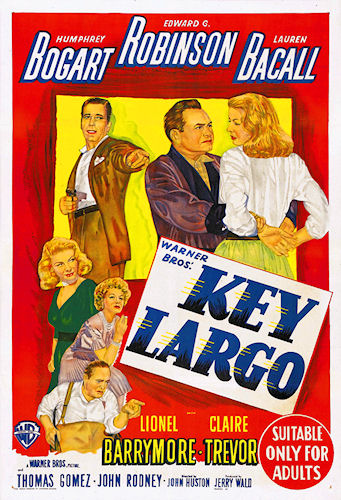
Key Largo (1948) – Film-Noir

5b446-key_largo432Starring Humphrey Bogart, Edward G. Robinson, Lauren Bacall,  with director John Huston, the film takes place on a sweltering day during the hurricane season. Bogart is passing through Florida to say hello to the relations of a dead war buddy. In the process he and the others at the hotel are held hostage by the mobster Johnny Rocco (Robinson). Bogart seems to back away from conflict but he is only biding his time with the villainous gangster. Through a series of events the war veteran is supposed to pilot the mobsters to Cuba, however he ultimately turns on them and brings justice. This is a fairly good film with Lionel Barrymore, Claire Trevor, and Jay Silverheels in support. It must be mentioned that this was the final film pairing of Bogey and Bacall. Get ready to sweat it out in Key Largo.

4/5 Stars

In honor of Lauren Bacall

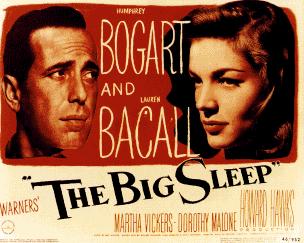
The Big Sleep (1946) – Film-Noir

e3d1f-bigsleep2This noir, crime-drama starring Bogey and Bacall with director Howard Hawks, follows private eye Phillip Marlowe (Bogart) in Los Angeles. His difficult and ever changing case has him interrogating every one under the sun and following every lead. In typical Bogart fashion, Marlowe is a tough guy who does not shy away from danger and he has the eye of many a woman. What starts off as a normal case quickly turns deadly, setting the plot off. The constant twists and new characters complicate Marlowe’s case and get him in numerous messes. However, thanks to his grit and wit he comes out on top, falling for the girl, and overcoming his adversary. One word that sums up this film is incomprehensible. Despite the confusion with the plot, this film is very enjoyable and seems to work itself out.

4.5/5 Stars

In honor of Lauren Bacall

The Best Films of Humphrey Bogart

1. Casablanca
2. The Maltese Falcon
3. The African Queen
4. The Treasure of Sierra Madre
5. The Big Sleep
6. To Have and Have Not
7. In a Lonely Place
8. The Caine Mutiny
9. Key Largo
10. Sabrina
11. High Sierra
12. Sahara
13. Dark Passage
14. Angels with Dirty Faces
15. The Harder They Fall
16. The Desperate Hours
17. The Barefoot Contessa
18. We’re No Angels
19. Dead End
20. The Roaring Twenties
21. The Petrified Forest
22. Dark Victory
23. They Drive by Night
24.All Through the Night