Umberto D. (1952)

I recall in middle school I was giving a current event on the horrible conditions in a hospital for war veterans. The handyman who just happened to be in our classroom overheard my report and was moved to speak. He shared his displeasure not at me but at a system that would so completely fail these people who had sacrificed so much.

As a film, Umberto D. ably tackles many of these same ideas while also suggesting to me how seamlessly Vittorio De Sica can move in documenting varying subsets of humanity. He’s often remembered for his child actors and the numerous untrained performers he put before his camera.

It’s a reminder of how, rather like Robert Bresson, he knew the types he wanted on the screen, “normal” people with features that have now become iconic all these years later. I think of Martin LaSalle in Pickpocket, Anne Wiazemsky, or even Balthazar the donkey.

But whereas Bresson always seemed to be engaged in his actors most specifically for their movements and how he could dispel them down to their most basic entities within the context of his films’ action, De Sica was always a director totally enamored with the contours of his characters as living, breathing human beings who have to go out and make a living like any of us.

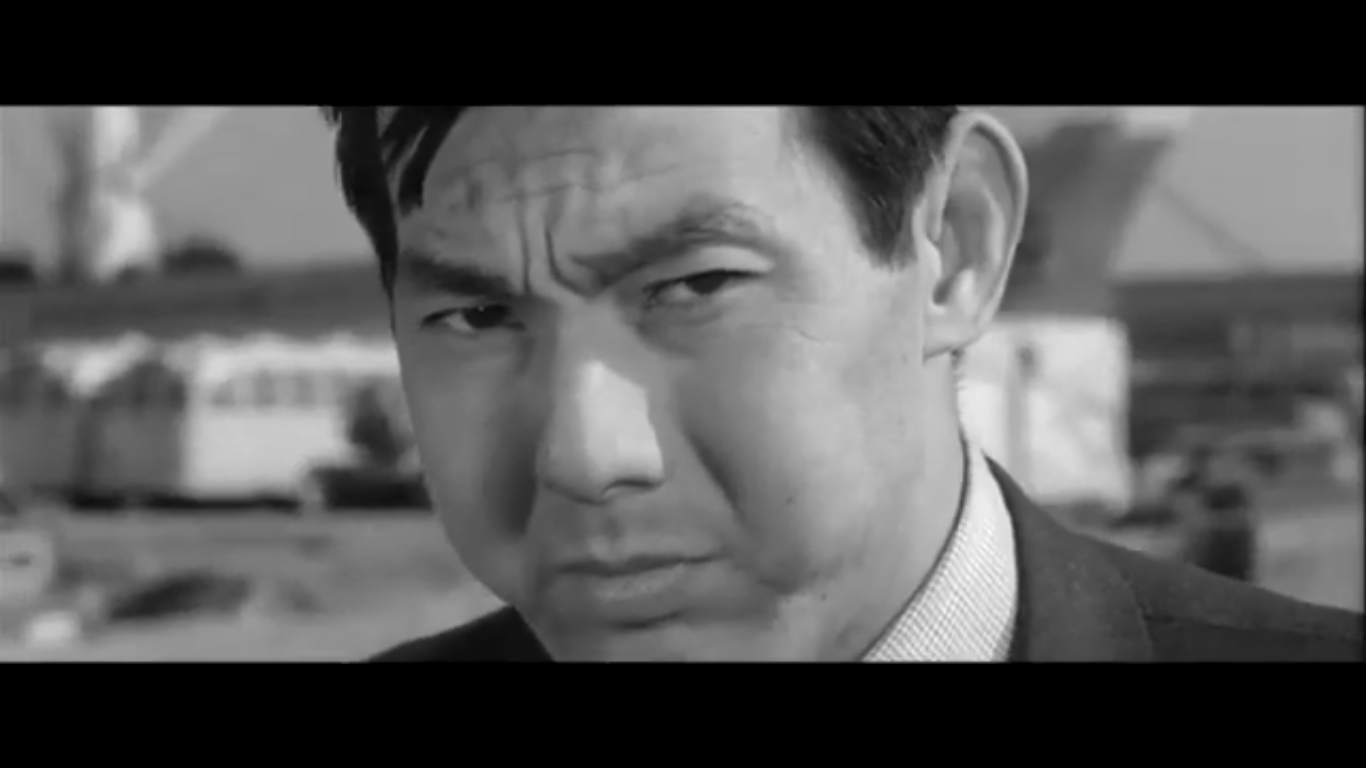
In Umberto D. it’s the eponymous character (Carlo Battisti) and his dog. Part of the magic is how De SIca found people who could inform his faux reality and make it sing with what feels like a deeply honest truth. Carlo Battisti is no longer a college lecturer nor is he an actor. In the confines of this film, he is Umberto Domenico Ferrari.

Although it’s a film dedicated to De Sica’s father, it’s never heavy-handed in its implementation or maudlin in a way to manipulate emotions out of us. The story opens simply with retirement-age marchers protesting in a plaza. They take issue with how low their pensions are especially after having devoted their entire lives to work. Instead of being heard, they are hustled out by local cops in jeeps. They are seen at best as doddering old fools and at worst as a public nuisance.

He must settle instead with taking his dog Flike home to his small domicile. There’s a lovely ordinariness in the full spectrum of his apartment as the camera pans around the room. Umberto settles down to his chair still grumbling about paying rent for such a dump as the young maid gets ready to cut up a chicken.

The peppy 15-year-old Maria-Pia Casilio feels perfectly suited for her part like Battisti, and they make a venerable pair. It feels reminiscent of the two co-workers in Ikiru. The disparity in age somehow highlights how they are able to spur one another on, joining their bright-eyed naivete and jaded experience to encourage one another in unknowable ways. 

It’s soon apparent his money problems follow him everywhere. His stingy landlady (Lina Gennari) is prepared to evict him by the end of the month if he doesn’t come up with his back rent; she’s making it as difficult for him as possible. It’s very plain she doesn’t what to bargain with him and yet she’s more than willing to make allowances for trysts as long as their money is good.

Umberto is incensed, but he has to manage the best he can, hocking all his belongings while he battles through a fever. If the movie made up of a recurring motif it might be how the old man is systematically belittled and disregarded. The building is getting refurbished with new paint and wallpaper, but the painters have no regard for his space. They have work to do.

A doctor coolly dismisses his tonsillitis because of his age. He’s already lived a decently long life so why bother? Street vendors won’t haggle with him and force him to buy useless stuff that he doesn’t want just to pay a taxi fare. Old work colleagues look at him as a lucky man, free of hassles and living the good life; they fail to notice the signs of his discontent. And finally, there are a husband and wife who mind a household of mutts and strays.

Umberto has ideas of leaving him with a husband and wife who live with a pack of mutts. Again, it’s not stated, but he doesn’t have to. We know this is his final act of love as he dishes out all the money he has left and feigns a trip. It’s all for show, but it would be worth it if Flike was guaranteed a good home.
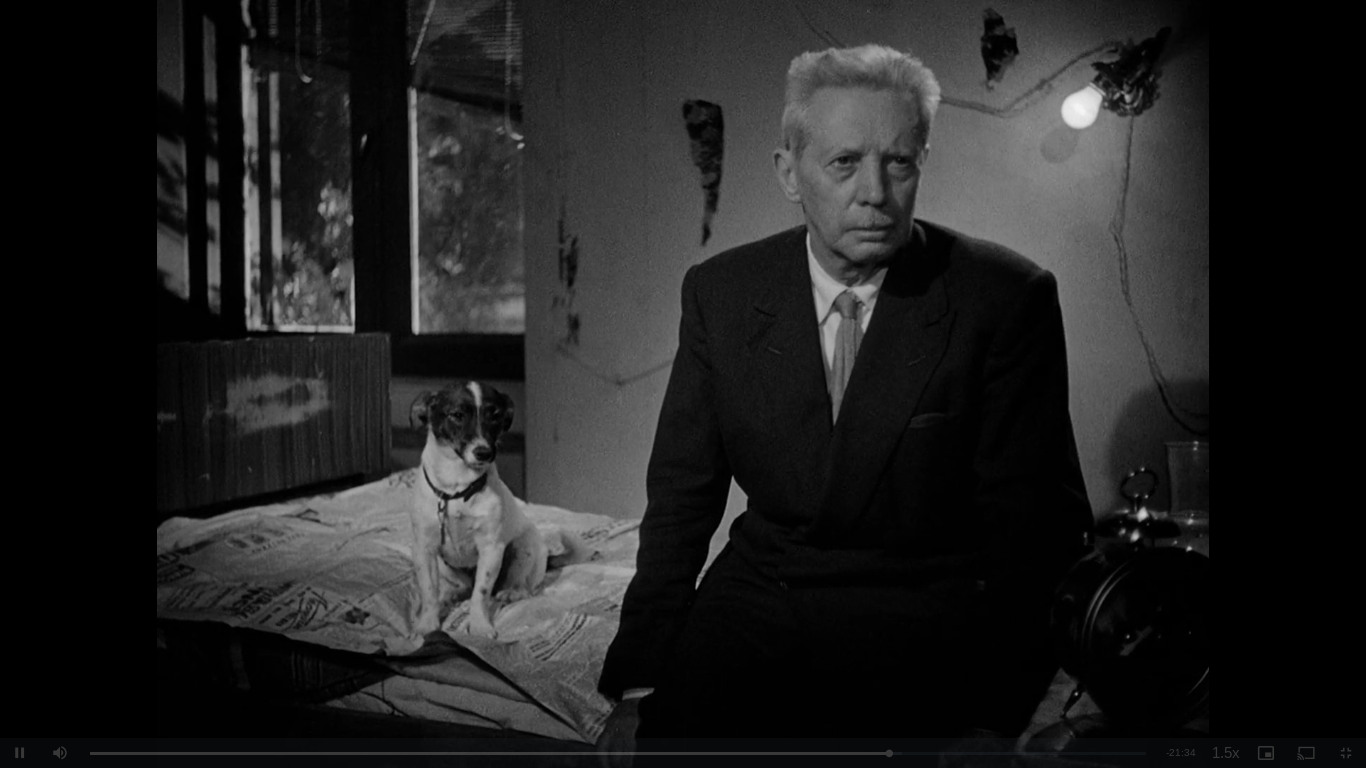
It’s better than the pound, death in no uncertain terms, but he slowly realizes he cannot bear to do it. It’s not good enough and so he takes his dog away. A little girl’s parents scorn the idea of taking in the cur.

How he knows them and where she came from was only a passing query. Yet again he’s been brutalized. It feels like people are very pointedly rejecting him and he’s helpless. What is he to do?

There are several times throughout the movie it becomes obvious. There’s a glance out a window down to the dizzying cobblestone below. Later Umberto has Flike in a near-chokehold as he disregards the warning bells and totters toward the train tracks. Nothing happens but both instances, first by the direction of our gaze and then by Umberto’s actions, you know he’s thought about doing — ending it all. It would be so easy. But then he thinks of Flike, his best friend, and the one that means more to him than anything.

It never hinges on one singular apex of drama though it does feel like the movie is going increasingly toward the nadir. If I recall The Bicycle Thief — a film with the most crushing of exit points — it’s not simply about poverty at all; it’s about what that does to an individual’s sense of self-worth and dignity. Because De Sica makes us see these people as worthwhile, if only for the mere reason that he takes his time to put them in front of his camera.

However, Umberto D. differs from many of its predecessors because there is no obvious inflection point. We get this full-bodied totally present sense of who he is without a preconceived notion of drama. The picture never goes there, instead, leaning into the sobering sense of desolation and angst.

The fact that De Sica claimed this to be the personal favorite of his film and that it was dedicated to his father seem to be interrelated. I know nothing about the man and if we’ve seen Umberto D. we don’t need to. Not that they’re one and the same; it’s his plight saying so much about how we should treat not only our parents but our elders in general.

I’ve never forgotten that man who came into our classroom because he was right. What a sorry world we live in when the men and women who have served faithfully and put their faith in a system are so rudely cast aside. If I’m to understand this film, it’s not simply a social or political issue, though these play a part; this is about searching out and affirming the worth of other people.

4.5/5 Stars
Miracle in Milan (1951)

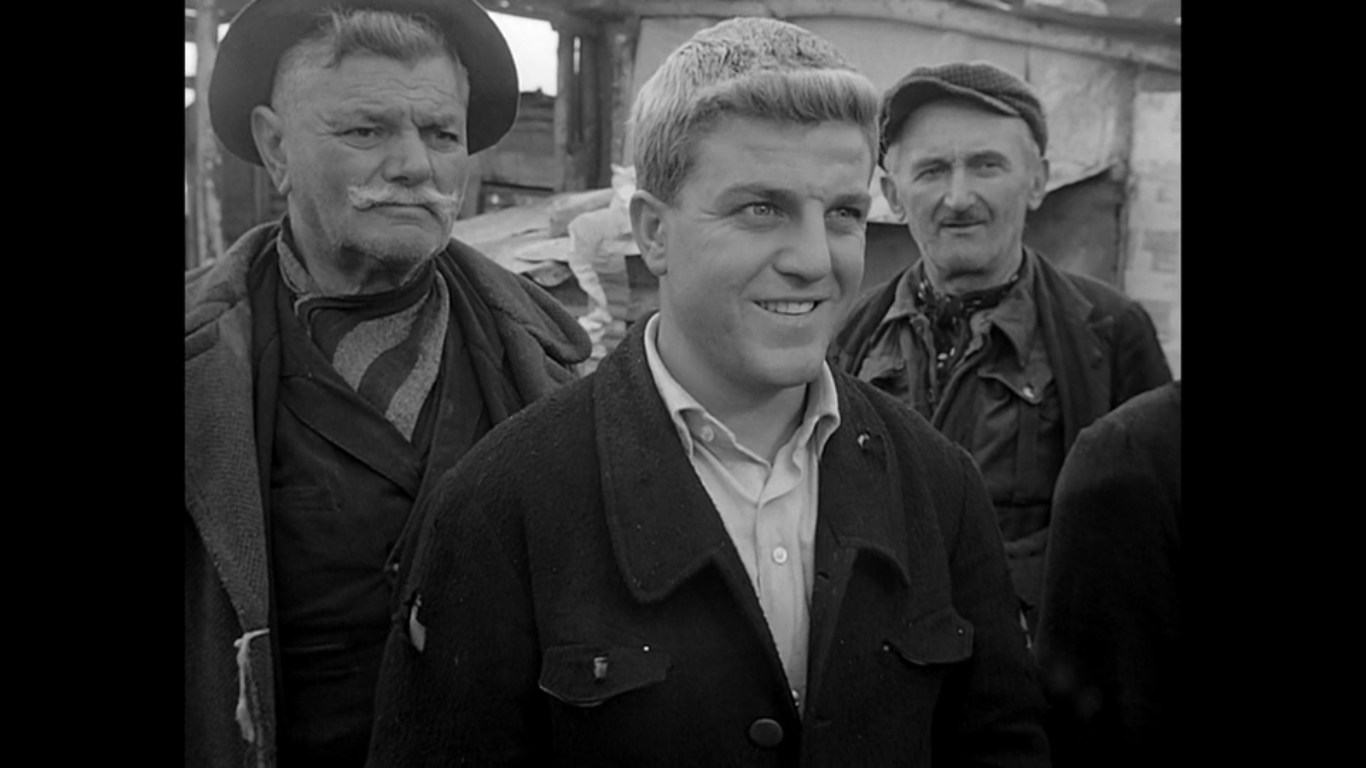
The title and the opening preface hint that this is a kind of fairy tale. True to form, Miracle in Milan opens with a baby being found not in the reeds like Moses but lying in a cabbage patch. He’s taken by a ditzy old lady — with a smile almost permanently placed on her face — and together, as he grows up, they share a childlike zest for life. It’s hardly a spoiler to say that she ultimately dies. He must forge on ahead with his mother’s blessing.

The boy Toto (Francesco Golisano) grows up before us in a matter of scenes, and yet his essence is still very much the same. His most salient features might be the far-off expression he wears. I can’t explain it though it seems like he’s seeing beyond the present moment into some other realm. He’s cut from the same cloth as Elwood P. Dowd and other angelic creatures who seem to walk among us.

The curious nature of the film is how it takes the visual landscape we come to equate with De Sica’s Italian Neorealism and subsequently blends it into a fantasy story which becomes a kind of fable. The dramatics are not in the same realm as Shoeshine or The Bicycle Thief, but it becomes another exploration of the plight and also the irrepressible spirit of the common people.

With this absence of natural conflict or drama, at least initially, it becomes more of a roaming, rambling character piece. This in itself is enjoyable if lightweight compared to some of De Sica’s most lasting tales of humanity. What it does allow is license to cover terrain he would not be able to reach in his other films.

The score is charged with this continual sense of peppy motion toward a certain destination though it does revise itself under many different situations. Meanwhile, the weather above feels positively empathetic with a layer of fog shrouding the city. This becomes quite literal when sunbeams break out through the dogged marine layer and leads to a frenzy of men chasing after the coveted light.

They make quite the sight: a singing, pushing, prancing, bobbing mass of humanity, all clumped together bathing in the rays. It’s a comical moment that has no equal, and yet De Sica makes his intentions quite clear even if this is just his entry point.

“It is true that my people have already attained happiness after their own fashion; precisely because they are destitute, these people still feel — as the majority of ordinary men perhaps no longer do — the living warmth of a ray of winter sunshine, the simple poetry of the wind. They greet water with the same pure joy as Saint Francis did.”

When this minor miracle dissipates and they are forced to go back to their days one voice in the crowd mutters, “Jesus wept.” There’s a bit of comedy in the scenario — visually if nothing else — but there’s also truth in these words. Because this is always cited as a definitive example of how Jesus Christ was a man of empathy; he had genuine feelings and was moved to tears for the downtrodden.

De Sica is fascinated by these types both in their innate comedy and common accessibility to us as an audience. Because we watch them as Toto with his generous spirit and warm-hearted nature helps in building a utopic colony of shanty houses. All are welcome and provided accommodations of their choosing.

This is the version of The Grapes of Wrath that Steinbeck was incapable of writing. Where the world comes together and develops into a kind of benevolent order instead of continued dissolution and stratification between classes and creeds. And when trouble does come in any form, it’s met with a resounding answer — some kind of miracle — returning things to their natural, rightful order.

In one moment their encampment becomes an oil geyser. Later with their colony in danger of being overrun by authorities armed with smoke bombs, they respond by blowing the smoke from whence it came. Fire hoses are met with an army of umbrellas, and the military forces are met with humiliations of operatic proportions.

Toto, as a character, feels like the group’s talisman, and it becomes even more pronounced when his long-departed mother swoops down and grants him a magical dove from above. It’s a prodigal, practically indecent gift. Suddenly even his charmed ability to grant happiness — the finest hobby he could ever have — goes haywire in the midst of human greed. A clamor takes over the camp, and it’s hilarious at first although it soon grows tiresome.

People get their fur coats, top hats, chandeliers, and anything else their greedy hearts can dream up. Toto conjures up the frenzy of Christ-like miracles though he soon becomes much more like a genie. Even statues (Alba Arnova) come alive to dance off into the night! The young maid Edvige (Brunella Bovo) feels like the one character not looking to gain something from him; she likes him for who he is, a decent young man overflowing with an almost blind faith and geniality.

I lied a bit about the dearth of conflict because the wheels of progress and wealthy men finally do overtake them effectively pushing them off the land. They find themselves unceremoniously carted off in police wagons — Toto and everyone else. However, De Sica has already conditioned us, even dared us, to maintain our belief in the unimaginable. There are still a few spritzers of magic left for the finale.

It’s somehow fitting that Milan Cathedral becomes the final backdrop for one last miracle. Although the ensuing animation and special effects are hardly spiritual in nature, it feels like a resolution befitting such a fairy tale with a bit of pixie dust Walt Disney would have no doubt appreciated.

4/5 Stars

Shoeshine (1946)

Shoeshine was penned by a whole host of people: Sergio Amidei, Adolfo Franci, Cesare Giulio Viola, and Cesare Zavattini. However, it’s quite easy to focus on Zavattini due to his longtime partnership with De Sica dating back to The Children Are Watching from a few years prior. Their lucrative collaboration would produce a string of well-remembered works, not least among them The Bicycle Thief, Umberto D, and even Sunflower in the 1970s.

Together they created stories out of deceptively simple scenarios that always find a way to be imbued with raw emotional truth. We are quickly reminded of how many of De Sica’s greatest films were pictures of youth. In this one, two shoeshine boys are infatuated with a beautiful horse they wish to buy for their own.

When they return to the city we get an immediate roving sense of the post-war world on the streets, not unlike The Bicycle Thief. Giuseppe and Pasquale feel fully integrated and familiar with their world, chatting up their acquaintances as they work away shining shoes.

We soon come to realize how they are a part of the postwar economy (“Shoeshine Joe!”) and they even manage to unwittingly get themselves into the thriving black marketeering racket. It’s usually people like them who end up paying their dues on the inside in place of others. They aren’t exactly innocent bystanders, but their crime certainly doesn’t fit the punishment.

They end up in a boy’s prison, clamming up to protect a no-good older brother who we never see again. He’s not of primary importance. Instead, we witness how two friends who weather thick and thin together are forced to separate — resigned to separate holding cells.

However, there has to be a moment of reversal where the narrative locks in on a dramatic question ripping the story to its core. This is the mother fleeing for her lover in The Children are Watching Us or the man choosing to steal in The Bicycle Thief. Sure enough, Shoeshine introduces such a moment of its own. Because the one element not in doubt throughout the movie is the camaraderie between these two boys. Until it is…

Giuseppe receives a tearful visit and learns his older brother was taken in; immediately, he knows Pasquale squealed, and regardless, of the circumstances, he feels totally betrayed. He doesn’t realize his buddy has been played for a fool as the policeman tricked him into a speedy confession. But the means make no difference. Now there is an irrevocable wedge between the friends because a sacred vow of silence has been broken. The very bedrock of the friendship has been spurned.

Whether merited or not, one betrayal reaps another in the form of a planted file and the rival factions form around their cellmates only serving to escalate the animosity. There is no other way to settle matters than a bloody fistfight in the shower rooms. But this can never solve the hurt; it only pushes them farther apart.

Still, despite the wave of spite between them,  the veil of naivete and a vow to truthfulness is not totally lost on these boys. In the proceeding court case where they are both brought before a judge, the defense attorney looks for a scapegoat — the boy without a family — but his young defendant cannot understand how personal utility (for himself and his brother) trumps telling the truth. It’s a foreign concept to him. Kids are not made for the mercenary games of bargaining in the courtroom. Their moral codes are of a different kind.

Later, during an in-house movie screening, there’s the inevitable escape attempt because it’s not natural for anyone (boys included) to be caged and so a few of them make a unified break for it. It feels reminiscent of some of the old Cagney movies or other prison noir, but of course, it was a contemporary if not a predecessor to some of the greats like Brute Force and White Heat.

However, if you look at the picture in terms of genre conventions, what sets it apart is the youthful perspective because we see something so precious — that of friendship — get crushed as hearts grow cold with bitterness. Again, we find our two boys in compromising positions, their rocky friendship put under one last round of duress.

The ending is nothing short of devastation where all the dreams and innocence of youth are summarily crushed in one tragic act of inhumanity that can never be undone. One can barely imagine the film after “Fin” comes up on the screen because it feels like De Sica’s story is so thoroughly engaged with the present moment and when it dissipates there’s nothing left. All we have to go on are our feelings of anguish for these boys and the broken system that has no capacity to get better any time soon.

I think this part of what Orson Welles meant when he says of Shoeshine, “the camera disappeared, the screen disappeared; it was just life.” In a deeply profound way, you very rarely consider the tenets of filmmaking at work while watching the film. Perhaps like Chaplin or some of the classical masters, De Sica speaks to us through resounding images we can understand intuitively, suffusing them with the most honest of emotions, and allowing the scenes to wash over us.

Suddenly, time has passed and the full breadth of an emotional arc is realized. You get totally lost in the moment — overtaken by the pure, overwhelming force of cinema. I’m no expert when it comes to describing the main facets of neorealism as embodied by the works of De Sica, Roberto Rossellini, and others. However, beyond any kind of post-war malaise and on-location shooting with untrained actors, it seems like it comes down to this intimate frequency of resonance. We realize that we too share in their story and their experiences by just being human.

4.5/5 Stars

Babette’s Feast (1987)

I love fairy tales where we know conspicuously that we are being told a story. They can be delivered by Peter Falk in The Princess Bride, Edward Everett Horton in Fractured Fair Tales, or in this case, Ghita Norby.

Let it be said that there’s something inherently peaceful about the rhythms of Babette’s Feast. We meet two sisters devoted to simple acts of charity and good works generally living a simple life of tranquility.

Years prior they grew up on the right and left hand of their father, who was a local preacher, beloved by all in their little community of thatched roofs and decent folk. They are a world away from French courtesans and the social elite of the age. In this regard, the movie’s set design runs the gamut from a puritan-like asceticism to ornate interiors worthy of 19-century royalty. One of these outsiders is a young soldier (Gudmar Wivesson).

Riding upon his steed, he’s taken by one of the daughters, Martine, so angelic with golden hair and scintillating eyes. He’s never seen someone so glorious. And so he joins their little commune, all gathered around the table. Yet he is not made for their life and so he takes his leave to return to the world he knows — a world less harsh and cruel to the senses. His friends tease him for being defeated by some long-faced sectarians, but if it is a defeat, then it is one that stays with him.

He is not the only one. The Jutlands conquers others too… Next arrives an exuberant barrel-chested French baritone. He’s revered and fawned over by all the literati (including Bibi Andersson), but it is in this little town where he finds someone who makes his heart sing. It’s the minister’s other daughter Filippa.

The jovial Achille Papin (Jean-Philippe Lafont) requests the honor to help train up the young lady and refine her vocal talents. It’s hardly a pretense as his tutelage is inspired and brimming with impassioned vigor. It’s contagious. But he too fades away. The devoted daughter recognizes her father would never approve of anything further.

And so years passed, their father died, and the two women, still unmarried, shepherd and care for their local parish. We can make allowances — time progresses and is condensed so easily because, again, we are working within the parameters of a kind of parable or fairy tale.

Intuitively it becomes a kind of rumination on aging and what that means — not just for to pious spinsters — but also how our joys and the manner in which we conduct our days become affected. Are they injected with renewed vigor or the kind of enervating melancholy that builds up almost imperceptibly so we just come to accept eour plight with passivity?

The population of their community is aging as well, and with it comes a schism of bickering and discord within the ranks of the disciples. The sisters look on with wide-eyed bewilderment. Surely this is not what they worked so hard to cultivate in their father’s absence.

However, the sisters also gained a housekeeper in the form of Babette, a French woman seeking asylum and recommended at the behest of an old friend. Stephane Audran is starkly different than my memories of her in Claude Chabrol’s work or the representation of vacuity of the Discreet Charm of the Bourgeoisie. Here she is a saint gifted with a hand for cooking and a generous heart. She can be a blessing to these people.

It takes some time to recognize what the film is doing — what magic spell it’s casting. The sisters have a meager vision of cobbling together a modest supper to commemorate the 100th anniversary of their little congregation’s founder, but Babette requests to throw a banquet. She’s set on the idea so the sisters acquiesce.

The whole town is agog when her procession of goods comes imported from France: qual, turtle, and wine of all things! They are wary of being exposed to potentially dangerous forces in the form of such decadent food and drink, and so they form a pact with their small clan to not speak a word about these provisions.

It also strikes one as a tactic to avoid any unwanted gossip because suddenly it becomes another arena for “good Christian virtue” to play out. They are too blind to see an alabaster jar of perfume being poured out on the feet of a guest. In other words, they are out of step with the moment.  It’s not hard to detect Biblical underpinnings.

Babette’s Feast is somehow a movie drenched in the rhetoric and messages of Ecclesiastes. A graying soldier (Jarl Kulle), who we know must be vaguely familiar, looks into a mirror solemnly and says, “Vanity, vanity, all is vanity.” It puts words to a life spent striving after things all for naught.

It’s also easy to conjure up the words “Eat drink and be merry for tomorrow we die!” The parishioners don’t live in this manner, and yet if this picture’s ending is any indication maybe a certain amount of uninhibited joy is a balm and not simply a cursed reminder of how transient and finite our lives are. Could it be, if we flip the paradigm, that a feast is not simply a coping tactic, a way to muddle through this life, but it’s actually a sign or a foretaste of something better?

This act of radical extravagance at the hands of Babette is not to be taken only in a literal sense. It’s not a moral prerogative about how to spend one’s funds, but this parable points to something else of vital importance. Because the table setting is so foreign to these folks — it’s so ornate — the food equally rich and extravagant.

Is it a waste — such rich food lavished on people who don’t appreciate it? These are my immediate reactions. I’m no foodie, but this is not the point. For Babette, it is an act of love, and to have even one person — the general — appreciate her toilings is reward enough.

The look of incredulousness and utter admiration for each new course and subsequent drink is something to relish. His face lights up like it hasn’t for a long, long time. Can I state the obvious and say it is a joy to watch these people eat — living vicariously through the experience set before them? And something contagious comes over all of us (audience included). The meal seems to have powers beyond mere food and drink.

Of course, this isn’t the end. It has greater import than she could ever imagine. The memories come flooding out as the gathering becomes a kind of conduit for community. Nothing overtly supernatural occurs, and yet it feels like no less of a miracle all thanks to Babette. The sisters realize it too and marvel at her talents with gratitude. Filippa joyously affirms her, “This is not the end Babette. In paradise, you will be the great artist God meant you to be.”

Her words can’t help but remind me of J.R.R. Tolkien’s “Leaf by Niggle.” Tolkien was of course well-versed in the creation and appreciation of fairy stories, but in this particular short story, he highlights a middling man who spends his whole life painting a leaf. His name just about sums up his existence. He’s never satisfied, never can quite see the whole picture, and never accomplishes enough to finish what he started.

And then he dies…It sounds like a paltry existence, and yet when he gets to the other side, he sees the full glory and the magnificence of the tree his leaf was a part of. Suddenly his preceding life gained more meaning, not less.

If we are to believe Babette’s Feast, Tolkien, and fairy tales, then this is not the end. There is a happy ending still to come. Herein lies one of the lasting potencies of this brand of stories. They tap into our deepest longings in youth and even as we grow older, I would be remiss to say that we didn’t still want them to become true. Let’s hope we’ll get to feast on the plenteous bounty of the likes of Babette someday soon. My mouth waters just thinking about it.

5/5 Stars

A Colt is My Passport (1967)

Nikkatsu studio’s reputation for these kinds of down and dirty pieces of noir pulp employed action and gangster plots to entice the youth market. Obviously, the influence of the American canon cannot be disregarded, and yet the films came into their own given Japan’s own turbulent history with syndicated crime.

However, A Colt is My Passport does something more with the genre archetypes. It starts with this mythical weapon, not traditionally of mobsters and hitmen, but western heroes and villains dueling out on the range. Wherever the firearm might have progressed, it always carries this mythos about it.

As such, the movie is introduced with a whistling, stringed, and partially staccato score that might as well be plucked out of a  spaghetti western. Further strengthening the ties is Quick Draw Joe, a movie Joe Shishido starred in that was also directed by Takashi Nomura. Now half a dozen years they meet again to build on their collaboration.

The initial beats are familiar if you’ve seen any of these types of pictures. There’s a target to knock off. His name’s Shimazu, and when he’s not constantly being shadowed by a bodyguard, he’s stashed away behind bulletproof glass. It’s a tough job with only one day to see it out.

In this world of guns and souped-up automobiles, Shishido, the chipmunked-cheeked cult hero of cool, somehow feels right at home. It’s all part of his work as he studies his target, sets himself up with a hotel room, and then prepares to get in and get out with surgical precision behind his sniper rifle.

If there’s a methodology here it suggests how Colt is a film built out of a regimen and the setting of its protagonist in an architectural world. He is always completely cognizant of his location and how he functions in relation to the spaces around him. Thus, it becomes as much about mood and milieu as it is focused on action and violence.

Take for instance, how the story is constantly switching contexts. It’s in a car, about getting to a plane at the airport, holding up in a hotel, then fetching a barge out of the country, and when that fails, commandeering a big rig to retaliate against the enemy.

Of course, there must be a love interest. In the subplot, Mina, a young woman who works at the Nagisakan hotel, offers them asylum from their pursuers. What draws her to them? She says the god of death follows in her wake. Her former beau must have been like them, and as she spends her days serving the riffraff and sewer rats always loitering around, she looks to take back her life in some way. This is her form of rebellion in a world generally dominated by men.

However, even with the proliferation of gangster imagery and this kind of masculine bravado, the contours are the film consistently emulate the West with its own recurring motifs. There’s a musical aside of guitar not unlike Ricky Nelson or Dean Martin might knockback in Rio Bravo (Your star is a lonely little star…but now your face is a ghost town in the mist”).

It’s a way to bide the time before inevitable showdowns while also distilling this sense of male camaraderie in such a way as to make it palpable. It evokes the loyalty forged between two men, one mentor and his pupil, who have been through so much together. He shields his partner by giving himself up.

He knows where he must go. Where else would we end up but a deserted, windswept landfill where we half expect to see a tumbleweed roll by? Instantly the urban world and streets, even the maritime port of Yokohama, all but evaporate and fade into the periphery. The entire film culminates in one definitive moment where the sides are drawn up all but prepared to have it out in an instant. While the final showdown is fairly spare, it still manages to blow the lid off the picture with its gritty cross-pollination of the noir, western, and yakuza inspirations.

It’s hardly drawn out — finished in what feels like a few suspended moments of chaos — and yet it might be one of the most monumental standoffs you’ve ever seen. As Shishido digs a hole (what might as well be his grave), then sets a charge of dynamite, which might as well be a self-destruct mechanization, and then finally fights for his life, we are inundated by the full brunt of the impact.

There’s hardly any mistaking who came out victorious, but then again it might be just as difficult to claim a hero as a man totters away from the wreckage.  I’m not altogether familiar with the etymology of “borderless action” cinema as marketed by Nikkatsu, but here it feels like one meaning is about this unabashed melding of genre and inspirations.

Shishido channels hitman, gunslinger, and jaded antihero all rolled into one. He’s got a dash of Eastwood, maybe a bit of a Melville assassin, but also a distinctly Japanese sensibility. It creates this pleasing amalgamation that finds something rather gripping in its myriad of influences. There’s an indiscriminate and still somehow an artful freedom to it drawing me in all the more. 

4/5 Stars

Pigs and Battleships (1961)

If you want to make some sense of the rise of Shohei Imamura, it’s convenient enough to fit him into the context of two of Japan’s foremost filmmakers. During his time as a university student at the prestigious Waseda University, he saw a screening of Akira Kurosawa’s Rashomon, which not only became a catalyst for Japanese film worldwide but also for young men like Imamura.

However, upon arriving in the film industry he found himself working with another acclaimed master, Yasujiro Ozu. The only problem is that Imamura’s own sentiments played in stark contrast to his elder’s fairly sedate albeit meticulous style. Imamura wanted to get into the issues and the conflicts of the times. He feels like both a  nonconformist with a bit of a rebellion in his blood and someone with an acute appreciation for humanity.

Here he positions himself as a Japanese New Wave iconoclast having some fun at the expense of his countrymen and their most prominent post-war ally: the United States. In his own words, he was an anthropologist using his films to analyze humanity in all its foibles and messier predilections.

This might be as good a place as any to provide a jumping-off point for Pigs and Battleships. It plays as the antithesis of his elder Ozu by readily showing Japan at its most pathetic with a host of men who might well be a circus of dim-witted ignoramuses in a comedy of errors.

In the opening frames, you get an instant impression of the backstreets and alleyways frequented by American sailors, bums, and pretty girls with their come-hither looks. Vagrants of all sizes can be found scampering around town messing with sailors — swiping their hats — and generally causing mischief. Some of this is organized.

This is the unruly underbelly of Japan as represented by the seaport of Yokosuka and those with a certain perception of civilized Japanese society, would do well to avert their eyes. Imamura has no intent to present some idealized or cloying sense of his homeland

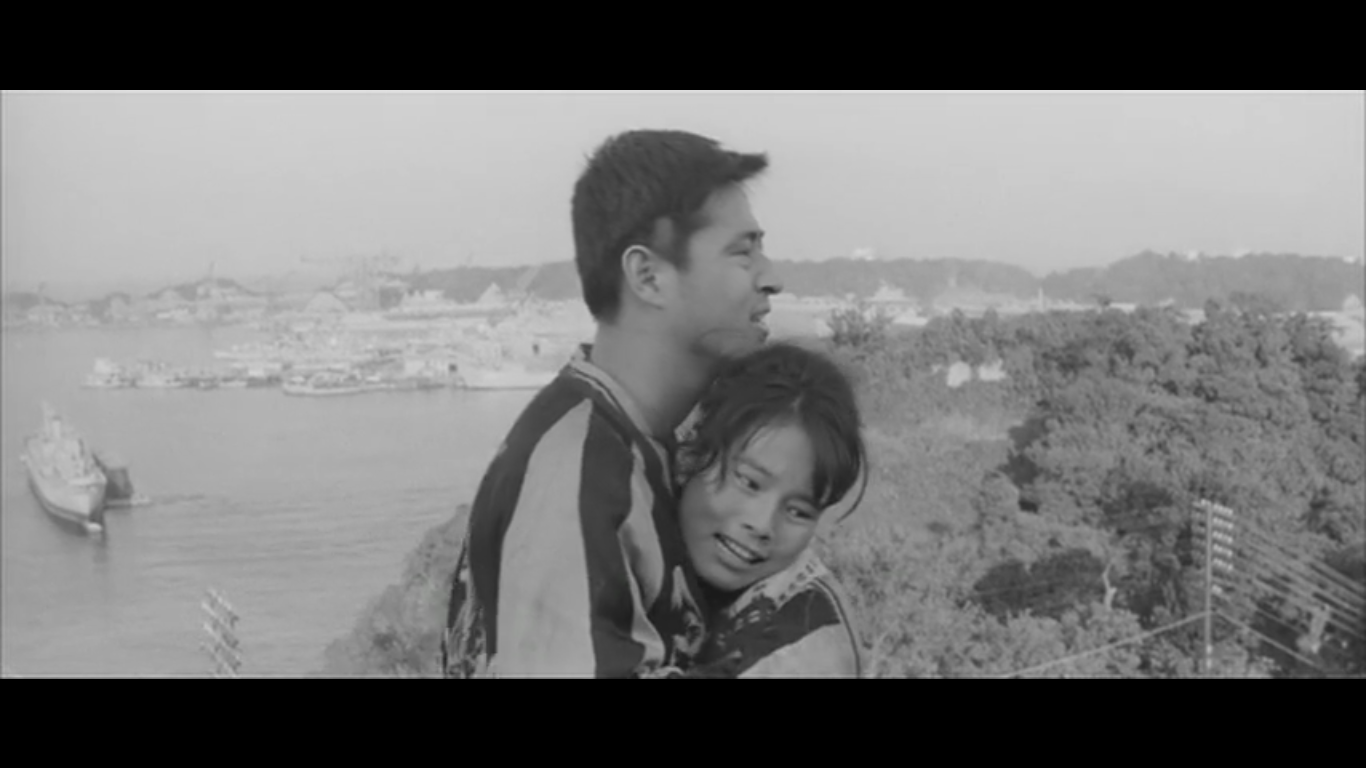
Kinta is one of the ilk of street trash gaining our attention for whatever reason. He’s a lowly gangster yet to earn his stripes.  Hiroyuki Nagato plays him in such a way that his movements come off as those of a callow, entirely overgrown child. While he tries to make a name for himself among the local gangsters, he has an on-and-off fling with a local girl named Haruko.

She’s not a glamour queen, but there’s something good and decent about the naivete found in her eyes. However innocent she might be, she still chides Kinta to get out of the racket and take up a steady factory job out of town.

Whether he meant to or not, you begin to see how the Japanese New Wave was carried on the shoulders of filmmakers such as Imamura. He accentuates a certain world through a particular methodology.

Where hoodlums feel more like snickering hyenas in baggy clothing ready to pound the populous for a good laugh. These aren’t criminals given any amount of deference or import. It feels like we should scorn them even in their hijinks trying to make some money off a drove of pigs.

However, the movie is not without a shock factor. You know when a man’s head is dunked in a tank of gasoline and a thug waves a lighter in front of him ominously, he’s making the threat count. It’s easy to see the director pushing back against any post-war American tokenism. Because Kinta is found right in the crosshairs.

Where being American is king and if you can’t be white Anglo-Saxon — victors of WWII and wooer of Japanese women — at least with the gangs you get to do something cool with your life. You belong to something bigger than yourself. Anything honest and menial is frowned upon. There’s a self-contained scene when a little boy reads out loud how refined and highly cultivated Japan has been able to fluidly integrate aspects of other nations, the irony is not lost.

You only must watch what happens before and after to have a good laugh. The hiccups keep on coming. The mobsters have their hands full disposing of a body, and it feels like a bout derivative from The Trouble With Harry than any hardened crime drama. Try not to giggle with morbid glee when they find a false tooth inside the pig they’re chowing down on!

Even, the yakuza boss, that symbol of towering and lethal villainy is a sorry figure. He’s dying of cancer — looking pitiful when his little brother comes to visit him — the gang gathered around his bedside. He thinks he only has days to live and there are so many affairs to get in order. Namely, all the debts he still needs to collect!

We also meet the man known only as Sakiyama at a bar talking with a Chinese fellow. They’re involved in this pork deal between the Americans and the locals. Although the “Japanese-American” man speaks English, it’s easy enough to tell in a moment it’s not his native tongue. This actor is Japanese and so the illusion is broken, but given the carnivalesque bits of business we’ve already been privy to, it’s not completely out of place.

Because things just keep on falling apart in this ever-changing state of fateful narrative entropy. For most of the film, Imamura remains an observer, but in one specifically pointed setup, he inserts himself into the action. It happens in the aftermath of a row between Kinta and Haruko. They’re probably not getting back together, and she vows to get drunk and party with American seamen as an act of spite.

Instead, she ends up in an empty hotel room with three brawny men prepared to overpower her in their stupor. The overhead shot of Haruka and the three boisterous sailors might be the pinnacle of the film’s hysteria in this intersection of worlds and toxic schemes of life. It breaks the moment down to its most pointed elements as we spin toward oblivion and a horrible outcome that cannot be undone.

Going with its prevailing tone, Pigs and Battleships owns a final act built on total futility. However, there’s something about seeing pigs roaming in the streets that made this feel like Pamplona for porkers. It’s a hilarious image even as the film comes to terms with its own human tragedies. Ozu would never make this movie; not even Kurosawa with his more dynamic proclivities. No, this is something new.

Most important is the implicit message found in the title and much of the comedy. In the post-war landscape, Japan was very much subjugated to America, and they too became conduits of Capitalism.  However, in case it’s not already apparent, our way of life and systems come with their share of flaws. Pigs and Battleships begins to suss out the complexities of this relationship. We’d do well to consider it.

3.5/5 Stars

Cesar et Rosalie (1972)

It occurs to me that the title Cesar et Rosalie is a rather peculiar choice for this movie. However, it’s also very pointed. If Jules et Jim was about two friends caught in a ceaselessly complicated love affair with one woman (Jeanne Moreau), then here is a story shifting the focus just slightly. This time it is Romy Schneider caught between two suitors.

It opens with two men who both were coupled with the unseen woman named Rosalie. Formerly she was with a handsome comic book artist, but before they could ever get around to marriage (what would have been her second), she ended up with a middle-aged scrap metal man (Yves Montand). He’s quite successful in his trade while maintaining a penchant for gambling.

Whether it’s solely because they are represented by creative types, it feels like there’s a kind of vacuity about the younger generation. Yves Montand, now there is a man with something interesting about him. After doing some digging, I found out he was actually Italian by birth though thanks to his music and acting, he became synonymous with French cinema. Films like Wages of Fear and Le Cercle Rouge work in a pinch. He’s one of France’s indelible faces, and here he is another character with a lumbering larger-than-life posture.

Both a bit of an overgrown baby and a gregarious teddy bear. He can be found smoking his cigars and establishing himself as the life of the party. He loves to vocalize, and in contrast to his rivals, there’s something refreshing about his blustering style. You know what you’re getting.

In comparison, I’m less inclined to be infatuated with any semblance of the bourgeoise milieu as embodied by David (Sami Frey). This might be a poor descriptor because he’s only a comic book artist, albeit a very successful one. But there’s a detached, casual air about him that feels far more refined. It lacks all of the volatile personality exhibited by Cesar. If I speak for myself, Cesar seems like one of the common men.

However, right about now it’s worthwhile to acknowledge a handful of his shortcomings. He’s quite petty and jealous for the affection of Rosalie. In one instance, his childish antics and brazen show of bravado leave them idling in the underbrush at the side of the road. In the aftermath of a convivial wedding party, a game of chicken ensues between him and David becoming a portent for future drama.

Although he and Rosalie have been together for some time, and they have a contentment between them, there is still this lingering sense of individuality. Rosalie is a mother. She has been married before and maintains her own independence. She remains with Cesar mostly because she wants to be, at least for now. That could easily change, and, eventually, it does. Her whims make her alight once more for David because his quiet charms have not atrophied with time. She feels the electricity between them still.

At the midpoint, the picture hits the skids. Cesar’s ugly underbelly comes alive as his transgressions and jealousy take over. He acts as if he owns Rosalie and in one harrowing scene practically throws her out the front door. He’s a wounded brute prone to violence. There’s no way to condone his behavior even as it reflects the toxic social mores of the era (or many eras).

But of course, he can never forget her. He feels lost without her and so he resolves to find her with David. He tracks them out to their beach getaway but instead of coming to have it out once and for all, Cesar returns sheepishly with his tails between his legs. He’s paid for the damages he inflicted, and Rosalie looks over his sorry figure and can hardly contain her amusement.

It’s moments such as these where it becomes apparent how the movie is mostly able to coast on the goodwill of its stars and their various romantic dalliances. Initially, it feels like Romy Schneider spends a great deal of time in the kitchen grabbing drinks and making coffee for her man. However, she’s also a keen observer of male anthropology.

Like Moreau before her, she really does play the deciding part in this film. As much as it seems framed by the male perspective, though our title subjects have shifted slightly, Rosalie does hold a great deal of sway in the story. It does feel like these men need her more than she needs them or, at the very least, she is not willing to settle into this kind of relaxed equilibrium where they exist in a menage a trois without the intimacy.

Is it wrong to consider this the most French of romantic setups? It becomes plainly apparent that this is never just a film about Cesar and Rosalie. There must be parentheses or ampersand including David tacked on the end (or any other love interest for that matter). The film is far more crowded and complicated than a mere romance actuated by two solitary human beings with Sautet crowding the canvas and relational networks of the film with so many ancillary swatches of life.

Although it feels like it’s not about very much, Sautet is able to hone in on this core relationship and tease out both the comedic eccentricities found therein while still leaving us with this kind of wistful resolution. It’s not a tragedy in the same way Truffaut managed when he detonated Jules et Jim, but it leaves us with that sense of regret that love often conjures up in the human heart.

All these characters could have done things differently to patch things up, to stay together, and earn the Hollywoodesque ending. However, what leaves an impression is this kind of pensive anticlimax. It’s a lighter touch than The Things of Life or Max and The Junkman, even as it might owe something to Lubitsch.

3.5/5 Stars

Les Choses de la Vie (1970)

I’m not sure if director Claude Sautet was just never esteemed enough by the cineastes of his day to receive his due, but the string of pictures he made with the likes of Michel Piccoli and Romy Schneider feel worthy of further, more stringent consideration.

What becomes evident is this kind of prevailing melancholy about his films with fated lovers or destined tragedies all but ready to be searched out. Les Choses de la Vie opens with a scenario that would be quick to tap into the minds of any filmgoer wary of the Nouvelle Vague’s most prominent iconoclast. By that, I mean the living legend, Jean-Luc Godard.

Here a rolling tire sets the stage for a Weekend-like pileup. This one was caused by a collision: a man blazing down the country road doing everything in his power to miss a stalling truck. While this event might provide what feels like an excuse for a dramatic movie, the core of The Things of Life is far more intimate. Some might say it’s stereotypically French: a movie concerned with amour. So be it.

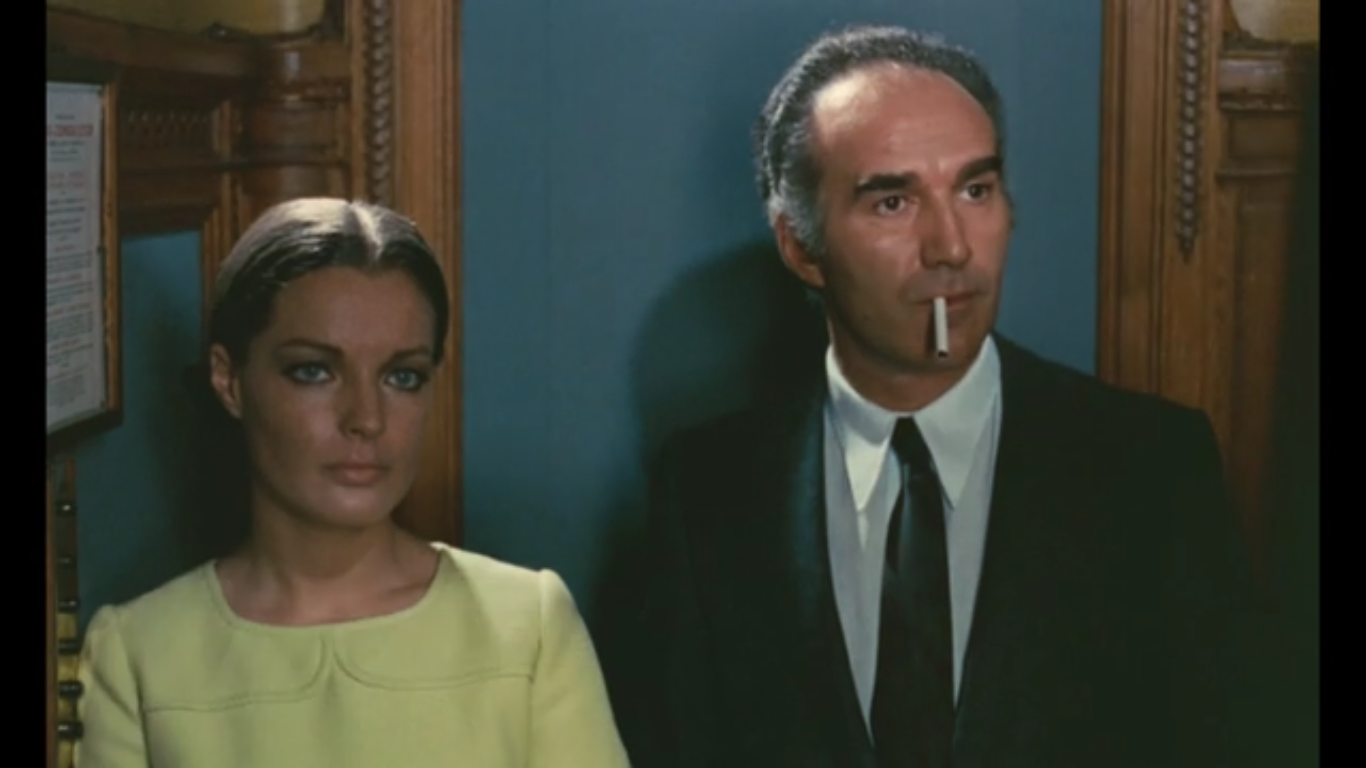
We get a sense of Pierre’s life, past and present, without everything being conveniently spelled out for us. It’s made plain by how people look at one another — how they fill up the space with a shared familiarity. He is now with Helene Haltig (Romy Schneider). You can see the affection with which he gazes at her as she taps away at her typewriter after getting out of bed.

All the allure of Schneider is right there on her face, tucked behind her glasses, as if an instant reminder of why she’s remained such a lasting icon in cinema the world over. A premature end often has a way of canonizing people for posterity, but we cannot sell her short. This has little relevance here. Her vibrancy is undeniable on its own merit.

Pierre loves Helene even as he maintains an amicable, if aloof, relationship with Catherine, his former wife. Over a lifetime, they have shared and shared alike in business, with their kids, and through a vacation getaway on Re Island. There’s still a sense that they are fond of one another. Perhaps time has moved on or maybe they regret their choices. For now, it is what it is.

If Pierre is the protagonist, one would be remiss not to mention the palpable distances between father and sons, be it real or imagined. He grapples with his own father, a spirited fellow who hardly seems like the paternal type, and then there’s his own boy who’s growing up fast into a man with his own ambitions. As much as he wants to rekindle their relationship, it does feel like he hardly knows him now.

It’s this very same inkling, a longing for connection that causes him to agree to a trip to the family isle. Of course, it conflicts with his business arrangements in Tunis and the future plans he already worked out with Helene. Their romantic dinner together becomes deflated having lost all the life that was there before. The wine is spilled.

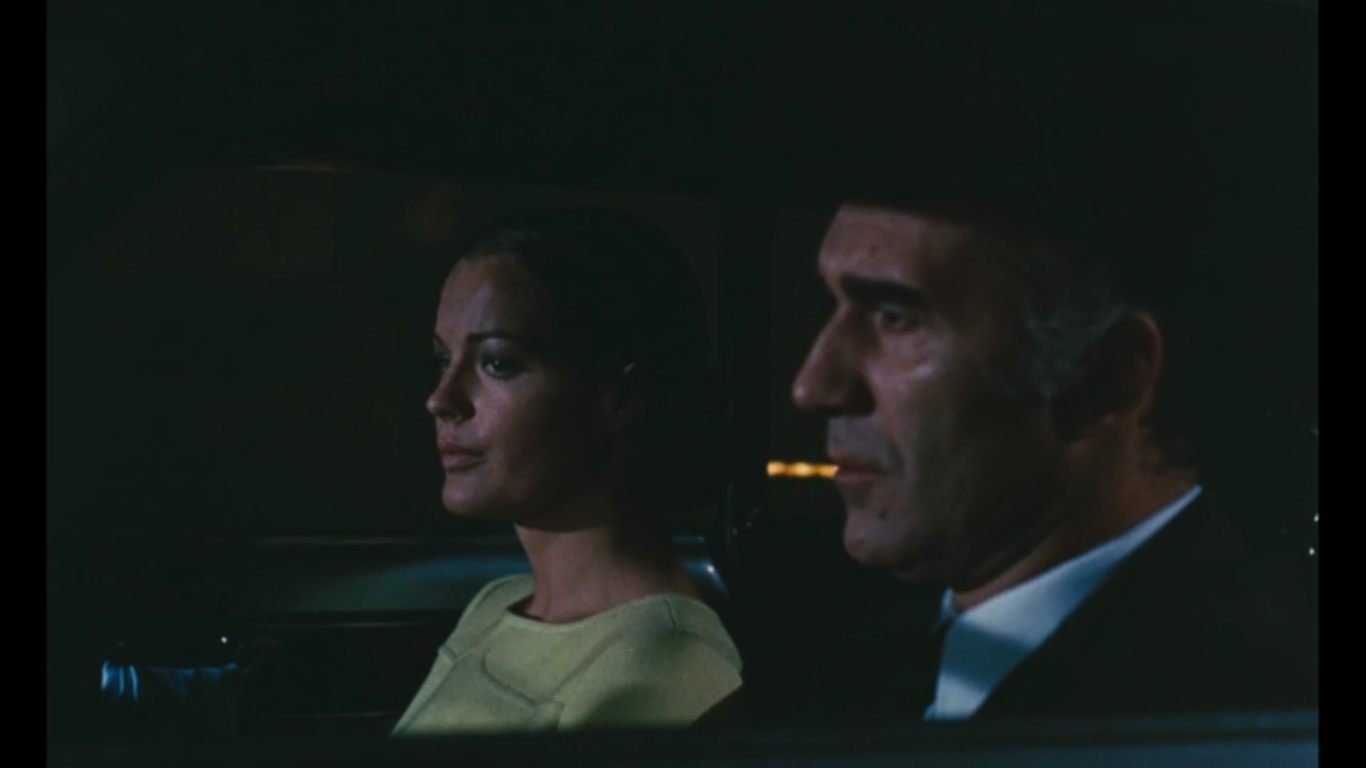
What’s next can only be a wordless car ride. He rolls down the window to toss out his latest cigarette and to keep from suffocating in the silence. Then, he clicks on the radio to fill the void between them. That too gets thwarted. They look to be doomed.

If it’s not evident already, time is allowed a level of fluidity rather reminiscent of Stanley Donen’s Two For The Road even as we motor toward the inevitable — a car wreck and what feels like romantic dissolution. Like its predecessor, the musical accents accentuate the mood. This time it’s not Henry Mancini but Philippe Sarde’s languishing score that is always available, softly plinking away in the background

In fact, it has its own wedding scene — Piccoli observes the giddy guests as they scramble toward a white banquet table set for a feast. He’s a man who’s been all but consigned to his car, smoking cigarettes, and this one exuberant display, far from earning his contempt, provides a seedling of hope…

Then it happens. I need not systematically go through all the gory details. However, in the end, there Pierre is lying on the ground thrown from his decimated automobile at the side of the road in the grass somewhere. It’s an almost out-of-body experience as the world swirls by him, and he exists in his thoughts and his memories.

The motion of the world around him carries on, whether it’s onlookers coming to see the wreckage or the body, then an ambulance comes to rush him to the hospital as the rain starts pouring down. Catherine gets the news and Helene comes rushing to his side too…

The Things of Life is constructed in such an inevitable way, but somehow it’s still entrancing, this sense of moroseness and the elasticity of time in the service of one man’s romantic memories. It’s built around melodrama, yes, but with a very specific bent, totally mechanized, and stylized in such a way as to supply the desired effect. And rather than the Sirkian school of high camp, it seems to hewn closer to the path of John Stahl.

In other words, Sautet, in some ways sucks much of the typical theatrics out of the storyline, or at least they do not seem to be his primary concern. What we are left with is this pervasive sense of lasting melancholy, and it’s a powerful emotive force that would hold over to his next picture together with the same primary players: Max and The Junkmen.

4/5 Stars

The Passenger (1975): From Dust to Dust

Screenshot 2020-07-24 at 10.07.49 PM

Jack Nicholson was awarded the distribution rights of The Passenger soon after the movie came out, and he purportedly kept it out of circulation until the 2000s. From my understanding, it wasn’t for the typical reasons. He wasn’t trying to kill it so no one would catch wind of what a debacle it was. On the contrary, in some way, he was looking to preserve its artistic integrity and keep it pristine. What better way to do this by only allowing it to exist in your memories.

These circumstances allow for an intriguing dialogue on art vs. commerce and what this means in the Hollywood landscape. Take, for instance, One Flew Over the Cuckoo’s Nest, released in the same year — wildly popular, an Oscar cash cow, and still well-regarded to this day.

I don’t want to make any unfair insinuations about Milos Forman’s film — it can still be art — but by sheer box office appeal, it readily fits the category of commerce. It was a highly successful film in many regards and no doubt a lot of people have seen it and enjoyed it immensely.

Whereas The Passenger is a film, also released in 1975, that probably only cinephiles have a passing interest in because it hardly has any visibility. Even as I dipped my toes into the filmography of Michelangelo Antonioni, I was made aware of all his other works from L’Avventura to Blow-up before I ever had an inkling of this movie.

But it does exist and it’s such a fascinating, understated counterpoint to the rest of Jack Nicholson’s career. You get a sense of why it would remain so near and dear to his heart even as it becomes difficult to categorize. For one thing, he plays journalist David Locke at his most sincere — normally he feels a bit disingenuous, here every action rings with a core resonance.

This in itself might be a strange remark. We meet Locke in Africa. He is following a fast-evolving story about the local liberation front. He’s conducted many interviews and promoted the revolutionaries, but there is this sense he still doesn’t know what he’s in the middle of. In earlier decades he would have been the imperialist trying to make sense of the natives. A generation after that he would have been Jake in Chinatown.

But the most curious development is this: Locke finds another foreigner dead in the adjoining hotel room. They shared a conversation earlier. Now, he looks to take on the man’s identity. It remains to be seen why he does it. Locke’s not a criminal or a spy; he’s a journalist, and yet there’s a premonition that seeing this other fellow’s life — a globetrotter, as it were — proves highly attractive. He’s not weighed down by the same regimen and responsibilities.

If you’re unfamiliar with Antonioni, the premise might sound like a precursor to Bourne or maybe an Alan Pakula paranoia thriller. However, it has none of those hallmarks. It’s never preoccupied with the narrative beats. They only seem to be there — to exist as a conduit with which to explore something else.

The movie shifts to Germany but location is far too convenient a reference point. The movie freely shifts wherever it pleases, within time frames, as a kind of exercise in fluid, stream-of-consciousness storytelling. Where the present and the past can literally crossover and play out into one another within a single scene. Prior conversations echo in Locke’s ears even as he begins globetrotting around the world.

Over time they play more like moments and memories than traditional scenes adding up to what we would consider a conventional plot. He meets with some revolutionaries and realizes he’s a gunrunner. His wife and her lover learn of his death, go digging through his interviews, and go looking for this missing person. However, it all spins together another totally elusive tale as envisioned by Antonioni. This is his whole modus operandi as a filmmaker.

Locke (or Robertson) thinks he’s being followed and he is, but there’s never a true sense of fear or dread. In fact, we don’t quite know what to feel. It could be called a mood piece or a tone poem although I’m not sure those are quite right.

These moments are plucked out of time. There’s a chance encounter in Barcelona. He casually explains to a young French student (Maria Schneider) he’s running away. She wishes him well — hopes he makes it — noting people disappear every day. Sometimes it’s just around the corner, sometimes it’s with the cut of a film, and sometimes it’s for good. In perfect cadence with Nicholson’s amiability, Maria Schneider has a pleasant forthrightness about her; she’s another creature drifting on by, made solely to exist in this world.

Screenshot 2020-07-24 at 9.35.54 PM

It’s very rare to pull Antonioni away from the architectural landscapes he finds at his disposal because this is where he derives geometry, shapes, and with it an overarching composition for his works. Barcelona is a perfect marriage because one of its supreme talents was the incomparable Antoni Gaudi. Even a couple years of remedial art history tell us his buildings were of an unmistakable, singular design. The most startling progression is from dour Gothic interiors to these near-fantastical exteriors. Like Picasso and others like him, somehow in these shapes, or lack thereof, they derive meaning. Because how else are we going to ascribe it to our world?

It’s fitting that a movie that’s plot was incited in a hotel room should end in one as well. There’s a near-imperceptible zoom during the film’s famed denouement — peering out into the world. Up until this point, the story seldom feels chaotic as if our hero is resigned to his fate, and he has a kind of solace in it.

Luciano Tovoli’s camera magically pushes through the bars of the window to view the sandy plaza outside. It’s these tracking shots across the horizontal plane of existence I won’t soon forget opening up the world to be fuller and more immersive. In one full cycle of the camera, it’s like we see the plot and a life’s journey come to its conclusion all in one fell swoop.

Like others, I spent time deliberating over the meaning of the title. In Italy, it was known as Professione: Reporter. In English, it was changed to The Passenger. There might be numerous logical readings for both, but for me, I couldn’t get the picture of those two dead bodies lying on beds. You have to see them to know what I mean. They feel empty when they are found. Only a shell of a human being because it’s true the spirit or the life force of the person or whatever you to call it, is gone.

We are a culture rich in euphemism or closer yet metaphors. In the biblical text, Jesus gave up his spirit. Others have fallen asleep. Hamlet talks about shuffling off this mortal coil. And others have passed on. For me, this is what the title resonates with. This idea of how we are only on this earth a finite time. We are not solely defined by our body and our vocation and all these other intangibles.

It’s the spirit inside — the beating heart, the breath in our lungs, our souls — these are what make us alive as human beings. So quickly do we arrive and in another moment we are gone. In The Passenger, death is not violent. It’s only a voyage finally coming to an end.

What makes it disconcerting is the lingering alienation and dissatisfaction propagated by the world. It feels like a sullen place to be. Death as such seems like a tranquil respite. Each must decide for themselves if this holds true for them. Because surely we are not meant to live life without hope, existing in a constant state of listlessness. There has to be more.

4/5 Stars

Rocco and His Brothers (1960): An Epic Family Drama

Screenshot 2020-07-12 at 8.02.52 PM

One immediate takeaway from Luchino Visconti’s Italian epic Rocco and His Brothers is its gorgeous, swoon-worthy black & white that’s absolutely magnificent. It shares hallowed ground with films such as The Grapes of Wrath or The Godfather where the palette does yeoman’s work when it comes to informing the drama.

At its most essential level, the movie is about a poor rural family from the South journeying to Milan to make a new life for themselves. Their patriarch is dead and now his wife (Katina Paxinou) heads up north with her four boys to reconnect with the oldest brother.

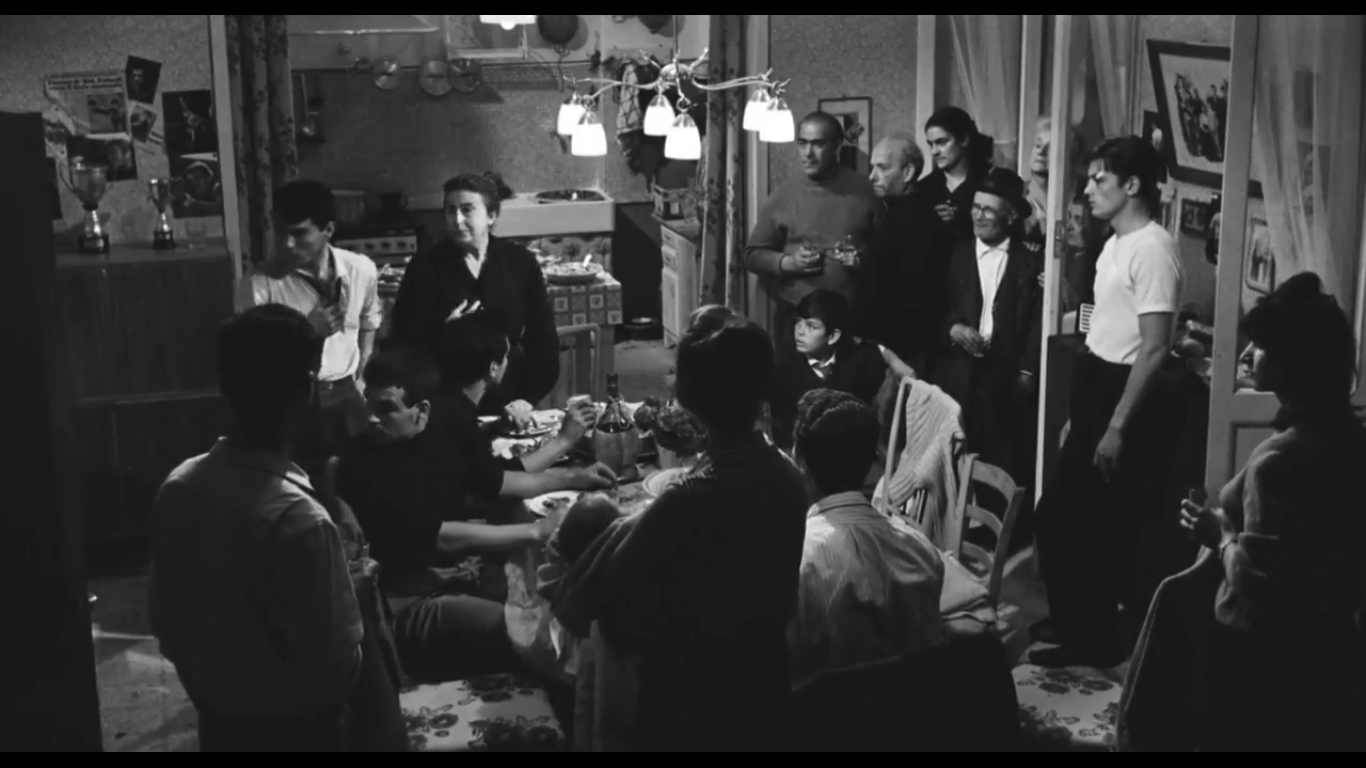
Vincenzo (Spiros Focás) is courting a dark-haired beauty (Claudia Cardinale) with thoughts of marriage once he gets steady work. Their home feels gay and bright with the roving camera capturing the full expanse of their household. It’s positively overflowing with family, and we expect nothing less.

I think some contemporary critics were disappointed by its sheen which is very un-neorealist. But it does boast its own brand of truth about family and life and love and all the constellations of emotions that we grapple with every day whilst living with other people. In this way, it shares a brand of authenticity with those earlier generations of films.

Francis Ford Coppola was certainly influenced by the picture, not only based on his hiring of composer Nina Rota but also in a more general sense in courting themes about family. It makes for a compelling ensemble telling their stories in a manner that feels totally immersive and honest to who they are as human beings. And yet it’s destined for heightened tragedy akin to Rebel Without a Cause or West Side Story.

Screenshot 2020-07-12 at 9.21.48 PM

What a raucous opening it is; it’s spectacular with the families pitted against one another and by families, I mean the mothers butting heads, while their children are left to pick up the pieces and play peacemakers. It feels all too real. Vincenzo quickly finds himself with an angry mother and a whole pack of brothers he has to find lodging for, no wife, and still no job. Everything goes to hell in a matter of moments.

Despite its sheer expanse, Rocco and his Brothers feels simultaneously well-organized and still free to follow the whims of life. Each brother gets a chapter of sorts and yet each one bleeds into the next. They’re never obvious sections and so it feels more like poetry woven throughout a story than hard and fast rules that must be adhered to.

For the time, Vincenzo lands them a temporary place to live, somewhere they can stay on until they get evicted. It’s not a promising life, but the family does receive a couple propitious bits of luck. Newly fallen snow means work shoveling snow, and the boys wake up early, downing their mom’s piping hot coffee, as they scramble out into the early dawn to bring home some bacon as it were.

Because it becomes a story of each brother exercising their worth. They are valued by the manner in which they are able to provide bread money to the family unit. Rocco (Alain Delon) bumbles his way around a dry cleaner weathering all the young ladies teasing with a good-natured stoicism. Ciro goes the sensible route, conducting his schooling so he can land a suitable job at the local Alfa Romeo factory.

Simone (Renato Salvatori) fancies the idea of joining the local boxing gym as a chance at some easy dough, and he gets the biggest break out of all of them. A trainer takes a chance on him, and he wins his first fight, despite a belligerent temper.

If these scenes are only preliminary, they provide the framework to understand our characters going forward. Simone presumably lacks the moral prerequisites for a lengthy boxing career: a rejection of drinking, smoking, and women. Rocco is called upon to be his sparring partner and his guardian.

After his glorious showing for the home crowd, the brothers proceed to get embroiled in a street fight only to wander off with the pretty streetwalker Nadia (Annie Girardot). Simone’s behavior doesn’t bode well. Life roles onward and with few prospects, Rocco pursues his military service. It’s far from a digression. Instead, it reflects the passage of time

Screenshot 2020-07-12 at 8.06.38 PM

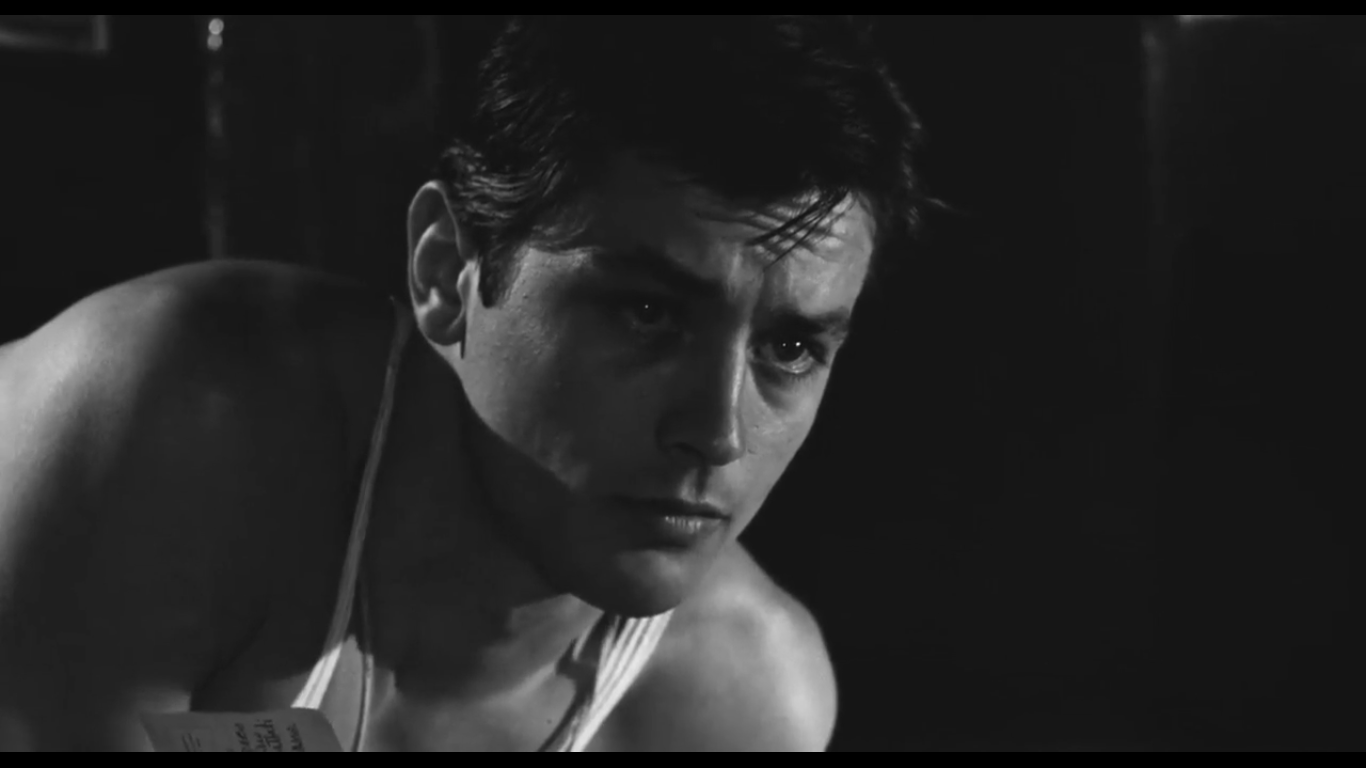
Rocco is one of those enigmatic figures who watches the world and seems to see everything. Those who think he’s quiet or unfriendly, over time, come to realize he’s perceptive, carrying deep reservoirs to make the most of life and have faith in everything around him. There’s a dashing nobility to him. This becomes even more true when he returns home.

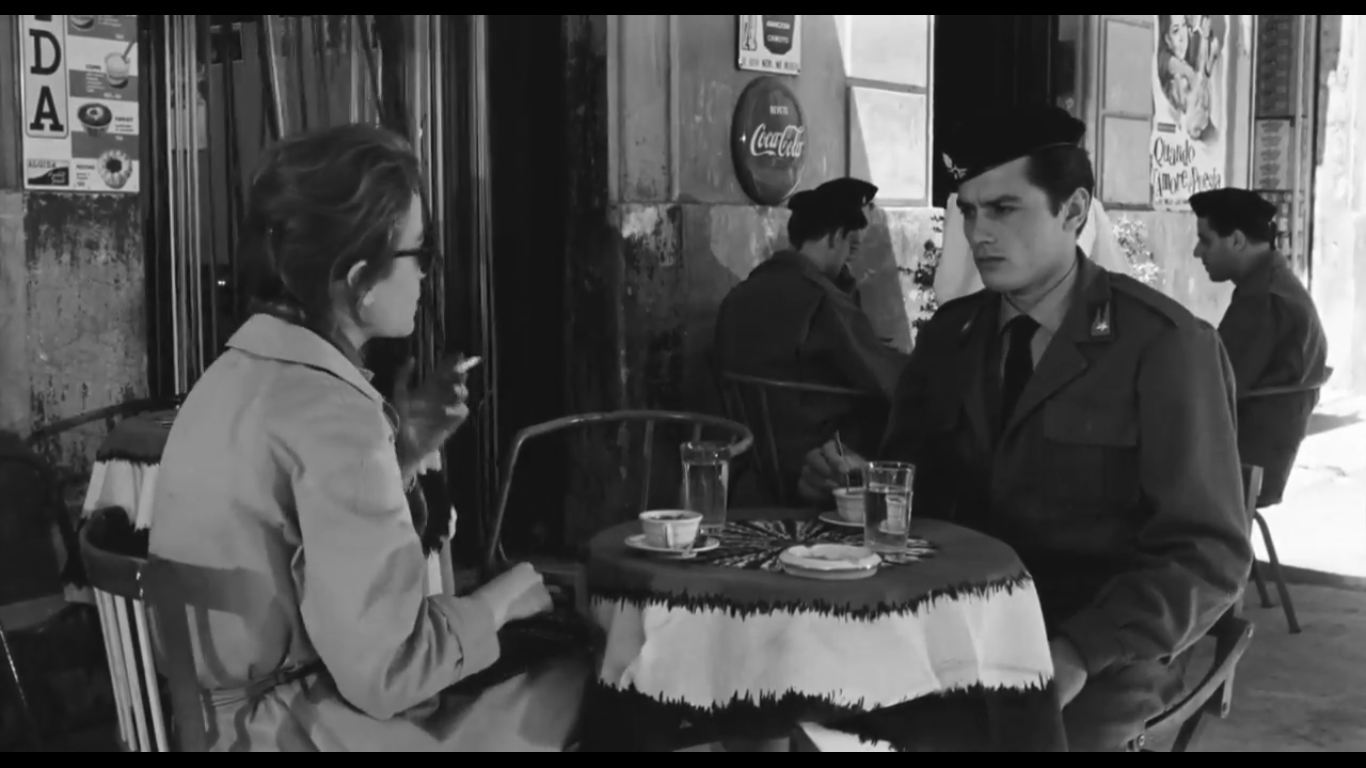
The first person he meets at a sidewalk cafe is a face from his past: Nadia. He, smartly dressed in his uniform. Conservative. She, in her sunglasses looking him over. She’s no longer with Simone — at least they drifted apart — because she was serving a prison term. In Rocco, she finds someone understanding and kind who never demeans her. She feels understood in his company. Pretty soon a subtle romance blooms between them, warm and tender.

What we haven’t taken into account is Simone. The time has changed him as well. Now he’s hardened, disgruntled, and disillusioned with his boxing career. He dedicated himself to smokes, drinks, and pool with the boys. But he’s also intent on ripping Rocco and Nadia apart. Jealousy takes hold, and it’s the stuff of melodrama. To detail it all now would be rote and a disservice.

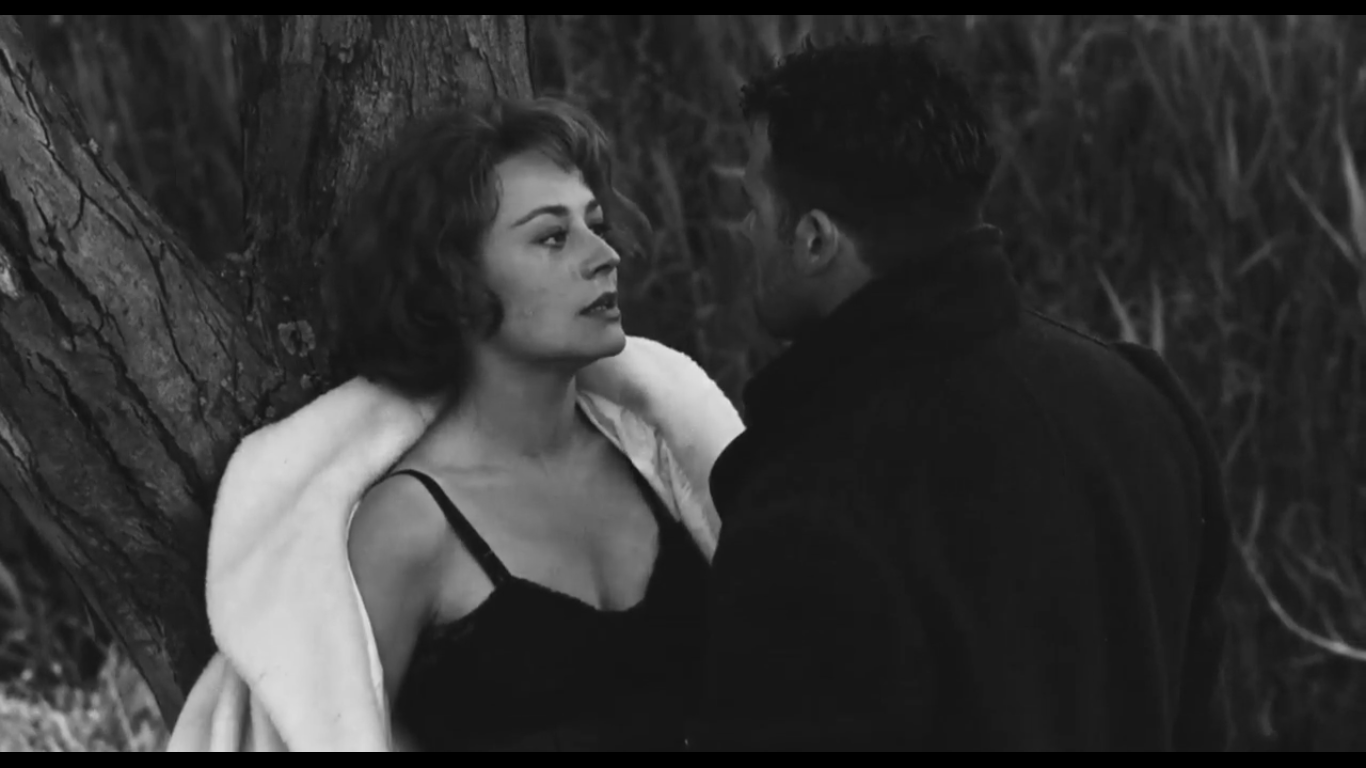
You need to see it as he brings them down to his level with a wounded tenacity nearly as electric as anything Dean or Brando managed in East of Eden or Streetcar. Suddenly, everything that was so blissfully and right between the two lovers is besmirched. And they cannot get it back. The way the camera clings to them violently as Simone tries to advance on Nadjia feels convulsive. It’s the film’s cataclysmic event.

Screenshot 2020-07-12 at 9.14.36 PM

In its wake, Rocco ascends in his own boxing career channeling his hatred into his rounds in the ring and shedding tears for how the harshness of the world has changed him. 

As Vincenzo settles into his own familial life, it is Ciro’s turn to respond to the fracture between his other brothers. He confronts both on his mother’s behalf, entreating Rocco, “A seed gone bad must be weeded out. After all, trees are meant to bear fruit.” However, the well-meaning boy doesn’t quite know how to apply this teaching into practice.

Rocco continues on the rise in his singular objective. Simone’s sunk into the gutter as not only a malcontent but the laughing stock of the community — his debts piling up and Nadia staying with him, partially out of malice and a promise to Rocco. It is here where the film’s editing comes front and center as the two brothers go their separate ways.

My mind is drawn to a curious interchange between mother and son as they dialogue on the self-destructive nature of the black sheep of the family:

“It’s not for us to judge him but to save him.” – Rocco

“Christ will regret the suffering he visited upon us.” – Mother

“We’re no longer under God’s grace. We’re our own enemies.”

Rocco proves himself again to be this near-otherworldly figure. He has an almost unfathomable amount of grace for others, and yet he’s prepared for penance and to take the burden and sorrow on his back. He is Christ-like and yet unable to be their savior.

It makes for a dismal denouement drained of all hope. Still, the family must pick themselves up out of the muck and the mire and make a way in life — each brother on his own path. Rocco finds his face plastered all over the news kiosks for his latest exploits. Simone has fallen into disarray. Ciro represents a certain hopefulness — what his brothers used to be, and Vincenzo is what they could have been — both settling down with families. Little Luca’s fate is yet to be decided. He’s indicative of the fight still left to be forged.

But I am left to return to my opening metaphor. Whether it’s Tom Joad or Michael Corleone, and in this case, Rocco, these are young men who made irrevocable choices in their lives from which there is no turning back.

The chasm between who they were and who they become couldn’t be more disparate and in all accounts, it has heady implications on their family unit. What they do, they do for their loved ones, and they still see everything they love crumble around them. It’s not a new concept — it’s not novel — but there’s something distinctly profound in this. Because we all experience something of the same.

My final thought is only this. It occurs to me that the Parondi brothers might all represent the seeds in the parable, falling all along the road. I’ll leave it up to you which ones will make their way through the straight and narrow and which ones will bear fruit. Because human beings are often resilient, and they are often granted second chances in life if they accept them. Perhaps they can remain under God’s grace after all or maybe it’s not for us to know.

4.5/5 Stars