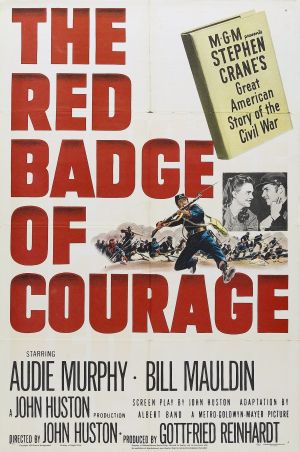
Red Badge of Courage (1951)

Red_Badge_of_Courage_1951.jpgStephen Crane’s seminal Civil War novel was made to be gripping film material and although my knowledge of the particulars is limited John Huston’s story while streamlined and truncated feels like a fairly faithful adaptation that even takes some effort to pull passages directly from the original text.

Even with the film getting butchered by the producers and chopped down to only 70 minutes from its original 2 hour running time, there’s still a gripping power to this war story. The narration feels a bit forced (despite being delivered by James Whitmore) but beyond that Huston’s film has an undeniable resonance for the atmosphere it develops and the very palpable inner turmoil of its central character as portrayed by famed real-life war hero Audie Murphy.

It suggests the other side of what it is to be a soldier. The fear, the reluctance that wears on the individual, and it begs the question, who are the real heroes if not men who did their duty despite the very fears that shackled them? Portrayed in this film are men and boys who were thrust into conflict and they were forced to respond accordingly. Not necessarily because they wanted to but out of very necessity.

In the end, the realization is that maybe fear is alright and acknowledging it is oftentimes the very sign of a brave individual. Someone who knows their limitations and still manages to push beyond them to do extraordinary things. Because as FDR so famously noted, the only thing we have to fear is fear itself. It can be debilitating, stifling our resolve to take action. Thus, it’s our response that’s paramount.

Barely 20 during the war Murphy isn’t all that much older here and it feels remarkably fitting for him to play the naive Youth getting his first welcoming to war faced with this very conundrum. He wants the glory of war. He wants that red badge of courage. But he’s too afraid to take it. The utter irony is how battle-tested Murphy was by that point in time–but of course, he became a hero at a very young age and that doesn’t necessarily mean it came easily or without a cost.

Huston also examines the disillusionment in the utter absurdity and idiocy of war sometimes. Though it had already been 6 years since the end of WW II with men such as Audie Murphy and Bill Maudlin involved it’s easy to get the sense that this was a rumination on that particular war’s effect. Huston as well had been involved in documenting the life of soldiers and Maudlin made a name for himself as one of the great wartime cartoonists originating the iconic duo of Willie and Joe. Murphy’s accolades spoke for themselves as one of the most highly decorated soldiers of his day but he also undoubtedly suffered from the trauma of PTSD.

The dialogue is ripe with colloquialisms and the images seem generally authentic with photorealistic visuals to match a fairly dismal outlook. It does not shy away from the reality. Figures constantly moving through the frame mechanistically. Claustrophic closeups, tights angels, billows of smoke and relentless gunfire make the battle sequences truly immersive. And the soldiers are played by actors of all shapes and sizes including Murphy, Mauldin, Royal Dano, John Dierkes, Arthur Hunnicut, and even Andy Devine.

If it had not been for the studio’s meddling we might be calling Red Badge of Courage one of the great American war movies. As it stands today, cut down from its original running time and slightly removed from John Huston’s original ambitions, it’s still a highly moving picture. Because moments of greatness shine through no matter the muddling factors. So despite its minor status and a runtime that suggests lesser fare, Red Badge of Courage is really Class A material through and through. Huston did not call it one of his best movies for nothing.

3.5/5 Stars

Have a wonderful Memorial Day and here’s to all the humble heroes in our armed forces.
Review: The Maltese Falcon (1941)

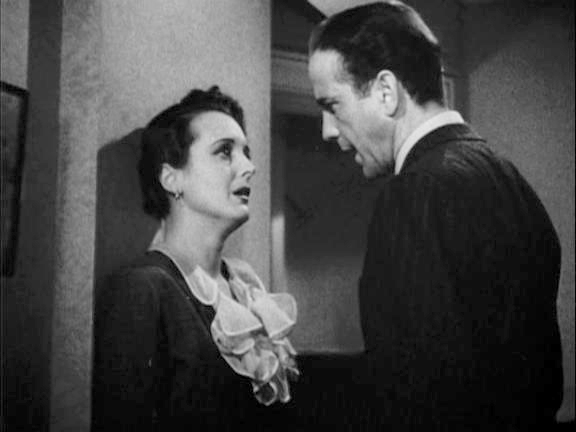
maltesefalcon1Dashiell Hammet’s “blonde satan” Sam Spade is an icon of not only 20th-century literature but also 20th-century cinema, thanks in part to Humphrey  Bogart and John Huston. He’s the cynical, hard-nosed, unsentimental P.I. whose general unpredictability sometimes leads to angry outbursts and other times gleeful amusement. He’s a straight talker and not about to be pushed around. If this sounds familiar at all, it’s because it lays the prototypical foundation for any film noir gumshoe ever. Except Bogart’s Spade receives the credit as the archetype. All other portrayals whether homage or parody stem from his performance. And it is quite the performance, but he has some worthy adversaries attempting to upstage him.
Brigid O’Shaughnessy  (Mary Astor) is the conniving, beguiling, lying little stagy siren who comes into his office in need. She sets a precedent with a string of lies and that never ceases. However, there are half-truths and bits of genuineness backed by her quivering voice and pleading eyes. It took another round to realize what a femme fatale she actually is because she is in fact so good at it. You almost don’t realize how deadly she could be. And in the pantheon of femme fatales, I admittedly forget her in deference to the likes of Phyllis Dietrichson, Gilda, or Kitty Collins. Perhaps Spade’s a little stronger than most protagonists, a little more resilient, not allowing himself to be completely duped. But from the get-go, Brigid has him reeling and guessing. The difference is that he knows it. It’s not until the very end however, that’s he’s finally able to get an actual line on her.

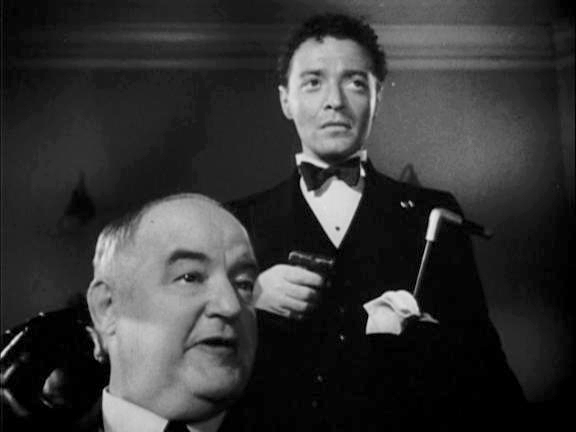
maltesefalcon2Then there’s Joel Cairo played so cunningly by the always wily and beady-eyed Peter Lorre and Kaspar Gutman portrayed so assertively and pointedly by the perennially memorable Sidney Greenstreet. These two men would come back in Casablanca and numerous other Warner Bros. Pictures, but they are the epitome of iconic characters actors who make any narrative that much more interesting. They have mugs and physiques really made for the dark recesses of the noir world, and when you put these four together it does spell trouble. Add a quietly seething Elisha Cook Jr. as Wilmer, the always personable Ward Bond as a Police Detective, and Lee Patrick as Spade’s doll of a secretary and you have a true winner.
With the eponymous blackbird to drive the plot all you really need are these characters and their inherent greed to pull them along. The beauty is that we do not know the details, but following Spade we slowly have piece after piece revealed, character after character make their entrance until everyone’s together and things get interesting

The story has loads of substance built-in and Huston was absolutely meticulous with his preparation for the film script and otherwise, which paid heavy dividends in the end. Hardly anything seems throw away and all the dialogue and scenes flow in a wonderfully seamless way that continues to carry us along in anticipation. It’s so engaging in fact that it becomes quite easy to disregard the film’s astute cinematography utilizing low-key lighting, which would become a norm for noir and then low angles that are reminiscent of another film that came out that same year, Citizen Kane.

Modern viewers might well accuse this film of being overly talkie, but amidst its iconic characterizations and bewildering plot, there are immeasurable pleasures to be mined. Few people would contest that the Maltese Falcon really is a major benchmark in film, as not only the early beginnings of German-influenced American melodramas (aka film-noir) but also a major career boost for the up and coming Huston, not to mention the veteran character actor Bogart. For film-noir lovers or cinephiles in general, this truly is the stuff that dreams are made of. John Huston and Bogart would both come back with success, after success, after success, but there’s something to be said for where it all began. The Maltese Falcon is a treasure indeed.

5/5 Stars

Review: Chinatown (1974)

chinatown1Forget it, Jake, it’s Chinatown

The more you watch movies like Chinatown, the more you realize how much you’re still learning. I saw it the first time and I naively thought I knew everything about it. After all, it seemed fairly cut and dry. But the beauty of this film is a labyrinth-like story that can still keep me engaged after multiple viewings. There are things that I missed, things that I have to piece together once more, and more often than not details I simply forgot.

Robert Towne’s script has an intricacy to its constantly spiraling mystery plot that remains powerful and Roman Polanski — with cameo included — directs the film with a sure hand as well as a cynically bitter ending worthy of his work. At that point, he was returning to the same city where a few years prior his wife Sharon Tate had been brutally murdered and that certainly had to still be heavy on his mind.

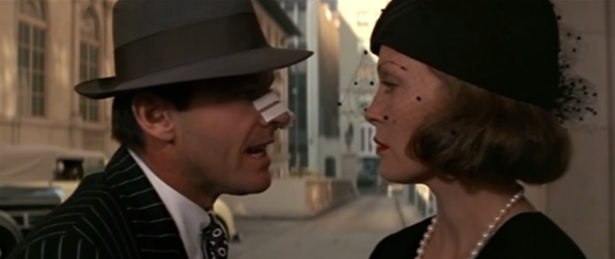
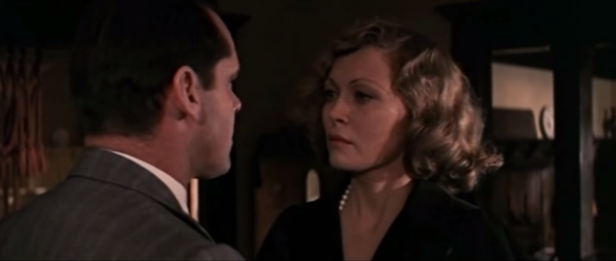
Throughout, Chinatown has elegant visuals of a desert-dry Los Angeles circa 1930s, and it is aided by a smooth Jerry Goldsmith score made for such a period crime film as this. Jake Gittes (Jack Nicholson), is the smooth-talking, smart-aleck P.I. with a penchant for trouble, but that goes with the business. In the tradition of all his heirs like Spade and Marlowe, the whole story is told from his point of view and we get the details at the same pace as him. That means a lot of the time we are just as confused as him, trying to pick up all the pieces.

Aside from Nicholson, Faye Dunaway’s performance is an interesting reworking of the archetypal femme fatale, because she has a different side to her. Also, John Huston’s performance is wonderfully nefarious, because he plays Noah Cross with a top layer of geniality that is ultimately undermined by his base nature. It’s wonderfully wicked.

In the story’s first few moments of being in his office, we begin to learn a little about the means Gittes uses to appease his clients. Then, his newest client walks through the door, a Mrs. Mulwray, who wishes for him to tail her husband. And so he does, just like that, and he’s pretty good at it too. Hollis Mulwray (an anagram for Mullholland) happens to be an integral part of the L.A. Department of Water and Power as the chief engineer. From what Gittes sees, the bespectacled Mulwray seems to have his scruples, but he also has a secret girl, who the P.I. is able to snap some incriminating photos of.chinatown2 Back at the office, another woman shows up, a Mrs. Mulwray, but this time the real one. She wants to slam J.J. with a lawsuit, but he realizes he got framed, and in the end, she quickly drops her case. Pretty soon Gittes former colleague Lt. Escobar digs up Mulwray’s body and the cause of death is the height of irony. He drowned during a drought, a cruel demise, and his body is joined by that of a drunk, who also was wandering around the local reservoir. It’s time for our nosy P.I. to do a little more snooping, but he is scared off by two security guards from Water and Power who give him a deadly nose job.

None worse for wear aside from a small cast, J.J. knows the department is diverting water. It’s more than a little runoff like they contend. He gets lunch with Noah Cross (The great John Huston), who is the father of Mrs. Mulwray and the former business partner of the deceased. Like J.J., he’s curious about finding the mysterious girl, and he sweetens the pot for the P.I.

A bit of detective work takes Gittes to the hall of records and then a vast acreage of orange groves where he is mistaken for a member of the Department of Water and Power. They aren’t too happy to see him, but Mrs. Mulwray is able to bail him out. They check up on an assisted living home and tie it into the whole conspiracy. Someone is buying up land under the names of the unknowing residents.

chinatown3But as it turns out, Mrs. Mulwray is hiding a major secret of her own that she’s been keeping. Another girl is murdered and since he’s found at the crime scene, Gittes is in a tight spot with the police and so he wants to get things straightened out. But he doesn’t quite understand what he’s gotten himself caught up in. At the last minute, he decides to take the hero’s path, but it’s to no avail. The good is snuffed out, the bad walk away free, and corruption still runs the streets of L.A. There’s not much the cops can do about it either.

chinatown4So many people remember the film’s final words, which epitomize this place of confusion, corruption, and helplessness. The final words of Jake are just as illuminating, however, because he repeats the words he spoke to Mrs. Mulwray earlier when she asked what he did when he worked a beat in Chinatown, “As little as possible.” It’s so pessimistic and yet it’s the truth that everybody knows. He must resign himself to doing nothing because there is no way he can win, no way to overcome the forces that be. It’s a haunting conclusion, but ultimately the most powerful one we could hope for.

Earlier I alluded to the fact that every time I watch this film I pick on things that I missed before. For instance, within Robert Towne’s script are some interesting instances of foreshadowing. The first comes in the form of a pun uttered by the Chinese gardener who is constantly muttering, “It’s bad for the glass/grass.”

Then, while they are in the car Mrs. Mulwray dejectedly drops her head on the steering wheel and it lets out a short honk. This acts as an important portent to the end of the film along with the blemish in her left eye. If you have not seen the film yet, this might sound very cryptic, but if you keep your eyes open these little details are rewarding. Chinatown is a fascinating place to return to again and again after all.

5/5 Stars

The Treasure of the Sierra Madre (1948)

treasureofsierra2If you was to make a real strike, you couldn’t be dragged away.  Not even the threat of miserable death would keep you from trying to add ten thousand more.  Ten you’d want to get twenty-five, twenty-five you’d want to get fifty, fifty a hundred.  Like roulette. One more turn, you know.  Always one more.

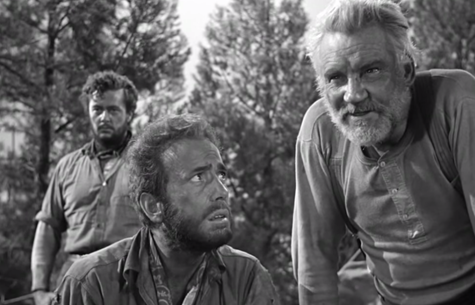
If there’s anything to take away from The Treasure of the Sierra Madre it’s that wealth never satisfies, it only serves to compound our anxieties. John Huston’s film is without question an American classic pure and simple, and it maintains that distinction because it has lost very little of its power to this day. Huston returned from shooting WWII documentaries with this project waiting for him back home. He partnered once more with Humphrey Bogart, and he even cast his father in a role that proved to be the standout in the film. Also, he shot most of Sierra Madre actually on location in Mexico, while also hiring locals as extras. It adds to the gritty realism and it was a trend that was slowly becoming more popular.

His prospecting adventure film with shades of western or even noir follows three men who join forces to prospect for gold in the mountains. They first cross paths in the town of Tampico where they’re strapped for cash and barely scraping even. Fred Dobbs meets Bob Curtin (Tim Holt), who shares a similar predicament and they stick together. Upon hearing the tempting tales of gold and riches from a loquacious old prospector (Walter Huston), he plants an idea in their mind. And with nothing to lose the three partners embark on this grand undertaking.

Humphrey Bogart is undoubtedly our main protagonist. In fact, he had been playing them ever since dropping the supporting roles and donning the fedora of Sam Spade in The Maltese Falcon (his first collaboration with John Huston). But down-on-his-luck, scraggly-faced Fred C. Dobbs is probably one of Bogey’s greatest performances. He’s a sourpuss and a bum, who’s begging for money and telling the local kids pestering him to beat it. These early sequences include a cameo from the director and young Robert Blake. I can also debunk a myth by confirming that Ann Sheridan is not the eye-catching woman walking down the street early on, at least not in this cut of the film.

These early moments set Bogart up in such a way that we feel pity for him, even if we are not completely sold on his moral character. Tim Holt’s Curtin likewise is a sorry fellow, and he’s far more understated which makes us want him to see success. Walter Huston steals his scenes because he fits his part so beautifully. He talks and talks and talks. Laughs, gives sage advice every once in awhile, and does a jig if he feels like it. He’s a completely free-spirit, comfortable in his years, and perhaps a little less invested than the other two. He’s in for the gold, but he realizes the transience of life.

treasureofsierra4

Their journey is plagued by harsh terrain, heat, banditos, and even a nosy fortune hunter from Texas named Cody. But Howard’s premonitions were right and they begin raking in a mother lode. It’s hard work, but it’s coming slowly but surely. This is the key turning point in the film and the keystone to Bogart’s whole performance.

The early warnings of Howard seem all too pertinent now, “Murder’s always lurkin’ about. Partners accusin’ each other of all sorts of crimes. Aw, as long as there’s no find, the noble brotherhood will last, but when the piles of gold begin to grow, that’s when the trouble starts.

And so it does. Dobbs is the perfect embodiment of what avarice does to a man. The paranoia builds up. Friends become foes, everyone is out to get him, and Reason no longer has any presence in his life. First, he wants to turn on Cody, who by all accounts wasn’t a bad fellow. Next, it’s Howard and then Curtin, who once was his closest companion. By the end of the film, “Dobbsie” has been so totally wrecked by greed, he no longer is the same person. In fact, Bogart has a similar trajectory to Gollum except he is not redeemed. The implications here are not simply some conclusion on wealth and gold, but more importantly what it does to the hearts and minds of men.

treasureofsierra3

However, with all the darkness and corruption pulsing through Sierra Madre, there also are some comedic undertones mostly delivered by Walter Huston. In a sense he was the mediator between Curtin and Dobbs, keeping things civil and so when he left them, they were left to their own devices. He also is the one who is able to look at the cruel hand that they are ultimately dealt and laugh it off. Thus, Bogart gave a wholly aberrant performance, Tim Holt was more morally steadfast, and Huston was the standout with his lively turn. Humor and treachery make strange, but thoroughly entertaining bedfellows indeed.

5/5 Stars

Heaven Knows, Mr. Allison (1957)

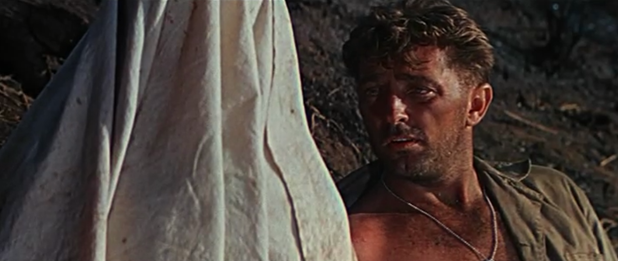
heavenknows3From John Huston comes another film about a woman of principle and a man who seems to be everything she is not. This time instead of Katharine Hepburn and Humphrey Bogart aboard The African Queen in WWI, we have Deborah Kerr and Robert Mitchum stuck on a deserted island together during WWII.

Kerr is Sister Angela who was on the island only a few days with a priest before he passed away. Now she is alone taking care of herself in solitude. That is until castaway Marine Mr. Allison washes up on her shore in a raft. For a time it is just the two of them as the Sister offers the marine food after his long, arduous journey. But after getting rest and some nourishment, he returns the favor proving his resourcefulness at scrounging up food on the island. For a while, they live in relative ease like this.

But they are reminded that the war is still going when the Japanese set up camp on the island. The unlikely pair finds themselves living in a cave together. Allison invades the camp on the sly to acquire food for them, and they continue to manage in hiding. Once the enemy is gone, the exuberant marine gets drunk on some sake and professes his love to the novice nun. Although the situation had never quite been awkward up to that point, it quickly becomes so. Sister Angela, in a tizzy, flees out in the pouring rain and winds up getting sick as a result.

heavenknows5To add to the predicament, the Japanese forces return, and back to the cave, it is. This time Mr. Allison must kill a soldier in order to get a blanket for Sister Angela. Soon the Japanese are burning the underbrush in pursuit of the culprit. It’s dire straights certainly, but then help comes.

Mr. Allison once again proves himself and regains the faith and admiration of Sister Angela. Once the marines roll in Mr. Allison is able to leave the island on a stretcher with the faithful novice by his side. They are a strange pair, but their relationship makes this story actually engaging. In a way, the life of a marine and a nun have some similarities, although they fall at completely different ends of the spectrum. In the same way, Mitchum and Kerr are adept at playing their roles to that degree. Allison is rough around the edges, a Joe Palooka type, and yet he means well. The nun is devoted to her calling, proper, and it never seems as if she could ever approve of Mr. Allison. And yet, in the midst of all the divides that seem in place, a true bond forms. It’s an entertaining relationship and these two stars,  led by John Huston’s direction, made it thoroughly enjoyable.

4/5 Stars

Review: The Killing (1956)

e4855-thekilling1Stanley Kubrick is one of the most acclaimed directors of all time, and The Killing is his first great film. The main focus of the action takes place at a racetrack, but a great deal of the story occurs in other places before and after the job is pulled.  Recently released Johnny (Sterling Hayden) is the mastermind behind an intricately planned job. It’s a whole complex jigsaw puzzle involving a few “Average Joes” and a couple professionals. When you put it together it all adds up to the perfect heist.

Marvin is a friend of Johnny’s and a fatherly figure who is backing the deal. George (Elisha Cook Jr.) is the paranoid window teller banking on the job so he can hold onto his shallow wife. Randy is the policeman who is set to pick up the plunder. Then, Mike is the bartender who is supposed to help with the distraction. Johnny lines up the brawn, Maurice, to start a fight at the race track with Mike. He gets a sharpshooter named Nikki to bump off a horse and it’s all set. All their plans revolve around the Seventh Race, and they have it planned out to the minute. The beauty of The Killing is that it all but works like clockwork. The horse is shot, the brawl does its job, the vault is cleaned out, and the money gets picked up. Only a few small problems crop up.

After the job is done is another matter, as the perfect timetable begins to break down. In a matter of seconds, things blow up thanks to George’s backstabbing wife (Marie Windsor). Soon the carnage is strewn all over the floor. Johnny holds onto the money as previously decided since things go awry, and he makes the getaway. His girl (Colleen Gray) is waiting at the airport and it looks to be smooth sailing from here on out.

Thanks to a yippy dog and a precarious perch, the money-laden suitcase takes a tumble and the contents fly off. All too soon it’s raining money, and there’s nothing Johnny can do about it. He leaves the terminal with Fay, but with no taxi to be had, he gets nabbed and there is no chance to escape. After everything lining up so perfectly for him, in a cruel turn everything that could go wrong did. He was not going to be so lucky.

The title of this film always struck me as ambiguous, whether it meant the amount of money being taken or the deaths that take place I’m not sure. However, I do know that The Killing is tautly constructed. The non-linear and sometimes overlapping narrative is held together by the narrator. He seems fit for a newsreel, but he complements the straightforward procedure of the film with timestamps included.

Because of the lead performance of Sterling Hayden and the main plot element of a heist, this film can sometimes be confused with John Huston’s The Asphalt Jungle (1950). However, I enjoy this storyline more because the heist is not the issue. It is the aftermath and all the subsequent problems occurring so rapidly.

It is a wonderful unraveling thriller and although we do not see Johnny arrested, he might as well be because there are two men with pistols drawn walking right towards him. The Killing was not a big payoff for Hayden’s character, but it certainly is for the audience.

4.5/5 Stars


Key Largo (1948) – Film-Noir

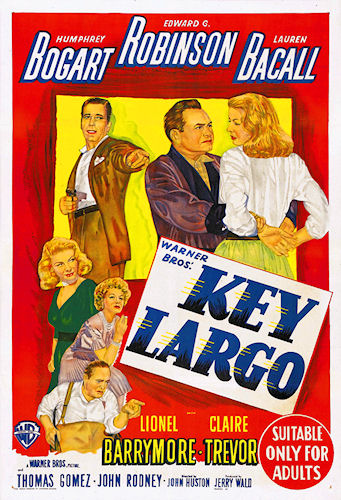
5b446-key_largo432Starring Humphrey Bogart, Edward G. Robinson, Lauren Bacall,  with director John Huston, the film takes place on a sweltering day during the hurricane season. Bogart is passing through Florida to say hello to the relations of a dead war buddy. In the process he and the others at the hotel are held hostage by the mobster Johnny Rocco (Robinson). Bogart seems to back away from conflict but he is only biding his time with the villainous gangster. Through a series of events the war veteran is supposed to pilot the mobsters to Cuba, however he ultimately turns on them and brings justice. This is a fairly good film with Lionel Barrymore, Claire Trevor, and Jay Silverheels in support. It must be mentioned that this was the final film pairing of Bogey and Bacall. Get ready to sweat it out in Key Largo.

4/5 Stars

In honor of Lauren Bacall

The Best Films of John Huston

1. The Maltese Falcon
2. The Treasure of Sierra Madre
3. The African Queen
4. The Man Who Would be King
5. The Asphalt Jungle
6. Key Largo
7. The Misfits
8. Fat City
9. The Dead
10. Chinatown

The Misfits (1961)


The Misfits is a film directed by John Huston and starring the likes of Clark Gable, Marilyn Monroe, Montgomery Clift, Thelma Ritter, and Eli Wallach. The story opens in Texas where a young woman is getting a divorce in Texas with the support of another divorced woman. After she goes through with the proceedings she feels bad but her spirits are lifted by a mechanic and then an aging cowboy who both find her extraordinary. She and the cowboy move into the half-finished home of the widowed handy man on his urging. Rosalyn and Gay slowly become closer and then he resolves to rope some wild mustang for money. Later, they go to a rodeo and meet Gay’s friend Perce who takes part in the dangerous proceedings. After a night on the town, he eventually joins the other two men in their endeavor. However, when they actually begin Rosalyn is horrified by the whole thing. In the end, Gay is back with Rosalyn but not without a great deal of strife over the horses. In many ways this film can be seen as prophetic and it certainly is historically important because it was the last film of both Marilyn Monroe and Clark Gable. Gable looks haggard and Monroe seems highly emotional, possibly hinting at their imminent deaths. Both the acting and the Arthur Miller script were commendable, and I think a good deal of credit has to be given to Eli Wallach and Thelma Ritter for their performances as well.
 
4/5 Stars

The African Queen (1951)

1c3a0-the-african-queen-1With the ultimate pairing of Humphrey Bogart and Katharine Hepburn, this film throws together two starkly different people in extraordinary circumstances. Hepburn is a prim and proper missionary in Africa whose brother dies after a confrontation with German soldiers. Bogart is the rough-edged pilot of an old steamboat christened The African Queen. Together they take on the dangerous task of going down the river in order to sink a German ship. At first they are both at odds with each other and struggle to cope with their situation. However, with no one else to turn to, over time, they become close. Their bond is so great that they are willing to die rather than to be separated. This is truly a heartwarming story of love and loyalty with two legends who literally light up the screen.

5/5 Stars