Never Give a Sucker an Even Break (1941): W.C. Fields and Gloria Jean

Screenshot 2020-07-07 at 9.13.35 PM

“Do you think he drinks?”

“He didn’t get that nose from playing ping pong.”

Self-reflexive metanarratives have the capacity of dissecting celebrity and playing with personas. Such a context is ripe with possibility and so when we find ourselves on a studio lot with W.C. Fields eyeing the a big billboard for The Bank Dick, we know we just might be in for something. It came out the year prior, a critical darling and a commercial flop. He’s looking to pitch the follow-up to his producer.

He is under employment at Esoteric Pictures. His niece in the picture, real-life songstress Gloria Jean, plays a young ingenue out of the cut of Garland or Durbin. They are the film’s affable nucleus.

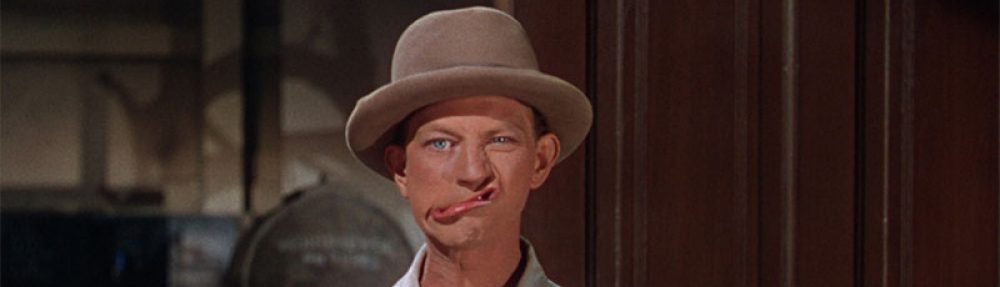
W.C. Fields is a picture of his usual self with his protruding proboscis and that straw hat of his as battered as ever. There’s the way he casually mumbles away at dialogue. It falls offhand and unrehearsed. You can almost lose it. Some of the garbled gook he gets out only makes it to your ears after he’s said it, and your mind has time enough to catch up.

Meanwhile, a typically huffy Franklin Pangborn with his stringy hair tries to command the unremittent chaos of the studio sets to get Gloria Jean to perfect her latest song, one of those high-pitched operatic numbers out of yesteryear. He’s already in a unstable mood when Fields pays him a call.

The script Fields is pitching becomes the premise for the movie itself as he darts in and out of scenes that might as well have no relation to one another aside from featuring Fields and Gloria Jean.

They start on an airplane together to some unknown destination. They might as well be waiting for Godot. He goes free-falling through space in pursuit of a bottle of spirits only to end up trampolining into the stratosphere of a pretty maiden from an oblivious world. Margaret Dumont is her imperious mother Mrs. Hemoglobin leading a great dane by the leash like some bleak Amazonian woman.

Fields, who penned the script under one of his many aliases, pushes the boundaries farther than he’s ever gone before, and it’s spectacular and surreal if this is what creative control looks like. It’s not as out and out funny as some other Fields movies, but it’s giving itself over in its totality to this absurd rhythm which is quite extraordinary to watch. He throws himself over a cliff in a basket only for Pangborn to loudly protest. The story lacks continuity! It’s an insult to human intelligence!

Is it too obvious to read it as a commentary on a career of movies and studios and such? I think not. Because W.C. Fields films were never the most tensely plotted, tightly constructed gems. He built his career out of ad-libs and performance, not so much the written word. Not that he didn’t come alive with verbal wit of his own accord and this was his gift.
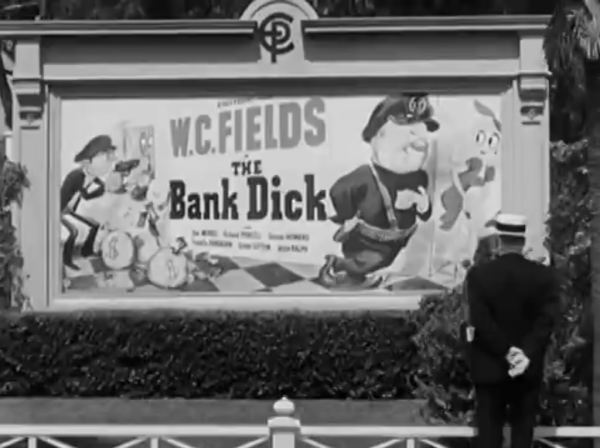
never give a sucker an even break bank dick billboard

But he was never made for the strictures of the industry, and so it’s fascinating to watch him when the restraints come flying off, and he’s got his run of the candy store so to speak. In fact, he rebels against conventional plot to the point of totally pulling it apart in front of us and tossing it away as collateral damage.

There is absolutely no pretense here. It’s even less about fast and free gags and bits being assembled together. It’s given itself over fully to surrealist feats of cinematic fancy. It might leave some befuddled now as it did then, but one can gather some sense of the performer. It suggest so much about him implicitly that still needs to be parsed through.

With the real-life context, it shows the decline of W.C. Fields who was quietly ditched for other more agreeable talent, especially because Never Give a Sucker… was hardly going to woo the audiences. Not in 1941. It was of that rarefied breed we often far too easily label “Ahead of its Time.” Here it seems pertinent.

The final set piece is an eye-popping death defying car chase to the maternity hospital. It feels like a flashback to the heyday of Keaton or Lloyd. It’s the most purely comedic slapdash moment in the picture, and does it fit with the rest of the movie? Not by a long shot, but somehow it remains a capstone for something that is totally of its own form and function. It’s almost obligatory. Here the career of W.C. Fields quietly came to an end. This was his final opus to hang his reputation on for future generations.

Doing a bit of perfunctory research, Fields was game to make another such picture with Gloria Jean and some of his favorite stock players. The studio wasn’t about to have it, and his own health was at the detriment of his drinking habit, lampooned as it might have been. W.C. Fields is one of the more irascible classic comedians to be able to pin down. But his comedy at its core does seem to get at a central human longing. It was always him against the world. He took it as well as dishing it out.

gloria jean

Maybe it’s only a small reward and too little too late, but I think even Fields understood the significance of Gloria Jean being in his corner unreservedly. Yes, it’s mawkish in the kind of Hollywood tripe sort of way, but secretly it also feels like a healing balm to the Fields character.

At last he can have some kind of peace. At last there is someone who will accept him unconditionally for who he is. My hope is that Fields experienced some of that in life as he did in his final major screen role. That’s not for me to know. All I know is that we all crave love; we all crave relief.

Fields wanted the film to be titled “The Great Man.” We can read it as jest or a bit of self-congratulatory pomp. But I think this is inside all of us veiled by insecurities. For people to see past our flaws. We want kids to look up to us and see us as what we aspire to be and not as the damaged goods we actually are. Gloria Jean extends her uncle such an honor as she smiles into the camera one last time. He is known and loved. To her he is a great man.

3.5/5 Stars

Review: Animal Crackers (1930)

animal crackers 1.png

Animal Crackers usually makes me think of the soggy little critters floating in Shirley Temple’s soup but the joke’s on me because that tune didn’t come out until 5 years after this film. In fact, legend has it that Harpo purportedly offered Temple’s parents $50,000 to adopt her when they walked by the studio.  That was before she was famous. Imagine what his price might have been afterward. But I digress.

This is the second of The Marx Brothers’ stage adaptations and there’s no hiding its origins. It’s very flat and confined as far as cinematic ambitions go but the same can be hardly be said of the Brothers themselves.

The plot involves a small trifle about a party put on by one Mrs. Rittenhouse (Margaret Dumont) for the intrepid African Explorer Captain Spaulding (Groucho). She is preparing to unveil a priceless masterpiece christened “After the Hunt.” This character set up would be common practice in later films becoming a type of shorthand in itself. Dumont was normally a wealthy socialite humoring Groucho and showering him with accolades. Not to be outdone Groucho would shower her with insults.

But he gets a particularly effusive introduction in Animal Crackers with “Hooray for Captain Spaulding.” Learning something from Cocoanuts the opening musical number integrates Groucho into the song and lets him make an extended charade out of all the pomp and circumstance. It would be followed by comparable numbers in Horse Feathers (1933) and Duck Soup (1933).

Though not as effusive, Chico and Harpo also get a warm welcome playing the parts of Revelli and The Professor respectively. Their gags are rampant, their anarchy as cheeky as ever, and there’s little to no respect for the plotline they find themselves in or the people who fill the spaces around them. That’s simply how they operate.

Groucho begins by picking up a full head of steam and taking off for minutes at a time with a steady stream of verbal soliloquies of lowbrow wit that gives any modern comic a run for their money. Stop me if heard this one. The most iconic involves shooting an elephant in his pajamas and Alabama where the Tuscaloosa…

Not to be outdone Harpo chases after girls incessantly, cheats at Bridge thanks to a sleeve full of Aces, and not only runs off with each version of “After the Hunt” but purloins the silverware for good measure. Meanwhile, Groucho continues to cut down his costars, foremost among them Dumont who would be his verbal punching bag time and time again. But let it be known that no one’s safe. Only Chico seems capable of upending him with his pure stupidity. Then, Harpo just can’t say anything to Groucho. They work great together.

Chico busts the guests’ ears with his idiosyncratic brand of piano playing and Harpo earns his moniker plucking his strings. And to be honest, these are the moments that I have the most difficulty enjoying. Like the musical numbers, sans “Hooray for Captain Spaulding,” these elements feel as if they are set in their era. But when the Brothers get together in a room and the wheels come off in any number of ways, those are the moments where you can’t help but smirk — you can’t help but marvel at the sheer ferocity of their comedy that still feels so alive even today.

So while this picture is much more a stage production than a film, that cannot neutralize the gags which ultimately bodes well for the pictures yet to come, maintaining the chaos but providing room to grow and mature into the transcendent qualities of A Night at the Opera (1935) for instance.

On a side note, my heart always goes out to Zeppo who was reputedly so funny in private life and nevertheless donned his typical straight man role that as expected gets completely overshadowed by his brothers. This is most obviously Groucho’s picture.

However, that’s not to underplay Harpo and Chico with their many talents.  Their constant fits of delinquency are crucial to the comedy. No better example than Harpo pulling at a Flit Gun and proceeding to gas the entire drawing room before committing suicide as it were and dropping next to his sleeping beauty.

3.5/5 Stars


Cocoanuts (1929)

the cocoanuts 3.png

“Did anyone ever tell you that you look like the Prince of Wales?” ~ Kay Francis, Chico, and Groucho.

The Marx Brothers were modern comedians. Out of Groucho Marx alone, there are numerous comics spawned and basking in his incomparable shadow. When certain jokes come out you can all but tip your hat to him. But also Chico and Harpo had their own personas and they worked with each other to simultaneously set up different bits and turn those bits into pandemonium that have overtaken the world with laughter over and over again.

And that’s not over one film or with one studio but over a whole host of projects. For all I know, Harpo Marx went through life mute (I Love Lucy cameos don’t tell me any different) and Chico really did use that accent of his. Even Groucho who was arguably the most visible thanks to You Bet Your Life, What’s My Line, and memorable Dick Cavett interviews, though he lost the greasepaint mustache and eyebrows, still maintained much the same witty image his entire life.

Playing purely the numbers game most comedy teams are duos. Think of most of the great ones. But the Marx Brothers had three and even four when Zeppo was around. They were all family. So when this well-oiled mechanism of chaos is released it really does a number on people. They were known for overwhelming producers in real life with their antics and they do precisely the same thing to each individual audience member who watches them onscreen — at least the ones who don’t mind being railroaded a little. That is their lasting impact.

The fact Cocoanuts was their first film and from the 1920s makes more an impression on my mind. Because talking pictures hadn’t been around for all that long. Sure, some of their gags could have been retroactively transferred to the silent cinema but in many ways, the talkies suited them just fine. After all, they were a vaudeville act and The Cocoanuts was a success on the stage before it was a film. Even during filming, they were already at work on their latest production Animal Crackers (which would again become a film the following year).

Where does that leave us? Looking at The Cocoanuts today, it definitely is stagey because well, it came from a stage play. Furthermore, it’s a rather odd combination having Irving Berlin and The Marx Brothers names attached to the film. Given the main attraction, there’s probably too much singing anyways although the overhead shots soon accredited to Busby Berkeley are quite prominent here.

If we turn our attention to the opening moment, Groucho is on the staircase of the Hotel de Cocoanut giving his restless bellboys some wise words full of crap about money. Meanwhile, a seductive woman (Kay Francis) and her suitor look to steal the priceless necklace of one of the few vacationers (Margaret Dumont) and pin the crime on someone else for their own nefarious purposes. This might not be a criticism you hear often but there’s too much plot and not enough Marx Brothers.

cocoanuts 2.png

Let’s cut right to the best gags. There’s the adjoining room & slamming door gag which provides one of the most pointed moments where the boys are all working seamlessly together to promote chaos on celluloid.

Groucho and Chico have one of their bits over a map and linguistic disconnect that Groucho riddles with his puns and Chico then decimates with his miscomprehension of English vernacular (Most famously Viaduct becomes Why a duck?). Watch it if you don’t understand what that means. In Marx Brothers terms it’s probably poetry in motion.

There’s an auction, termed a big swindle by Groucho but even with Chico’s involvement in the chicanery, for some unknowable reason, they don’t seem to be making any money. Finally, Groucho and Harpo play Tic Tac Toe on a man’s chest and act boorish at a dinner party before running off for the plot’s real finale. Let’s face it. The picture ended right when they left the stage.

The improv and dynamic nature of the Brothers given their vaudeville roots makes me realize just how much their shows would have been blessed by repeated performances and the heat of the moment. Though we can’t have that luxury at least we have this film to remember those hoodlums who elevated the art form of anarchy and wisecracking to new heights.

3.5/5 Stars

Review: A Night at the Opera (1935)

ANATOcontract“That’s in every contract, that’s what you call a sanity clause.” – Groucho

“You can’t a fool a me there ain’t no sanity clause” – Chico

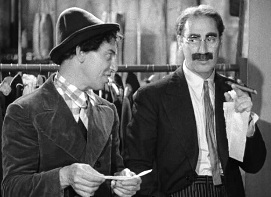
The Marx Brothers had a set formula, where everyone else played the drama straight and they did whatever they wanted. So essentially there is no formula, lending itself to the anarchic comedy that they will be forever known for. However, if you put A Night at the Opera up against there earlier work at Paramount (this was their first film with MGM), you can see some important changes. Wunderkind Irving Thalberg wanted to give their films a more concrete plot line and in an effort to make them more sympathetic figures, all their antics were aimed at obvious “villains,” while they helped those who needed help. In this case, it was the aspiring opera star Rosa (Kitty Carlisle) and her beau Ricardo (Allan Jones), who get a helping hand from the boys.

This restructuring worked out because although the film plays out dramatically under the direction of Sam Wood, the Marx Brothers are still up to their old tricks, pulling off the same stunts that they used to. In fact, A Night at the Opera would be a very boring operatic drama by itself. Some of the interludes including song and dance are rather dull even in their extravagance. But Chico, Harpo, and Groucho inject the film with their brand of comedy that is difficult to top.

Groucho’s quips are aimed once more at the oft-abused Margaret Dumont. And then Harpo and Chico help befuddle the conceited opera star Lasparri, an Opera Company magnate (Sig Ruman), and the police among others.

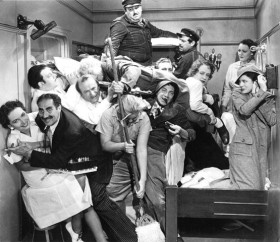
ANightattheOperaStateroomThe film borrows the stowaway storyline from Monkey Business (1931) so the brothers and their friend  Ricardo can follow the opera to New York. This lends itself to the now iconic stateroom scene where a total of 15 individuals are crammed together into Groucho’s tiny ocean liner abode.

Earlier on Chico and Groucho have fun drawing up and ripping apart a contract for their new partnership (including the famed Sanity Clause at the end). It ends up that the three fugitives are on the run from the authorities and Groucho is thrown out of his job finally.

But everything culminates at the opening performance at the opera and the Brothers are in high form. Chico and Harpo invade the orchestra pit, insert “Take Me Out the Ballgame” into the arrangement, and join the cast as a pair of gypsies. Meanwhile, Groucho delivers his usual quips from the box above, much to the dismay of all the patrons. To top it off, Harpo goes swinging up above the performance making a shambles of Lasparri’s big night, and Rosa and Ricardo are able to win over the audience. But it goes without saying, it’s the Marx Brother’s who steal the show. Groucho is as rude as ever. Harpo is always ready to knock someone out, and Chico is just waiting to join in on the ruckus. It’s comic mayhem at its apex.

4.5/5 Stars

A Day at the Races (1937)

Starring The Marx Brothers, the film begins with a pretty young lady who owns a sanitarium near a racetrack. In danger of closing, she brings in a new doctor named Hackenbush (who specializes in horses) and at the same time her love buys a race horse. A powerful man wants the place closed down so he can build a casino and he is in cahoots with the financial adviser  a wily woman, and the police. However, wanting to help the two lovebirds out, Groucho, Chico, and Harpo lend a wild helping hand. It all culminates with an uproarious Day at the Races. This film is full of funny moments such as the code book sequence, the dinner and wall papering scene, the medical exam, and of course the final race. I felt that a lot of the music was an unnecessary added feature.

4/5 Stars

Animal Crackers (1930)

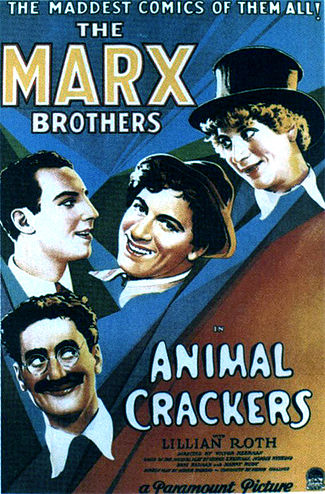
efe9f-the_marx_brothers_animal_crackers_film_posterHeaded by the four Marx Brothers, the film opens with the return of the famous African explorer Captain Jeffrey Spaulding (Groucho), who is being honored at the estate of a Mrs. Rittenhouse (Margaret Dumont). Along with him there are two musicians (Chico and Harpo), and an art lover with an especially extraordinary painting in his possession. The daughter of the hostess is in love with a young, aspiring artist. She enlists the help of the two musicians to replace the painting with a fake done by her beau. However, they are not the only ones with an interest in the masterpiece and mayhem ensues. In the end all is revealed and everything works itself out. Besides some famous Groucho quips about his travels, there is “the flash” sequence, several musical numbers, and the final scene with the insecticide gun. As always the brothers deliver the chaotic and pun laden humor they gained notoriety for.

4/5 Stars