The Clock (1945)

the clock 1

May 25th, 1945. That’s when The Clock was originally released. To save you doing all the mental calculations V-E Day was on Tuesday, May 8th and the folks at home were ready for the war to be over. So in such an environment, this is hardly a war film and it can’t even claim to be a post-war picture like The Best Years of Our Lives (1946). It’s floating in limbo.

This is the story of a fresh-faced soldier boy in the big city (Robert Walker) constantly craning his neck in awe of skyscrapers and cowering a little bit under the weight of them all. As such he’s constantly being bumped into, like a tourist perpetually lost. From such a moment springs an almost unforgivable meet-cute we can spy from a mile away. She trips over him and loses a heel.

But our stars are winsome and their persons genuine in nature in the days when that was unequivocally so. Corporal Joe Allen (Walker) proves to be to New York City what Mr. Smith was to Washington D.C. He even rides the very same sightseeing bus. He’s also a bit of an idealistic builder not unlike George Bailey.

The soldier and the gal he asks to follow a piece, end up taking a Central Park stroll together followed by a tour of the local art museum, taking a load off, butt up against an Egyptian sphinx. There’s something inherently refreshing about its meandering wanderings through New York City. It gives this illusion of circumstance where there is no clear-cut agenda. In a moment of decision, he goes pell-mell chasing after her bus because he knows something special is onboard and he sets up a date just like that.

Vincente Minnelli is looking out for his heroine as Judy Garland was his own new romantic interest but his camera setups also reflect a stewardship over the contents of the film with his usual array of fluid shots. Far from just taking care of Garland you always get a sense Minnelli is watching out for all his actors with his camera often walking alongside them. She proves to be a fine performer sans singing and although long remembered for Strangers on a Train (1951) and his tumultuous personal life, Robert Walker undoubtedly exudes a naive candor of his own.

It’s always striking how Hollywood was able to cast a certain vision of the every day while reality was oftentimes so different. One aspect of that was the wartime shortages which made shooting on location highly impractical so everything from train stations to exteriors were created on the MGM lot to closely mirror their real-life counterparts and it, for the most part, takes very well. We feel like we are traveling through the big city with a soldier and a gal. At any rate, the city crowds feel realistically suffocating.

But beyond the simple (or not so simple) realm of sound stages and set design it also extends to the actors themselves. Robert Walker who played opposite his wife in the epic home front drama Since You Went Away (1944), had a horrid time getting through the picture as their marriage was on the rocks.

By the time he got to The Clock he had been overtaken by alcohol addiction and Jennifer Jones was all but on the way to marrying executive David O. Selznick. Judy Garland on her part, that shining beacon of traditional Americana was struggling with an addiction of her own and after some creative differences with Fred Zinnemann, she had her soon-to-be husband Vincente Minnelli brought on to revitalize the production.

In these ways, it becomes obvious how there’s almost a conflicting double life going on in front of and behind the camera and yet there’s no doubting that this picture is brimming with sincerity whether partially made up or perfectly simulated. It still works.

You can undoubtedly see the same fascination with the very conversations and interactions that make up a relationship in everyday environments. The walking and talking we do when we share time together. The silly things we get caught up on or pop into our heads on a whim. And yes, there is a bit of Before Sunrise (1995) and Before Sunset (2004) in Minnelli’s picture for those who wish to draw the parallels but the beauty of it is The Clock is obviously not trying to be anything else. It takes simple joy in its story and the characters it holds in its stead.

It’s a film that dares have a scene where our two leads sit in a park, silent for a solitary moment as they listen to the street noise emanating from the city center and breaking into their tranquility. Take another extended sequence where the two lovebirds catch a ride on a midnight milk wagon driven by that perennial favorite James Gleason.

He’s the local milkman waiting impatiently for his request on the late night radio station and intent on some company along the route. But a flat tire puts him out of commission only to bring about another inspired piece of casting. Keenan Wynn as a drunk appears for mere minutes and earns high billing in the picture. It’s worth it. When our stars are allowed to sink into the periphery, the accents of the real world come into focus.

It’s equally true that those are the exact moments where you see the extent of another person’s character. Because it’s not simply the two of you but you get the opportunity to see them in a context with other people and that’s often very telling about who they are. Depending on the perceptions it can make you fall even more in love with someone and seeing as these two individuals help their new friend with his milk run, you can just imagine what it does for their relationship.

As for James Gleason and Lucille Gleason, they make the quintessential cute old couple and that’s because they truly are spinning their wisdom and bickering like only the most steadfast wedded folks do. The last leg of the film is when it goes for drama turning into a literal race against the clock bookended by one of the most distinct courthouse weddings ever captured. But even this picture doesn’t end there. Further still, it sinks back into this odd shadowland between the drama and the happy ending.

We could venture a guess it settles in on a realistic denouement where life isn’t always as we would like it but we can still love people deeply and do not regret the decisions we have made. As we walk off into the crowd with Judy Garland there is little to no regret only a faint hope for a future and assurance in the institution of marriage as something worth pursuing.

They are traditional values and yet, in this context, there’s something comforting about them. Minnelli has spun his magic on us even as the cinematic in its so-called reality slowly drifts away from the Hollywood marital standards of its stars. It’s both an idealized vision and a genuine one.

4/5 Stars
For Me and My Gal (1942)

for me and my gal 1

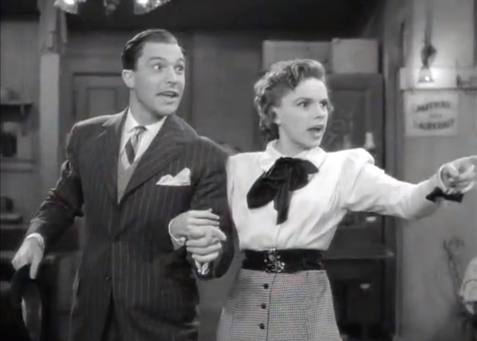
Here is a good old-fashioned American musical that effectively acts as an homage to the vaudevillian circuit that saw many performers realize their talents including numerous future Hollywood icons. At the core is a musical dream team in Judy Garland and Gene Kelly.

Behind the camera is the much revered Busby Berkeley who made musicals into gargantuan extravaganzas thanks to how he managed to capture human forms from above like no one before him. Ironically, here he’s working in a somewhat more conventional and dare I say, informal setting where we get to share the mundane spaces with our stars.

Kelly is Harry Palmer, a man who makes a living clowning around on stage. The arm spinning pirouettes and the athletic moves that defined his style of hoofing are obvious from the outset as are his infectious charm and winning smile. He’s still in the latent stages of his genius but that’s okay. There’s still time.

Judy Garland at this point in her career already had sizable stardom and it was Kelly the Broadway up-and-comer featured in his film debut. But in the ensuing decade, there was no doubt about it whatsoever. They both became quintessential musical stars of a generation along with a select few.

Jo Hayden (Garland) is a song and dance gal who while not having made “The Big Time” yet, still has a noticeable amount of talent. She partners with the good-natured Jimmy Metcalf (George Murphy) who harbors an obvious crush on her. She thinks he’s sweet.

Harry Palmer on the other hand, always seems to be making a fool of himself. A genuine person like her can see right through his come-ons. While her gangly brother (Richard Quine) agrees to finish up his med school, Jo is following her ambitions to get somewhere. She subsequently realizes she does have a bit of chemistry with Palmer on stage after an impromptu performance, if not for the fact that she is already a part of an act.

Jimmy does the noble thing and lets her go as they all have their sights on the Palace Theater in New York City.  You see, it’s the holy grail for vaudeville performers. It means you’ve made it. Palmer is ecstatic when he meets a singer (Martha Eggerth) who already performs there, thinking she might be his in. But he remains true to what he has going with Jo. Still, time and time again they’re playing small towns and their aspirations never seem in reach.

Even when it is right there in front of them and their manager (Keenan Wynn) has seemingly pulled through, Harry is torn up to find that he’s been drafted to head over to France to help the doughboys in putting the Kaiser to rest. He’s no draft dodger but he wants his dream so much and they are so close to being realized. He takes a plan of action that Jo misconstrues as cowardice. She’s ashamed that he would do such a thing especially since her brother is overseas fighting already.

Thankfully that is not the final word. Life sometimes has a curious way of bringing people back together and in the case of this cinematic world, we get a cheering finale courtesy of the MGM dream factory. While For Me and My Gal revels in its star power and the intimate chemistry built between them on the stage and in dressing rooms or in train compartments, we are soon reminded that this film has an ulterior motive. It’s a musical, it’s a romance, but it’s also a product of the American homefront.

Like a Sergeant York (1941) or a Yankee Doodle Dandy (1942) this effort was made with a higher purpose to act as a kindling rallying cry for nationalistic fervor going into WWII. However, just like its contemporaries, the reason we’re still watching it today isn’t necessarily due to those aspirations but the emotional connection elicited from its stars. This is what makes For Me and My Gal truly swell with sentiment. Thankfully Judy Garland and Gene Kelly got together on two more musical efforts to keep it going. Because they help elevate this above the spectrum of a run-of-the-mill propaganda musical with their palpable charisma that transcends any maudlin patches.

4/5 Stars

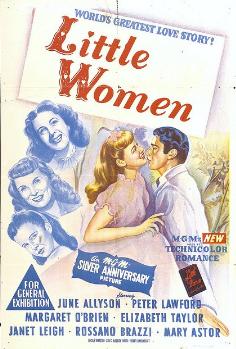
Little Women (1949)

Littlewomen1949movieposter.jpgIn the recent days, I gained a new appreciation of June Allyson as a screen talent and in her own way she pulls off Jo March quite well though it’s needlessly difficult to begin comparing her with Katharine Hepburn or Winona Ryder.
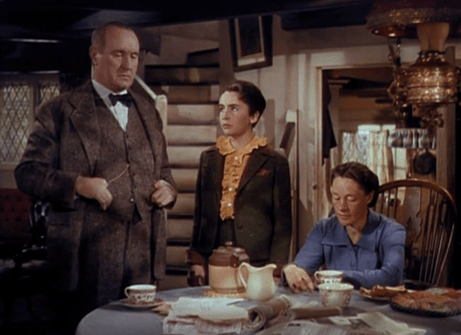
Meanwhile, Mervyn LeRoy was a capable director of many quality films and it’s difficult to say anything damaging about this one because no matter the amount of mawkishness, it’s all heart to the very last frame.

If possible to imagine, this cast is even more star-studded than the 1933 adaptation and yet still somehow the casting just doesn’t seem quite right. In the Katharine Hepburn anchored cast every character was almost perfectly wrought and they felt like an impeccable ensemble.

Somehow here you have the varying personalities rubbing up against each other and it doesn’t feel like this is the March Family as much as this is June Allyson, this is Elizabeth Taylor, this is Janet Leigh, and Margaret O’Brien. Their beloved Marmee being played by none other than Mary Astor. They’re all fine actresses with esteemed Hollywood careers in their own rights but as a family, the dynamic is slightly off.

Of all the names attached, Elizabeth Taylor feels the most at odds with the material, not that she couldn’t play these types of sincere characters — she did it in Jane Eyre (1943) and National Velvet (1944) — but she’s nearly past that stage of being cute and now simply comes off as a bit of a snob. If I know anything about the character Amy (which I may not) she’s hardly that.

This is also far from Janet Leigh’s best role as she all but disappears into the background because there’s this underlining sense that Jo is the oldest sister here (due to Allyson’s obvious age advantage over Leigh) and so with that subtext Meg loses a great deal of her quiet strength as the perceived eldest sister. Because that means she’s hardly the one that the others look up to due to her age. She’s just the noble one while Jo is the free spirit hurtling over fences and throwing snowballs. Thus, the order of sisters really does matter for the full integrity of the narrative.

Come to think of it, the other obvious departure in the film is the development of Beth as the youngest March girl which gave Margaret O’Brien the opportunity to play her and she does a fine job at stirring the heartstrings with her timid solemnity but another dynamic gets altered in the process. I also wasn’t sure what I would have to say about Peter Lawford as Laurie and yet he does a commendable job as does the stately mustachioed C. Aubrey Smith.

It’s fascinating how the same story with at times almost verbatim dialogue can give you a completely different sense of the characters. Because it’s true that this version borrowed much as far as dialogue from the 1933 version. Thus, the scenes are all but the same with slight alterations to the opening and such, but the results are starkly different.

The same goes for the setting or rather the tones of the sets. Though the colored pictorials are glorious and lend a real jovial nature to everything also helping to make this Little Women adaptation a shoe-in for annual yuletide viewing, some stories just are not made for that treatment. It’s no detriment to this film whatsoever but there’s something about the original black and white that evokes the nostalgic aura of tintypes and antebellum photography in a way that this one simply cannot. Little Women seems like such a story.

Of course, that’s only my opinion and it could very easily be the case that someone else’s conception of the March family is very different than my own. That’s part of the fascination with novels and their adaptations. Despite our best efforts, or maybe because of them, they all turn out vastly different. It’s probably for the best.

3.5/5 Stars

National Velvet (1944)

national velvet 1

“Everyone should have a chance at a breathtaking piece of folly, once in his life.” ~ Anne Revere as Mrs. Brown

There’s been many a boxing and a ball sport movie and so it seems only fair that there be room for at least one more Technicolor horse drama, especially one with the breathtaking and gloriously unbridled energy of National Velvet.

It showcases the lofty aspirations riding on the back of a horse and carrying the effervescent hopes of a young girl. I’m certain we could use more movies like this — ones done with this amount of candor and geared toward a broad audience — namely the entire family.

True, Clarence Brown is a director mostly lost to time and perhaps understandably so. This isn’t so much of a technical marvel as it is a story that wraps up its audience with some amount of vigor.

Nor was it a film shot abroad in some exotic location. But that is hardly a criticism, mind you. This was Hollywood’s rendition of the British Isles created in Pebble Beach, California much in the same category of other such period classics like How Green Was My Valley (1941) and Lassie Come Home (1943) — the most obvious point of connection being the always admirable Donald Crisp.

Featured front and center is Elizabeth Taylor in the days when she hadn’t yet been propelled to iconic sex symbol status and still remained the sweet precocious little girl who made the screen sparkle with her adorableness.

Here she is as Velvet Brown. Other girls, namely her big sister (Angela Lansbury) are boy struck but Velvet can best be described as horse struck. She dreams about them in her sleep, thinks about them in her waking hours, and must stop the moment she sees one of her favorite thoroughbreds in the fields on the road home to her town of Sewells.

From the first time she sees “The Pie” in all his majesty, she’s absolutely enchanted by him. It was a love story meant to be. Stirred up by her mother’s own past forays in sport, Velvet begins to entertain thoughts of entering her beloved horse in the Grand Nationals which she believes he is capable of winning with the right training and a rider who knows him.

With the guidance of Mi (Mickey Rooney), a young nomad hired on by the family, they get the horse trained up for competition. But of course, the only one who truly can ride “The Pie” and believes he cannot put a foot wrong is Velvet herself.

Perhaps it’s not as epic as a Ben Hur chariot race or a pod race but there’s still somehow such investment in Velvet and her horse and we feel the same urgency that’s coursing through Mi as he’s watching the race. It’s an infectious moment that catches us up in its swelling emotions to the very last leg.

Far more important than the outcome of the race, however, is how Velvet remains true what she deems to be right. She never lets her pure love of horses — or this particular horse — be muddied by any amount of press or potential fame that might come out of the partnership. Because she’s not seeking any of that. Her intentions are very sincere. She’s doing it all for the sheer joy of getting to gallop across country with her best friend. That’s reward enough for her.

It’s true that Velvet’s parents prove to constantly upend our typical expectations and there’s a pleasure in finding out more about their true character bit by bit. They are folks of hardy stock who are plain but not without their unostentatious charm that comes from being bred in a world of hard work and no doubt Christian charity.

Anne Revere gives one of the most enjoyable performances of her career, start to finish, imbued with an impeccably dry wit that also comes with being a mother who loves her family dearly and aspires for them to have hopes and dreams to carry them through life. You get a sense that she desires they might be decent people who never weary of doing the right thing. There’s a sublime nuance to her turn that would be lacking from the film’s frames otherwise. She is the moral heartbeat and the counterbalance to every other character.

Fiction also mirrored reality in that Elizabeth Taylor truly became the tenderhearted horse whisperer as one of the few people who could actually handle and ride her horse. There’s no sense of parlor tricks and if it’s possible to say this, there’s almost a visible chemistry between her and her steed. They seem meant to be together. Fittingly, on her 13th birthday after the filming was done she was bequeathed her four-legged friend and they remained together for his entire lifetime.

The only rather odd performance or casting choice might seem to be Mickey Rooney who was still a major star in 1944 but sometimes his role doesn’t feel the most authentic. It feels like he’s playing at his part. Meanwhile, Taylor continually bowls us over with every drop of cheerfulness she has in her being.

Maybe I am unfairly prejudiced against Mickey Rooney but he always seemed more like a personality than a true actor. Here as Mi he more or less looks like a tragic story waiting to happen but now thanks to a girl and a horse, he’s getting his shot at redemption. Thankfully for us, this is not wholly his story but more so the story of the horse and its girl.

It’s a wonderfully forward-thinking message for its day that a young girl with ambition can succeed in a man’s world even on the racetrack. Fantasy or not this is a story that uplifts with sheer climactic euphoria.

To all the future teachers, doctors, lawyers, explorers, scientists, and jockeys, this film gives its message loud and clear. Dare to dream. You can’t worry about what others might say. Just go out and pursue whatever it is with all the passion you can muster. No matter the outcome, there will be little to regret.

4/5 Stars

Forbidden Planet (1956)

Forbiddenplanetposter.jpgWe’re all part monsters in our subconscious. ~ Leslie Nielsen as Commander Adams

I couldn’t help but recall Han Solo’s line about the Millenium Falcon in the original Star Wars in response to Luke’s derision. After giving his pride and joy an affectionate pat he defends her reputation like so, “She may not look like much but she’s got it where it counts.”

It seems fitting that the line is used to commend Forbidden Planet because this is the film that in many ways made science fiction what it is today. It’s almost too easy to trace the line from this film to the likes of Star Wars and Star Trek and a plethora of others. But today we’re so used to the canonical worlds of established sci-fi that Forbidden Planet might come off as quaint and a bit outmoded. Still, the film has it where it counts even today.

Forbidden Planet was also unprecedented in its day because this was no B-picture. This was A-grade entertainment and that was almost unheard of at the time for science fiction, a historically low budget genre. Leslie Nielsen is given his first starring role while Walter Pidgeon plays the scientist who greets the explorers on the surface of the planet that they were sent to investigate.

But the band of expeditioners who came before them was all but decimated by some unknown force leaving only Dr. Morbius alive (Pidgeon) along with his pretty daughter Altaira (Anne Francis) who has no grasp of what life on earth is like. Commander Adams (Nielsen) is intent on staying on the planet until receiving further instructions from earth.

Still, something doesn’t sit right. There’s something off about Altair IV. A silent, invisible adversary is oftentimes more engaging than a visual one especially when it dwells very close to home and that’s precisely what presents itself moment by moment as the narrative progresses.

From their very first touchdown, this is an incredibly eery picture which manages to carry the audience’s attention for a great deal of the movie. In fact, if this was Star Wars they would have said, “I have a bad feeling about this” at least a couple times. But equally crucial is the subsequent development of the landscape around us that’s at times utterly entrancing.

The key to the film is that everyone plays it straight and serious and in this particular case it doesn’t come off as camp. There’s a gravity to it all that’s mesmerizing even in its bits of antiquity because the world is full of grand endeavors in creativity.

The electronic instrumentation provides what is purported to be the cinematic world’s first fully atonal electric score and even today each note is unnerving to the core. Whereas the theremin has somehow entered into the realm of parody these notes still seem resonant and they perform far better than any traditional score might have in the same circumstances.

At times Forbidden Planet showcases a very simple, even austere mise en scene and other times expands to almost labyrinthian proportions. The sweeping palette photographed in Eastmancolor with CinemaScope certainly adds to its allure straight out of the 1950s while still managing to take cues from stories from centuries prior, Shakespeare’s The Tempest, being the most obvious inspiration.

While not necessarily prophetic or correct in all its assertions about space travel (as far as we can possibly know) there’s a commitment to the world and a specificity to its inner workings that makes the Forbidden Planet into a fairly immersive place — a world alternative to our own that we are able to explore and I think that’s part of its unique status as a pioneering film. Because now we are so used to worldmaking and fantasies outside the realm of Earth whether it be Star Wars or Lord of the Rings or Harry Potter.

Here we see it too but it comes out of a time where most stories were human stories planted on earth or at the very least had the semblance of the reality that we know to be true here. And yet here was a narrative that dared transplant our human shortcomings to the other end of the universe in an entirely different paradigm while showing how man is his fallen nature can still make a mess of life even there. It’s a fairly powerful statement full of human psychology as much as it is about conquering new frontiers.

Robby the Robot (designed by Robert Kinoshita and the team at MGM) stands as a landmark among cinematic robots since he is his own entity as a standalone character. Far from turning on man, he’s about as useful as we might possibly think — even creating gallons of whiskey for the thirsty cook (Earl Holliman). The film was also a trendsetter in describing space travel in increments of light while miniskirts far from being a thing of the future still made a splash with 50s audiences as worn so provocatively by Anne Francis.

Through its final credits, Forbidden Planet is a special picture and that uniqueness goes far beyond its rightful place as one of the seminal explorations in science-fiction. The only thing left to say seems to be despite the iconic nature of its film poster, it has absolutely no bearing on the plot whatsoever. Still, it makes for a good piece of advertising. It must be if someone as oblivious as me is talking about Forbidden Planet over 60 years later.

4/5 Stars

Viva Las Vegas (1964)

Viva_Las_Vegas_1964_PosterPreviously, whenever I thought of Elvis and films, my first inclination was to think musical and then secondly because, by some form of osmosis the culture had taught me this, Elvis went with Ann-Margret. In truth, they were astoundingly only ever in this one picture together but what a picture for them to be in. It left an indelible impact on both stars as much as it did their audience.
Sure, it’s at times utterly laughable, light, and saccharine with gaudy color schemes that make Las Vegas the flashiest spectacle known to man (which it might actually conceivably be), but there’s something still so winsome about it.

The story is one of those contrived Hollywood love stories that we know the rhythms of before they have begun.  Boy meets girl. Boy becomes infatuated with girl. Girl keeps him at arm’s length. Girl begins to fall for him. Girl gets turned off because of some trivial misunderstanding. In the end, girl gets boy or vice versa. Whichever you prefer because either way it still proves a formulaic picture.

But gosh darn it, Viva Las Vegas has a vibrant energy that probably makes every man, woman, and child wish they could go back to that era, especially all those rock ‘n rollers and beboppers who grew up with Elvis for breakfast, lunch, and dinner.

There’s no doubt that he had a magnetic charisma that went beyond a voice or a look but the very way he shimmies, snaps, and shakes his way into the heart of every gal. However, the real vivacity of the picture comes from the same kinetic friskiness that seems to charge through Ann-Margret as well. Because in most any given equation Elvis Presley is bar none going to be your dominating force commanding the screen as the indisputable Elvis the Pelvis, the King of Rock and Roll. But put him up against Ann-Margret and they tease and prod each other this way and that — the perfect romantic counterpoints.

It’s as if they both have a sense of the game that they are playing — the back and forth — the one-upmanship and playful toying that gives the story a hint of sensuality while still maintaining that squeaky clean sensibility allowing a picture like this to remain more charming than most films we are introduced to today.

And when it’s all said and done, aside from the title track which will undoubtedly be most familiar and exhilarating for audience members in its numerous refrains, there are quite a few truly dynamic sequences that go beyond tedious asides in a musical love story.

They reflect how Hollywood seemed to understand the collective power that musicals could have. Director George Sidney is not necessarily a noted name of great repute but if you look down the list of his directing catalog you see many a diverting musical (ie. Annie Get Your Gun, Kiss Me Kate, Bye Bye Birdie, and a whole slew of others).

With Viva Las Vegas it’s easy to acknowledge that he has a knack for the spectacle that remains light and amusing to the end including the notable Ray Charles tune “What’d I Say” played out on a giant roulette wheel, our leads making eyes at each other, surrounded by a crowd of fellow shimmy and shakers. But also the hip swinging, finger-snapping crowd pleaser “C’mon Everybody” that puts our stars on full display. They even end up making the smaller trifles like “The Lady Loves Me” and “If You Think I Don’t Need You” more than a complete drag.

To top it all off, far from being corny, the final Grand Prix sequence is actually quite marvelous as the cars speed through the desert past Hoover Dam and we see Lucky win out against his good-natured rival. The film truly does benefit from the on location shooting only topped by the breezy chemistry of its leads. More than The Rat Pack or Bond, this film gives me at least an iota of desire to visit Las Vegas. Although that might simply be the fact that Elvis and Ann-Margret, in particular, imbue the lifestyle with so much verve. Anyways there are no qualms in proclaiming, Viva Las Vegas!

3.5/5 Stars

The Thin Man (1934)

The_Thin_Man_Publicity_Photo

“What were you doing on the night of October fifth, nineteen-hundred-and-two?” ~ William Powell as Nick Charles

“I was just a gleam in my father’s eye.” ~ Myrna Loy as Nora Charles

With The Thin Man, Dashiell Hammet successfully crafted several archetypes that go beyond the basic pulpy film noir standards that he also helped to define. Nick and Nora Charles were a cinematic power couple even before the word was in vogue and as their real life counterparts, William Powell and Myrna Loy were quite the pair in their own right being matched in a mind-boggling 14 films together.

The Thin Man became one of the most beloved pairings, helmed by W.S. Van Dyke and spawning a wildly popular series of sequels that continued throughout the 30s and 40s. At the very least it suggested that it was not so much the story lines but more so the characters that resonated with the general public.

It’s true that casting William Powell as Nick Charles was one of the hand in glove situations. He had a certain dashing even debonair quality with his pencil mustache perfectly thrown askew by the scenarios he gets himself into. Above all, he has a witticism or lithe quip handy for any given situation. He’s a real riot at dinner parties. One of those men who has a perpetual smirk on his face.

But Myrna Loy is just as impeccably cast as his fun-loving wife who is as game as he is to have a rip-roaring good time. She’s constantly keeping up with his droll wit while continually chiding him good-naturedly to get back into the amateur detective game.

For the time, with no children to speak of, their beloved wire terrier Asta (the famed Skippy who was also featured in other such classics as The Awful Truth and Bringing up Baby) rounds out their happy clan.

It really is a strategic depiction of marriage and family circa 1934. The Great Depression still had a fresh imprint on the nation and yet in Nick and Nora you see no indication of any such malaise.  Their days are spent drinking martinis and gallivanting around town while their nights are filled with fancy dinner parties and the occasional crime caper.

These forms have been so often parodied to this day but at the time it seems obvious that The Thin Man whether subconsciously or not was an escapist fantasy that indulged the desires of those less fortunate. Because if nothing else, they could at least spend some fun taking a load off and joining the Charles for an enjoyable evening. Everyone laughs. Cops and citizens have close knit connections. Excessive drinking is only a delightful diversion. The only ones who were in need were the slothful and the greedy.

Although The Thin Man employs admittedly incomprehensible plotting at times it’s hardly a knock. So many characters get thrown in and chatted about it becomes difficult to keep them all straight much less figure out what their bearing on the plot is. And it is the oddest cross section of individuals to be sure.

Much like The Third Man, this precursor, The Thin Man acts as a nifty MacGuffin in a pinch, driving the plot forward with his spectral presence. The fact he’s hardly on screen does not detract from his overall importance in this film. Meanwhile, his invested daughter (Maureen O’Sullivan), wife, mistress, and various other involved parties all get tossed around as culprits and accomplices including Porter Hall and Cesar Romero.

While not noir in the typical sense James Wong Howe’s photography does give the film certain dark sensibilities at times to contrast with the plethora of more comic moments in drawing rooms and the like. It also shares in the tradition of Agatha Christie and other such detective fiction narratives with bits of amateur sleuthing and all the subjects rounded up for a dinner party so the culprit might be revealed.

But what The Thin Man truly explored was the capabilities of crime when paired with comedy. In some sense here is a film where you have certain screwball aspects but I hesitate to call this film a true screwball just as I hesitate to call this a gangster picture though there are cops and thugs.

It’s that immaculate blending of comedy and crime that makes The Thin Man go down like a perfectly mixed martini. It was the charisma of Powell and Loy that allowed the series to exist well beyond the parameters of a one hit wonder.

4.5/5 Stars

A Tale of Two Cities (1935)

a tale of two cities 1.png

It’s no surprise that this adaptation begins with that oft-repeated bit of poetic parallelism. “It was the best of times it was the worst of times” etc. Of course, in its abridged format the opening suggests the universal quality of those iconic words. It was a period very much like the present.

The scene is set. What follows are images that prove to be deliciously atmospheric with a loving mixture of British colloquialism and Hollywood storytelling all stirred together in an agreeable period drama.

Perhaps the highest compliment I can pay this film, directed by Jack Conway, is that it manages to capture some of the essence of Dickens’ novel even if it does not wholly enrapture me as the source material did those many years ago in my freshman honors English class.

The beauty of literature is that it allows you to create pictures in your head — to let your imagination run rampant — the magic of film is how it allows for such spectacles to be brought to us visually though they might come out imperfectly. Owing to length and practicality, it cannot completely transcribe every last detail onto the screen resorting to jumps in time and abridging of the text.

In fact, a slight criticism is that the film resorts to title cards too much. Still, there are some inspiring moments including the climactic storming of the Bastille sequences courtesy of that inspired combination of Val Lewton and Jacques Tourneur. It’s simultaneously harrowing and marvelously condenses the sweeping forces of the mob rule’s swift rise during the French Revolution into a matter of brief images that overwhelm with their sheer scope and ferocity.

Also, whether this film succumbs to pure histrionics or is instead an impassioned interpretation of Charles Dickens’ material is up for debate but there is no denying that there is a pleasing texturing to many of the most prominent characterizations.

Though a minor part, Basil Rathbone that legendary villain turns in one of his myriad performances as a heartless French nobleman. Whereas Miss Pross is played with endearing yet resolute defiance by Edna May Oliver. Both Lucie Manette and Charles Darnay exude a certain geniality that we’ve come to attribute to the roles. They are less interesting but necessary for the story to have any magnitude.

The most telling difference in depictions for me was in the character of Mr. Lorry (Charles Gillingwater) likened to a crotchety old coot though Dickens paints a picture of him that feels much more reserved and similarly steadfast. I would know because out of all the many figures, I always resonated with him a man who remained a supporting player but nevertheless reflected fine qualities of loyalty and quiet integrity.

But of course, we must inevitably come to Sydney Carton. In the book, he transforms into our hero coming to the fore among a wide array of other characters but with Ronald Colman undoubtedly the biggest star in our film we are conveniently tipped off to his crucial importance and he is vital to the story.

It could have been all too probable that like The Prisoner of Zenda, Ronald Colman could have taken a double role because (SPOILER ALERT) Dickens’ original novel hinges on the likeness of Charles Darnay and Sydney Carton. But in this case, it’s almost a stroke of good fortune that Colman was only given one part.

In it, Ronald Colman plays the brilliant young solicitor who nevertheless spends most of his evenings with his snout in a bottle wasting so much of his talent toward purposeless diversions. He’s a charming fellow but he seems hardly a person of note. But that’s not the final word.

Colman is aptly able to focus all his energies on the man and he’s further allowed to embody one of the great redemption tales in all of English literature. It seems he knew it too, willingly relinquishing his iconic and beloved mustache in deference to the role which no doubt was one of the defining moments of his career.

There’s also no denying the transcendent themes that course through this narrative and reveal themselves much as we would expect. Because this is a story of ultimate sacrifice and a very overt evocation of the Christ story.

Thus, it seems no small coincidence that as Carton takes part in a selfless act that will define his life the trills of “Come All Ye Faithful” quietly play in the background. The inference is plain. Though, it’s a political fable as well a spiritual one, Carton’s words are what entrench themselves into the viewer’s consciousness, “It is a far, far better thing that I do, than I have ever done; it is a far, far better rest that I go to than I have ever known.” Some might vehemently disagree but this is a Christmas film if ever there was one. Because it points to hope even in the darkest times. That’s how those paradoxical lines can stand true. It was the worst of times but also the very best.

4/5 Stars

The Mortal Storm (1940)

The_Mortal_Storm-_1940-_Poster.pngOur introduction to The Mortal Storm feels rather flat. Bright and bland in more ways than one as we become accustomed to our main storyline.  Professor Viktor Roth (Frank Morgan) is held in high regard all throughout the community as a prominent lecturer at the local university and beloved by his colleagues and family. The year is 1933 and the Bavarian Alps are still a merry and gay place to live. That’s our understanding early on as the Professor celebrates his 60th birthday with much fanfare and receives a commemorative memento from his class.
In some ways, Frank Borzage’s picture shares a striking resemblance to All Quiet on the Western Front another film that makes its German roots blatantly obvious and yet it wears its incongruities like the ubiquitous use of the English language with ease. And as all the characters accept it, we do too as we begin to sink into the story. But crucial to this story is that they are not as accepting of other things. It feels a little like paradise. Life is good and people are happy. But we expect that at some point the time bomb will go off and it does. Adolf Hitler is elected Chancellor and just like that people begin to change. It’s a collective revolution — a youth movement of sorts.

Pastor, pacifist, and thinker Dietrich Bonhoeffer tore apart the Fuhrer concept straight away in a talk he gave in 1933, long before many of the later horrors during the Nazi reign of terror. But much as this film portrays, such an ideology only leads to destruction — a necessity to harm your brother. Bonhoeffer stated the following which feels surprisingly pertinent to this narrative:

“This Leader, deriving from the concentrated will of the people, now appears as longingly awaited by the people, the one who is to fulfill their capabilities and their potentialities. Thus the originally matter-of-fact idea of political authority has become the political, messianic concept of the Leader as we know it today. Into it there also streams all the religious thought of its adherents. Where the spirit of the people is a divine, metaphysical factor, the Leader who embodies this spirit has religious functions, and is the proper sense the messiah. With his appearance the fulfillment of the last hope has dawned. With the kingdom which he must bring with him the eternal kingdom has already drawn near…

 “If he understands his function in any other way than as it is rooted in fact, if he does not continually tell his followers quite clearly of the limited nature of his task and of their own responsibility, if he allows himself to surrender to the wishes of his followers, who would always make him their idol—then the image of the Leader will pass over into the image of the mis-leader, and he will be acting in a criminal way not only towards those he leads, but also towards himself…”

And so it happens in this film. We see it around the professor’s dinner table first. Formerly, a forum for high-minded debate, it’s quickly become a battleground of ideology. Roth’s step-sons and most notably his daughter’s fiancee Fritz Marberg (Robert Young) have all been caught up in the rhetoric and promises of Herr Hitler. All other forms of thought and free thinking have been discarded, these new ideals burrowing into their minds, dictating their actions, and ultimately poisoning their lives and the lives of all those around them. I never thought it was possible to despise Robert Young but when his mind is polluted by an ideology as rancorous as Nazism it’s far from difficult.

We don’t see Jimmy Stewart until quite a ways into the film and he disappears from sight for some time following an escape to Austria from the Nazi clutches, but he’s still our hero imbued with that same iconic everymanness. He is the man to continue the open-minded, compassionate forms of thinking that Professor Roth exemplifies and subsequently get torn asunder.

Margaret Sullivan and Stewart yet again make a compelling pair following Lubitsch’s Shop Around the Corner. She is the good little German girl Freya who actually proves to have a backbone and he is the humble farm boy who stands by his ideals like Stewart always did. They are caught up in a love story amidst a world that seemingly lacks any shred of romantic passion.

Undoubtedly the Production Codes forbade from mentioning Jews in the story — the non-Aryans like Professor Roth, but that makes this film even more haunting, the fact that the people without a voice are not even acknowledged. They are silenced and remain silent.

With its overt portrayal of the Nazis as menacing thugs and brainwashed ideology machines, The Mortal Storm is startling. For years and years most all of us have read, heard, and seen a great deal on the Nazis that we have unknowingly compiled but this film brings many of those common factors to the fore. It’s obvious that people saw them then. They knew them then. They weren’t blind. Thus, it makes us beg the question what were other Europeans and Americans actually thinking? Because although The Mortal Storm might be the exception rather than the norm, there had to be a general consciousness about the Nazis.

Because the film hardly sugarcoats anything nor does it mince words. It’s surprisingly blunt and utterly bleak in its portrayal even with a bit of a bittersweet Hollywood ending. What’s left is a lingering impact that’s terribly affecting. Only at that point do we realize the total transformation the film world has gone through. Those opening moments of The Mortal Storm are so vital as it is only in the waning interludes where we truly comprehend how far things have fallen into hell.

It’s a stunning piece of work and this is not simply the ethereal love story I was expecting. It is a thoroughly gripping indictment of the Nazi menace and far more candid than I would have ever imagined. The Mortal Storm suggests perhaps most audaciously that there were people who waded against the pervasive current of the time. They let their lives be dictated by good will, decency, and personal relationships rather than any churning force of a single political ideology.

The final quotation pulled from the moving work of Minnie Louise Haskins “God Knows” ends like so:

“I said to a man who stood at the gate, give me a light that I may tread safely into the unknown. And he replied, go out into the darkness and put your hand into the hand of God. That shall be to you better than a light and safer than a known way.”

4.5/5 Stars

Red Badge of Courage (1951)

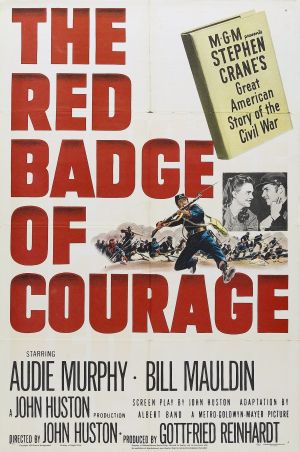
Red_Badge_of_Courage_1951.jpgStephen Crane’s seminal Civil War novel was made to be gripping film material and although my knowledge of the particulars is limited John Huston’s story while streamlined and truncated feels like a fairly faithful adaptation that even takes some effort to pull passages directly from the original text.

Even with the film getting butchered by the producers and chopped down to only 70 minutes from its original 2 hour running time, there’s still a gripping power to this war story. The narration feels a bit forced (despite being delivered by James Whitmore) but beyond that Huston’s film has an undeniable resonance for the atmosphere it develops and the very palpable inner turmoil of its central character as portrayed by famed real-life war hero Audie Murphy.

It suggests the other side of what it is to be a soldier. The fear, the reluctance that wears on the individual, and it begs the question, who are the real heroes if not men who did their duty despite the very fears that shackled them? Portrayed in this film are men and boys who were thrust into conflict and they were forced to respond accordingly. Not necessarily because they wanted to but out of very necessity.

In the end, the realization is that maybe fear is alright and acknowledging it is oftentimes the very sign of a brave individual. Someone who knows their limitations and still manages to push beyond them to do extraordinary things. Because as FDR so famously noted, the only thing we have to fear is fear itself. It can be debilitating, stifling our resolve to take action. Thus, it’s our response that’s paramount.

Barely 20 during the war Murphy isn’t all that much older here and it feels remarkably fitting for him to play the naive Youth getting his first welcoming to war faced with this very conundrum. He wants the glory of war. He wants that red badge of courage. But he’s too afraid to take it. The utter irony is how battle-tested Murphy was by that point in time–but of course, he became a hero at a very young age and that doesn’t necessarily mean it came easily or without a cost.

Huston also examines the disillusionment in the utter absurdity and idiocy of war sometimes. Though it had already been 6 years since the end of WW II with men such as Audie Murphy and Bill Maudlin involved it’s easy to get the sense that this was a rumination on that particular war’s effect. Huston as well had been involved in documenting the life of soldiers and Maudlin made a name for himself as one of the great wartime cartoonists originating the iconic duo of Willie and Joe. Murphy’s accolades spoke for themselves as one of the most highly decorated soldiers of his day but he also undoubtedly suffered from the trauma of PTSD.

The dialogue is ripe with colloquialisms and the images seem generally authentic with photorealistic visuals to match a fairly dismal outlook. It does not shy away from the reality. Figures constantly moving through the frame mechanistically. Claustrophic closeups, tights angels, billows of smoke and relentless gunfire make the battle sequences truly immersive. And the soldiers are played by actors of all shapes and sizes including Murphy, Mauldin, Royal Dano, John Dierkes, Arthur Hunnicut, and even Andy Devine.

If it had not been for the studio’s meddling we might be calling Red Badge of Courage one of the great American war movies. As it stands today, cut down from its original running time and slightly removed from John Huston’s original ambitions, it’s still a highly moving picture. Because moments of greatness shine through no matter the muddling factors. So despite its minor status and a runtime that suggests lesser fare, Red Badge of Courage is really Class A material through and through. Huston did not call it one of his best movies for nothing.

3.5/5 Stars

Have a wonderful Memorial Day and here’s to all the humble heroes in our armed forces.