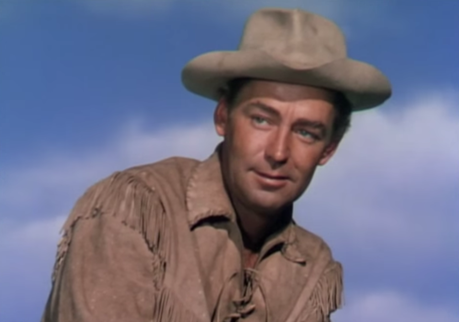
 Jackson Hole, Wyoming and the looming Tetons lend the same iconic majesty to this western that Monument Valley does for many of Ford’s best pictures. But then again, George Stevens was another master and he too was changed by the war, coming back with a different tone and an “American Trilogy” that included some of his best work. Shot in Technicolor, this picture boasts more than wide open spaces and raw Midwestern imagery. Stevens has some wonderfully constructed sequences and there are a number of great characters to inhabit them.
Shane is the eponymous gunman who is content to linger in the background while others become the focal point. Namely, Joe Starrett (Van Heflin), a man who came to the untamed land due to the Homestead Act and won’t let the rancher Stryker muscle them off the land that he believes is rightfully theirs. Despite this being her final film — and a favor to her previous collaborator Stevens — Jean Arthur is as wonderful as ever. The character Marian is brimming with goodness and a sensitivity that is hard to discount. It’s a part very different than her earlier work and yet she plays it so wonderfully. As for newcomer Brandon De Wilde, he’s an astute little actor and we really see this world through his eyes, so he does wonders to hold the story together.
Grafton’s general store and saloon become a wonderful arena of conflict within the film because it is rather like Ryker’s stomping ground since he and his men can always be found lounging around there when they aren’t terrorizing some poor sodbuster. After he agrees to work for Starrett, Shane goes into town for new duds, leaving his gun behind, and he quickly learns what he’s in for. It’s in such a scene that we learn who this man really is. He’s not a hot-head and he initially takes the abuse of Stryker’s guns, who call him out for purchasing soda pop. It’s for the boy Joey, but he doesn’t have to say that, because he needs not prove himself, at least not yet. Also, the relationship between Shane and Marian might be troubling to some — will they fall for each other — but when Ryker makes insinuations about Starrett’s wife, Shane is quick to shut him up. He’s not that kind of man. When Shane does return to the store, he’s prepared this time for retaliation and although it might not have been the smartest thing, it sure is gratifying for him and for the audience. He and Starrett make a killer team, after all, beaten and bruised as they end up.
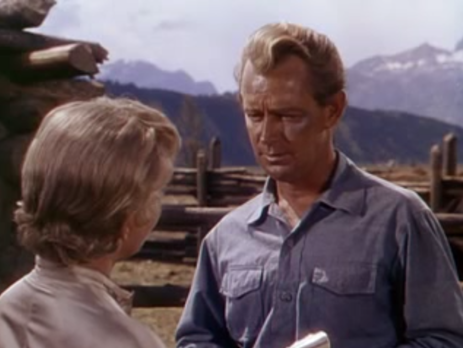 What follows is retribution from Stryker as he tries to buy out, threaten, and continually lean on the sodbusters, but Starrett remains resolute in keeping his friends together. In fact, there’s still time to share a wonderful Fourth of July dance with all the neighbors and it shows signs of a brighter, happier time that could be possible. With neighbors joining together in simple community and sharing life together. Shane feels somewhat out of place in this type of environment, and maybe deep down he knows it too, but he seems oddly content.
This happy time is juxtaposed with the funeral of ornery “Stonewall” (Elisha Cook Jr.), who was gunned down near the saloon by hired gun Jack Wilson (Jack Palance). His death is making some of the others jumpy, but once again Starrett keeps his group together, by first giving their former friend a proper burial and banding together once more. But by this point, they’re barely hanging on. Stryker’s got them on the run and Joe knows he needs to have it out with his arch-nemesis once and for all if things are ever going to return to the status quo. His dreams of ending this whole thing are ludicrous because there is no way he can get out alive. His wife knows it. He knows it, but it doesn’t stop him and his American Dream.
 It’s interesting how Shane at first does not try to stop him, but then he gets tipped off to what awaits Joe, and he decides to go in his place. This is his arena after all. The gun we all fawn over is finally getting put to use as Shane rides into town for the final showdown to have it out with the men in the saloon. However, although the shootout is intense it ends very quickly. Thus, what is really interesting are the moments beforehand where friend is literally fighting friend. Both doing what they think is right. However, since Joey only thinks in absolutes, when he sees Shane hit his father over the back of the head, he initially reacts with hatred towards his fallen hero. He doesn’t understand why all this is necessary. But as time goes on and he sees events unfold, he gets it.
As Shane rides off into the night, Joey yells after him to come back, he cannot bear for this idolized man to ride off. It makes me wonder if young Joey grew up with the image of Shane, the hero of his childhood. The doer of good and the ultimate champion of the oppressed.
The cast was rounded out nicely by some solid supporting players like Palance, Ben Johnson, Edgar Buchanan, Elisha Cook Jr., and down to Ellen Corby and even Nancy Kulp. It’s astounding to think that this film could have starred Monty Clift and William Holden potentially with Katharine Hepburn as well. Because, after all, the casting of Shane feels just right. Clift would have brought depth and emotional chops to the role, as a wonderfully impassioned actor. Just look at George Stevens’ A Place in the Sun (1951) for proof of that. However, what Alan Ladd has is a serenity and simple goodness that still somehow suggests something under the surface. It begs the question, how can someone so upright make a living packing a six-shooter? No doubt I like Holden better as an actor, but Heflin has the scruffy outdoors-man look, while still reflecting high ideals. Hepburn just does not seem to fit a western. This is one of the instances when all the pieces seemed to fit into place and we were blessed by a western classic that never seems to lose its luster. In a sense, we become boys again like Joey, completely in awe of Shane. Let us revel in that feeling, that moment of innocence once more.
5/5 Stars


 4 Star Films