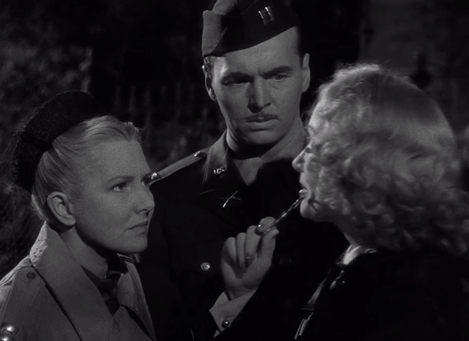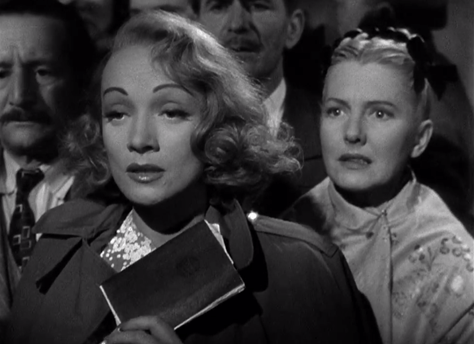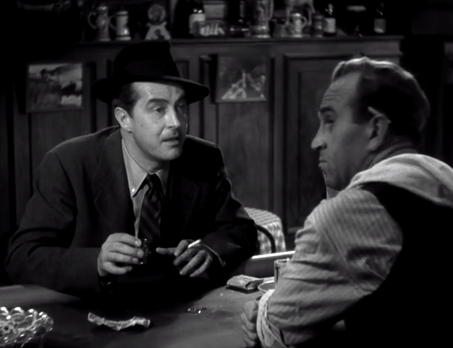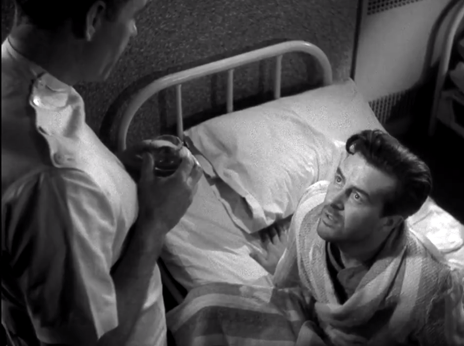
The Eagle and The Hawk (1933): March The WWI Flying Ace

Screenshot 2020-03-20 at 80407 PM

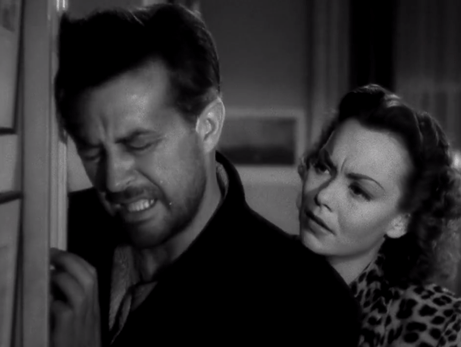
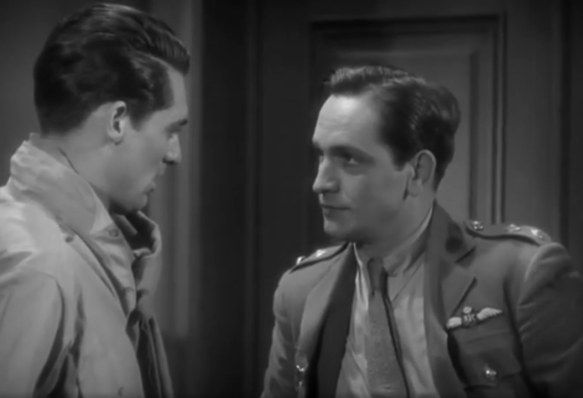
There are two elements in the opening of The Eagle and The Hawk that might catch some viewers off guard. First, is the matter of a plane landing upside down. Second, being the fact the pilot is an uncharacteristically abrasive Cary Grant. He’s still playing support to our true lead Fredric March.

It’s alright to admit the shoe never quite fits and, thankfully, Grant was not forever relegated to such unseemingly roles again (well, there is Suspicion or Notorious). Regardless, in this WWI picture, a group of American aviators ship out from London to give their British allies a lift in France.

New forms of technology like aeroplanes still feel a bit rudimentary, yet to be time-tested, and therefore they carry with them a bit more danger. They must take recon photos flying close to the ground and often engage the enemy in aerial combat. The footage of the dogfights is lively if equally rudimentary.

It’s Grant’s Lt. Crocker who has aspirations to be a pilot, not an observer — the less glamorous posts going to those who take pictures and gun. Cary’s got a chip on his shoulder, and it’s turned him sour. Jack Oakie is the complete opposite — chipper, well-liked by all, and conveniently supplying comic relief.

However, it is the final star, the leading man, Fredric March who stands head and shoulders above the rest, at least on this occasion. He goes through a startling transformation over time. He soon learns the hard lesson. For every two kills of a jubilant Jerry Young (March), there’s the searing reality of a comrade dead.

We are instantly reminded war never allows a man to rest on his laurels before inundating them with the sheer callousness of such a conflict. It shows no favoritism. Officers or enlisted men alike. Doughboys or flyboys. It makes no difference. Everyone is susceptible.

In a matter of minutes, the weight of war is made obvious. It happens between a letter written to a dead man’s spouse and a blackboard with names constantly being erased and added.  Beyond being indiscriminate, war also waits for no man.

As time progresses, the dogfight sequences maintain quite the impressive pace for their day and age. The sequences use the resources at their disposable and varied shots to develop something fairly immersive beyond mere back-projection fillers.

Finally getting his first go, Grant shoots down an unarmed parachuter with great relish, his first day on the job, only to kill the mood after hours. They say he’s a “dirty deuce,” but perhaps he’s the only realist around. He treats it like war. They treat it like an exhibition in some contrived form of chivalry.

There are rules to war and gentleman’s agreements to be abided by on one side and then the “killed or be killed” mentality of Grant. And yet even as March remains one of the righteous ones, he starts medicating with alcohol to get over what he’s been privy to.

Soon he can’t get over the insanity or reconcile with the consequences set before them. They are bestowed medals by the French military with the rain pouring down — it’s a wet affair — and he’s still soused. 

A new batch of fresh-faced youngsters come to replace those who have already expired. He’s enlisted to speak to the new recruits, sharing a message for the sake of moral, though it’s evident he barely believes what he’s spewing. Because some of them will die before even getting to the front. What’s the purpose of it all? So the folks back home might cling to some misguided patriotic fervor?

The night terrors begin — Jerry’s mind now filled with burning, blood, and snipers at night. A change of scenery is suggested and so he’s given leave.  But in the households, the conversations are boorish and needlessly taken with the romanticism of war and glory.

Here are people drunk on the same wine. Men laugh about the enemy going down in flames. Curious young boys ask questions about what it’s like to meet the enemy with hopes to be up there one day. No one seems to understand, and how can they. They haven’t been there.

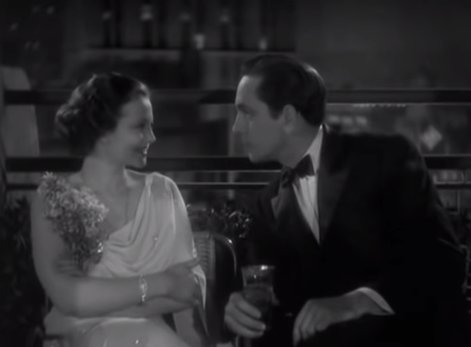
Watching from a distance, there is at last one pair of perceptive eyes. They belong, of course, to Carole Lombard. She slides her way into Jerry’s cab as he tries to leave the idle chatter behind. Instead, they find a quiet park, out of the way, to share some champagne and engage in genuine conversation.

She has only a momentary part — it really is a glorified cameo if we should call it that — and this is a movie that’s already so succinct. Still, it’s a memorable spot, and she offers a sympathetic countenance in a world all but lacking such consideration. It makes her all the more attractive.

Still, Jerry must go back to the lines and maintain the burden of being a shining example for others. After all, he is the fitting emblem of what a military hero should be. Fearless in the face of the enemy. All but indestructible with a stirling flying record.

However, we become jaded with the same persistent cynicism of Jerry pulling him from the airs above back into the parties and routines down below at the base. He can’t even manage to muster any kind of good-natured sentiment in such a jocund company.

All he sees are the chunks of flesh and bone on his chest in the form of medals. And all he can think about are the boys who have died either by his hands or at the hands of others. He’s gotten his medals, gained hero status and adulation from his peers, for killing kids. What’s worse, few seem to acknowledge him, going on their merry way. Surely he’s merely drunk. He’ll get over it in the morning. Except he doesn’t.

The film’s ending is a brutal shock to the system, but it settles into an honorable arc. If anyone was worried, Cary Grant is redeemed in the final moments preparing to soar off toward bigger and better successes.

What I’m most impressed with is how The Eagle and The Hawk does such a phenomenal job distilling some of the most pressing themes of war in its harshest and most bitter realities in such a meager allotment of time. It’s like All Quiet on the Western Front lite, and I mean this as the most sincere of compliments. It adeptly hones in on the essential elements of the prior film as another stark, unfaltering statement exploring human conflict on this seismic scale.

It comes not through heedless idealism but a sobering, unblinking examination of what war really is. Any pretense is stripped away in a matter of minutes while March gives one of the most piercing performances, arguably, of his entire career. If you haven’t already, go seek it out. My hope is that you’ll be glad you did.

4/5 Stars

A Foreign Affair (1948): Billy Wilder and Post-War Germany

a foreign affair.png

What A Foreign Affair offers is a curious mix of Billy Wilder’s brand of gleeful satire with docudrama. In this regard, it stands alongside the likes of The Search (1948) as one of the earliest American films to explore the world of post-war Europe with so much rebuilding to do both physically and emotionally. It plays as a precursor to One, Two, Three (1961) certainly, offering contemporary observations of the new world order. Still, one cannot even consider these films without acknowledging Wilder’s own background.

He was an exile from Nazi Germany who was welcomed into the American film industry with a myriad of emigre filmmakers, who, subsequently, helped fashion Hollywood into the worldwide powerhouse it would become. He was eternally grateful but never allowed that to totally cow his pointed barbs aimed at America’s inherent flaws.

During the dwindling days of the war, he even served with the Psychological Warfare Department to help develop propaganda material about the concentration camps. His time abroad and the securing of funding launched A Foreign Affair as his latest project.

In the opening moments, a Senate Committee is preparing to make their official visit to observe the current climate. The script’s aims are twofold, setting up the story while also bringing audiences up to speed about the bombed-out world below.

a foreign affair 2

Jean Arthur is more repressed than she’s ever been in her life with some license for her typical comedic chops written in as the narrative progresses. For now, she is a methodical taskmaster very cognizant of her constituents’ tax dollars. Perhaps we need more like her, but for the butt of a comedy, she’s an easy target. The congresswoman entreats her venerable colleagues that they must eradicate moral malaria once and for all as she’s increasingly wary of what they might uncover.

Col Rufus J. Plummer (Millard Mitchell) shows them the sights, stroking his cheek with bemusement (a recurring gag), as he catches everyone up on current events with his wry bent. Meanwhile, serving under him is Captain John Pringle (John Lund), one of the brave boys from home who has taken it upon himself to help rebuild the new world order on the liberating tenets of capitalism.

His typical hobbies include fraternizing with black marketeers to haggle for mattresses using chocolate cakes as collateral. As it turns out, it’s for a girl who drops her key out of the window every time he honks the horn of his jeep. Suddenly the film’s title has become an overt double entendre, and we have our movie.

John Lund is not without charisma and yet somehow the way he goes about this characterization feels all wrong. There’s nary an ounce of genuine charm conjured up by his faux tough-guy persona. It seems ill-fitting. At least he was likable in The Mating Season. Here he can barely hold a candle to the luminary talents of Marlene Dietrich and Jean Arthur no matter how different they might be.

As the Americans make the rounds on their carefully curated sightseeing tour, the representative from Iowa is positively scandalized by all the soldiers with their German gals. She makes a brazen decision, going undercover and winding up at a Hofbrau with a couple of lug head G.I.s,, posing as a reticent German fraulein named Gezeuinheidt.

In the process, she gets the poop on the sultry songstress formerly purported to be in cahoots with Goebbels or Gohring — one or the other. Her gabby companions surmise she still has big brass running interference for her. They’re not too far off and her Phoebe’s detective work brings her even higher up on the totem pole. The very top actually. The Fuhrer himself.

In danger of being ousted in his little arrangement, Captain Pringle starts romancing the congresswoman to keep her off the trail. If the dilemma’s not already obvious, it becomes even clearer in time.

a foreign affair 3

Unfortunately, A Foreign Affair drags a bit in the middle, and the plot doesn’t always maintain the usual self-assured zip of a typical Wilder picture. There are lulls and distractions, which can be enjoyable in their own right, though hardly bolstering the drama. The core issue is a lack of emotional investment in the characters. I love Jean Arthur to death, but her role flip flops too easily on its axle. Dietrich is striking as she ever was, but, again, she is larger-than-life, while the contours of the role itself feel ill-defined and uninteresting. At the very least, the stars the one making it worth it.

There was some talk that Dietrich got all the attention and the favoritism of from her director. And it’s true that she is beguiling even in this latter portion of her career. Arthur felt undercut. It starts with how the script is laid out. However, as she becomes more daring and uninhibited, one could argue Arthur gets the most out of her performance, even down to her always hilarious facial expressions.

Certainly, the camera loves Marlene Dietrich, her sleepy eyes, the husky yet sensual quality to her singing voice. That was her persona. Still, she’s the one playing mistress to an ex-Nazi so that’s not exactly the most flattering part.

a foreign affair 4

Consequently, the denouement doesn’t quite sit right with me. It feels like a muddled conclusion where events just happen, winding up in a manner that tacks on a convenient rom-com ending, instead of leaving us with something that feels truly cynical in the vein you grow accustomed to with the director.

What’s most compelling is the intersection of Billy Wilder and the world of post-war Berlin. Others could have told this story, but he seems uniquely positioned to offer a very personal perspective. The curious clashing of his typical tone of trenchant comedy somehow matched with the war-torn panorama. And there are intermittent moments where this is the case.

Namely, how he’s not squeamish about showing the aftermath, nor poking the beehive of Nazism with his stick. In one scene a heel-clacking father is having trouble with his little tyke who can’t stop habitually chalking swastikas on everything. For a brief moment, we are given a reprieve and license to laugh at such a horrible ideology. It’s almost cathartically hilarious.

In another scene, Colonel Plummer notes in passing how there is rubble of all kinds, be it mineral, vegetable, or animal. We know it to be true, but what an opportunity it would have been to see more of it. I’m reminded of the scenes in the Hofbrau with song and dance and cigarette smoke or the bombed-out streets crowded with black marketeering types. I recognize these are spliced together scenes between Berlin and a Hollywood backdrop.

But this is the exact reality that feels like such a ripe birthing ground for Wilder’s comedy. I never thought I’d be the one to say this; the roots of his romantic comedy all but got in the way of what could have been.

3.5/5 Stars

The Lost Weekend (1945) and Alcohol The Femme Fatale

the lost weekend 1.png

It might be a futile exercise but at least for a brief moment, I will attempt to get back into the headspace from when I first came upon Billy Wilder’s The Lost Weekend. I was younger then. Bright-eyed and a budding cinephile. It is the film that defined Ray Milland’s entire filmography for me as I had never seen another one of his pictures (although Dial M for Murder followed soon thereafter).

Now I understand the crucial context. To say Ray Milland is defined by The Lost Weekend is analogous to attributing Anthony Perkins’s entire persona to Norman Bates and Psycho. You wouldn’t be wrong but in order to understand this inference, you have to understand how the viewing public viewed them in the moment. They were matinee idols and boys-next-door. They fit in comedies and as youthful love interests.

It takes a subversive and inventive mind like a Wilder or a Hitchcock to take the inherent expectations provided by an actor only to toy with the audience. Milland, in his early years, could be defined by the likes of Easy Living or The Major and The Minor. Even noir like Ministry of Fear and The Big Clock, though clouded by menace, rely on the inherent likeability of our hero thrown into trauma though he maybe.

The Lost Weekend was an unequivocal gamble for Milland, in particular, and history has proven to be on his side. He gamely throws himself wholeheartedly into the drama, and it pays heavy dividends.

Don Birnam (Milland) is a struggling novelist with a persistent drinking habit. He’s playing at being reformed, about to go on a trip to the country with his pragmatic brother, but just out of sight and out of reach is a bottle. He’s still beholden to the stuff. It’s a hidden cache of security just in case he needs a nip.

His concerned girlfriend (Jane Wyman) has the cutest way of remedying their height disparity when it comes to kissing (bend down). Even as I’ve gained a more full-bodied impression of Ray Milland, I would like to believe I’ve also reappraised the stardom of Wyman with newfound respect.

She’s not merely an ironic Sirkian pawn in melodrama. During the bulk of the 1940s, she more than asserted herself as a quality performer.  In retrograde, the likes of The Yearling and Johnny Belinda show an extraordinary range, redefining how I perceive her for the better. The Lost Weekend exhibits her at her most likable while still being bolstered with personal resolve.

This is evident even as her boyfriend so quickly falls into outrage as if the people who love him most are turning against him. It all plays as a symptom of the real problem. He feels hemmed in or could it be the withdrawals from the alcohol crying out?

Regardless, the theremin has never used as effectively to denote menace in such a different context than the ubiquitous Sci-Fi trope it would soon become. Because one bottle is snatched away and yet it’s simply indicative of a far more pervasive problem. Don has stashed alcohol all over his apartment in the most ingenious hiding places though his brother is equally adept at hide and seek.The premises are really and truly dry. That is until the cleaning woman unwittingly tips him off to $10 he can splurge on. He’s up for a perilous road ahead.

John Seitz photographs the drama like a brooding noir, and it is as if alcohol — the siren on the shelf — is the deadly fatale entrapping Ray Milland in its web. His girlfriend even goes so far as to label the “other woman” and confidently intimates she’s not going to go down without a fight; she’ll help him beat it and keep Birnham for her own.

the lost weekend 2

Eventually, he succumbs to a bender of a weekend, caught as he is within his own self-exile. What becomes so very evident is how isolating addiction becomes. His only confidante is the local bartender (Howard da Silva in an uncharacteristically sympathetic part).

As Don spirals back into his destructive habit, he recounts how he managed to meet a girl like Helen even in the throes of his alcoholism. There he was sitting in the theater like a fine thespian and yet he couldn’t get it out of his mind. Even the play reminds him of the bottle he has in his jacket pocket, currently stashed out in the coat check. It proved a fortuitous evening as his petulant first impression gave way to charms that won his girl over.

However, it is a portent of all his recurring troubles. The want of liquor leads him into distancing himself from the community just so he can get alone with his bottle. Companionship seems so much more vital and yet we tell ourselves backward lies to rationalize our decisions.

He is a man who suffers from the age-old affliction of Jekyll and Hyde syndrome. He even admits there are two sides to his persona. The man about town with a charming public persona, and then the other Don Birnam. The drunk who remains a tortured writer.

He hits the pits of despair, wandering the streets, desperately looking to hock his belongings for one last satiating drink — even a handout if he can get it. But that’s the lie, isn’t it? Just one more time and we’ll reform. Just one more and never again. We gather together the willpower for an hour, a day, a week, a month, until it comes back with a vengeance.

Birnham’s life is indicative of a whole caste of society. The silent and the forgotten in dark rooms and lonely bouts of aggravation. His brother has turned his back, and he won’t respond to his girlfriend. It quite literally feels like a little slice of hell.

The film makes one harrowing detour to an archaic-looking drunk ward where a sardonic Frank Faylen takes care of the jittery new arrival inside the booze tank. He’s confident Birnham will be a regular customer soon enough. It feels like a harsh and unfeeling extension of the world.

For some, The Lost Weekend might be a tempered now antiquated exploration of alcoholism firmly planted in the past. However, I would like to push against this preconception slightly.

the lost weekend 3

Wilder purportedly penned the piece with his writer partner, Charles Brackett, as a way to explore his relationship with Raymond Chandler and how alcoholism affected their art — the processes of a writer being derailed by drink.  So in this regard, it too is personal and yet about as universal as a picture can be. There is this obvious duality of art and alcohol where one impacts the other in highly detrimental ways.

Wilder’s not always known as a technical director but, if nothing else, he surrounds himself with competent people. A couple names that come to mind in this picture, in particular, are cinematographer John Seitz and then his editor Doane Harrison.

One is reminded of the shots of the overturned lamp repeatedly reflecting the shambles of Birnham’s current life, derailed by drunkenness as it is. In another, it’s Milland’s eyeball spinning psychotically inside its socket. He’s more alive than Marion Crane on the bathroom floor, but we can hardly deign to call this life.

Each of these elements, even the more blatant evocations of his delusions, illustrates the torment of human beings stricken by addiction. It saps our creativity and our energy. It can take away a want for relationships and, in some cases, our desire to live.

The Lost Weekend is a reminder sometimes we need to enter into the storm of our struggles so we might come out on the other side. When you’ve hit rock bottom, the tap is dry, and your body is shaking, the only place to go is up.

However, sometimes we’re not strong enough to pull ourselves up by our own bootstraps. Grit, determination, and resolve only get us so far. We have nothing left. We’re broken, alone, destitute.  Utterly defeated. It’s in this place of helplessness when we are forced to look outside of ourselves…to something or someone else. To reclaim all that is lost and be found again.

4.5/5 Stars

The Palm Beach Story (1942): Another Screwy Sturges Freight Train

the palm beach story 5

“After you’re married… That’s a funny thing to hear your wife say!” – Joel McCrea as Tom Jeffers

All the timeless Preston Sturges pictures have the pace of a freight train barreling down the tracks in loop de loops and figure eights. The Prologue of The Palm Beach Story sets up a raucous race to make it to a wedding ceremony involving a bride and a groom…and a woman tied up… It’s gone in a blink. Hold that thought.

Cut to present. There’s Franklin Pangborn, always hustled and harried. This time as an apartment manager trying to show off the new apartments he has for lease to the grouchy, incessantly deaf Wienie King and his bubbly wife.  These two initial scenes are textbook examples of how to juxtapose people and places for comic effect. In fact, sometimes Sturges will gladly lean into the joke before giving us any indication of what his story really pertains to.

When we finally find a premise, he’s already taken us for a spin. Because the previously revealed bride and groom, Tom and Gerry Jeffers (Joel McCrea and Claudette Colbert), sunk all their money trying to get a bite — namely the $99,000 he needs to get his suspended airport project off the ground. As of right now, there are no takers, and their marriage has tanked. Strangely enough, they still love each other madly. At the very least, their constant quarreling seems to hint at their continued devotion. That’s the wrinkle.

She wants to get a divorce (sacrificially, of course) so she might hook a rich husband to pay for his pet project. He selfishly wants to stay married to her. He tries to hold onto her, racing out of their apartment, in only the bed linens, as she resolves to go to Palm Beach — to find herself a millionaire — for him.

Sturges relishes the comic situation, which verges on the risque, especially for the day and age. The script was even repeatedly balked at by the Production Codes for the very same reasons and still they manage to mention the word “sex” quite frankly (Gasp)!

What becomes most evident is this increasingly flippant disregard for the institution of marriage. The ensuing world and the situations arising make sense originating from a man who himself came out of affluent circles with a row of marriages left in his wake. He’s in a sense writing what he knows intimately while still utilizing his own idiosyncratic perspective.

It’s a glorious trip to Palm Beach as he loads the cars end to end with his stock company, comprising a traveling circus of dopey millionaires making up the Ale and Quail Club. Gerrie gratefully becomes their mascot as they pay her way to the far off land of the Florida coast.

the palm beach story 4

In typical Sturges fashion, he overwhelms the screen with the sheer force of bodies and figures from the likes of William Demarest, Al Bridge, and just about anyone else you’ve ever seen in a Sturges film before. They divert themselves with any number of dalliances including hiccups, trap shooting crackers, and nighttime serenades of “Sweet Adaline.”

What’s even more hilarious is how we never actually see these characters again. They serve their purpose and service the writer-director’s scatterbrained devices. The extended sequence functions as its own standalone vessel of amusement.

He really is the king of writing robust character parts that, while never throwaway, need not be overly important. Today it feels like every bit role must be functional. For Sturges, a character functions, first and foremost, if they add to the comic maelstrom he’s whipping up. When they serve their purpose he can zip onward toward further zaniness.

Likewise, aside from being entertaining, The Wienie King is Sturges’s great enabler within the entire picture, gladly shoveling out money as if it were nothing, for rent and plane tickets — whatever the story requires — and despite his apparent obliviousness, he has these near-surreal bouts of hyper-lucidity. In considering his character, one cannot help surmising a stopped clock is right twice a day – even a tone-deaf one.

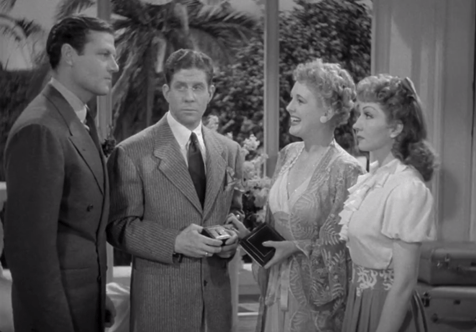
There must be a story, but the script gladly supplies a vehicle full of hilarity to deliver the goods for the benefit of the audience. As we progress with the ever-whirling thingamajig of wackiness, there’s the introduction of Rudy Vallee. The former matinee idol shows a certain penchant for comedy in his own right, added to the Sturges hall of fame of crazy aristocrats.

His dry idiosyncrasies serve him well, from the methodical removal and placing of his specs to the ongoing accounting he does in his little black book. Even a couple rueful in-jokes to his earlier crooning days, including “Isn’t It Romantic?,” send a few knowing winks toward the perceptive viewer.

the palm beach story 3

Although she purportedly struggled with her director’s style of mile-a-minute dialogue, Mary Astor, nevertheless, does the corkscrew language a major service as the ably speedy-mouthed Princess Centimillia, who bowls one over with her mixture of glitzy upper crust exuberance and ready-made amorousness. The perfect foil for her dry brother dear “Snoodles.”

To round out the quartet (quintet if you include the single misfire Toto), Tom Jeffers arrives to reclaim his wife but finds himself being turned into a brother named Captain McGlue before he can get in a word edgewise. The quarreling goes on behind closed doors as estranged husband and wife both find themselves romantic objects — currently pursued by other people.

One can’t help to compare it to Midnight, the Billy Wilder penned film with all sorts of little white lies and shenanigans being pulled to keep the charade going for as long as possible. It’s true often the best screwball farces — including some of Sturges’s successes — involve people donning aliases with highly comic ends, of course. Even in this frenetic company, The Palm Beach Story might be more outlandish than most, on par with the rambunctious insanity of Some Like it Hot.

What a glorious wisenheimer Sturges is holding off on the one loose end we’ve been wondering about since the outset of the movie only for it to be the final payoff, setting in motion another story that we’ll never hope to see. Everything is bookended by this ultimate gag that plays as pure Sturges. He’s shoehorned the whole story just so he can swoop in from left field with the most propitious footnote.

At its best, The Palm Beach Story exudes all the zany charms of Sturges’s screwiest works between a finely wrought cast with plenty of whiz-bang patter that time and time again gladly succumbs to silliness. Preston Sturges does his secondary characters a major service, and they more than return the favor. It’s a picture totally stolen away by the supporting cast and rightfully so.

4/5 Stars


The Great McGinty (1940): Preston Sturges & Politics

the great mcginty 1.png

“If it wasn’t for graft, you’d get a very low type of people in politics!” – William Demarest

The Great McGinty feels like a film of many notable firsts. The two most prominent ones being Preston Sturges’s first time in the director’s chair, famously agreeing to a salary of $10 for creative control of his screenplay. The second first has to be Brian Donlevy getting a break at a starring role, even if the picture itself was an inauspicious beginning. As an in-joke, he plays into his image as a heavy only to turn that on its head for something far more intriguing and intermittently hilarious.

We wind up in a banana republic for a hot minute. There’s the usual melange: dancing girls, sailors, drunks, and behind the bar is a very familiar face indeed. It’s the strangest of interludes for such an expedient picture and for a satire that will wind up whipping us all the way around the world to the grand ol’ United States of America. However, one should admit in the mind of such an inspired looney as Preston Sturges, the progression is as natural as X, Y, Z.

Because, formerly, Dan McGinty (Brian Donlevy) was no better than a tramp before his bartending days.  However, even someone like him was a vital cog in the crooked methods employed by a dirty political machine. Led by a bigshot shyster (Akim Tamiroff), they conveniently pad the ballot boxes in the favor of their rather limp candidate.

In fact, they finagle the homeless vote in return for some hot soup and a couple of bucks in their pocket, getting it down to a very dubious science. Each ballot box is manned by an inside man who supplies a name to each new recruit with the deceased, the elderly, and the chronically infirm played by masquerading vagrants.

They’re an easy market to exploit because when desperation is your only guiding light, you’ll bend to any low for some grub. Only one man is cunning enough to take advantage of their shady business for his own benefit. Soon McGinty’s weaseled his way into over $70 bucks and his tough-guy act gets him in with the boss.

He starts out on the lowest rung as an enforcer but soon works his way up thanks in part to his self-assured charisma and the built-in brawn to back it up. When the old mayor gets tossed out on the waves of scandal, the time is ripe for a new up-and-comer. The recurring farce of the movie is how easily the Boss shifts between tickets and candidates with the system all but rigged his way regardless of political affiliation. Is it some uncanny portent Tamiroff originated from the Russian Empire by birth?

the great mcginty 2

The Great McGinty might feel like a one-joke pony if it solely relied on the ludicrous premise of a nobody jumping through the hoops to become mayor and then governor. Instead, Sturges fills out his story with the details of a real life, including the highlights of marriage to his secretary, the new home they purchase together, and the mammoth parade that is thrown in his honor to celebrate his ascension.

Muriel Angelus’s name has been all but buried under years of celluloid — this was her last picture in a truncated career — but she has surprising bearing and charm throughout the picture. One is briefly reminded of Madeleine Carroll. But either way, it serves the movie well to lean into this highly irregular and totally ill-proposed couple. Somehow she manages to be well-suited for Donlevy because they appear so diametrically opposed. His hard-nosed rough and tumble bravado constantly chafes against her inbred propriety and ready-made home life with two kids.

After all, their subsequent marriage is only meant to be a vehicle of convenience although it’s easy enough to infer…perhaps she loves him dearly but is also too proud to force her affections on him. He’s a numbskull, yes, but perhaps there’s some deep-rooted affection in him as well.

They shape one another. He becomes a father figure. Catherine encourages him to tap into his inherent decency and the slivers of goodwill she’s seen glimpses of, even as he feels content to let well enough alone, riding the machine all the way to the governorship.

On the other hand, sweatshops, tenements, and child labor all need a champion to hasten their demise. He has the chance to actually stand for something of substance, and Sturges suggests behind at least some cutthroat half-rate men stands a great woman. They can change for the better.

Admittedly, The Great McGinty is actually a much darker, more foreboding film than we might be initially be led to believe from a production headlined by Preston Sturges. It’s easy to start cross-referencing it with the political graft featured in some of Frank Capra’s notable works, even as the wit and jabs of cynicism of a similar nature would also find their way into the work of Billy Wilder.

Capra’s pictures like Mr. Smith and Meet John Doe probably lay into the graft and corruption harder, but they grant us a sincere happy ending to smooth everything over. Wilder would have to subvert everything to the very last line. And Sturges is more so in this camp although Wilder would come in his wake as another prominent writer-turned-director.

But the stock company is his alone, and he is totally devoted not only to the word on the page but the utter mayhem of it all. It’s a story of graft and corruption where the “bad guy” winds up playing barman alongside the man he was looking to bury earlier on. That in itself is the grand joke Sturges gives us as a parting gag. Thankfully, it doesn’t kill the satire of this otherwise unheralded comedy. In fact, it helps punctuate the utter lunacy of it all. 

3.5/5 Stars

The Lemon Drop Kid (1951): Bob Hope and Silver Bells

the lemon drop kid.png

“Don’t look like you’re handling hot reindeer” – Bob Hope as The Lemon Drop Kid

There blows the infamous Lemon Drop Kid a racetrack scrounger feeding the populous phony tips. In another context, he’d be one slimy stooge a la Richard Widmark, but played by Bob Hope, he’s nothing but a lovable dope. As with any Hope vehicle, it does seem as if the part was tailor-made for him with the gags to boot, and he has his usual repertoire ready.

It all slides along with the usual endearing hiccups until it hits a brick wall. The Kid inauspiciously steps into a booby trap of a southern gal whose actually with feared mobster Moose Moran (Fred Clark) of all people. He pays off his friends handsomely and his enemies not so much…

Because The Kid made him lose out on a sure thing — $10,000 in cold hard cash — he’s put out an ultimatum. Either The Kid gets him the dough by Christmas Eve or else he’ll find his head in his stocking on Christmas morning. It makes the craven grifter shiver just thinking about it.

He’s got to get a move on with his days running down. The main problem — or else there would be no movie — is the fact he has little capital to work with. He’s broke and everyone he knows is either in the pokey, homeless, or not too keen to dish out their hard-earned cash. It’s these odds and Bob Hope’s own persona that allow us to root for such an incorrigible loser.

He pays a house call on his best girl Brainy Baxter (Marilyn Maxwell) who fits into the latter category. She’s not about giving out handouts, and she has good reason. However, after a few minutes of schmoozing about a marriage license, The Kid has run off with more of her money.

Local New York boss Oxford Charlie (Lloyd Nolan) is the next stop and not being too fond of the Kid himself. Given their history and his own financial straights, he’s not about to oblige. The Kid does reconnect with an old chum Nellie Thursday (Jane Darwell), but she is the worst off of all of them with her husband about to be paroled from the clink and the two of them having barely enough money to get by on.

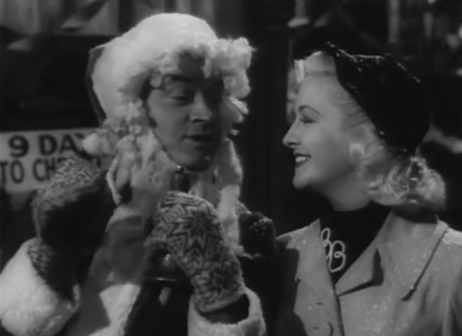
To swipe a phrase from Dr. Seuss, a street-corner Santa gives The Kid an awful idea –The Kid has a wonderful, awful idea. Although knowing Hope, he bungles it. The first time he dons his bearded costume and gets out his bell and tin can, it lands him in the clink for panhandling. The host of elves jailed with him let him have it. But he gets smarter once bail is posted.

Soon he’s wrangled together all the lovable scum of the earth to help him salvage Christmas — and his life — from being completely abysmal. These are the most gratifying scenes for bringing in such grouchy talents as William Frawley, Sid Melton, and Jay C. Flippen. They pull off the parts well providing the manpower for The Kid’s regiment of Santas.

Soon with Nellie as their real-life poster doll, they turn a casino into an old folks’ home completely on the level. The Kid is the only one in it for himself. Everyone else thinks they’re genuinely in it for the ladies, and it pays heavy dividends in a matter of days. People appreciate the extra goodwill during the holidays.

In fact, the platoon of reformed Santa Clauses do fine work. Brainy is happy, we have the birth of “Silver Bells;” it even looks like The Kid might live to see New Year’s. Oxford Charlie is also visually impressed. So impressed he decides to elbow his way into the racket taking the old dolls as hostages to live in his own home, leaving The Kid high and dry.

In his typical self-aware fashion, Hope mentions Milton Berle in passing, so what better gag than to take a cue from Mr. Television himself? He infiltrates Charlie’s base. However, the only problems left to be solved are how to deal with Oxford Charlie and then Moose Moran.

Thankfully, the movie ends with the right ribbon on top with the good guys beating the bad, the guy getting the girl, and one final jab at Bing Crosby as the curtains go down. The Kid has finally learned about selflessness even if Hope still plays up his usual vanity. He wouldn’t be Bob Hope without that, now would he?

It won’t win major accolades, but if you’re a fan of our star or crave alternative Yuletide entertainment to fill out your holiday festivities, The Lemon Drop Kid has something to offer. It’s corny and full of the kind of good-natured cheer that just about everyone could use more of during Christmastime. If you don’t, you know who you are.

3/5 Stars

Merrily We Go to Hell (1932): Directed by Dorothy Arzner

merrily we roll to hell.png

Bubbly is flowing and the gaiety abounds. Alcohol is not an evil, just a tonic to loosen morals, tongues, and dour countenances. When Joan Prentice encounters Jerry Corbett for the first time at a party, she’s immediately taken with him. He’s a few drinks in and has let the merriment overtake him. It comes off charming if a bit dopey.

Merrily We Go to Hell feels like a provocative title, and it’s true this alcohol-drenched drama is a predecessor to the likes of The Lost Weekend and Days of Wine and Roses.

Sylvia Sidney is about as winsomely sweet as she ever was and ever could be playing a socialite at a party. Frederic March has momentary glimpses of warmth and allure, though it’s hardly his finest hour on the screen. However, it is a testament to how phenomenal his career was at points, and even a picture like this seems to suggest how often he is an underappreciated star of Classic Holldywood.

There’s also a third far more surprising presence in the movie filling what might be considered a minor bit part. Cary Grant is all there, but it’s a bit like seeing John Wayne in Baby Face or James Stewart in Wife vs. Secretary. We’re there but not quite there when it comes to their career trajectory. He still needed to meet Mae West and then Leo McCarey to really get the wheels rolling, thus entering the stratosphere of quintessential screwball suavity.

As it settles in, Dorothy Arzner’s picture is all for hitting the journalistic beats contemporary to the day and age. It’s a perfect arena for modern, capitalistic America. An arena of vocation, class, and in this case, alcohol. One easily recalls Platinum Blonde though March, despite all his able acting prowess somehow cannot muster the same fitting charisma Robert Williams managed as a newshound. The former performer lent almost a screwball sensibility to Frank Capra’s picture.

It’s the same kind of affable charm that made Jack Lemmon so effective even as he dipped into similar depths of hell in Days of Wine and Roses. But back to Platinum Blonde. It’s hard not to see the earlier movie’s imprint being reworked within this material (even unconsciously) with less handsome results. Because some of the same dynamics are present. We have a lead infatuated by a platinum blonde (Adrienne Allen) and then opposite him is the endearing “other girl” we know full well will actually win out his heart. At least, in theory.

And if that isn’t enough, both newsmen dabble in playwriting, suggesting the menial pavement-pounding, all for the sake of making a buck, giving way to a higher calling of art and patronage. It handily reflects rungs in the social ladder to mirror contemporary society, as the film’s of the Depression-era all have a habit of doing. Obviously, they can’t help it. This is their world.

However, in Merrily We Go To Hell, playwriting holds a more substantial role aside from being a narrative device for the sake of parallelism. It brings Jerry Corbett the highs and lows of such a career while throwing him back together with his former flame, the glamorous thespian Claire Hempstead. The scenario feels rudimentary and mediocre going through these typical dramatic progressions.

Before it becomes complicated, the film is a basic love story of the lowly working stiff smitten with the heiress, although not for money’s sake. As it predictably dips into drunken stupors, strained relations, and infidelity, the film actually loses some ground. Corbett rounds up his chums, partakes of some merriment, and resigns himself to the platinum blonde rival. In an act of preservation more than rebellion, his wife deflects by digging up her own beau (hence Cary Grant) in an attempt to be equally “modern.”

What resonates most fundamentally are some of the more curious shot selections by Arzner. She certainly manipulates the camera and the images in such a way we are aware of them as an audience, whether through early forms of product placement or a curious rear-view of two men sauntering through a mansion. It feels sporadically alive with invention and a very particular vision, even as it spirals toward an unimaginative soap opera denouement. The accompanying  Pre-Code elements are there, but the picture doesn’t entirely douse itself and drown in the melodrama.

This proves to be a key because any such digression could have been its final death. Instead, the sense of restraint and understatement proves a far more powerful tool of storytelling. It subtly undermines stock Pre-Code sordidness for something nominally more intriguing. This nor the actors, totally save the movie, but they keep it from completely sinking. More people are finally starting to talk about Arzner, and Merry We Go to Hell feels like a worthy touchstone in her career.

3/5 Stars

Five Graves to Cairo (1943) and The Desert Fox

five graves to cairo.png

For modern audiences especially, the movie’s opening crawl gives us a bit of helpful context. It’s June, 1942.  Field Marshall Erwin Rommel’s Afrika Corps was pounding the Brits back toward Cairo and the Suez Canal. His notoriety as a tactician and “The Desert Fox” is already spreading. That’s enough on the historical moment.

However, as far as the film is concerned, this was Billy Wilder’s second film behind the camera. Not only is Charles Brackett producing, but he also shared script-writing duties with Wilder, deep into their lucrative, if complicated, collaboration. With the gorgeously perfected cinematography of John Seitz, it’s hard not to consider what was just around the corner. We can almost feel Double Indemnity peeking through. But we’re not quite there yet. There is still space to grow.

Wilder’s opening image is a fine vision: a phantom tank trawling across the sands driven by the dead weight of a corpse. Except, there is one survivor inside the rolling tomb; his name is Corporal John Bramble (Franchot Tone), of the British army. He’s exhausted and terribly disoriented trying to make sense of his curious predicament just as we are.

In the end, the tank gets away without him, leaving the corporal to wander through the desert in a one-person exodus. Plagued by sunstroke, he eventually trades the vast arid emptiness for a ghost town, the former regimental headquarters for the British forces. They have long since left the premises.

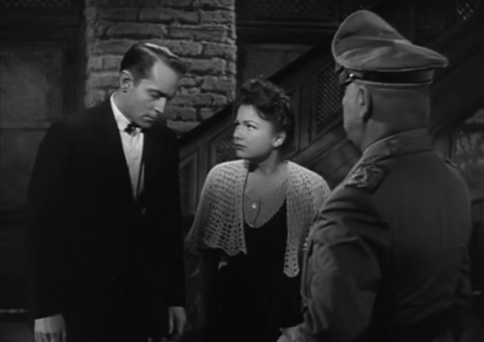
One of the only people left in The Empress of Britain Hotel is Farid (Akim Tamiroff), a bumbling wreck of a man, trying to keep his neck and assuage all parties at every turn. The other is Mouche (Anne Baxter), a Frenchwoman in the middle of nowhere, serving as a maid. His cook ran out on him and his only waiter got it in the most recent blitzkrieg.

There’s no time to form a decision about the delusional Brit because just to make things more tenuous German forces roll into town, in preparation for the high command. It’s enough to make any man cave, much less a pile of perpetual nerves, wearing a fez, like Farid.

He obviously acquiesces to their every whim, except giving away their newest guest, currently stowed away behind a counter. He gets by on the skin of his teeth and through the clemency of his newfound benefactors as they vouch for him in his position as their waiter. For the time being, no one can catch them in the lie.

In full transparency, I’m not quite sure what to make of Baxter’s performance — that of an American playing a Frenchwoman, however, I’m rather hesitant to admit she does a fairly spot-on approximation of a Simone Simon or other French contemporaries speaking in English. Truthfully, the whole picture brazenly scrambles all the nationalities, somehow normalizing all the casting. Another American as a Brit. A Russian as an Egyptian, An Austrian as a German, and so on.

Italians come in as well, represented by the boisterous baritone, Fortunio Bonavova, grumbling about the state of affairs for his army. There proves to be a testy relationship even within Axis allies. As always, the Italians feel like the comical little brother in the scenario. If we take the Germans nominally serious — as a kind of threat — the Italians are all but dismissed.

Erich Von Stroheim gives a blood-chilling introduction, back turned completely toward the camera. One thing he doesn’t lack is stage presence, capturing the screen with the entirety of his entrance. While he’s not doing an imitation of the real Rommel, it seems Von Stroheim does us a greater favor by being a version of himself. After all, this is the same hallowed figure who gave us Greed, showed up in Renoir’s Le Grande Illusion, and subsequently Sunset Blvd (1950). He is a worthy enigma in his own right.

The story twirls on a peculiar, if not altogether compelling, coincidence. Bramble takes on the persona of the crippled waiter as a pure survival tactic, only to find out he’s not what he seems. The Germans are the ones who make him realize this, by bringing him into their confidence. They seem in one sense highly rational — at any rate, not utter buffoons — and yet would they have actually been so stupid? We can only conjecture. Regardless, here we are. He’s been given an invaluable if precarious, opportunity.

With an influx of British prisoners, there’s a fear that the jig is finally up. They only need give the word, and he’s done for. Instead, they too play along, realizing their brilliant luck. 20 questions over dinner with The Desert Fox only elicits more riddles when it comes to his plans and unparalleled success.

Even more so than Stalag 17, Wilder’s picture is a small-scale war film. What’s present is a decently solid script by he and Charles Brackett. While it doesn’t always jump off the page, there are frequent lines, giving a stirring reminder of who is penning this story. These are the men behind Double Indemnity.

five graves to cairo 2.png

It also becomes obvious the battles have been left for others to reenact. At its best, Five Graves to Cairo is about character and with it, cracking the code of Rommel. It might seem like an insignificant victory but the implication for the broader war are made obvious. It’s easy to admit lives are at stake, even as Bramble teeters precariously close to being ousted. Mouche has no allegiance to him or the country that left her countrymen stranded at Dunkirk.

Instead, Wilder uses the bombers overhead as a bit of a tumultuous symphony for what is going down in the bomb cellar. Chiaroscuro is most boldly on display as our hero must flee for his life. If any character is redeemed, it is Mouche, but for the narrative to function, she is also forced to pay the consequences.

The ending is nothing to bat an eye at — certainly no extraordinarily inventive digression — but it suitable enough for its purpose. There’s a bit of satisfaction as Tone returns back to the place he once stumbled into, now victorious. There’s time for a laugh or two, even as a hint of somberness sets in. In the end, a new resolve has been instilled. We’re ready to go out there and do our part. It fits conveniently enough into the contemporary propaganda machine.

It left me thinking, what’s really missing is the trademark Wilder wit, whether trenchant or wholly subversive. Thankfully, there was still ample time for this to come to fruition. There’s certainly no illusions about war smelling like honeysuckle with enough sand, killing, and residual dead to rule that out completely.

But this early in his career, it still feels like Wilder willingly propagates an ongoing idealism about the Allies and America — the country that openly took him in when he needed a place. He would never lose his gratitude, even as he began to subvert convention soon enough. One could contend Wilder started to understand his adopted nation to its core — warts and all — and still managed to love it. This is one of the true marvels of his career.

3.5/5 Stars


Alias Nick Beal (1949): Ray Milland’s a Devil

Alias_nick_beal (1)

This is my entry in the CMBA Politics on Film Blogathon.

Alias Nick Beal handily flips the paradigm of cinematic angels in vogue with Hollywood, specifically during the 1940s. You could make a whole subgenre out of them. As its name suggests, the lynchpin character of the entire movie is Nick, though this is admittedly only a pseudonym. Across time and space, he’s come in many forms, under many names, including the serpent, Lucifer, or the Devil.

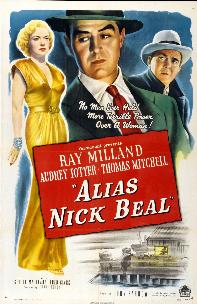
Ray Milland portrays him in bodily form, providing a deliciously evil turn in fine threads. He’s not quite the “blonde Satan” out of Dashiell Hammett’s Sam Spade literature, but he’s almost there, about as close as you might possibly come in the flesh. With such a devious figure pulling the strings, Alias Nick Beal becomes noir mixed with myth and allusion in a rather unusual manner. It is the first of its kind: a Faustian noir.

The story itself opens in more conventional territory. There’s an earnest, hard-working district attorney named Foster (Thomas Mitchell) who is looking to clean up local corruption, manifested as always by cigar-chomping Fred Clark with his host of slot machines and bookies just looking to rake in the dough.

Try as he might, he’s never been able to deal the definitive blow to the town’s graft. Regardless, he’s an upstanding man of principle with a devoted wife (Geraldine Wall) of many years and a solid base of friends, including local minister Reverend Garfield (George Macready). Of course, even someone like him falls to temptations; they seem innocent at first even honorable. The trajectory of his entire political career starts to change for the better, although his personal relationships are poisoned beyond repair. More on that later.

For now, he has an inauspicious meeting at the local watering hole, the dubious China Coast Cafe. It’s the kind of joint that can only exist in the foggy back lots of some Hollywood studio (in this case Paramount Pictures).

It’s the cheap, low-lit atmospherics of such an obviously stylistic or phony facade that make Alias Nick Beal feel like low-grade entertainment. With noir, however, this often proves more of a blessing, and what’s more remarkable is how impressive the cast manages to be. The cafe also happens to be a fitting place to meet the devil’s incarnate.

No, Foster doesn’t go and sign the pact right then and there. His new acquaintance is far too cunning, far too diabolical to be so direct. But it comes soon enough as his new undue influence makes an insidious impact on the politician’s life. Isn’t it true that small habits compound as days, weeks, months, and years go by before you realize how much you’ve actually changed? Whether good or bad.

Simultaneous with his public ambitions, Foster’s reverend friend helps run a boys’ home not unlike similar storylines in Boy’s Town or Angels With Dirty Faces. It’s a conventional if generally uninteresting element. The one moment prodding the movie’s core conflict with a stick comes with the daily Bible reading.

Nick doesn’t want to be caught dead near the good book, but the minister opens it all the same as is his practice reading the following words to his charges:

“The earth is the Lord’s, and the fullness thereof; the world, and they that dwell therein. For he hath founded it upon the seas and established it upon the floods. Who shall ascend into the hill of the Lord? Or who shall stand in his holy place? He that hath clean hands, and a pure heart; who hath not lifted up his soul unto vanity, nor sworn deceitfully. He shall receive the blessing from the Lord, and righteousness from the God of his salvation.”

If they’re not obvious already, the passage is an implicit call for Foster — to make him take heed — a warning against his current trajectory. Nick knows if Foster heeds the words, all his tireless work in interference will be thwarted. However, he’s still got some tricks up his sleeve.

One of them is named Donna Allen (Audrey Totter), a dame he found out on a street corner by the same upstanding establishment he just happened to meet Foster at. Audrey Totter does her gloriously acerbic rendition for this strange character and plays it nice and tender as well. It’s a fluid performance for a peculiar role calling for a hooker to get promoted in status to that of a campaign manager and confidante.

Suddenly, the works of devils and angels don’t look altogether dissimilar. After all, he raises this woman of ill-repute out of the gutter, gets her an apartment, drapes her in mink coats and stoles. However, it’s the ulterior motives that are most revealing.

Because eventually, Nick has worked his way up — greasing the wheels of Foster’s ego as it were — so they can start talking about the murky grays of politics. His line of arguments are deceptive to the point he has his victim finds himself conceding on the same points of moral bedrock as Claude Rains in Mr. Smith Goes to Washington.

They buy into the lie that this is the only way to get anything done. Maybe it is partially true. Who am I to say? Conveniently, in the other picture, Thomas Mitchell was the wisecracking journalist who could observe from a comfortable distance. In this one, he’s embroiled right in the middle of the mess.

With Nick Beal constantly needling him and all the conflicting forces and voices in his life swelling, it really is a tug-of-war for his soul. Everyone wants a piece of it. His wife, the reverend, Nick, even Donna. It’s the intent that colors their true character.

Thus, Alias Nick Beal is an impeccably noirish take on spiritual warfare — the necessity of “pinning the devil to the mat” — before he totally makes you into a self-serving, arrogant person. Given the context it’s already working within, Nick Beal is a creative riff on Faust, but it never feels like full-fledged noir since the moralism is laid on a bit thick.

Neither of these elements is altogether detrimental, but it does feel like the movie is diluted in all its efforts. It’s this curious amalgam of disparate points of interest and self-reflexive in its orchestration with Milland being allowed to be villain and impresario. Again, the pieces and the resulting performances are intriguing, but it feels too cut-and-dry in the scripting department.

There’s never the great intrigue of watching a movie where we imbibe the sense of drama, romance, laughter, or whatever else. It feels like a story is being spun for the sake of Nick Beal so we can see him pulling the strings in front of the camera. Meanwhile, other themes are either cast aside or never fully explored. They could have been the building blocks for another movie entirely.

All told, I’d put it a couple rungs under the likes of The Bishop’s Wife and Here Comes Mr. Jordan. And it’s not quite on par with director John Farrow’s The Big Clock or His Kind of Woman. Milland is enough to make it nearly worth it.

3/5 Stars


Last Train from Gun Hill (1959): Douglas Vs. Quinn

the last train from gun hill.pngThe action begins with a chase of sorts, except with the men pursuing a buckboard, carrying a woman and a young boy, it’s more like a game of cat-and-mouse. As a Native American maiden and a pretty one at that, they look to have their way with her. A horrible incident follows, and it’s a fairly frank depiction for the 1950s.
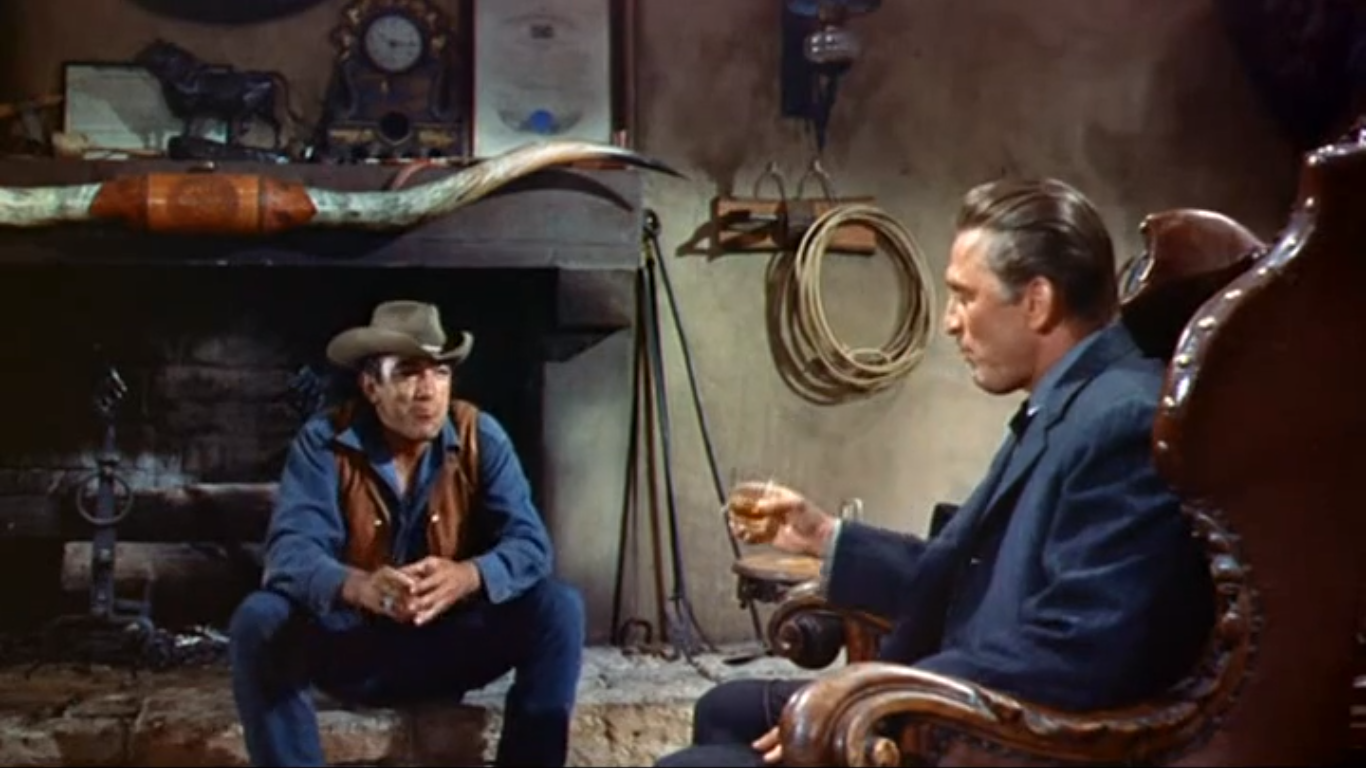
Meanwhile, a local Marshall (Kirk Douglas) can be found regaling the kiddos with a story about the olden days, 10 years prior. It’s strangely light in contrast to the preceding scene. This is precisely the point because never again will we see the Marshall with such a jovial demeanor. We must wait only minutes to comprehend how our pieces fit together. Because this young boy, his son, races to call upon his father. It is his wife who has been brutally ravaged and left for dead.

There are only a couple of clues to go by. The first is a deep scar on the cheek of one of the perpetrators. His wife did not give up without a fight. The second is an abandoned horse with an ornate saddle. He knows it well. It belongs to an old friend: cattle baron Craig Belden.

Because the man who raped Catherine Morgan was Belden’s gutless son. The other man was one of his many hired hands. If not already clear, the dramatic dilemma becomes even more tenuous. The Marshall wants justice and resolves to pay his old buddy a fateful house call.

Under any other circumstances, these two men would be meeting for a drink to wax nostalgic about old times — the glory days — because it’s true things were different back then. As we have a habit of doing, we memorialize our youth, and the friends and experiences we gird around us as young men commonly follow us our entire lives.

But now they must factor in their current lives. Morgan’s wife is dead. Belden’s last kin is his boy Rick (Earl Holliman). Family is everything to the two of them, and it finds them at odds across most fragile lines.

Soon enough, this western finds its tracks along with the lumbering steam engine barreling through the local town. It’s the age-old format gleaned from High Noon and 3:10 to Yuma. A showdown is inevitable. The train is the method by which locals keep time. It’s is a destination, a symbol, and a way in which to move from here to there. It brings people in and takes them out. Sometimes to leave and find a new life. Sometimes to end someone else’s life.

And yet, as alluded to already, this western is far more personal. This is its strength because Kirk Douglas and Anthony Quinn, as old chums, are pitted against each other under very unpleasant circumstances. But the story also requires someone who can stand up to Kirk Douglas as far as acting chops and screen presence go.

If not exact equals, they keep the playing field level based on their enduring differences. Neither is looking to budge. One, a marshall with an unassailable will. The other, a cattle baron who owns the entire town. They represent justice in two divergent forms, as individuals enacting the law as they see fit, whether through dictatorship or vigilantism.

The Marshall tries to drum up some allies in town. The stand-in for sheriff is always about taking the long view. That is, whatever will let him keep his craven neck alive. Realizing the whole town’s on Belden’s side, he settles in for the long haul, taking the young upstart prisoner and holding up inside an upstairs hotel room — his captive manacled to the bedpost. The stakes are set firmly in place, milking the tension to the nth degree. We know what must go down if no one budges.

the last train from gun hill 1.png

Earl Holliman’s not necessarily as adept at mind games as Robert Ryan in The Naked Spur or Glenn Ford in 3:10 to Yuma, but he proves he can play the jerk. He’s the detestable combination of an entitled rich kid and a spineless loser.

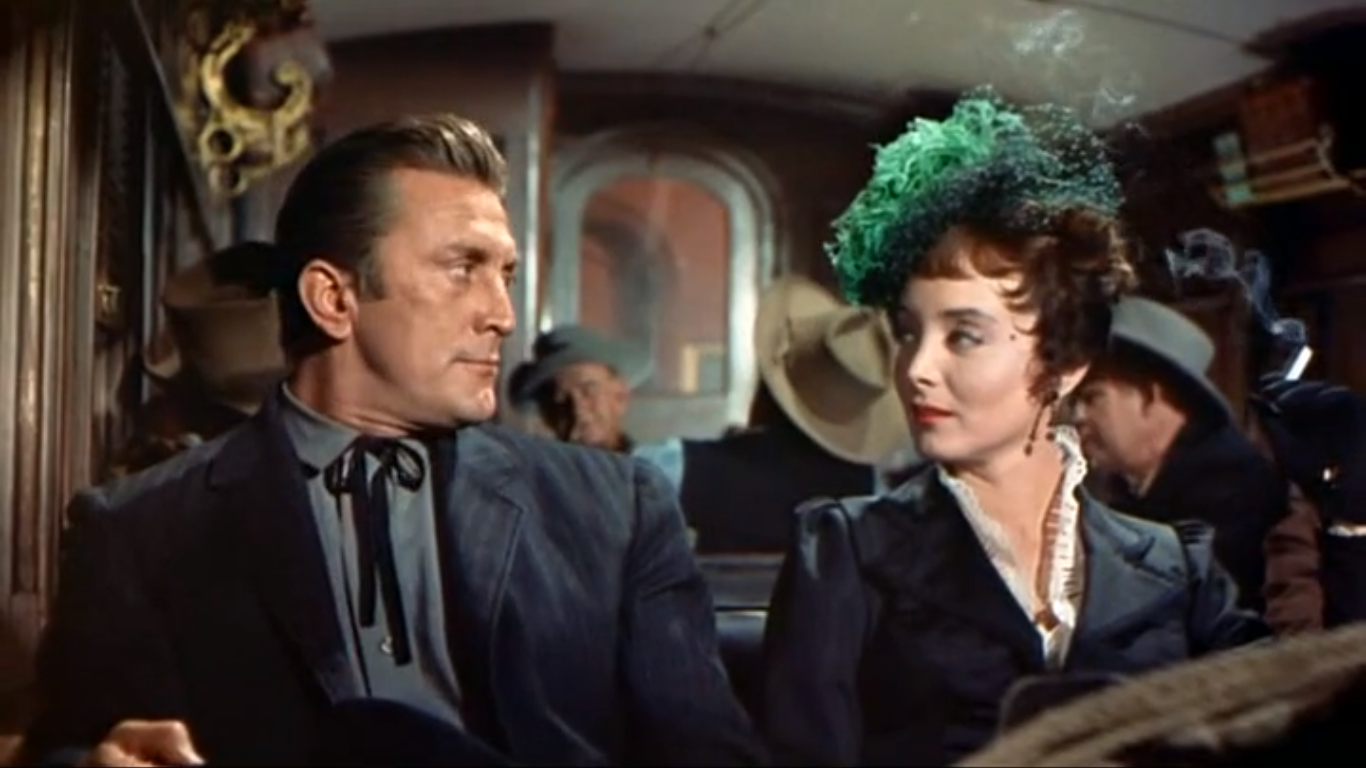
It’s a misnomer to say there are no sympathetic figures. Morgan makes the acquaintance of one on the train into Gun Hill. She too has a past with Belden. In a town and theatrical landscape literally dominated by men, Linda (Carolyn Jones) has to be strong and a bit of a pragmatist. For these very reasons, she wants to see the Marshall succeed in his foolhardy task.

So, in fact, he has one minor ally for the very reason she’s not completely against him, though she’s not looking to play hero. Nevertheless, she admires a man with manners and the moral compass to hold doggedly to his principles. In a passive way, she’s in his corner, if only because he has the gumption to stand up to her old beau. However, she comes to be more than just a mere observer. Linda gives him his lifeline for bringing his crazy plan to fruition.

With tension mounting, he leads his prisoner out of the hotel with the whole town watching, all the guns trained on him, and the 9 o’clock train arriving just as planned. He marches out with his shotgun square on his prisoner’s quivering jaw. He’ll get it if anyone moves and so we have a contentious stalemate. By some crazy circumstance, he might find a way to achieve justice yet. Because, again, the train is a symbol. It reflects what he might still be able to do if he can only get there.

In the end, it barely matters. It’s a partial spoiler yes, but this was always a story about relationships more than anything. The draw must blow up somehow before reverting to its most crucial point of conflict. It’s all over and yet we’ve reached the inevitable point of no return. A hesitant Marshall is called to draw on his best friend. He doesn’t want this.

But Belden is an equally proud man, and he lives by a certain creed of western masculinity. You must face a man for any personal affront to your being. There is no other way. Even if he has to die in an ensuing shootout, he’s done his paternal duty for his flesh and blood. One must question what the bloodshed accomplishes. In this film, it’s a fitting end of fatalism. Whether it could have been avoided is quite another matter.

3.5/5 Stars

Note: This review was written before the passing of Kirk Douglas on February 5th, 2020.