Detective Story (1951)

detective story 1

“Who are you, God? Didn’t you ever make a mistake?” – Cathy O’Donnell as Susan Carmichael

Counselor at Law (1933) was an early William Wyler film from the 1930s that shares some cursory similarities with this feature. Along those lines, Detective Story proves to be an exploration into the life of a cop much as the earlier film allowed us to look through the keyhole at the life of a lawyer (John Barrymore). Fundamentally they also both provide the same cross-section of society with Wyler navigating the space in such a way to tie the threads together while keeping things engaging.

Detective Story proves to be a stage play and a morality play in one fell swoop and that is decidedly both good and bad. It’s true that the crossroads of so many films and talents meet here and all share a room together.

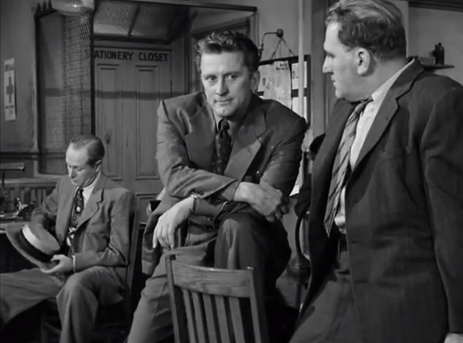
There’s another fiery role for “Mr. Instensity” himself Kirk Douglas as Jim McLeod, a man who strives to rid the streets of criminals and put them where they belong: The electric chair. He wants to be judge, jury, and executioner if at all possible. His all-out war on crime can be traced back to his lousy father. Ever since those days, he’s vowed to be everything his old man never was — not tolerating any kind of infraction of the law. It’s a thoroughly intense portrayal though it jumps off the emotional deep end a few times too often.

It’s his supporting cast that steadies him and guides the film toward something more authentic and attainable. William Bendix was potentially slated for a reunion with Alan Ladd before Douglas ultimately took the role. However, he trades out his image as a heavy for a policeman with a decent dose of humanity.

Frank Faylen is the acting desk clerk who fields all the incoming calls that come his way. Meanwhile, Lee Grant is a skittish young purse snatcher who winds up at headquarters for her first offense. Cathy O’Donnell (wife of screenwriter Robert Wyler) plays her always immediately likable ingenue role as the young woman trying to bail out her childhood friend on a charge of theft.

There are a number of others including journeymen cops, journalists, and four-time losers and then there’s McLeod’s wife Mary (Eleanor Parker). I’m not sure what to evaluate Eleanor Parker on but in the recent months, I have gained an appreciation for the fact that, good or bad, she will fearlessly commit to a role and pour her all into it. She owns a very eclectic body of work as well but Detective Story sees her succumbing to histrionics much like her onscreen husband.

Because at its best Detective Story is a slice-of-life drama that gives us insight into humanity much as Counselor at Law (1933) did. But this picture is high on the dramatics and whether or not they are completely believable is up for contention.

It’s also a fairly frank picture at that — at least for its day — though it does point out the duplicity that’s so blatantly clear.  Here a taboo is utilized as the fodder for melodrama as something so despicable. Yet in the heart of Hollywood itself, there were undoubtedly many women who did similar covering up jobs to save their reputations.

The Hays Code could try and keep taboos under raps but in doing so they were ignoring an unfortunate reality. It is necessary to remove the shrouds and let these things live on in the light.

But far from seeing this film with our enlightened postmodern sensibilities and condemning it for making such a frank subject seem sullied and unseemly, I would contend that this picture leaves me melancholy. Not for the reasons you might expect either.

I feel sorry for women ostracized and labeled as “tramps” like Mary is. I’m ashamed that there is a standard that everything must be good and pure. There is no room for grace. It’s this hypocritical nature that’s blatantly obvious in McLeod with the bitter irony coming to fruition. He became the very person that he was striving never to become.

The depressing depths of the drama suffocate any chance of a laugh by the film’s latter half and so while I’m all for fatalistic even tragic denouements in the right context, this film is so utterly discouraging and it has nothing to do with desiring a happy ending. It’s more closely related to the lens in which the film seems to use. There’s no integrity left in humanity. A world where beating hearts of flesh have been transformed into hearts of stone. That’s a very dark world to try and reconcile with.

Worst yet it does try by heaping on more drama and last minutes heroics to right all the wrongs in a matter of seconds. So we lose on two accounts. The picture doesn’t have the guts enough to dig into its disconsolate inclinations and still for almost its entire runtime it’s focused on those precise conflicts making it supremely difficult to enjoy Detective Story as much as we could have.

3.5/5 Stars
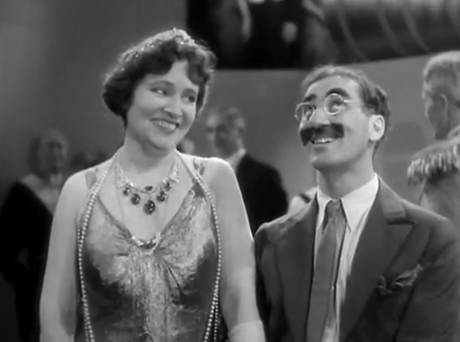
Review: Duck Soup (1933)

duck soup 1

Up until this point in time, The Marx Brother’s all-out assault on humanity had still mostly been geared at the likes of stuffy socialites, gangsters, college campuses, authority figures, etc. Albeit entertaining but fairly straightforward worlds where there was not that much to be navigated beyond what we already knew to be true. All that was necessary was to sit back and enjoy the boys at work and cue the rolling in the aisles.

Their audiences by now had been conditioned with a certain type of environment. The framework is still somehow familiar in Duck Soup as well — at least on first glance. There we have Margaret Dumont at the center of it all surrounded by a bunch of stuffy bespectacled chaps with beards. She is calling for the resignation of one of the leaders of the nation of Freedonia.

Her choice to fill the position is none other than that progressive visionary Rufus T. Firefly (Groucho). Why she thinks he is anywhere close to being qualified is slightly beside the point. We just want a chance to see Groucho and he receives the usual majestic fanfare rushing down the fireman’s pull to see what all the hubbub is about.

Meanwhile, Louis Calhern of the adjoining nation of Sylvania is simultaneously conspiring with a cunning mistress to ignite a revolution and take over the country from within while also attempting to woo the prominent Mrs. Teasdale.

Two spies are tracking Firefly right as they speak. In fact, they’re a lot closer than they might think. They’re his brothers. Scratch that. They’re Pinky and Chicolini sent to scrape together some dirt to discredit him with the people. Little does their ringleader know that Groucho, errr, Firefly has been doing a good enough job being disreputable all by himself.

Only when Margaret Dumont has returned back in the fold do you realize how much she improves Groucho’s jokes. Years later the man said himself that the key to the magic was the fact that she never understood any of his barbs — much less why they were funny. However, in this particular outing, Louis Calhern and the demonstrative lemonade vendor Edgar Kennedy do much the same for the other two conniving troublemakers, Chico and Harpo. They’ve never truly had such a good foil as Groucho had in Dumont.

The picture segues into a scene where Groucho sticks his head out the window overlooking a peanut vendor and pretty soon Chico is being offered a spot in Groucho’s cabinet. Sounds about right. Likewise, Harpo gets in on the action and the most surprising discovery is that his body is covered with art in the film’s next truly surreal interlude.

Now with such crucial positions so close to Groucho, who coincidentally would have probably offered positions to a chimpanzee if given the chance, the two infiltrators are called upon to steal Freedonia’s war plans. Again, who cares?

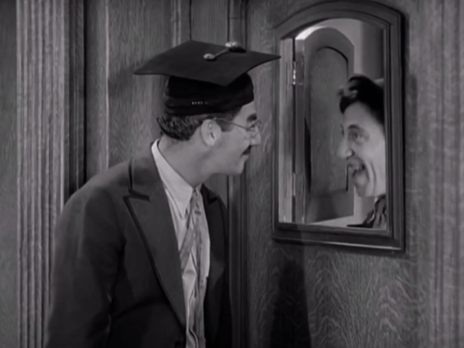
Crucially, their little escapade sets up The Marx Brothers’ next iconic gag with three Groucho’s dressed in nightcaps and pajamas. The mirror scene is the most remembered bit and it’s fun but it’s only a segment of a whole drawn-out sequence that plays on the brothers’ mistaken identities. This in itself could be another commentary if you wanted to make it into one.

Personally, it struck me for the first time that though physically the sequence revolves around Groucho, much of it takes place in Harpo’s world without any dialogue. Furthermore, there are times when we don’t actually know who is Groucho or who is not until we are given cues whether Chico’s trademark accent or Harpo’s hat.

First, the mirror is shattered and then reality when one Groucho steps out and is replaced by another only to be joined by a third. Regardless of what you want to say about this realm of the absurd, it’s a great gag.

duck soup 2.png

Then there’s the final sequence which is the actual escalation of the war between the two belligerent countries but it’s done with the typical tongue-and-cheek manner you might expect from the brothers where war is equated to a minstrel show and Groucho breaks out into a slightly doctored spiritual, “All God’s Children Got Guns.” From thence forward let the surrealist nonsensical nature of war take over.

For me, Groucho sums it up in sending Chicolini off to battle, “While you’re out there risking life and limb through shot and shell, we’ll be in here thinking what a sucker you are.” This was no grand anti-war statement. If anything it was a cynical statement. Of course, that doesn’t take into account Groucho’s constantly changing military garb from Revolutionary War attire, Civil War uniforms, a coonskin cap, etc. It was comedy pure and simple.  

In my mind, it’s no small coincidence that one of the Brothers most reputed films was also directed by Leo McCarey who in some respects still remains criminally underrated. Certainly, he was more a Cary Grant director than a Marx Brothers one but there’s a sense that he could focus their comedy into something utterly electric.

The irony of it all is that The Marx Brothers really hadn’t changed all that much but the way people perceived them and by extension, how they perceived their comedy, had provided this new context that surrounds Duck Soup. So people could start placing all types of assumptions and beliefs onto the film in ways that were most alarming and subversive.

I think the brothers themselves may have even admitted that they unwittingly rather than consciously made this departure. But the implications were great and cultivated the soil for a film that’s legacy would only grow year after year. And it’s true that there really is no superfluous scene. There’s no real chaff as it were even if it is all utterly marvelous absurdity.

However, it made just enough sense for Mussolini to ban the film on grounds of pointed satire. One last time let’s turn to Groucho who would have been overjoyed by such a response but pointed out, “We were four Jews just trying to get a laugh.” That was all. But it was so much. Duck Soup is a pinnacle of comic nonsense.

4.5/5 Stars

Review: Horse Feathers (1932)

horse feathers 1.png

At Paramount Pictures The Marx Brothers released a row of comedies with seemingly arbitrary names evoking fauna like Animal Crackers, Monkey Business, Horse Feathers, and of course Duck Soup.  The phrase  “Horse Feathers” is essentially a variation on “Nonsense” though it sounds rather archaic by today’s standards. That hardly detracts from any of its charms as a film.

There must be a location — a place for the brothers to be unleashed upon the world where they can belittle and bash heads all at the same time. What better place than a university campus that pantheon of learning dating all the way back to the Greeks? It commences with a perfect opening ceremony that’s quintessential Groucho.

He accepts his new post by badmouthing his eminent predecessor, pulling on the facial hair of all his eminent faculty, besmirching the reputation of his eminent institution and singing a typically cheeky ditty, “I’m Against It.”

His son played by none other than his younger brother Zeppo has been spending his idle hours outside of the classroom and off the football field in the company of a College Widow (Thelma Todd). Much like “Horse Feathers,” this might come as another antiquated term or at the very least euphemistic. It usually denotes a woman who lived near college campuses to romance male students. She was commonly known to be easy pickings. But that’s enough context. Watch the film and you’ll probably have all the context you need because Groucho wants to get in on the action too — not to mention the other brothers.

However, there’s more important business at hand. Namely the fact that Huxley hasn’t had a good football team since 1888. Even in 1932 that was still a very long time ago. As Groucho notes they’re neglecting football for education. At the behest of his son, he personally heads down to the Speakeasy to dig up some talent. It isn’t the least bit ethical so obviously, the school’s new head promptly heads straight there.

Before he can enter, however, he needs to provide the password and you guessed it the gatekeeper is the bootlegger Baravelli (Chico). Getting inside is more convoluted than you ever imagined. Of course, the actual joint is then Harpo’s personal playground and overflowing slot machine. His hat runneth over so to speak. The steady stream of gags keeps on flowing.

I was genuinely cracking up whilst Harpo stokes the fire with books in Wagstaff’s office Groucho remarks that Baravelli has the brain of a four-year-old boy, and “I bet he was glad to get rid of it.” Classic Marx Brothers.

Follow that up with an invasion of a lecture hall with Chico and Harpo taking up seats in the front row after their typical fisticuffs while Groucho stands by making snide remarks over the professor’s shoulder. Another perfect scenario capped off by Groucho taking over and getting caught in a spitball war with his two most unruly students.

horse feathers 2.png

Next, it becomes grand central station in the promiscuous college widow’s pad with slabs of ice getting repeatedly chucked out the window and Groucho repeatedly breaking up the action and the fourth wall by talking to the audience. He even invites them to go out to the lobby during  Chico’s piano playing. To be honest, I was never that big of a fan. Each of the brothers pays the dame a visit as does her other beau backing Darwin while Groucho constantly makes a chore of carrying out his umbrella and rubbers before exiting the busy room.

We have the resulting romantic date on the lake with the dame conspiring to steal Huxley’s signals. Groucho’s serenade of “I Love You” is the kicker. In fact, it’s very true that everyone says I love you — including each of the brothers — each in a very different way. Meanwhile, Todd assaults Groucho with baby talk and he all but tosses her out of their dingy (in case you didn’t realize, they had Life Savers candy back in 1932).

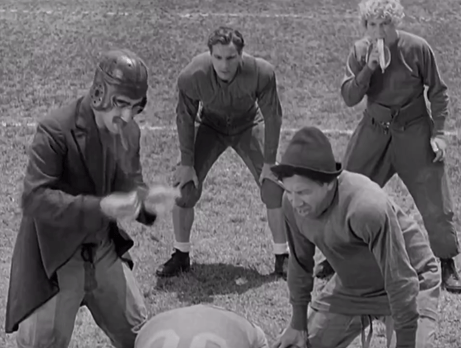
But the finale comes on the football field and there’s no doubt that Chico and Harpo liven things up. The most storied gags are courtesy of Harpo including a football yo-yo and laying down a minefield of banana peels, and of course chariots. They have no respect for the game. What better way to sum it up than marriage Marx Brothers style. They have no respect for that institution either.

Whether or not its second tier to the likes of Duck Soup (1933) or Night at the Opera (1935) is beside the point aside from being purely dismissive. Watching the boys at work here is arguably as wild and deliriously funny as anything they ever put to film. Here is a comedy that wonderfully condenses all that these brothers stood for as far as comic hooliganism was concerned in a gag reel that never has time to run out of steam. A wonderful summation of what college might be like if the Brothers had ever had the good fortune of making it there. Regardless, it’s a joy to the very last hike and the very last frame of chaos.

4/5 Stars

Review: Monkey Business (1931)

monkey business 1931.png

“Love flies out the door when money flies innuendo.” – Groucho Marx

To call on an unforgivable quip worthy of The Marx Brothers, this film is a barrel of laughs. Hardy Har Har. I promise. Never again. I’ll leave it to the professionals. I never was much for comedy anyway…

It’s true these men had approximately 20 years of vaudeville and 5 years on Broadway under their belts even before moving to film. They were a well-oiled, grease-painted machine by now.

Because while some of their puns might be horrendously awful, they come in such a constant barrage of quips and commotion, it’s difficult not to tip your hat in deference. The Marx Brothers are a force to be reckoned with on a great many fronts.

In this particular instance, they are four stowaways who are singing “Sweet Adeline” in the ship’s hull on a transatlantic voyage. It’s the stuff of urban legend whether or not Harpo can actually be heard singing in the film (Later on he gets a little help from Maurice Chevalier on a phonograph).

They spend much of the film’s opening half fleeing the ship’s Captain and all his staff who are looking to put the brigands in irons. But they’re a slippery bunch and they find plenty of time to get into all sorts of mischief as they do best. After all, that’s what they’re there for.

The narrative is blessed by a greater fluidity than its predecessors meaning the Brothers can scramble around and they have an ever-changing array of sets to do their worst. In the same sense, it suggests that they have graduated from mere stage to screen adaptations and are finally getting their feet wet in what the cinema truly has to offer.

It also boasts the swellest live-action Punch and Judy show you’ve ever seen courtesy of Harpo’s pantomime as he outsmarts his pursuers while trading the type of blows you’d expect with such a violent form of entertainment. It’s for the kids.

Groucho and Chico overrun the Captain’s quarters with colossal impudence calling for lunch to be served and finding time to play their typical back and forth over a globe and the history of Columbus sailing the ocean blue in 1492. They were never ones to connect linguistically, though they do agree on one thing amid the stultifying banter. They’d rather be talking about nurses.

Then Chico and Harpo showcase their ineptitude as barbers when cutting a man’s mustache. Their game of too long-too short soon has him looking like Charlie Chaplin and then the cleanest baby face on deck. Likewise, they disrupt perfectly civil chess matches and bowl over innocent bystanders. Harpo even befriends a frog.

Meanwhile, Zeppo the most straight-laced of them all charms a beautiful young woman with greater implications. She’s a perfectly innocent girl but her father is a fairly notorious gangster, Big Joe Helton.

Groucho quite by accident ends up in another gangster’s closet and works on wooing his mistress (Thelma Todd) with his suave dancing and witty one-liners. Groucho’s dancing and guitar playing are on point with that iconic half crouch of his, coattails flying and strings twanging with raucous abandon. Harpo and Chico might be considered the more memorable indulgers in the arts but I almost prefer Groucho. Maybe its a matter of relating to him more.

You expect him to get a belly full of lead but this is the Marx Brother’s Universe so he and Zeppo get hired on as heavies. That brings us to the film’s main conflict if there is any. The Brothers unwittingly find themselves on opposite sides of a gang feud. They never were much for gun-toting, preferring a more primeval form of violence known as slapstick.

A lavish gala is held by Helton only to have his daughter kidnapped by his mortal enemy. The terrace is almost more interesting as Groucho starts meowing like a suggestive kitty picking up the prancing two step where he left off with the same gangster’s moll.

But let us not forget someone was kidnapped. A barn proves to be a fitting setting for the final showdown Marx Brothers-style as Groucho provides color commentary and Chico and Harpo conk their adversaries over the head like they do best. Zeppo’s the only who’s up to any serious fighting.

Monkey Business is probably the first Marx Brother picture to realize their talents with cinematic scope. The wealth is spread wonderfully with each brother alotted the time to shine — showcasing their various shticks — but the medium also provides greater avenues for the sake of a punchline. They would only push the envelope further with Horse Feathers (1932) and Duck Soup (1933).

4/5 Stars

Girls About Town (1931)

girls about town 1.png

I came to this film for Kay Francis and I stayed because of Kay Francis, George Cukor, Joel McCrea, Eugene Pallette, and Lilyan Tashman. All to say, it is a supreme pleasure to watch this cast in action and already Cukor seems capable of handling the material in a way that intuitively understands the comedy while never losing sight of the romantic heart. That balance seems key.

But we also see another Cukor hallmark with two strong female characters who are central to the film’s integrity. Wanda (Francis) and Marie (Tashman) make a living as girls about town. They are bankrolled to get comfortable with out-of-town businessmen. Because a little female company and a lot of bubbly makes any business transaction go down smoothly.

Marie doesn’t mind the vocation but you can see it in Wanda’s eyes. She’s tired of the same haggard men and droll conversation. She wants something of a little more substance. An actual man and a real relationship.

Yet she concedes to do another gig as part of a yacht excursion that’s looking to schmooze a wealthy whale of a man named Benjamin Thomas (Palette). He also is a self-proclaimed king of practical joking. In fact, he doesn’t know when to quit whether it’s glasses of water or deep sea diving for golf balls. Marie gravitates to him for a laugh.

Meanwhile, Wanda has her eyes set on the younger one, Mr. Benjamin’s associate (McCrea) who isn’t much for conversation or any kind of companionship. As hard as she tries there’s nothing doing. But they finally strike up a compromise by playing “pretend.” Their relationship becomes jovial. The only problem is that Wanda is falling for a man who never meant to romance her. Things get a little too real.

But thank goodness, the feelings are mutual and it looks like they will be together for good. A zoo might as well be the tunnel of love as our two euphoric romantics smooch their way through the animals. At this point, the love story is floating on air. Until Jim mentions marriage.

Here Girls About Town earns its keep as a Pre-Code picture due to its subject matter, the flippancy with which it deals with romance, and even fairly radical views on the necessity of the institution of marriage between two people.  None is the focal point per se but they certainly make the picture quite bold even in what it deems to be the status quo when placed up against films that came a mere three or four years later. The inevitable bomb is dropped but it hits like a pin drop. She’s married already. She doesn’t even bat an eye. Divorce is what is called for and there’s no reason her husband would not grant her one. She hasn’t lived with him for a time.

girls about town 2.png

The films secondary narrative involves Benny’s own wife coming back into his life to try and save his reputation only to join forces with the surprisingly reasonable Marie as they scheme to get the old curmudgeon to spend his money and show his affection for his wife.

The final complication just gets better and better and it keeps the picture interesting. At this crucial stage, Wanda’s spineless husband Alex turns an about face and crosses paths with Jim to talk it out.  Now the indignant Jim smells blackmail and lashes out not only at this man but his formerly soon-to-be wife. You can see the heady implications.

But there’s something more to Alex. Perhaps he’s not the villain we assumed him to be. That would have been too easy. So instead of getting the money back from him, Wanda sets her sights on the next best option. An impromptu auction is undertaken as the girls rally to raise $10,000, complete with a heel for a gavel and a wheeling-dealing Marie presiding.

Certainly, it’s not the necessity but the principle of the matter as Wanda wants to pay her man back to show her true character. She was never looking to take advantage of him and she is willing to go to great lengths to renew his trust. It’s made easier by the fact that he’s torn up about what happened. Now she has him where she wants him. Her days as a girl about town are numbered.

Ernest Haller is our cinematographer and there are several setups that are particularly interesting because they trade out our normal frame of reference as the audience by putting us in different places. The first instance comes in the zoo where we find ourselves literally inside different cages with a bear and then some reptiles.

Then, there’s a later sequence where we similarly end up behind the glass of a display case. And of course, we can’t hear the exchange going on outside but the pantomime gets it across just fine. But the creme de la creme is the flurry of close-ups on Palette’s face when he sees all the jewels that he thought he bought for another woman on his wife. Priceless.

3.5/5 Stars

If I Were King (1938)

if i were king 1.png

There’s a moment in the film that can’t help but draw us back to Genesis where Joseph (of technicolor dream coat fame) has risen in the ranks of Egypt and finds himself with the lives of his brothers in the palm of his hands. He’s able to toy with them while also blessing them immensely. It’s easy to see the hand of Providence at work. Nothing so meaningful happens in If I Were King but there is, nevertheless, a similar moment.

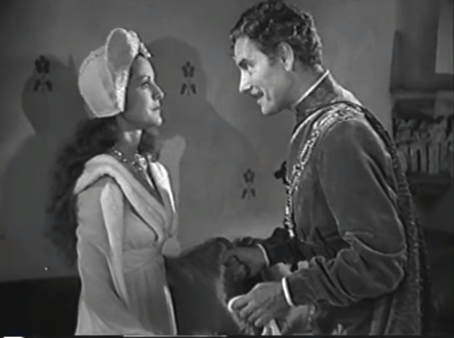
Ronald Colman plays the charming, most agreeable of vagabonds and that’s hardly a complaint. We might call into question the validity of his portrayal of such a mythic figure as Francois Villon but we can never doubt his pure charisma.

Francois Villon as witnessed in this film, directed by Frank Lloyd (Mutiny on the Bounty) is a glorified scoundrel who might be a far cry from the man who actually bore the name Francois Villon but, once more, do we care? Hardly.

Preston Sturges’ quill is in playfully fine form mixing eloquent verse with a lightness of being that’s able to upend typical medieval drama with its warring nations, kings, and battles. All of the aforementioned are present but they’re made rather more enjoyable. The tongue in cheek nature of it all enlivens any dips into needless melodrama.

Instead of stringing this man up for his obstination, insubordination, and theft the giggling king (Basil Rathbone) proceeds to make the same man commander of his armies for not only killing the most loathed traitor in the king’s ranks but also boasting he could do a far better job running the kingdom. The origins of a new medieval gameshow are afoot: King for a week.

Basil Rathbone shines in a particularly enjoyable performance for its various quirks including a cackling delivery that feels completely at odds with the persona he cultivated with the majority of his villainous roles. In other words, it’s a real corker.

Meanwhile, in his newfound place of power, the remade Grand Constable finds he has considerable influence. First, to free his friends from the caverns of the dungeon and being by the king’s side to advise him in his moment of crisis. You see, his generals don’t want to fight the militant Burgundians who are about to lay siege to his kingdom.

Villon receives a stroke of genius from the lovely lady in waiting (an exquisite Frances Dee clothed in royal opulence), unload all the kingdom’s food supplies to the poor so the feckless military leaders will get off their duffs and be stirred to action with their larders all but depleted. It’s a drastic and terribly outrageous solution but it does produce some results.

The earlier raucous swordfight within a tavern against the king’s constable is only surpassed and subsequently quashed by the sheer magnitude of the final conflict between the Burgundian marauders and the city’s protectorate — a sequence that was declared to use some 900 extras. It’s certainly no hoax watching the mad chaos of clattering steel.

It was some time into watching this medieval period piece that I realized if Hollywood were to remake such a film as this or one of a similar nature it seems like there would be an unspoken impetus to somber it up and make it into high drama.

All but gone are the days when period dramas could be fun with a touch of whimsy to go with the usual action, adventure, and romance. Errol Flynn and Ronald Colman, those charming heroes of old, are a forgotten breed of leading men and the last time I remember a film channeling this same enjoyment in such things was The Princess Bride now over 30 years ago.

In truth, I suppose the space for medieval heroes and swashbucklers has been edged out by newer and bigger blockbuster beasts. Namely, sci-fi and superhero mammoths that have taken over the main stage. And I have nothing particularly against said tent poles mind you, but I do long for more pictures like this one. Period pieces that don’t have to be so serious. They can have fun too (even if historical accuracy goes a bit to the wayside). That’s a pardonable offense when there’s no pretense for accuracy.

Because If I Were King is blessed by its rich and constantly comedic overtones. That is no doubt the gift of Preston Sturges. This picture can wear the strains poetry and still keep the mood a sprightly one. Films like this are something special.

4/5 Stars

So Proudly We Hail! (1943)

so proudly we hail 1.png

There were three reasons to watch this film. Their names are Claudette Colbert, Paulette Goddard, and Veronica Lake. Yes, this picture directed by Mark Sandrich was fairly groundbreaking in its day for telling a story about nurses during WWII but there might be mixed feelings across the board about how the story unfolds.

While I still try and organize my own perceptions, a moment can be allotted to take stock of our stars. Claudette Colbert strays quite far away from her comedic sweet spot in a dramatic role as Lt. “Davy” Davison that she nevertheless conducts with a compelling fortitude.

The studio also all but got rid of the iconic peekaboo bangs of Lake and exchanged any of her many noir gals opposite Alan Ladd for a vengeful nurse, Olivia D’Arcy, traumatized by Pearl Harbor and the dirty Japs who ruined her life forever. She’s practically a different person.

Although Paulette Goddard hardly ever appears in a sweater, the boys are still enthralled by her like always but even she is given a major reality check about the hardships of war. And that’s part of what this film was meant to reflect — that it wasn’t just the brave soldiers who were putting their lives on the line — but there were legions of women too sacrificing and giving their all.

Paramount also did a very commendable thing in trying to de-glamorize their biggest stars in deference to delivering this stirring patriotic drama as a eulogy to all of those at Bataan and other South Pacific battlegrounds. But while the intentions are admirable, there’s this underlying feeling that Hollywood still creeps into the story far too often, which makes sense, since this is a Hollywood picture.

It all begins with an extended flashback as the film follows the nurses through their deployment. First, there are the tearful send-offs leaving families for the first time or gals leaving their best guys. In the case of Joan (Goddard) she gets away from two of them and by the time she’s onboard, it looks like she’s already landed a new one (Sonny Tufts).

In the wake of the hysteria following Pearl Harbor, the nurses are for the most part caught in a fog of war without any knowledge of what is going on and the Japs have all but jammed their communications. They continue floating around listlessly just waiting for some definitive plan of action.

When it comes and they are brought in as reinforcements to the Bataan peninsula. Here finally it seems we get our first look at the front lines. What reality really looked like. The mayhem that overtakes any war zone. It’s pure insanity. By the film’s midpoint, they are being pushed back and the evacuation becomes a life or death ordeal. We finally begin to see the casualties.

What follows is a single moment that comes like a kick in the gut and it’s a segment in the picture that we cannot criticize for being hammy or over-sentimental, delivering a visceral shock that’s a painful reminder of how abhorrent and horrible war truly is. Lake is allowed to let her hair down for a final instant as she leaves the picture in searing fashion. It burns but there is another inkling that suggests that this might really be emotional manipulation.

My main qualm is that the picture feels fake in a theatrical sense. If it’s true that film puts a mirror to reality, it also seems equally true that we often only care to see what we want to in that reflection. We document that and then do a little touch up afterward. James Agee harshly likened So Proudly We Hail to war through the lens of a housewife’s magazine romance.

My own feelings are perhaps more nuanced. It’s propaganda to be taken with a grain of salt. In one sense it couldn’t be more realistic as a document because it comes out of that time and place as a timely film while the war was still raging abroad. But the narrative is still so wrapped up in romance and melodrama built out of said love stories or personal torment. And yet it indubitably has its affecting moments that are difficult to brush off.

What I really appreciated was that its intentions were honorable. To give a spotlight to women and it also depicted a number of Asian allies in a positive light whether they be Chinese (Hugh Ho Chang) or Filipino children dreaming that Superman will come to save the day.

All this is to say in convoluted terms that So Proudly Hail cannot be condemned as an awful picture outright. It does some things well and others with a level of mediocrity but what do my words matter now nearly 75 years after the film came out?

Hopefully, contemporary audiences were uplifted by its intentions. I’m inclined to recommend another picture taking place during the same time. They Were Expendable (1945) directed by John Ford and starring the trio of Robert Montgomery, John Wayne, and Donna Reed is another title worth considering.

3.5/5 Stars

“I’m a Chinese madame, not an Indian.” Hugh Ho Chang as Ling Chee

Midnight (1939)

midnight 1939.png

“You’re in a fine mess! You got to get a divorce from a man you’re not even married to!”

It was only a recent revelation that Claudette Colbert at times feels far too sophisticated to be playing beautiful hitchhikers or penniless taxi passengers as she does in It Happened One Night (1934) and this film, Midnight. Though it’s easy enough to explain away.

The screwball comedy has always thrived on incongruities as much as it did on the class divides between the rich and the poor. Where the extravagance is almost laughable in its boorish decadence and the little men still have lives seemingly worth living because they are free from societal pressures. After all, making just enough money to scrape by is nothing short of paradise.

In this way, Claudette Colbert was the perfect person to tiptoe this line because she could be cosmopolitan and was glamorous with all those other snooty folks. But she’s also a comedienne like the normal folks, seeing the humor and working it for the laughs just as much as she’s willing to do things that seem normal. A walking enigma she might be but she also makes Midnight a sublime comic fairy tale as our uproarious modern-day Cinderella.

One of her cohorts and romantic partners is Don Ameche, the Parisian cab driver Tibor Czerny who begrudgingly opens up his livelihood on wheels for her as a random act of kindness. As we mentioned before the smartly dressed Eve Peabody has no penny to her name or a franc for that matter.

But what she does have is audacity and it buys her a ticket into a lavish gathering as one Madame Czerny put on by some rich somebody or other. It doesn’t much matter since it’s all only a pretense anyway. Billy Wilder and Charles Brackett’s script unwittingly created the original party crasher plot.

Eve finds herself at a snobby patronage of the arts where the impassioned man at the piano plays either Chopin’s 12th Prelude or his 11th Etude. Again, it doesn’t much matter but it’s hilarious all the same.

What happens subsequently subverts expectations nicely. Instead of getting tossed out of the proceedings she winds up the fourth in a bridge game of rebels warring against tepid entertainment.

There’s the debonair Jacques Picot (Francis Lederer), Marcel (Rex O’Malley) the man who nearly gave Eve a fright by fetching her, and Helene Flammarion (Marry Astor) a married socialite who is more than a little buddy-buddy with the dashing Monsieur Picot.

The charade becomes increasingly awkward the longer it keeps going and going and going. Every Cinderella has her midnight. The real joke comes when the fanciful game finally ends only to be replaced with a new reality as a true to life Baroness. She has no idea how it happened and that’s where our last important party comes in — her fairy godmother so to speak.

Mr. Georges Flammard (John Barrymore) witnessed Eve putting on a nervous floorshow and was intrigued. Now he watches her masquerade continue and he sees how they can help each other out. It has nothing to do with a desire to fool around. On the contrary, in an attempt to undermine his wife’s philandering he wants to bankroll Eve’s little white lie a while longer until she can win Jacques over and pull him away from Mrs. Flammard. It works quite well too.

Meanwhile, the entire cabbie population of France looks for the mysterious girl at Tibor’s behest. It proves to be equivalent to any missing persons agency in town and it comes with made to order traffic jams to boot.

Midnight turns into a magnificent floorshow as all parties collide in an immaculate perfectly timed collision. Eve and Mr. Flammard’s joint ruse looks like it might soon be ousted by Marcel and Mrs. Flammard who are intent on finding the truth about this curious baroness. But the whole fantasy is saved by a dazzling entrance by one well-tailored gentleman, Baron Czerny.

Now a new round of sparring back and forth begins. It’s full of glorious escapades, riotous telephone conversations with fictitious daughters, and Eve and Tibor trying to one-up each other with tall tale after tall tale. One thing Eve has going for her is Mr. Flammard still in her corner working his magic and John Barrymore puts on a fine showing in the film’s latter moments — his devilish eyes still gleaming as bright as ever.

Monty Wooley is introduced into the plotline in the ultimate piece of pitch-perfect casting as an opinionated but easily swayed judge. Thanks be to Classic Hollywood where pompous Americans can preside over a Parisian divorce court. But what matters is the right people get together. So screwball and fairy tales can still coexist. Wilder would prove it once more with Balls of Fire.

John Barrymore has always struck me as the tortured talent of the silver screen. One could contend that he was the most prominent member of the Barrymore dynasty except whereas his siblings Lionel and Ethel aged gracefully he burned out. Midnight came a little too soon for him.

It’s been a longheld fact that Billy Wilder and his writing partner Charles Bracket gifted two quality scripts that were ultimately directed by Mitchell Leisen. The integrity of the work was compromised to the point that Billy Wilder vowed to become a director himself so no one could mess with his material and when the material being messed with was Midnight and Hold Back the Dawn (1941) it begs the question how would the same magnificent films have ended up in Wilder’s hands?

Nevertheless, the actors are a fine gathering of talent while the script does wonders with the typical Wilder-Brackett combination that squeezes innumerable wit out of its wonky plotline. Billy Wilder must always get the last word in and his scripts always do. This one is no exception.

4/5 Stars

Fear Strikes Out (1957)

fear strikes out 1.png

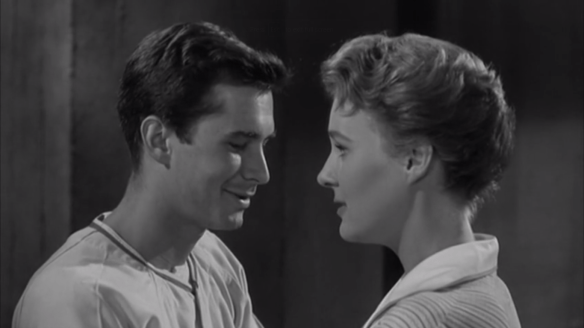
I can’t think of another actor more apt to play this version of Jimmy Piersall’s story than Anthony Perkins. History reflects a more multifaceted even complicated individual.  By other accounts Piersall could be a real cut-up; here the story is very singular-minded in how it portrays its protagonist. It’s played for the drama which it no doubt was but you get to wondering if Piersall had written the script it might have turned out to be more of a comedy.

Robert Mulligan’s film suggests there are arguably the two most important people in Piersall’s life. The first is his father (Karl Malden) who from an early age instills his boy with the onus of making it to the big leagues. That’s the goal and his father watches proudly as his boy becomes a high school star while never letting his son rest on his laurels or let down his guard. He must be constantly vigilant, continually thinking ahead, all in an effort to land a contract with the Red Sox.

He starts out in the minor leagues and there he meets a pretty nurse, the relatively unknown Norma Moore playing the ingenue and his first wife Mary. She makes him deliriously happy and vice versa as they begin to build a life together.

But the conflict at the core of the biopic is Piersall’s own bouts with undiagnosed nervous breakdowns which would be now categorized as bipolar disorder. Put in the context of the era where mental disorders were more often than not left stigmatized and misunderstood, this is actually a fairly fearless film for taking on such source material. But, of course, much of the credit must begin with Piersall himself for being willing to acknowledge it all, to begin with.

Particularly foundational to this film is Jimmy’s ongoing relationship with his father. The scenario happens so often it seems like a cinematic trope but sadly it’s also very close to the truth. It occurs between a parent and their child when they get so vicariously invested and demanding and controlling of their child’s life that they heap so much pressure on them that it becomes nearly an unbearable weight to succeed. Compounded by the fact that these parents are usually trying to realize their own failed talent and never seem to find it within themselves to give their children a pat on the back or a word of encouragement.

You get the sense it was a vicious cycle. Their father never did it for them and so they wind up having a hard time showing any amount of their affection to their kids. It’s something, in this case, that must be earned on the ballfield or in Brian Wilson’s case earned with how many hit records he churned out and composed. Maybe it’s why a parent a la LaVar Ball seems to cherish the spotlight, commanding the media’s attention even more than his boy. Whatever the outcome is, it never seems enough.

It’s purely a testament to Karl Malden’s quality as an actor that he makes Piersall’s father into a nuanced man who is not a holy terror. In fact, even when he doesn’t say it outright we know full well he is proud of his son and he even loves him. He’s not a bad man by any means. That doesn’t make measuring up to his standards any less daunting or his behavior any less damaging.

Though tender and tortured in the everyday moments, Perkins performance on the ballfield feels artificial but you can hardly blame him for lacking the posture or the swagger of a ballplayer where hitting and fielding come as second nature. He looks too much like he’s playing at it — he’s too wooden — not like he’s actually played it his entire life.

Almost uncannily it seems that I find myself at certain movies only after the subjects are gone. Piersall was still a young man in the midst of a baseball career when his story and the subsequent film was made. He passed away in 2017 at the age of 87.

Whether this story is completely true or sensationalized, there’s still an essence of something meaningful here. That we should not be ashamed of our fears and we cannot live life in pursuit of what will earn us the affection of others. It will only succeed in running us into the ground.

That’s why the moment at the end of the film is so fitting, showing Piersall playing a lazy game of catch with his dad. There’s no agenda. No pressure. You simply get the joy of throwing that ball rhythmically again and again perfectly in sync with the person across from you. I’ve done it many a time with my own father and I permanently retired from the game after being little league champions in middle school. Still, I love baseball for those very simple pleasures that it offers.

3.5/5 Stars

The Joker is Wild (1957)

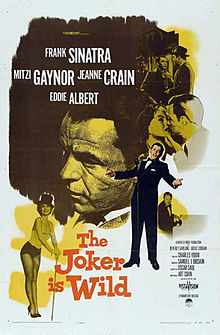
Jokerwild.jpgIt required quite the journey to make it to this film, starting out with a different joker entirely. My introduction to comedian Joe E. Lewis happened because of the late, great Jerry Lewis. Revisiting his life and work I made the discovery that the comedian changed his name to avoid confusion with two men. First, Joe Louis the stellar boxer of the 1930s and then Joe E. Lewis the comedian.

I had never heard of the latter and if you’re in the same boat, here is a biopic that gives a little more definition to his life and times. It seems desirable to actually turn back the clock and see footage of the man himself but if anyone has to play him why not have Frank Sinatra and he does a fine job with a performance that finds time to crack the jokes, throw back a few tunes, while still revealing the inner demons that befall even a funny man. Yet again Ol’ Blue Eyes proves he’s an acting talent to be taken seriously.

Lewis’s beginnings were nearly tragic as he found himself under attack by one of Al Capone’s enforcers who slit his vocal chords and left him for dead after he walked out of his current contract to sing at another club. Except he fought back and even with a shaky voice he found his way to burlesque shows and then stand-up comedy followed.

All the while he was supported by his piano accompanist and best friend (Eddie Albert) and even finds time for love or rather it comes to find him in the form of Jeanne Crain. However, with obligations in serving the troops and his own insistence that a marriage would never work, he balks at popping the question only to regret it for years to come.

Soon his alcohol problem is even more of an issue — even affecting his work — and the marriage he got into with one of his precocious chorus girls (Mitzi Gaynor) was doomed to fail from the beginning.  The self-destructive tendencies seem present in this life as they often are for those in entertainment. And far from rewriting the ending to his story, we leave Brown in a very real state. He’s no longer married and he’s still trying to break his habit for the sauce. It’s a very honest place to be and that’s to the film’s credit.

I will forever be a pushover for Jeanne Crain who always plays the most charming romantic roles and here it is little different. Though she’s older, her beauty is still as striking as ever. Furthermore, Mitzi Gaynor slightly subverts her reputation here delivering in a couple of scenes that aren’t simply song and dance showcases.

Meanwhile, Eddie Albert just might be the greatest second banana known to man because he instantly makes his star all the more lovable acting as their faithful foil in all circumstances. He was just so phenomenal in those types of roles building something out of almost nothing.

There’s little left to do but let the lyrics of All the Way carry us away into to the evening with a bit of melancholy:

When somebody needs you
It’s no good unless he needs you all the way
Through the good or lean years
And for all the in-between years come what may

Who knows where the road will lead us
Only a fool would say
But if you’ll let me love you
It’s for sure I’m gonna love you all the way all the way 

3.5/5 Stars