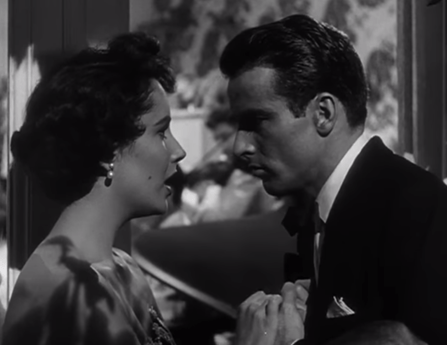
Review: A Place in the Sun (1951)

a place in the sun 1.png

George Stevens is only one among a plethora of filmmakers who came back from WWII changed. He had seen a great deal of the world’s ugliness — Dachau Concentration Camp for instance — and as a result, the films he made thereafter were more mature ruminations on humanity at-large. Adapted from Theodore Dreiser’s An American Tragedy and a subsequent play, A Place in the Sun is one of those pictures crafted in the wake of such historical change.

There’s no doubt that this is Hollywood melodrama backed by a raging score from Franz Waxman but this is no less, high powered high-class stuff. It’s augmented by gorgeous black and white imagery that reaches pitch-black tones and still manages to make Lake Tahoe into a scintillating getaway. Meanwhile, the camera captures the action with elegant movements, sashaying through space, at times nearly imperceptible to the eye. Though admittedly the film’s stature as a social commentary is less interesting now than it probably would have been in its day. Still, we can’t have everything now, can we?

Montgomery Clift is often forgotten in the fray of powerhouse actors but the line can easily be traced from his intense performances to the work of Brando and Dean which would also sprout up in the 50s. Though that same intensity is there, it never feels like he’s trying to sell us a gimmick or a method. He’s simply trying to provide a lens to see a bit more clearly the intricacies of an individual, in this case, one George Eastman. It manages to be a profound and at times an agonizing performance.

Of course, Elizabeth Taylor is exquisite in every frame as always but her bright-eyed sincerity is equally arresting. She feels perfectly made for the role of Angela Vickers and seamlessly transitions into more adult fare with A Place in the Sun, standing tall alongside Clift, destined to make them one of the great romantic pairings of the 1950s. She supposedly said that she finally felt less like a puppet and more like an actress after this film. It shows.

Still, though given a thankless role at times, Shelley Winters is equally important because, in her simpler, humbler way, she reflects how quickly a man can change. She’s not a bad person at all, just a frail, even helpless one who feels like she has very few people in the world to hold onto. George proves to be a comparable companion until he unwittingly finds himself running in different circles and that’s where the tension begins.

I look at George Eastman and see the same drive for recognition, power, and wealth in many of us, those desires that oftentimes can be our undoing because they turn out to be meaningless. The irony is that his intentions never seem malicious but he is undermined by something. He quickly sinks into this double life. At first, he was simply happy to have a job and some companionship. His desires were simple. But slowly, as he found himself rising in the ranks of the Eastman company and getting more recognition, he couldn’t help but want more. Are these impulses bad? Not in the least, but they led him to some pretty rocky soil.

The scene that stands out in my mind could seem fairly mundane. But Stevens maintains a fairly long shot that’s peering through Eastman’s living room and we can see into the next room over as he is on the phone. It feels like minutes go by and Stevens fearlessly never cuts the sequence. The first call is from Alice which he takes.

But the second comes from Angela and at that point, we know that things have changed. It’s set up the dilemma. He genuinely loves Angela and wishes to be with her and to be a part of her life. Yet for that to come to fruition he must do something about the other girl. Alice won’t disappear. It’s funny how someone who you used to appreciate so dearly now feels like a burden. To her credit, we feel sorry for  Winters’ character without question.

In fact, the film succeeds along those lines. We pity her for the sorrowful position she is placed in — essentially abandoned by George. And even in her frivolity and opulence, there’s a candidness to Angela that makes us want to root for her and that allows us to simultaneously pity her because she has no idea of George’s other life. If there is anyone to lash out against it is George Eastman himself and still even in that regard, Montgomery Clift reveals the full gamut of this tortured man so even if we are hesitant to feel sorry for him, he does open us up even with a tinge of compassion.

But the muddled morality is complicated by the fact that Clift’s character has a sense of remorse. Surely he cannot be all bad based on what Vickers saw in him? His capacity to love and be tender is evident. Still, that is not enough to keep him from going on trial and the film’s final third takes place, for the majority, in a courtroom. The district attorney is played by Raymond Burr, who might well be in a dry run for Perry Mason and he comes at Eastman with all the fervor he can muster to convict him in his lies. Even in these moments, we must fall back on George’s inner conflict, his capability to love others, and his intentions for love.

If A Place in the Sun gets too preachy or succumbs too much to Hollywood’s stirringly romantic tendencies, it still might be one of the finest examples of such a film. Front and center are two phenomenal stars and Stevens films their euphoric romance with a meticulous eye, catching them in particular moments, with close-ups, and such angles that we are constantly aware of their intimacy.

As much as Eastman is looking for his place in the sun, and he could spend hours just sitting with Angela soaking in the sun’s rays (not many would blame him), it’s just as true that there is nothing new under the sun. That’s what we’re left with. Mankind is still distracted by many things. Oftentimes they are good things, but we make them ultimate things, and they wreak havoc on our lives. Meaningless, meaningless, everything is meaningless under the sun. But that doesn’t keep us from wanting to bathe in its tantalizing warmth any less. That’s part of the American Tragedy.

4.5/5 Stars

Review: Psycho (1960)

psycho 1.png

For all intent and purposes, Psycho could be an episode of Alfred Hitchcock Presents and Hitchcock knew that better than anyone else. Foregoing the more lavish Technicolor tones he had used in Vertigo (1958) and North by Northwest (1959) and lacking the same type of studio backing, he shot this film in the much cheaper black and white format and brought on a great deal of his television crew to make this production a much more inexpensive package.

In that way alone it paled in comparison to some of its much more ostentatious predecessors but that cannot for a moment take away from the impact or cultural clout that Hitchcock still managed — truly topping any of his previous efforts to date. If not his greatest film, then Psycho was certainly his greatest feat of marketing and ingenuity. Because he would never allow his public to forget their experience witnessing Psycho and very few have for generations with it becoming so closely tied to our public consciousness.

The plotline itself is a simple affair of love and small-time crime set in Arizona then transplanted to California. Marion Crane (Janet Leigh) has a man but a life with him seems unlikely especially with both of them being terminally strapped for cash. He’s got alimony to pay and she makes very little on a secretarial salary. But when $40,000 is dropped on her desk in cold hard cash — money she is supposed to deposit in the local bank — in a brief moment of decision she attempts to buy happiness.

She takes the money and keeps on going. From the moment Marion first sees her boss on a crosswalk as she drives off with the money, Bernard Hermann’s score starts pounding. Every time she hits the gas the composer does too and it’s one of the most unnerving pairings in cinematic history.

Even without the scoring, this would still be matchless silent storytelling and yet it’s improved upon by the music working with the image.  A paranoid Leigh becomes the latest iteration of Hitchcock’s icy blonde, curt and still constantly looking over her shoulder because she is not made to be a lawbreaker. She tries to dodge the interrogation of a suspicious policeman and brushes off the friendly salesmanship of California Charlie (John Anderson). But she rides on no thanks to the guilt written all over her face only to be impeded by Hitchcock’s latest implement, a fateful rainstorm that lays her up at the first motel she can find: The Bates Motel.

In Vertigo and Psycho, you can see how Hitchcock distinctly puts us in the eyes of the main character so we have no choice but to view the world as they do and it’s highly effective in bringing us into the story. Thus, it’s even more jarring when he rips our star and stand-in away from us brutally and forces us to frantically search for another anchoring character.

psycho 2.png

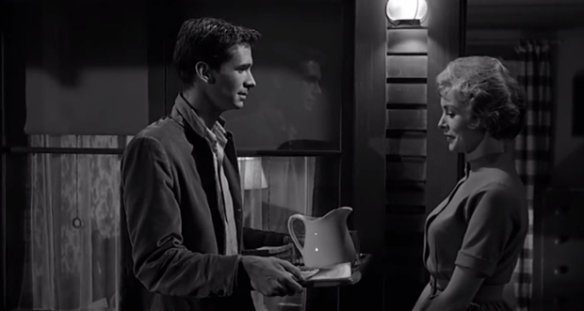
That brings us to Norman. Norman Bates (Anthony Perkins) is such a fascinating character because in one sense he’s like a shy little boy. The moment he asks Marion to have dinner with him is brimming with candor and a pitiful awkwardness — like a boy asking a girl out to the prom or something. That sweetness and social ineptitude are at the core of his being. He can’t hide it just as Anthony Perkins playing Bates feels like he is hardly acting at all. It’s just his way.

The Bates home could be a character in itself, a looming beast that hangs over Marion as the domain of the unobserved Mrs. Bates. It poses itself as a portent of Norman’s own ominous instability along with his pointed drawing room conversation with Marion where he freely discloses, “We all go a little mad sometimes. Haven’t you?” 

That, of course, brings us to the famed shower scene that is a tour de force not only in editing but in the synthesis of all the cinematic components from the image, to sound, to the scoring of Hermann’s impeccable cacophony of screeching strings. It stands alone as arguably the single most iconic scene in all the movies. Thus, it’s surprising that from the very moment Hitchcock was showing Leigh flush some pieces of paper down a toilet he was already making history — because bathrooms were long-held off-limit locations. Hitchcock made them far worse for folks after Psycho.

He also starts moving around the bathroom in a way that’s vaguely reminiscent of Rear Window’s opening. Finally, cutting from the drain to the eye of Marion Crane suggesting the same spiraling black holes of emptiness as Vertigo. It pretty much sums of the conclusion of her life.

But then we’re back to Norman. There’s an extreme distaste in how goes about cleaning up the bathroom but also a certain industry to it. He gets to it silently and efficiently in another one of Hitchcock’s great sequences that unfold without the aid of any dialogue whatsoever until it leads us the precipice of the swamp where Marion’s car is disposed of.

It’s in these interludes that we understand the full gravity of Hitch’s wicked humor. That money — the load of cash that propelled the film forward — is cast aside as simply as that. No two thoughts about it as if to say you thought that’s what this picture was about but he’s not entirely interested in that. He just wants to hook his audience on that objective before sending them hurtling in completely different directions.

psycho 3.png

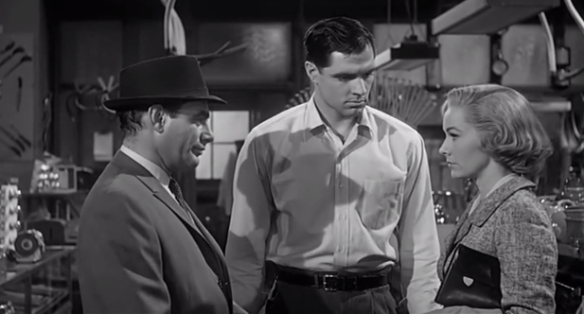
John Galvin plays Leigh’s lover and he’s the stark contrast to Perkins’ character. Both dark-haired and handsome but Sam is a virile man even a masculine ideal of the 50s and 60s. Nevertheless, he joins forces with Lila Crane (Vera Miles) Marion’s concerned sister, subsequently becoming the driving force in the latter stages.

But also of note is the hired private investigator named Arbogast (Martin Balsam) who coincidentally comes onto the scene at the same time at the behest of the old coot that lost $40,000. Balsam a wonderful character actor throughout his career, not surprisingly appeared in two episodes of Alfred Hitchcock Presents and he’s at his best as he questions Norman Bates in that genial manner of his about his person of interest, one Marion Crane.

At this point, in some small way, it feels like we are a bit of an accomplice in this crime of Norman’s.  Complicit in his secret and as Arbogast digs around for answers we crawl inside our skin. Norman tries to cover up and we know he’ll be caught in his lie.  Hitchcock frames his nervousness most overtly peering over to look at the guest registry knowing that something might give him away.

For its day and age, Psycho goes into admittedly dark and taboo territory. But what’s most unsettling is the subverted ideas of romance it showcases. Marion is looking for some form of companionship. She has desires for the American Dream including money and love. All the things that lifestyle entails and yet her desires are quickly snuffed out never to be realized. She doesn’t even receive the hope of love because on the horizon there is nothing for her — only the nothingness of a drain taking away her lifeblood.

Then, of course, Norman is so closely intertwined with his mother that it destroys his being so much so that he cannot even comprehend how to cope with other people. He’s so injured and wounded by a dominating woman and a lack of love that he has no healthy way to express his love and it’s not so much his undoing as it is his stumbling block. Sure it makes for chilling outcomes and a remarkable turn from Anthony Perkins but what resonates time and time again is the pitiful brokenness within Norman Bates. It’s all there in his famed observation that “A boy’s best friend is his mother.” His is a sorry state of mind.

Even in Sam and Lila, we find our best chance at romantic satisfaction. But that relationship too falls on problems when you cast it in the light of Vertigo. If they do continue their relationship, will it simply be because Sam sees Marion in his sister and wishes to have that or does he see the true worth of this woman in front of him blessed with an insurmountable persistence? If anyone can make it work they can but that is not to say it will not be messy. After all, this is a film of messiness — relationally, psychologically, morally. We all go a little mad sometimes. That’s why we’re not to go through life alone. We’re communal beings.

In the denouement, a psychiatrist tries to explain things away and provide a voice of reason that looks to stabilize everything his audience has just ingested. But even that fails to undo and rationalize Norman Bates completely. Yes, his psychological instabilities, his compartmentalized personalities, and the utter dissonance coursing through him can be understood at least partially by such deductions. Human psychology has its place as does scientific thought. Still, that cannot take away from that final shot as the voice inside Norman’s head keeps talking to us and he raises his eyes with a possessed grin breaking out over his face.

There is no explanation that can be given for that look. It burns into us. Emblazoned on our minds and sending shivers down the spine. That image and all those proceeding are what the cinema is capable of, evoking emotion far beyond what any word can possibly begin to unearth. That is the exorbitantly visceral brilliance of Psycho. Hitchcock was a proponent of so-called pure cinema and this is yet another showing of the “Master of Suspense” at the peak of his creative powers. Few filmmakers have made such a stream of classics of such variety and of such a multitude in such a condensed span of time — each one slowly reworking and ultimately rewriting the rules of suspense. Psycho is yet another testament to that.

5/5 Stars

Review: To Catch a Thief (1955)

to catch a thief 10.png

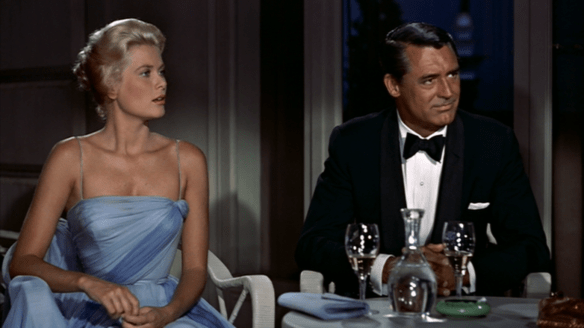
There’s little doubt that To Catch a Thief is Hitchcock at his breeziest and with the once-in-a-lifetime pairing of Cary Grant and Grace Kelly the picture could coast on looks and charm alone. Not simply based on the attributes of its stars either but the extensive on location shooting boasting Cannes shorelines colored in VistaVision and sumptuous flyovers of the winding Riviera, villas and all. It’s a scintillating getaway and a fine departure following the nerve-wracking confinement of pictures like Dial M for Murder (1954) and Rear Window (1954).

Thankfully while it is supremely light entertainment there’s something else to it as well. A rash of copycat crimes has taken place all across the Riviera leading the local police commissioner to suspect reformed cat burglar and French Resistance hero John Robie (Grant). Though the slinking and perfectly executed jewel heists bear the mark of “The Cat,” he’s the best one to acknowledge his own innocence.

Still, that doesn’t stop the police from questioning him nor his old war comrades working at a French cafe to begrudge him for what they deem as an affront to them. They want nothing to do with him. And so with things as they are, Robie must try to exonerate himself by verifying his innocence. John Williams proves the perfect accomplice as a generally agreeable chap from Lloyd’s of London who has vested interest of his own in catching the real culprit in order to recover his client’s assets.

Their introduction could not be more memorable culminating in a tussle in the flower market in Nice with bouquets flying every which way, the local authorities in hot pursuit. From there Robie floats away from the police soaking in some sunbeams as he devises his plan of action. But already we see the dangers as he must essentially play the thief, casing the joint, getting close to the jewels and their owners but all in the name of personal vindication.

What follows is a fortuitous meeting around that whirling pickpocket — the roulette wheel — where Robie makes a dashing entrance. Actually, make that a purposefully inept showing dropping a chip down a lady’s front. What follows is a fairly haphazard routine as Oregon lumber magnate Conrad Burns trading pleasantries with his newfound acquaintances.

to catch a thief 1.png

Jesse Royce Landis knocks her scenes out of the park allowing Grant and the others to laugh along amusedly due to her affinity for bourbon and straightforward speech.  Her daughter Francie (Kelly) tries to maintain her own dignity as an aloof beauty bred on finishing school.

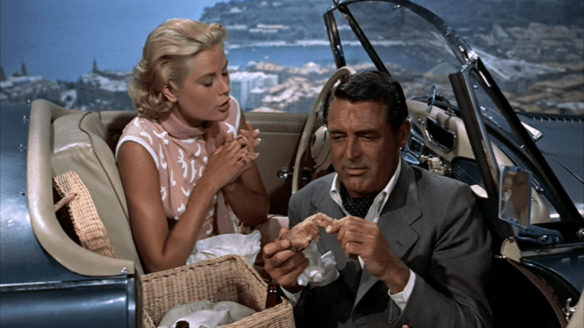
However, she’s more forward than she lets on leading with a wordless smooch in the doorway on her way to bed that begins the chase. What becomes rapidly apparent is the fact that she knows what she wants and doesn’t waste any time pursuing it. First, there’s a jaunt on the beach, then a picnic, and numerous other little romantic getaways perfectly constructed for romancing.

By now the double entendre of the title comes into full relief. On one level Robie is trying to catch someone and Francie is trying to catch him. Charade (1963) would provide a similar dynamic with the woman becoming the huntress out for love. But it’s true that the ravishing gal has a jackpot of admirable qualities which Robie nevertheless tries his best to avoid. Just as he tries relatively unsuccessfully to dodge her flurry of probing questions before finally resigning himself to beer and fried chicken.

to catch a thief 6.png

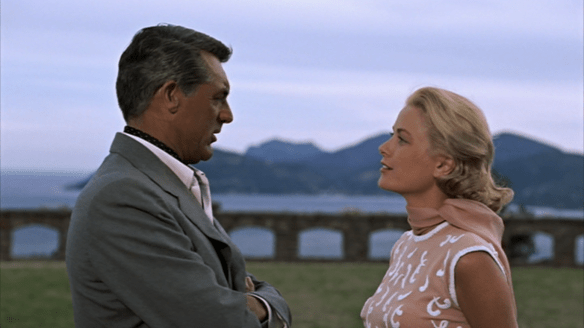
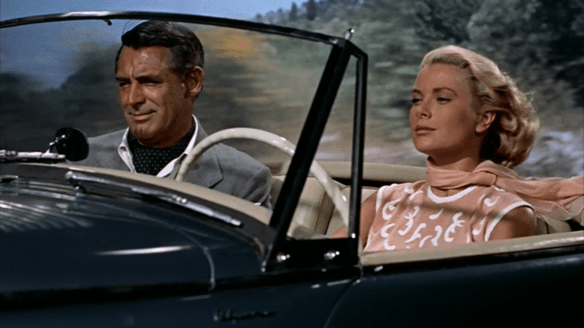
I’m the first to admit I’m the least fashion-conscious person around but there’s little denying the iconic nature of Kelly’s coral top during the picnic scenes with Grant. Again, the outfit realized by renowned costumier Edith Head is only rivaled in my admittedly meager estimation by Audrey Hepburn’s Little Black Dress (conceived by Hubert de Givenchy) in Breakfast Tiffany’s (1961) during her early morning window shopping.

The country road car sequence is a fine summation of the film’s general balancing act of John Michael Haye’s scripting with Hitchcock eye for the visual. It’s broken up by the glib interplay between our stars and yet proves silently comedic with knowing gazes and the dodging of pedestrians and roosters as the police tail close behind Francie’s sporty Sunbeam Alpine.

Though the same scene is underlined with a bit of morbidity as Princess Grace would die in a car crash years later as Princess of Monaco brought on by a sudden stroke which occurred not far from where the film was shot. It’s a tragic moment that left a dark blot the world over.

to catch a thief 7

But for now, the picture is effervescent only bounded by fireworks with the impetuous blonde intrigued by this man who she easily pinned as “The Cat” despite his constant rebuttals. She wants to be a part of his game too, all the while entrapping him with her divine loveliness.

Now’s as good a time as any to marvel at the character of John Robie who must have been made for Cary Grant precisely. At first, it’s easy to surmise that he’s supposed to be a Frenchman who can barely speak any of his native language. However, that would disregard the randomly assorted tidbits scattered throughout the film. For one, he’s said to be an American on multiple occasions. Except as Francie notes, “you’re like an American character in an English movie.” Robie even notes he once toured Europe with a troupe of acrobats, not unlike a young Archibald Leach.

The picture is also littered with what can only be termed touches of Hitchcock whether tops of umbrellas, policemen playing hacky sack on the job, or cigarettes stubbed out in eggs instead of ashtrays.

But back to the action. The final game of cat and mouse is proposed to trap the clandestine specter who has been absconding with all the jewels. It comes down to a decadent Louis 15th extravaganza frequented by the social elite and costumed policemen milling about amid the guests. Robie is waiting to pounce and takes to the rooftops to have it out once and for all!

We think we’re in for one last perfunctory car chase instead Grant and Kelly receive their final rendezvous at a villa which proves far more thrilling. The plot generally took a backseat to the stars anyways even for a Hitchcock movie. We leave them as they embrace with Francie exclaiming, “Mother will love it here!” and Grant’s quizzical look barely visible past his costar’s shoulder. That’s priceless. How could we have more fun than this?

4/5 Stars

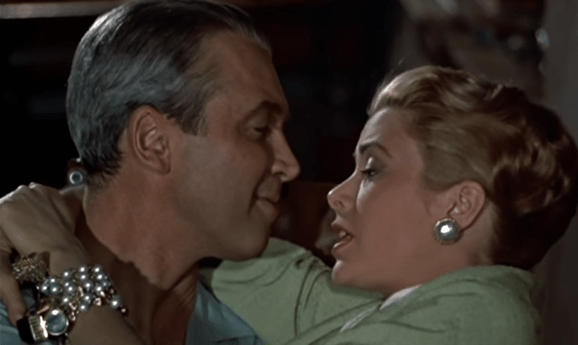
Rear Window (1954): Visual Cinema and “Lisa”

rear window 1.png

There are such a vast number of levels to appreciate Rear Window on and one of those is its impeccable use of sound as well as a score courtesy of Franz Waxman. In fact, it is quite easy to consider it as a film with a wholly diegetic soundtrack but it’s really a complicated weaving of sound orchestration playing against the images onscreen. For instance, against the credits, as the blinds come up, we’re met with the playfully cool jazzy beats of “Prelude and Radio” which proves to be in perfect juxtaposition with the deathly hot heatwave hitting Greenwich Village in the film’s opening moments.

We’re also inundated with all types of songs popular and otherwise which can be picked out of the story organically if you’re paying attention. Two of the most obvious additions are “That’s Amore” and then “Mona Lisa” which can be heard being sung by a group of party guests.

Whether or not it’s a slight nod to our heroine Lisa is up for debate but it’s also notable that she, in essence, receives her own theme song which is concurrently composed by the songwriter who lives in the courtyard that we come to know over the course of the film. It slowly involves from its nascent stages into a full-fledged tune that gains its wings once the romance between Lisa and our protagonist L.B. Jefferies has come into its own.

Obviously, beyond the elements of soundtrack Rear Window develops so immersive a world and Hitchcock expertly inserts us directly into the environment to the extent that we have no choice but to become involved in the whole ordeal. We are accomplices, if you will, in this viewing party of Jimmy Stewart’s.

It truly is an exhibition in the moving image because the film works so brilliantly with them. Certainly, it begins with the staging and the complex setup Hitchcock had to work with at Paramount Studios but there’s simultaneously the use of color cinematography, the lighting of the stages which sets the scene given the time of day, and common street noise that lends an almost imperceptible authenticity that we take for granted.

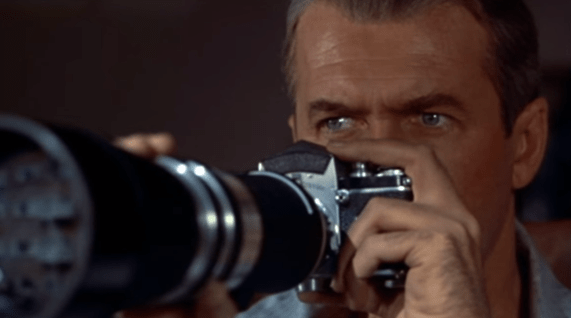
Furthermore, working with his long trusted photographer Robert Burks you see Hitchcock moving so fluidly and with so much purpose through the playground provided him. The camera captures objects with clear intention and a crispness that far from simply giving us the illusion of being in the space, in many ways, makes us feel like we are actually right there with Stewart looking out into the courtyard.

You also get the true essence of what visual filmmaking is because his powers of suggestion and even persuasion of the audience are impressed upon us by what he deems important. Hitchcock lays out nearly all of Stewart’s backstory not with clunky expositional dialogue but by giving us a wordless parade of his apartment while our protagonist sleeps. And the whole picture is a constant rhythmic cadence of being fed images followed by Stewart’s reaction shots. It’s Film at its primacy. Where two images put together are blessed with so much more meaning and suggestion than they could ever have alone.

But far from simply marveling at what Hitch has accomplished it’s far more miraculous that we become so enveloped in this story. It’s an admirable mystery plot chock full of tension that’s built up over time and successive shifts in perception, time of day, and personnel moving in and out of the complex. Our one commonality is Stewart stuck in that wheelchair with only his broken leg, his camera, and the neighbors to keep him entertained. They do far more than that.

rear window 4.png

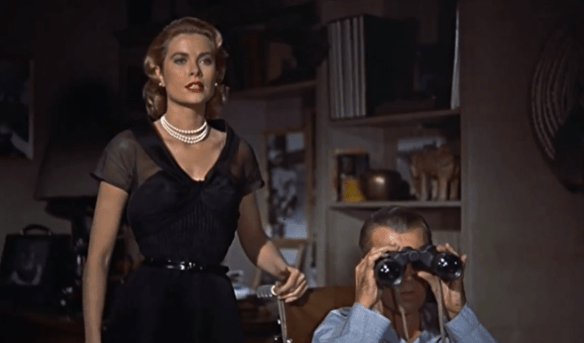
Rear Window’s A-Plot is a perplexing mystery thriller that we watch unfold with a systematic unraveling that’s unnerving in part because Hitchcock has orchestrated it all in a limited space. Furthermore,  he has handicapped his protagonist and the outsiders coming in are constantly causing us to second guess or reevaluate our assumptions be they the insurance agency nurse Stella, Jefferies’  policeman pal, or his best girl Lisa. Each character is at one point in opposition to Jefferies while also providing a sounding board for his cockamamie theories which start to bear the grain of truth. We get to be a part of it all.

The utter irony is that once more not only is Hitchcock’s villain atypical — in nearly all areas a seemingly unspectacular man — he’s also quite overtly styled after David O. Selznick. If you know anything about the producer he shares some resemblance with Raymond Burr and there’s no denying that Hitchcock was never fond of the other’s meddling. As much as I love the Rebeccas (1940) and his earlier American works if Rear Window was a representation of the hands-off approach to his filmmaking than I would have to side with him.

At least by this point in his career, there’s no denying that he projected a singular vision that could hardly be quelled by any individual. This is “Alfred Hitchcock’s Rear Window,” after all, as the opening credits proclaim.

However, the beauty of this picture is that it truly does stand up to multiple viewings and every repeated viewing offers up new depths or at least minor revelations that add an even greater relish to the experience.

In particular, are the underlining themes of romance. Because this is a film about love in all its many facets with each character or couple reflecting a certain permutation of what romantic love looks like.

The love stories are playing out in each compartment of the apartment complex. Miss Torso, the queen bee with the pick of the drones. She’s very much eye candy but in the final frames, we realize there’s more to her as her love comes back home from the army. There’s Miss Lonelyhearts who is desperately seeking love and yet has enough respect not to stoop below her dignity. It’s a song that lifts her out of her despair. The Newlyweds are still in the honeymoon phase and we never see them.

rear window 2.png

Meanwhile, you have Stella providing her homespun philosophy that people shouldn’t overanalyze their situation. Jefferies is pushing back against any serious romance because in his estimation Lisa is far too perfect for him. Meanwhile, Lisa is left believing she can live in any world that Jeff is in. The list goes on and on.

But for the threads to be resolved that must become fully intertwined with the murder at its core because such an event calls for a response from our characters — at least our main ones. When Lisa sacrifices so much to show her love and devotion to him, he realizes how much he misjudged her character and perhaps more profoundly how dearly he loves her and never wants to lose her. He has made the transition from armchair philosopher and misanthrope to a man smitten with someone else. As long as he ditches the window watching he should be fine.

That leads us to another area of discussion. There’s a bit of a moral commentary present though Hitchcock doesn’t seem all that interested in those conclusions per se as much as he likes manipulating them for the sake of his drama. And yet like Vertigo four years later there is this unnerving sense that he is tapping into some of humanity’s darkest desires to watch and spy on others for pleasure without any consequence or any vulnerability on the part of the peeper.

That draws me to another aspect of the film that I’ve never really considered. Rear Window implicitly asks what it is to be a neighbor or at least what it is to live with neighbors. There’s very little in the realm of actual judgments except for the small condemnation that comes from the woman who lives just above the murderer after her yippy dog has been killed. What does she say?

You don’t know the meaning of the word ‘neighbors’! Neighbors like each other, speak to each other, care if somebody lives or dies! BUT NONE OF YOU DO.

What she provides is a heartfelt and searing indictment which is nevertheless lost in all the commotion whether it’s the big party going on across the way or the realization by our heroes that their theories about murder have been confirmed. It did make me consider even briefly if the so-called Great Commandment is to “Love Thy Neighbor,” what does that look like?

Far from peering in at other people and staying anonymous, it seems like it involves reaching out to others. In some ways, being vulnerable and candid — transparent even — so others feel comfortable entering into our lives. Like Stella says sometimes people need to go on the outside and look in for a change. If nothing else that breeds empathy.

Of course, if that was the case, there would probably have been no murder and that’s what we want right? Well, anyways, Rear Window still stands as my favorite Hitchcock picture and one of the most clinical and compelling thrillers of all time.  But you probably already knew that. If you did not I implore you to break both your legs if need be and go lock yourself in a room and force yourself to watch it right this minute.

5/5 Stars

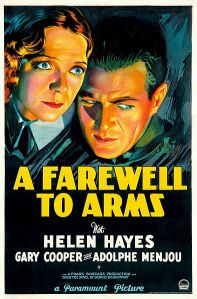
A Farewell to Arms (1932)

394px-Poster_-_A_Farewell_to_Arms_(1932)_01Again, I must confess that I have not read yet another revered American Classic. I have not read A Farewell to Arms…But from the admittedly minor things I know about Hemingway’s prose and general tone, this film adaptation is certainly not a perfectly faithful translation of its source material. Not by any stretch of the imagination.

However, I do know at least a little something about Frank Borzage a filmmaker that time has been less kind to, though he contributed some quality pictures during the silent era and during the ensuing generation of talkies — even a couple of reputed classics. And yet watching A Farewell to Arms you can see his philosophies working themselves into the story line — the very themes that he would repeat again and again in many of his movies.

It soon becomes apparent that Borzage’s film is not about a war at all though WWI is a major plot point. He would examine an analogous idea with The Mortal Storm. Its his predilection not to focus so much on the carnage or alienation of war and more so on the effects that such a cataclysmic event has on the lives of those thrust into the middle of it. So his narrative borrows from Hemingway but hinges on this idea of lovers battling against the wiles of the world through the sheer euphoria of their romantic fling and yet it proves to be more than transient.

There’s without question a verisimilitude and a candor to the portrayals of Gary Cooper and Helen Hayes as said lovers — an ambulance driver and a nurse. Two seemingly unextraordinary individuals who nevertheless become extraordinary in each other’s arms. They will go to such great lengths to remain together despite the obstacles hindering them on every side. Perhaps it’s heightened by the times but still, there is this general belief in what they do on the part of the audience — that they can actually fall in love and will do whatever it takes to stay together.

Even if it’s not wholly plausible, they lend that needed credence to the parts. Their emotions feel genuine even as their romance gets crippled by the very circumstances they find themselves in. Where years are sped up into days and marriage must be forged in the most humble of moments. There’s no time or space for a normal life with a normal love affair even if that’s what both parties desire. It cannot be so.

Gary Cooper exudes a gentle tenderness in the majority of his scenes and he manages to be as vulnerable as we’ve ever seen him in the part because this romance tears him apart. Helen Hayes is an actress that I, unfortunately, know very little about but she strikes me as a beauty like Claudette Colbert and yet I find an easier time liking her and by some form of transference, the same goes for the character that she plays. It’s also crucial to note the splendorous black & white cinematography of Charles Lang which paints the contours of this love affair with expressionistic shades while never quite allowing us to forget the war at hand.

Though we can compare Borzage’s film with the original novel it seems equally compelling to juxtapose this cinematic adaptation of A Farewell to Arms with Joseph von Sternberg’s romance, Morocco, of only two years prior also starring Gary Cooper and Adolphe Menjou with von Sternberg’s muse Marlene Dietrich. Hayes doesn’t have the same gravitas or allure of Dietrich but that actually serves her better in this film with what Borzage is trying to accomplish.

Because this story is a tragedy as much as it is a romance of faithful devotion. Whereas von Sternberg seems most interested in the locality and the depictions of his stars — allowing them to have looser morals, you could make the argument that Borzage film holds a greater stake in its thematics and what such a romance can represent in such a turbulent world. The Great War is only an unfortunate backdrop to play the action against and it’s unfortunate because love is a rapturous thing. But it’s the many evils of the world that tear it asunder. The kind of troubles that force two people to bid each other a tearful adieu even if it’s the last thing they want in the world.

3.5/5 Stars

It (1927)

It 1.png

“IT is that quality possessed by some which draws all others with its magnetic force. With ‘It’ you win all men if you are a woman and all women if you are a man. ‘It’ can be a quality of the mind as well as a physical attraction.” ~ Elinor Glyn 

I was always under the impression that the It Girl was a concept that came out of this movie but little did I realize it was literally built into the very construct of the storyline. But that deserves a bit of elaboration.

There are really three figures of note in It (1927). We meet the bumbling playboy Monty first as he ushers in his buddy’s first day of managing a department store with some good luck flowers. He bums around for a moment before happening upon an article by columnist Elinor Glyn and immediately he is taken with this idea of “IT.” He tells his friend that they need to find girls with that very same quality.

It’s a rather staid and antiquated concept when you actually consider its implications. Men ogling women trying to pinpoint this elusive quality or trait that seems far more based on physical features and outward appearance than anything else. And all the pretty maids all lined up in a row welcome the attention from the two well-to-do bachelors. Though it’s important to note “It” can apply to men as well.

Still, perhaps regrettably the term has remained prevalent to label women and still maybe it’s morphed for the better into the calling card of anyone who has ever burst onto the center stage and become the next big thing. However, you could argue that said person becomes a bit of a commodity or a fad for the media.

Still, Clara Bow in her own right was indubitably an icon and it went beyond a gimmick or a plot device. In many peoples’ eyes, especially in hindsight, she represents the free-spirit and joy of The Roaring Twenties as one of the foremost sex symbols of that generation.

You get that sense of the eponymous “It” that goes beyond her so-called sex appeal. It’s that genuine winning charm when she peeks in on her friend’s baby and begins cracking him up with a barrage of funny faces. “It” is when she’s snipping away at her dress to get ready for a night of fine dining at the Ritz because that one dress is all she has to work with. It’s frowning when she’s trying to order off an elegant international dinner menu. Yes, it’s even playfully sliding up onto the bosses desk or posing on a yacht to try and win her man back.

But we also cheer for her because she cares about those who are down and out and maintains a certain level of moral restraint. In other words, she has boundaries and standards set up. She’s not about to let a man just have his way on the first date. She’s a take-charge kind of gal but also a proponent of traditional values. Women in the home and taking care of children. Though she shares some of the striking features of Louise Brooks, the makeup of their characters are very different — not to mention their hairstyles.

This silent romantic comedy like so many others in the storied tradition is made of moments of miscommunication. But Betty (Bow) is not about to let miscommunication get in her way. A pair of colliding boats leaves a soaking wet Clara Bow just waiting to be rescued right after she saves her fellow castaway. Not even the long-held blonde versus brunette conundrum can get in the way. In the end, there’s nothing quite so romantic as clinging to an anchor soaking wet with the love of your life.

Though not the same type of comedy, It (1927) is a rom-com that has some similar set pieces to Harold Lloyd’s pictures. Namely the fact that its protagonist is a sales clerk like Safety Last! and there’s an excursion to Coney Island rather like Speedy. By today’s standards, IT might seem like a mere trifle but there’s no denying the unquestionable impact of Clara Bow and the influence she still holds on our cultural lexicon even today.

3.5/5 Stars

Morocco (1930)

Gary_Cooper_and_Marlene_Dietrich_in_Morocco_trailer_2.jpgBefore the exoticism of Casablanca, Algiers, or even Road to Morroco, there was Josef Von Sternberg’s just plain Morocco but it’s hardly a run-of-the-mill romance. Far from it.
Although it involves soldiers, it’s also hardly a war film but instead set against a backdrop that presents an exotic love affair as only Sternberg could. With a sultry Marlene Dietrich matched with a particularly cheeky Gary Cooper, it instantly looks to be an interesting dynamic because they couldn’t be more different.

She, a radiant German beauty with an evocative pair of eyes to go with a somewhat sullen demeanor. He, America’s ruggedly handsome ideal of what a man should be. And it in Sternberg’s film neither of them is what we’re used to.

He’s a renegade soldier in the French Foreign Legion. She’s a cabaret singer (that hasn’t changed) but she also manages to be French, not German. Somehow it’s easy enough to disregard because it’s not necessary to get caught up on the particulars.

All that matters is that they both find themselves in Morocco. He is traipsing through town with his division and spends some free time taking in her floor show along with the rest of the rowdy masses. Neither one of them has found someone good enough for them — they’re equal of sorts. He’s a gentleman cad if you will and she’s hardly an upstanding woman, making a living in a dance hall but there’s more to her. It’s hinted that she once had love, perhaps.

It takes so long for them to actually speak to each other but they’re flirting from the first moment they lay eyes on each other. They say so much through simple expressions all throughout the cabaret show. Things proceed like so. She slips him a flower, then an apple, and finally a key. At this point, he gets the drift and we do too.

Later that evening he winds up at her flat and they spend their most substantial time together. It’s full of odd exchanges, meandering conversations that run the risk of sounding aloof. In fact, their entire relationship is replete with oddities.

Another man (Adolph Menjou) is smitten with Amy but he’s never driven to jealousy. He’s good-natured and generous in all circumstances. People like him must only drift through the high societies.

She holds onto some wistful longing for the tall dashing Legionnaire who drifted through her life. But she’s slow to act. Meanwhile, he hardly seems to take it as a blow to his love life when she resigns to stay behind. After all, he’s quite the ladies’ man. He probably doesn’t need another woman. He’s always got several draped over each arm.

Morocco is a film interesting for the spaces that it creates and not necessarily for the story it develops. Visually, by the hands of the director and then simultaneously by Cooper and Dietrich as they work through their scenes both together and apart. Though it might in some ways lack emotional heft, its stars are still two invariably compelling romantic stars of the cinema.

Somehow it still manages to be quite lithe and risque when put up next to its contemporaries. It exudes a certain mischievousness of the Pre-Code Era. It’s not so much licentiousness and debauchery but it wishes to suggest as much. It can be implied without actually going through all the trouble of showing it.

Dietrich sums it up perfectly in her little diddy about Eve (What am I bid for my apple/ the truth that made Adam so wise? On the historic night/ when he took a bite/ they discovered a new paradise). In essence, the world got a lot more exciting when sex and deceit were brought into the equation. Maybe she misses the implications the Fall of Man but that’s precisely the point. Still more Pre-Code sauciness case and point.

In the final moments, where Dietrich abandons her heels and goes slinking across the sand chasing after her man, it feels less like a romantic crescendo or even a tragic turn and more like a ploy by the director to make his leading lady the focal point of his story one last time. She is granted the final bit of limelight. Because in many ways Gary Cooper could not win when it came to upstaging Marlene Dietrich orchestrated by her devoted partner/director Sternberg. Thus, Morocco turns out to be a rather curious love story different than some of the more typical Hollywood fare.

4/5 Stars

The Big Clock (1948)

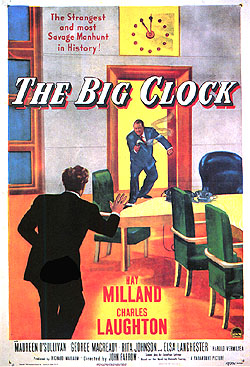
TheBigClock.jpgWith its rather dreary title aside, The Big Clock is actually an enjoyable thriller that works like well-oiled clockwork. It’s true that oftentimes the most relatable noir heroes are not the hardboiled detectives, although they might be tougher and grittier, it’s the hapless everymen who we can more easily empathize with. Bogart, Powell, and Mitchum are great but sometimes it’s equally enjoyable to have someone who doesn’t quite fit the elusive parameters that we unwittingly draw up for film-noir. Ray Milland is a handsome actor and he was at home in both screwball comedies (Easy Living) and biting drama (The Lost Weekend). He’s not quite what you would describe as a prototypical noir hero.

In some fascinating way, The Big Clock falls somewhere in the middle of those two reference points and to explain the very reasons it becomes necessary to start from the beginning. In fact, our story opens in a cold open that’s foreboding, shadowy and tense. The reasons being we don’t quite know yet and that’s how we get to know George Stroud (Milland), a workaholic chief editor of a crime magazine. He’s got a lovely wife (Margaret O’Sullivan) and a kid but, really, he’s married to his vocation. He’s never even been on a proper honeymoon.

And the reason for all this is Mr. Earl Janoth (Charles Laughton) the newspaper magnate with the vice-like grip and enigmatic way about him. He’s very practical in how he shows his displeasure (docking pay and firing employees at will) and it also allows him to exercise complete control in all facets of his business. That and the fact that his life is constantly on schedule, perfectly epitomized by the giant clock that has become the emblematic tourist attraction of his empire.

It’s a fascinating reflection of modern times circa 1940s Hollywood with international communication, journalists, and media conglomerates helping the world to function on a national level with mass media. Oddly enough, the story hardly conjures up Citizen Kane but instead the crime-filled frames of While the City Sleeps.

This film functions on two layers due to the fact that someone has been murdered. The blame is being pinned on a phantom man who looks strikingly like our hero, but simultaneously, the evil lurks close at hand. And things begin to fall into place. Strout is called upon to close in this criminal but only he knows that the man they are trying to capture is him. It’s complicated by the fact that, conveniently, he’s also the only one who knows for sure of his own innocence. After all, he would have known if he murdered someone. Here lies the tension as the film comes full circle back to its beginning – back to its climactic moments. Now we comprehend what’s at stake.

But what sets The Big Clock apart is the satisfaction in every little human interaction. The many characterizations are surprisingly lively and are at times fit more for a comedy than the darkened hallways of film-noir. Rita Johnson takes well as a bit of a femme fatale while Laughton pulls off his role with a certain sphinxlike iciness. Meanwhile, Laughton’s real-life wife, Elsa Lanchester delivers a scene-stealing performance as an eccentric artist who finds herself at the center of this entire investigation because of one of her very outlandish (and incriminating) paintings. And as every noir needs a thug, a menacing, mute Harry Morgan carries the mantle as is necessary–thank goodness he got promoted to M*A*S*H in due time. Everyone else, from the bartender to the elevator girl, to bar regulars all have wonderful moments to shine and show some personality that fills out the frames of the narrative.

Furthermore, John Seitz’s photography is on point, his camera roving with the necessary precision making for dynamic sequences while also developing the perfect tonalities of light and dark within the corridors of the mega news conglomerate. Director John Farrow is not all that well-remembered, but either way, The Big Clock stands tall as a quality film-noir that still somehow finds ways to be invariably funny. It’s a rare but still greatly welcomed combination.

4/5 Stars

The Blue Dahlia (1946)

bluedahliaSoldiers returning home from war is a recurring theme in films such as The Best Years of Our Lives and Act of Violence and given the circumstances it makes sense. This was the reality. Men returning home from war as heroes. But even heroes have to re-acclimate to the world they left behind.

Blue Dahlia is not so much about the assimilation of G.I.s though. It’s more an excuse to show the noir world creeping into a man’s life infecting all he left behind. As he returns, Johnny Morrison’s wife (Doris Dowling) is keeping company with another fellow (Howard Da Silva) and everyone else seems to know about it except Johnny. Also, his young boy died tragically while he was away and his wife has taken to a life of drinking and partying. He’s not expecting any of this but then again what happens in film-noir is very rarely what we expect.

Raymond Chandler weaves together his first original screenplay here, a production that was hampered by the impending deployment of Alan Ladd as well as Chandler’s own bouts with alcoholism and writer’s block. It’s hard to know which one caused the other. But either way, the film finds its roots in a murder and the man who is suspect just happens to be the returning G.I. Before he ever knew people were looking for him he playfully took the name Jimmy Moore after meeting a lady (Veronica Lake) who happens to be closer to him than either of them realize.  Their paths cross more than once.Then he’s on the run. His war buddies (Hugh Beaumont and William Bendix) are worried about him after being questioned by the cops. And the cops are anxious to hone in on the killer because no one is of any real help. No solid leads come their way and that means Johnny has to track down the killer himself.

The direction of George Marshall is not particularly inspired but his players are compelling enough. Alan Ladd can still play the brusque tough guy and William Bendix steals the show with his own blue-collar bravado and snarling bluster. Veronica Lake doesn’t show up until well into the film and in many ways, despite her billing, she feels relegated to a smaller role. She’s not particularly memorable in the majority of it even with her scenes with Ladd. She’s mostly just there which is grossly unfortunate. It feels like a waste.

After the novelty of Hugh Beaumont wears off it makes sense why he transitioned to TV while Howard Da Silva and Doris Dowling denote a certain sleaze that comes off quite well. Meanwhile, Frank Faylen plays an integral role as one of his typical curmudgeon types. He made a killing off of that niche. Still, Ladd and Bendix are the main attraction in this adequate serving of film-noir. On a darker note, this film also gave its name to the unsolved Black Dahlia killing of Elizabeth Short in 1947. It’s one time when perhaps reality was more tragic than fiction. Raymond Chandler could not have even dreamed up such a grisly drama. At least not for the silver screen.

3.5/5 Stars

The Glass Key (1942)

the-glass-key-1942With Dashiell Hammett’s The Maltese Falcon making a splash just the year before and giving a big leg up to its star Humphrey Bogart as well as its director John Huston, it’s no surprise that another such film would be in the works to capitalize on the success. This time it was based on Hammett’s novel The Glass Key and it would actually be a remake of a previous film from the 30s starring George Raft.

But instead, we had Alan Ladd in the lead fresh off a career-making performance the year before. True, Ladd’s no Bogart and the forgotten Stuart Heisler is hardly the caliber of Huston, and still, the film is somehow entertaining in its own way. It channels the political corruption of Force of Evil with a bit of the unfathomable plot and mile-long laundry list of characters rather like The Big Sleep. And once more like any comparison with the Maltese Falcon, it hardly holds a candle to these other films but it’s not trying to be overly smart. It never makes an attempt at commentary or some deep philosophical character study but it does ladle out some unabashed noir entertainment.

There’s the pairing of Ladd and Veronica Lake once more to capitalize on their breakout success in This Gun for Hire. Noir regular Brian Donlevy stars alongside them playing a tough guy and political boss named Paul Madvig. His right-hand man Ed Beaumont (Ladd) stands stalwart by his side until Madwig gets caught up in politics as well a murder accusation. By day he tries to win the hand of the pretty daughter (Lake) of an aspiring governor while at night he looks to run out the towns gangsters namely one Nick Varna. As one might expect murder, corruption and familial turmoil all become integral plot points

Once more Ladd shows his aptitude for playing “leading roles” that still somehow allow him to stand on equal footing beside other stars. His most prominent performance as the gunslinger Shane is a fine example because although he is the title character, still somehow he manages to walk in the periphery and he does so with a quiet confidence. Similarly, in This Gun for Hire and The Glass Key, there is a cool curtness to his demeanor that he pulls off well. It allows him to be the star without really seeming like it. That’s the quality he’s able to cast and Lake works well to balance him out. Donlevy gives a surprisingly spirited performance but he’s not a magnetic star. If anyone, this is Ladd’s film with Lake too.

As we would expect with any decently entertaining noir thriller, the rest of the film is filled out with quite the menagerie of characters the most memorable of those being William Bendix as a rough and tumble henchman. He and Ladd have it out in a couple of scenes and in real life, they would become lifelong friends. The way they beat each other up though it’s sometimes hard to tell.

3.5/5 Stars