
 Where to start with Liberal Arts? It’s one of those deep blue funk movies. Zach Braff tackled this issue in Garden State, and Josh Radnor does a similar thing here. Because the reality is that we live in a generation of early onset midlife crises. In the opening moments, 35-year-old Jesse Fisher (Radnor) has nearly every article of clothing he has aside from the shirt off his back stolen from a local laundromat when his back is turned. We can easily surmise that this single event epitomizes his life right now, and this is hammered home rather obviously when his unnamed girlfriend clears her belongings out of his flat. There’s no better symbol of isolation and alienation than a break-up.
That’s when Jesse’s former professor the personable and witty Professor Peter Hoberg (Richard Jenkins) pays him a call that doesn’t so much change his life as it alters his course. The professor is preparing for his retirement and as is usually customary a dinner is being held in his honor. Jesse is one of the people he looks to invite and the former liberal arts major takes him up on it gladly as the nostalgia begins to waft over him. It’s excruciatingly corny at times even painfully awkward.
However, it’s no small coincidence that it was filmed at Radnor’s real-life alma mater Kenyon College in Ohio–a beautifully tranquil campus that reflects an idolized Middle America–a perfect place to rediscover youth and ruminate pensively on past endeavors. Jesse does all of the above, but while staying with the professor he also meets Libby (Elizabeth Olsen), a current college sophomore whose father and mother had ties with Peter as well.
Zibby has a self-assurance–the way she carries herself is completely disarming but in a good way. In fact, it intrigues Jesse (Radnor) sweeping him off his feet before he even knows it. But that’s not the only thing that affects him. Nostalgia is a powerful thing. I can feel it now as I close the books on my own college career, and I can only imagine this character who is looking back at those idyllic glory days when he was an optimistic, naive young man.This peaceful campus is completely different feel than the bustling public institution I became accustomed to, but the important things are not all that dissimilar.
 It’s crucial to note that at this juncture nothing substantive builds between these two acquaintances romantically, but they do foster an immense connection. While Jesse is taken by Zibby’s personality, she, in turn, is discontent with a contemporary culture where no one dates–everybody’s casual about relationships. She feels unequivocally millennial and yet she readily admits these areas of old-fashionedness.
As she and Jesse part ways, Zibby burns a CD of classical music for her new confidante and entreats him to write her correspondence with pen and paper–like gentlemen and ladies in days of old. It feels very much like a Jane Austen novel, perhaps a little pretentious, but it’s hardly a criticism of these characters. What it creates within the both of them is not only a deeper connection going beyond sexual attraction but an awareness or realization of being — what people these days often call mindfulness.
As they traverse this road together there are some obvious digressions that we could easily foresee, and yet the film takes a mature and altogether realistic path. It considers the relationship between various points in time, passing of the years, looking backward and forwards. In one direction with nostalgia and the other with anxiety and maybe even expectancy. All these are the backdrop for this complicated friendship between a 35-year-old and a college student.
The conclusions of Liberal Arts perhaps feels a bit muddled, but that’s only indicative of life. We’re all set adrift in a world that we don’t know all the answers to. As Zibby so rightfully ascertains life is basically improvised. We’ve just got to step out and live it to the best of our capabilities. Pick ourselves up when we fall and do our best to make the most of what we have. A lot of that comes when we learn how to connect with the people around us in such a way that leaves us content with who we are. I think it can be said that we leave both Jesse and Zibby better off than they began.
3.5/5 Stars
This is the only time you get to do this. Read books all day. Have really great conversations about ideas. – Jesse Fisher
 Inspired directors oftentimes do not make themselves known in grandiose flourishes but in the smallest of touches, and in his debut, Polish newcomer Roman Polanski does something interesting with the opening of Knife in the Water. Perhaps it’s not that unusual, but it’s also hard to remember the last film where the camera was on the outside of a driving car, looking in. We see shadows of faces overlaid with credits and then finally the faces are revealed only to be shrouded by the reflections of overhanging trees glancing off the windshield.
 Thus, it becomes an exercise of technical skill, much like Hitchcock in Lifeboat or any other film that limits itself to a single plane of existence. Polanski’s framing of his shots with one figure right on the edge of the frame and others arranged behind is invariably interesting. Because although space is limited, it challenges him to think outside the box, and he gives us some beautiful overhead images as well which make for a generally dynamic composition. That is overlaid by a jazzy score of accompaniment courtesy of Krzysztof Komeda, a future collaborator on many of Polanski’s subsequent works during the ’60s.
 However, at this point, as a young director, he is simply sharpening his teeth and getting acclimated to the genre a little bit. Knife in the Water builds around the three sides of a love triangle, creating a dynamic of sexual tension because that’s what tight quarters and jealousy do to people. This is less of a spoiler and more of a general observation, but the film does not have a major dramatic twist. Instead, there are heightened tensions, a bit of underwater deception, and finally a fork in the road.
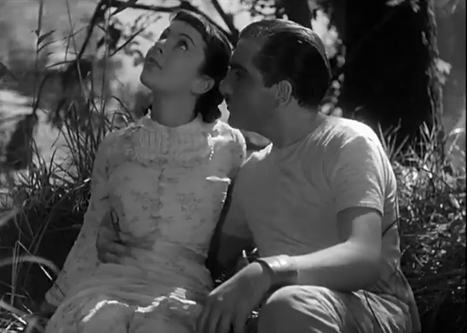 It’s only 40 minutes — hardly a feature film and more of a featurette, but Jean Renoir’s truncated work, A Day in the Country, is nonetheless still worth the time. Admittedly, I still have yet to venture to France and I hope to do that someday soon, but this film propagates marvelous visions of the countryside that resonate with all of us no matter where we hail from. Those quiet jaunts out in nature. Sunny days perfectly suited for a lazy afternoon picnic. Peacefully gliding down the river as men fish on the bank contentedly.
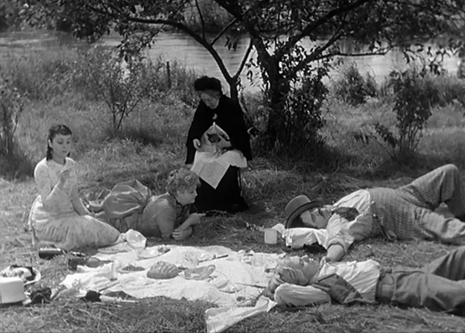 As always these characters set up Renoir’s juxtaposition of luscious extravagance with the earthier lifestyle of the lower classes. However, there is a geniality pulsing through this film, with Mrs. Dufour exclaiming how polite these young men are–they must be of good stock, obviously not tradesmen. Even Mr. Dufour is a good-natured old boy who gets fed up with the elderly grandmother, but he willingly takes the boys charity and advice when it comes to the prime fishing holes.
 We get the essence of what is there and we can still thoroughly enjoy Renoir’s composition. His is a fascination in naturalistic beauty where he nevertheless stages his narrative to unfold in time. But really this mise-en-scene created by the woods, and meadows, trees, and rivers really function as another character altogether. And when all the players interact it truly not only elicits tremendous joy but an appreciation for Renoir’s so-called Poetic Realism. Whether he’s capturing a woman swinging jubilantly on a swing or framing a shot within the trees, we cannot help but tip our hat to his artistic vision. If his father Auguste was one of the great painters of the impressionist era, then Jean was certainly one of the most prodigious filmmakers of his generation, crafting his own pieces of impressionistic realism. In fact, with father and son, you can see exactly how art forms can overlap on canvas and celluloid. They truly share a fascination in some of the same subjects. Universal things like nature and human figures interacting in the expanses of such environments. It’s beautiful really, even in its pure simplicity.
 “He spat on Balzac!”
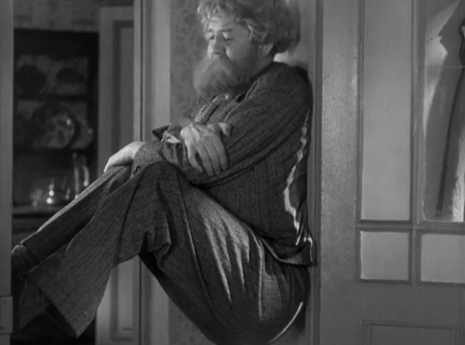 Soon Boudu is wrapped up in middle-class luxury that he didn’t ask for, at the behest of Edouard who takes an initial liking to this bushy-haired man he happened upon. After all, he is intent on playing savior and Boudu obliges. It’s in these forthcoming scenes that Renoir examines class in a satirical way, feeling rather like a precursor to some of Bunuel’s later work, without the religious undertones. And yet for some reason, we cannot help but like Boudu a lot more. True, he is loud, messy, rude and unruly, but there’s something undeniably charming about his life philosophy. There are no pretenses or false fronts. He lets it all hang out there. In this regard, Michel Simon is the most extraordinary of actors, existing as a caricature with seemingly so little effort at all. He steals every scene whether he’s propped up between two door frames or cutting out a big swath of his beard for little reason.
 Charity in a sense is met with scorn, but it feels more nuanced than, say, Bunuel’s Viridianna (1961). In many ways, Boudu seems like a proud individual or at least an independent one. He hardly asks for the charity of the wealthy, and he’s content with his lot in life, even to the extent of death. It’s also not simply chaos for the sake of it, and he hardly lowers himself to the debauchery of Bunuel’s unruly bunch. Still, he obviously rubs the more civilized classes the wrong way, by scandalizing their way of life and trampling on their social mores without much thought. It’s perfectly summed up by the last straw when a fuming Edouard incredulously exclaims, “He spat on Balzac.” The nerve!
 Two hallmarks of the political film genre are Mr. Smith Goes to Washington and All the President’s Men. The latter starred The Candidate’s lead, Robert Redford. However, in this case, the candidate, Billy McKay, is perhaps a more tempered version of Jefferson Smith. He’s a young lawyer, good looking and passionate about justice and doing right by the people.
 Yogi Berra famously once said, If the world was perfect, it wouldn’t be. And to go even further still, in As You Like It Shakespeare wrote, the world is a stage and all the men and women are merely players. They have their exits and entrances.” So it goes with this film — The Truman Show. In fact, in some ways, it feels reminiscent of the likes Groundhog Day and even Jim Carrey’s later project
  However, as things progress there begin to be even more warning signs and indications to Truman that all is not right in his world. In truth, his life is a TV show, where everyone is privy to a television program including the audience, but that program ends up being his life. Truman Burbank is at the center of this orchestrated universe and he has been for 30 years. But over time he gets wise to the game and he’s looking to push the limit of the rules as far as they will go so he can get to the bottom of it all.
 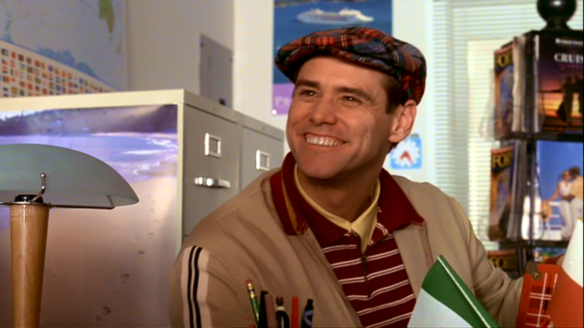 If there is a Creator of the Universe, our universe, The Truman Show puts it in a clearer light. Christoph seems like a somewhat selfish individual who allows his creation to walk off set rather reluctantly, but he finally does let go. Thus, his actions seem to make it clear that the most loving Creator possible would let his creation do what they pleased. He would be in control, but he would willingly give his created ones free will to do what they want. That makes sense to me. I would want to be a living, breathing, mistake-doing individual rather than a mechanized robot. That’s the beauty of this life.
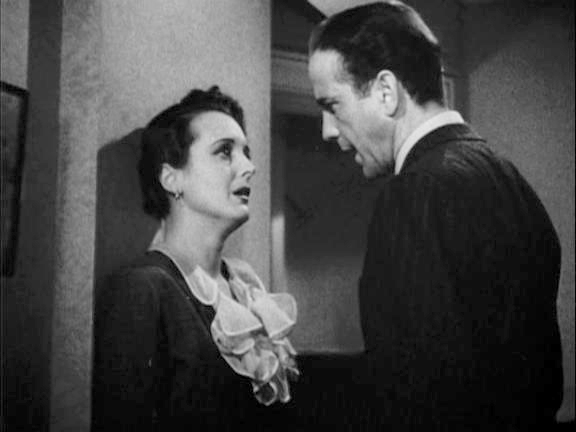 Dashiell Hammet’s “blonde satan” Sam Spade is an icon of not only 20th-century literature but also 20th-century cinema, thanks in part to
 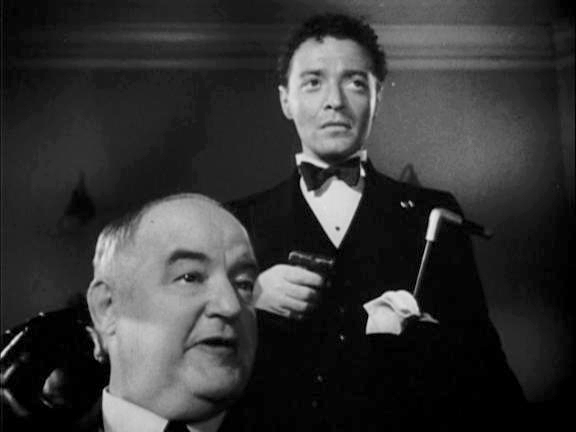 Then there’s Joel Cairo played so cunningly by the always wily and beady-eyed Peter Lorre and Kaspar Gutman portrayed so assertively and pointedly by the perennially memorable Sidney Greenstreet. These two men would come back in Casablanca and numerous other Warner Bros. Pictures, but they are the epitome of iconic characters actors who make any narrative that much more interesting. They have mugs and physiques really made for the dark recesses of the noir world, and when you put these four together it does spell trouble. Add a quietly seething Elisha Cook Jr. as Wilmer, the always personable Ward Bond as a Police Detective, and Lee Patrick as Spade’s doll of a secretary and you have a true winner.
 As I’ve grown older and, dare I say, more mature, I like to think that I’ve gained a greater appreciation for those moments when I don’t understand, can’t comprehend, and am generally ignorant. Now I am less apt to want to beat myself up and more likely to marvel and try and learn something anew. Thus, Marienbad is not so much maddening as it is fascinating. True, it is a gaudy enigma in form and meaning, but it’s elaborate ornamentation and facades easily elicit awe like a grandiose cathedral or Renaissance painting from one of the masters. It’s a piece of modern art from French director Alain Resnais and it functions rather like a mind palace of memories–a labyrinth of hollowness.
 In fact, although this film was shot on estates in and around Munich, I have been on palace grounds similar to the film. There’s something magnificent about the sprawling wide open spaces and immaculate landscaping. But still, that can so easily give way to this sense of isolation, since it becomes so obvious that you are next to nothing in this vast expanse. Marienbad conveys that beauty so exquisitely, while also paradoxically denoting a certain detachment therein.
 Do we understand this bit of interaction at this stately chateau? Probably not. In fact, I’m not sure if we are meant to know the particulars about last year in Marienbad. That doesn’t mean we still can’t enjoy it for what it is. Because Alain Resnais is perennially a fascinating director and he continued to be for many years. Whether you think this is a masterpiece or a piece of rubbish at least give it the courtesy and respect it is due. Then you can pass judgment on it, whatever it may be.
 It’s the bane of my literary existence, but I must admit that I have never read Joseph Heller’s seminal novel Catch-22. Please refrain from berating me right now, perhaps deservedly so, because at least I have acknowledged my ignorance. True, I can only take Mike Nichol’s adaptation at face value, but given this film, that still seems worthwhile. I’m not condoning my own failures, but this satirical anti-war film does have two feet to stand on.
 The Chaplain (Anthony Perkins) doesn’t feel like a man of the cloth at all, but a nervously subservient trying to carry out his duties. An agitated laundry officer (Bob Newhart) gets arbitrarily promoted to Squadron Commander, and he ducks out whenever duty calls. Finally, the Chief Surgeon (Jack Gilford) has no power to get Yossarian sent home because as he explains, Yossarian “would be crazy to fly more missions and sane if he didn’t, but if he was sane he’d have to fly them. If he flew them he was crazy and didn’t have to; but if he didn’t, he was sane and had to.” This is the mind-bending logic at the core of Catch-22, and it continues to manifest itself over and over again until it is simply too much. It’s a vicious cycle you can never beat.
 But the tonal shift of Catch-22 is important to note because while it can remain absurdly funny for some time, there is a point of no return. Yossarian constantly relives the moments he watched his young comrade die, and Nately (Art Garfunkel) ends up being killed by his own side. It’s a haunting turn and by the second half, the film is almost hollow. But we are left with one giant aerial shot that quickly pulls away from a flailing Yossarian as he tries to feebly escape this insanity in a flimsy lifeboat headed for Sweden. It’s the final exclamation point in this farcical tale.
 We are met with a deluge of drums, explosions, and the unmistakable voice of Bono murmuring over the credits. The year is 1974 in Guilford England, the Irish Republic Army is as belligerent as ever, and right from the beginning director Jim Sheridan’s In the Name of the Father grabs hold of our attention.
 But what follows is something out of some perverse nightmare. Upon a return trip back to Belfast Gerry finds his home raided and he ends up in the interrogation block being grilled by a group of less than sympathetic police attacking him with a barrage of insults and threats. This doesn’t just seem like an Irish-English problem. There’s so much hatred present and Conlon and three of his buddies get roped into signing confessions under duress.
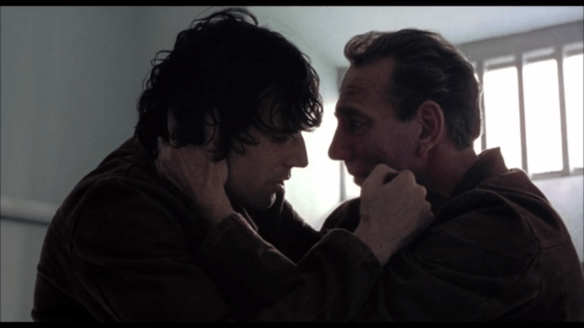 However, as he has the habit of doing Daniel Day-Lewis falls so seamlessly into his role as the Irish lad from Belfast who was wrongly accused. His Irish brogue is second-nature and he jumps between rebelliousness and fear with tremendous skill due to the emotional range demanded by the role.
 4 Star Films