
 This is an Otto Preminger film about politics. That should send off fireworks because such a divisive topic is only going to get more controversial with a man such as Preminger at the helm — a man known for his various run-ins with the Production Code. All that can be said is that he didn’t disappoint this time either.
Who knew a film revolving around the seemingly simple task of passing the president’s nomination for the new Secretary of State could be so complicated and lead to such turmoil? True, the nomination of Robert Leffingwell (Henry Fonda) might be controversial, but there’s a lot more to it than we initially conceived.
There’s the obvious political angle on Capitol Hill involving a Subcommittee chaired by majority member Brigham Anderson from Utah (Don Murray). Meanwhile, the majority leader is working behind the scenes to gather the necessary support, since he is loyal to the president, despite his share of doubts. However, old curmudgeon Seeb Cooley (Charles Laughton) is prepared to unleash all his fury and political wiles to stop the nomination in his tracks. Soon it seems to be working well enough.
But that ends up being hardly the half of it. There’s perjury, the aging president (Franchot Tone) is biding his time, and Brig begins to receive threatening telephone calls at home. At first, they seem wholly unsubstantiated, but it seems there really are some dirty little secrets to be drudged up on him. As one who is faithfully looking to uphold their position and do a credible job accessing Leffingwell, it looks like someone really doesn’t want him to reject the nomination. Brig doesn’t end up having time to find out.
And so the day of decision in the Senate Chamber turns out to be an eventful one, bringing old rivals together and resolving the issue of the nomination once and for all. It seems that so much legwork was done all for naught, but that’s politics for you.
Advise & Consent is a fascinating representation of the political system because it involves so many interconnected, intertwining conversations and interactions going on behind the scenes. There’s the pomp & circumstance, the traditions that go with these posts, but it’s actually all the side conversations behind closed doors, in private, where the real work seems to get done. Preminger uses extended shot length to allow his audience the luxury of watching events unfold methodically while using a fluid camera to keep them from being completely stuffy. And his laundry list of stars great and small lend a depth to Capitol Hill.
Although Henry Fonda might be the headliner the film’s focus is wonderfully distributed by the well-balanced cast of players. In fact, you can easily make the case that this is Walter Pidgeon and Don Murray’s film with the decrepit-looking Charles Laughton (who unfortunately passed away months later) falling close behind. Murray is the principled tragic family man, while Pidgeon is wonderfully cast as a veteran white knight of politics. Laughton while beleaguered, still manages a wry performance worthy of his final screen appearance.
Preminger also includes his longtime collaborator Gene Tierney in her return to the screen in a small but crucial role and Lew Ayres as the benevolent V.P. Harley Hudson. Even Peter Lawford is involved in a role supposedly inspired by his real-life brother-in-law incumbent president, John F. Kennedy. Some notable inclusions in the cast include the formerly blacklisted actors Will Geer and Burgess Meredith. One notable part that didn’t end up being cast was Martin Luther King Jr. in a cameo as a Senator from Georgia. Although it truly would have been a lightning rod of a political statement, in reality, Preminger didn’t end up needing it. His film already used words and covered topics hardly touched previously thanks to the watchful eyes of the Production Code. It didn’t need more dynamite.
While Advise & Consent may not be the greatest of political films or the most stirring, it still certainly has its share of riveting moments. Most anything from Otto Preminger is bound to be interesting and this one is no different.
4/5 Stars
 As the film opens we watch a foot slowly wiggling its toes. It’s nothing extraordinary because we’ve undoubtedly seen this millions of times. If not on film then at least in our own lives. But it’s what the foot does that piques our interest. Quite dexterously but still straining, it manages to pull a record out of its sheath, set it down on the player, and lay down the needle before music finally emanates out. This simple act gives us some profound insight into the story that we are about to invest ourselves in.
 Peter Pan was immortalized by Disney in 1953, but as with many of the great fairy tales that they have adapted, it’s easy to forget that there was an earlier spark. These stories do not begin and end with Disney. They have a far more complex origin story and ensuing history. So it goes with J.M. Barrie’s Peter Pan.
 Coming out of a psychology background I was familiar with Stanley Milgram’s famous social experiment back in high school during Intro to Psych. Even back then it was a striking conclusion on conformity and just how far people will go. It was also ruthlessly contrived and even more methodically executed. Inspiration came from Milgram’s own background working with psychologist Solomon Asch, as well as his own Jewish ancestry, nights watching Candid Camera, and a fascination in the Adolf Eichmann trial.
 “Two people shouldn’t know each other too well if they want to fall in love. But, then, maybe they shouldn’t fall in love at all.” – Vittoria
 The initial scene in the stock exchange is gloriously tumultuous and it never lets up. This is the dashing young Piero’s (Alain Delon) domain that he rushes through with lithe business savvy. What this arena becomes is the quintessential Italian marketplace, a hectic theater of business made up of all kinds, involved parties and observers alike. Vittoria (Vitti) is one of those who looks on with mild interest and really throughout the entire film she is a keen observer as much as she is a person of action.
 And the narrative becomes perhaps even more tantalizing than love because it’s the prospect of romance that keeps it going. But it never seems fully realized. It’s frustrating, unfulfilling in a sense, like most of his films. Whether it’s an unsolved mystery or the most perplexing conundrum mankind has ever faced romantic attraction, he always leaves us an open-ended denouement.
 Steven Spielberg is this generation’s

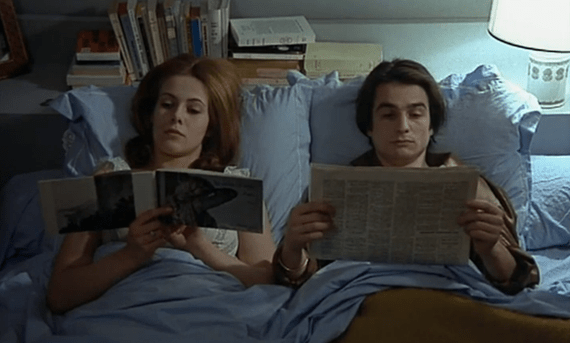 Arguably the greatest French comic was Jacques Tati and like Chaplin or Keaton he seemed to have an impeccable handle on physical comedy, combining the human body with the visual landscape to develop truly wonderful bits of humor. Bed and Board is a hardly a comparable film, but it pays some homage to the likes of Mon Oncle and Playtime. There’s a Hulot doppelganger at the train station, while Antoine also ends up getting hired by an American Hydraulics company led by a loud-mouthed American (Billy Kearns) who closely resembles one of Hulot’s pals from Playtime. Furthermore, there are supporting cast members with a plethora of comic quirks. The man who won’t leave his second story apartment until Petain is dead and buried at Verdun. No one seems to have told him that the old warhorse has been dead nearly 20 years. The couple next door that is constantly running late, the husband pacing in the hallway as his wife rushes to make it to his opera in time. There’s the local strangler who is kept at arm’s length until the locals learn something about him. The rest is a smattering of characters who pop up here and there at no particular moment. Their purpose is anyone’s guess, and yet they certainly do entertain.
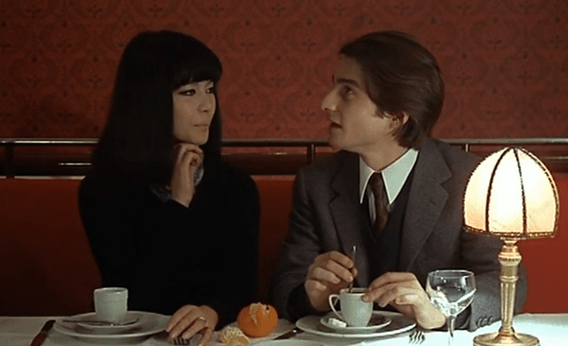 But as Truffaut usually does, he digs into his character’s flaws that suspiciously look like they might be his own. Antoine easily gets swayed by the demure attractiveness of a Japanese beauty (Hiroko Berghauer), and he begins spending more time with her. Thus the marital turbulence sets in thanks in part to Antoine’s needless infidelity –revealed to Christine through a troubling bouquet of flowers. It’s hard to keep up pretenses when the parent’s come over again and Doinel even ends up calling on a prostitute one more. It’s as if he always reverts back to the same self-destructive habits. He never quite learns.
 If you’ve read any of my reviews on the original trilogy, you undoubtedly know that Star Wars had a tremendous impact on my childhood. That’s true for many young boys. It was the film franchise of choice, and it wasn’t just a series of movies. The beauty of Star Wars is that it encompasses an entire galaxy of dreams beyond our own. It’s a world that reflects ours in many ways — the difference is that they have lightsabers. But not just lightsabers. Aliens. Spaceships. Planets. The Force. Characters who for all intent and purposes live like us. Good, that is in constant conflict with the evil in the world. It’s a struggle that is constantly evolving.
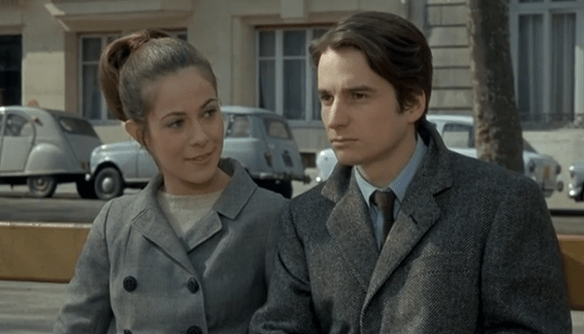 Charles Trenet’s airy melody “I Wish You Love” is our romantic introduction into this comedy-drama. However, amid the constant humorous touches of Truffaut’s film, he makes light of youthful visions of romance, while simultaneously reveling in them. Because there is something about being young that is truly extraordinary. The continued saga of Truffaut’s Antoine Doinel is a perfect place to examine this beautiful conundrum.
 In fact, all in all, if we look at Doinel he doesn’t seem like much. He’s out of the army, obsessed with sex, can’t do anything, and really is a jerk sometimes. Still, he manages to maintain an amicable relationship with the parents of the innocent, wide-eyed beauty Christine (Claude Jade in her spectacular debut). Theirs is an interesting relationship full of turbulence. We don’t know the whole story, but they’ve had a past, and it’s ambiguous whether or not they really are a couple. They’re in the “friend zone” most of the film and really never spend any significant scenes together. Doinel is either busy tailing some arbitrary individual or fleeing pell-mell from the bosses wife who he has a crush on.
 By the time he’s given up the shoe trade and taken up tv repair he’s already visited another hooker, but Christine isn’t done with him yet. She sets up the perfect meet-cute and the two young lovers finally have the type of connection that we have been expecting. When we look at them in this light, sitting at breakfast, or on a bench, or walking in the park they really do seem made for each other. Their height perfectly suited. Her face glowing with joy, his innately serious. Their steps in pleasant cadence with each other. The hesitant gazes of puppy love.
 4 Star Films