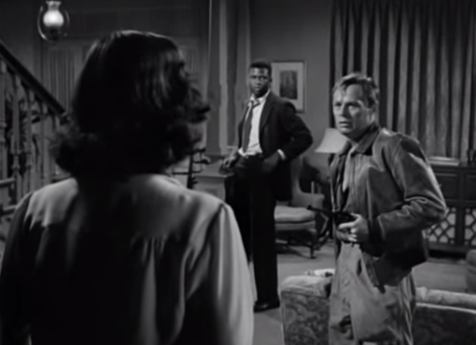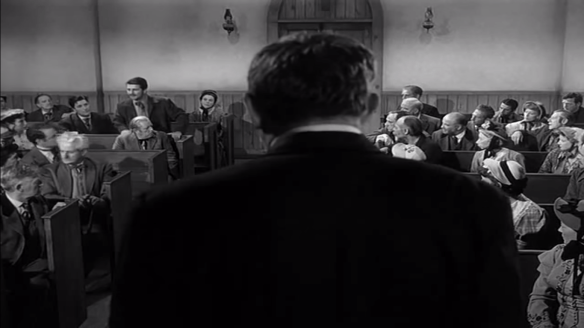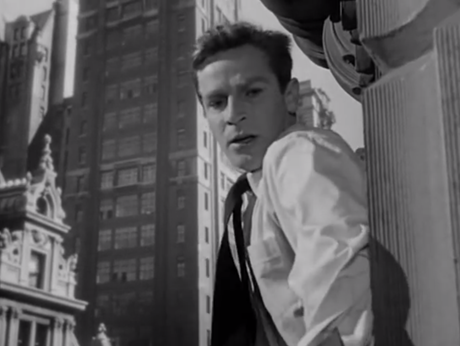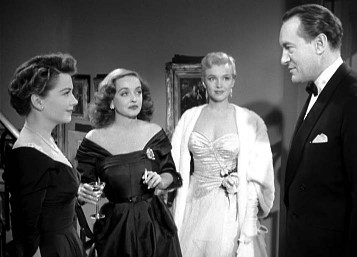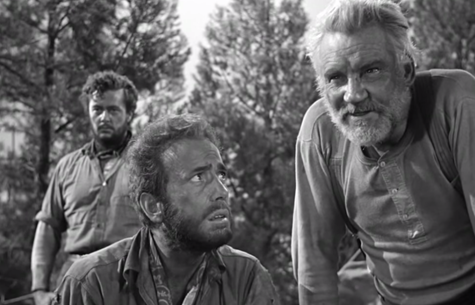
The Treasure of the Sierra Madre (1948)

treasureofsierra2If you was to make a real strike, you couldn’t be dragged away.  Not even the threat of miserable death would keep you from trying to add ten thousand more.  Ten you’d want to get twenty-five, twenty-five you’d want to get fifty, fifty a hundred.  Like roulette. One more turn, you know.  Always one more.

If there’s anything to take away from The Treasure of the Sierra Madre it’s that wealth never satisfies, it only serves to compound our anxieties. John Huston’s film is without question an American classic pure and simple, and it maintains that distinction because it has lost very little of its power to this day. Huston returned from shooting WWII documentaries with this project waiting for him back home. He partnered once more with Humphrey Bogart, and he even cast his father in a role that proved to be the standout in the film. Also, he shot most of Sierra Madre actually on location in Mexico, while also hiring locals as extras. It adds to the gritty realism and it was a trend that was slowly becoming more popular.

His prospecting adventure film with shades of western or even noir follows three men who join forces to prospect for gold in the mountains. They first cross paths in the town of Tampico where they’re strapped for cash and barely scraping even. Fred Dobbs meets Bob Curtin (Tim Holt), who shares a similar predicament and they stick together. Upon hearing the tempting tales of gold and riches from a loquacious old prospector (Walter Huston), he plants an idea in their mind. And with nothing to lose the three partners embark on this grand undertaking.

Humphrey Bogart is undoubtedly our main protagonist. In fact, he had been playing them ever since dropping the supporting roles and donning the fedora of Sam Spade in The Maltese Falcon (his first collaboration with John Huston). But down-on-his-luck, scraggly-faced Fred C. Dobbs is probably one of Bogey’s greatest performances. He’s a sourpuss and a bum, who’s begging for money and telling the local kids pestering him to beat it. These early sequences include a cameo from the director and young Robert Blake. I can also debunk a myth by confirming that Ann Sheridan is not the eye-catching woman walking down the street early on, at least not in this cut of the film.

These early moments set Bogart up in such a way that we feel pity for him, even if we are not completely sold on his moral character. Tim Holt’s Curtin likewise is a sorry fellow, and he’s far more understated which makes us want him to see success. Walter Huston steals his scenes because he fits his part so beautifully. He talks and talks and talks. Laughs, gives sage advice every once in awhile, and does a jig if he feels like it. He’s a completely free-spirit, comfortable in his years, and perhaps a little less invested than the other two. He’s in for the gold, but he realizes the transience of life.

treasureofsierra4

Their journey is plagued by harsh terrain, heat, banditos, and even a nosy fortune hunter from Texas named Cody. But Howard’s premonitions were right and they begin raking in a mother lode. It’s hard work, but it’s coming slowly but surely. This is the key turning point in the film and the keystone to Bogart’s whole performance.

The early warnings of Howard seem all too pertinent now, “Murder’s always lurkin’ about. Partners accusin’ each other of all sorts of crimes. Aw, as long as there’s no find, the noble brotherhood will last, but when the piles of gold begin to grow, that’s when the trouble starts.

And so it does. Dobbs is the perfect embodiment of what avarice does to a man. The paranoia builds up. Friends become foes, everyone is out to get him, and Reason no longer has any presence in his life. First, he wants to turn on Cody, who by all accounts wasn’t a bad fellow. Next, it’s Howard and then Curtin, who once was his closest companion. By the end of the film, “Dobbsie” has been so totally wrecked by greed, he no longer is the same person. In fact, Bogart has a similar trajectory to Gollum except he is not redeemed. The implications here are not simply some conclusion on wealth and gold, but more importantly what it does to the hearts and minds of men.

treasureofsierra3

However, with all the darkness and corruption pulsing through Sierra Madre, there also are some comedic undertones mostly delivered by Walter Huston. In a sense he was the mediator between Curtin and Dobbs, keeping things civil and so when he left them, they were left to their own devices. He also is the one who is able to look at the cruel hand that they are ultimately dealt and laugh it off. Thus, Bogart gave a wholly aberrant performance, Tim Holt was more morally steadfast, and Huston was the standout with his lively turn. Humor and treachery make strange, but thoroughly entertaining bedfellows indeed.

5/5 Stars

Au Hasard Balthazar (1966)

auhasard1Robert Bresson’s Balthazar is the best piece of art I have viewed in some time and it is art in the sense that it may have various interpretations, it causes us to think, and it elicits an emotional response. In truth, it is a story that I do not fully understand and I can never hope to know, but there is nevertheless an austere beauty to this parable. Furthermore, there is a kind of magic in this air of ambiguity. I want to watch it, again and again, to see if I can understand, to see what revelations come my way. It was one of those experiences that left me wondering what I had just watched, however, I know enough by now not to fight it, but enjoy that feeling of not comprehending in full.

Essentially this is a tale about a donkey cherished by a young girl and over the years they lose contact, reunite, and go away again, as is the rhythm of life day to day. The plot points started becoming less important in comparison to the images and emotions that begin to well up inside of us. At the same time that the donkey is often being mistreated or carrying the burdens of his various masters, his girl Marie (Anne Wiazemsky) is growing up trying to figure out what love is. She is close to a boy named Jacques only to have him drift in and out of her life several times. She cannot decide how she feels exactly about him. There’s the boy Gerard who is good at raising hell and Marie spends some time with him. But it remains to be seen what the real agenda of her parents or Gerard and his friends are. What of these matters of honor and murder? Do all the particulars even matter that much?

Balthazar’s own path includes whippings, long hard toil as a beast of burden, a stint in the circus with all the other captive animals, and happy times driving Marie’s cart. But is that wrong to personify him? Is he even capable of emotion? I’m not sure if he is, but the audience certainly is. We can be joyful when we see that cute young donkey being enveloped in hay with young children playing. We can become somber as Balthazar is slowly being worked to death as the years drag ever onward and his master considers putting him down in lieu of getting a new harness. Somehow a donkey can be a victim of his circumstances, bravely taking the abuse of others, and living without a shred of retaliation. In some strangely entrancing way, it works.

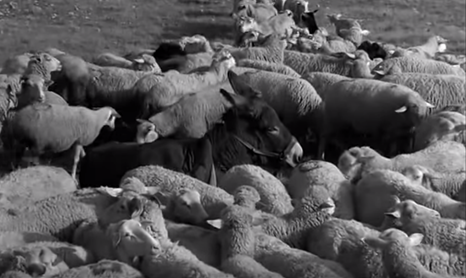
auhasard2Then, Balthazar takes a stray bullet and weakened he comes upon a green pasture where he kneels down peacefully to die. Around him comes a flock of sheep led by a shepherd. It’s a deeply heart-wrenching and visually arresting moment evoking Biblical imagery from Psalm 23. The full life having been lived and now it’s over in tranquility. It’s really a summation of the spiritual journey that each one of us traverses in our lifetime and yet Bresson brings us this allegory through simple, clean strokes. Images and sounds balanced exquisitely together in a completely naturalistic mode of expression.  Wiazemsky on her part is a natural beauty who positively captivates with every move she makes (reminding me of Anna Karina) Furthermore, Bresson somehow causes us to build a deep connection with a donkey which is hard to believe.

It’s the trademark of Bresson to have a stripped-down, straightforward approach to film-making, so much so that his style almost feels like no style at all. It’s so clean and unobtrusive. He shows us the world simply, succinctly, and without pomp. Even with the casting of non-actors, and in this case a donkey, as his main players. But he’s undoubtedly the master of inducing a response based on even the most basic of subjects. There are times it’s almost easy to forget you’re watching a film entirely because you get so wrapped up in what he is showing us.

4.5/5 Stars

The Young Girls of Rochefort (1967)

rochefort1If the Umbrellas of Cherbourg is a piercing operatic drama, The Young Girls of Rochefort is pure, unadulterated escapism at its finest. 

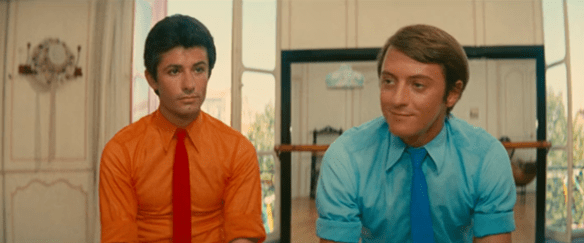
Directed by Jacques Demy and starring an ensemble cast including Catherine Deneuve, Francois Dorleac, Gene Kelly, Michel Piccoli, George Chakiris, Grover Paul, and Danielle Darrieux, this is a whimsical French musical that has no equal. 

rochefort9

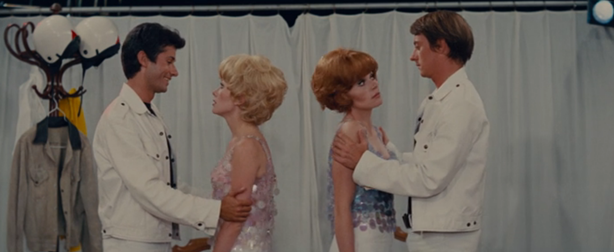
The film opens with a group of performers coming into the town of Rochefort to get ready for a big outdoor show. They become acquainted with the local hangout that includes a kindly matron (Darrieux) and many locals including an idealistic artist and sailor who is searching for his ideal lover. Nearby her two adult twin daughters hold piano and ballet lessons as they too get their little prodigies ready for the big show. Delphine (Deneuve) is fed up with her suitor and desires a new love, while Solange (Dorleac) on her part hopes to advance her career as a pianist. She goes to the proprietor of a local music store to see if he can introduce her to a prestigious American Friend.

A great deal of dramatic irony sets in and the plot is constantly moved forward through song. Yvonne at the café is still depressed over a split with a lover 10 years prior, because he had an unfortunate name. Solange has a chance encounter while stopping to pick up her kid brother Booboo, and Delphine becomes curious about an artist who painted a portrait that looks strikingly like her. All of these events reach their apex on the Sunday of the big performance, and in need of some performer, the carnies enlist the help of the twins. They are a huge success and things wind down.

rochefort4

The next morning the performers get ready to leave for Paris and the girls decide to follow suit. However, Solange has another encounter that changes her plans and then Yvonne is united with her love. That leaves only Delphine to go with the boys to Paris, but not to worry, she would be united with her painter soon enough.

The light and very French-sounding tunes are hard not to like, but that is only the very beginning. Demy pays homage to Hollywood musicals of old going so far as casting Gene Kelly (Singin’ in the Rain) and George Chakiris (West Side Story) in his film. He undoubtedly owes a debt to Vincente Minnelli and Stanley Donen with some striking moments reminiscent of An American in Paris (1951). It makes sense. Demy uses the pastels and costumes of a Hollywood musical extravaganza while also including dashes of French style.

rochefort2

Rochefort takes place in a real location, but it truly is a fantasy world that the characters inhabit, full of perpetual dancing and dialogue that is delivered through song. The real-life sisters do a wonderful job in this film and there is something reassuring about seeing Gene Kelly. Rather like an old friend who gives comfort in a whimsical, but altogether new experience. The story arc of dashed, renewed, and ultimately newfound love allows Demy to once more explore the issues of fate and chance that always seem to enchant him.  His partnership with Michel Legrand is once again bountiful including the enduringly memorable “Chanson Des Jumelles,” an infectiously bouncy, trumpet-laden number performed by the sisters.

There’s nothing much else for me to say except The Young Girls of Rochefort is one of those underappreciated gems that is thoroughly enjoyable and chock full of all sorts of fun. It delivers a serving of something with a familiar flavor while giving it a little extra panache. It’s about as playful and fluffy as you can get which in this case is not a bad thing at all. 

4.5/5 Stars

No Way Out (1950)

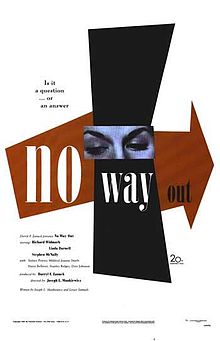
220px-No_Way_Out_(1950_film)_posterI had a preconceived notion that No Way Out might be the kind of social drama that was groundbreaking for its day and by today’s standards looks mundane and quaint. 65 years have passed and this film from Joseph L. Mankiewicz still packs a wallop, believe it or not. We are blessed with the first major role for screen icon Sidney Poitier as young doctor Luther Brooks. His main antagonist is Richard Widmark playing a racist scumbag like he does best, and Linda Darnell also gives a key performance, although her career would soon be on the decline.

The film opens with the young interning doctor — Poitier was only 22 at the time –getting ready for a night shift. His first customers just happen to be Johnny and Ray Biddle, who both got it in the leg after a botched robbery attempt. At first glance, their wounds look superficial, but Luther notices Johnny is disoriented. His diagnosis is a brain tumor so he tries to administer a spinal tap which ends up unsuccessful, partially due to Ray’s constant berating. But Ray has no sympathy; all he knows is that this black doctor has killed his brother. A white doctor could have saved him and all his prejudiced beliefs of blacks are confirmed. At least that’s what he tells himself in his narrow little mind.  Luther even goes to his superior Dr. Wharton (Stephen McNally), and although he cannot be absolutely certain, he maintains confidence in Luther’s competence.

nowayout1Again that bears little importance to Ray and he will not grant them the opportunity to do an autopsy. After all, his mind is already made up. So the next best thing is to track down Johnny’s former wife Edie (Darnell), who has pulled herself out of the gutter which is Beaver Canal and made a modest living for herself. They want her help, and unbeknownst to them, she does go see Ray. You can see it in how they interact with each other. She was Johnny’s wife once, but there was something between them and Ray won’t let her forget it. That’s undoubtedly why she wanted to get away, but Ray brings out the worst in her. Even as they speak, her racist sentiments come bubbling to the surface. It’s in her veins after all. It doesn’t help that unrest is building in the city. A riot is at hand and the slow build-up leading to the imminent rumble is boiling with tension. Mankiewicz does something important here. He shows both perspectives. I cannot help but think some things have not changed a whole lot over the years. Black vs. white. The same racism. The same belligerence. The same lack of understanding.

nowayout2Of course, after that is all done, that still does not wrap things up with Ray. He still has to settle a score with Luther and he uses Edie against her will. They set a trap at the home of Dr. Wharton for the unsuspecting Luther, and this scene has vital importance to the film, not simply because Biddle and Brooks come face to face once more. This is the scene where Edie must make a choice. Really it’s the universal choice. Stand passively by as injustice is being done or take a stand against it.

So you can make your own diagnosis, but this was not a superficial message movie. It hits fairly hard. I was even surprised by how often Ray Biddle lets the N-word fly. It completely fit Widmark’s characterization, but the production codes allowed it. Supposedly the actor apologized profusely after many of his scenes with Poitier, but his performance is nevertheless potent. It’s certainly convicting and we cannot be too quick to find fault with any of these characters because, truth be told, we all have some apathy and narrow-mindedness stuck inside our skulls. No Way Out is a striking reminder of that.

4/5 Stars

Review: High Noon (1952)

highnoon1Drums softly beating. A voice mournfully bellowing,”Do not forsake me, oh, my darlin‘.” It can only mean one thing, the beginning of High Noon, a western that has grown near and dear to my heart in the recent years. And yet how can a western of under 90 minutes mesmerize and cause goose bumps to form time after time? That opening ballad sung so wonderfully and folksy by Tex Ritter is one great reason. It’s a mournful dirge of a song which nevertheless draws us into this film, and personally, I cannot help but belt out a few lines now and then (I’m unashamed to say I know the whole song). After all, it’s this song that reflects the story of our main character Marshall Will Kane (Gary Cooper) and reiterations of the tune can be heard throughout for the following hour as we all wait for the noon train.

The song makes it clear that Ben Miller is coming after Kane for sending him to prison. He’s got revenge on the mind and three of his buddies, including his brother, are waiting for his arrival, along with everybody else in town. Meanwhile, the Marshall is about to hang up his badge as it were, because he’s gotten hitched to a pretty young quaker (the estimable Grace Kelly), and they look to settle down with a store in some sleepy town. He’s well-deserving of it after all he’s done and the town stands behind him.

But the news of Miller’s return is no way to start the honeymoon. Still, the couple sets off, but Kane turns around realizing he cannot run (I do not know what fate awaits me. I only know I must be brave. For I must face a man who hates me, Or lie a coward, a craven coward; Or lie a coward in my grave).

highnoon4

This is the backdrop that he’s trying to scrounge up a posse with. Others getting out of town, some telling him he should get out of town too, and a general commotion about what they should do about the whole mess. There are numerous cross-sections and enclaves all with different motives and most importantly excuses. They all turn down a chance to help Kane for one reason or another (even his closest friends). It seems so easy to pass judgment, but then again what would we do in such a situation? In fact, it brings to mind the Hollywood Blacklist which this story was supposed to be an allegory for. This is not just some fictionalized parable, it was mirroring real life to some extent.

What really resonates about this film is the resolve of one man, because when it comes down to it, Kane did not need to stay, he did not need to do what he did, but he stood by his guns, literally, when no one else would stand with him. It’s easy to conform, easy to go with the crowd. It takes real courage to walk out on your own — although the Marshall did have a little help. So whether or not John Wayne thought this film was wholly “Un-American” or not, I think I would have to disagree with him on this one. Maybe what Kane has is reluctant courage, and I could see how the Duke would be disgusted by such a “spineless” individual. But for me, he’s all the more relatable played so aptly by Gary Cooper.

highnoon7It continues to amaze me that a film of this length can have so many wonderful characters who leave an indelible mark on the story. Certainly, you have the hero and the villains, but then we have character actors such as Thomas Mitchell, Harry Morgan, and Lon Chaney Jr. playing some of Kane’s buddies. There’s the gang at the bar and the hotel clerk, who are no friends of the Marshall. There’s his former flame Helen Ramirez (Katy Jurado) and his hot-headed deputy (Beau Bridges). The rest are filled out by men, woman, children, town drunks, and churchgoers. Zinnemann does a wonderful thing aside from just using the clock as a plot device and tension builder. He also calls back all these many characters as the noon train comes in with smoke billowing black. The audience and all these people know what that shrill whistle means. Things are going down, and Kane is going to face it all alone.highnoon2The isolation is so wonderfully conveyed by an aerial shot where the camera moves up to show the stoic Marshall standing in the middle of a ghost town. No people around and no one showing their faces. Then of course, when it’s all over, the floodgates open and all the folks rush into the center of town. Fittingly,  Kane drops his tin star in the dirt in disgust as the refrains of Tex Ritter’s ballad continue.

Put High Noon up against other films and it could be criticized as nothing more than a western, but perhaps that’s why I like it. I cannot help but gravitate towards it. In some ways, it reminds me of growing up and it allows me to forget about any sort of deeper meaning for an instant so I can be fully enraptured with this story, this song, and these characters. It’s a worthy incarnation of the mythic west, that also leaves a little space for some humanity.

People gotta talk themselves into law and order before they do anything about it. Maybe because down deep they don’t care. They just don’t care.” – Martin Howe (Lon Chaney Jr.)

5/5 Stars

Fourteen Hours (1951)

fourteenhours1Fourteen Hours is a taut little thriller, based on real circumstances that occurred in New York in 1938. The film opens with a young man standing on the ledge of a tall hotel in New York City. An unsuspecting waiter happens upon him and a traffic cop (Paul Douglas) spies him from the street below. All of a sudden, a mundane day gets a little more exciting for all the wrong reasons.

Henry Hathaway’s film has the kind of self-contained drama of a modern film like Phone Booth (2002) and a media frenzy that is in some ways similar to Billy Wilder’s Ace in the Hole (1951). Really when you break it down it’s essentially about two men. Robert Cosick (Richard Baseheart) is the despondent and disturbed man tottering on the edge of destruction. He needs a friend. He needs guidance. The rapport built between him and Charlie Dunnigan (Douglas) is what keeps him where he is.

Outside of this main dynamic, we have a lot of smaller events all happening at once. The gruff deputy chief Moskar (Howard Da Silva) tries to work on the inside of the hotel to get the man indoors. A psychiatrist with a hypnotic stair (Martin Gabel) tries to divvy out advice to Dunnigan and others. Meanwhile, Robert’s histrionic mother (Agnes Moorehead) and his plain-speaking father both make appearances, but to no avail. They even finally track down his girl Virginia (Barbara Bel Geddes) in the hopes that she can get him down. All the while the journalists scrounge around for a good story that they can feed to their papers because this is news!

fourteenhours3Down in the streets below young people (Debra Paget and Jefferey Hunter) look up wishing they could do something. The cynical cabbies decide to make a wager on when the man will jump since they aren’t getting any more business for the time being. Even Grace Kelly makes an appearance (her debut), as a young wife who is about to go through with her divorce. But the man on the ledge flusters her and she and her husband have a happy ending.

Hour after hour drags on as Dunnigan continues to work on Robert to get him to come in. He loses his temper once, converses about fishing for floppers, and talks fondly about his wife. By far Paul Douglas is the standout because he has such a genial quality that makes his newfound friend, and the audience, trust him. He’s a good egg as they say, and at the end of the day, he gets to walk off with his wife and son after a good day’s work.

I think it’s true that the film was remade as Man on the Ledge, but I doubt that I would ever want to see it after this film. Don’t get me wrong, it crawls a little bit in the middle, but the combination of this human drama and the plethora of characters lent itself to a generally interesting tale. Also, it’s never static visually. Hathaway gives us a lot to look at. I will admit that several of the storylines were flimsy and unnecessary, but it was still fun to see Grace Kelly for at least a few moments.

3.5/5 Stars

Review: All About Eve (1950)

EveEveMargotCasswellWitt“Fasten your seatbelts. It’s going to be a bumpy night” ~ Margo Channing
It’s cliche, I do admit, but they simply do not make films like this anymore. Stories about people talking where the actors take center stage. In this case, the story from Joseph L. Mankiewicz is about the Broadway stage and all that happens behind the curtains, in the dressing rooms, and behind the closed doors of the royalty of that profession.There is so much that could be dissected, antagonized over, or acknowledged so I will move through it the best way I know how.

A moment must be spent acknowledging that this is the film that revitalized the career of Bette Davis. She was the tops during the 30s and early 40s, but the role of the histrionic stage icon Margo Channing was her comeback and it thoroughly suited Davis. I have actually never been a fan of hers because I always found her rather arrogant and she scares me visually. However, All About Eve plays on my personal sentiments wonderfully. When we’re first introduced to Margo, she’s everything we expect in a Bette Davis character, and truth be told I don’t really like her. But interestingly enough that changes. That’s where Eve and the rest of the cast come in.

The film is book-ended by the wonderfully wry and snooty commentary of theater critic Addison DeWitt (George Sanders). He makes it his mission to rake every new play over the coals, and he can be merciless. But he also is a great ally and he proves so for young Eve Harrington (Anne Baxter). Because, after all, this film is her story, we just don’t quite understand why at the beginning.

Eve came from humble roots and was the most devoted young fan of Margo Channing. She would attend every one of her performances and wait outside her dressing room timidly, just to get a glimpse of the star. One of Margo’s best friends Karen Richards (Celeste Holm) was accustomed to seeing the girl and in a kindly gesture she invited Eve up to the dressing room. And just like that Eve had her backstage pass into this world rounded out by Margo Channing, Karen, her husband the playwright Lloyd Richards (Hugh Marlowe), and the young director Bill Simpson (Gary Merrill) who also happens to be Margo’s suitor.

She begins unassuming enough on the outskirts of their little group. Always seen, not heard. Always thoughtful and ready to be of service. Eve takes on the role of Margo’s personal assistant just like that and an ego like Channing doesn’t mind. In fact, everyone seems to like having her around except the skeptical Birdie (embodied by the always spunky Thelma Ritter).

As time marches on, Eve loses her charm. More and more it feels as if she’s analyzing Margo. Watching her every move. Monitoring her success and slowly moving in. She plants the idea that she can be the next understudy and so it is. One fateful night Karen agrees to stall Margo and Eve gets her big chance as an understudy. She of course politely invites all the major critics to see the performance. It was the conscientious thing to do after all. Ironically, it’s at this point where things turn. Margo becomes the victim and in her great vulnerability, while sharing with Karen, we begin to sympathize with this woman hiding behind the facade of Margo Channing. Meanwhile, Eve continues her ascent using whatever means possible. She alienates Margo and begins driving a wedge between the always amiable working relationship of Lloyd and Bill. Eve even resorts to blackmail and home wrecking sharing her master plot with Addison.

She’s used everybody else and so he seems like the next logical target. However, he’s too much like her. He’s too cynical to fall for her act, and he points out a few chinks in her armor. So like that we end up back at the award ceremony where Eve is about to win her big award. Now we know all the clawing and backstabbing it took for her to get there. Now all that is veiled under her perfectly demure features and charming voice. But we see it on the faces of all the ones who sit there knowingly. Each one knows all too well the damage that this girl has done. She came out of the woodwork, used and abused them because everything was about Eve. Nothing else mattered to her.

But the beauty of the film’s ending is that the cycle continues. Margo is fading away yes, and Eve is taking her place, but that means that there are more Eves where she came from. Young girls obsessed with stardom, fame, and success. It’s a frightening evolution and it proves to be a sharp indictment of the industry as a whole.

The five leads are solid and their performances shift as the Margo-Eve dynamic fluctuates. However, George Sanders is possibly the most enjoyable character, because, despite his cruel wit, he’s the one who is outside of Eve’s influence, or at least he catches her in her charade. There’s something utterly satisfying in that. Also, he has some memorable moments alongside the aspiring Ms. Casswell (none other than the show-stopping Marilyn Monroe in an early role). So really this is a film about the performances and they are well worth it because they suggest that in such a cultured world, so many things lurk under the surface. It might be insecurity, fear, suppressed desire, or savagery. Humanity is most definitely messy, you just have to look behind the curtain sometimes.

5/5 Stars

The Empire Strikes Back (1980)

SW_-_Empire_Strikes_BackGrowing up, Star Wars was my life. I lived, ate, slept, and dreamt Star Wars. But notably, Empire Strikes Back was always my least favorite film in the original trilogy. In truth, it scared me because it showed a different side to this galaxy. It seemed to be ignoring the unwritten rule that good should and will always prevail over evil.

Now I know better than that. Every great film trilogy needs that moment where it delves into the darkness and scours the depths of despair. it’s in these moments that characters become solidified, pun intended, and we truly begin to care for them on a deeper level.

Because Empire Strikes Back is certainly a film about darkness; that’s part of the reason why I shied away from it growing up. But such evil always seems to reveal the polarities of nature.  To balance out the dark side there must be light. Heroics, sacrifice, and friendship come to the forefront because baseness calls for such a response from our protagonists.

Another reason I was not always a fan of Episode IV was rather shallow, I admit. Planets like Hoth, Dagobah, and even Bespin were just not as thrilling as Tatooine and Endor for some reason. That still holds true to some extent, but now the first issue I touched on takes greater precedent.

It’s in this story where the Rebels are struggling to survive, fleeing Hoth desperately from an Imperial garrison that seems largely regrouped and unfettered by the destruction of the Death Star. All seems bleak and hopeless once more. Things begin with Luke being kidnapped and dragged off to a Wampa lair. He almost gets crushed by an incoming AT-AT as his buddies get fried, and finally, he crashes his X-Wing into a swamp searching for a Jedi Master who is little more than a green muppet. It’s not much of a hero’s journey, or more precisely it’s a journey full of pitfalls and failures.

Meanwhile, sparks are flying between Han and Leia, not because of their chemistry, but their complete lack of any chemistry. He’s a scoundrel and she’s an aloof princess hardly enamored with his show of bravado. After all, he pilots a heap of junk and walks around with a furry walking carpet prone to fits of rage. C3P0 is at best comical every now and again when he’s not overly annoying. R2D2 is a spunky dynamo like always.  These hardly seem like complimentary words, and it’s hardly thoughtful commentary, but it sets the stage for brilliance.

The plot is contrived just as Vader contrives to lead Luke right into his trap. On both accounts, it works to perfection. Bespin becomes the perfect place for some major truth-bombs. The most obvious one pertaining to a certain person’s father. But we also see the evolution of Han and Leia’s relationship. We see the true camaraderie between Han and Chewie, and the real nature of Lando, another scoundrel with a heart of gold, much like his buddy Han. Finally, we find out that Leia has extraordinary powers of her own.

On a purely cinematic level, The Empire Strikes Back introduces us to our first real lightsaber battle we ever got and it never disappoints. True, Vader and Obi-Wan faced off, but that was more symbolic in nature. The bout between Luke and Vader was the next step, necessary for this story to progress. Luke has fallen and failed this time as the power of the dark side is too strong for him, but this is only the beginning. Any great trilogy must enter into the darkness certainly, but there’s also an ending to the story. Completely different than what came before. In this case, the Jedi will return prepared to bring order to the galaxy as it is meant to be.

Thus, I wasn’t completely against The Empire Strikes Back as a kid, because I knew it wasn’t the end of the story. We leave our characters on a hopeful note as they survey the vast galaxy in front of them. It’s far from being redeemed, but it’s also not too far gone. This is a space western for the ages with dramatic storytelling, twists, and turns worthy of one of the great series of our generation. Let’s just take another moment to salute John Williams too. Without him, Star Wars is far less. He makes this world of George Lucas come alive.

5/5 Stars

Hold Back the Dawn (1941)

holdbackthedawn boyer de havilland 5Hold Back the Dawn was written by the winning combination of Billy Wilder and Charles Brackett, but the director was actually Mitchell Leisen. That was the last time Wilder would let someone else take hold of his work. It’s actually rather meta, a film within a film. We see our director and a film being made (Complete with Veronica Lake), but that is only a pretense for this story to be told.

Georges Iscoveu (Charles Boyer) wanders into the studio hoping to tell his story to somebody who might help him. The tale goes something like this. Much like many other hopeful emigrants, he heads to Mexico in an attempt to try and get into the states, but he’s told that he’ll have to wait and so Iscoveu holes up at the Esperanza Hotel with all the other masses. Time passes and he is getting nowhere fast, but he does bump into an old partner in crime named Anita (Paulette Goddard). Undoubtedly using her feminine charms, she wrangled herself a husband in order to secure herself citizenship. Then she swiftly got a divorce to close the deal. She’s a real peach and she plants the idea in Georges because he is desperate after all.

The gears are turning and he sets his sights on the pretty young schoolteacher, who is in Mexico with some of her students. Their car is in the shop, and after swiping a sprocket, Georges goes into action.

With soaring rhetoric, he wins Miss Emmy Brown over and he puts a ring on it, a borrowed ring from Anita to be exact. He’s a real cad, but it is a Charles Boyer leading man.

To her credit, Olivia De Havilland plays this ingenue and small-town teacher with bright eyes and idealism. We cannot help but feel for her because this is a woman who is swept off her feet and she exhibits true affection. She’s naive, but as Georges acknowledges, she’s swell. Anita has plans for them to meet up once the marriage is terminated because she thinks that she and Georges can run in the same circles once more. But all the time he has spent with Emmy has not left him unchanged. Car rides and travels through Mexico becomes intimate and sweet. So somewhere there is a turning point in the psyche of Iscoveu. It no longer becomes a con game with Anita, but a true romance with Emmy.

However, the trouble comes when the inspector named Hammock (Walter Abel) comes sniffing around because the marriage of Emmy and Georges seems obviously fishy to him. But Ms. Brown does the noble thing and defends Georges not out of ignorance, but charity. She knows she was living a dream and is about to go back to reality, making the drive back to her home in Azusa, California.

Georgholdbackthedawn6es has what he had initially set out to get, but the story cannot be over. When he hears of a deadly car accident, he rushes across the border without heed of the law so that he can be with the love of his life. It’s a gushy conclusion that looks like it might end badly. After all, Iscoveu broke some major laws, but Hammock gives him some grace showing he’s a softy at heart. Even Anita gets what she’s always wanted.

The film is a treat because we not only get an A-grade performance from De Havilland, there’s a conniving Paulette Goddard, and even a brief cameo by everybody’s favorite Peekaboo girl Veronica Lake. Curt Bois (the pickpocket from Casablanca) also makes a spirited performance in one of the minor plots.

Hold Back the Dawn certainly begs the question whether Wilder’s own experiences are infused into this story since he often told anecdotes about his emigration into the U.S. which ultimately led him to success in Hollywood. Also, this film suggests that Mitchell Leisen is not so much a great director or a maker of masterpieces, but he is in his element with romances. However, I wonder if part of his success was having the likes of Billy Wilder and Preston Sturges writing scripts for some of his most prominent films (including Easy Living, Midnight, and Remember the Night).

4/5 Stars

Me & Earl and the Dying Girl: Depth and Dying (2015)

meandearlandthedyinggirl1What struck me about Me & Earl this time around was not just the cinematic homage or the quirky indieness, but the fluid movement of the camera matched with the ever-evolving score of Brian Eno. It made me appreciate this film yet again because some people might say it’s weighed down by over-trod tropes, but it leaves those in the dust. Others might criticize it for playing up to all the cinephiles out there in order to garner respect. Which might be true.

But in essence, this film resonates on such a greater level. All the side characters are fun and interesting and I’m sure all the various parodies will open the floodgates for some enthusiastic young moviegoers to discover film’s roots. Those are all wonderful perks of this story. And yet again, Greg Gaines feels so relatable it’s almost scary at times. He’s so insecure on so many levels, drifting in and out of the school corridors, awkward around dying girls, and awkward around girls in general. Most of this I pointed to already in my initial review.

However, it’s the work of director Alfonso Gomez-Rejon along with cinematographer Chung-hoon Chung that contribute an added layer of depth to this film. The gracefully spiraling camera is at times reminiscent of Ophuls ascending a staircase. There are perfectly symmetrical shots popping with colors that Wes Anderson would most certainly approve of. But like the great minimalists out there, the camera is still when necessary. In poignant moments when Greg and Rachael have real, heartfelt, even hurtful conversations, there’s no need for flashiness. It’s in these moments where those behind the camera prove their skill because we can see them having fun with their artistic vision, but we also notice the great deal of care they have for these characters.

meandearl2It never feels flashy or superficial in these crucial moments. Any slick plot device or cinematic allusion falls away to get at the heart and soul of this film. It’s about coping with death and finding closure in that terrible event in life. Specifically for this one young man, but it is universally applicable to most every one of us. Especially when you’re young because as young, naive individuals, death can feel like such a foreign adversary. It’s so far removed from our sensibilities, and that’s what makes it so painfully unnatural when it strikes. In many ways, Greg is our surrogate. For all those who struggled to find themselves in high school, or college, or even life in general. And for all of those, who took risks on friendship in a world full of death and dying. Once more Me & Earl and the Dying Girl proved its worth, not by being a perfect film, but by being a heartfelt one.

4.5/5 Stars