The Battle of Algiers (1966)

The_Battle_of_Algiers_posterBeing rather oblivious to the relations between France and Algeria as well as the battle of Algiers, this documentary-style film proved to be an enlightening and thoroughly engaging historical exercise. I certainly cannot corroborate all the facts, but the reality is, The Battle of Algiers is one of the most well-paced films that I have ever seen coming out of Europe. There is a great deal of drama, harrowing intensity, and it all brings up numerous political questions that parallel the world we live in even to this day.

It’s the story of 1950s Algeria and specifically the Casbah Muslim district of the city. It is there between 1954 to 1957 that the National Liberation Front waged war against their perceived oppressors from France. And they certainly had a point that imperialism has left an indelible mark on them. However, their own strategies include bombings and assassination that utilize civilians and people loyal to the front. You don’t know when the next attack will come, and they sweep across the land like wildfire. The leaders of the FLN include the fiery Ali la Pointe and El-hadi Jafar, who recruited la Pointe early on. A Lieutenant Colonel named Mathieu is brought in to bring down the enemy, but it proves to be a difficult task since the FLN, much like a tapeworm, will never die until the head is destroyed. Otherwise, it’s extremities will keep rebuilding in the form of loyal underlings.

The film is rather shocking in its straightforward depiction of violence, whether it be bombed buildings, gunfights in the streets, or French authorities being gunned down by insurgents. Somehow these images feel still very relevant to the contemporary age. You have the imperialists clashing horns with the locals. There’s racial profiling. Women and children are involved in the violence just as much as anyone else, and destruction pervades the public squares. There is no refuge from bomb or evil. Anyone coming around a corner could be carrying a bomb or looking to shoot you when you least expect it. Really it is amazing that a film like this was even made, and it was undoubtedly a lightning rod for controversy.

In the film’s epilogue, the unrest continues and it is finally noted that Algeria did eventually receive their independence. The French may have won the battle, but they ultimately lost the war. The audience is left to develop their own opinions about this conclusion. As for me, I find Gillo Pontecorvo’s film fascinating, because he takes a point of view that does not seem especially biased. This is not noticeably propaganda in its depiction, but instead, it is a thought-provoking document of civil unrest developing questions on war and race relations. Maybe we can even learn something from it as well in this modern age that still includes so much human conflict.

5/5 Stars

Review: Schindler’s List (1993)

Schindler's_List_movieWhat is there to say about Schindler’s List except that it is necessary viewing for its depiction of Shoah, suggesting that, literally, out of the ashes beauty and hope will rise. It would be rather callous to call Steven Spielberg’s film pure entertainment. True, he comes with a pedigree that includes such escapist classics like Jaws, Raiders of the Lost Ark, and Jurassic Park. However, Schindler’s List is a far different creature and it is arguably his most significant film. It is so moving on a heart-wrenchingly beautiful level. Because great films are more than entertainment, pure and simple. They are affecting, tapping into some deep well inside of us that causes us to laugh, to cry, and have feelings.

Schindler’s List shows us the horrors of the Holocaust without dumbing them down. We see those getting shot. We see the naked bodies. We see the mass graves and the billowing ashes. It can be hard to watch. Abrasive in its content, but not in its form. The film itself is beautifully cast in black-in-white with the most moving of compositions by John Williams and poignant performances by many. But permeating through all of this is, of course, the tragedy, but with the tragedy comes the hope which is crucial to a story such as this.

Spielberg’s reference point is one man named Oskar Schindler (Liam Neeson), who not only was a war profiteer and womanizer but a member of a Nazi party. He’s not afraid of ingratiating himself with the right people to make a pretty penny off the imminent war because in his mind it’s all good business acumen. And aside from his affiliations, what’s not to like about him? He’s well-groomed, a gentleman, and charismatic. It still would be a far cry to call him a hero, at least not yet.

With his main motive still being money, he makes contact with a Jewish man named Itzhak Stern (Ben Kingsley) who not only has the bookkeeping abilities he is looking for but also connections to the black market and Jewish investors. So as the ghettos in Poland fill up to the brim, Schindler is quick to capitalize, offering the Jews more practical resources in exchange for their money. They get something, but he’s the big winner. He begins to set up his factory for the production of pots and pans which proves to be a lucrative business, especially with most of the bigwigs on his side. At the same time, he takes on Jewish laborers since they’re cheap, and Stein is able to save them from a fate of a concentration camp or being shot.

Our primary villain, Amon Goeth (Ralph Fiennes) is ordered to start a new camp and just like that the ghettos are closed and the Jews are forced out. He is a despicable creature and a sadist to the max, exemplified by the many people he shoots from his balcony in the mornings. There’s no provocation for it. He just does it because he can. He is not the type of man you can seemingly deal with normally, and yet being a man with immense charisma, Schindler does just that, all in the name of business.

But Schindler too sees the chaos, destruction, and killing that is going on. He can not try to underplay it now since he has seen it all firsthand. But there is a point in the film where his focus slowly evolves from a desire to make money to actually saving Jews from complete annihilation. The most obvious moment occurs after he sees the little girl in the red coat lying in a wagon, dead. Moments earlier he had seen her scampering through the streets, an innocent beacon of color amidst the chaos. What is the world coming to when a girl such as this can be killed for no apparent reason? It begs for a response from Schindler. He can no longer be a passive observer and so he does take action.

With the aid of the ever faithful Stern, Schindler is able to construct a list of over a 1,000 Jews to save from the concentration camps. As the war is going poorly for the Germans, Goeth is ordered to transfer his prisoners to Auschwitz, and although Schindler almost loses all his workers, he is able to save them by literally buying all their lives from Goeth. He spends his entire fortune to save them as well as ensuring that his armament plant does not actually make any working shells. It’s bad business, but it is all in the name of one of the greatest acts of humanity he could perform.

In one final word to the people, Schindler protects his Jews one last time, daring the Nazis working at his factory to kill them or go home to their families as men. They silently choose the latter, and he flees the camp as a war profiteer.  He breaks down looking at the few possessions he has left suggesting that more Jews could have been saved with them, but the Jews in front of him, represented by Stern, point out the great good he did. They bestow upon him a ring with the inscription: “Whoever saves one life saves the world entire.”

He is gone now and the story of Schindler’s Jews is not yet complete, because they do not know where to go, but they head out with purpose making their way towards the future. And it is in this moment that their story stops being a memory and breaks on into the present. It is a wonderfully powerful device from Spielberg that evokes an overwhelming flood of emotion. In a line of solidarity, the Schindler Jews walk forward toward the grave of Oskar Schindler. Nothing can quite explain the feelings pulsing through the body as we watch actors and their real-life counterparts laying stones on the grave of this man, much like the Israelites laying stones down in remembrance of what their God did for them.  In one final moment, Schindler’s wife lays one final stone and Liam Neeson lays downs a final rose and we see his imposing but solitary silhouette off in the distance. It’s magnificent, to say the least.

Out of the many scenes that become ingrained in the mind, there were two that especially resonated with me. One of them occurs when the children were trying to evade capture and imminent death. In such a life or death situation they willingly resolved to literally swim in the urine of the outhouse. Another scene that got an immense reaction from me was when all the naked women, with their hair now cut off, are herded into the showers. Both they and the audience think this is the end of their lives so it is almost a cruel trick when water begins flooding from the shower heads. I’m not sure the last time I have felt so much anxiety as an observer. It’s hard to discount.

There are so many great performances big and small, but Liam Neeson and Ralph Fiennes are both superb. We always love a good anti-hero or at least a complex one, and Oskar Schindler fits that bill beautifully. Also, we love the same in our villain, and I must say although I absolutely despised Goeth for all his evil, I must admit that somehow I still felt sorry for him. He was only a cog in the machine, a lonely man who was really so insignificant, in spite of what he wanted to believe. He shoots Jews, beats them, and yet can have such a twisted and somehow intimate relationship with his Jewish maid Helen.

For over 20 years this film has been a beacon of hope and fragment of truth from a period of history that contains so much darkness. Hopefully, it can continue being that touchstone to the past so that there is never the danger that anyone would forget these catastrophic events, but also the heroes like Oskar Schindler who through their actions were able to do a great deal of good.

5/5 Stars

Review: Jaws (1975)

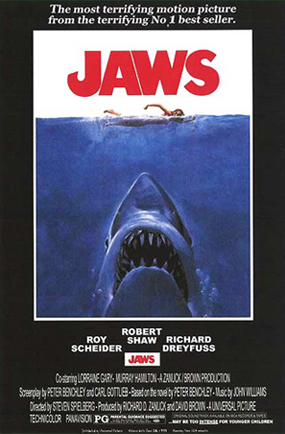
JAWS_Movie_posterAlfred Hitchcock once was quoted as saying, in typical Hitchcockian fashion, “There is no terror in the bang, only in the anticipation of it.” A young Steven Spielberg channeled this type of sentiment when he directed the smash hit and archetypal summer blockbuster Jaws in 1975. It’s still a cultural phenomenon and for good or for bad, it has forever instilled a fear of great white sharks in the general populous.

The film is a man-versus-beast type of story. It starts off on Fourth of July weekend on a New England resort town named Amity. After a girl is found the beach chewed up, it starts a frenzy. Well, not quite initially because although police chief and mainlander Martin Brody (Roy Scheider) wants to shut down the beaches, the local mayor will have nothing of it. Really, the first half of Jaws is very much political, as the mayor attempts to do anything he can to keep the masses flocking to his town because Amity gets all their revenue from the summer months. Meanwhile, Brody has the beaches monitored, but that does not stop a young boy from getting attacked. Up until now, we have only seen the handiwork of the beast, but in a brief instant we can catch a glimpse of him and it is shocking.

The vacationers flee the shoreline, and Brody is left to answer to the boy’s mother since he did not close down the beaches. She holds him responsible. However, Brody’s hands are still tied, especially when local fishermen catch another shark that they assume is the culprit that has terrorizing the town. He is met by a young marine biologist named Matt Hooper (Richard Dreyfuss), who also realizes the gravity of this shark problem. No one will take him seriously except Brody, and Hooper labels him the only other sane man on the island.

Because all the precautions that are taken cannot avoid still another shark attack from going down. And it is at this point that Brody and most certainly the Mayor, have to change things. At a tense news conference, they must walk a fine line in order to assuage the locals and the business owners. Ultimately, Brody convinces the mayor to let him go out with the salty veteran seaman named Quint (Robert Shaw) who agrees to take the shark down for a fee.

For most of us, the second half is what we all remember or at least equate with the film (probably for the iconic line, “We’re going to need a bigger boat.” It is this part of the story that breaks the adventure down to three men, our stars, going off on a mission to take on the terror of a great white (ie. “Bruce”). It feels very Captain Ahabesque, thanks to the addition of the grizzled fisherman Quint, but if he is a stabilizing force it soon becomes obvious that not even he is fully ready to take on this behemoth creature. It seems like no amount of barrels, harpoons, or even a “shark-proof” cage can humble it.

What we end with is utter destruction that spirals out of control. That’s what makes this shark such an intriguing foe because we certainly cannot really call it evil, but it certainly is an overpowering force of nature. Brody stands in for many of us who have an innate fear of the ocean and what lies underneath the surface. For all the plucky young adventurers they have a stand-in in Hooper. I am struck by how tense this film is even to this day, and Spielberg never seems to show is hand too early and he never gives us too much of the shark. Otherwise, it might look faker, and it would lose that heightened anticipation. Above all, John Williams lent a great deal of potency to Jaws, single-handedly, with his ominous score. Without his score, Jaws is nowhere as scary and certainly not as memorable.

5/5 Stars

L’Atalante (1934)

LatalanteHere is perhaps one of the greatest wedding processions we could ever hope to see. Buster Keaton is more outrageously funny in Seven Chances, but this one is solemn, and somehow still funny in its own way. And that’s what is most striking about L’Atalante (which also serves as the name of the boat of choice). This film seems so serious and strait-laced, you might say, and yet it brims with comedy. It’s the type of everyday comedy that makes us laugh even now. Funny looking characters, odd voices, a plethora of cats all over the place. There’s no way for that to get lost in translation, and it remains quirky and engaging 80 years later.

It also happens to be a beautiful film exemplified by a newly-wedded bride walking the prow of a boat with the fog billowing around her. Or perhaps it’s two lovers embracing passionately and a smile bursting on the face of the woman. It’s so visceral, so engaging in its displays of love, energy, and emotion. In this way, it brings to mind other love stories of the age like Sunrise, It Happened One Night, and certainly the early works of Jean Renoir. Except the thing here is that director Jean Vigo never made another film after L’Atalante. He entered bad health even during filming and died soon afterward in his early 30s, but he left behind a masterpiece.

In short, the story revolves around four main characters living life together on a boat named L’Atalante. Jean is the captain and groom who has picked a beautiful wife named Juliette who is going to share his existence on the sea. His first mate is the weathered and scruffy Pere Jules. He might have a rough exterior, but he and his cabin boy are full of bumbling and buffoonery that endears them to all.

For the two lovebirds, Paris is the enchanting destination for a fantastic makeshift honeymoon, but it also proves to test their relationship from the get-go, since Jean is extremely jealous and a street peddler openly flirts with Juliette. It’s a tragic turn in their love story which leads to Juliette looking for a way home and Jean sinking into a state of depression aboard his boat. That’s what makes their ultimate reunion all the sweeter.

Thus, L’Atalante blends a timeless topic like love with little moments of magic that bubble up from within these scenes. Whether it is Juliette walking the streets window shopping, or Pere Jules giving a lens into his past with all the souvenirs he has accrued over the years. Without a doubt, he was my favorite character. I have never quite seen anything like him.

4.5/5 Stars

Through a Glass Darkly (1961)

througha2There is so much that could be talked about with Through a Glass Darkly, but I feel the need to point out the more obvious, to begin with. Ingmar Bergman, in retrospect, envisioned this film as the first installment in his 1960s trilogy. As such, the film is a chamber piece that takes place entirely on a single island with only four main players. It lets go of some of the symbolism of many of Bergman’s films, but it still surges with religious content that reflects Bergman’s own background and spiritual conflict.

Through a Glass Darkly is one translation of 1 Corinthians 13, essentially suggesting that at the present time we only get a poor reflection of what is to come. In other words, we cannot fully understand the ways of the world and the ways of God. But how does this theme relate to the film you ask? That’s what I wanted to know as well.

At a basic level, this is yet another story about family and interpersonal relationships. Karin is staying on an island with her husband Martin (Max von Sydow), her father David (Gunnar Bjornstad) who is an author, and her baby brother Minus. She recently was released from a hospital for schizophrenic-like symptoms while her father has recently returned from Switzerland trying to combat a fierce case of writer’s block.

In a day’s time, these four individuals try to parse through all that is going on. Though they initially attempt to shroud it with morning swims and silly stage productions, they cannot completely disregard their reality.

througha3Minus feels he is lacking love and affection. He feels like his sister makes fun of him while his father is aloof and withdrawn from his life. Meanwhile, David is grief-stricken in private, realizing that his daughter’s condition is incurable and yet he also regrets his morbid fascination with it. David tries to cope with his wife’s condition, but although she seemed jovial and fine at first, Karin’s situation begins to decline.
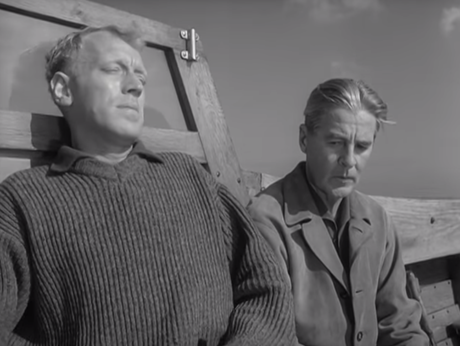
She hallucinates, speaks of going through the walls, and faints. Matters are made worse when the voices in her head tell her to go through her father’s diary. There she reads about his thoughts on her and her “incurable” state. When they take a boating outing Martin asks his father-in-law about what he wrote on the request of Karin, and they get into a discussion. As Martin surmises he seems to be a man with all the right words, but no clue about life itself, and David does not try and object.

Back on the island Minus is with his sister, who confides in him about the voices, and when a storm hits she hides dejectedly in the hull of a boat. Minus follows soon after along with his father. They send for an ambulance to fetch Karin and in a penultimate moment, she speaks candidly with her father one last time before she is to be taken to the hospital. In these final moments she goes up to the attic and while being observed by her husband and father, Karin, breaks into hysterical fits. The visions she has seen are obviously too horrible to bear

througha5This is a film about brothers, sisters, husbands, wives, fathers, and daughters. All revolving around four characters wrapped up and intertwined in this complex spider web of relationships. The spiritual content is great and there is also a lot of minutiae in Through a Glass Darkly. It shares some of the same mind-bending moments as Persona (1966) and yet this film felt even more personal if that is possible. As the title suggests and David even tells his son, we cannot fully understand what is happening, but we can be certain that someday we will know if only we grasp hold of love and the love that God has for his people.

Ingmar Bergman’s type of film-making seems foreign to us now and I don’t mean simply since it’s Swedish, but due to the fact that it is so connected to issues of spirituality and deep questions of faith and love. He cannot and will not allow his work to be cut and dry, because he cares about delving into the human condition. And that condition by default is chock full of ambiguity and complexity. Through a Glass Darkly. The title fits aptly indeed.

4.5/5 Stars

Seven Men From Now (1956)

220px-Poster_of_the_movie_Seven_Men_from_NowAlong with Detour, Budd Boetticher’s Seven Men from Now is undoubtedly one of the greatest B-films I have seen to date. It rejuvenated the career of Randolph Scott who plays gruff sheriff Ben Stride. We are introduced to the often stoic man when he walks into a dimly lit cave during a torrential downpour. There he meets two strangers and demonstrates his skill with a gun for the first time.

For the rest of the film, he comes alongside a couple from the East, struggling to move westward with all their possessions carted on a wagon. The husband John Greer (Walter Reed), is a chipper man, but not a very adept pioneer. His kindly wife Annie (Gail Russell) loves him in spite of this ineptitude. He doesn’t say much, but Stride seems to like them both as well or at least, he knows they won’t make it very far without help. So after helping them get their wagon out of some thick mud, he sticks by their side.

They are eventually joined by Bill Masters (Lee Marvin) and his accomplice Clete, who look to make some money in the wake of Stride. He willfully explains to the Greers how Stride used to be the sheriff in the town of Silver Springs, before his wife was killed by a group of bandits when they were robbing a Wells Fargo shipment. He made it his mission to track down the seven men who took part in the act. And so as an opportunistic schemer Masters is content with riding along with Stride until the opportune moment to score a big payoff.

In this way, he helps the Greers and Stride fend off some Apache and even puts a bullet through a man before Stride gets it. If we didn’t know better, we might think that Lee Marvin has gone to the good side for once. But that’s not so. He’s full of insinuations, flirtations, and veiled threats that somehow feel more ominous than a Vince Stone or Liberty Valance. It’s not just physical brutality but he is playing perhaps an even deadlier game of mental warfare. Against not only Stride, but Mrs. Greer, and her husband.

It’s around this point that Masters and Clete make a move. They alert Stride’s nemesis to his plans and just like that two men go and ambush the veteran sheriff. He knocks them both off after receiving a wounded leg that leaves him unconscious out in the canyon. Luckily the Greers come across him and John decides to take responsibility for what he has unknowingly done. He goes into town to face the music for the role he has ignorantly taken in this whole deadly affair. After discounting Greer as weak and spineless, Masters is finally forced to recant his previous statement.

What’s left is Ben Stride out in the canyon with the Wells Fargo shipment, but with two new bandits and Masters and Clete, it looks to be a bloody finale. After a bit of backstabbing, Ben Stride stands alone in the aftermath. He has completed his odyssey and he says goodbye to Ms. Greer with a new resolve to take on the role of deputy sheriff in Silver Springs. But it’s doubtful if that is the end of his story.

4/5 Stars


The Bravados (1958)

The_Bravados_-_US_film_posterThe Bravados opens with an ominous stranger in black riding towards a town. He doesn’t say much, but his presence alone creates tension enough. He gets led into town by the local deputy and after a meeting with the sheriff, he is allowed to stick around. His only reason for coming to the city of Rio Arriba is to watch the hanging of four outlaws, at least that’s what he says. But when he asks to see the prisoners, he surveys them and there is nothing but anger in his eyes.

As they wait for the hangman from out of town to arrive, Jim Douglas (Gregory Peck) gets reacquainted with the beautiful Josefa (Joan Collins). And nothing is said about their backstory, but there is obviously something between them. He at first refuses her offer to go to church, but requests to walk her over before reluctantly joining her in the chapel.

However, back at the jail, the hangman is not who he appears and stabs the sheriff in the back with the four outlaws getting away taking a local’s daughter with them. So the town is in a fury sending a posse after the fugitives led by Douglas.

And one by one Douglas tracks down the culprits. First, ambushing Parral (Lee Van Cleef) who he shoots after the man begs for his life to be spared. Next, he takes down Taylor and hangs him from a tree after dragging him behind his horse. The posse does eventually get the kidnapped girl Emma, but Douglas is far from satisfied, crossing the border to Mexico to finish the job. He guns down Zachary in a bar and his only target left is Lujan (Henry Silva). But that’s when things change. Douglas is knocked out of his blind rage for a moment. Because this whole vendetta began after his wife was raped and murdered. He went on an obsessive quest to find the four culprits and although these four no-goods constantly denied seeing his wife, he just went after them anyway.

It is Lujan who finally makes Douglas realize he made a mistake. In this epiphany, Douglas realizes he is little different than these four outlaws, willing to kill mercilessly, even in the name of justice. He goes back to town a hero, but he heads straight for the church where he confesses his wrongs to the local priest. He is a man with a lot to wrestle with, but also a lot to live for thanks to his daughter and Josefa. Although not quite as iconic and memorable, The Bravados, in a sense, is Gregory Peck’s version of The Searchers. This Henry King western in CinemaScope is noteworthy for allowing Peck to play another morally ambiguous character. He is no Atticus Finch.

3.5/5 Stars

Yellow Sky (1948)

yellowsky2From William A. Wellman comes an unheralded western with an intriguing cast dynamic. Gregory Peck is the undisputed star as the boss of a group of outlaws who ride into town, pull a quick bank job, and are forced to flee from the Cavalry across the desert wasteland. It’s the prerogative of “Stretch” (Peck) to continue across the desolate terrain, despite the obvious drawbacks. But everyone else reluctantly follows although a few are opposed including his biggest rival Dude (Richard Widmark).

The story could end there with the band of fugitives dying of thirst in no man’s land and it nearly does happen, but like a mirage, they come upon a ghost town. It’s like a sick joke because it seems that all the people have picked up and left. All that is except an old prospector and his plucky Granddaughter (Anne Baxter). She is wary of these marauders, and she is extremely protective of her old grandpa. The men get a bit lustful since they have not seen a woman for some time and she catches the eye.

Again, the path of this story seems like it will be stagnant once more and yet that’s before we knew that the two relations are sitting on top of a gold mine. That catches the attention of the outlaws and the avarice grows in the hearts of the men. Not to mention their lustful desires.

yellowsky4That’s what makes “Stretch” such an interesting villain as portrayed by Gregory Peck. Certainly, he does wrong in the eyes of the law, but he has his morals in a sense. He vows to the old man that they will keep their agreement to split the gold. It’s the honorable thing to do and he is smitten with the attractive Mike. But Dude is not so excited about this act of charity and so he gets the boys to turn on “Stretch.” They try and pin him down and thus unfolds the necessary gunfight. The power struggle reaches its apex in the shrouded saloon where “Stretch”, “Dude”, and “Lengthy” face off for one final showdown. Shots are fired and a desperate Mike goes charging in to witness the outcome.

The bad boys get their comeuppance and the stooges including Walrus and Half-Pint (Harry Morgan) are okay. Most importantly “Stretch” is now a straight arrow for the girl he loves by pulling the world’s first reverse bank robbery.

Yellow Sky was a thoroughly enjoyable story because it felt surprisingly dynamic and even graphic for a 1940s western. Highlights include Anne Baxter slugging Gregory Peck and dishing out the ultimate insult that he smells bad.  Peck is such a commanding presence, and it’s fun to see him in a darker role. Baxter was also deadly in a very different way than her backstabbing Eve Harrington. Richard Widmark and John Russell were worthy adversaries while Charles Kemper was the token fat guy. And I still cannot get over how young and dare I say, scrawny Henry Morgan looks.

I must confess that I have never read The Tempest, but this story is supposedly based on that Shakespearean tale. Well, now I know.

4/5 Stars


Stage Door (1937)

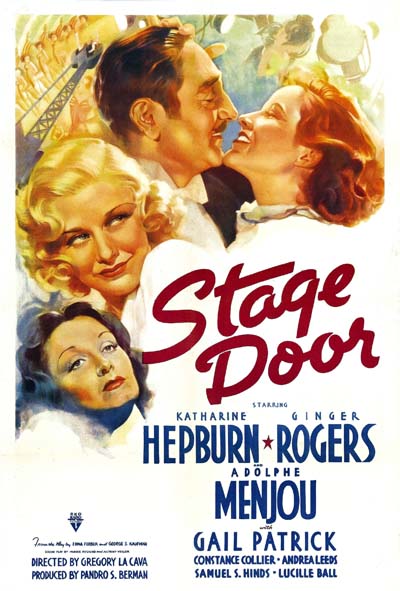
Stage_Door_(1937)Watching Stage Door illustrates one of the pleasures of film because it’s an unassuming classic that very easily could be overshadowed by other films. Its main stars are Ginger Rogers and Katharine Hepburn, who both have numerous films more well known than this one.

However, this story about a boarding house for aspiring stage actresses is a light piece of sassy fun while still finding moments for poignancy. Rogers is a cynical dancer named Jean, and she is not too pleased to be getting a new roommate. The last one moved elsewhere after constant fighting. But the new girl, Terry Randall (Hepburn), is different. She is from a well to do family, but she is pursuing a career in acting so that she might stretch herself.

The other girls look on with an air of contempt thanks to her fine clothes and pristine manners. She doesn’t fit the mold of many of the other struggling actresses looking for their big break. Many spend their evenings trying to grab hold of a sugar daddy such as famed theatrical producer Anthony Powell (Adolph Menjou). Several of the girls have their eyes on him as they try and land a role in his next big production.

Kay Hamilton is the most well-liked girl in the house and arguably one of the most gifted performers. She opened the year before in a production that won her rave reviews, however, a year later she has yet to get another break, and she is running out of funds. Powell’s show is her last big chance. Thus, when Powell cancels her audition last minute for a trivial reason, Kay faints and an irate Terry bursts into his office to confront him. He is initially turned off, but then he chooses her for the lead role of the upcoming Enchanted April.

Although the girls were beginning to warm to Terry, Jean has trouble forgiving her as tragedy strikes. In fact, Terry almost refuses to go on stage altogether, and yet she goes out and gives an emotional performance that is hailed by critics. In the end, Terry and Jean are reconciled which is far more important than any type of fanfare.

In many ways, Gregory La Cava’s Stage Door feels similar to The Women (1939). Both films have casts with women in the primary roles and the stories are at times volatile, with so much drama and many zinging comebacks. Some of this was courtesy of the supporting cast which included such legendary comediennes as Lucille Ball and Eve Arden. Ann Miller is even present, but at its core Stage Door is Ginger and Katharine’s film. Pardon my curiosity, but did Fred and Spencer ever do a film like this?

4/5 Stars

Dinner at Eight (1933)

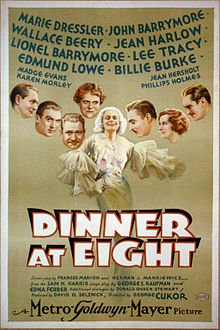
220px-Dinner_at_Eight_cph.3b52734Dinner at Eight is another all-star slug fest from MGM meant to capitalize and top the success of Grand Hotel from the previous year. This time around, well to do wife, Millicent Jordan is setting up a charming dinner party for a wealthy English couple Lord and Lady Ferncliffe who are traveling to New York. The hostess is frantically trying to figure out dinner guests for the big occasion because everything must be perfect. Observant viewers will notice that the high strung lady of the house is played by Billy Burke (more widely known as the Good Witch Glenda). Her husband Louis (Lionel Barrymore) is a kindly shipping magnate, who was hit hard by the depression, and his health is also failing as a result. Their daughter has problems of her own since she does not really love her fiancee and has fallen for the much older, and washed-up alcoholic actor Larry Renault (John Barrymore).

Next on the list of probable invitees is Carlotta Vance (Marie Dressler), the formerly prominent actress, who is now still in the twilight years of her career, but she still carries on a lavish lifestyle with furs and all. She is old friends with Louis, and she is always ready and willing to reminisce, fish for compliments, and offer a little sage advice on the side. She’s a character we like.

The most dynamic pair is most certainly Wallace Beery and Jean Harlow. They play the gruff, crooked businessman and his equally feisty wife, Dan and Kitty Packard. They’re hardly together because he’s working and she’s buying up clothes and caught up in an affair. When the two of them finally are together in the same room, they are constantly at each other’s throats. No punches or barbs are spared. And yet on the invitation to the Jordan’s they both pull their act together. He wants to meet the highly prestigious Ferncliffes, and she wants a chance to get dressed up. They’re quite the match.

With a title like Dinner at Eight, you expect the drama to take place around the table with the guests all seated together. However, that would be rather stuffy, I suppose, and instead, the dinner only acts as the culminating event to push the plot along. We actually never see the guests at the table, only the action leading up to it. Millicent is in a tizzy, especially when she hears the Ferncliffes have a change of plans. Her husband’s health is slowly deteriorating at the same rate as his company. The arrogant actor Larry Renault bickers with his agent about his next role. Honestly, this was the most unsatisfying of the threads, and it did ultimately end in tragedy. However, I’d be interested to know how close this parody actually came to John Barrymore’s actual life, because sometimes it’s hard to know how to parse the fiction from the reality when they seem to overlap.

Once all the guests are assembled it’s a rather ragtag group, but it is a fun mix of characters, and Millicent gets her cousin Hattie to attend along with her Garbo-loving husband who is unenthusiastic about the whole affair. It’s a satisfying overall result and an enjoyable enough ensemble that George Cukor directs with relative ease.

4/5 Stars