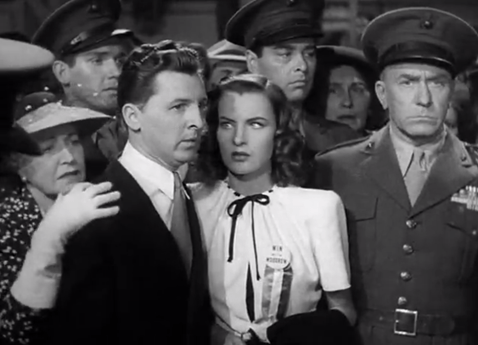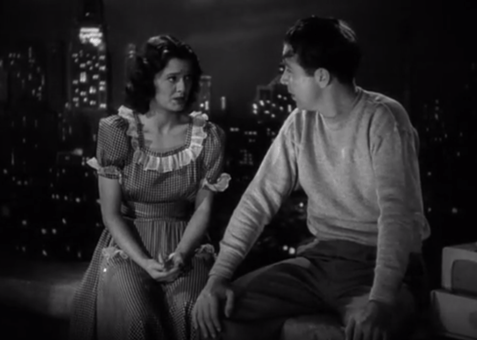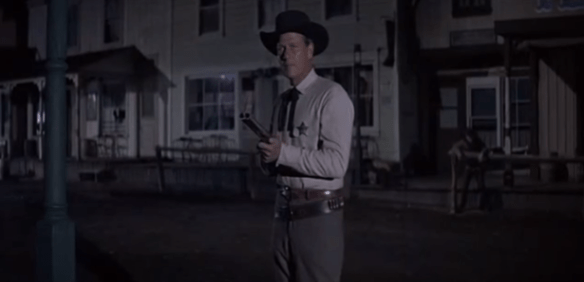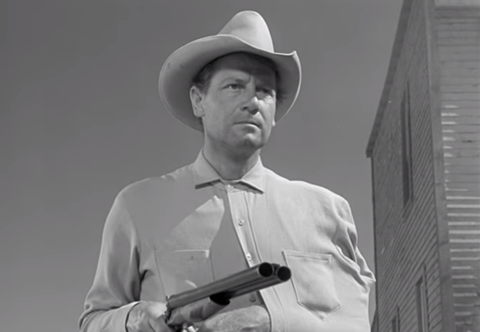
Day of the Outlaw (1959)

day of the outlaw 1.png

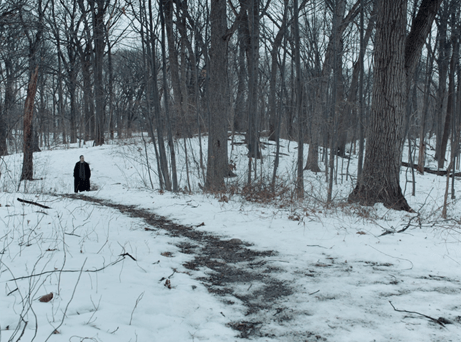
Filmed in Central Oregon on the eve of winter, Day of The Outlaw displays gorgeously fluffy photography as the snow covers the ground. With the leading part anchored by Robert Ryan, I could not but help recall his portrayal in Nicholas Ray’s On Dangerous Ground (1951), another project that made liberal use of immaculate winter exteriors. Likewise, that was only the backdrop for a tough and unfeeling world.

In this particular instance, Andre De Toth’s picture has grudges burning deep under the surface making relationships generally contentious. The story is as old as the western itself. At least its central themes make themselves known straight away. The conflict is between homesteaders and cattle ranchers embodied by two men. The aptly named town of Bitters, Wyoming has recently seen more folks settling down there. One of them named Hal Crane is intent on putting up barbed wire fencing to measure off the land for his new homestead for he and his wife.

As always, there are two sides to every field and the epically named Blaise Starrett (Ryan) is vehemently against the wire being put up because it will keep his cattle from roaming free across the land. He hasn’t minced words about what he’ll do if Crane tries it. He’s equally bitter, and he has some right to be because the way he sees it, he was one of the men who tamed the land with blood, sweat, and tears. The farmers are the ones who settled down in his shadow and now look to shoulder their way into what he has made.

However, what makes the story even more embittering is the fact that Blaise once had a thing for the other man’s wife, Helen (Tina Louise). We witness them as they meet in the general store. And at first, they give off nothing away. All that’s there is seemingly a mutual distaste. But they sit down to a nice neighborly cup of coffee alone and something else becomes evident.

She starts the conversation and makes a cold observation, “You want another man’s wife but the man has to be dead before you take her.” It’s obviously a twisted David & Bathsheba triangle. It’s about to come to its boiling point when the two men look to have it out in the local bar. Finally, a moment of violent catharsis is at hand as a lone bottle rolls down the bar to an inevitable end.

day of the outlaw 2.png

But in a bit of serendipitous (or not so serendipitous timing) they’re bloodbath gets postponed by the entrance of a band of renegades who have just ridden into town fleeing the Cavalry for some unnamed crimes. Time to put all that we assumed the film to be about on hold and do an about-face.

Their fearless leader, a former Union officer Jack Bruhn (Burl Ives) is a surprisingly honorable man who vows to the people of Bitters that no harm will come to their women. He also forebays his men ffrom drinking, commanding the proprietor to get them some grub and lock away his liquor. Ives had a key role in the William Wyler western epic from the year prior The Big Country (1958). His performance here is fascinating for its nuance.

Jack Lambert is the quintessential baddy in my book right up there with Lee Van Cleef and he shows up in fine form here joined by a crew of other sneering malcontents just waiting to go crazy. You can see the pressure rising yet again. However, the fact that much of the film is confined to interiors makes the moments that we break out into the open that much more impactful and the imagery is equally rewarding.

One particular highlight is a fist fight in the muddy slush where Blaise puts up a good struggle but ultimately gets wailed on as an example to everyone else. Simultaneously the women folk fear for their well-being trying to make a break for it and a little boy is taken as a hostage. Another sequence involves a whirling dance hall gathering of forced fun. Bruhn’s men get riled up with the ladies but as their leader sees it, this is a safety valve to blow off steam, far better than more sordid alternatives.

Everyone knows this cannot go on forever and so Starrett agrees to lead them in their escape — a heroic act to remove the men from the town he helped civilize. The final ascent into the mountains to traverse a tortuous path through to the other side proves treacherous on multiple accounts.  While the ending might be yet another slow burn, it does the picture justice even if a fuller, happier ending would have been appreciated by contemporary audiences. We are given enough.

The picture successfully suggests that Tina Louise is far more than Ginger in Gilligan’s Island. She certainly leaves an impression. At first, I didn’t realize David Nelson was even in the picture. Besides, his brother was the true matinee idol and yet to watch him in this oater you see the tender-hearted candor in the older Nelson. Perhaps his father was trying to make both of his sons into western heroes in Rio Bravo (1959) and Day of the Outlaw respectively. Though this outing hardly gets as much respect, it’s nearly as entertaining.

Phillip Yordan’s work on the script does a fine job of creating numerous points of contention that get placed right on top of each other, tweaking the expectations of the audience nicely. What looks like a straightforward feud over a woman soon becomes far more volatile as old enemies must join forces to protect their town against the invaders. And yet the invaders are led by a man who has a sense of conscience. So the ticking time bombs are set off with his cronies hemming and hawing, private resentment still lingering under the surface, and a gunshot wound sustained by Bruhl threatening to put him out of commission permanently.

Day of the Outlaw is a genuinely satiating effort from De Toth that brims with brooding energy supplied by the perennial outsider Robert Ryan and aided by gorgeous snowscapes and a script brought to life by an engaging ensemble. If there is any one thing that hampers the picture, it could probably be chocked down to budget restraints. The production ran out of money in the end and so De Toth wrapped up filming prematurely.

That’s what makes it even more phenomenal the movie boasts undisputed quality as a truly unheralded western classic. Just as my estimation of Robert Ryan rises after every subsequent performance displaying his at times tortured and dogged resolve, I have a newfound respect for Tina Louise and their director. This would be Andre De Toth’s final time helming a western and there’s little doubt he went out with a winner.

4/5 Stars

Tall In The Saddle (1944)

tall in the saddle 1.png

“Boy oh, boy has somebody come to town!” – Gabby Hayes

How else is there to describe Gabby Hayes except for a cantankerous old cuss? When we first set eyes on him he’s berating his old mare for making him spill his liquor although he’s already swigged down quite the snootful.

Even Walter Brennan who was often cast in similar roles showed some diversity in performances during his early years (maybe Hayes did too) but Gabby will always be such a lovable coot in my eyes. Because, you see, if you grow up on westerns of the B variety with the likes of Gene Autry and especially Roy Rogers, Gabby Hayes was a mainstay of the genre as far as sidekicks go. I was fond of Smiley Burnette and Slim Pickens but no one holds a candle to Hayes.

He makes us chuckle along with the tall handsome stranger who’s just witnessed the same events. Before ever interacting we know they will wind up good friends. They hold a mutual admiration for each other.

The man named Rocklin, played by Marion Morrison and known to the world as John Wayne, rides shotgun on the stage headed for the town of Santa Inez. The coach’s other occupants are a terribly irksome old crone and her demure young niece who are heading to the same town for some business. Rocklin has come for the prospect of work.

However, he finds out the man who paid for his train passage was killed and his holdings have passed on to the very same young lady in the stage except her peevish aunt is not about to allow her to conduct her own affairs.

Rocklin seems to have little reason to stay and yet he does. He gets into a tussle with a young hot-head over a poker hand. Then, the next day he gets a faceful from strong-willed Arly Harolday (Ella Raines); she comes into town to get this brazen newcomer to hand the money over.

How can you not love John Wayne? His lady costar confronts him, guns-drawn and shrilling at him to stop and turn around but he just keeps on walking nonchalantly as she fires a hail of bullets all around. He pushes the saloon’s door open and saunters up to the bar, nice as you please.

The next such moment could have easily been a climax — as a gun duel looks all but imminent. Wayne cuts a business proposition short and proceeds to clock hulking George Clews over the head with the butt of his revolver before going back inside to return to his conversation. He subsequently gets hired on as Topaz ranch foreman.

tall in the saddle 2.png

As he so eloquently puts it, “No women is going to get me hogtied and branded.” However, that does not account for the power-hungry land grabs and the shooting of men in the backs that’s being orchestrated. Wayne must navigate with his own brand of sleuthing. A later highlight follows our hero destroying an entire office space having it out with his old football chum Ward Bond, playing a local judge.

While there’s nothing especially novel about the yarn spinning, there’s nevertheless something comforting in this as Paul Fix pulls double duty as co-scriptwriter (with Michael Hogan) and also portraying the thug Bob Clews.

It does feature two formidable female characters, one in Raines whose fiery pistol-packing showcases her own charisma opposite Wayne, while Audrey Long, who plays the reticent Easterner, proves to have enough intuition to see the picture to its conclusion. Because it must end with Wayne a wanted man, a posse coming to get him, and two guns looking to finish him off. But he has some corruption to thwart and let me assure you he puts an end to it just as assuredly as he nabs the girl — I’ll let you be the judge which one it ends up being.

Search for an underlying moral and you might not discover anything outright. What you will receive for your trouble is a good ol’ fashioned western vehicle for John Wayne that he tackles with his usual fearless gumption. Despite his rediscovery in Stagecoach in 1939, that didn’t mean that The Duke had quite risen above B fair completely. For what it’s worth, Tall in the Saddle does the low budget genre justice.  Besides Duke would get plenty of other quality movies in the future.

This is an unnecessary aside but whenever I hear John Wayne speak Spanish it always seems to add another layer of authenticity to his persona. He once said that he’d want to be remembered by the phrase, “Feo, fuerte y formal.” He was ugly, strong, and had dignity. Sounds about right.

3.5/5 Stars

Roma (2018)

Roma 1.png

Alfonso Cuaron is always a director whom I’ve admired from afar whether it be Harry Potter or Gravity (2013), but I would stop short of saying I’ve felt a connection to any of his work. Not that it is not there, I simply have not been affected in a specific way.

Roma, right from the outset, is vastly different from those other titles. Here is a man who has carved out success for himself in Hollywood along with his fellow countrymen like Guillermo Del Toro, Alejandro Inarritu, and Emmanuel Lubezki. Still, by taking stock of his life, stepping back, and returning to his roots, instantly I have a more profound understanding and subsequent appreciation of Cuaron.

What can I say? I’m a sucker for monochrome and Roma is by far the most gorgeous movie that I’ve seen from 2018 in this regard. Also, the world being documented intrigues me. The only film I recollect existing in a comparable space is Machuca (2004) and even that story was very pointed in putting the social and racial elements front and center.

Roma somehow manages to work wonders by bringing those normally existing outiside of the spotlight into the forefront, while nudging usual focal points to the periphery and yet they are no less a part of this world. It’s a deeply admirable endeavor to try and pull off and it generally succeeds.

Because this is a story of a family living in the Mexican quarter of Roma but if it is about children, a grandmother; a husband and wife, then it is more specifically about their in-house maid Cleo (Yalitza Aparicio). It’s made plain she is the glue to hold everything together in this story and within this splintering family.

The camera itself follows suit, with Cuaron making a concerted effort to keep his visions broad and encompassing (He served as cinematographer as well as director and screenwriter). We still know we’re being guided albeit by someone coaxing us to observe and take in scenes at a certain distance. It’s the overall impressions and a sense of the gestalt that is more important than mercilessly driving our focus. Soft pans at times turning a full 360 degrees make all the space fair game. I’m not always a fan but they generally work.

The freedom is exhilarating and at the same time pensive because it allows space to really sit back and relish scenes unfolding at their own pace. I can’t help but be reminded of Tati’s Playtime (1967) where so many things might be going on in the frame and you are given license to enjoy all or none of them at any given time.

Beyond these shots, the most gratifying are the tracking ones moving right to left along street corners. Maybe it’s a pair of young women running to their favorite lunch shop to get a torta for or little kids scampering ahead to get to the movie theater to see the new movie Marooned (a Gravity inspiration perhaps). It’s not simply a technical appeal but a complete immersion in the landscape that we can appreciate.

roma 2.png

But the drama is also evident, especially following a tumultuous one-two punch instigated by rioting and blood in the streets, an outcome of the notorious Corpus Christi Massacre. The historical moment gets personal and the sheer volatility of it all feels palpable. I cannot help but remember the rumblings of unrest and chaos at the 1968 Olympic Games in Mexico City. For Mexico’s people, it was far more than a pair of black power salutes.

This is augmented by a moment that proves equally bleak. It feels like a dream out of 8 1/2 (1963). Stuck in a traffic jam — not moving an inch — except this is very real and disconcerting. There are some real issues with not only the social and economic unrest but the very infrastructure of the nation.

Cleo is on the verge of pregnancy and yet they are not moving anywhere. The hospital seems desperately out of reach. When they do finally arrive it too is full of tumult. Pulling strings, they manage to get Cleo to the doctor. However, nothing can prepare us for the devastating drama with the birth of Cleo’s child.

The news finally drops that father is not gone away in Canada. He’s simply not coming back. In the aftermath of all this excitement and the family vacation, life settles into a new equilibrium. Cleo tries to get over her heartbreak as the family accepts that dad is not coming back and they must be brave and move forward with life.

These encompass many of the moments already mentioned but it seems just as necessary to mention hail storms, barking dogs, hanging up the washing, nights in front of the television, and the complete decimation of automobiles simply in an attempt to park them in the narrow family garage.

A story like this thrives on these moments just as much as the overt drama because Cuaron has pulled from his own memories — the personal recollections of his childhood — and so when we see these very mundane sequences there is an appreciation for the details.

The only caveat that should come with Roma is the necessity to be aware of the social structure in place within the context of our story. If we were taking an anthropology course we would probably call it hegemony. Because our central family is part of the middle class, the social elite, and their background shows connections to higher education and the world at large.

The first tip-off Cleo is different is simply how she looks and her occupation as the family maid. Even the fact she speaks both Spanish and her indigenous Mixtec. These are elements we would do well not to gloss over.

Then, we see the community she was raised in and it becomes obvious the poverty present. Everyone does not live like her employers because they are part of the privileged few who can manage with multiple cars, many vacations, a fridge full of Twinkies, and money for frequent trips to the movies.

Again, these stark contrasts cannot be taken for granted. We have this strange process of dealing with these complex relationships deeply rooted in the country itself. Cuaron is attempting to acknowledge an unsung hero in his life while coming to terms with his own past. It’s imperfect but I have difficulty finding fault in it because this is essentially his existence with the curtains pulled back.

It is not for me to pass judgment on the merit of his life or his upbringing. What I can hold onto and feel drawn to are the moments of pain and suffering that feel human. We have instances of quiet strength and dignity, affection and bravery. Cleo is a beautiful figure. That doesn’t make her station in life right or the world around her okay but she gleams with something powerful. There are deep reservoirs of emotion evident here but they are not of the conventional sort.

In my estimation, pulchritude will always hold precedence over ugliness. It’s not about being complacent or ignorant towards the dark tendencies of this world but it hinges on a resolute hopefulness. Roma is a meaningful ode even as it reminds us both the past and our current reality are deeply flawed.

4.5/5 Stars

Big Jake (1971)

Big_jake_ver2.jpg

The film has an opening gambit that nearly feels unbecoming of a John Wayne picture and yet there’s something simultaneously quite riveting about it. You can’t quite take your eyes off of it, waiting to see what will come to pass.

Our narrator sets the scene in 1909 where, while the East is rising in a constant deluge of modernization, the West is still as ornery as ever. What follows is a full display of that reality as a band of thugs led by John Fain (Richard Boone) rides into a sprawling ranch with one thing on their minds.

There’s a sense that this late-period work from veteran director George Sherman, his last film, in fact, is well aware of Butch Cassidy and The Sundance Kid (1969) and The Wild Bunch (1969) generation and it readily ups the violent content. Although it is a modern western in this sense, there are still blatant signs of not only antiquity but the deep-rooted hierarchy of the West along ethnic lines.

With his good buddy from the early days behind the camera, John Wayne has another personal vehicle on his hands. There’s no doubting the centrality of his presence on the plot even if his entrance is delayed. The stock company is rich and deep as per usual but there is a myriad of young guns too and Duke had a habit of making his work a family affair.

Bobby Vinton gets a near token cameo while little Ethan Wayne becomes crucial to keeping the plot chugging forward as the thugs run off with the boy expecting a ransom in return for his life. Duke’s other two grown sons are played by Patrick Wayne and Bob Mitchum’s boy Christopher. Though not quite family, Maureen O’Hara makes a lovely appearance as the strong-willed ranch matriarch who has long been estranged from her husband Jake McCandles. The scenes with her longtime costar end in a blink of an eye but with such a meaningful cinematic history together they leave the necessary impression.

Like most of these later works, similar to a McClintock! (1963), Big Jake is unequivocally a must-see for the John Wayne faithful — people who could watch him in just about anything will find time to be heartily entertained.

It’s somewhat of a menacing western drama but there’s still ample room for a cheeky and rip-roaring good time. Big Jake, though more violent than some of Duke’s predecessors nevertheless has his mark of approval all over it. There are falls in the mud. He gets plenty of time to smack his sons around and also receives his share of wallops as retribution. Pulling buckshot out of backsides and dousing them with whiskey is all in a day’s work. And Duke is as vociferous as ever.

That’s what will get people to stay. Because it’s one thing about John Wayne that is rather refreshing. Like him or not, you know full-well where he stands and how he’s going to play it. Larger-than-life and tough-as-nails but with unquestioned integrity. I’m drawn to that like many others because I come from a wishy-washy generation. But far more than that, even if I don’t necessarily agree with everything he does, the Duke never seems to do something purely out of spite. Instead, he has some deep-seated convictions.

He plays Big Jake McCandles with his typical presence that knows few equals in terms of longevity or sheer durability. Wayne certainly understands how to command a room and while everyone else tries to upstage him no one has the gumption. Richard Boone is probably the only old-timer who has the wiles and the pedigree to try to steal his spotlight and he’s, of course, the ringleader of our villains.

Despite being a man who left his family long ago, McCandles returns on a moment’s notice to rescue his kidnapped grandson. He’s a no-good old coot but there is that aforementioned sense of moral integrity. He’s has a funny way of showing it but he cares about family.

The truth is, he sees out his objective with his typical dogged resilience laced with worldly wisdom and tenacity. The conflict spawns from one son who is rightfully bitter and another son who seems like he’s traded out the past for new-fangled gadgetry. In the end, it seems the tried-and-true methods prove most effective. Wayne is joined in the task at hand by his feisty canine named “Dog” and a veteran Apache tracker named Sam.

Elmer Bernstein’s scoring automatically evokes layers upon layers of added richness from any western scenery and he’s somehow able to perfect everything that is resplendent and majestic about this way of life. There’s a deep abiding understanding of what The West meant and what men stood for.

Their final destination comes in a bustling boom town with thugs milling about and everyone looking to get a hand in on the cash payload that the McCandles have hauled around in order to save their young kin.

We know it’s only a matter of time before things come to a head. Of course, Duke gives it a bit of a kick in the rear by instigating barroom brawls to rile up the masses as a quality distraction. The resulting payoffs are as expected and gut-bustingly uproarious. And of course, John Wayne gets the last laugh of all from inside the shower stall of a barbershop followed by a final showdown where every member of the McCandle clan gets their own chance at redemption.

There’s nothing cutting edge here but this is a story of the dwindling West and so when that’s what your story is about, I think it can be said that Big Jake succeeds in these modest regards. After all, it’s a self-selecting film because anyone who wants to see it will be satiated and anyone else probably won’t search it out anyway. John Wayne has that influence on people even today.

3.5/5 Stars

The Adventures of Sherlock Holmes (1939)

adventures of sherlock holmes 1.png

“Elementary My Dear Watson” owes its indelible stature in the lexicon hall of fame to this second installment in 20th Century Fox’s Sherlock Holmes series. The studio obviously did not gather the phrase to have that much resonance as they gave up on the franchise only to have it be picked up by Universal Pictures for many, many more outings. This would be the last one set in its original historical context and it’s unquestionably the gem of the lot.

Though the analogy breaks down, it was easy to see the first installment of Rathbone’s outing as Holmes like Peter Sellers in the original Pink Panther (1963). You get a sense of a formidable character who is subsequently given greater fluidity and is, therefore, able to break into their own. A Shot in the Dark (1964) was far better than its predecessor because it gave Inspector Clouseau his own vehicle.

The Adventures of Sherlock Holmes proves to be a superior film for two such reasons. First, Rathbone and Bruce coming off their success are put front and center in this picture. But also while the first film was an adaptation of a Doyle story, this picture is an original narrative thus taking the characters from the page and extrapolating them onto the screen in new and intriguing ways.

In one sense, I’m glad for that change because whereas The Hound of the Baskervilles was much better as detailed by Doyle’s pen, this story is a creation blessed with an imagination. Taking all that is good about the original work and synthesizing it into something that never quite loses the spirit but on the contrary, builds on it all the better for distillation to the big screen.

The remarkable revelation is that the story does provide a true conundrum for Holmes as he battles it out with his arch nemesis Moriarty in a chess match of wits. While there are several moments that seem uncharacteristically on-the-nose for a man of his intellect, otherwise we relish the game and his astute observations.

It opens in a courtroom as Professor Moriarty is exonerated for a crime that everyone seems to agree that he committed. Only moments after the pronouncement Holmes rushes into the courtroom with the needed evidence. But it’s far too late. His rival has lived to scheme another day and what a scheme it is. He plans to pull off the crime of the century by distracting Holmes with two toys that he won’t be able to put down. He likens Holmes to a fickle little boy easily distracted and he plans to exploit his idle curiosity.

What unravels and what is articulated by the script is a lovely piece of intrigue that provides many distractions not only to Holmes but his audience as well. We know full-well that though they might appear completely unrelated, they’re indubitably tied together. It’s simply a matter of understanding how and for what purpose.

The first involves a young woman named Anne Bramdon (Ida Lupino). She comes to Mr. Holmes on the behalf of her older brother who has received an ominous note. The reason she’s worried is that her dear father received much the same message before he died under strange circumstances years before.

Although it ultimately takes a back seat to this more interesting case, Holmes is also counted on by his friend at the Tower of London to help with security in the transfer of a priceless diamond to be added to the Crown Jewels.

Holmes is caught up in this perplexing case in front of him as Bramdon’s frightened brother is attacked by a mysterious assailant and soon after the lady gets a note of her own telling her to attend a certain social gathering of a longtime friend. Holmes advises her to go as he will be there to protect her but of course, the date and time are the exact same as the jewel transfer. You see the point already.

Rathbone makes another stunning showing in disguise apprehending the killer and dashing off to thwart another crime as Moriarty cleverly infiltrates the Tower’s security, no thanks to Watson. George Zucco seamlessly embodies an intellectual yet sociopathic mind filled with disdain for human life. He asserts in one such scene to his harried valet that killing a plant should be a far greater offense than taking human life. He proves overwhelmingly that a superior villain with brazen intentions elevates any story.

Director Alfred L. Werker shoots the finale with some amount of artistry that heightens the climax to an agreeable apex. It goes down as it must on the top of the Tower of London and what is curious but rather refreshing is that there are no back and forth monologues of doom and heroism. Actions speak for both our hero and villain. While London fog now seems like free atmosphere and little else, the film is actually at its best in visual terms with well-lit Victorian interiors.

The finest success of this film was in projecting a certain image or reputation that extends far into the present age. Watson became an incorrigible bumbler. Holmes a cinematic detective both partially sanitized and still witty. Moriarty remains one of the standards for villains to this day. And with so many different iterations on these same characters, the influence on Robert Downey Jr. to the modernized Benedict Cumberbatch is equally evident. There are few qualms acknowledging the impact of such a sublime mystery adventure as this.

4/5 Star

Hound of the Baskervilles (1939)

The_Hound_of_the_Baskervilles_-_1939-_Poster.pngThough there’s not a shred of doubt this picture was filmed on a Hollywood backlot, our story takes place in 1889 on the Moors of Dartmoor in Devonshire. It’s all very British and when you do a quick scan of the most British figures coming out of literature and pop culture, you would probably find few higher on the list than Sherlock Holmes.

For better or for worse, this is one of the films we must thank for countless Sherlock Holmes archetypes as established by Basil Rathbone’s characterization. Joined by his oafish, vacuous-minded friend Dr. Watson (Nigel Bruce), Holmes looks to investigate the mysterious death of one Sir Hugo Baskerville which supposedly came to pass due to the curse of a demonic curr labeled “The Hound of the Baskervilles.”

Right at this very moment, his nephew Sir Henry (Richard Greene) is coming to take up residence at the supposedly deadly manor deep in the heart of Devonshire. Holmes asks for Watson to accompany him as he has important business of a different nature to attend to. It unfolds as a stylized gothic murder mystery with typical studio melodramatics that are still somehow invariably delectable.

Some might be especially surprised to find out about Holmes’ absence for much of the film’s middle though Rathbone makes a stunning reemergence just in time to do a bit more sleuthing and confirm his numerous empirical suspicions. Bruce proves just how vital he is because there must be a stooge to make the hero look all the more preeminent.

The picture is hardly a whodunit. Deciphering the guilty party is quite simple to guess, working with the tropes that we have in our toolkit. But in the habit of Arthur Conan’s Doyle’s work, the enjoyment is in our hero’s highly-perceptive method of deduction.

While the short stories are probably more rich in this regard, what this film has in an iconic turn by Basil Rathbone — a man who was often made into a villain and yet was just as impeccably cast as a hero. However, to match the aesthetics at the time this picture has a broad menagerie of characters and the foggy atmosphere with the easily conjured shrouds of Gothic Hollywood.

We have shifty house servants, a deranged killer out on the loose, a husband and wife trained in the art of seances, and the crotchety old buffoon who is constantly threatening lawsuits. They are among the casts most colorful additions. Yes, we even get an appearance from the Hound, though, in fact, he’s actually a Great Dane.

It’s hardly an exercise to work your brain too strenuously but it’s a jolly fun piece of entertainment with several true moments of intrigue and menace. The pleasure is in its economy as well because the adventures of Sherlock Holmes as portrayed by Rathbone and Bruce proved so popular they were serialized on both radio and many more films to come.

Of course, when this effort came out, 20th Century Fox wasn’t so sure how their new hero would fare and so they conveniently cushioned his billing and his sidekick between the two love interests. I have nothing against Richard Greene or Wendy Barrie whatsoever but they are hardly the reason we turn out to see this picture.

Still, it seems necessary to at least acknowledge that one would do well to start with Arthur Conan Doyle’s work first and once you get a sense of them, enjoy this film without reservations. You can test the merits of Sherlock Holmes on this picture but you would do better not to. Because this is a Hollywood confection more than anything, proving to be a diverting adventure even as it helped usher in the accepted mythology of everyone’s favorite amateur detective for future generations.

3.5/5 Stars

Summer 1993 (2017)

summer 1993 2.png

Summer 1993 is a testament to subtleties which can make a film into something imbued with deeper meanings than what we might initially realize. It begins with the title immediately asserting this is a period piece and also implicitly we have the suggestion of the autobiographical. The postcript dedication is the final confirmation.

Otherwise, the film does not project a sense of self-awareness nor does it continually remind us what we are watching. Instead, it works in terms of intimacy and nuanced beats which lay out a world of the past that is piercing for the very transparency it projects. The personal becomes obvious in the ways it is handled with grace and an emotional candor.

This is a story of a small girl named Frida. She owns a pair of beautifully expressive brown eyes. Her hair is curled like a perfect little cherub and she is introduced in the midst of tragedy though we know very little about it. Being a child, she cannot quite understand the circumstances either. Much of the film occupies her head-space and point of view. Conversations waft over her. Things she cannot understand the gravity of. All we know is she has been affected. But even that rarely comes out of her.

She is defined mostly by pensive and measured actions. Her grandma teaches her the words necessary for her first communion. She repeats them obediently. Then, comes the move out of her family home with her new parents — an uncle and aunt — who have agreed to take her to live with their baby daughter.

They are caring and yet as with any change, there is a difficulty in adapting — a disconnect because she must become acclimated to a new life and even as the familiar has been replaced with something novel, we question how the transition will go.

Her doll collection is most important to her — and she plays house with her baby cousin — taking on the persona of the emotionally-detached mother even smoking a make-believe cigarette through her garish mascara. In town, she joins in a game of tag with the local kids and like it always goes — being the one new person — she gets shouldered with the task of being “It.”

She scrapes her knee scampering about and one mother becomes frantic that her child might be infected.  It’s an overreaction but it gives a hint to Frida’s past — the very reason her parents are no longer present in her life. Later there is a solemn conversation held over the kitchen table with all the extended family discussing her as she sits docilely by.

At night she’s lying in bed, saying her prayers and the barely audible notes of a marital argument can be heard between two people who nevertheless seem kind and in love. Life has a way of weighing on our hearts and minds. It is never an easy road to traverse.

When the baby daughter gets lost in the woods, injuring her hand, there is another change. Husband and wife, with prodding from the wife, in particular, agree limits must be put in place for Frida. She can hardly be trusted to look after her sister in this state.

summer 1993.png

Even against this backdrop, Summer 1993 is a reminder of the beauty and inquisitiveness of children. Their hands so meticulous, their eyes searching and innocent. In many ways, they are not jaded and troubled by many things as we often are as adults. Still, they are capable of selfish acts, defiance, and naughtiness. They do not understand how their actions affect others besides themselves. What ties us all together is the very fact we all have feelings and emotions. These do not change. They are the universal connector between us all.

The greatest pleasure is that the film very rarely — if ever — feels like artifice. There is such a measured and sensitive eye at work here to be able to capture a moment in childhood and do it without unheeded histrionics.

Better yet are the sweet refrains like the whole family snuggling up in bed together. Double-fisting ice cream as a reward for another successful doctor’s appointment after a whole slew of tests. I was there once as well except it was always Cheetos and strawberry kiwi Snapple.

The other moments are just as real. Frida watches her baby sister tumble into the water and watches wide-eyed as her father jumps in after her. She is scolded for her inaction in the face of the helpless cries for help. Then she drops her grandma’s gift nightdress in the dirt — ungrateful and jealous of her baby sister’s — even spilling milk on it. Her mother tells her to go wash it even as Grandma tries and make concessions.

She likens her plight to that of a Catalan Cinderella but then again for all kids childhood is a bit of a fairy tale even the bad parts. It feels like the whole world is against her. Of course, it couldn’t be farther from the truth but she is blinded by her own childish narcissism.

The fact her adopted parents are so loving, understanding, and have her best interest in mind makes it all the more striking. How can she view the world in that way? One evening she finally gathers her meager belongs, all but prepared to go off on her own, loading her bag with all the necessities including fruit from the kitchen table.

Her baby sister tells Frida she “loves” her and she reciprocates by leaving behind the doll she had packed. It’s undertaken with the sincerity of youth and that’s what makes it so sweetly affecting. There is this gravity to the proceedings even as this innocent girl does not understand all the intricacies of her situation.

summer 1993 4

A fitting final scene comes over the kitchen table again. Frida finally seems happier, at least she is getting used to life, but then out of the blue, she asks her new mother how her first mother died? Then, what follows are a row of very honest questions.

Her new mother fields them calmly in a reassuring way so her daughter can comprehend but you also sense there’s a touch of relief as Frida is opening up and willing to talk about the things she’s been aching to know. It’s a moment of deep personal connection. The impact is heady because it is hidden inside something seemingly so mundane in nature. But to those involved, it means the world. It is the beginning of greater understanding, moving them closer and closer to a whole family.

Getting ready for bed Frida spontaneously breaks into tears. For the whole film she has kept it in — remaining surprisingly unemotional — and yet now she can let her guard down. She doesn’t know why she is crying but we have some inclination. Could that be an eye getting misty? Not unlikely.

It recalls one lovely summer I spent living overseas because it is the one and only time in my life where I have lived on the edge of nature where you can hear and see the wildlife and walk around in it. It truly becomes your backyard. But it was in such a paradise where I had to rebound from personal grief as well.

It was not in the Catalan countryside but I was going through the same sense of isolation. Being a bit older I tried to cope in a different manner. What I realized is there is a need to gravitate more toward others opposed to falling away. But even as an adult it is difficult to do. It goes against our impulses in such moments where solitude is our greatest friend. Ultimately, Frida got there and I did too; it simply takes time. What a beautiful elegy to a childhood, to a mother, and, ultimately, the rebirth of a young life in the midst of tragedy.

4/5 Stars

The Only Son (1936)

the only son 1

Tragedy in life starts with the bondage of parents and children.

The film opens with a single extended scene with the title card reading: Shinshu, Central Japan 1923. Ozu guides us in with his pillow shots framing the story’s sequences with images of his locales which neither serve the narrative nor reveal anything about our characters at hand. But he more than many directors is well aware of his environment and basking in its very contours.

The opening premise has to do with a young middle school-aged boy and his mother. The problem is whether or not he will go onto high school. You see, his father is dead and his mother must eke by a living. They don’t have much money. School costs money.

There are two stories going around. The one he told his mother saying he would not continue his schooling and then the one he told his teacher. His mother only finds out when the man comes by to acknowledge how happy he is for the boy.

Though distraught at first, from that day forward the mother vows to pay for her son to have schooling, first high school and then college. Likewise, he vows dutifully to become a great man so her maternal sacrifice is not in vain.

Flashforward to the present and the now elderly mother decides to pay a visit to her son in the big city of Tokyo. He’s grown now and has a job. But it turns out that things are not as she might have hoped.

First off, he has a couple of surprises for her. He got married and already has a baby son. Also, their home is fairly run-down and humble because his salary as a night school teacher is meager at best. So much for being a great man. It turns out such aspirations are difficult, especially in a metropolis like Tokyo. Look no further than his old teacher who has turned to running a butcher shop just to provide for his family.

However, despite these circumstances, the son throws out all the stops to make a lavish showing of hospitality for his mother’s benefit. After all, he can’t possibly let on how things are actually going. Because that would break her heart. He would have failed her.

So he buys extra chicken, offers small trinkets, and they attend the picture show. Things he probably never would have done if she were not present. Slowly he’s sinking under the surface, borrowing money from everyone who might oblige.

But of course, the truth always finds its way out. She worked so hard to get him to college and the hope of his successes kept her going. The revelation of his current situation pains her heart and she’s forthright in telling him precisely that. She is utterly ashamed as he explains how difficult it is to become a big man in Tokyo. Hard work does not always cut it.

This could be the end of their relationship right there and yet there is another moment. After a horrible accident, he gives all the money they have left to help a single mother pay for her son’s medical bills. It’s a meaningful gesture and right before she leaves, the mother tells her son that she’s proud of his integrity.

All he can think about is how unsatisfied she must be and how much he didn’t want her to come to begin with. His wife concurs he’s lucky to have such a good mother, because by the standards of Japan, she made her child her all so that he might succeed.

Meanwhile, the mother regales her solitary friend back home about her son who has become a great man and his lovely wife and how she can die now without any regrets. All the while we know the full truth but she must save face and so she makes up the most satisfying story she can. Hidden away from view her head is downcast in grief and shame.

What’s striking to the very last frame of The Only Son is the conflicting feelings it provides. It constantly flits back and forth between this false sense of security and contentment to moments of deepest regret.

It never quite allows you to rest on a single one of these emotions but instead requires you to cope with them in equal measures as the scenes are layered one on top of another. First, the mother is happy, then the son is anxious, then the mother is ashamed, then proud. Her son is regretful and finally spurred on to make another go of being a great man. So there’s this lingering sweetness, this not uncertain hope, and yet his mother is in the backroom head bowed, saddened by where she left her boy.

There is no easy answer. There is no definite category. There’s no way to siphon off this person’s emotions from that person’s because they all remain interconnected. That’s what allows this film to make sense and have such an emotional impact as it quietly whiplashes us back and forth between mother and son. We feel for both of them even if their hopes and aspirations seem somewhat misplaced. It’s a film that pains the heart of anyone who hates to see lives in utter distress.

I must confess that I racked my brain for the reason Ozu might spend so much time cutting to shots of the hanging laundry — a recurring motif throughout the film. Surely, there’s some intricacy that I am missing or some subtle symbolism. While that is undoubtedly true, I realized even more clearly that Ozu did not require an overt reason for his shot choices.

Just as our eyes stray to observe the world around us so his camera turns its lens in such a way. It is attracted to faces, rooms, and maybe even the mundane qualities of hanging shirts as the wind softly swirls past. There need not be more than this.

Likewise, I kept on staring at the image of the glamorous movie star up on the wall of their humble home. I was trying to decide if it was Joan Crawford or some German actress I am not aware of. Someone else might be able to distill my ignorance but I realized, again, it did not matter as long as I enjoyed the overall experience.

Ozu can be cast much in the way of the famed woodblock printer Katsushika Hokusai most famous for his “36 views of Mount Fuji.” Likewise, the Japanese director took similar forms and topics and unearthed the intricacies of temperament and interrelations which he subsequently revisited again and again.

If you notice, he has simply reversed his normal dynamic of father with daughter and it has become mother and son. Relatively similar origins and yet the outcomes are no less enlightening. So it’s not necessarily about the novel. There can be just as much relish in taking something that we are so used to, like parent-children relations, and recasting them in such a way that we recognize the situations with greater lucidity. Therein lies a space for growth and understanding.

Surely Ozu takes some getting used to. However, eventually his style will age on you and you will come to find the same fascinations he does until your tastes meld and it becomes second nature to see the empathy and beauty in his subject matter just as he seems to. Pretty soon it feels as if you are looking alongside him. If you let him, it can become a thoroughly symbiotic relationship between filmmaker and audience.

4.5/5 Stars

Arigato-san (1936)

arigato san.png

The translated English title of Mr. Thank You somehow comes off insincere as if it’s making fun but there’s nothing of this kind of sentiment in this picture from director Hiroshi Shumizu. It proves to be a cordial exploration of human nature and human kindness played out in the most organic fashion possible. In turn, it’s blessed by extensive on location shooting as well as a wide-ranging cast of players.

What it promises is a charming road film like few I’ve ever seen; self-contained and yet freely spilling out over the roads with meandering ease guided by our eponymous hero. The driver of the bus traversing the road from the rural area of Iku to the big city in Tokyo is known to everyone as “Arigato-san” because when you hear a polite ‘Honk’ followed by an “Arigato,” he’s more than made his presence known.

People appreciate his continuous gratitude and also the courteous favors he does for them along his route. It might be picking up pop records for girls in the hills so they can have quality entertainment. Or for someone else promising to place water and flowers at a deceased father’s grave. He obliges graciously and constantly makes necessary pit stops to accommodate everyone.

The rhythm becomes second nature to us as an audience as well and we gladly follow any diversion the story takes. By the end, we’re so used to the film’s continual visual motif of point-of-view shots followed by an “Arigato” and a rear view of the pedestrians making way and waving our travelers on.

Peppy scoring right out of a Hollywood silent reel comedy does wonders to develop a certain mood on the road. In one respect it matches the jovial demeanor of our protagonist but at the same time, there are slight nuances of more solemn issues merely touched upon. Because it’s a bus that brings together quite the gathering of folks from all walks of life.

If our bus driver is a lovely character full of cheerfulness then his passengers are certainly just as colorful. He can be seen almost like a benevolent symbol of modernity and in some respects, his cohort is one too. She takes the seat right behind him and we gather at first that it’s simply to flirt. But as the story unfolds and we see more interactions those initial preconceptions give way to a more complex reading. She reflects a different sort of progressiveness. A woman who speaks her mind, drinks with the boys, and calls others out for their improprieties. You get the innate sense that she is worldly wise but generally kind-hearted.

The rest of the core group includes an impoverished mother and her daughter who is going to Tokyo for the sake of her family; it’s further implied that she will be forced to take on the ignominious life of a prostitute. Next, is a phony businessman with a handlebar mustache and a penchant for ogling pretty girls. The passengers are rounded out by earthy but nevertheless amiable folks and momentary travelers attending weddings and wakes. Each has a unique destination. Arigato-san transports them all.

For a director as prolific as he was — Shimizu had over 160 screen credits — it’s astounding that he has very little recognition among audiences now, at home or abroad. Yasujiro Ozu, one of his contemporaries and colleagues in their days at Shochiku Studio is of course revered the world over. Some might actually find Arigato-san more accessible in some respects and it’s definitely deserving of more acknowledgment.

Because what it offers up is not only a genial portrait of Japan and its humanity but also some of the inherent plight of the common man in rural Japan. In fact, the film is so affable that some of its undertones easily slip by. There’s a wide range of depth going from humor to surprisingly delicate commentary.

All the while we come to relish the time spent with each one of these individual passengers and especially Arigato-san. When they exit the bus upon arriving at their appointed destination it means something because in such a short time it does feel like we’ve built some sort of rapport with them. That’s one of the joys of travel felt most readily when you make the concerted effort to get to know those around you.

In this particular instance, the film provides deeper cross-cultural understanding and there is the realization that economic depressions were not centered solely around the U.S. Japan had similar if not worse conditions for its populous. And if anything, it makes you realize how the nationalistic movement in Germany or imperialistic ambitions in Japan took root. It comes from people who are weary from economic and social deprivation. They want something better.

For his part, I deeply admire the character of Arigato-san because his purpose is a noble one planted in humility. It seems like he genuinely cares for his neighbors and he readily goes out of his way to increase their joy. On a large scale, things might well seem hopeless but the micro-level shows that Japan was made up of many considerate people. While that cannot alleviate all the suffering of the impoverished it certainly is a jumping off point to instigate human flourishing.

4/5 Stars

The Burmese Harp (1956)

The_Burmese_Harp_Nikkatsu_1956_poster.jpgPut in juxtaposition with Kon Ichikawa’s later rumination on WWII, The Burmese Harp is a romanticized even simplistic account of the Japanese perspective of the war. However,  this is not to discount the mesmerizing nature of the story that is woven nor the overarching truth that seems to linger over its frames.

If anything, it humanizes the Japanese point of view and, rather remarkably, it does this so soon after the war’s conclusion. They were a nation deeply concerned with honor and the only way to get past such an egregious defeat was to frame it in such a way that empowered them for the future.

Because the men who came out of the war unscathed would be the shoulders on which to build a new democracy. You see that even in Ichikawa’s portrayal of the “enemy,” in this case, the English. There is no obvious ill-will. In fact, you could even consider it surprisingly laudatory. Because The Burmese Harp is not concerned with any types of residual politics or long-harbored injustices.

One could make the case it’s a far more universal and a far more moving portrait of the wartime landscape. The story, adapted from a Japanese children’s tale, plays out rather like a parable.

In the waning days of the Burma campaigns, a Japanese Captain named Inouye (Rentaro Mikuni), with a background in music teaches his group of men chorale arrangements which they sing to maintain their morale while they march and during their idle hours. One of their company, Private Mizushima (Shoji Yasui), quickly picks it up and becomes especially skilled at playing the harp to accompany their songs.

One evening they find their position in a local village surrounded by British soldiers in the night. The tense scene is diffused by music in a mutual connection reminiscent of the Christmas cheer in Joyeux Noel.

They learn that Japan has officially surrendered and so they lay down their arms peaceably. Although fearful and demoralized by months of struggle, they resolve to weather it all together. But one of their members is called upon to try and get some of their comrades to stand down before the British blast them to smithereens.

Mizushima volunteers to be the one to undertake this initial task as a liaison to try and avoid the needless loss of more countrymen. It is not to be. Even as the war is already over, it’s this event that proves to be galvanizing in the private’s new position as a missionary of mercy.  After being rehabilitated by a monk, he takes on their dress and shaves his head compelled to give a decent burial to all his fallen comrades.

Moved by the memorial hymn sung over the dead Japanese soldiers at the British Hospital, he realizes what his final calling must be. It’s easy to wager that the film’s most poignant moments occur in conjunction with song. In many of the best interludes, we hear the voices ringing out amid nature whether it’s the shade of the forest or the cleared terrain of a military encampment you can sense the notes rising up into the heavens with the strains of angelic melodiousness.

The same songs lift the spirits of our characters, comforts their souls,  and gives them the resolve to push onward for the greater good.  It has to do with an unswerving belief that each individual life holds dignity. Despite their many spiritual differences, there’s no doubt that this is a conclusion arrived at by both Buddhism and Christianity. Yes, the ugliness is unavoidable. But just as prevalent are immense reservoirs of beauty.

Mizushima is compelled in the inter most catacombs of his being to rescue the bodies of his brothers-in-arms that their spirits might rest in peace for posterity. It seems like such a small even insignificant act especially in response to such a cataclysmic war. But it’s one man’s calling. It is not for a mere man to know the answers to all the plaguing questions. All we can do is ease the suffering. For him, it is something. For him, it is enough.

What lends urgency to the story is the very fact that Mizushima’s entire company is frantically trying to obtain news of his whereabouts as they are getting ready to be shipped home. One of their most faithful messengers is a kindly old lady who learned some Japanese dialect. She can only give them small morsels but they cling to some hope. First, they think he’s been killed. Then, they think they’ve passed him on a bridge. Finally, they get their closure.

The candor is nearly startling especially put in relief with Ichikawa’s later work Fires on The Plain which paints a starkly different picture (or a very different side of the same picture). Likewise, this movie is aided by a script penned by his wife and close collaborator Natto Wada.

What we are left with are clear resounding strains of pacifism but by no means does it feel belligerent. What is conveyed is the sheer meaninglessness of war. However, it’s done through different avenues than his later work.

The film is bookended by the phrase, “The soil of Burma is red and so are its rocks.” The mind quickly flies to the pints of blood that were spilled across this terrain. It’s a grim reminder and yet The Burmese Harp, despite being a bittersweet tale, does boast hope. In the wake of war, such hopefulness is indispensable. You cannot progress without it.

4/5 Stars