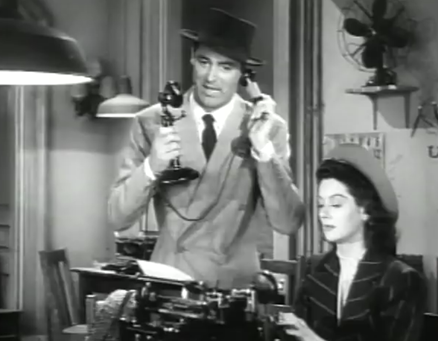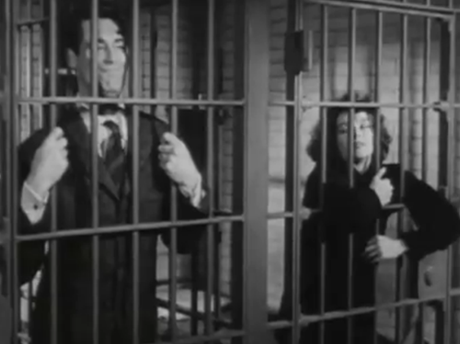
Review: Bringing up Baby (1938)


bringingup2“Our relationship has been a series of misadventures from beginning to end, so if you don’t mind, I’ll see Mr. Peabody alone and unarmed.” –
David Huxley

Bringing up Baby is really and truly one of a kind, almost headache-inducing with its sure energy and dizzying with its scatterbrained tracks, but nonetheless it is a screwball masterpiece. From Hollywood master Howard Hawks comes arguably one of his greatest films, boasting the rat-ta-tat-tat of some killer dialogue, some fantastic comedic sequences, and a number of memorable performances.  Honestly, if I learned anything from this film, you can’t watch it just once, because you’re bound to get bowled over, and afterward you probably won’t realize half of what you saw. For instance, there’s so much talking you hardly realize that there’s not much of a score.

Young Katharine Hepburn is at her most radiant and almost smothering with her constant barrage of words. You either love her or hate her. There’s no way to ignore her performance here because it’s completely out there. It’s hard to believe she was a novice when she came into comedy. There’s no inhibition whatsoever. Not in the least.

Cary Grant is the bookish paleontologist who is content with constructing the skeleton of his prized Brontosaurus and then marrying his admiring, no-nonsense sweetheart Ms. Swallow. It sounds like a pleasant albeit mundane lot in life. In an effort to gather a $1 million in funding, he goes out to the golf course ready to do a little business on the side with Mr. Peabody. That’s when hell strikes in the form of one scatterbrained lady extraordinaire Susan Vance (Katharine Hepburn). First, she swipes his golf ball (quite certain it is her’s), then she batters up his car (sure it is her’s again), and to top it all off she causes him to sit on his hat when they cross paths again at a club. Poor Dr. Huxley doesn’t know what’s hit him. He just wants to get away from her and all the fury that comes in her wake.

Good luck with that Cary, because she’s a force of nature! She misunderstands everything, and he gets endlessly caught in her web of miscommunication.  Susan initially roped him into coming along with her, thinking he was a zoologist who could help her take care of “Baby.” Of course, it turns out to be a tame leopard that they must get to her aunt’s home out in Connecticut (Only in a screwball comedy). By now he’s bothered. She’s falling in love.

So she does what any resourceful girl would. She keeps him occupied. First, she swipes his clothes. Then the dog George runs off with his prized possession, the intercostal clavicle. Initially, they want to get rid of the leopard. Then they want to keep it. Auntie comes home along with her gentleman friend Major Horace Applegate. A not so friendly leopard escapes from a carnival. The police get involved led by their bumbling leader Constable Slocum.
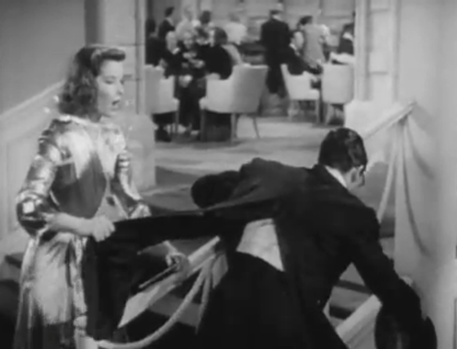
bringingup1It’s a doozy of a masquerade and most everything and everyone is utterly confused. It’s as if everything that enters the world of Susan Vance is further complicated. To her, it’s simply a day in the life and Huxley begins as an outsider, but despite all the madness, he becomes accustomed to it.  Running after the dog, getting soaking wet, tripping, falling, fending off a leopard, getting thrown into the clink. Dr. Huxley realizes that he’s never been happier and it ends pretty much as it began. Never a dull moment.

This has to be one of Hepburn’s greatest performances earlier in her career because she has everyone in a tizzy. Although he’s literally getting the run around from Hepburn, Grant is her perfect comedic foil. He dons the glasses at first and carries the sensibility that goes with them. However, he is equally equipped to go without them as a scatterbrained gentleman ready for all the pratfalls, quips, and escapades that ensue. And they are surrounded by a solid set of character actors including a drunken Barry Fitzgerald, the easily distracted Walter Catlett, the big game aficionado Charles Ruggles, and the peppy dog Asta (of Thin Man fame) among others.

Howard Hawks once said that “a good movie is three good scenes and no bad scenes.” In Bringing up Baby some of the memorable moments include the fateful meet cute at the golf course, the chuckle-worthy encounter at the club, and of course the sequence leading up to jail. But it’s also the little comedic moments wedged in between. Maybe Hepburn’s parked in front of a fire hydrant and trying to pull the wool over the policeman’s eyes. Or perhaps Grant dons the only piece of clothing, a frilly bathrobe, and is forced to answer the front door. It’s utterly absurd. It’s become classic and it shows the ability of Hawks behind the camera to make the action flow so organically.

It’s amazing that this film was a flop, Hepburn was labeled “Box Office Poison” by this point, and Cary Grant had yet to become an established star. Oh, how things changed. Because this film, in a sense, was the beginning of something truly wonderful. When two of the greatest stars aligned with one of the great directors.

5/5 Stars
Easy Living (1937)

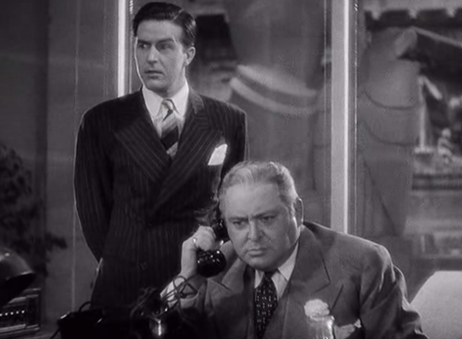
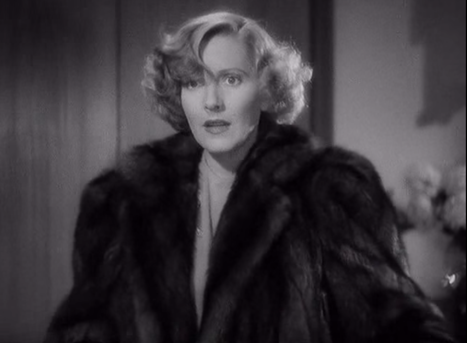
easyliving1Easy Living is a sizzling screwball comedy propelled by a Preston Sturges script and the direction of Mitchel Leisen (a former costume designer). It finds humor in the stratified 1930s society and the so-called easy livings of the affluent. But it also has it’s fair share of rip-roaring slapstick. Really the whole plot revolves around a rogue fur coat.

J.B. Ball (Edward Arnold) is the third most prominent banker in New York. His wife has a penchant for fur coats and his son John Jr. (Ray Milland) is fed up with his father’s constant criticism. He’s ready to leave the luxury and make a go of it on his own. Fed up with his wife and not all that pleased with his son, Mr. Ball tosses one of his wife’s sables off their balcony. Mary Smith (Jean Arthur) is the unsuspecting recipient of the coat as she rides by on a passing bus. By chance, she and Mr. Ball strike up a conversation and they hit it off after he resolves to buy her a new hat, in lieu of the one that was ruined. Of course, the clerk gets the wrong idea about their little friendship and it has major repercussions.

Many folks want to get on her good side since they’ve heard through the grapevine that she’s connected to Mr. Ball. This includes the befuddled hotel owner Louis Louis, who offers Mary one of his finest suites and she has no idea what she ever did to deserve it. Of course, Mary crosses paths with John Jr. who is smitten with her right off the bat. But she has no idea who his father is.

A joke from him, relayed by Mary, ends up having overwhelming consequences on the stock market and it ends up spelling major trouble for Mr. Ball. But of course, father and son and Mary all wind up in J.B.’s office together as the comedy of errors finally synchronizes. Son finally proves his acumen to father and gets the job he desperately needs.  Mary has her guy now and Mr. Ball’s marriage is all intact.

easyliving3Edward Arnold is an absolute riot and at his pushy best as the affluent banker. Jean Arthur has always been one of my favorite comediennes. She has such a great voice for delivering quips; there’s a certain lilt to it that is always invariably funny. She’s also the perfect independent working woman like a Barbara Stanwyck or Rosalind Russell. She’s no pushover. I knew Ray Milland for later films like The Lost Weekend or Dial M for Murder, but I saw here firsthand that he has some comedic chops. I also learned what an automat was and at the same time got treated with some top-notch slapstick. Thank you, Preston Sturges.

4/5 Stars

Review: Sullivan’s Travels (1941)

Veronica_Lake_and_Joel_McCrea_in_Sullivan's_TravelsIf Preston Sturges was a comic wordsmith then Sullivan’s Travels was his magnum opus. It has so many pieces worth talking about, despite it only running a meager 90 minutes. It is the kind of comedy that director John L. Sullivan (Joel McCrea) would want to make, and it’s a message movie against message movies. It’s a film about filmmaking (including mentions of Capra and Lubitsch). There’s even a scene where an ecstatic actress goes racing around the studio lot, completely disregarding the period piece she is acting in. The script has the undeniable frenetic poetry of Sturges and even takes time to wax philosophical at times. Sullivan opens the film with some very grandiose vision of what film can mean for the everyday filmgoer (I want this picture to be a commentary on modern conditions. Stark realism. The problems that confront the average man!).

Sturges’ film is scatterbrained and insane in its pacing at times. Take the opening speeding sequence as a newly bedraggled Sullivan tries to shake his caravan so he can really get a feel for the common man’s plight. It almost gives you a heart attack as they blitz down the road, people and everything imaginable flying every which way. It’s faster than most modern action sequences could achieve.

However, although Sturges is undoubtedly known for the strength of his scripts, it’s important to note that Sullivan’s Travels has some wonderful visual sequences. Many of them lack his typical lightning dialogue and instead rely on music and images to develop scenes. Sometimes it’s the plight of the homeless on the road as Sullivan and his companion make their way across country. I would have never thought of this comparison before, but sometimes his heroes elicit the same type of empathy that would be given to Charlie Chaplin or the Gamine (Paulette Goddard) in Modern Times. In that same way, this film so beautifully fluctuates between comedy and heartfelt drama.

Another beautiful thing about Sullivan’s Travels is the cast. Our star is Joel McCrea, who is sometimes known as the poor man’s Gary Cooper, but that is rather unfair because he’s a compelling actor in his own right. Just look at this film to prove his case. Also, he and Veronica Lake (Ms. Peekaboo Haircut herself) have a fun relationship going from the beginning when they first meet in a diner. You might say the shoe’s on the other foot since she thinks she’s doing a good deed for this down on his luck nobody. She has no idea that her “big boy” is actually a big shot movie director. However, it makes no difference, because in some ways she feels responsible for him, and so she takes part in his noble experiment even afterward. That’s where we build respect for them, and she, in turn, falls for him. It’s what we want as an audience. And we finally get it when Sullivan beats his death and a chain gain to return to civilization. His nagging wife has married some other boob, so Sullivan gets his girl.

Sometimes I feel like a broken record, but it definitely seems like they don’t make character actors like they used to. It helps that Sturges has a stock company of sorts and the studio system probably helped in propagating certain actors. However, there’s no doubt that players like William Demarest and Porter Hall are so memorable. Their voices. Their look. There’s no escaping them and there are numerous other faces that you get deja vu with. We’ve seen them before somewhere and just cannot place it.

Within this whole story of comedy, romance, and a heroes journey, there is, of course, a moral. However, I don’t mind Sturges and his simple didacticism. Because he ditches high rhetoric or sickening idealism for a simple conclusion (There’s a lot to be said for making people laugh). A Pluto cartoon short that brings a few giggles can be just as impactful in this world of ours compared to the next big Oscar drama. That’s what Sullivan’s Travels led to. A change in perspective through a hilarious itinerary.

5/5 Stars

Libeled Lady (1936)

Poster_-_Libeled_Lady_01Libeled Lady has screwball comedy written all over it and that’s perfectly alright with such a glorious cast. Myrna Loy and William Powell reunite once again (for one of their 13 pairings), but we also get Jean Harlow and Spencer Tracy. Amazing!

The set-up is easy and pretty self-explanatory. Warren Haggerty (Tracy) is the managing editor of the New York Evening Star, but while he is reluctantly getting ready to walk down the aisle, he gets the horrific news that the paper sent out a misinformed scoop by mistake. Now Haggerty is faced with a $5,000,000 libel suit from wealthy socialite Connie Allenbury (Loy), and it brings his weddings proceedings to a halt, much to the chagrin of his peeved fiancee (Harlow). This isn’t the first time that their big day has been postponed after all.

Stuck between a rock and a hard place, he goes to one of his former reporters, Bill Chandler (Powell), who really rubs Haggerty the wrong way, but he also happens to be a whiz when it comes to libel. He’s the only man who can get the paper out of the major jam so he leverages his position. Things go down like this. Chandler will ingratiate himself to Ms. Allenby and soon afterward Gladys Benton (Harlow) posing as his wife, will rush in on them. Presto! The suit will be dropped. Simple, right?

It’s the consequences that get even dicier. At first, Gladys absolutely despises being cooped up in a hotel with Chandler and she’s still fed up with Warren. But over time, the close quarters cause Chandler to grow on her. Meanwhile, Chandler tries to learn everything he can about angling, to charm Allenby’s father (Walter Connolly), who is a fishing aficionado.

From the start, his daughter has Chandler pinned as a fake (which of course he is), but by some act of heaven his act actually works and he wins them both over. Worse, Connie is falling for him and he’s reciprocating, but Haggerty is still waiting for the plan to be executed. Gladys is waiting impatiently for her “husband” who she seems to genuinely miss. It’s all a big mess to be sure.

The finale involves the four leads together for one final climactic barrage of pandemonium and spouse swapping. As you would expect everyone ends up with the right partner, but it was sheer craziness to get there. It had been a while since I had seen a screwball, and Libeled Lady is a striking reminder why the genre is so fun. It had me laughing pretty hard whether it was the utter absurdity of the fishing sequence or any of the other madcap moments. It boasts quite the cast too. It’s crazy to think that in only a year Jean Harlow would be gone, a short but vibrant career behind her.

4/5 Stars

Miracle of Morgan’s Creek (1944)

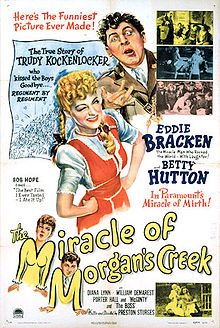
220px-The_Miracle_of_Morgans_Creek_1944_posterPreston Sturges was a revelation when I first saw Sullivan’s Travels and then The Lady Eve. His scripts are always wildly hilarious and full of memorable characters, whether they are headliners or just supporting the stars. The Miracle of Morgan’s Creek (1944) was a lesser known film to me, starring Eddie Bracken and Betty Hutton, but I was ready to see what this screwball could deliver.

With the start of the war, there began a push on the home front to strengthen morale by throwing parties and drinking victory lemonade in honor of the boys going overseas. Young Trudy is intent on dancing the night away with a lot of soldier boys. She just wants to do her part in the war effort after all. Her grumpy and domineering daddy Mr. Kocklenlocker (William Demarest) forbade her from taking part in such a shindig.

She sullenly goes to the movies with Norval Jones (Eddie Bracken), the young man who has been infatuated with her since they were kids. However, she somehow talks Norval into letting her go off to a party, and she spends the night living it up, while he waits dejectedly at the theater. When she finally returns its late morning of the next day and Norval knows her father will kill him.

However, Trudy also discovers a ring on her finger signifying that she married a soldier in her wild stupor the night before. The only problem is she cannot remember who it was, there were so many soldiers that she danced with after all. On top of that, add the prospect of a baby and you have a real doozy that has small-town scandal written all over it.

Norval tries his best to help remedy things for Trudy, only to wind up in jail with a big to-do building up — even making its way to the governor! Things don’t look good for poor Norval until Trudy gives birth and it’s a MIRACLE! When he finds out about what happens he has a little fainting spell.

That’s the craziness that is the Miracle of Morgan’s Creek, thanks to the rapid-fire dialogue and caricatures created by Preston Sturges. William Demarest is especially memorable as the hard apple Mr. Kocklenlocker who is always bossing his daughters around, but he’s not all bad. By now Morgan’s Creek looks dated, but all the same, it is still a memorable piece of WWII homefront cinema. Supposedly it was standing room only back in the day and honestly, it’s surprising that this film ever got past the censors. Bigamy, pregnancy, and so much more all comically mentioned in a 1940s film. Who would have thought?

4/5 Stars

Monkey Business (1952)

monkeyb5I always was under the assumption that the screwball comedy died off in the 1940s with homages coming out years later. Is there such a thing as neo-screwball comedies? Anyways, after watching Monkey Business I feel it is necessary to reevaluate that general conclusion. Here is a film from Howard Hawks that channels a great deal of the madcap craziness that you see in his earlier works like Bringing up Baby (1938). For lack of a better term, it is very screwy indeed. Right from the opening credits, you have the voice of God (Hawks himself) breaking the fourth wall and calling Cary Grant by his real name.

Then the film actually opens, and we meet the quintessential absent-minded genius Barnaby (Grant) and his loving wife Edwina (Ginger Rogers). They are meant to go to a social gathering and yet he is so caught up in his work that they stay behind. You see he is trying to develop an elixir of youth. His experiments are of interest to the business-minded and much older Oliver Oxly (Charles Coburn), who only sees the positives of such a discovery. Barnaby tries to explain to him that it’s not so cut and dry. In fact, his work could have dire effects if careful precautions are not taken.

Little does Dr. Fulton know that one of his lab chimps got loose in his lab and tampered with some chemicals, dumping them in a water cooler. After this absurd moment, Barnaby unknowingly consumes the rejuvenating concoction and his whole demeanor takes a turn.

Soon he’s out buying flashy clothes, getting a flamboyant car, ice skating, and driving like a speed demon down the thoroughfares with an astonished secretary Ms. Laurel (Marilyn Monroe). Cary Grant even shows off his impressive acrobatic skills, performing a cartwheel and a few other tricks.monkeyb3Only when the concoction wears off does he figure out what happened, and he resolves to be more careful next time. Except next time turns out to come sooner than he was expecting when Edwina willingly drinks some of the substance so Barnaby can observe her. Just like that, she is a prank-pulling schoolgirl with insatiable energy.

Once more Barnaby takes the elixir while Edwina is sleeping off the effect. However, when she wakes up a misunderstanding leads to more mayhem as she tries to get help from Mr. Oxly. What develops is a spiral into more hilarity. Barnaby and Edwina are reunited, Edwina’s old flame is incensed, Ms. Laurel is petrified, and chimps and man alike are taking part in some Monkey Business. If none of this makes much sense then I did my job!

3.5/5 Stars

What’s Up, Doc? (1971)

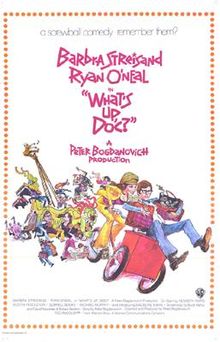
What's_Up_Doc_posterA nod to the 1930s screwball comedies, this hilarious film is directed by Peter Bogdanovich and stars Ryan O’Neil and Barbra Streisand. It opens with the prologue, “Once upon a time there was a plaid overnight case,” however very soon it becomes obvious that there are four of these cases! 

One belongs to the bookish Ryan O’Neil who is going to a musicologist convention with his annoying fiancée Eunice, the other to the free spirited Judy, one has top secret information, and the last is full of jewels. This dramatic irony is set up early on for the audience and things really get chaotic when Judy tries to pick up Howard. She masquerades as his fiancée and creates a good impression with a Mr. Larabee who is in charge of giving out the grant. However, later, Judy succeeds in completely destroying Howard’s room while causing more problems for Howard with Eunice in the process.  

The next day Howard is invited to a party at the home of Mr. Larabee and he is instructed to bring his charming “fiancée.” That’s where the mayhem hits its peak. All four bags end up together. There are gangsters, government agents, guests, servants, and Judy and Howard all a part of the chaotic ruckus. The unlikely couple finds themselves on the run through the hilly streets of San Fran where an epically frenzied car chase takes place. Put together a pane of glass, some bumpy steps, three cars, a parade, and a large body of water to add up to some hilarious moments. The bedlam carries over into the local courthouse where everything is eventually figured out. Everything is back to equilibrium and Howard flies off into the sunset with his new love and an in flight Bugs Bunny short.

4/5 Stars

Review: His Girl Friday (1940)

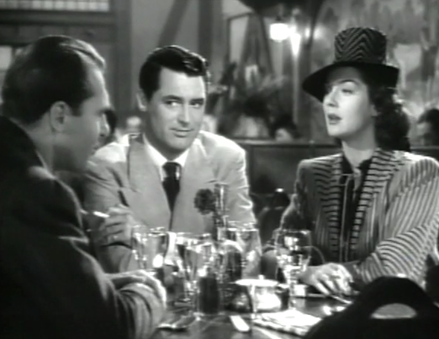
25148-hisgirl1It all happened in the “Dark Ages” of the newspaper game — When to a reporter “Getting that story” justified anything short of murder. Incidentally you will see in this picture no resemblance to the men and women of the press of today.”

Hildy Johnson (aka His Girl Friday) is making her return to the Morning Post but not to get her old job back. She came to pay a visit to her former husband (and paper editor) who she divorced because she is newly engaged and wants to break everything off for good. It means she can go off into the sunset with her new beau, but it also means no more paper. She drops the news and it turns out the wedding is set for the next day so Walter has very little time to go to work. He soon begins a sly barrage of subtle and not so subtle jabs, ridicules, and put downs aimed at the easy target Bruce Baldwin (Ralph Bellamy). Walter cuts him off, plays dumb, and is in general condescending and conniving. Hildy sees it all unfolding and half watches with bemusement, while also trying to stop Walter from causing any major trouble.

You see he’s a wonderful fellow in a loathsome sort of way, but you cannot help but like him. Because as Hildy notes he comes by charm naturally since “his grandfather was a snake.” These are the kinds of barbs and witty put downs we deal with the entire film. Besides being good fun, it also is quite extraordinary, since they never stop coming. It’s also fascinating to simply watch the many expressions of Cary Grant, whether it is a smirk or straight face, it always has a tinge of mischief which suits his character just fine. He seems more like a little boy at times, trying to win back his girl, and in many ways, that’s what he’s trying to do. But back to the action.

Hildy unwittingly falls into Walter’s trap, and from that point on there’s no stopping her, or Walter’s scheme for that matter. When the wheels of journalism start turning there’s no stopping someone like Hildy with newsprint in her blood. Walter lets her catch wind of a man who pleads innocence though he is to be hung for shooting a black policeman. Hildy puts up a fight, but she doesn’t last very long.

Soon she’s gotten into talk to the nervous prisoner Earl and gets his point of view on the whole messy ordeal. The other newsboys are callous to the world, and as the gallows goes up outside their window, all they can do is play cards and think about the best scoop. Hildy is a little different but she’s still leaving…or is she?

Next, Williams escapes and the mad search for the fugitive is on as the newsroom goes into an uproar. The mayor and sheriff are in a tizzy and then a reprieve for Williams comes, but they ignore it because they need this hanging in order to get re-elected. By a stroke of luck, Hildy finds Williams and stashes him away in a desk. Now she is hooked, and when Walter hears about her stroke of luck, everything begins again like old times. Bruce and his mother are soon disregarded as Hildy types feverishly, and Walter wheels and deals on the telephone. Then, the sheriff and mayor burst in with the rest of the boys. Williams’ hiding place is uncovered and the two reconciled lovebirds look like they might wind up with a jail sentence. But the honorable air-head Mr. Pettibone saves the day. All that’s left to do is depart on a two-week honeymoon to Niagara Falls or maybe a workers riot in Albany. All is right with the world again. Walter’s got His Girl Friday, and she’s got her lovable wiseguy husband back.

I’m not quite sure why I am so often drawn to this movie because it is more than it being readily available in the public domain. The dynamic of Grant and Russell is certainly superb. Walter can be an absolute cad, but Grant’s charm makes him bearable to the end. Russell is the true star of this film and she deals the punches with the rest of the boys. It really is the perfect role for her. The film is blessed with the great supporting cast including Porter Hall, Roscoe Karns, Gene Lockhart, Billy Gilbert and a host of others who populate the film with colorful faces and voices.

After seeing Nothing Sacred (1937) it was also interesting to see another script from Ben Hecht about journalism. Again, it might be a screwball comedy but there are also political undertones. Most blatantly about journalism itself, but also about corrupt leaders (like the mayor and sheriff), the Red Scare, gender roles, capital punishment, and even WWII.

Of course, it must also be noted that this is a film directed by the great Howard Hawks. I have always had difficulty pinpointing his trademarks, because the reality is, he was so versatile, trying his hand at so many different genres. All I know is that I more often than not enjoy his work behind the camera because it is seamless and it feels quintessentially American. His Girl Friday is no different. Although, this one is just a tad faster than most. It’s sure to raise your blood pressure so be warned.

5/5 Stars


Nothing Sacred (1937)

 13094-nothingsacred2Before His Girl Friday (1940) came, there was another screwball comedy about journalism, the perfect scoop, and deception. After getting on the bad side of his boss, newsman Wally Cook (Frederic March) is demoted from the living and forced to write obituaries. It’s quite the awful setup and Cook desperately looks for another story to get him in the good graces of the Morning Star’s editor.

The perfect news flash has just come up in the form of a woman who is soon going to die of radium poisoning, and so Wally Cook goes to meet her. Heading up from New York, he ends in the one horse town in Vermont. He meets a lot of unobliging people whose vocabulary is limited to “Yup” and “Nope.” He finally comes across the crying girl who has just left an appointment with a doctor. He comforts the girl cheering her up by promising a trip to the big city where she will be treated like royalty (And he’ll get his story). So Hazel Flagg soon becomes the sweetheart of New York with public appearances at Madison Square Garden, parades, poems, articles and special honors. It’s all going according to Cook’s plan, the only thing is that Hazel is not actually ill.

That’s a wrench in the plan and soon it becomes evident that Cook will look like a cad. To make matters worse, he’s falling for her and his editor Oliver Stone is all over him. Now he must take part in Hazel’s charade, despite his annoyance. She too is annoyed and ends the game so the two lovebirds can elope. Still, the story of Hazel is given a romanticized ending that the public deserves.

Frederic March is decent as the desperate and long-suffering journalist. Carole Lombard is her typical light-headed, whimsy, high-strung, scatterbrained, sniveling self. It proves to be a volatile combination partnered with Ben Hecht’s script. The news industry loses a lot of its self-respect for the sake of laughs because nothing’s sacred. Some might be interested to know that it was shot in glorious technicolor and it was the only time Lombard would appear in a technicolor film. She would, of course, die in a tragic plane crash in 1942.

This film was quite short so the story moved quickly and there were definitely some screwy moments. I am however partial to His Girl Friday and some of the other more well-known screwballs.

3.5/5 Stars

It Happened One Night (1934) – Updated

Hopefully no one holds this against me, but I have never been a big fan of Claudette Colbert. However, I will say that I am a Capra aficionado and Clark Gable is certainly a classic Hollywood star who is dynamic in this film. Thus, despite my hangups with Colbert, I can still thoroughly enjoy this romantic comedy, the so-called original screwball. It helps to have such comedic fellows as Roscoe Karns, Alan Hale Sr. (father of The Skipper) and Walter Connolly.

Peter Warne is the down on his luck newspaper man and Ellen Andrews is a socialite who feels trapped between her suffocating father and an upcoming marriage. Does this formula sound familiar? It undoubtedly is, but this was the original, all those following were impostors.

The unlikely pair begin a cross country trek towards the destination of New York. It includes uncomfortable bus rides, awkward overnight stays, a bit of hitchhiking, and eating carrots to survive.

Only in the movies could such a scenario play out and yet that is the fun because anything can happen one night or another. In this case all the caterwauling and antics lead to a happy ending. To think many people thought this film would not be very good! That was obviously proved wrong by numerous accolades. Just think this film came out 80 years ago and we are still watching it today! That is amazing. That is the power of the movies.

Peter Warne: A normal human being couldn’t live under the same roof with her without going nutty! She’s my idea of nothing!
Alexander Andrews: I asked you a simple question! Do you love her?
Peter Warne: Yes! But don’t hold that against me, I’m a little screwy myself!

5/5 Stars