
A version of this article was published in Film Inquiry.
“I am always highly irritated by people who imply that writing fiction is an escape from reality. It is a plunge into reality and it is very shocking to the system.” – Flannery O’Connor
As someone fascinated by story structure the biopic form is often a tough nut to crack. Cradle-to-grave entries in covering the breadth of a life, can either feel like rushed simulacrums or stodgy overlong hagiographies nailed to the floor.
The very best movies of this ilk inevitably evoke the spirit of their protagonist with the very sinews and bones of their structure. Hence a movie on Mishima that’s wild with heavily striking mise en scene. A Brian Wilson story that is empathetic, hallucinatory, and musical to the nth degree.
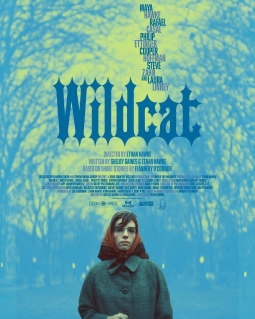
Director Ethan Hawke and his co-writer Shelby Gaines have found their own way to do service to famed southern Catholic author Flannery O’Connor. Because her life was famously banal — she lived in her Georgia town with her mother writing before her death at 39 — they tackle her formative years through the vivid imagination of her own literary works.
It’s important to note while this movie is full of fanciful and often humorous and grotesque portraits of humanity, it never feels like the escapism the author abhorred (One can imagine she would have choice words for a hothouse melodrama abruptly featured at the outset). O’Connor always was concerned with depicting the life she knew by unorthodox and often startling means. There was nothing conventional about it.
A Good Man is Hard to Find is case and point, one of her startling works where a self-righteous old hag ends up being shot to death by a wanted fugitive and in this precise moment she becomes a gracious person for the first time in her life. In the film when the gun shot goes off, we watch a young O’Connor (played by the director’s daughter Maya Hawke) go flailing backward from behind her typewriter. She feels her stories so profusely.
We watch her life during her early years as a young woman. There are stints at the illustrious Iowa Writer’s Workshop under the tutelage of Cal Lowell (Philip Ettinger). She pays a visit to a publisher who tries to tactfully give her feedback on her first novel Wise Blood. She’s quick to retort that she’s “amenable” to criticism but only if it does not attempt to neutralize her artistic vision.
There are segments of her returning to live with her mother Regina (Laura Linney) in a society where people want her to be the next Margaret Mitchell, penning the next Southern nostalgia lost cause classic like Gone With The Wind. Meanwhile, Flannery seems antithetical to this entire idea.
It’s evident she is a singular mind who will not settle when it comes to her writing. She tells the truth as spiny and ugly as it might be. This is my own experience with her work. I rarely enjoy it. I feel scandalized and assailed by it at every turn.
It’s difficult going and then she turns a story around and uses her characters and the bizarre scenarios to ambush me. Ironically, the saving grace of her stories are how they all revolve around the scandal of grace — our need to recognize and accept it in our own lives.
The threads of the movie’s narrative are tied together with earnest excerpts from her prayer journal and many of her most notable short stories. One that was my introduction to Flannery was “Revelation” where a self-righteous southern woman gets tackled in a waiting room by an indignant girl named Mary Grace. This comes only after a dream where Jesus comes to her and says she can only enter heaven as a negro or white trash. Perish the thought…
The other is “Parker’s Back” where a profligate covered in tattoos marries a devout woman and gets the image of Christ tattooed on his back to please only for his wife to beat him. He’s tossed out of the house, bloody and bruised, brought to the lowest point imaginable. Is this idolatry or as we watch the picture of Christ being bloodied in front of us, what are we to do with it exactly? It feels uncanny and uncomfortable, a perfect evocation of O’Connor’s sensibilities.
Delving into their conversations, it’s apparent Maya and Ethan Hawke have an abiding appreciation for this woman and her writing. There would be no other reason to make a movie like this with so much tender loving care. And so any mild criticism feels like putting kindred spirits under the chopping block. It need not be so. They feel like dear friends.
John Huston’s adaptation of Wise Blood has an intuitive handle on the Southern milieu and the absurd humor found in O’Connor’s work. She’s darkly funny. It seems to thrive while still getting to the perplexing themes at the core of a story that feels scandalizing as she tears through the Southern mentality with her incisive quill.
What Wildcat has is something so often absent from both film and art these days. It’s not squeamish about the tough conversations nor does it skirt over the most prickly issues, not only of America’s legacy but the very essence of the human experience.
There’s a weight and a gravity to it that’s felt in almost every frame. The only reprieves come from O’Connor’s own wit. This is all in service to its subject because Flannery was a young woman sincerely struggling to balance her aspirations to be a great writer and a devout person of faith in communion with God.
So often we are told these creatives and religious life are mutually exclusive. Which of course feels preposterous to O’Connor in the face of her Creator-God. It’s easy to be moved when she sits among her cohort at the writer’s workshop in Iowa — a midwestern institution that nevertheless maintains a reputation for the literati — and she says religion is not an electric blanket; it’s the cross.
It’s so difficult to take stories that live in our mind’s eye and bring them to the screen because then they are tangible and concrete. Endless possibilities of imagination are distilled down to distinct creative choices. Hawke’s film tailors its palette to a tempest-like existence that roils O’Connor’s soul as she seems to battle for life and death with her typewriter as her only weapon.
Is this a bit much? Perhaps and yet anyone who does write and cares about art or has suffered and struggled, recognizes that it doesn’t feel like hyperbole. It feels real and affecting — like something we understand intimately. In O’Connor, we see reflections of our own struggles in our creative endeavors.
Because we believe our words mean something and that life matters and questions of death and religion are not ancillary topics for dinner parties. They are the crux of our entire existence.
Cal, Flannery’s pen pal and hinted love interest, gives her Thomas Merton, and in this reference and watching her tumultuous struggle depicted on film, it’s difficult not to draw lines between Hawke’s performance and her father’s protagonist in First Reformed (Ettinger who plays Cal also had a crucial role in that film).
For that matter, one of the other integral scenes involves a priest played by Liam Neeson. It feels almost like a reprieve after his apostasy in Silence. He pays Flannery a visit as she’s bedridden, stricken with the lupus that killed her father, and currently unable to write.
Here he enters in to provide Flannery comfort and in all her internal struggles remind her of grace and grace abundantly — something given to her through the death and resurrection of the Jesus they believe in. There is immense power in this scene, even in its simplicity.
Because the storm outside her bedroom widow or even the lupus that’s ravaging her body almost feel like outward manifestations of the real struggle going on. Why does hardship often make us more aware of grace and our need for it in our lives whether we want to accept it or not. Pain is not easy. Happy, warm, affable stories are a lot more palatable.
O’Connor would never dare to be so disingenuous about her faith or her storytelling. And judging from her life and premature death, she was more than acquainted with troubles. She had an intimate relationship with them. Certainly this was not the life she had envisioned for herself.
Still, she ran the race of life even if it was on crutches. Perhaps not dissimilar to that hapless chicken walking backward. What’s more, she blessed all of us with her stories — signposts to help us along our own paths — shocking us back to reality.
I couldn’t get the image out of my head — first as Flannery picks up her new peacock from the train station and then the remarkable moment where its tail feathers fan out behind her in a glorious display. If other people saw her as that measly chicken, in the eyes of her Creator she really was that glorious peacock. What a gift it is.
4/5 Stars




 Growing up in a household indebted to British everything, you get accustomed to certain things. Numerous everyday knickknacks and antiques imported from The U.K. Muesli Cereal in the pantry with copious amounts of English Breakfast Tea. Beatrix Potter, P.G. Wodehouse, and Postman Pat become household favorites.
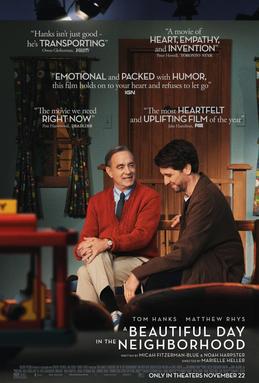 As of late, it feels like the world has entered a bit of a Mr. Rogers Reinnaissance. He’s been gone since 2003 and yet last year we had Morgan Neville’s edifying documentary Won’t You Be My Neighbor? There are podcasts galore including Finding Fred and then Mr. Rogers’s words, whether before the Senate Committee or pertaining to scary moments of international tragedy, seem to still provide comfort and quiet exhortation to those in need.
 4 Star Films