Classic Movie Beginner’s Guide: Kirk Douglas

With this ongoing series, our goal is to help people who are new to classic movies, get a foothold. To make it easy, we give you 4 representative choices and then some supplementary options.

Sadly, with the passing of Kirk Douglas earlier this week at 103 years of age, it seemed apropos to tackle his career for those who might be interested. There are so many great movies to choose from, spanning the decades, but we’ll give it our best shot.

Champion (1949)

Image result for champion 1949

Kirk Douglas had so many stellar early supporting roles in noir: Strange Love Martha Ivers, Out of The Past, I Walk Alone are all memorable. However, Champion was Kirk Douglas’s big break channeling his trademark intensity into the ring as an overzealous fighter. It would set the tone and help shape his growing reputation in Hollywood.

The Bad and The Beautiful (1952)

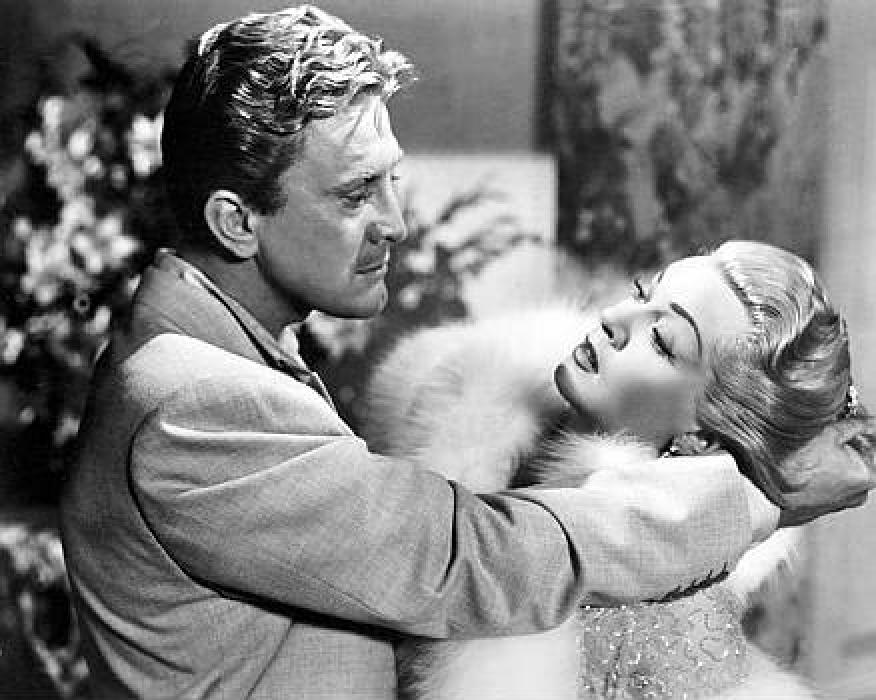
Image result for bad and the beautiful 1952

Despite all the glitz and glam to go with a Hollywood storyline, Kirk Douglas is as blistering as ever. Like Sunset Boulevard or In a Lonely Place, it shows another side of the industry and Douglas and Lana Turner deliver some of the most memorable performances of their careers in this Vincente Minnelli drama. That’s saying something if you consider Kirk’s work in Detective Story and Ace in The Hole around the same time.

Paths of Glory (1957)

Image result for paths of glory 1957

Paths of Glory stands as one of the great wars films for the very reason it runs counter to many of the narratives we know well. At the core of this Stanley Kubrick WWI piece is Douglas as a man caught in the middle of the insanity of war, in this case, perpetrated by his own superiors. If you want more conventional entertainment there’s also Gunfight at The O.K. Corral (1957) highlighting Douglas’s longtime screen partnership with Burt Lancaster.

Spartacus (1960)

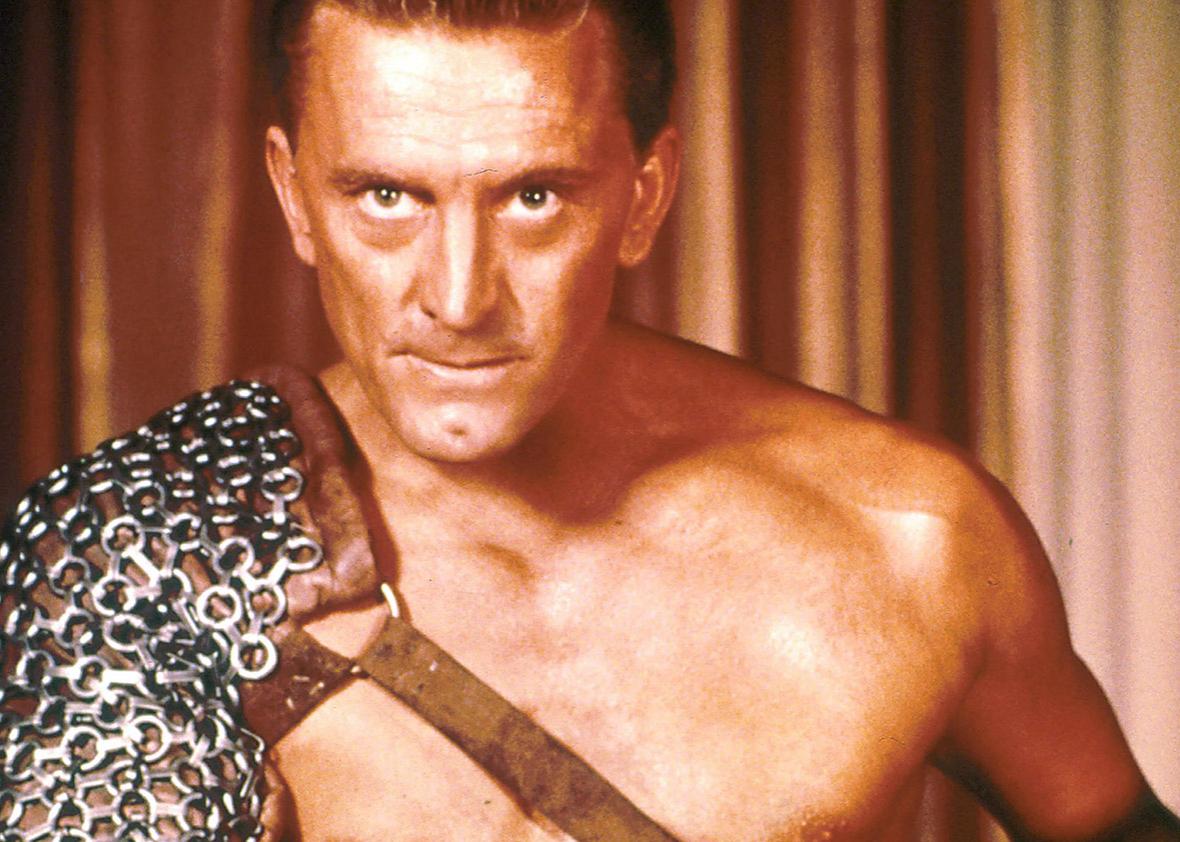
Image result for kirk douglas spartacus

Spartacus is arguably the tentpole of Kirk Douglas’s entire career, and it has the epic spectacle of sword and sandal epics of the era with Douglas anchoring the action with his typical dimpled charisma opposite Jean Simmons. Behind the scenes, the picture would prove to be a watershed for unofficially ending the Hollywood Blacklist by openly crediting ostracized writer Dalton Trumbo. It’s one of Douglas’s great moral triumphs as a Hollywood producer.

Worth Watching

A Letter to Three Wives, 20,000 Leagues Under the Sea, Man Without a Star, Lust for Life, Last Train from Gun Hill, Lonely are The Brave, Seven Days in May, etc.

Parasite (2019): Bong Joon-ho’s Household Thriller

Parasite_(2019_film)

I heard in an interview director Bong Joon-ho had the idea for Parasite percolating in his mind for a long time, and it was born out of the most curious forms of inspiration. In college, he used to tutor English for the child of a rich family. From that point of disembarkation, he started asking “what if…” and all of a sudden his latest thriller was born.

Whether this story is completely true or not, it gets at what I relish about screenwriting and the inception of ideas in any form. Oftentimes they come straight out of real-life experiences only to be morphed and molded, burnished and extrapolated upon until they take on an existence entirely their own.

In some ways, Parasite feels very much related to the previous year’s Cannes darling Shoplifters, directed by Hirokazu Koreeda. In both cases, a story about an impoverished family becomes a handy jumping-off point for social commentary. But that’s just it. The premise provides a jumping-off point and there’s little else we can compare because the stories take drastically different turns simply adjudging from their creators.

Because the Kim family live crowded in a shoddy basement-dwelling leeching off the wi-fi of those who live around them, somewhat contented or at least resigned to their vagrant lifestyle. However, one day their teenage son, Ki-woo is enlisted by a friend to fill his position tutoring the daughter of a rich family.

His family helps him with the con using their skills of photoshop, composition, and dramaturgy to pull off the masquerade and ingratiate themselves. It helps that their mark is a simple-minded, trusting, and generally kind matriarch. There’s a touch of Luis Bunuel in the depiction of this rather naive and vacuous bourgeoisie family getting overrun by the lower classes.

And yet a distinction must be made here too because Bong does not altogether mock them. There is the inkling of affection for all his ensemble even as he teases them. This is one of the keys to the movie’s success. The message is not hammered home at the expense of the characters. 

One thing leads to another and the household vacancies begin filling up. First, an English tutor, then an art therapy instructor, next a new chauffeur, and finally a housekeeper. If the early dynamic is a tad like Shoplifters, as Parasite gears up, I couldn’t help but feel this same pervading unease experienced throughout Jordan Peele’s Get Out. While it might seem like a curious touchstone, what both films fashion are compelling thrillers carved out of the home.

The domicile and symbol of social capital, stability, even the family unit, is turned into this perturbing space that can be easily sabotaged and infested. It doesn’t matter if the main thematic element is race or class. They can both function in an insidious manner as a source of tension throughout the picture, seeping in through the cracks. Where you can live life from the heights of privilege or sunken in the subterranean void below. 

While the cat’s away the mice will play, and it’s at this point we ponder where we could possibly be headed. The Kims succeed in totally taking over the house and lounging in all its decadent luxuries. This could be the end of the story. Thankfully, we are in the hands of someone who knows full-well what they are looking to accomplish. 

Part of the ingenuity of the film comes in how form follows function in this very tangible way. Because the visual and environmental disparity trickles down through the story until it emphatically erupts. The metaphor takes on a very real and concrete form throughout the picture. But for the time being, it’s all about building the mounting suspense to a crescendo.

Bong is a disciple of Hitchcock, and thus he’s taken to heart the pervasive power of dramatic irony. He can both manipulate the audience while implicating us and making us totally invested in the charade at hand.

Though Parasite does have twists — one particularly harrowing in nature — it is built out of this maintained sense of dread and tension. It only works because the director has taken us into his confidence and we know something other characters do not.

The film is also built and developed out of not only its architecture but the sound design helping to create a distinct space and also a rhythm conducive to the action. A chaotic scramble to neutralize, not a gun, but a phone with social media capabilities is the centerpiece of one memorable scene full of struggling bodies, flailing arms, and the like, choreographed to perfection.

There are certain scenes like this one where they cease to be bits of exposition and dialogue, and they feel more and more like they’re verging on visual symphony as we watch images and actions flash by with a very particular cadence. They have the force to carry us away in the moment — cutting to the music — like many of the greats have done, from Hitchcock to Scorsese. 

When the Kim family is finally at their lowest point, sleeping on a gymnasium floor, their patriarch utters the film’s one line which feels like some kind of worldview tucked into a movie that otherwise functions only as a satire, if not an out-and-out black comedy. He says the best plan is no plan because nothing works out the way you mean for it to anyway. It doesn’t matter if you kill someone or commit treason. Nothing matters. Nihilism is alive and well.

Still, the beauty of this is even while Mr. Kim says these things, there is a director behind him — an artistic creator — who has more than a vision for where he will end up. There is a purpose to everything that is happening to him. 

If the majority of the movie is an exhibition in Hithcockian manipulation, then the ending is suitably macabre for someone totally versed in the Master of Suspense. Bong somehow manages to be playful, shocking, thrilling, and a tad somber all in the course of the final hour. The film is lengthy; we don’t always know where it will wind up, and yet it ends up in places that continually lead to further questions.  You cannot unsee it or quite forget about what we have witnessed. 

Parasite has an undisputed climax and still the story continues allowing itself to sink back into a newfound despondency and the original status quo. I still cannot decide if this suits everything we have been subjected too thus far.

Although another joy of screenwriting is narrative symmetry when we can take a movie back to where it began. Because so much has happened. We have weathered so much as an audience, watching and in some perverse way, rooting for this family, only for it to end up back the way it was, under very different circumstances.

All I know is that this is one of the most wickedly sharp and ingeniously pulse-pounding movies I’ve seen in quite some time. It irks me and yet in the same instance, I cannot quite turn away.

If there is any more fruit, broader still, it will come from the phenomenal press the film has received, and in an age where acclaim still guides public opinion, like Bong said himself, maybe this can be the film to help the general public conquer their fear of subtitles. Because if Parasite‘s any indication, it wields the power to open people up to expansive avenues of cinema. This is only the tip of the iceberg.

The joy of making the leap is the realization that you are not being pulled further away from what you know. More often than not, you’re getting closer — closer to the things that feel universal — the human predilections connecting us on an intimate scale. Both the parasitic and the hospitable, the good and the evil. 

Although they couldn’t be a more diverse company, you see it in Hitchcock (a Brit), Koreeda (a Japanese), Bunuel (a Spaniard), Bong (a South Korean), and many others. Go watch them if you have the chance. My hope is you will be glad you did. 

4.5/5 Stars

In Memoriam: Remembering Kirk Douglas (1916-2020)

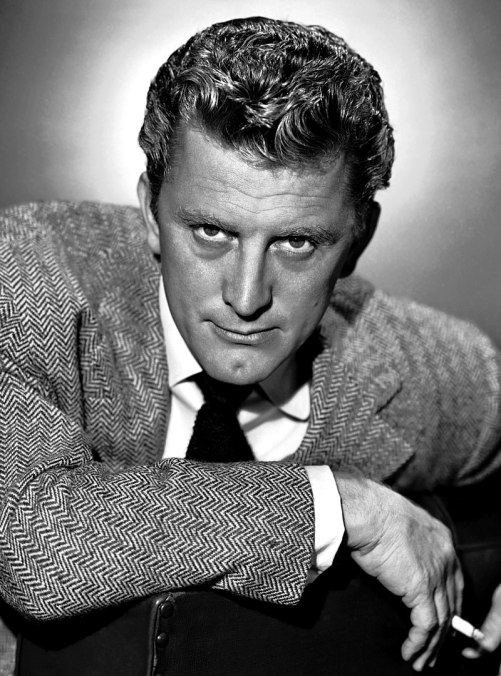
800px-Kirk_douglas_photo_signed

One of the greats is gone. At 103 years of age, Issur Danielovitch, known to movie lovers over as Kirk Douglas has finally left us.

In full transparency, if he was up against Robert Mitchum I would have probably sided with Bob. If he was facing off with Burt Lancaster I might have gravitated to Burt. But there was something so fiery and passionate about Kirk Douglas making him simultaneously one of the great action heroes and villains over an illustrious career.

Because he thrived on ferocity, conflict, and volatility before the days of Brando and company. In the 40s he knuckled down with the aforementioned men in seminal film noir like Out of the Past and I Walk Alone.

His first truly blistering protagonist proved to be the ambitious boxer Midge in Champion, and he would set a beeline for parts channeling the same energy straight to the top. Take anything like Detective Story, Ace in the Hole, and Bad and The Beautiful to get an idea.

If you take stock of these portrayals their altogether fearless. They are not consumed with being likable or palatable. They have sleaze and corruption dripping all over them but they’re also unmistakably magnetic. You can’t take your eyes off them.

Paths of Glory trailer 2.jpg

In many ways, Douglas felt as fearless in life as he was on screen. As he gained more clout he used his powers to pick uncompromising material. Paths of Glory, directed by Stanley Kubrick, is one of his finest hours as a stirring statement and morose portrait of war.

Is it an obvious cliche to say he had a Lust for Life in line with the characters he played including Vincent Van Gogh and Spartacus? Certainly, it is, but why belabor the point.

It was the latter film which galvanized his pronouncement for generations of parodies (For me it was in Community). And yet all kidding aside, it was this very same antithetical, and wildly popular biblical epic that helped crush the gates of the blacklist.

Douglas was one of the few men with the guts (and the sway) to call on the irrepressible talents of blacklist poster boy Dalton Trumbo and still get away with it.

If these few passing bits of observation were all his life had to offer, it would be well worth acknowledging. There’s so much more that I don’t even have the time or knowledge to fully cover. I will simply leave you with this. Kirk Douglas will be dearly missed because he loomed large over the industry.

To be fair we aren’t simply paying tribute to him because he was one of the last living testaments to the days of Old Hollywood though that holds true. We are remembering him in part because he had his fingerprints all over the film industry for generations. You cannot talk about the classical period of the 20th century without rubbing up against his influence.

There is a reason he was placed #17 on The American Film Institute’s list of screen legends. Not simply as a token award, but because it was well-warranted. As someone who is invested in sharing the world of classic cinema with others, he will be dearly missed. But the beauty of film is the fact he will not be forgotten.

Those who love or (even in my case) deeply admire his talents, will look to pass them on.

R.I.P. Kirk.

To many of us, you were Spartacus…and there’s nothing wrong with that.

Kirk Douglas (2011).jpg

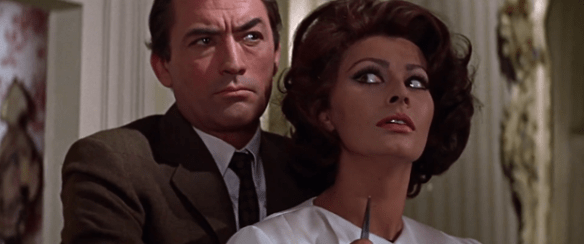
Arabesque (1966) with Gregory Peck and Sophia Loren

arabesque 1.png

I was trying to recall if the actual word “arabesque” was ever uttered in the movie. Granted, in a narrative like this, it’s just as easy for something to fly over your head. There’s comparable lingo bandied about pertaining to ciphers and hieroglyphs, mentioned in the context of coded messages and bits of secret information. You can hardly have an international spy thriller without such prerequisites, and yet this isn’t the fun of it.

Nor is it a foreign prime minister’s plight or the dubious intentions of a peregrine falcon-loving mastermind who holds a ravishingly beautiful woman in house arrest (in all cases Middle Easterners are played by Westerners). Because for any such story, the lasting enjoyment comes in the road traveled and the people we get to follow along with through every twist and turn.

It’s the saving grace of Arabesque, a movie with an overhauled and doctored script tinkered on by many hands including Peter Stone (writer of the similar Charade and Mirage). All this work produced a simultaneously mind-boggling and messy plotline. It doesn’t take a genius to recognize the particulars barely add up.

All that must be know is Professor David Pollock (Gregory Peck) finds himself on the run from any number of villains, all with their own selfish, nefarious schemes to employ. At the center of this sinister web of mayhem is an alluring spy (Sophia Loren) who is constantly switching and shape-shifting under every given circumstance. Our protagonist doesn’t quite know what to do with her.

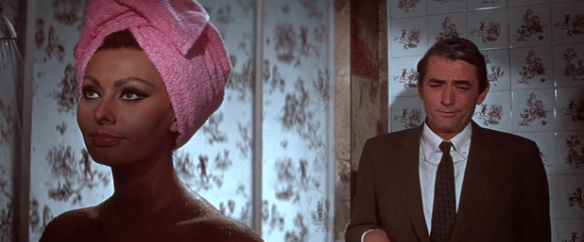
One might note Arabesque has another memorable shower scene after Charade’s. However, this rendition is decidedly more awkward and tense as Pollock finds himself under the hospitality of a sinister man, and Yasmin Azir (Loren) is under his watchful gaze as well. They wind up playing footsies with the soap in an effort not to raise suspicion.

arabesque 2.png

Arabesque tries to make it extremely evident all this peril is being thrust upon our heroes as they travel through the heart of Britain. It can be little more than a nod to The Master of Suspense to have our characters running through first a zoo and then a local aquarium, recalling the museum pieces in Blackmail (1929). There’s even an overt nod to North by Northwest, complete with cornfields, this time patrolled by deadly threshers instead of a crop duster.

Stanley Donen’s solution to the so-so storyline is to do just about anything he can to mix things up with kaleidoscope prism shots, angles through glass tables, reflections, unique framing, and on and on. In one sense, it is inventive, but there’s no unified purpose to it. It feels precisely like he’s trying to do whatever he can to distract from the material when it gets dull. Of course, the fact that this is the 1960s doesn’t hurt the aesthetic with enough drugs and hallucinations to pass the decade’s quotas.

In one particularly otherworldly vision, Peck becomes a hallucinogenic bullfighter on the motorways causing a major traffic jam. It adds little to the plot, but it certainly creates an impression. Still, I’m not sure if the merits of form over substance apply in this situation, even if Donen is ceaselessly creative. It gets to be almost too much. It could easily verge on out-and-out camp — considering the ludicrous nature of scenes — though it knuckles down when it matters most. An assassination plot must be averted, and it does offer a decent payoff in the thrills department.

Peck admittedly feels a bit miscast, although this could just as easily be my subconscious speaking since Cary Grant was earmarked for the role. Because one can imagine, even with his advanced years, Cary could have pulled off the wit marvelously. God love him, but Peck is almost too regal, and he has too much presence if that can possibly be an impediment. Sometimes it’s difficult to take him lightly. He does make an admirable go of it and the hint of Indy, an educator by trade, does not hurt his image.

Sophia Loren is absolutely scintillating carrying scenes with her usual poise owning every line and effortlessly building the needed chemistry with Peck, even as she sends him bouncing all over the place. He needs her for this picture to work, and she delivers.

When it ends, there’s some amount of contentment. Not because we saw a perfect movie by any means or even anything quite on par with Hitchcock or Sean Connery’s Bond, but we got to spend some quality time full of mayhem with two sublime personalities. It is all worthwhile because Peck and Loren are together.

After all, who wouldn’t want to swim in Oxfordshire with them? Maybe the days haven’t quite left us entirely, but I do crave more pictures that could coast on the charisma of their stars. Without question, Arabesque overrides its flaws through sheer star power.

3/5 Stars


Mirage (1965): Gregory Peck 20 Years After Spellbound

mirage 1.png

“Most people will do in the dark what they never would think of doing in the light.”

Mirage takes full advantage of one of those grab-you-right-away openings. The scene commences in the dark, there’s a power outage, candles are flickering, and voices call out up and down the corridors as people mill about.

Among the bystanders whose work has been disrupted is cost accountant David Stillwell (Gregory Peck), and within a minute, he receives an invitation to a braille party (touching only) by two giggly women. Then, one minute he’s talking to his chipper colleague (Kevin McCarthy), and the next he’s climbing down the stairwells with a woman (Diane Baker) who had the same idea to get out.

As they walk and talk, they comment on how everyone is looking to “rescind the 10 commandments.” The cloak of darkness has a strange effect on people. Of course, when the lights do go on, this phantom woman vehemently asserts they know each other. Stillwell’s never seen her before in his life. Now we know something must be up. They cannot both be correct.

For a movie from the 1960s, it’s awfully noirish and that we can easily enough attribute to Edward Dymtryk who, before becoming a Blacklist casualty, was behind such pictures as Murder, My Sweet (1944) and Crossfire (1947). It continues with the bleak black and white tones for the rest of the picture, the complete antithesis of comparable thrillers like Charade or even Arabesque.

A shocking suicide impacts the street below the building Stillwell works in, attracting hordes of onlookers. He has more pressing issues like disappearing floors in buildings he cannot find. More peculiar interactions follow with not only the same woman, but bartenders, security guards, and just about everybody else.

The story is blessed by a plethora of oddball characters shuffling about who might or might not be a part of some sinister plot. That or they’re just your typical New York eccentrics. They are indicative of a world full of strange circumstances that cannot be unrelated. It’s all uncanny.

Next, he’s getting held hostage at his own apartment. Could it be he’s some type of doppelganger — living a double life of sorts? One cannot help but think of Roger Thornhill’s predicament in North by Northwest. However, in this case, it comes out Stillwell cannot remember his life from two years prior.

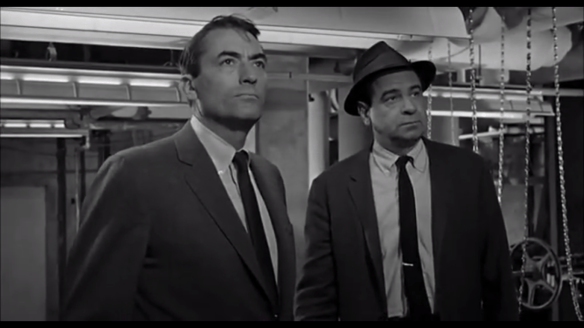
The most fortuitous decision he makes is to visit the AAA Detective Agency run by an amiable shmuck of a P.I., Ted Caselle. With these forthcoming developments, Mirage becomes almost a buddy film — the buddy is no other than Walter Matthau — and it’s the most delightful interlude while still being injected with this same perplexing conspiracy.

mirage 2.png

All of a sudden, our solitary hero has someone at least willing to listen to his predicament. Someone who is in the dark just as much as he is (and we are). They get whisked and weaved all around the city, so much so that detailing it all won’t do any good. There are gunmen and murders and even a little girl named Irene who gives them asylum. She makes them a make-believe cup of coffee while they wait it out. Screenwriter Peter Stone, by this point, is relishing every unique aside he can wring out of the utter convolution.

Scenes are constantly intercut with earlier conversation all of sudden becoming illuminated — as the puzzle pieces start falling into place in the present — only making the past all the more perturbing. We are not allowed to forget anything, knowing it all ties together into this patchwork that has yet to be revealed. This is the source of the continual tension.

Mirage and then Arabesque from the following year might both be in the running as the unofficial sequel to Charade (1963). Mirage, of course, carries over such supporting actors as Walter Matthau and George Kennedy while retaining the services of Stone’s screenwriting. Arabesque was actually meant for Cary Grant (though Peck ultimately ended with the role), and Stanley Donen reluctantly was enticed back by the star power of Sophia Loren and Peck in color.

Neither of these pictures is on par with their predecessor, but they hardly need to be. Likewise, one might easily concede Mirage is Hitchcockian in plot but not execution. Again, it’s not an outright criticism. Instead, it leans more toward a sparse, unsentimental spy drama like Martin Ritt’s The Spy Who Came in From the Cold.

It is about human beings who are frail, jaded, and scared. But most of all, deep, trenchant flaws are revealed. It’s not quite a full character study, but it is inching in that direction, even as the labyrinth is laid out for us to rack our brains over.

A psychiatric appointment allows space for scientific and ethical terms to be traded like “insanity,” “right and wrong,” and “good vs. evil.” Mirage is not a top tier social commentary — it works best as a bewildering thriller — but it’s admirable in its attempts to say something. Human psychology plays a part as much as human malevolence and avarice.

Despite the wide chasm of time between them, Mirage does conjure up Spellbound,  which by now feels like a dusty old entry on psychoanalysis. Thankfully, 20 years on, Gregory Peck still makes an interesting mental case and Edward Dymtryk is still a capable director. The most honest assessment proves Mirage to be a flawed yet deeply underrated thriller.

3.5/5 Stars

Zelig (1983) and Gordon Willis’s Mimicry of Classical Hollywood

Zeligposter.jpgI never thought I’d be saying this about a Woody Allen film, but it feels more like a technical marvel than purely a testament to story or dialogue. Although The Purple Rose of Cairo did something similarly compelling, Zelig is literally a film relying on a look that is authentic to a time period. Allen even goes so far as using old-fashioned cameras, lenses, and techniques to try and get them as close to classic filmmaking as possible.

Preceding the cutting-edge footage in Forrest Gump, we have Woody Allen as his alter ego, Leonard Zelig, being inserted in all sorts of images. It’s spliced together in such a seamless way we wonder if some scenes were simply chosen because they featured a lookalike of Allen to fit with the rest of the film.

Shot as an obvious mockumentary, which could be likened to Citizen Kane‘s News Marches On segment, one might concede Zelig is humorous in a similar vein. It’s not like Take The Money and Run (1969), Sleeper (1973), or even Annie Hall (1977), each offering genuinely zany and laugh-out-loud gags.

By playing something so ludicrously out of left field, completely straight, Allen has his comedy. He goes to the furthest extreme to make this feel like a real Ken Burns-esque documentary complete with talking heads giving their dry, poorly lit commentary from the present. They lend this credence, this seemingly real-world ethos, to something so utterly ridiculous. This juxtaposition gets at the humor precisely.

The story itself isn’t much of anything at all, loosely tied together over the course of an hour. Zelig (Woody Allen) is a generally non-descript Jewish man (Allen’s usual archetype) with a curious tendency brought on by an undying need for approval.

Dr. Eudora Fletcher (Mia Farrow) is intent on helping him and confirming her findings that he is indeed suffering from a chameleon-like disorder, causing him to transform his appearance to assimilate with whoever he’s with. It could be politically, socially occupationally, even racially, as he is found speaking Chinese and frequenting an African-American jazz club in two separate instances.

In the good doctor’s presence, he conveniently thinks he’s also a psychologist trying to do therapy with her, even having a fine approximation of the vocational jargon. But this is just a cursory sign to a much deeper-seated issue.

It turns out he’s unwittingly duped tons of people with wives married, babies delivered, and all sorts of other feats and accomplishments undertaken in different lives. He’s the most interesting man in the world who consequently has no idea about any of his accomplishments.

The laundry list of real-life icons is too delightful to pass over from F. Scott Fitzgerald, Charles Lindbergh, Al Capone, Babe Ruth, Lou Gehrig, Bobby Jones, and the list keeps on going and going. William Randolph Hearts himself (a Kane archetype) and his mistress Marion Davies show up along with Charlie Chaplin, Clara Bow, Carole Lombard, Marie Dressler and a host of others I failed to mention. You get the idea. It’s among the ranks of all these folks, Zelig was able to take on his chameleon-like personality and win their friendship.

It also occurred to me that Allen always makes his admiration for Ingmar Bergman fairly obvious. Like the other director’s films, which are always inhabited by interesting female characters, Allen settled on his own muses in Dianne Keaton and Mia Farrow. Farrow in this picture, captured completely in black and white, even gives a striking visual approximation of Liv Ullmann in Persona. I’m not sure, but it seems too close not to be an obvious nod, albeit with a typical Allen twist. The added punchline is that Farrow’s character ultimately falls for her highly neurotic patient. It’s of little surprise.

Like many of the New York-based auteur’s work, Zelig doesn’t leave me with any nuggets I want to hold onto. Conceptually, it’s somewhat arresting and the execution is phenomenal. I can understand with all the credits to his name why Gordon Willis might have considered this to be one of the most difficult he ever undertook.

If I were the director of photography, I would want to pull my hair out too. But his work and attention to authenticity is probably the greatest takeaway from Zelig. Modern films pale in comparison when it comes to mimicking the past. There’s little to no contest. If nothing else, Zelig stands as the crown jewel of Classical Hollywood mimesis.

3.5/5 Stars

Note from September 2018: I did not address the allegations to Allen in this review, but I must acknowledge they now linger over any film of his we watch, especially those seen in retrospect. It’s a topic I do not know enough about, and I do not feel privy to the conversation, so I will leave it to others at the moment.