

 John Garfield was never the most dashing of leading men but nevertheless, he was always thoroughly compelling as ambitious working class stiffs during the 1940s. He had a straightforward tenacity about him like he had to fight his way to the top. At the same time likable and destined for trouble right out of the gates. You can cheer for him and still rue the decisions that he makes. That’s what makes his foray as boxing champ Charlie Davis all the more believable. His aspirations are of a very real nature and they give his character a genuine makeup.
Abraham Polonsky’s (Force of Evil) script for director Robert Rossen’s Body and Soul drops us in the middle of the life of Charlie Davis (Garfield). He’s the big “Champ” of the local boxing world with a fresh bout coming up soon but he doesn’t seem all that happy. He’s restless in sleep, haunted by specters, and everyone from his mother to his girl seems to be distant. We don’t know what it all means and yet in the ensuing unfoldings of the plot we begin to understand the true gravity of the situation.
He comes from a humble background on the seedy side of town where his parents (Anne Revere and Art Smith) run a humble candy shop that barely allows them to get by. He’s handy in the ring and wins an amateur prize. Part of his winnings includes a dance with a pretty gal named Peg (Lilli Palmer). It’s just part of her job but being persistent he looks to get to know her and call on her again. She allows it.
Mrs. Davis wants her son to go to night school, leave boxing behind, and make an honest living. Pool halls and speakeasies are not a place to make a life, much less a boxing ring. And Charlie tries to make an honest go of it for a time, but he’s going nowhere fast.
With the backing of his best bud Shorty, Charlie gets in with a small-time promoter (William Conrad) who still is big potatoes compared to what they’re used to. Soon it’s more wins, larger pots, and then Charlie hits the big leagues when a ruthless promoter named Roberts (Lloyd Gough) comes in his corner. It means heavy payoffs on all accounts. Charlie can put Peg up in a nice place and take better care of his mother. They can sell the family candy store. Even Shorty gets a bigger cut.
But Charlie has finally lost sight of his priorities. When the film establishes itself back in the present, we soon realize that the big time boxer has fallen away, compromising everything that gave him integrity. And as a result, all those close to him resolve to let him find his own path. It’s likely to lose him money or worse yet get him killed but Charlie’s dilemma is far greater than that. This is a fight for his very soul as he struggles to hold onto his morals, grappling with his conscious.
Lilli Palmer is a breath of fresh air as the love interest who is intelligent and refined with a penchant for art and poetry. Her German roots give her a rather unplaceable accent and she’s equal parts beauty and charm. She’s a cut above Charlie but the very fact that he goes for her suggests something about his sensibilities. There’s also a highly sympathetic African American character for that day and age in Charlie’s fellow boxer Ben portrayed with extraordinary grace by Canada Lee.
And you only have to go down the line to notice many interesting performances. The opportunistic Alice (Hazel Brooks) is beguiling as a perfect counter to Peg. Her accomplice and equally sleazy partner Quinn (William Conrad) proves a meaty role for the actor who served as a delightful heavy in many films noir. His visage, build, and voice gives him a leg up on a great deal of the competition. Anne Revere plays the disapproving yet concerned mother with relative ease and Shorty (Joseph Pevney) is surprisingly adequate as Charlie’s best pal, a man who first sees only dollar bills flashed in front of him, yet still has enough gumption to know when to back out.
The Set-Up filmed a couple years later was a fine boxing film along similar lines. But with more to work with and a robust cast, Body and Soul is a fuller study not simply with gritty boxing scenes but also a gripping character analysis indicative of the human condition. It’s precisely the multifaceted drama that its title suggests. Cinematographer James Wong Howe’s sequences in the boxing ring are especially dynamic supposedly created by racing around the ring on roller skates. The film is also covered by the foreboding clouds of the blacklist that claimed the careers of many of those involved including John Garfield, Anne Revere, Canada Lee, Art Smith, and numerous others. But despite the unforgivable blot of the blacklist, Body and Soul still stands as a marvelous example of the potent capabilities of film noir. That remains untarnished.
4/5 Stars
 Father hear my prayer. Forgive him as you have forgiven all your children who have sinned. Don’t turn your face from him. Bring him, at last, to rest in your peace which he could never have found here. ~ Ida Lupino as Mary Malden
 Films Noir often find their hooks in lurid titles but also in metaphor. Ride the Pink Horse fits into the latter category as pulled from the pages of Dorothy B Hughes and adapted by Ben Hecht & Charles Lederer. The horse can be taken in the literal sense as one of the wooden animals that go round and round on the local carousel but there’s some symbolism in this opulent creature. In some distant way, it’s the fantasy of a different life that every man seems to crave when he doesn’t have it. But still, he strives and grinds to get closer and closer to it. More often than not he does not succeed in finding so-called contentment.
 And it’s from these opening moments that we try to get a line on Gagin by watching his every move and word. He’s brusque and abrasive with almost crazed features — constantly suspicious, demanding, and sour. He had a little too much cyanide for breakfast (although he does like fruit cocktail). Just as we watch him with interest, his probing eyes case every joint and every person he comes in contact with. Because, if it’s not obvious already, he’s not come to San Pablo for R & R. He’s come to town to avenge his dead army buddy, who was double-crossed and put out of a commission by a very big man (Fred Clark).
 Just as there is a cultured femme fatale (Andrea King), her counterpoint is the tentative Pila (played sympathetically but rather unfortunately by Wanda Hendrix), who floats in to watch over Gagin even when he doesn’t want her around. She stays anyways.
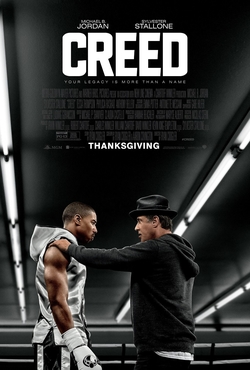 There’s a very special place in my heart for Rocky (1976) and I choose those words very carefully. The reason being, subsequent films lost the appeal of the original and I simultaneously lost interest in the franchise. Perhaps it’s because, after Sylvester Stallone’s breakthrough film, the series lost much of its unassuming charm. It was no longer an underdog story. It no longer felt as personal and intimate.
 Sophie Scholl: The Final Days is a film that people need to see or at the very least people need to know the story being told. For those who don’t know, Sophie Scholl was a twenty-something college student. That’s not altogether extraordinary. But her circumstances and what she did in the midst of them were remarkable.
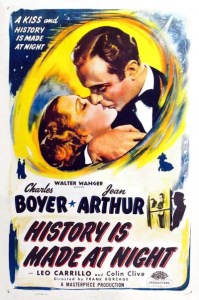 History is Made at Night molds love into the grandest of pursuits and it wouldn’t be altogether wrong in that assertion because for humanity it is one of the most euphoric, confounding, beautiful entities known to mankind. I have no qualms with saying that whatsoever.
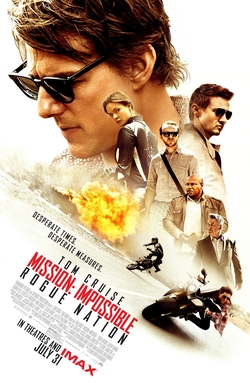 n the last decade or so arguably the greatest action/spy/thriller franchises have been Jason Bourne, James Bond, and Mission Impossible. To their credit, each series has crafted several passable films fortified by a few real stalwarts of the spy thriller genre. Although many of these series thrive on gadgetry, set pieces, and a cynical tone more at home in the modern millennium, one thing that set some of the better films apart were interesting female characters.
 Early on, when she is growing up, it seems very easy to read Stella (Barbara Stanwyck). She is a young woman born into a humble background with a family that could at best be called earthy. Still, Stella wants to know what it feels like to live in the lap of luxury. She wants a more refined life and it’s easy for all the cynics to assume she’s making eyes at the handsome mill executive Stephen Dallas (John Boles) for what he can give her.
 You could say that Fritz Lang was fascinated, even preoccupied with issues of justice. M, Fury, and You Only Live Once all take a particular interest in crime in relation to systems of justice while still functioning as tense thrillers. Although Fury was his first film across the pond in Hollywood, Lang maintained his fine form in a potent debut.
 Our introduction to The Mortal Storm feels rather flat. Bright and bland in more ways than one as we become accustomed to our main storyline. Professor Viktor Roth (Frank Morgan) is held in high regard all throughout the community as a prominent lecturer at the local university and beloved by his colleagues and family. The year is 1933 and the Bavarian Alps are still a merry and gay place to live. That’s our understanding early on as the Professor celebrates his 60th birthday with much fanfare and receives a commemorative memento from his class.
