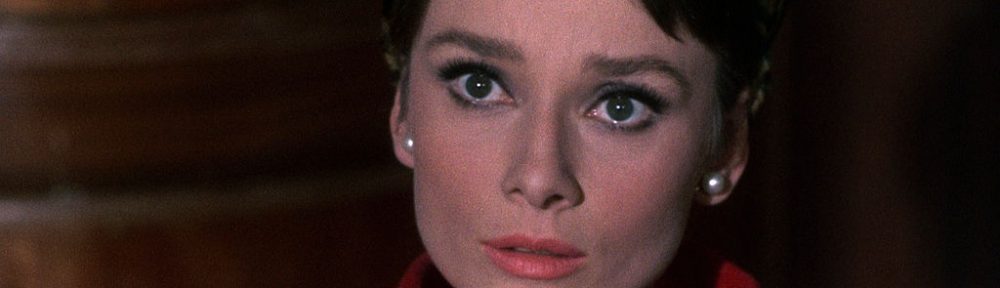

 Its title suggests that this film might be something like Lubitsch’s Heaven can Wait but The Devil and Miss Jones could easily hold the title as the original version of Undercover Boss. Although its main function is on the romantic and comic planes, it also has a bit of a social message behind it that signals for change.
Setting the stage, the wonderfully memorable Charles Coburn is none other than the 6th richest man in the world and he is also a hopelessly cranky curmudgeon. A comic Mr. Potter if you will. He’s also a finicky eater only indulging in graham crackers and constantly calling upon his longsuffering servant (S.Z. Sakall). He’s always got something to gripe about.
At the moment, the workers at the department store franchise he holds ownership of are decrying his policies and the benefits he gives workers. They’re pretty bad but he really doesn’t care. All he cares about is that his name is being slandered and he’s looking to hire a detective to find the conspirators. However, not finding a suitable candidate, he resolves to join the floor staff in the shoe department himself so he can act as a mole and undermine any plans they have against him. He’ll beat them out his own game. He’s “a real Benedict Arnold in Sheep’s Clothing” as they say.
Soon he is befriended by the kindly Ms. Ellis who swears by her tuna fish popovers and it takes a moment but he is disarmed by her generosity. The plucky Ms. Mary Jones (Jean Arthur) also takes him under her wing in a way, looking out for him amidst the cruel world of customer service. He isn’t much good at it anyway — selling slippers that is. Edmund Gwenn in a rather subdued role as the snooty store manager tells him as much.
And it’s Mary who unwittingly introduces him to the inner workings of all things store-related. Including the fact that her beau is the infamous Joe O’Brien (Robert Cummings) a recently fired store employee who is working his hardest to rage against the accepted order by organizing a labor union to protect his fellow working class friends.
But it’s not all serious, hardly. Among other things, the foursome takes a lively day trip. One can only imagine Coney Island or some such hot spot with crowded beaches that look more like sardine tins and bustling avenues with kids running hither and thither. In these moments it becomes obvious that there’s a bit of a comical culture war being waged, perfectly summated by the moment some of his new colleagues dilute his fine wine with soda pop to kill the peculiar taste. And despite, their simple ways, they grow on Mr. Merrick, while at the same time his naivete about real life, gains their sympathy. He seems fairly helpless without them. A rambunctious trip to the police station ensues because he gets lost like a little kid.
Of course, there’s the expected turn of events. It must happen. Mr. Merrick is slowly becoming redeemed, falling for Ms. Ellis and gaining the trust of both Mary and Joe. But Mary happens across something that puts everything in jeopardy. And it could be melodramatic but Arthur knows how to adeptly play the comedy even in these moments. Most notably, when she’s summing up the courage to clock her deceptive colleague over the head with a hay maker courtesy of the season’s latest model of footwear.
The final crusade for unionization leads to utter bedlam with the higher ups and it has a trickle-down effect on everyone else. Mary and Joe lead the charge emphatically but with this inside look at the corrupt inner workings of his leadership, Mr. Merrick is aghast and willfully joins the rebellion. It’s comic absurdity and all the main players do the film justice making their happy ending all the more deserved. Sam Wood might not be noted as a director of raging comedies (true, he worked with the Marx Brothers) but he does well enough with The Devil and Ms. Jones to make it a delightful trifle even now. Thanks be that Jean Arthur and Charles Coburn were paired once more in More the Merrier. They’re gold together.
4/5 Stars
 They Drive by Night is a surprisingly engrossing picture and I only mention it for its obvious relation to High Sierra. It came out a year earlier, helmed by Raoul Walsh starring George Raft, Ann Sheridan, Ida Lupino and, of course, Humphrey Bogart. The important fact is that if Walsh had gotten his way, he would have cast Raft again as Hollywood’s perennial tough-guy leading man.
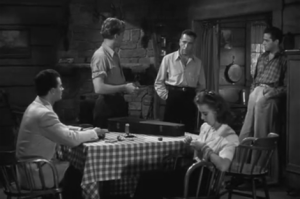 He’s not about to lose his nerves or take his eyes off the objective but the two young bucks he’s thrown in with (Alan Curtis and Arthur Kennedy) carry the tough guy bravado well but there hardly as experienced as him. He’s not too happy about the girl (Ida Lupino) they have hanging around either because she’s an obvious liability. In his experience, women squawk too much. The man on the inside (Cornel Wilde) is even worse, a spineless hotel clerk with even less nerve.
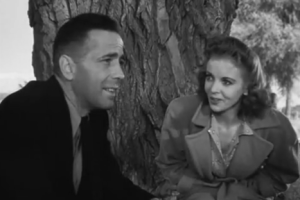 In an unassuming act of charity, Roy has a doctor friend take a look at Velma and ultimately pays for the surgery that heals her ailment completely. Still, if the story ended there it would be a happy ending but with the heist in the works, Roy is not so lucky. He pulls off the job and makes his getaway but with most any cinematic criminal activity in Hollywood’s Golden Age there must be repercussions. After all, that’s what keeps things interesting and it’s true that Roy and Marie are able to lay low for a time but soon the word is out and the gangster is a wanted man.
 The film opens with a dead end drifter being ushered off a bus in the little every town of Walton, wedged somewhere between LA and SF. Although in actuality it was shot partially on location in Orange, California, serving up a perfect representation of quaint Middle America. You can almost hear Paul Simon singing from the future (Got off a greyhound to look for America) as Dana Andrews gets off the bus. Except he winds up at Pop’s instead. There he sizes up the town and gets his first eyeful of the alluring waitress Stella (Linda Darnell).
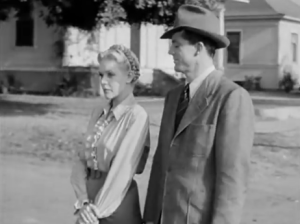 Being blessed with a certain amount of charm, Stanton strikes up a relationship with the untouchable gal, the churchgoer, the book reader, the generally good human being, June. He knows how to pull her out of her shell. Catering to her necessity to get out and live life (All the things you look down on are the things that make up life. Little things, like a game of bowling..or a swim at night, or a dance, a kiss, stuff that bubbles). It works and she begins to be swayed. Conveniently she also has a great deal of money. The outcome seems obvious and yet the story twists in unexpected ways.
 Fallen Angel undoubtedly gets a bad rap because it does not reach the rapturous, beguiling heights of Laura (1944) from the year prior, but it deserves to be seen in its own light. It’s true that both films are murder mysteries but while Fallen Angel isn’t all that interesting in that regard it has a surprisingly sharp script in other ways. Preminger works through his story with a certain dynamic assurance and like its predecessor, it’s the characters that are by far the most fascinating. Laura was a superior mystery, character study, etc., but Fallen Angel gleams brightly thanks in part to its classical chiaroscuro cinematography and an engaging menagerie of locals including Charles Bickford, Percy Kilbride, Bruce Cabot, and John Carradine.
 In his noted Crisis of Confidence Speech, incumbent president Jimmy Carter urged America that they were at a turning point in history: The path that leads to fragmentation and self-interest, down that road lies a mistaken idea of freedom. It is a certain route to failure.
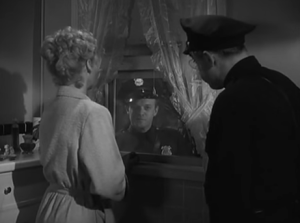 The whole thing turned on a freak accident. You’ve got to believe that Susan.
 If you know what you want in life be sure of it and you can’t miss. I found that out early. ~ Lawrence Tierney as Sam Wilde
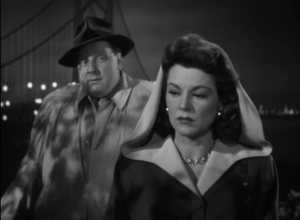 However, evil always looks to catch up with the guilty party and a private investigator is poking around in all the places he can to find the culprit behind an egregious crime. Walter Slezak’s Albert Arnett is a witty sleazeball with the lowest scruples imaginable when money is concerned. But he also happens to be decent at his occupation bringing him to San Francisco in pursuit of answers.
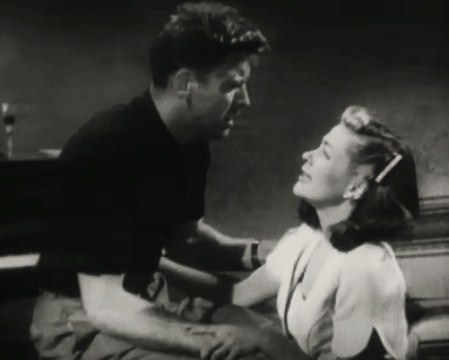 Aesthetically, Robert Siodmak’s roots in German Expressionism are crucial to the formation of the film-noir world as we know it today and Criss Cross has to be one of the most diverting additions to his repertoire. Once more he’s paired with his star from The Killers (1946) Burt Lancaster with another raging score from Miklos Rozsa and yet again there is a heist involved.
 This was yet another pleasant surprise. Just when I think I’ve finally washed by hands of superhero movies the cineplexes are blessed by two pictures like Wonder Woman and then Spiderman: Homecoming. And they couldn’t be more different. Still, as much as Wonder Woman was invested in its heroine, you get the sense that the crew behind this film care some about Peter Parker too.
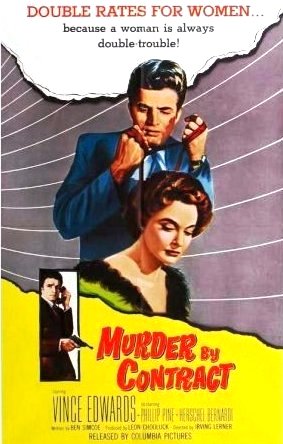 Every once and awhile when you dig through the treasure trove of cinema which includes the B film you can wade through the refuse and come upon something truly special — elevating itself from all the lesser offerings of the past decades. Murder by Contract is such a film.
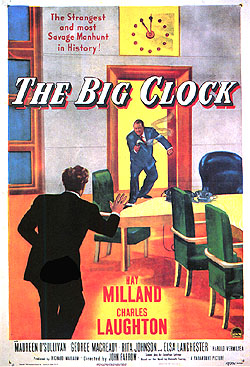 With its rather dreary title aside, The Big Clock is actually an enjoyable thriller that works like well-oiled clockwork. It’s true that oftentimes the most relatable noir heroes are not the hardboiled detectives, although they might be tougher and grittier, it’s the hapless everymen who we can more easily empathize with. Bogart, Powell, and Mitchum are great but sometimes it’s equally enjoyable to have someone who doesn’t quite fit the elusive parameters that we unwittingly draw up for film-noir. Ray Milland is a handsome actor and he was at home in both screwball comedies (Easy Living) and biting drama (The Lost Weekend). He’s not quite what you would describe as a prototypical noir hero.
