Unknown's avatar

About 4 Star Films

I am a film critic and historian preserving a love of good movies. Check out my blog, 4 Star Films, and follow me on Twitter @FourStarFilmFan or Letterboxd. Thank you for reading!

Lust For Gold (1949): Biography of a Deathtrap

lust for gold 1.png

The movie opens with a score raging with dramatic tones fit for a title like Lust For Gold. The resulting narrative ploy is not a new one either, suggesting the details of this “unusual situation” were substantiated by historical records and legends of Arizona. It’s meant to provide this obvious sense of real-world ethos.

We find ourselves at Superstition Mountain. A severe voice, strung out with the same dramatic intensity of the music, paints a wild portrait of this horrible place — Satan’s art gallery in the rocks.

His name is Barry Storm (William Prince) — a real figure — and yet for all intent and purposes, conveniently fictionalized to narrate the tale for us. Unfortunately, the man isn’t able to pull off the voiceover like a Bogart or Mitchum. It lacks the hardboiled lip or the inherent sense of noir malaise.

It’s possible to mention noir, even when our prerequisites are more aligned with a western because we are dealing in terms of avarice and the greed found within the human heart. These are the building blocks for any respectful film noir of old where humanity runs amok with murder and deceit. In any regard, this is what the hope is.

Still, Prince comes off lacking from the outset because as an actor he’s a bit of an innocuous blank slate. Even if this is purely how he is meant to function, there’s nothing impressionable about him. But it also falls partially to the anatomy of a faulty story with dialogue practically regurgitated to us to get our pulses going. The effect is moot.

Still, this version of Barry Storm does serve one solitary purpose if only to toss us headlong into this narrative. He’s part unwitting victim, part fresh-faced raconteur and adventurer looking to dig up the famed treasure once belonging to his distant relation “The Dutchman.”

He crosses any number of people among them cocksure explorer Floyd Buckley (Hayden Rorke) and two fellows who act as deputies under the local sheriff: a relaxed fellow named Covin (Will Geer) and the quietly observant Walter (Jay Silverheels).

To their credit, they are the first people who bring some color of any sort to the picture. However, even Geer’s own recounting of the Dutchman legend — delivered in a casual, conversational manner — isn’t able to rescue the dialogue which feels just as straightforward and didactic as before.

The real meat and potatoes of the movie come with a substantial flashback moving the action to 1880, and it couldn’t come soon enough. Because it’s at this juncture we are reminded Lust for Gold has a surprisingly stellar cast, and the best patches of drama come with the biggest stars. Regrettably, they’re never able to assemble in full force spread out across the years as they are.

Glenn Ford is reteamed with Edgar Buchannan from Framed, although this time they’re a bit more dubious and hardened, following the trail of a mythical gold mine. If you were to fashion an approximate reference point the movie, functions a bit like Treasure of The Sierra Madre Lite with everyone gold crazy and opportunistic.

Glenn Ford is not much of a Dutchman. His accent or lack thereof could have used some sharpening if he was really looking to commit, but perhaps, more importantly, he shows himself capable of some vindictive fury before the days of The Big Heat. This is what the story must rely on.

He’s the man who ends up the victor with all the gold to himself and no one else left alive to challenge him when he checks his wealth in the nearest outpost. The whole town’s envious of his cache, and the news spreads rather hilariously through the local gossips. They want a piece of the action because it’s far too much wealth for one man, but he clings to its with near-violent secrecy. There’s not one male or female who’s going to get him to open up about it.

That doesn’t keep them from trying. The best bet is one Julia Thomas (Ida Lupino), an educated woman who nevertheless runs the local mercantile and doesn’t have much hope of going anywhere. Her useless husband (Gig Young), hasn’t done anything to alleviate their situation. So, much to his chagrin, she’s prepared to slip off her wedding ring and weasel her way into the miner’s affections.

It works quite well and as with any of these old star vehicles, the movie is most enjoyable when we have Ford and Lupino together. They were both seasoned performers in all the grungy corners of the genre pictures even if this is a hybrid. But what sets them apart is how they both have desires. Sometimes opposing, sometimes convening, and their feelings for one another do become complicated.

To her credit, Lupino plays a far more nuanced part than a simple seductress. She is tired of her life. She is tired of her husband. She’s ready to take things into her own hands, and yet there is some amount of feeling dwelling within her. The Dutchman, for one, is happy to find someone to hold, someone to share his native tongue with. It’s the human face slipped in with the pervading moments of avarice.

Because in the end all parties are pitted against each other in a testy competition for the goods — both in the past and present — weathering seismic avalanches and showdowns up in the rock crevices. Some of these moments, especially crammed within the middle of the story have the pulse of compelling action. It’s only a shame this hybrid noir offering must be so hampered by its own plotting device.

3/5 Stars

I Love Trouble (1948): Enter Roy Huggins

800px-I_Love_Trouble_(1948)_1.jpg

In the days before they were known as film noir, the melodramas of the 1940s have such evocative titles, which now verge on the edge of camp. One can imagine the plethora of quality bumper stickers noir aficionados could plaster on their jalopies and Cadillacs. Try these on for size: Kiss Me Deadly, Murder My Sweet, Touch of Evil, In a Lonely Place. You get the idea.

I’ve become so conditioned to hearing them — to referencing the actors and directors within their frames — sometimes it’s easy to forget how strange they sound. Well, you might as well add I Love Trouble to the bunch. Of course, it means absolutely nothing, but that’s the point isn’t it, stirring something volatile up within the viewer. It suggests a vivid mental picture and this is somehow equally important.

I Love Trouble is generally forgotten today, as is its director-producer, S. Sylvan Simon, and yet the movie is a swirling labyrinth capable of going toe to toe with anything Marlowe ever faced. The dividing line between tautness and plot holes or logic and absurdity almost ceases to have credence. If this will fluster you as a viewer — enrage your logical sensibilities — it’s best to look somewhere else for your two-bit entertainment.

The true pleasures come with getting swept up in the world with all its additions and misdirects courtesy of a neverending conveyor belt of characters riffing off snappy bits of repartee. It fills in fairly nicely between the confrontations and beatings, smoothing over any major issues.

The opening is simple. A man is trailing a woman and she confronts him. It turns out he’s a private eye in the service of one Ralph Johnston (Tom Powers), looking for the other man’s missing wife. So it’s a bit of a Vertigo set-up, except the woman he’s already confronted wasn’t her. Well, it was, but it might as well be somebody else. Because she altogether vanishes from the film.

What follows is as expected. Stuart Bailey (Franchot Tone) makes the rounds being his charming, slightly ingratiating self in order to dig up the facts at the behest of his employer. Tone is a dashing lead prone to cheekiness, but this is most of the fun, played in the vein of the best P.I. work of Bogart and Dick Powell if not quite as iconic.

No matter. It leads him to run around Los Angeles and take a venture to Portland, Oregon. The facts start unveiling themselves bit by bit but never in a clear, definitive manner. There must always be further convolutions and new moments of sheer incomprehensibility.

In a picture like this, every single Dick and Jane might as well have a motive and the cast just keeps on coming. To explain how all the characters fit together siphons off a bit of the gamesmanship of the drama. It’s safe to say John Ireland is a brooding heavy. Steven Gerray, though graced with pleasant features, somehow contrives them, along with his accent, into something vaguely sinister.

Then, there’s the bald-pated cafe staffer Buffin (Sid Tomack), who knew the dame in a former life when she was making the move to Los Angeles. There’s a Chauffeur who seems oddly invested in the whereabouts of Mrs. Johnston and his enigmatic employer Mrs. John Vega Cabrillo (Janis Carter).

Others might be far more astute than me, but upon a single viewing, it’s easy to admit never quite getting one’s head straight on which woman is which, and maybe that’s the point of it all. Regardless, it hardly seems necessary to avail oneself of the details.

Janet Blair has near-top billing and drifts into the story almost haphazardly on the pretense of finding her sister. Janis Carter is suitably brooding with that imperious allure of hers. Adele Jergens is just another pretty face who jousts with our protagonist because what would such a picture be without her? Finally, there’s Glenda Farrell with a bit of lovable fortitude as Hazel Bixby, Bailey’s hapless secretary.

It actually proves to be a fine asset, having so many female characters all of varying degrees of importance, but all getting a piece of the pie. Because granted some are more cursory than others, and yet I’m even disposed to remember the two waitresses (Karen X Gaylord and Roseanne Murray) at the sidewalk cafe. It says something about the characterizations, where the bit players get to leave an impression.

These whirling, abstruse brands of noir often work best on this level. I Love Trouble can generously be christened a lesser disciple of The Big Sleep but nevertheless a decent go at the gumshoe genre. Because it has the peculiarities — small pockets of interest — placed within the befuddling signposts of the plot.

Roy Huggins would be remembered much later for his work in television for shows like 77 Sunset Strip, coincidentally starring Efrem Zimbalist, Jr. as Stuart Bailey, and then The Rockford Files, which owes more than a small debt to the hardboiled procedurals of the olden days with a James Garner twist for the 70s.

The final moments of I Love Trouble could play out as a male dreamscape. Our protagonist is surrounded by a myriad of women, and yet since the threat is abated, he’s taken in by the calls of matrimony. For being such an obscure entry in the noir canon, it’s quite a surprising piece of diversion if you go for such things.

3.5/5 Stars

The Locket (1946): Laraine Day and Splintering Psychology

the locket 1.png

“Have you ever done this before?” – Robert Mitchum as Norman Clyde

“No. I’ve never stolen anything in my life.” – Laraine Day as Nancy

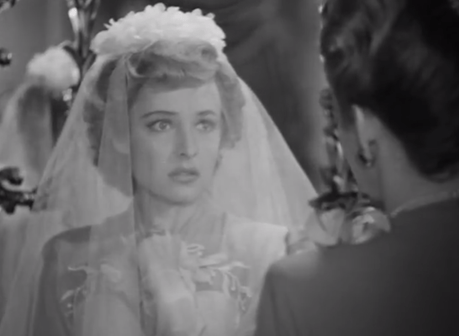
We’re met by a wedding with all the trimmings. It’s a well-to-do affair and Laraine Day looks quite dazzling. Her groom (Gene Raymond) is high on his good fortune in finding such a spectacular bride, introducing her to the aunts and uncles. Taken at face value, it’s a suitable development for a drawing-room comedy.

However, the perceptive viewer will note the presence of two very telling names in the opening credits. They are director John Brahm (The Lodger & Hangover Square) along with Nicholas Musuraca, who helped define the shadowy compositions of RKO Studios all throughout the 40s.

If anything, it suggests that what we’ve seen up to this point is mere pretense, an ebullient calm before the storm, until the past comes crashing through to wreak havoc. Sure enough, a grim, well-spoken psychiatrist (Brian Aherne) walks into the man’s study for a quick word. He’s comes bearing some doom to drop on the deliriously happy groom’s lap.

It lends the injection of noir sentiment we’ve been waiting for with bated breath supplying a flashback to go with it. Dr. Harry Blair recounts how, in his distant more jovial past, he wound up crashing bicycles with Nancy (Day). From then on, they were all but destined to be lovers.

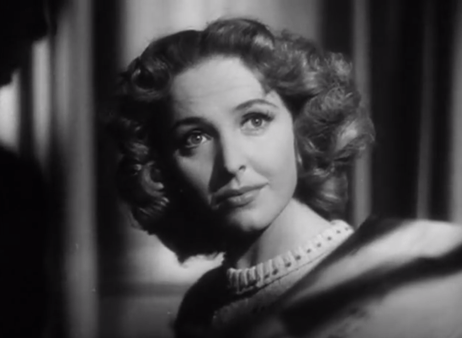
It’s in these interludes where it becomes apparent Nancy is not altogether unlike Laura (Gene Tierney’s character) not because of her mental state so much as this perfectly bewitching aura she is allowed to cast over the frames of the film. Although this makes it sound too manicured; still, it’s true between the scoring, photography, and Day’s own vibrant, fully alluring performance, it’s difficult not to be swayed by the captivating energy.

The cute buoyancy carrying the opening replicates itself in this prelude as Nancy and the good doctor plan a deliriously happy future together. And yet screenwriter Sheridan Gibney brazenly interrupts the gaiety again. This time it is none other than Robert Mitchum interrupting the matrimonial euphoria with his own futile warning — yet another couched deja vu moment to follow the others.

As a matter of fact, in a spectacular move, The Locket utilizes no less than three couched flashbacks involving the three men, layered on top of one another, and each making the same mistakes as the man before them, caught in a deadly cycle…I wouldn’t recommend it to budding screenwriters, but here the commitment’s rather impressive.

This is one of the first great Mitchum performances establishing his world-wearied embodiment of the noir hero — smoking a cigarette, coat upturned in the falling snow — and he’s only one of the supporting figureheads.

the locket 3

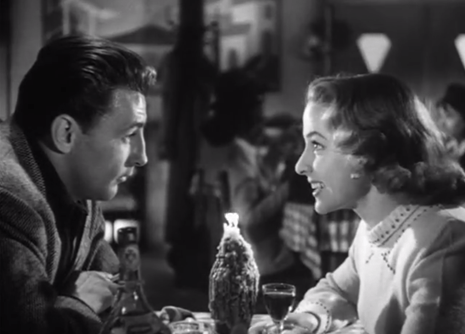
Norman Clyde (Mitchum) is a fairly successful artist, not a sterling success but talented and proud; he’s not about to take flak from anyone. After he gets off on the wrong foot with a woman in his studio, he starts obsessing over the girl. He can’t get her out of his head and wouldn’t you know, she’s holed up in the same Italian restaurant he always frequents. They make amends, of course, and their resulting relationship looks eerily similar to the glimpses we’ve already been granted. Nancy’s deliriously happy with her man of choice. There are no visible blemishes in sight.

However, the fragments and wisps of story keep on fading into one another. It’s so exquisitely rendered by the camera, in particular, when Mitchum and Day go into the recesses of their own personal recollections.

The striking similarities with Laura or even Woman in the Window become even more obvious due to the art angle — the enchanting portrait of a woman — because it does create this meta sense of the woman in the art both painted and photographed on celluloid. It allows her this sense of being out of body — almost otherworldly to the viewer — existing in this illusory state we must come to terms with. In one sense, it’s hard to shake the image of her. Nancy is no different.

One turning point is at a fancy dinner party. Shots ring out and Clyde sees Nancy exit a room frantically. A maid comes, and they hide down the hallway slinking away. Musuruca captures the instantaneous decisions with a fluid ease. We don’t realize it at the time, but it’s a crucial moment teasing out a bit more about Nancy — about her past secrets — and who she is as a person.

My only qualm is with Mitchum’s exit. It serves the story best, otherwise, he would continue to steal the show, but it certainly does not gel with his soon-to-be cultivated image. Alas, it is what it is.

Next, remember the doctor also had his chance with Nancy. They go off to England to stay at a stately manor to get away from the intensity of the Blitz. However, the accusations he’s heard about his wife start to burrow into his mind, so much so he can’t get rid of them.

Surely the rumors can’t be true! Because Nancy is so warm and genial, hardly begrudging or showing malice toward any of her past suitors. In fact, she downplays every interaction she’s ever had with any of them. As if they were nothing. As if the man she’s with right now is the only man she’s ever loved.

the locket 5

The extraordinary nature of Day’s character is how she is not a femme fatale — at least not in the traditional sense. They’re always two-timing and deceitful. With Nancy, at face value, you get none of that, and yet it’s not to say she’s not without her flaws. In a strange way, there are two sides to her as well.

She calls others out for being guarded, cynical, and suspicious, and yet she can often be found doubting everyone else’s motives even as she’s retroactively smoothing over her own. There’s the convenient compartmentalization of all the prior relationships into their individual spaces and the projecting of her issues onto others. It hints at something. Still, there must be a tipping point.

Then, we’re whipped back to the present. The wedding march in all its pomp becomes offset and infiltrated by the tinkling of a music box, like the memories slowly overtaking Nancy’s psyche. These latter moments turn into some of the most evocative sequences of montage in recent memory with all the weight of memory, trauma, and guilt flooding Nancy in the form of all the people she knew. There is no space to keep them apart and so they crush her under the weight, her mind totally fractured as she tumbles to the floor.

In a fit of irony, I couldn’t help but continually be reminded of the contemporary Frank Sinatra tune, “Nancy (With the Laughing Face).” It’s a startling juxtaposition with what we’ve just witnessed, a swelling, unnerving, engrossing exhibition in splintering psychology.

Laraine Day gives an absolutely unforgettable performance — easily the best of her career — and Brahm continues his run of moody melodramas with suffocating environs. The Locket doesn’t hold an instant appeal from the outside looking in, but once you get inside, it’s a bedeviling little gem of a film — as tantalizing as the trinkets so enrapturing to Nancy. There’s one major difference: we can enjoy this one without debilitating consequences.

4/5 Stars

The Undercover Man (1949): Starring Glenn Ford

the undercover man 1.png

The Undercover Man gives off an early vibe akin to Anthony Mann’s T-Men thanks to a disclaimer reading something like this: Behind the big headlines are stories of ordinary men and women with extraordinary courage. This picture concerns one of those men.

However, the title is a bit of a misnomer. It is about government treasury agents, among them Frank Warren (Glenn Ford) and George Pappas (James Whitmore in his debut), but the real “undercover man” is the stoolie looking to spill the dope on the Big Fella — a stylized, faceless take on Al Capone.

As is, Joseph H. Lewis’s picture plays as more of an updated (or out of date) riff on the Untouchables and the Capone story. Instead of guns constantly blazing, they’re trying to get to the mob kingpin another way: His taxes. Thus, it relies on the persistence of our protagonists to see the story to completion.

While the characterizations are worthwhile — Glenn Ford was born to play these types of stalwart tough guy roles — the documentary-styled drama itself feels mostly stodgy and uninspired. Especially given the B mavericks pedigree for punchy and rather unnerving material with unconventional flourishes, it’s rather disappointing to admit this one feels quite run-of-the-mill — at least content-wise.

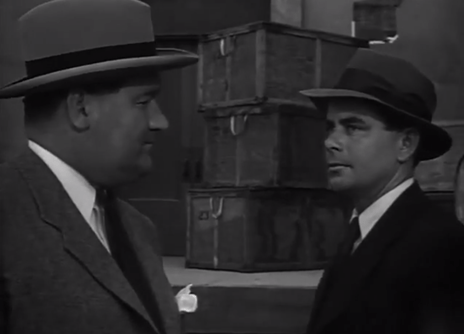
Lewis still develops engaging scenes from the outset including the botched rendezvous staged at the train station. After their crackerjack chomping canary gets it unceremoniously, Warren finds himself back at square one and growing testy by the minute. Because the mob has a hand in everything, and they’re leaning on everyone.

It goes beyond police corruption or paying everyone off. Even as they run around looking for leads, there are tight lips all around, because everyone’s scared. They have good reason to be. They’re suspicious of authority as much as organized crime. What assurance do they have their lives will not be impinged upon.

One of the movie’s most inspired figures is lawyer Edward O’Rourke (Barry Kelley), a paunchy, beady-eyed besuited fellow who oozes sliminess from his generally sociable demeanor.

While he’s not an out-and-out criminal type, he also has no morals. One foot is planted in the good citizens league and the other gladly helps the gangsters keep their stranglehold by wheedling out of all signs of trouble. He seems to also glean great delight by watching the government agents stand down, their hands normally tied. He always has a smart response for them.

Still, Frank’s latest mark, Salvatore Rocco (Anthony Carus) — an AWOL husband who is currently courting a showgirl (Kay Medford) — looks like his exorbitant greed might provide a bite. He’s willing to squawk for adequate compensation. Purely a two-bit opportunist. There’s only one way to deal with him…It’s one of the movie’s best set pieces as the informant races off, his daughter, Warren, and his assailants, all sprinting after him through the midday crowds.

For Warren, the job always gets in the way of his lovely marriage, and he and his wife (Nina Foch) especially suffer for it. They barely get any time together, and the rest of the time he’s crammed in a lousy hotel room bickering with his colleagues. Back amid the tranquility of his home life, he resolves to give up the whole business because the safety of his wife seems like too high a price to pay in the pursuit of justice. The visual dichotomy between the two spheres is especially evident due to Burnett Guffey’s characteristically stark photography

His decision could be the unceremonious end to the picture, but we get a bit more — a nighttime visit. It is the obvious entreaty for him to consider the crusade. He’s not one to see evil and run away with his tail between his legs.

None of this is much of a surprise as we cycle through yet another bookkeeper, this time one Sydney Gordon (Leo Penn), who is on the lam with his newlywed wife (Patricia Barry). The question is whether or not they can convince him to talk and if he does agree, can they even protect him?

The last few minutes are worth seeing through to the end specifically because the action falls on the two most compelling characters in the whole story. For the first time, our hero has O’Rourke on the back foot forcing his hand. He really is the crucial piece since, with the sides drawn up between the good guys and bad, he plays like the wild card. The ending is a foregone conclusion, although, on the road, there are several tense confrontations predating the more action-dominated days of Robert Stack’s Untouchables.

3/5 Stars

So Dark The Night (1946): Directed by Joseph H. Lewis

so dark the night.png

So Dark The Night is certainly a bit of an oddity functioning as Columbia’s attempt at a Parisian noir before being transplanted to the idyllic countryside. Linguistically, it’s a strange hybrid dominated by English with stylistic sprinkles of Francés.

Regardless, of any discrepancies, Joseph H. Lewis follows up My Name is Julia Ross with an equally befuddling little drama imbued with his usual elan, freely breaking through the obvious economy.

Some of the compositions are mesmerizing. For one thing, they often draw a moderate amount of attention to their near artificiality. Take, for instance, a tracking shot moving from outdoors to an interior in one fell swoop. There’s no fourth wall — real or invisible — to get in the way of the camera. You also cannot help but notice the very deliberate and rather ostentatious zooms applied throughout to emphasize character entrances.

He has other visual tricks too. One is reminded of the moment he introduces his taciturn heroine (Micheline Cheirel) hanging up laundry on the line. All we see are her hands as they move down the line as her head pops shyly over the articles of clothing. Then, noticing a fancy car rolling into the courtyard, she’s busy eyeing all the shiny grills and nobs with a mesmerized fascination. She barely notices the famed policeman Henri Cassin (Steven Geray ), nearly stars truck, staring at her before he’s snapped out of his own reverie. 

Most, if not all of the cast, are all but forgotten today. They are a homely crew, stilted at times, while still obliging with their own brand of blushing charm. Given the prerequisites, Geray, a chipper Austrian-American with a vaguely foreign accent, earns center stage. The quibbling mother and father are played by a pair of veterans, Eugene Borden and Ann Codee. However, it is the relationship between Gerray and Cheirel giving rise to this slightly perturbing psychology — not to mention a budding romantic connection.

The ensuing courtship feels like Lewis’s own artificial Hollywood-style take on the scenery of a Renoir movie, and it’s not meant to be as dismissive as it might sound. Because given his greatest successes — all low budget crowd-pleasers — he somehow makes the aesthetic work in his favor.

However, a threat is injected into the storyline with the jealous, near-suicidal obsession of Leon (Paul Marion), the young man she’s been pledged to be married to since adolescence. He makes it very clear he doesn’t want to see his Nanette with Cassin anymore and his brute jagged edges effectively disrupt the picture’s cornballish jauntiness with high-strung dramatics. It’s one extreme replaced with a new normal on the complete opposite side of the spectrum.

However, it remains to be seen where our sights are set. We can do little more than observe what is before us. Surely, someone will make a move amid the prevailing uneasiness. There must be an initiation of rising action. Soon enough we get an answer.

Nanette goes missing and all roads point to Leon. A crime of passion perhaps? Except he’s nowhere to be seen either. The local commissioner calls on the expertise of Mr. Cassin and the kindly man sets aside his vacation to investigate the troubling events.

Driven by empirical evidence, he nabs his man — under quite extraordinary circumstances — and his conclusions verge on the ludicrous. Given the little amount of time it’s allotted, So Dark The Night quickly spirals from a mere mystery to a tension-infused time bomb of anticipation. It’s a matter of knowing what’s coming: Murder!

Still, far from stripping the movie of its intensity, it lends the finale a Hitchcockian flair even in its abrupt denouement around the shattered shards of a window frame. This intermittent sense of spectacle is what will draw some viewers to an otherwise unassuming noir, which might be easily forgotten. Couched between the evocative cinematography of Burnett Guffey and this odd strain of psychological extrapolation, we have a most peculiar curio on our hands.

The one implausibility I cannot forgive is how Gerray could have been such a prolific policeman for such a long time and yet he nor anyone else picked up on the imminent warning signs swirling around. Otherwise, it’s idiosyncratic enough to enjoy without too much reservation.

3/5 Stars

Framed (1947): Janis Carter and Glenn Ford

framed.png

The opening scene of Framed is glorious. It’s the epitome of why these old B pictures have some much to offer audiences often bloated on cinematic glut. A runaway truck careens down a mountain road as the driver sweats it out trying to punch the breaks uselessly. Entering a busy town, he’s forced to make a wild maneuver the other way. Finally, his big rig dies down lazily plunking a truck backing out into the street.

In the ensuing altercation, we learn so much about the tightwad trucking foreman who won’t pay for the damages and our nameless hero who took the gig for the cash and proceeds to hand over what’s coming to him to pay for the damages of the victim (Edgar Buchanan).

We’re finally allowed a breather as he steps into the nearby La Paloma cafe and conveniently our whole story is laid out before us in tantalizing fashion. We’re on board for the ride.

The internal logic of the film noir malaise means everything that can be stacked up against a man will be. Mike Lambert’s not a bad fellow; he seems as honest and frank as any. True, he drinks too much, he’s prone to gambling, but he’s been given the bum steer. In a matter of minutes, he sits down at the bar only to get whisked off to court and sentenced for his misdeeds. In this regard, the crook of the law seems to be bent in favor of the unscrupulous.

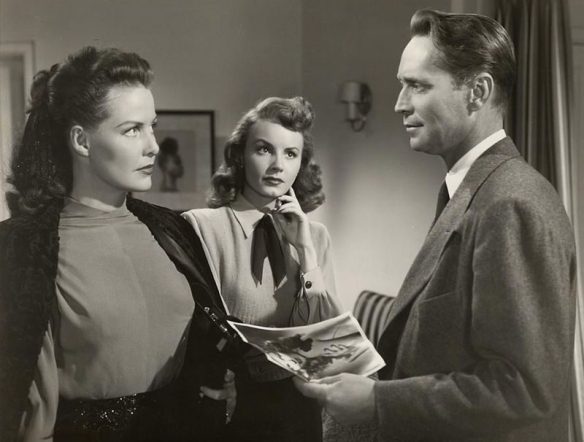
However, this is only a starting point or a pretense because Lambert is pulled out of the clink by the dubious generosity of an amorous barmaid bombshell with a pair of bewitching eyes (Janis Carter). Why she would stick her neck out for a stranger and dish out $50 remains to be seen.

Except everyone in a picture like this has an angle to work. Soon enough, we find out hers. Because she and an accomplice are looking for the perfect stooge, the perfect patsy, the perfect man to be framed.

The movie is built out of what feels like a chainlink of romantic entanglements with people strung out in a line between one another. Glenn Ford is romanced by Janis Carter to keep him in town and at the same time oblivious. Her real accomplice is a man named Steve Price who has married into money; his wife remains utterly disillusioned with their loveless marriage.

It’s also a contrived story where everything is conveniently interconnected — at least in cinematic terms — so all the relationships, even if they feel circumstantial, fit together in just the right ways to tease out the dramatic situation.

Consider for a moment how Ford, a field engineer, reconnects with the straggly man Cunningham (Buchannan) who happens to be a miner in need of a loan. Then, consider how the man in charge of loans at the bank is none other than Mr. Price. It’s his refusal that keeps Lambert waiting around town looking for a break as Paula continues to run interference and ingratiate herself to him.

However, the logic never feels like a lynchpin because it all builds up to this near fatalistic helplessness of a man unknowingly walking straight into a trap. Perceptive viewers might recognize that this ensuing sense of powerlessness setting in is not unlike North by Northwest or more aptly Double Indemnity — albeit from the inside out.

It gives us a different kind of investment as this time our “hero” is not the perpetrator but the victim. Because Lambert, without his knowledge, is being dragged into a grand conspiracy rife with larceny, murder, and any number of things. Although in the end, the trap is sprung in a different manner than expected.

janice carter framed

Do you think Ford’s about to get bested in his own picture? Not likely. As a steady leading man, he’s always easy to like even when he verges on the brusque in a movie like this. The film sets him up as a straight arrow, hampered by his vices though he might be. Edgar Buchanan falls into his role like most any of them with a familiar aplomb. Whether the part is stretching at all seems beside the point, because he manages to fill it so seamlessly.

Another character veteran, Art Smith, has a bit part as the none too solicitous, solitaire-playing hotel clerk. If nothing else, while I always enjoy coming upon him in a picture, his presence is a marker of the times. He too, like so many others, would become a casualty of the McCarthy-era witch hunts, self-imposed by Hollywood. Included in this unfortunate club was the film’s screenwriter Ben Maddow as well as actress Karen Morley.

Barry Sullivan is unscrupulous but fairly straitlaced and bland while end-to-end Janis Carter is yet again the unsung hero of the picture. Like all the great conniving dames of yesteryear,  beauty is an asset with which to utterly bewitch the opposite sex. She uses it handily.

We watch her continually modulating between moments of self-serving opportunism and genuine showings of sentiment and fear — as the fairer sex — with the movie somehow casting her in this duplicitous mold of both temptress and victim.

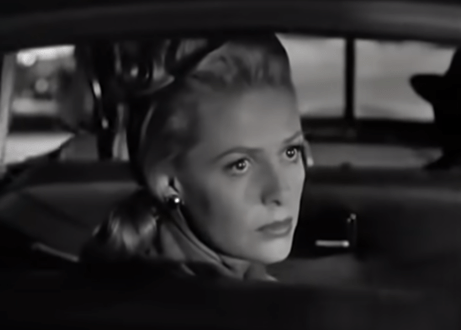
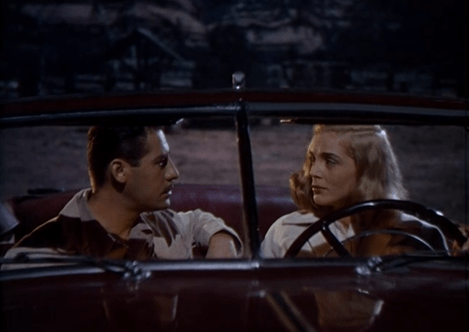
There you have the heart and soul of the femme fatale right there. So when Paula looks out the back of that car and Mike drops his cigarette butt in disgust, we are borne into the tension. It’s the tension between doing the right thing and getting to have someone like that look at you that way. In such a disquieting world, there might be right or wrong, but somehow, it doesn’t make it any more agreeable on the other side. Frankly, it stinks.

3.5/5 Stars

Night Editor (1946) and a Femme Fatale Worse Than Blood Poisoning

night editor 1.png

This expedient B noir opens with the most peculiar of narrative devices. The only guess is it’s somehow tied to the film’s roots in serial radio drama. A pack of poker-playing, late-night newshounds is chewing the fat, and out of their nattering comes the story of Tony Cochrane (William Gargan).

The real film starts in a kid’s bedroom. A father talks cops and robbers with his son along with roller skates and going fishing like they used to. The boy watches his “Pops” leave before entreating him to “Keep his nose clean.”

Gargan, a gruff, marble-mouthed type, fits the role of the nondescript detective on a beat, though he doesn’t seem like much of a family man. It’s not the only seemingly incongruity around him. His doting, overly angelic wife (Ms. Jeff Donnell), a typical noir staple, wants to see more of him because she loves him dearly. Expectedly, her very presence sets up an uneasy queasiness in the cinemagoer’s stomach. Where there exists a “noir angel” her foil must be nearby — a woman whose feet go down to death.

Sure enough, he’s knee-deep in a clandestine affair. He’s got another dame and what a vicious creature of deception she is. We’ve jumped from the seat of matrimony and domestic tranquility to the front seat of his car stashed away in some neglected place all the more convenient for necking.

Janis Carter doesn’t get too many kudos these days, even in noir circles, but a picture like Night Editor alone is worthy of hoisting her out of the shadows into a place of ill-repute. It’s more than scummy and vindictive enough to put her on the map.

Granted, a lot of the film’s dialogue is clunky but some of it is also too delicious to pass up in terms of noir-speak. One opening exchange between the surreptitious lovers springs to mind, “You’re just no good for me. We both add up to zero. You’re worse than blood poisoning.”

This is fertile ground for something devastating to happen. It turns out we don’t have to wait around because Cochrane and Jill happen to witness a nighttime murder just across the road. It’s the kind of punchy jolt movies like this thrive on.

Instantly the dramatic situation is placed before us conveniently because our protagonist is a cop — bound by some sense of morals and justice — he’s not completely ditched his conscience yet.

Still, her pleading words ring in his ears as he sticks out his gun to apprehend the killer. It’ll be a scandal. His wife and kid will suffer. And the worst part: She’s right. So the assailant runs off into the night and for the rest of the picture, he’s got to wrestle with his decision. It’s a petrifying situation to be in, and it’s got him all twisted up inside.

Soon enough, news of the murder breaks, and the game is afoot as Tony is called on to help with the case (and simultaneously looks to cover his tracks). Ole (Paul E. Burns) is his amiable colleague at the police station. Although he’s more Swedish and less imposing, he shares some overlapping qualities with Barton Keyes, employing the same kind of uncanny intuition. But, best of all, he’s a loyal friend.

Meanwhile, the newshounds sitting around the station wait with bated breath for scraps. There’s a feeling the case could blow wide open at any moment. It just so happens his gal is a smarmy high society gal where it counts, married to an affluent old boy. She’s a trophy wife out on the prowl. However, she’s also got another budding love affair — no doubt one of many — but this one is of particular importance.

night editor 2.png

A flattering man named Loring who works at the local bank holds the keys to the case. Except only Tony and Jill know it. When she effectively provides him a fictitious alibi, Tony is all but forced to live a lie and eat his words as she walks off with another man. Truth is often created by the people who speak first, and there’s no way for him to easily refute her.

What’s before him now is an extension of his living nightmare. No girl, no relief, and, of course, his home life has suffered due to his increasing aloofness. There’s little recourse but to take a stand against Julia — with one final stab at veracity — lest the lies eat him alive.

It’s a foregone conclusion. Their final confrontation cannot end well. There’s too much between them, of both malice and consequence, for any decision to resolve itself smoothly. And so in the kitchen, sure enough, he lets her know he’s going to talk — someone’s going to believe him.

Her reaction is almost cute. The doe eyes. The breathiness. The physical touch and the vaguely genuine show of sincerity. There’s an inkling that it might be true. But even if it is, she’s predisposed toward the violence and self-preservation all but ingrained in her very nature.

He staggers out into the living room in a near surreal state, with a new resolve and calm cast over him. Still, we’ve witnessed something bearing irrevocable consequences. Out on the doorstep stand the authorities. Surely, this is the end…Then, he crumples to the ground — the dramatic exclamation point to a sordid procedural.

Sadly this quagmire of fatalism was not to be, all but remedied by the same hokey radio program hoax as the editors tie the story up with an ending fit for an innocuous Disney movie. Until this final false step of pollyannaism, Night Editor more than earns its keep as a wanton noir gem. You just have to look between the bylines.

3.5/5 Stars


Boris Karloff at RKO: Body Snatcher, Isle of The Dead, Bedlam

In our current climate, it almost seems like an oxymoron to have a shoestring-budget period piece, but many of Val Lewton’s best movies were founded on this formula.

His three-film partnership was beneficial for all parties involved and we would like to consider how he was able to fashion Karloff into a new kind of monster.

In honor of the spooky season, let’s talk about Karloff at RKO:

The Body Snatcher (1945)

Robert Louis Stevenson is an auspicious literary figure for anyone raised up on fiction like Dr. Jeykll, Treasure Island, or Kidnapped. Much of this might have come from any of their many adaptations. Thus, it seems fitting to know his work also received the Val Lewton treatment in the form of his short story, “The Body Snatcher.”

The year is 1831 in Edinburgh, Scotland, a place I reminisce about fondly. This is not a world of invading pod people; it’s actually a much more arcane movie with a gothic mood and style of the Victorian Age.

There’s a practicality to its premise and the origin of the horror. Not unlike Doctor Frankenstein, these doctors need cadavers — specimens on which to learn their trade. They have a bit of a silent agreement with a local coachman named Gray (his eminence, Boris Karloff), who is also a “Resurrection Man” by night. In other words, he digs up dead bodies.

The Doctor Macfarlane (Henry Daniell) has an empty callousness in his face and voice, like a shell of a former man who probably had ideals in his youth. Now he’s shackled by something, either vocational obsessions or something far more sinister.

The character dynamics are mostly intriguing as it’s hinted that “Toddy” and Gray shared a slightly sordid past together long before their current business arrangement. The Doctor’s housekeeper is also closer than she appears, chiding him to let the past go and with it the callow boy he’s brought on as his assistant.

Russell Wade is perfect as the naive Fettes, who only sees the altruistic good in their profession and his mentor. The young student vows to a pretty young mother that her invalid daughter might walk again if only the doctor might operate on her. Macfarlane’s less inclined to make such a rash promise.

Because of these clouded histories, much of the movie is about the specters of the past with Gray constantly at the ready to hound the man of reputation. He aims to keep their lucrative partnership going by any means necessary.

One of the film’s most visually arresting scenes is in the dead of night. There’s a haunting street singer done up in a shawl with a small bowl for alms. Her gorgeous brogue pierces through the evening lamplight and the all but silent cobblestone streets as she sings “When Ye Gang Awa Jamie.” Soon even she goes quiet…

Another definitive moment comes later upon entering the cabby’s quarters with the camera turning right into his horse resulting in a genuine jump scare. Bela Lugosi feels almost unrecognizable to me and by that I mean he hardly speaks, mostly slinking about in the periphery of the story. When he finally does speak that’s the giveaway.

Joseph pays a visit to gray with a mind to blackmail, but he’s not half as cunning. They share a drink in the firelight. Karloff’s propped on the table grinning lasciviously as he leans over the oblivious man. Who’s in control of the situation is plainly apparent, and it’s such a stunning composition honoring two of the greatest horror showcases Universal ever had.

Now they are with RKO, certainly older, but Val Lewton pays them his utmost respects. Although Karloff’s the biggest name, this is a new generation of films removed from his earlier persona. Lewton effectively allows him to rebrand himself as a new kind of villain, a new kind of monster to be feared. The extraordinary thing is how it’s hardly makeup or special effects-driven but performative in nature. It’s also chilling.

There’s a jolt of ambiguity into the ending of the movie as the Doctor is haunted by his sins, but Karloff’s just as agonizing. Maybe it’s because he seems to represent past sins reincarnated. I’m curious if contemporary critics hailed it as a return to form for Karloff. Even with the passage of time, it seems to show a startling range I’ve appreciated more with time. He gets to show another side of himself.

4/5 Stars

Isle of The Dead (1945)

Isle of The Dead begins with an unbelievable scenario with no forewarning as Karloff’s General intimates for a disgraced officer to commit suicide in order to maintain the company’s reputation. Minutes later he takes a journalist (Marc Kramer) for an amble through no man’s land in the First Balkans War as if nothing has happened.

There’s something uncanny and manufactured about how this General brings this other man along with him as he goes to visit his wife’s crypt on a nearby deserted island. Just saying it now sounds outlandish. But this is what happens. I’m not saying it’s naturalistic, but that’s hardly the reason for watching this movie. It’s as if we have entered this transitory world that operates outside of our accepted logic.

It is a bit of a surprise because Lewton normally worked very hard to create the baseline world and the logic of his stories, so we might be fully committed as an audience. Although this might be partially lacking in Isle of The Dead, what’s not absent is his signature sense of foreboding atmosphere adding a shroud of horror-worthy darkness to all his pictures. Their eeriness cannot be shaken off easily.

Then, again perhaps I spoke too soon. The story still works in ample amounts of mythology including Vrykolakas: undead, vampire-like creatures that haunt the living. Some believe they have been sent as punishment by the gods, there are pagan rituals to Hermes, prayers are sent up regularly, and belief is a powerful force.

Although the opening premise is suspect, it’s this added context creating the foundation for the rest of the movie as it sends Karloff deeper into this Grecian abyss of darkness and shadow. In no moment is this more clear than the glorious sequence when Ellen Drew walks the hallways at night, candle in hand. It encapsulates the entire movie in a few successive shots of stylized pitch-blackness.

Our protagonist says, “I put my faith in what I can feel and know and see,” and yet his rationality must do war with the steady barrage of wind and shadow. Many of the island’s inhabitants are stricken with the plague. It seems like a silent killer born out of voices calling out from the night and a fleeting apparition in white.

Lewton hasn’t lost his touch in conjuring up such mysterious environs to assault our senses. It’s never about out and out shock value, but this pervasive sense of the inevitable. This must all come to some end. We all die be it from war, plague, or something equally as sinister.

3.5/5 Stars

Bedlam (1946)

It’s curious and rather extraordinary that two of Karloff’s films with RKO were inspired by paintings. Bedlam came out of William Hogarth’s series A Rake’s Progress. It occupies itself with Bethlehem Asylum in 18th century London. Although this is the so-called “Age of Reason,” treatment of the mentally ill is hardly benevolent.

All the “loonies” are kept in their cages like sideshow attractions for the public to gawk at for a tuppence fare. We’re privy to one of its present tragedies: a man falling to his death from the asylum rooftops with a little assistance. If we want to get to the bottom of the callous hell hole, we must look no further than Master George Sims.

There he is: Boris Karloff done up in a wig and the attire of the age. Here’s another joyous occasion to see him take on yet another century of English history through the period lens of Hollywood. It’s a deliciously unctuous performance, and he proves himself just as skeevy as he’s ever been.

He’s called in for a stern talking to — the corpulent Lord Mortimer (Billy House) and his lady protege (Anna Lee) have some words for him. He’s taken mild dissatisfaction on losing some of their entertainment.

Always quick to ingratiate himself and despite having sent Mortimer’s poet to his demise, he vows to put on a frivolous performance to tickle the patron’s fancy. It’s so easy for him to use and degrade his tenants for monetary gain because what worth are they to the world outside?

The moment Anna Lee enters the inner sanctum of the asylum and sees the tenants in their own world she’s momentarily surprised even moved by their fate. Though she tries to mask it on the outside with words and a riding crop, she does harbor pity for them.

It is a perceptive quaker (Richard Fraser) who notices her reaction and rouses her to some form of Christian action. She is more sympathetic than the rest of the idle masses because she is self-made. Without the luxury of personal wealth or power, she knows intuitively how hard it is to find self-preservation in an often heartless world.

In some way, it feels like a call for tolerance and sympathy by reaching into the past to inform the present. Because although it is a story in the guise of 18th-century horror — Karloff’s presence makes sure of that — there is something more to the picture.

Like all Lewton’s work, there’s a deceptive depth and substance to Bedlam that is at one time both intriguing and generally commendable. Because he doesn’t just make entertainment. It entertains, yes, but you can watch the RKO films and there are supplementary thematic interests to them.

Karloff is the standout in all three pictures — no one else comes close — though I am fond of Lee here because she actually has spirit and stands for something. She’s willing to do battle with him. It’s a collision of dueling philosophies.

He snarls that men are not brothers — they are not good and kind — but savages that must be ruled by force and his worldview plays out in how he governs Bedlam. With the saintly quaker speaking into her life, she looks to reform the asylum as she is trapped on the inside vowing not to give in and cave to Sims’s merciless conception of the world.

Karloff obviously relishes his subtle insinuations and well-placed comments to stir pots and get what he wants while pushing back against those who wronged him. Namely, gaining the good graces of Lord Mortimer and spurning the impudent, proud lady.

Is he evil? Not exactly — at least not at first — but he has a steady mean streak which proves to be utterly Machiavellian and maniacal. It’s villainy at its finest because it slinks so easily under the radar of societal convention. He’s despicable and still oddly droll making for a fine antagonist.

4/5 Stars

Noises Off… (1991): From Stage to Screen

`????

In the olden days, a stage production — or shall we say “the theater” — was blessed with a certain cultural cachet not extended to moving pictures. While this dichotomy hasn’t totally eroded, given the directions movies have gone, Noises Off…is buoyed by the stage for another reason.

Rarely have I witnessed something that totally blurs the line between performance and reality in such a self-reflexive manner. Noises Off… began as a highly successful play about a stage production going off the rails due to inadequate rehearsal times and the backstage histrionics of an amorous cast of characters. In other words, the original form fits the function.

Just by merit of the medium of film, it cannot be as intimate as the stage nor is it performance art in quite the same manner, though the director tries to stretch out sequences as long as they will contort to maintain the pace.

But the stage, because it is live, requires actors who are able to keep up with the utter mayhem of the material like trained athletes. Both the controlled and wildly chaotic nature interpolate into one storyline. So you obviously lose some of that instant spontaneity acquired by no other means.

If anyone knows that fact it’s Peter Bogdanovich, an avowed theater aficionado. He doesn’t let the story sag; it’s always zooming along, and it still manages something almost palpable. The trick is not fiddling too much with the concept nor trying to contort it in some grandiloquent way to fit the cinema.

The structure of the story itself is just as crucial in developing this cumulative impact. The Three Act Structure begins with the frantic rehearsal hours before they are set to perform. The long-suffering director (Michael Caine,) who might be on the edge of a nervous breakdown, is running out of time and dealing with temperamental actors asking for motivations or just absent-mindedly showing up late to set. He’s also romancing his leading lady (Nicolette Sheridan). The issues are there for comedic effect, but we have yet to reach impact — that requires a theater full of people.

Next, we follow the show from behind the curtain. The preparations are frantic, actors are missing, and the backstage crew, Julie Haggerty and Mark Linn-Baker, run around like two stage chickens with their heads cut off. It doesn’t change when the performance begins either because the whole story is based on timing — cues and a bustling scenario with slamming doors and traded props. It’s everything we’ve already seen, albeit from the inside out, ignited by male feuds (John Ritter gives Christopher Reeve a bloody nose) and private lover’s quarrels filled with bitter malice.

The show from the cheap seats is the worst (or best) of all as this mounting discontentment disrupts the foregone storyline with all kinds of private barbs and acts of pettiness played out on the stage. The key is how the fictional audience eats it all up because each absurd miscue feels like the next great flashpoint of brilliant comedy. It’s the height of farce.

One of my few reference points is Hellzapoppin’ even as the earlier film was often about the endless possibilities of non sequiturs. What they have in common is this almost Vaudevillian sense of gags and payoffs — where each character has a shtick that can be called upon at any given moment. This isn’t method acting so objects don a different meaning as tokens to carry out gags, and Noises Off… brings them to a fever pitch. Sardines and telephones, flowers and bottles of bourbon. A pickaxe bandied about by all, each carrying varying attentions.

They effectively blend the space where two planes of existence bleed into one because these same tokens are exchanged and traded both on the stage and behind the stage. I joined the fictional audience in laughter even more heartily because, in many ways, we get to see the interworking of the beast in all its comedic underpinnings.

If we’re observant and stay with them, we see where the story has gone off the rails and the “unscripted” chaos that exerts itself on the storyline. The so-called “audience” snarks at each snafu because it’s a hilarious faux pas — the pratfalls are even better because they are “real.” And here you have the joy of Noises Off where it brings out these double-meanings or double realities and fictions.

We get the benefit of being both an audience member and a backstage observer. Because we know that all this world’s a stage and all these people merely players. Like Hamlet, it is only a play within a play, but it broaches into our space with startling verve and a raucous sense of precision.

I am reminded of the security guard; he sits in the wings watching all the madness quizzically with a raised eyebrow. What a crucial insert he proves to be because comedy is so much about the reactions to the stimuli. He reminds us how zany all this fracas is just in case we need a point of reference — a threshold to ground us back in reality.

Since they cannot help being in a cinematic space, the cast is tip-top including some faces I’m often quick to forget about and others who I miss dearly. John Ritter and Christopher Reeve are a joy even if this is hardly remembered compared to their greatest exploits. Carol Burnett is a comedic jewel. Bless her. Marilu Henner brings back all those fine memories of Taxi reruns. Denholm Elliot had such a long and illustrious career, but a doddering part such as this made me appreciate him even more.

The transition from stage to screen would not work as whole-heartedly without its cast, and I love them all in spite of their doltishness. In fact, it’s probably precisely because of this the movie works. Noises Off...would have been quite the sight to behold on stage, but it doesn’t lose all its merits in the hands of Bogdanovich, who makes it still a worthwhile and totally jocular experience. My primary barometer was my own personal reservoir of laughter. I couldn’t control it, and that speaks volumes enough for me.

3.5/5 Stars

Targets (1968): Orlok Makes You Scream

targets karloff bogdanovich

The story goes Peter Bogdanovich met Roger Corman sitting in a screening of Bay of Angels (1963). What came out of that was an apprenticeship of sorts on Wild Angels (1966) in the Corman Film School where Bogdanovich did everything you could possibly imagine from script doctoring to location scouting etc. What he got for his troubles was hands-on experience but also the chance to direct his first feature…with a couple stipulations.

Corman gave him full control of his own movie as long as he reused some footage from an earlier Boris Karloff picture, The Terror, as well as utilizing the veteran actor’s two days of service he still owed Corman. There you have the birth of Targets, which manages to amount to far more than these contrived beginnings might suggest.

Because Bogdanovich found a way to make these haphazard pieces work — where it feels more like a meditation than a constraint — and the movie uses this to its advantage. It’s like a ’60s rendition of the poverty row pictures of the ’40s where necessity is truly the mother of invention. Sometimes you get a diamond in the rough.

The irony is while the big pictures were giving us entertainment that would become emblematic of the times like The Graduate, Bonnie & Clyde, or 2001: A Space Odyssey, it’s a movie like Targets placing us in the times themselves. In this way, it functions more like contemporary television.

What we are provided is a very concrete sense of Reseda in 67-68. There’s the “Real” Don Steele on the radio waves. Otto Preminger’s Anatomy of a Murder is a modern classic featured as the Saturday night movie on channel 7. A family sits down in the evening together to take in Joey Bishop and sidekick Regis Philbin. And, of course, there are drive-ins.

If this sets the stage and places Bobby Thompson (No, not the ballplayer) in a vaguely familiar landscape, the movie itself comes flowing out of the persona Boris Karloff provides free of charge.

Looking at them without context, there are so many elements of Targets that might leave one mystified. For instance, this white-haired gent with the booming voice. If you put the movie in a time capsule, those who find it probably wouldn’t know this is Boris Karloff. His Byron Orlok isn’t an anagram, but it feels like one.

Although he’s an acclaimed name, he’s resigned himself to a sorry fate. In his own words, “I’m an antique, out of date — an anachronism. The world belongs to the young. Make way for them, let them have it.” He might have seen Bonnie and Clyde and The Graduate too.

Still, he’s continually in dialogue with his own personal legacy and very aware of it. Just as he watches a version of himself on TV. His character recalls a tagline from his heyday, “The Marx Brothers make you laugh. Garbo makes you swoon. Orlok makes you scream.” It’s all part of this persona closely mirroring Karloff’s past.

Likewise, Sammy — that guy’s not much of an actor — although it changes instantly if we know this is Bogdanovich himself. The young screenwriter walks in, sees the TV, and right on the nose says, “It’s Criminal Code. I saw this at the Museum of Modern Art. Howard Hawks directed this. He really knows how to tell a story.”

They become these dueling pawns, partly fiction, partly reality, as Orlok bemoans the fact he has become high camp; he can hardly play it straight anymore, and Sammy coaxes him that the role is something he can do (Targets?). Otherwise, he’ll offer it to Vincent Price.

It’s as if the director beat Orson Welles to the punch with this kind of intratextual dialogue between the medium and its real-life players. Surely history helped out because Targets was just his beginning followed by a whole slew of classics, albeit disrupted and undermined by his own turbulence and troubles replicating his most supernal successes. All these things and more are what make Targets so riveting when it has little right to be.

Targets Boris Karloff and Nancy Hseuh

Orlok’s secretary Jenny (Nancy Hsueh in a charming role) is romantically attached to Sammy, but also has a staunch devotion to Orlok. She doesn’t want the old man to just give up and she feels slighted when he lashes out at her — one of the few people who genuinely cares for his well-being.

He’s ready to turn his back on it all only to reluctantly agree to make a public appearance. He’s fallen to the low of the Drive-in Theater circuit, living off the residual celebrity of his waning fame.

Meanwhile, Bobby has gone through his daily paces. He seems like an All-American boy. He’s married but lives with his parents. He likes guns, and he’s been taught a healthy (or unhealthy) sense of competition. There’s an underlying angst supplied by this deceptively pristine life.

He stakes out on top of an oil well, brown bag and a soda pop in hand, as he sets up overlooking the freeway, prepared to pick some people off. Bogdanovich captures the evolving sequence with a Sam Fuller sense of grab-and-go photography, on the side of the freeway, with a brazen even outlandish sense of drama.

This is real traffic and real places and the director plucks out his shots from these pregnant moments of simulated reality. Between the crosshairs, gunshots, swerving vehicles, and flailing bodies. The scene evokes the Texas tower shooting of 1966 where killing becomes this indiscriminate force of violence.

The Sniper (1952), from over a decade prior, was a picture that, no matter its effectiveness, was meant to elicit a social response. Stanley Kramer’s movies can be strongly identified by this sense of responsibility toward the viewer. Targets hardly feels like a political statement of any kind, but its themes are no less intriguing — probably because it never feels like it’s preaching something. Instead, it allows us to consider its various digressions and still be gripped.

The drive-in finale actually does a solid job of reconciling the two disparate story strands. Bogdanovich had watched enough Hitchcock, heck, he’d interviewed the Master of Suspense, and put in this position calling for such a set piece, he seems to know intuitively what he has to do.

What’s more, it signaled the young director’s ascension as a New Hollywood darling. What’s so striking is how it marries Classic Hollywood with the contemporary climate and does it with a startling sense of command. If you needed a picture to try and sum up Bogdanovich himself, then there is no better lodestone.

He wants to revel in the days of Karloff and Hawks of old — when violence meant monsters and gangsters — and yet he brings it into the 60s. Because violence still existed but in a different form. In the age of social tumult and assassinations, the landscape of the 1960s feels a lot more futile and incomprehensible.

And the images make you shutter as we are implicated in this alongside a killer even as we sympathize with Orlok trying to bow out gracefully. I’m not sure which aspect is more telling. The power is that we need not pick between them. We are presented horror in its various forms, old versus new, and the person who unifies them so evocatively for us is Peter Bogdanovich. It’s quite a stunning feat of ingenuity.

4/5 Stars