Unknown's avatar

About 4 Star Films

I am a film critic and historian preserving a love of good movies. Check out my blog, 4 Star Films, and follow me on Twitter @FourStarFilmFan or Letterboxd. Thank you for reading!

The Hunchback of Notre Dame (1939) and The Rejected Cornerstone

hunchback of notre dame 1.png

Note: This post was originally written a few days after the Notre Dame fire on April 15th, 2019.

“All over France, in every city there stand cathedrals like this one, triumphant monuments of the past. They tower over the homes of our people like mighty guardians keeping alive the invincible faith of the Christian. Every arch, every column, every statue is a carved leaf out of our history.” Harry Davenport as King Louis XI

We often say rather facetiously “if only these walls could talk,” referring to those hallowed grounds imbued with a history of ages gone by, whether they reach near or far into the past. However, it’s necessary to acknowledge, with a place such as Notre Dame de Paris, such an aphorism rings true. It takes on resonant meaning the very week I write this.

Only a few days ago, this landmark of Paris (even preceding the Eiffel Tower) was stricken by a fire that ran rampant, even torching the iconic central spire, so it came crashing down. Given the context and what this structure stands for — even as implied by this film — it’s no small surprise the news grieved, not simply an entire nation, but the world-at-large.

It is part of the reason I desired to watch this adaptation of Victor Hugo’s lauded novel. It is a bit of a memorial, but also an act of solidarity. We need to remember these bastions of history because they carry so much worthwhile beauty within their walls.

As would have it, this version of the famed Parisian tale begins with the two pillars of authority within the film, rather like the towers of Notre Dame themselves, albeit one good and the other bad. The King (Harry Davenport) is an open-minded, bright-eyed, and benevolent ruler, who looks at advancements like the printing press with only mild amusement. He sees no harm in the people being able to spread ideas.

Meanwhile, his counterpart, Frollo (Cedrick Hardwicke), is the local judge and arbiter over the judiciary system. To mollify the production codes, he was changed from a religious hypocrite to a far more secular villain as his behavior is unbecoming a man of the cloth. Disney’s version would rectify this minor faux pas and yet for the longest time, this tweak went all but unnoticed. The sentiments and moral dilemmas work out much the same. Likewise, there’s little doubting the weight of the other performances in this version.

Like A Tale of Two Cities or Les Mis, both adapted throughout 1930s Hollywood, the palpable world being constructed here is one of the most prominent assets of this period piece. I might be biased toward these literary adaptations of old. They certainly are not faithful distillations of their sources; they’re processed through the mechanism of Classic Hollywood, and yet they never cease to amaze me for the sheer amount of atmospheric world they are able to put forth on the screen.

Case and point is the initial street carnival hitting the audience full-on with a flurry of activity, gaiety, and sensory overload in every area. There’s no way to fill in all the background with computerized extras or scenery and so what you see is what you get, from a mass of cackling gypsies to a giant hog on a spit, to all sorts of medieval dunces, stilt walkers, and street performers milling about. It’s true such an arena would be impeccable for a fruit fight and of course, there is one.

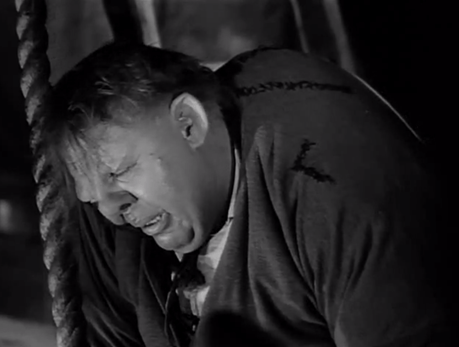
Charles Laughton’s turn as Quasimoto is a highpoint in an illustrious career because he willfully commits to the character in all of his outward ugliness and ostracization, while still endowing him with the tenderness dwelling therein.

At times, it’s a near-silent performance, which makes it potentially more compelling — so much is left to posture and expressions — the nuances of behavior speak volumes on his behalf. Dialogue might turn into a crutch for other characters, but very rarely for him. His words — when used at all — are chosen carefully and, thus, there is a meaning behind them well worth considering.
hunchback of notre dame 2.png

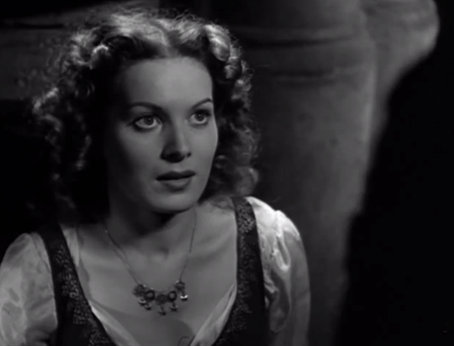
For the day and age, there is arguably no better lass to portray Esmerelda than Maureen O’Hara as youthful, fiery, and supernally beautiful as she is in this very moment. Whether she’s a convincing gypsy or not, it’s easy enough to believe she draws the admiring eye of nearly every mortal man.

So many eligible (and not-so-eligible) men vie for the affections of the striking, thoughtful, free-spirit. She is smitten with the handsome Captain of the Guards: Phoebus (Alan Marshal), who returns her favor. Another is the scorned poet Pierre Gringoire played by an initially unrecognizable Edmond O’Brien, due to the utter youthfulness of his features. Quasimoto harbors his own crush on the pretty maiden, though his is not the only unrequited love.

Frollo, as painted here, is no Disney villain — harsh and corrupt he may be — but there is something buried there to feel sorry for, even as his soul is twisted up inside. Tormented by an infatuation he cannot seem to quell. Ultimately, what remains is his vindictive polemic against gypsies and anyone he deems to be pernicious to his self-prescribed social order.

Here the narratives channels this undercurrent of Aryan prejudice sweeping the European landscape, this heavy strain of anti-Semitism that, ironically, brought a plethora of talent to Hollywood. The parallels are too overt not to comment upon. It goes to show how the social climate of the time cannot be completely stripped away from material which, while timeless, also has striking ties to the contemporary moment.

On a lighter note, what better vagabond to be King of the Hall of Miracles than the one and only Thomas Mitchell. His year would yield performances in a staggering five movies — all of them classics — including Gone with The Wind, Mr. Smith Goes to Washington, Stagecoach, Only Angels Have Wings, and this film. What’s more astounding is the consideration that this might be the weakest of all the pictures he was in! One can never discount the inevitable shadings of color he adds to any ensemble.

The Christ metaphors with Quasimoto are also blatantly clear. He is crowned the King of the people on the first day only to be ridiculed and mocked in the streets the next. He is the scapegoat, taking on all the people’s ills, grievances, and malevolence upon his head. Even the local leaders, as reflected by Frollo, look down on him in disdain and utter malice. So Quasimoto’s station in life is that of a total outcast, despised by everyone.

There is only one person who has pity on him and it is, of course, Esmerelda. She showed it before, marrying the poet to save him from hanging, and this is her second act of goodness. The wheels of justice can be harsh as she is sentenced to death, based on the bleatings of a Goat named Aristotle. The logic used is not unlike Witches sinking during the Salem trials. Her innocence falls on deaf ears, not as a result of clanging bells, but instead, even harder hearts.

There is a certain gravitas with the young vision of beauty bowed on the steps of the cathedral, awaiting her execution. The lingering essence is very much the same to Dreyer’s seminal masterwork Joan of Arc. A figure of such common virtue subjected to such ignominy on such a grand scale.

Again, the Christ-like metaphors cannot be dismissed as yet another martyr is unfairly condemned for practicing witchcraft. It takes one outcast rescuing another and seeking sanctuary in the house of God. While it might seem an antiquated tradition, there is something impactful about the walls of Notre Dame being a haven to all who call upon them.

The final storming of the cathedral feels more like disastrous miscommunication than a fully-fledged battle for the heart and soul of the city. Regardless, the last note is a resounding one. Esmeralda ends up with her man. Quasimoto, in a realistic development, despite being a hero, is forced to carry on his life of solitude.

Though he might not be the most prominent feature of Notre Dame de Paris, it becomes increasingly apparent he is like the cornerstone  — a vital component — mostly rejected and forgotten by the world around him. He did everything out of deep, abiding love, requited or not. Much the same might be said of Laughton’s performance. The whole story falls apart without him, and he handles each scene with his usual aplomb and theatrical bearing.

4/5 Stars
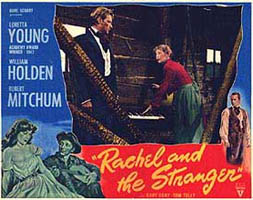
Rachel and The Stranger (1948): Indentured Servitude

Rats1948.jpg

It becomes increasingly apparent Rachel and The Stranger is a peculiar little movie that would have no place in the modern landscape, and not simply because RKO Studios is no longer in existence. It feels like arguably its biggest star is off-screen more than he is on because he was probably in at least 3 or 4 other pictures in the same year. When he is present, Robert Mitchum is altogether jolly, always wandering into the story with a guitar and a song on his lips. It’s a slightly different iteration from the rogues he was normally called on to play.

Likewise, Loretta Young isn’t her usual effervescent self for much of the picture, made to look dowdy and such given the territory. These were the days before William Holden had yet to come into his own. He’s likable in a movie like Apartment for Peggy or here, but he hardly has a voice. There’s nothing alive and individual about what he brings to the part. He’s not yet a romantic heartthrob, and he doesn’t have his cultivated sardonic edge.

Mind you, this is all before even getting to the content at hand. Because Rachel and the Stranger concerns itself with subject matter we rarely see in Hollywood either. Rather than consider it a conventional western, it’s more of a colonial drama taking on the pioneering days of the likes of Natty Bumppo and Davy Crockett.

David Harvey has just recently lost his wife to some unnamed affliction. He is comforted by his friend Jim Fairways (Robert Mitchum), even as he is faced with the seemingly insurmountable task of raising his son Davy (Gary Gray) on the harsh frontier with some element of civility. To uphold the honor of his wife, he wants to impress upon his boy the importance of education, praying before meals, and such puritan disciplines.

He knows he’s not able to give that to the boy as his own know-how is all of a practical nature, about survival out in the wilderness. The only alternative is to find a suitable wife, not a romantic partner, but someone who might be a good maternal presence in young Davy’s life. As women are scarce, David finds the next best thing in Rachel.

Historically, a step before mail order brides, there was something even more archaic: indentured servitude. This is before the chattel system of African slaves when we had another outdated economy where people were beholden to others to pay off debts. So David buys Rachel from her previous owner so she might fulfill the surrogate duties of a mother. One is led to inquire, “How in the world did Loretta Young end up as a bondservant, to begin with?”

As is all but expected, there are growing pains and chafing as Davy is unimpressed by this woman who is a shadow of his own mother’s talents when it comes to shooting guns and running a home. But Rachel has a will to prove herself and earn their undying respect.

In one sense, it’s somewhat difficult to consider the story soberly, given how the material plays, but Susan is quite a unique character, especially given the time period. Her point of view is typically unsung and unseen. For this reason alone it’s a slightly intriguing proposition.

The story escalates gradually with the men fighting over the woman. Because when Jim drifts back into their lives as he has a habit of doing, he brings out contours of Rachel they have never seen before. Her love of music. The warmth of her smile. Laughter. David realizes she is far more than he gave her credit for, and her personality is far more intricate than he ever took the time to find out.

However, this ensuing battle also asks the implicit question, “What say does she have in the turn of events?” If we wanted to use more current vernacular, we would need to consider her personal agency. Thankfully, she has a moment to fight back with a few choice words of her own.

The tone changes completely with a midnight onslaught by some militant Shawnee out on the warpath. It’s as if we needed a reminder of where our setting is. It does its job by blowing over the tiff between friends. It puts it in perspective so they can start afresh with a new lease on life. For once, this is a story about husband and wife — not man and servant.

True, there’s a controversial verse from the Old Book that reads, “Wives submit to your husbands” just as another entreats, “slaves obey your masters.” But there is a flip side to these seemingly patriarchal ordinances. Husbands are told to love their wives, “just as Christ loved the church and gave himself up for her.” Then, “masters, treat your slaves in the same way. Do not threaten them, since you know that he who is both their Master and yours is in heaven, and there is no favoritism with him.”

David Harvey without question is familiar with these words. This movie is an exercise of him grappling with the weight of their meaning, just as it is a tale of a woman coming into her own as a beautiful, unique individual.

3/5 Stars

Man With The Gun (1955): Mitchum The Town Tamer

man with the gun 1.png“I’ve seen some cures worse than the disease.” – The Doctor
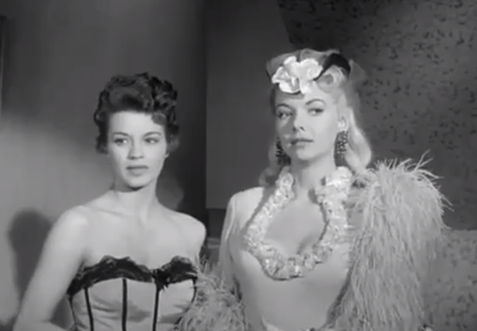
The opening images set the tone. It’s a sleepy afternoon in a ghost town. There’s a boy with his dog. The dog starts yipping at the boots of a rider cutting through town. In an instance, the merciless killer shoots the dog and rides on unperturbed. His calling card: a shoulder holster.

His actions go off, quite literally, like a gunshot, causing the whole town to stir and jump to their windowsills. It’s got them frightened and for the time being, there is no obvious solution aside from letting the gunman ride on unimpeded as he prowls around for a local tyrant named Holman.

Almost in response, soon another man (Robert Mitchum) rides into town, and in his wake is a much different temperament. He too makes his living with a gun — not a marshall or a sheriff — he’s what they call a town tamer. He works fast and demands free reign, such that he’s not beholden to anyone. It’s how he manages to run the scum out of town and make towns worth living in. However, to get the result, it requires fighting fire with fire.

Of course, it takes us a while to learn all about him. For a time, he’s just a new face making the rounds, getting to know people, including the town’s blacksmith Saul Atkins (Emile Meyer), while still keeping a tight lid on his private affairs.

In this regard, Man With the Gun is reminiscent of Wichita in how it unfolds. Although, in all manners of atmosphere, plotting, and thematic ideas, the other picture comes out looking far superior. This says more to the praise of the Tourneur-directed Joel McCrea vehicle because Man with The Gun still manages a few moments of flair in its own right.

What it might be best at is building up its regimen of stock characters and places. The world itself is just another riff on noted conventions, but familiar faces make it a quality retreading all the same.

Emile Meyer is their undisputed leader — a workhorse character actor in all sorts of roles — but I also relish spotting the likes of Jay Adler, Claude Akins, even the ever-reliable Burt Mustin manning the hotel desk. And of course, the scarred visage of Leo Gordon deserves to be canonized with the mugs of Jack Palance, Lee Van Cleef, Jack Elam, and a handful of others in the pantheon of 1950s reprobates.

Meanwhile, the local Palace, a steamy saloon run by a Frenchman (Ted de Corsia), gets their supply of pretty girls from a local businesswoman (Jan Sterling). She’s precisely the kind of strait-laced personality you wouldn’t expect to get tied up in such a line of work. It takes all kinds. Her troop includes the noticeably ditzy Barbara Lawrence, while a youthful Angie Dickinson gets to play one of her wry counterparts.

man with the gun 2.png

This is all mere groundwork for the coming attractions. Tollinger is installed, rather uneasily, by the local governing body, headed by the disgruntled blacksmith and family man. Somehow, despite his self-assured nature and a pedigree to back it up, the town is wary about backing one man against many. They aren’t so much assuaged as they are perturbed when he proceeds to gun down two thugs, who are running with the unseen, iron-fisted Holman.

Likewise, a proud young man, who’s been threatened, isn’t about to let someone else fight his battles, even as his plucky bride-to-be, Stella (Karen Sharpe), asks Mr. Tollinger to keep an eye on her beau. His response is noncommital, and Jeff Castle gets taken, after already sustaining a gunshot wound.

The dynamic is not explored fully, aside from a community dance, but there is a hint of some romantic feelings between the older man and Stella. Because he is a full-fledged man, even as her fiancee is still growing into his masculinity. She still sees him as the boy she’s grown up with. As added complication, Tollinger also happens to have another relationship in his past to seek out…

That, and cleaning up the streets, keep him more than busy. He gets the young upstart back in a trade while enforcing new gun laws, then a curfew. The townsfolk are grumbling all the time at these infractions on their rights. Another very calculated decision follows when Tollinger sets fire to the local house of sin, coaxing the enraged proprietor, Frenchy Lescaux (De Corsia), to come at him. This comes to fruition even as his relationship with an old flame starts nipping into previous unresolved wounds.

All the while a bright-eyed out-of-towner is watching everything with interest, twiddling his thumbs, capped with a bowler and feet propped up lazily. His demeanor is far from hostile, but there’s something disconcerting behind his eyes. He’s too amiable to not have an angle.

True enough, Holman is looking for retaliation on the town tamer, exploiting his greatest weakness, which seems to be a gentlemanly soft-spot for women. After all, this feels like one of the prerequisites for a western hero. They must be a strong and silent type with a dose of gallantry. So it is with Mitchum.

The cathartic shootout comes, and the town is “tamed” as much as it can be. Man with The Gun settles into a happy ending that arrives all too easily. For all the interesting dilemmas, either implied or touched on, there is not enough attention given to make them fully resonant.

It becomes necessary to take this sagebrusher at face value, and given all the alternatives, it’s probably too derivative to be a totally gratifying experience. However, if you’re fond of Robert Mitchum, give it a watch because he is and always will be the same. It’s to his credit. I will stop short of saying he makes a mediocre picture great, but without him, there’s not any point of connection.

3/5 Stars

River of No Return (1954): Mitchum and Monroe on a Raft

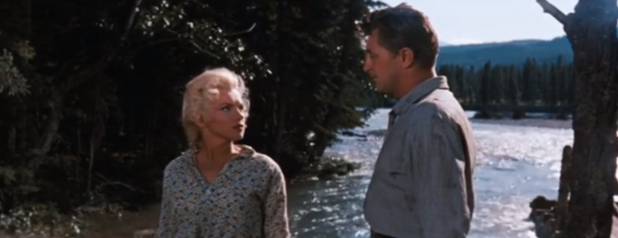
River of No Return is nearly worthwhile for its opening visuals alone. There stands the vestige of American manhood: Robert Mitchum — unmistakably himself — felling a tree. He pulls off his hat, wipes his brow, and we get a gorgeous lingering look at his backyard. God’s majesty as far as the eye can see. Absolutely breathtaking stuff.

After the credits roll, he enters a much livelier environment. It feels a bit like a choreographed dance as his horse trots through the hubbub of the newly erected tent town bitten by the gold bug. At the hitching posts, he has a momentary encounter with a padre, the religious man came for the Indians but having a look around, he notes he might need to stay in the hell-hole for the sake of the white men.

It’s in such a seedy world Matt Calder (Mitchum) goes hunting for the son he doesn’t know. He finds him soon enough, shielding the young boy (Tommy Rettig) from some drunken bullies. The only question remains, where is Marilyn Monroe? She’s set up in one of the many tents as a bright and sultry nightclub singer, who cuts through the otherwise scuzzy world around her with a voice and a guitar. Her silver dollar song catches the eye of Calder, but their real connection is little Mark. She’s been keeping an eye on him and doesn’t take kindly to the father’s malfeasance.

If this were the only interaction, we wouldn’t have a movie. Because they are on divergent paths. Matt and Mark look to build up a life for themselves in a cabin, living off the land earning an honest day’s wage far away from the lottery-style debauchery of the gold mines.

Meanwhile, Kay’s man, an unreliable big-stakes gambler (Rory Calhoun) has a promising claim to track down. He, no doubt, won it off some unsuspecting sucker. Whether it was legitimate or not remains to be seen.  They plan to go by riverboat to the distant territory; he wasn’t counting on the perilous waters. Instead, he forcibly takes Calder’s horse and gun as a bit of a “loan.” His scruples (or lack thereof) are all too clear.

The local Indians make their presence known through drums and smoke emanating up from the mountains. They also conveniently force the next move. With no horse and no gun, Calder goes with his boy and Kay (who stayed behind out of sympathy) aboard the raft. It is the river already warned against for its many perils. But in their present circumstances, they now have no recourse but to take it.

It’s hardly The African Queen. It’s not even Heaven Knows Mr. Allison (both directed by Huston). The movie falters in its most expositionally-heavy scenes. Is this the fault of Monroe for not masking the lines better or the script for laying it on too thick? I’m not sure.

It’s also a bit of nausea-inducing sequence, even as the interior studio shots with water splashing look immediately tacky. They take away from the import of any long shots actually out on the choppy rapids. Nor are they as interesting as Preminger’s staging of the previous town or the vast landscapes away from the river. In such moments, he exhibits an attuned eye for the width of Cinemascope all but undermined by these talky static shots inside a studio.

However, Mitchum and Monroe do manage a mild distaste for one another, playing quite well, especially when they’re stranded out in the forest with little prospect of survival. But perhaps, most telling of all, you see Monroe’s ability with children.

There’s a quality to her that while partially maternal almost tacitly understands their innocence and vulnerability. Wanting to keep the naivete precious and maintained in a world that can often be so very uncaring. You might hazard a guess similar qualities might be found in her.

Adulation might be aimed at Mitchum’s meaningful interactions with his son as well for altogether different reasons. He says it straight and honest and doesn’t pander when the questions come his way. There is a certain amount of buy-in when you see him give his son the unadorned truth as he sees it.

In one candid encounter, he tries to articulate how men make laws to live by. And when you break them, there must be some form of justice, some consequence. But we might go a step further. Laws of this nature — deep, universal human laws — are almost innate in us. He wants to help his son understand his rationale. It remains a work in progress.

The perceptive son is continually probing him with candid questions in order to understand the inconsistencies of the world around him, whether it is his father’s own past or their plan to catch the man who stole from them.

It enters its most uncomfortable territory when Mitchum all but assaults his co-star in the forest. What’s more, apart from being totally disconcerting, as a more callous observation, it simply does not fit the continuity of the scenes around it. The only true purpose seems to be shock value; not providing any amount of exposition or even logical progressions of character. That makes it even more flagrant.

Purportedly this was one of a handful of scenes commissioned by Daryl Zanuck and shot by Jean Negulesco after primary photography, to make the relationship more clearly defined. To a modern viewer, it undermines everything our actors have managed thus far.

Fortuitously, a cougar comes along and poses a more suitable threat, making it easy to forget what has just come to pass. Then, a pair of conveniently placed prospectors arrive and one happens to be a dandy shot with a rifle in close quarters.

Meanwhile, the Indians exert their force on the story once again in a portrayal that is a lame use of them and frankly, a shoddy excuse for storytelling on top of the inherently trivial portrayal. In other words, they are only a mechanism for storytelling, and it does not even manage a gripping outcome.

The revenge narrative gets its inevitable ending in a town. Not unlike the boy (Ron Howard) in The Shootist, Mark gains a new understanding of violence and a renewed appreciation for his father.

Surveying the results, River of No Return is saddled with flaws, though its star power and intermittently marvelous imagery, courtesy of Otto Preminger, serve as a decent distraction. Mitchum and Monroe aficionados might well find themselves treated to an average piece of entertainment.  Take from it what you will.

3/5 Stars

Vera Cruz (1954): Gary Cooper and Burt Lancaster

Below the Mexican border, during Antebellum days, a diverse array of Americans find themselves in the middle of the fight against Maximillian of France. Vera Cruz is far from a history lesson, however. It need not be. Still, it plays as an important footnote in a different type of history altogether, that of the classic western genre in a current state of evolution, jutting ahead into the 60s.

The script is not always phenomenal, but what it does have is an Aldrich-like penchant for the cynicism of noir. It starts to make even more sense when you consider Borden Chase’s pedigree: a fine row of Anthony Mann westerns. And yet the good sense of amusement overshadows everything else. This is how it still manages to remain a product of the 50s (which isn’t necessarily bad).

Its other readily available and beneficial assets are star power: the pairing of Gary Cooper and Burt Lancaster fits the bill. Then, the on-location shooting does so much to elevate the environmental credibility. There is no other way to make this picture feel truly robust aside from actually finding your way down to Mexico. It’s not that it’s a wholly authentic experience, but at least something in these locales breathes of some form of reality.

Lancaster has the beefier, more intriguing part as Joe Erin, but Gary Cooper (Ben Trane) is able to bring his even-keeled strength to a new generation of westerns, and it serves the picture splendidly. It’s paramount that the two stars act as the utter antitheses of one another while still managing to be opposite sides of the same archetype.

Their garbs still plant them squarely in the traditions of olds, Cooper in the light colors of an undisputed hero and Lancaster game to wear the pitch-black clothes of a two-bit bandit, who would shoot a man in the back and hold children hostage.

Due to Coop’s presence, I couldn’t help but feel Vera Cruz is somehow reminiscent of the adventure films of old like Lives of a Bengal Lancer. There is a similar sense of camaraderie here and our main characters are able to blow through their mission on their own personal valor, even as the locals only purpose seems to be that of collateral damage.

As hinted at before, Vera Cruz is also an early forerunner to a future generation of westerns, all but losing the luster of the mythologized west for something grittier, more graphic, and in some ways, more stylized.

This is the lineage that will lead us to The Magnificent Seven, Sergio Leone, and The Wild Bunch Et al. The presence of Charles Bronson and Ernest Borgnine in a pair of minor thuggish roles are a convenient nod to their future counterparts. For that matter, even Jack Elam would get into Once Upon a Time in the West.

The picture can generally be characterized by two distinct tones: giddy in one moment and equally tense and unsentimental in the next. If you mentally draw up any partnerships or rivalries in the picture, you’re probably apt to see it. It’s incredibly fluid. This precedent is effectively established when Erin growls at his pack of thugs that they aren’t even his friends. Instead of ganging up on Trane, he welcomes him aboard into their merry company.

In other words, he doesn’t show favoritism, nor does he harbor any kind of sentimentality. It’s both an asset and a curse. Always game for a new gun to come around, but equally intent upon looking after number one. His sole allegiance is to himself.

In their attempts to sell themselves out as mercenaries in the Franco-Mexican War — potentially to Marquis Henri de Labordere (Cesar Romero) — they find themselves trapped. Rebels poke their heads over the side of mission walls, guns pointed menacingly down on them.

One must only dip back into the memory bank to remember a similar visual in Butch Cassidy. But of course, in this picture Coop is still infallible and by most accounts, indestructible. Talking his way out of predicament with casual diplomacy and whipping out his six-shooter only upon provocation. He’s entered the grimy, blood-spattered world full of its ambiguous tones, and yet he still remains stalwart. One of the last remaining bastions of the archetypal western hero.

If anything, Vera Cruz signals the decline of his reign over the West, even as it manages to have a wagon full of fun. They show their prowess with a Winchester rifle in the courts of Emperor Maximillian, only to be entrusted with a tenuous mission to escort a Countess (Denise Darcel) to Veracruz. Their valuable cargo winds up being more precious than they first envisioned when they discover it’s loaded up with gold bullion.

The gold becomes the driving force worthy of all sorts of double-crosses and easily rearranged allegiances. There are those driven by greed, others who want the kingdom, and still others, the most noble of all, who want to return the nation to its rightful rulers.

In this last act, the patriotic Juarista and the French forces face off with all the fervor you can imagine. The editing feels surprisingly quick for a day and age when breaking 10 seconds on an individual shot was not altogether uncommon.

Aldrich, in his first big production, fused with the talents of cinematographer Ernest Laszlo, boasts a picture with a lot of frenetic energy to offer. It is an imperfect, at times, disjointed effort, but it willingly takes hold of the bridle and rides the story to a worthwhile conclusion.

There are ample visually striking moments to reference, from a column of men on horseback fleeing across the plains and then, in the climactic moments, gattling guns rattling the terrain with bullets. Cannon volleys follow in earnest as a charging onslaught of men look to take the Bastille, as it were. Clouds of gunpowder and smoke hang in the already dusty air.

This is purely on the macro level. Overlaid with Erin’s relentless ambitions to acquire the gold for his own, and Trane looking to do anything in his power to keep him at bay. It comes down to the fated face-off, all but bubbling under the surface from the first time they ever laid eyes on one another. Do you really need to guess the outcome? See it for yourself.

The final emblematic images are of a ravaged battleground strewn with dead bodies. Widows and orphans scurrying to find loved ones and survey the damage. Who ends up with the gold at this point feels inconsequential. The conclusions drawn might as well be the cataclysmic effects of avarice and war. Though Vera Cruz has enough wherewithal to manage a decently good time going about it. This might be an unfeeling observation to make but, once again, it also remains a fitting portent for the future.

3.5/5 Stars

Sierra (1950): A B-Movie in The Mountains

Burl Ives, knocking out the title ballad in his instantly recognizable tones, is the welcome mat laid out by the film. The setting is slightly novel. High in the hills and mountainous crags is the crib for our story. Sierra gives numerous hints at its modest budgeting. This is no grand, windswept epic and yet it does not need to be.

It opens with our leading loner Ring Hassard (Audie Murphy) who finds, of all things, a girl in the underbrush. Living an isolated existence as he does, the curt young man is slightly distrusting of human beings. It doesn’t help that they meet after she has scared away some wild horses he was stalking.

This is Sierra Vista. Hassard lives in the solitude with his father (Dean Jagger) raising their stock of horses and enjoying a simple life away from the prying eyes of the town miles below.

They have few acquaintances and fewer friends. One man who might fit the bill is the itinerant apothecary Lonesome (Ives), traveling lazily by mule, strumming away, with a tune for every occasion. I’m rather fond of Ives’ sleepy ditties, and the western was made for such asides, though there is quite the multitude. After Jeff Hassard is injured by a bucking steed, it’s the old-timer who patches him up. However, it’s only a maintenance job.

Ring continues with their work single-handedly, and in one representative encounter, he runs into a lowdown horse thief named Big Matt (Richard Rober), who unfortunately finds himself on the right side of the law. In another turning point, the irrepressible Ms. Riley Martin (Wanda Hendrix) gets ambushed by a rattlesnake and a fearless Ring shoots the poison out of her arm. It breaks with any form of reason I’ve ever heard of. Regardless, it sends the story hurtling toward a new conclusion.

He breaks his lifelong vow to never go into the town of Sierra Vista. Soon enough, people are lauding his quick thinking, and, of course, asking questions about where he materialized from.

When word gets out about him and his unfairly maligned father, a narrative has already been written about them.  The town knows only reputations. He is a menace to society, and they all but confirm his prevailing distrust in his fellow human beings. Foregoing all the normal systems of law and order — suspicious of all types of authority — he doesn’t do himself much good. Between her uncooperative client and a ridiculing public, Riley’s position as counselor to the accused is not one to be coveted.

Soon thereafter, the sheriff takes calls for a posse of men to comb the adjoining hills. Meanwhile, one of the town’s shifty characters, with a claim to our eligible heroine, looks to commit to a stealthy operation of his own with Big Matt — parallel to the law’s endeavors — and far more dubious.

Ring finds himself having no other choice but to play fugitive and outlaw — the card that has been dealt him — joining with a clan of curmudgeon mountain men, who have been regarded with the same animosity. They form a ragtag band of renegades to do battle with seemingly unassailable odds weighing against them.

The ending is a bit lame and too clean, but it can hardly be expected for the movie to have gone toward bleaker terrain. A B-movie is meant to be cheap and agreeable to the audience. Anything potentially alienating would be a hard break with accepted convention. All flaws aside, it’s a decent vessel for Audie Murphy. Idle curiosity might well lead one to Sierra if nothing else.

Some fitting subtext of the movie was the real-life, brief yet tumultuous matrimonial bond between Audie Murphy and Wanda Hendrix. Their union would be horribly short. Though married during filming, they would already find themselves separated by the time of its release.

One can only hazard a guess the relationship was exasperated by Murphy’s undiagnosed PTSD from his war experiences. Honestly, he was only on the cusp of his fledgling career, not so far removed from his premier status as America’s ultimate war hero, and the demons that come with such a pedigree.

If the eyes are the so-called window to the soul, Audie Murphy’s is burning with a maelstrom of fierce emotion, oscillating from melancholy and glints of warmth to tormenting darkness. His eyes are his greatest attribute and would remain so for all of his movie career. Action pictures like war films and westerns suited these attributes. He could probably speak more with his eyes than with any line of dialogue.

3/5 Stars

The Violent Men (1955) and Rockefellers on The Range

the violent men 1.png

The Violent Men is an age-old tale of cattle wars on the range. The local apothecary warns about Wilkerson a man from the long tradition of land eaters. There are only two choices: run or stand and fight.

Before we ever see him, his cronies are messing around town. In the town’s main street the Sheriff is gunned down in the back by a hotshot gunman (the always smirking Richard Jaeckel). Everyone either turns away or is in the coattails of the local tyrant. We learn so much about them from their inaction. This is a community that has acquiesced to a thug and conformed to a type of general passivity.

No one is willing to stand up or speak up or do anything involving gumption because it means sticking their neck out and being vulnerable to the consequences. Glenn Ford starts getting perturbed, realizing he is just as liable as everyone else.

He’s been stewing to the point of exasperation, even as his future in-laws and his girl coax him to mind his own business and think of their extended future happiness. Again, it’s this constant mentality of the individual over the common good. Maybe it’s a product of reading a book on the Red Scare, but I cannot help but see it as a parable of benevolent socialism versus the tenets of a particularly ruthless capitalism.

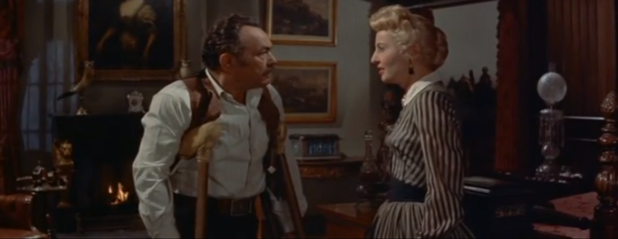
For well-nigh 20 minutes the name Wilkerson is all but mythologized and lifted up as one of the most ruthless, bloodthirsty names on the frontier; he is Rockefeller on the range. With such a build-up, there must be performances to hold up the bargain. Fortuitously the movie delivers with not only Edward G. Robinson but Barbara Stanwyck as well. Of course, Stanwyck is no stranger to the West, and she’s quite adept at exuding this certain balance of necessary toughness and femininity.

Robinson is hardly the image of a western cattle baron (he was, in fact, a late replacement for Broderick Crawford), but he still has the presence of Edward G. Robinson. The fact he is crippled with a pair of crutches and still so ornery makes for an intriguing character biography. He completely subverts conventional expectations.

Meanwhile, Dianne Foster feels a little like Martha Vickers in The Big Sleep — the first impression is important — and she leaves the audience wary of this family’s pedigree. They’re not allowed to have one normal member.

Next, comes the entrance that is of utmost importance. The hobbling old codger himself. He’s particularly boisterous and hard-nosed when it comes to land dealings and taking over the valley. Behind closed doors, his wife is equally cunning and calculating, along with his kid brother (Brian Keith). His main enforcer (Jaekcel) follows up murder in the streets with another grisly murder on the range as a message to the holdout, Parrish, and anyone else brazen enough to stand up to Wilkerson.

For the 1950s, it’s quite the brutal exhibition as they whip a man, rope him up, nearly choke him to death, before leaving him for dead. Words do not do it the justice it deserves.

If Wilkerson didn’t sanction these egregious actions, he gave Cole (Keith) free reign to enforce their presence on the territory in whatever manner he deems applicable. The crooked deputy, a seemingly obliging fellow, has the system conveniently tipped against anyone who dares stand in opposition. There’s no way to win.

The movie might easily end here if only our hero were to wash his hands of the situation and move back east. He loses his bride-to-be for the sake of his own private moral integrity. Whether it’s because this is Glenn Ford or his character, need not be important. He resolves to stay, playing the fool, only to draw in his foe and retaliate.

Soon he’s taken his army training and put it to good use, fighting a war against his neighbors who, by all accounts, seem more formidable. What he has are determination and tactical advantages. The distinction of who the actual foe is remains dicey.

Robinson is just the blustering frontman. Cole blasted the range open with his pack of thugs. Martha Wilkeson pulled the strings, working all the while in her husband’s shadow.

Cinemascope offers some expected monumental views of the west compete with all the trimmings of the great outdoors. Ironically, the actual montages of the stampedes, burnings, and killings are relatively uninteresting. It might as well be stock footage from other pictures, and it probably is. The most invaluable moments are delivered by the characters, served up just as much as psychological warfare than any physical grudge match.

As the Wilkerson girl perceptively berates the men in her climactic stand, at their core is this barbarism, causing men to constantly be driven by a senseless need to kill one another for a lousy piece of land. Merely to prove something to themselves and others. What makes it worth it?

There is the subsequent realization this is not wholly good versus wholly evil. There are corrupt people, selfish ones, yes, but even Ford, who is supposed to act as our moral center, has no qualms about retribution and annihilating his enemy, since they were first poised to kill him.

It makes for a volatile experience, and the leads are a worthy ensemble, capable enough to suggest these particular nuances and personal ambitions. The irony remains in the title. On a cursory glance, it’s a lurid eye-catcher, but it also happens to be an apt descriptor for a movie with a main conceit about the implications of such escalated violence. The Violent Men takes its most obvious attribute, only to turn it right on its head. The surprise punch is a much-appreciated admonition about violence in the guise of popular entertainment.

3.5/5 Stars

Lonely Are The Brave (1962): The Last Cowboy

lonely are the brave 1.png

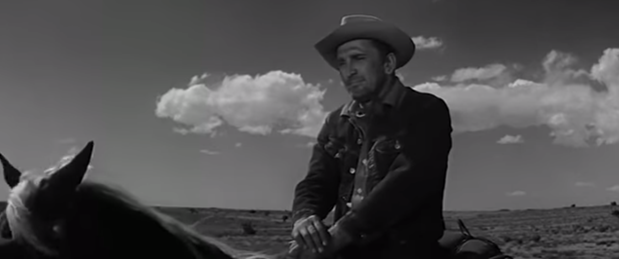
Armed with black and white and rolling plains full of instantly recognizable western exteriors, Lonely Are The Brave goes for an intimate approach. The camera focuses on a man splayed out with his hat tipped over his eyes in slumber. This could have been out of many earlier pictures up until this moment. An instant later the illusion is stripped when a jet cuts across the skyline. It’s an indication of where we are.

Because this is not a blaring lack of continuity. This is a telling signifier. What proves to be out of place is not this jet but the main character at the center of our story. If one of these things is not like the other, then he is indeed the anachronism.

This is the continual struggle of Kirk Douglas’s John W. Burns because even as he fights to maintain his rootless lifestyle reminiscent of the bygone drifting cowhands of old, it’s hardly in vogue with the introduction of social security cards and, for a lack of a better word, civilization. The two diverging stratospheres just don’t gel very well.

The film must sit somewhere atop the list of deceptive film titles. Going in imagining a High Noon-like film about one man standing up in the face of many, instead we get an equally meaningful meditation on the lingering ways of the west in a contemporary context. No thanks to the marketing department, I might add.

However, what does that matter when you employ the considerable wit and wizardry of Dalton Trumbo? He has a ball toying with the most obvious thematic idea of a near-mythical man — an old-time cowboy — whose code of conduct and dwindling philosophy on life butts up against a world that will not have him. He is at odds with it. Averse to fences, boundaries, sectioning off of lands — all now common practice.

He’s indicative of a certain romanticism with his horse and hat out on the range. Even as the pragmatic world around him as passed him by in favor of changing forms of living. This intersection of the remnants of the West with post-war American modernity is made visibly evident when he is forced into playing animal crossing with his horse on a heavily trafficked highway.

When he pays a visit to a woman (Gena Rowlands), there’s something enigmatic about the encounter. A wife, perhaps a lover. At first, we’re not sure. It’s more complicated and less understood. Until it comes out her husband — his best friend — is in prison, and she’s worried about him. Rowlands would have to wait for a true tour de force, but the best compliment I can give is her role has something equally bewitching about it. She’s not quite an entirely conventional housewife.

The subsequent scene takes place in a Mexican-flavored cantina. It proves to be the unlikely arena for an explosive fistfight with a belligerent one-armed man, for what seems to be no reason at all.

If we’re ever told, I’ve no recollection of it and if we weren’t, it doesn’t much matter. It conveniently serves the story twofold. Because we get a rowdy action piece with Douglas duking it out “mano y mano,” while subsequently landing himself a jail sentence so he can drop in on his old buddy as a favor to the incarcerated man’s wife. If this makes little logical sense, then at least it’s different — not where we expect the story to go.

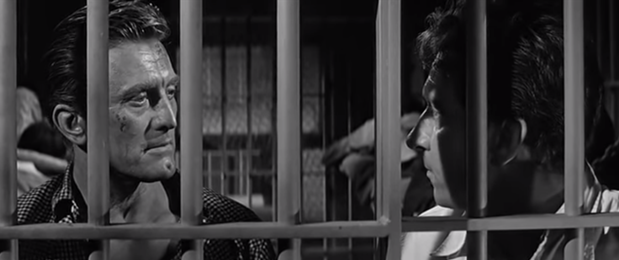
His jail sentence gets dropped and then upped following a police station scuffle carried out while the booking officer dryly lists off the unidentified drifter’s personal belongings like it’s just another day in the office. In the end, Burns keeps his promise to see Paul. There are momentary glimpses this could be a prison movie not unlike Brute Force, Caged, and certainly Cool Hand Luke.

We have a sadistic George Kennedy on the outside of the bars instead of inside. His main adversary is obvious. However, true to character, nothing can keep the cowhand in one place, not even prison.

lonely are the brave 3.png

The movie is beholden to a cast of giants (current and soon-to-be). Trumbo’s impeccably inventive scripting gives them all the words to emote with wry humor and assorted ticks making them come alive beyond the range of flimsy cinematic outlines.

The plotting itself is of a strange and unorthodox nature, nevertheless buoyed again by the talent and words on the page. Payoffs abound for these very reasons. Otherwise, it would wander as an ill-paced, unfulfilling mess. Thankfully, this is far from the case. The payoffs are strangely affecting, thanks to a story that bides its time, allows for asides, and spends time in untrodden places.

Between Douglas playfully cajoling a recalcitrant new mount and Walter Matthau observing the daily rituals of an unseen mutt outside the office window, Trumbo continually adds these delightfully offbeat touches.

William Schallert — as the good-natured bumpkin officer manning the police radio is in one sense totally aggravating and yet endearing in an innocent way. Even a fresh-faced Bill Bixby is manning the police helicopter the fugitive promptly shoots down from overhead. It’s an unceremonious reversal of fortune with the cowboy’s bullet taking on the whirly gridiron machine down from its illustrious heights.

Still, he cannot hang on forever. Eventually, even his tried and true way will betray him against the rapid assault of constant advancement. It cannot survive just as he cannot. Carrol O’Connor gets only a few solitary lines at the beginning and the end of the picture with rain pounding the highway, but his truck driver has a crucial moment we can all but see coming from a mile away. Though such a realization does not make it any less impactful when it arrives. It was inevitable.

Kirk Douglas, a man known for his intensity (some would say overacting), gives a performance bridled back with his winsome charm. In fact, the entire story plays with this generally lackadaisical, at times, melancholic pacing.

The final act in another picture might be chockful of moments. Lonely are the Brave needs only one. Turner makes one final push to freedom — his escape route, a harrowing ascent into the mountains. As gravity determines, the only way to go is down. It must be the so with John Turner.

So he never quite reaches his apotheosis. He is a partial embodiment of the sentiments of Dylan Thomas’s most famous work — the fight to rage against the dying of the light. Except the light is the way of the West and the battle is lost. It is a foregone conclusion. As time marches on, there is no way to claim victory. One wonders if being the last cowboy is an act of bravery, futility, or folly. Perhaps the answer runs the gamut of all three.

4/5 Stars

Note: This review was written before the passing of Kirk Douglas on 2/5/2020.

Gunman’s Walk (1958): A Cain & Able Western

gunman's walk 2.png

“I think it’s high time for this state to remember its history!” – Van Heflin

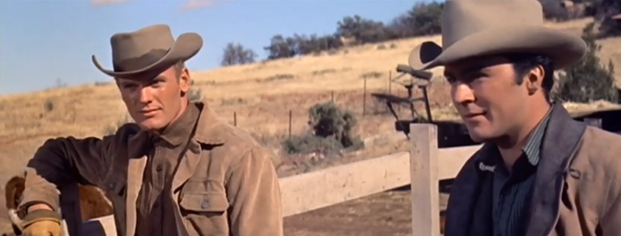
The whistling intro to Gunman’s Walk is one of the most insouciant beginnings to a western you might ever see. Regrettably, the opening lines of dialogue, penned by Frank S. Nugent, don’t stand up on their feet. It’s easy enough to understand Tab Hunter is a sharp-tongued pretty boy with a big chip on his shoulder. His reticent more unassuming brother Davy acts as his complete antithesis. This is the source of immediate tension, even visually, with the casting of such disparate actors as Hunter and James Darren.

Given these elements, the words coming out of their mouths aren’t of much use. It’s not simply in the opening arguments either but in their later verbal skirmishes. Even the brief interludes of candor, they are not always capable of holding a scene. They need a Van Heflin to work with, and he certainly makes them both better and more compelling. Because it is their conflict and confused relationship with him speaking to all other facets of the movie.

Gunman’s Walk finds its footing not only with the introduction of Heflin, but also when it settles into a story with ideas fueling relationships. We come to understand it to be more nuanced than mere bickering. Because with every fight there is an underlying trauma of some form. In the nucleus, you have the archetypal dichotomy between the two male progeny with divergent paths ahead of them. They are like Cain and Abel.

It’s their father who looks to guide them toward the straight-and-narrow or at least the western equivalent, which means molding them to be like he was when he was a boy. In fact, it goes further still. He wants to be one of the lads, even chiding them to call him by his first name.

Quick drawing, carousing, having a good time, and generally cultivating a “boys will be boys” mentality are all part of his regimen as their sole guardian. One boy shies away from this based on his natural tendencies and the other rebels more blatantly still, determined to be his own man, greater than his dad ever was.

Beyond their initial quarreling, we begin to comprehend the spirit of the brothers when they wander into the local mercantile. Tab Hunter notes the pretty “half-breed” working inside, and it’s the immediate barb to suggest this is also a drama about racism.

It cannot help but come front and center when Ed pushes a half-Sioux off the cliffside as he selfishly sprints after a prized white stallion, with no consideration of human life. The man killed, named Paul, happens to be the older brother of Clee (Kathryn Grant). She works in the mercantile and faces the debilitating, inbred bigotry of the town day in and day out.

What must come out of this is a trial. Because two bystanders speak up on behalf of their friend. They think it was murder, and it might as well be. But Lee will have none of it. He’s not about to let his son get railroaded by two natives.

It goes far to suggest a type of privilege not only earned arbitrarily through skin color but also in attributing who is memorialized in the history books and how they get remembered. Lee’s demonstrative cry to remember history is itself a highly ironic evocation, given the circumstances. Just what version of history is he talking about? Undoubtedly his version.

gunman's walk 1.png

There’s a trial to follow and of course, Ed gets off. A crooked witness comes to his defense — upon hearing what a generous soul Hackett is — though the conniving passerby is no better than a horse thief. Meanwhile, Davy finds himself in a Romeo and Julietesque romance, at least in considering his father would never agree to a union with a Sioux.

Ever disconsolate, Ed dodges jail once only to end up there again, this time for gunning down his father’s blackmailer. His attempts to frame it as self-defense fool no one in town and Lee is flabbergasted. Why would he do such a thing? Ed feels like his father has gone against his own principles. They’re further apart than they have ever been.

There is no turning back when Ed blasts himself out of jail, murdering another man, with a posse now out to get him. Lee has no choice but try and beat them to his boy — to try and do anything he can to shield him. One wonders if it’s already too late.

The final showdown feels like a foreign dynamic — father pitted versus son — there is no other way to go about it with the law bearing down on them. It ends unceremoniously, though the emotional toil remains heady.

Tab Hunter absolutely blows through his clean-cut, boy-next-door image and tramples on it with the hooves of his horse for good measure. As a result of constantly fighting the demons of his own malice and being cast in his father’s shadow, he remains all but unrepentant to the last frame.

Each subsequent film I see featuring Van Heflin cements my estimation of him as a giant among the unsung heroes of Hollywood’s elite. This is by no means a great western, but in the moments unearthing some semblance of deep emotional truth, it is Heflin who guides them with a craggy vulnerability. The final two scenes are pure class. They tear your heart apart.

It’s quite the statement given that during much of the film we wouldn’t mind tearing him limb from limb. He hobbles off with his boy and the boy’s wife, and we actually have sympathy stored up for him. It’s an extraordinary achievement in a relatively minor western.

3.5/5 Stars

Last Train from Gun Hill (1959): Douglas Vs. Quinn

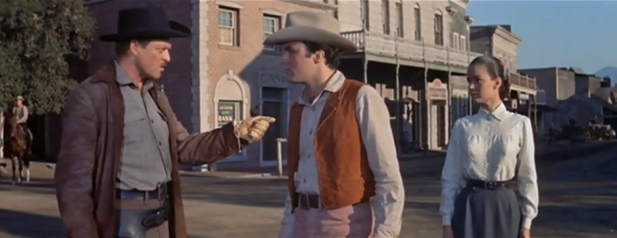
the last train from gun hill.pngThe action begins with a chase of sorts, except with the men pursuing a buckboard, carrying a woman and a young boy, it’s more like a game of cat-and-mouse. As a Native American maiden and a pretty one at that, they look to have their way with her. A horrible incident follows, and it’s a fairly frank depiction for the 1950s.
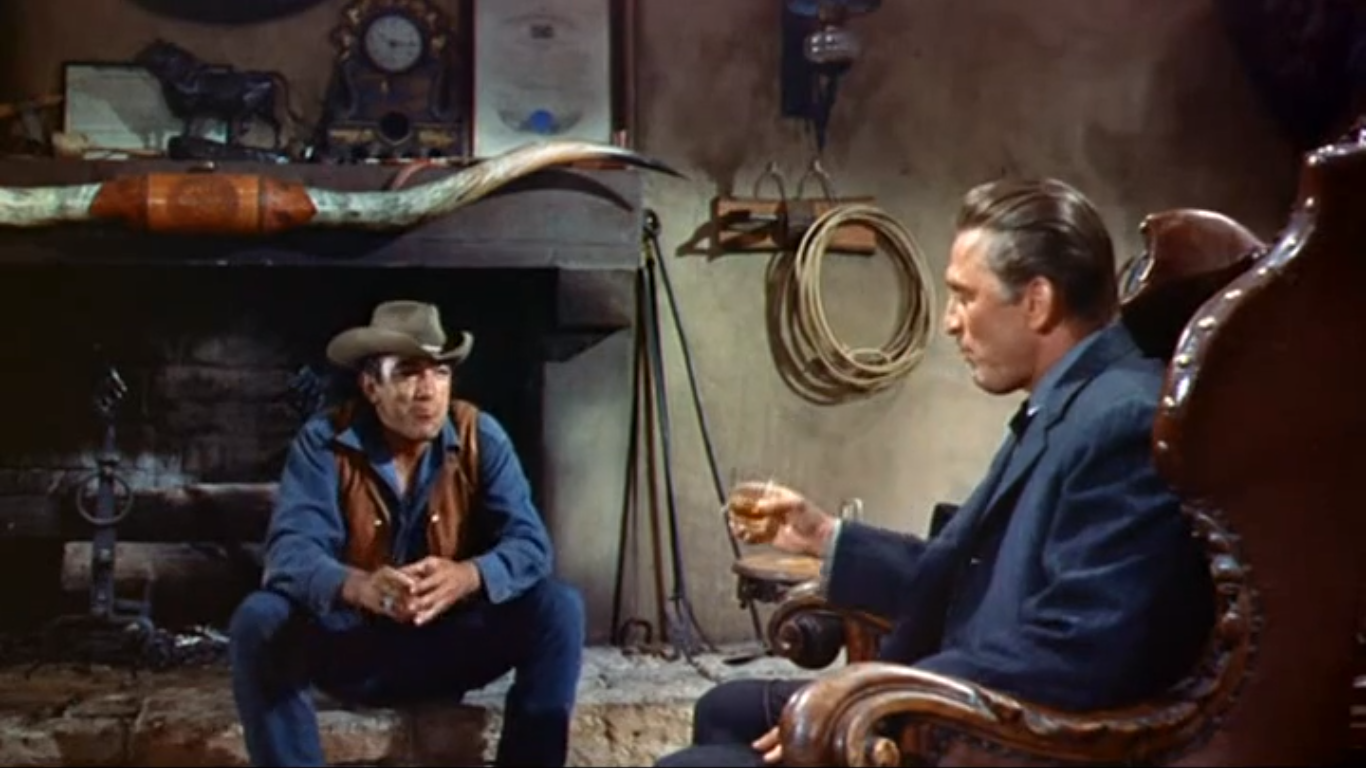
Meanwhile, a local Marshall (Kirk Douglas) can be found regaling the kiddos with a story about the olden days, 10 years prior. It’s strangely light in contrast to the preceding scene. This is precisely the point because never again will we see the Marshall with such a jovial demeanor. We must wait only minutes to comprehend how our pieces fit together. Because this young boy, his son, races to call upon his father. It is his wife who has been brutally ravaged and left for dead.

There are only a couple of clues to go by. The first is a deep scar on the cheek of one of the perpetrators. His wife did not give up without a fight. The second is an abandoned horse with an ornate saddle. He knows it well. It belongs to an old friend: cattle baron Craig Belden.

Because the man who raped Catherine Morgan was Belden’s gutless son. The other man was one of his many hired hands. If not already clear, the dramatic dilemma becomes even more tenuous. The Marshall wants justice and resolves to pay his old buddy a fateful house call.

Under any other circumstances, these two men would be meeting for a drink to wax nostalgic about old times — the glory days — because it’s true things were different back then. As we have a habit of doing, we memorialize our youth, and the friends and experiences we gird around us as young men commonly follow us our entire lives.

But now they must factor in their current lives. Morgan’s wife is dead. Belden’s last kin is his boy Rick (Earl Holliman). Family is everything to the two of them, and it finds them at odds across most fragile lines.

Soon enough, this western finds its tracks along with the lumbering steam engine barreling through the local town. It’s the age-old format gleaned from High Noon and 3:10 to Yuma. A showdown is inevitable. The train is the method by which locals keep time. It’s is a destination, a symbol, and a way in which to move from here to there. It brings people in and takes them out. Sometimes to leave and find a new life. Sometimes to end someone else’s life.

And yet, as alluded to already, this western is far more personal. This is its strength because Kirk Douglas and Anthony Quinn, as old chums, are pitted against each other under very unpleasant circumstances. But the story also requires someone who can stand up to Kirk Douglas as far as acting chops and screen presence go.

If not exact equals, they keep the playing field level based on their enduring differences. Neither is looking to budge. One, a marshall with an unassailable will. The other, a cattle baron who owns the entire town. They represent justice in two divergent forms, as individuals enacting the law as they see fit, whether through dictatorship or vigilantism.

The Marshall tries to drum up some allies in town. The stand-in for sheriff is always about taking the long view. That is, whatever will let him keep his craven neck alive. Realizing the whole town’s on Belden’s side, he settles in for the long haul, taking the young upstart prisoner and holding up inside an upstairs hotel room — his captive manacled to the bedpost. The stakes are set firmly in place, milking the tension to the nth degree. We know what must go down if no one budges.

the last train from gun hill 1.png

Earl Holliman’s not necessarily as adept at mind games as Robert Ryan in The Naked Spur or Glenn Ford in 3:10 to Yuma, but he proves he can play the jerk. He’s the detestable combination of an entitled rich kid and a spineless loser.

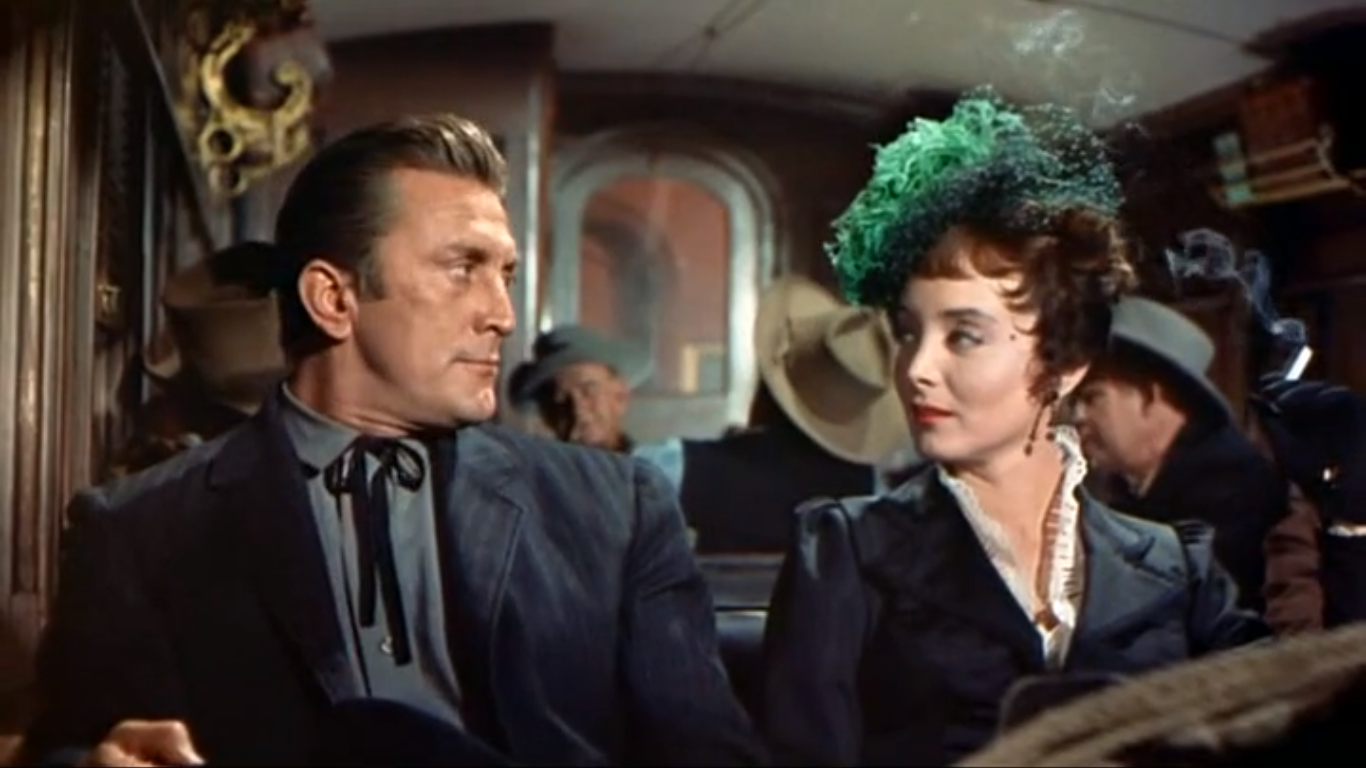
It’s a misnomer to say there are no sympathetic figures. Morgan makes the acquaintance of one on the train into Gun Hill. She too has a past with Belden. In a town and theatrical landscape literally dominated by men, Linda (Carolyn Jones) has to be strong and a bit of a pragmatist. For these very reasons, she wants to see the Marshall succeed in his foolhardy task.

So, in fact, he has one minor ally for the very reason she’s not completely against him, though she’s not looking to play hero. Nevertheless, she admires a man with manners and the moral compass to hold doggedly to his principles. In a passive way, she’s in his corner, if only because he has the gumption to stand up to her old beau. However, she comes to be more than just a mere observer. Linda gives him his lifeline for bringing his crazy plan to fruition.

With tension mounting, he leads his prisoner out of the hotel with the whole town watching, all the guns trained on him, and the 9 o’clock train arriving just as planned. He marches out with his shotgun square on his prisoner’s quivering jaw. He’ll get it if anyone moves and so we have a contentious stalemate. By some crazy circumstance, he might find a way to achieve justice yet. Because, again, the train is a symbol. It reflects what he might still be able to do if he can only get there.

In the end, it barely matters. It’s a partial spoiler yes, but this was always a story about relationships more than anything. The draw must blow up somehow before reverting to its most crucial point of conflict. It’s all over and yet we’ve reached the inevitable point of no return. A hesitant Marshall is called to draw on his best friend. He doesn’t want this.

But Belden is an equally proud man, and he lives by a certain creed of western masculinity. You must face a man for any personal affront to your being. There is no other way. Even if he has to die in an ensuing shootout, he’s done his paternal duty for his flesh and blood. One must question what the bloodshed accomplishes. In this film, it’s a fitting end of fatalism. Whether it could have been avoided is quite another matter.

3.5/5 Stars

Note: This review was written before the passing of Kirk Douglas on February 5th, 2020.