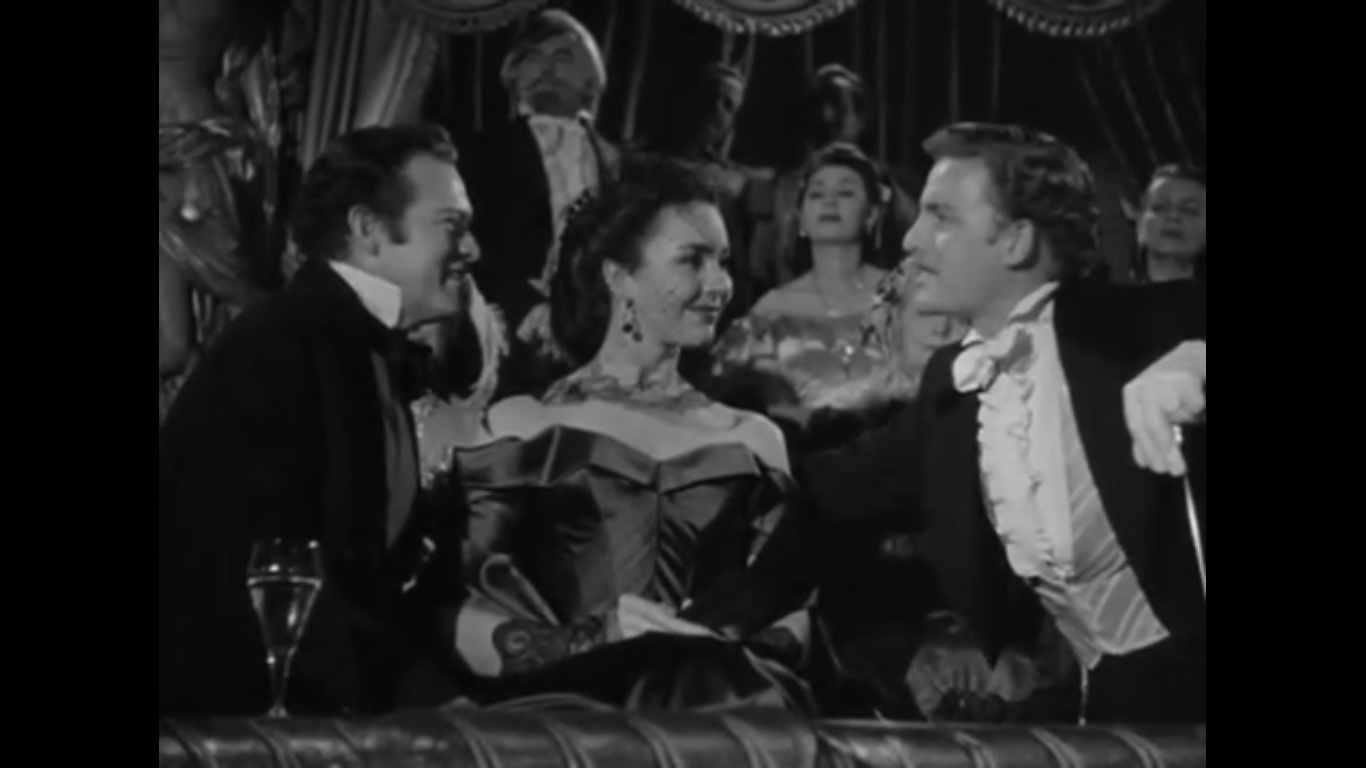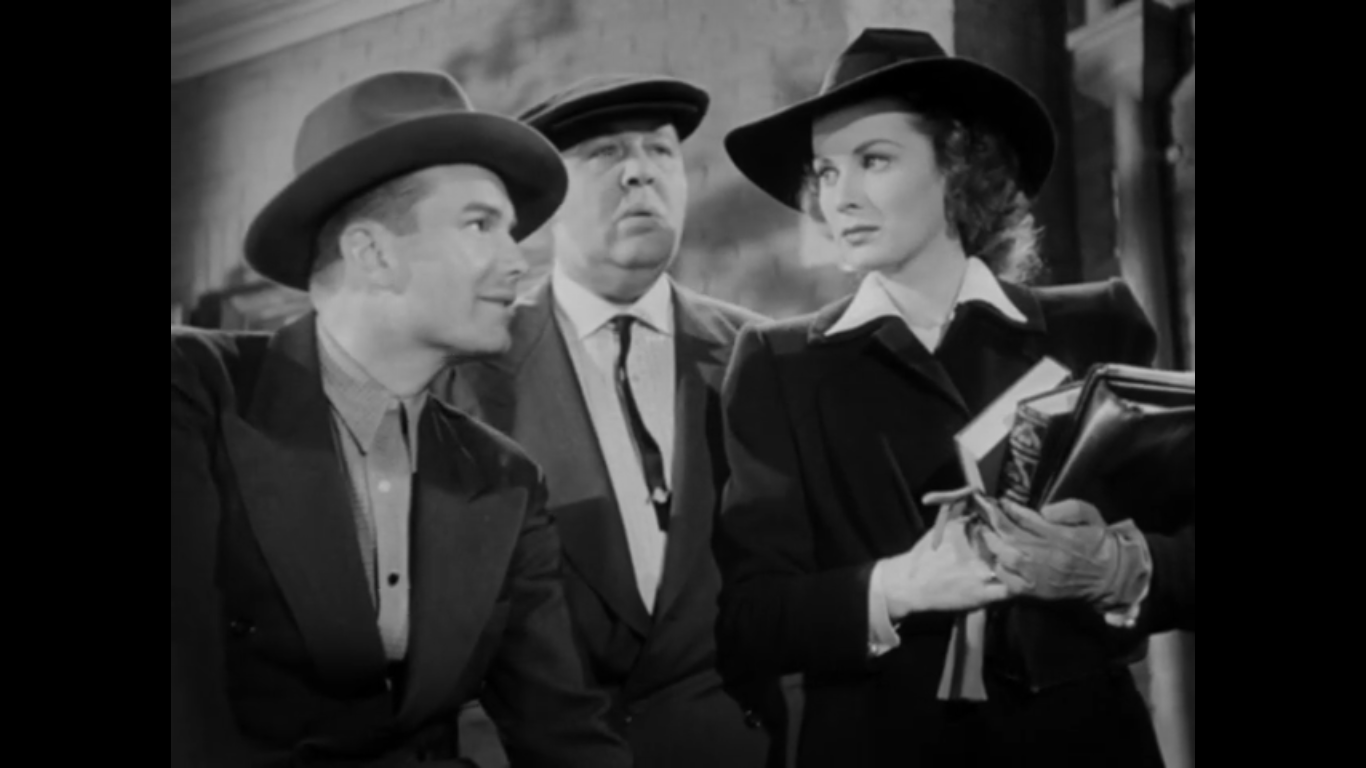
Man Hunt (1941): Fritz Lang vs. The Nazis

I feel like few filmmakers understood the menace of the Nazis as well as Fritz Lang. Perhaps it’s because he had firsthand experience, and he knew their schemes and what they were capable of — at least to a degree. But he does not make them total fools nor distant adversaries. They are cold, calculating purveyors of evil.

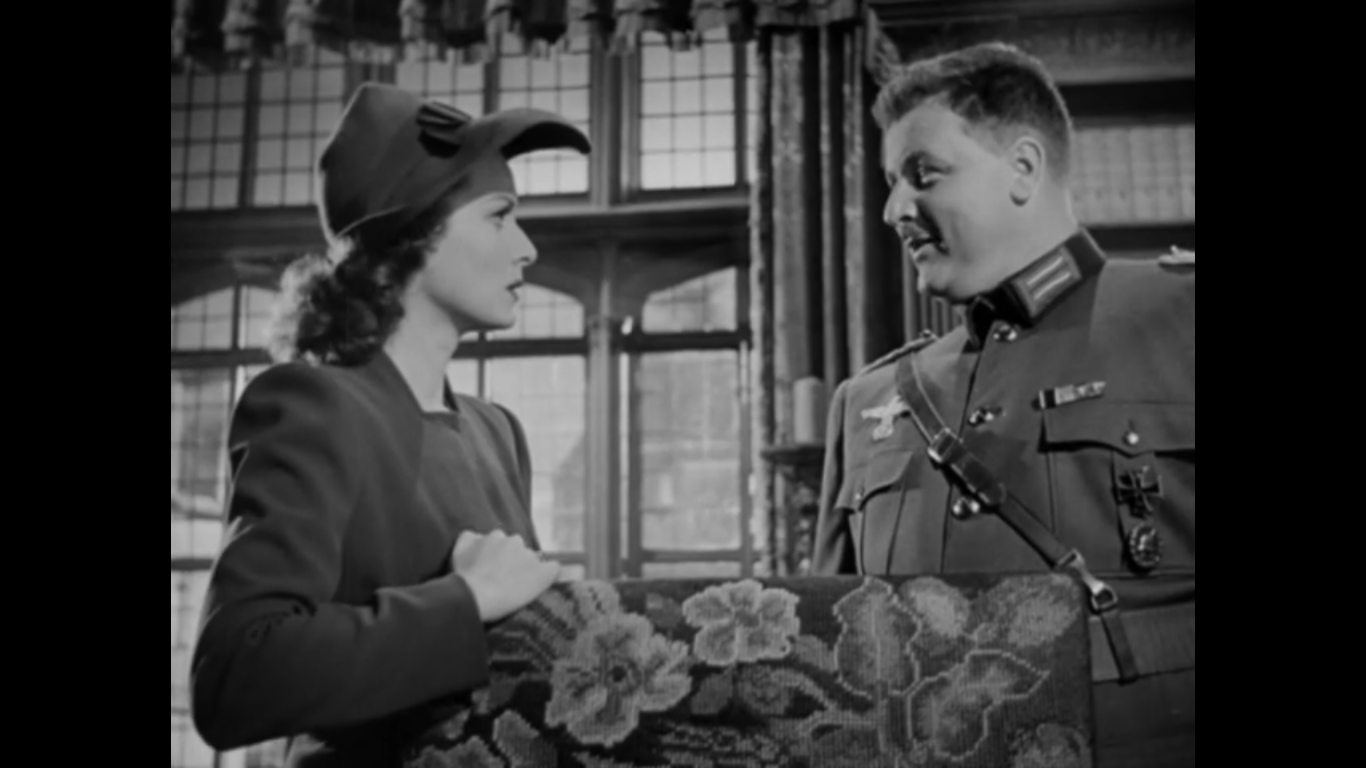
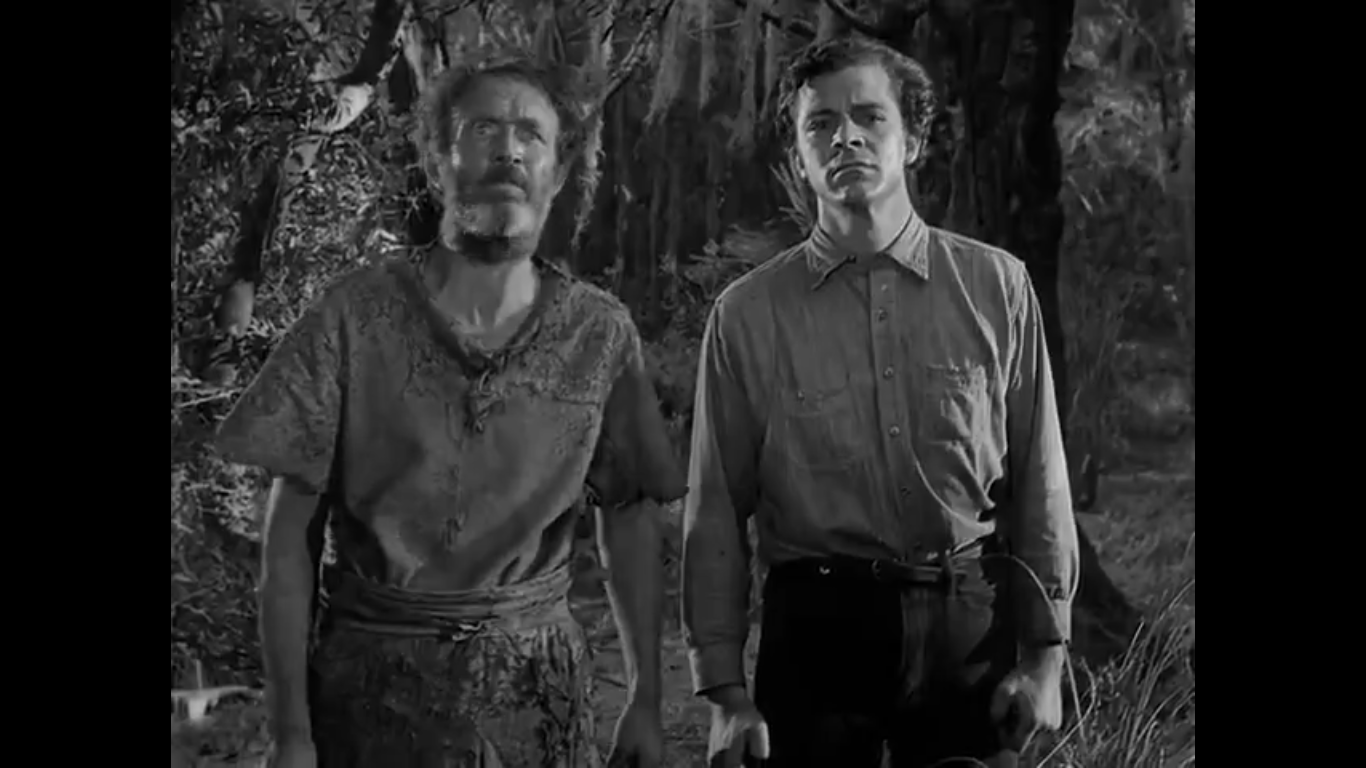
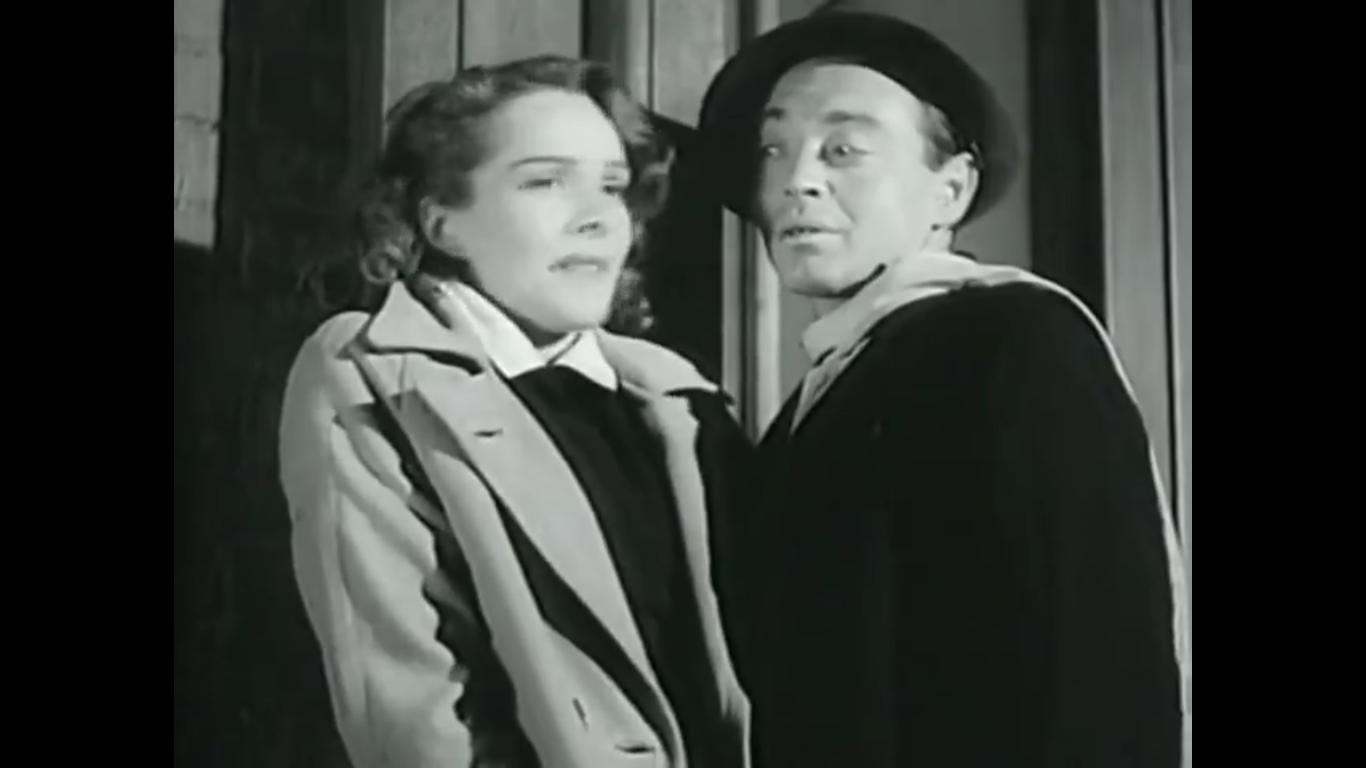
We open in a forest laden with the footprints of a hunter. Walter Pidgeon is the man stalking his very contentious prey. You see, he’s looking to assassinate Hilter! As he gets the Fuhrer in his sights, we’re almost willing him to succeed. But of course, this is not an alternate history. Hitler survives and we are led on an entirely different narrative train wrapped-up with a far more treacherous arc.

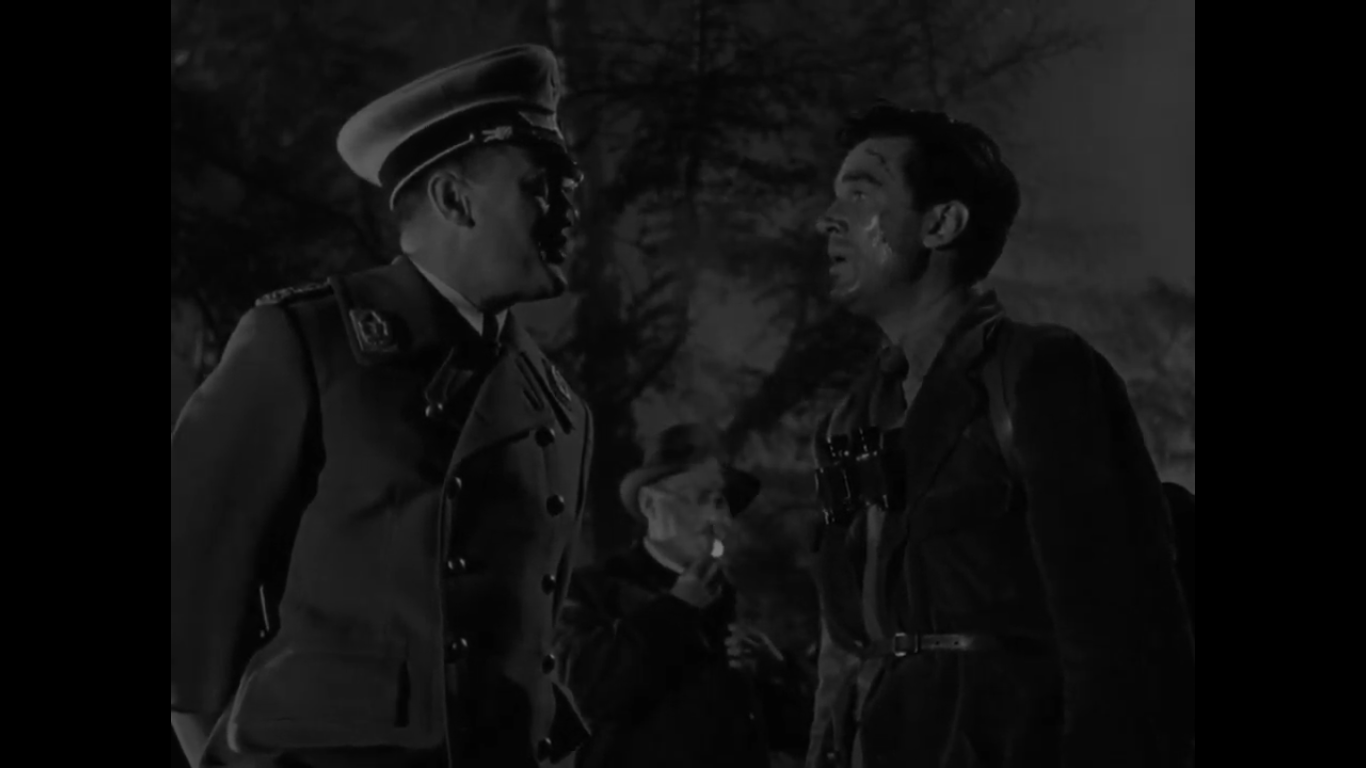
Captain Thorndike, a famed big game hunter, is foiled in bagging his target and dragged back to the offices of a local Nazi grunt, Major Quive-Smith (George Sanders).

It’s a compromising position to be in and the Englishman tries to plead his case. It was all part of a “sporting stalk.” He never planned to pull the trigger; it was all part of a game because he’s no nationalist and England’s yet to be embroiled in war. Times were very different and yet Thorndike is still taken in as a killer. There’s no recourse to see him as such and torture him until he confesses to his crimes.

This undercurrent of big game hunting humans can’t help but bring comparisons to The Most Dangerous Game and as Thorndike makes his own escape from the German hounds, we are caught up in his primal instincts of fight or flight. Lang is gifting us entertainment that feels like Saturday morning serials pitting the decadence of the English against the primitive barbarism of the Nazis.

Like Night Train to Munich or Lang’s own Ministry of Fear, the peril doesn’t desist with a return to the homeland. Instead, it increases by the hour as he’s trailed back to England and tracked from a cargo boat into the foggy streets. Roddy McDowall is a charmingly precocious ally and even in a small role, you remember why the plucky lad became such a fine star at such a young age.

Joan Bennett is a personal favorite although Man Hunt does her few favors. Jerry is a spunky lass who injects a level of almost screwball levity into the equation thanks to the mish-mashing of social class. Between a shadowy meet-cute and her grating cockney, there’s quite an outcome.

She’s not exactly a creature of breeding and when Thorndike pays a visit to his hotsie-totsie relatives, it’s quite the meeting of the minds: he must share his adventures and his uncle gives him some urgent news from abroad. He leaves Jerry with a token of his appreciation: a straight-arrow hatpin and she bawls her eyes out in the sniveling kid part that feels mostly unbecoming of Bennet. It’s her schoolgirl infatuation setting in.

John Carradine, ever-adaptable to any part he’s called upon to play, sits behind newspapers, sends off homing pigeons, and colludes with other murky agents infiltrating the country all while speaking German freely on the streets. In Lang’s submerged world, heroes and villains alike must skulk around in shadowy interior sets half-hidden by the London mist. It’s as much movie atmosphere as anything else.

Some of the best chase sequences take them through the Underground. We feel this lingering peril afoot as Thorndike is forced to disappear down deserted tunnels and winds up embroiled in the tube murder mystery slapped on the tabloid sheets the following day.

If the threat of Man Hunt eventually burns off, then perhaps it comes with a lessening of the pace and then purpose. We also ditch the darkened tones of lonely, shadowy evenings for Throndike’s hideaway in the country, which feels positively idyllic in comparison.

Although we swap out one German forest in the beginning for a British one in the end, what we really seem to lose out on is the metaphor of a man stalking his prey because the whole picture has become a reversal of that opening image. Except Thorndike spends a great deal of it stuck in the Nazi huntsman’s trap. There’s tension, but it doesn’t make for the most thrilling visual exploration.

The off-kilter moralizing at the end is not unexpected, but it hinders the drama as Pigeon gains his senses and sees Hitler for who he really is. We’re also bludgeoned over the head with a raucous montage superimposing current events and Joan Bennett’s doe-eyed face. The fight must continue!

But taken in the cultural landscape of the time, no matter its theatrical shortcomings, Man Hunt still bears the mark of a prescient picture that dared decry the merciless evil of Hitler and his Nazis when America was still disengaged from what was going on across the world. Appeasement and isolationism seemed like the easiest roads; not necessarily the right ones. That’s a lot easier to affirm in hindsight. In the moment, it was bold.

What’s more, Fritz Lang would follow up Man Hunt with more pictures like Hangmen Also Die and Ministry of Fear as if to make certain no one could ever mistake Nazis for innocuous patriots or forget how destructive they actually were. It’s a propaganda picture, but it doesn’t totally lose sight of good old-fashioned entertainment value even if it’s unsustained.

3.5/5 Stars

Never Give a Sucker an Even Break (1941): W.C. Fields and Gloria Jean

Screenshot 2020-07-07 at 9.13.35 PM

“Do you think he drinks?”

“He didn’t get that nose from playing ping pong.”

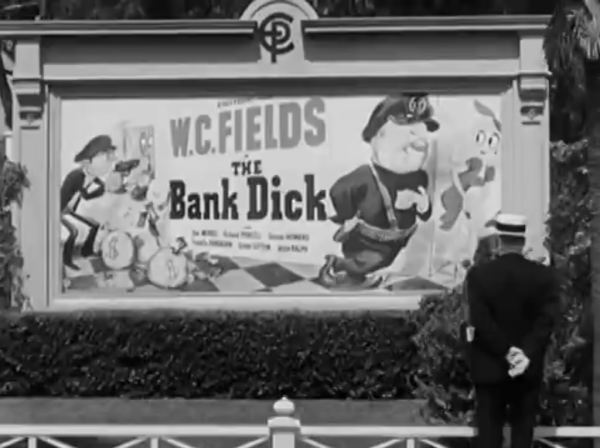
Self-reflexive metanarratives have the capacity of dissecting celebrity and playing with personas. Such a context is ripe with possibility and so when we find ourselves on a studio lot with W.C. Fields eyeing the a big billboard for The Bank Dick, we know we just might be in for something. It came out the year prior, a critical darling and a commercial flop. He’s looking to pitch the follow-up to his producer.

He is under employment at Esoteric Pictures. His niece in the picture, real-life songstress Gloria Jean, plays a young ingenue out of the cut of Garland or Durbin. They are the film’s affable nucleus.

W.C. Fields is a picture of his usual self with his protruding proboscis and that straw hat of his as battered as ever. There’s the way he casually mumbles away at dialogue. It falls offhand and unrehearsed. You can almost lose it. Some of the garbled gook he gets out only makes it to your ears after he’s said it, and your mind has time enough to catch up.

Meanwhile, a typically huffy Franklin Pangborn with his stringy hair tries to command the unremittent chaos of the studio sets to get Gloria Jean to perfect her latest song, one of those high-pitched operatic numbers out of yesteryear. He’s already in a unstable mood when Fields pays him a call.

The script Fields is pitching becomes the premise for the movie itself as he darts in and out of scenes that might as well have no relation to one another aside from featuring Fields and Gloria Jean.

They start on an airplane together to some unknown destination. They might as well be waiting for Godot. He goes free-falling through space in pursuit of a bottle of spirits only to end up trampolining into the stratosphere of a pretty maiden from an oblivious world. Margaret Dumont is her imperious mother Mrs. Hemoglobin leading a great dane by the leash like some bleak Amazonian woman.

Fields, who penned the script under one of his many aliases, pushes the boundaries farther than he’s ever gone before, and it’s spectacular and surreal if this is what creative control looks like. It’s not as out and out funny as some other Fields movies, but it’s giving itself over in its totality to this absurd rhythm which is quite extraordinary to watch. He throws himself over a cliff in a basket only for Pangborn to loudly protest. The story lacks continuity! It’s an insult to human intelligence!

Is it too obvious to read it as a commentary on a career of movies and studios and such? I think not. Because W.C. Fields films were never the most tensely plotted, tightly constructed gems. He built his career out of ad-libs and performance, not so much the written word. Not that he didn’t come alive with verbal wit of his own accord and this was his gift.

never give a sucker an even break bank dick billboard

But he was never made for the strictures of the industry, and so it’s fascinating to watch him when the restraints come flying off, and he’s got his run of the candy store so to speak. In fact, he rebels against conventional plot to the point of totally pulling it apart in front of us and tossing it away as collateral damage.

There is absolutely no pretense here. It’s even less about fast and free gags and bits being assembled together. It’s given itself over fully to surrealist feats of cinematic fancy. It might leave some befuddled now as it did then, but one can gather some sense of the performer. It suggest so much about him implicitly that still needs to be parsed through.

With the real-life context, it shows the decline of W.C. Fields who was quietly ditched for other more agreeable talent, especially because Never Give a Sucker… was hardly going to woo the audiences. Not in 1941. It was of that rarefied breed we often far too easily label “Ahead of its Time.” Here it seems pertinent.

The final set piece is an eye-popping death defying car chase to the maternity hospital. It feels like a flashback to the heyday of Keaton or Lloyd. It’s the most purely comedic slapdash moment in the picture, and does it fit with the rest of the movie? Not by a long shot, but somehow it remains a capstone for something that is totally of its own form and function. It’s almost obligatory. Here the career of W.C. Fields quietly came to an end. This was his final opus to hang his reputation on for future generations.

Doing a bit of perfunctory research, Fields was game to make another such picture with Gloria Jean and some of his favorite stock players. The studio wasn’t about to have it, and his own health was at the detriment of his drinking habit, lampooned as it might have been. W.C. Fields is one of the more irascible classic comedians to be able to pin down. But his comedy at its core does seem to get at a central human longing. It was always him against the world. He took it as well as dishing it out.

gloria jean

Maybe it’s only a small reward and too little too late, but I think even Fields understood the significance of Gloria Jean being in his corner unreservedly. Yes, it’s mawkish in the kind of Hollywood tripe sort of way, but secretly it also feels like a healing balm to the Fields character.

At last he can have some kind of peace. At last there is someone who will accept him unconditionally for who he is. My hope is that Fields experienced some of that in life as he did in his final major screen role. That’s not for me to know. All I know is that we all crave love; we all crave relief.

Fields wanted the film to be titled “The Great Man.” We can read it as jest or a bit of self-congratulatory pomp. But I think this is inside all of us veiled by insecurities. For people to see past our flaws. We want kids to look up to us and see us as what we aspire to be and not as the damaged goods we actually are. Gloria Jean extends her uncle such an honor as she smiles into the camera one last time. He is known and loved. To her he is a great man.

3.5/5 Stars

The Bank Dick (1940): Egbert Sousé and Lompoc, California

Screenshot 2020-07-08 at 4.50.58 PM

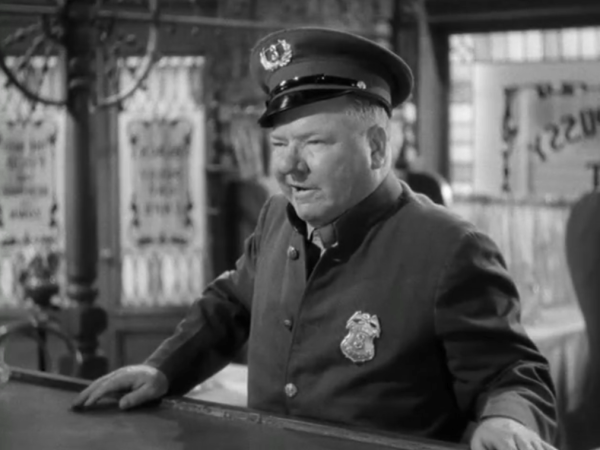
When W.C. Fields goes and names his protagonist Egbert Sousé it doesn’t take a brain surgeon to get the joke, although he does spend much of the movie explaining the correct pronunciation. The other half he spends drinking at his favorite bar: The Black Pussy Cat Cafe.

His hometown is none other than Lompoc, California. Aside from being a memorable name in its own right, the town had the illustrious title of being a dry zone with a long history of temperance. What better way for W.C. Fields to thumb his nose at them, than by setting up shop right in their fair city, albeit in his own made-up cinematic universe?

If it’s not becoming obvious already, I think the reason The Bank Dick is often touted as the finest example of his style is because it totally digs into his stereotypical persona whole hog. He’s an irreparable drunkard, a lier, and a braggart prone to any number of human vices. There’s no attempt to varnish them either. He’s a bona fide reprobate.

Nor is he particularly fond of his wife, daughter, mother-in-law, or the little kid who shows up in the bank. His daughter is bent on throwing rocks at him, and he about strangles a little boy who’s armed with a toy pistol. Does it even need to be said? He’s never a likable figure.

However, beyond mere character flaws, it is Field’s delivery that sets him apart from the crowd — the way he mumbles or draws out a line of dialogue. Again, it’s like an afterthought. He’s saying all the unfiltered comments he would say if he thought no one else is listening. Either he’s too dumb to know he’s being overheard or he plainly doesn’t care. At least that’s part of the shtick.

If he has anything close to a friend, it would probably be his bartender (Shemp Howard). He would follow the man to the end of the earth and back again, mostly because the man spells booze. It’s not all bad though since he makes another acquaintance over drinks.

After reminiscing about the good ol’ days giving a passing mention to Mack Sennett, Chaplin, Keaton, and Fatty Arbuckle — all the lads — he finds himself being pulled onto a 36-hour movie set in desperate need of a stabilizing force.

Souse’s tall tales nab him the job, and he certainly acts the part: Dishing out stage directions and convening with the script girl, between trips of being carried around like ancient royalty on a litter. His family’s far from impressed by his hamming.

What’s more, we drop this scenario almost as soon as it begins. It’s like Fields was bored with the narrative strands and decided to table it until his next go around. He has other priorities. His film, after all, is called The Bank Dick and so there has to be some scenario for this to come into being.

So, a bank robbery happens. He’s going to the saloon (where else would he go?). Alas, it’s closed, but sitting on a bench, with his nose in his paper, he ends up in the right place at the right time and gladly takes the mantle of a hero as a criminal is apprehended — no thanks to him.

As recompense, he’s bestowed a low-grade job as a bank dick that’s somehow tied to his home, which they might foreclose on if he doesn’t keep the position. It’s a dubious scenario, but also the kind of underhanded deal Fields probably more than deserves if we can say it. Tit for tat as they say. After all, it’s only a movie and this obliviousness underscores his very identity.

Next, he’s talking his future son-in-law into buying some useless mining stock, and pretty soon they’re embezzling from the bank for a dead-end deal. So of course the bank examiner, a snooty Franklin Pangborn, has to show up right on cue to throw a perilous wrench into their plans.

All Fields’ attempts at cordiality and voluntary sabotage fail, but the entertainment comes with each and every one of his ploys. I won’t try and spoil them here, but Pangborn was born to be his hapless target and Fields obliges with all sorts of shenanigans. Again, to no avail.

the bank dick

Of course, none of this matters. Not the embezzlement. Not the bank robbery. Not any of it. Because their mine is actually a bountiful lode, and they strike it rich as only W.C. Fields can. It’s an instantaneous, convenient reversal of fortune, but then again, Fields’ pictures always defy conventional logic. It’s in their very nature to shirk the normal rhythm for whatever behooves them at any given moment.

In this way, The Bank Dick synthesizes many of his prevailing themes — some of those mentioned already — capped off by an outrageously decadent happy ending. It also joins the ranks of Never Give a Sucker… in his line of raucous car chases, and it’s not a coincidence he’s working with Cline who partnered with Keaton on Sherlock Jr. Similar stunts abound here. It’s a bit of comic nostalgia even in 1940.

W.C. Fields isn’t for everyone. The Bank Dick is not always entertaining. But you come to appreciate his personal penchant for comedy as each performer of the era cultivated a very particular image. He’s little different and seeing as he wrote this number as well as starred in it, he’s giving himself over to the comedy and doing it the way he sees fit. If nothing else, it probably most closely aligns with his proclivities as an entertainer.

His films were never meant to be cohesive. They were never even really meant to be films at all. As with many comedians, it feels like the best dashes of serendipity occur in those suspended spaces in between. Where there’s a throwaway gag, an off-handed zinger, or just something resolutely out of left field.

Every person is different as are their audiences. They don’t always carry our interest every waking second. Sometimes all they have to do is bless us with little bits and pieces of time. It’s often enough for us to remember them so that they remain in the cultural consciousness. This is how I feel about Fields. He is an indelible figure for the persona he built, straw hat, big nose, flaws and all.

3.5/5 Stars

The Clay Pigeon (1949) and The Japanese-American Experience

The Clay Pigeon is a film that I have spent several years trying to track down, and I’ve finally been able to see it. From the outside, it feels like fairly run-of-the-mill post-war noir fare. It’s directed by an up-and-coming workhorse in Richard Fleischer and stars real-life couple Barbara Hale and Bill Williams.

It’s one of those amnesia plots steeped in the residual post-traumatic stress of WWII reminiscent of Somewhere in The Night, Act of Violence or even a later entry like Time Limit. It’s this kind of narrative device that injects instant ambiguity into our story since G.I. Jim Fletcher (Williams) doesn’t know why he is currently in a hospital, and he seems to be implicated in some far more dubious crimes. Richard Quine also turns up, and he still has a couple years to go before his prolific career behind the camera.

Williams feels like a bit of an innocuous leading man without the gravelly charisma of a Van Heflin though he works in a pinch. Barbara Hale is a fond friend from Perry Mason so it’s easy enough to take her even if she transforms fairly quickly from victimized hostage to loyal female companion.

Because during the war her deceased husband was compatriots with Williams and Quine in a notorious Japanese prisoner of war camp. This clouded mystery of how their buddy was snitched on drives the movie with dubious implications in their own backyard.

Screenwriter Carl Foreman (known for High Noon) spins a swift tale that incorporates some real-life history that’s too farfetched to be fiction. It came out of an incident where a former POW walked into a department store only to see the unmistakable face of his former tormentor, a notorious prison guard nicknamed “The Meatball.” What a nightmare scenario.

Tomoya Kawaita was an American-born Japanese, going to Japan for university, but he got stuck overseas as the war heated up and ultimately became a notorious prison guard who would speak to his captors in English. After the war, he returned to States to attend USC. He was ultimately tried for treason and eventually got deported, spending the remainder of his days in Japan living in obscurity.

We usually think of the idyllic serenity of returning home from war albeit with growing pains. Warzones and  home are mutually exclusive spaces. But here these scenes collide. The movie ties all of these details into a widespread conspiracy with broader implications and still it pales in comparison to the facts.

Richard Loo becomes “The Weasel” and the fateful encounter happens at a Chinese restaurant called “The White Lotus.” It’s possible that the movie conflates the Japanese and Chinese cultures, but regardless, it’s rather striking to even have this space acknowledged at all.

Loo purportedly relished the opportunity to put the Japanese in such a bad light, and he was often called upon to play such demented roles for WWII propaganda. The Clay Pigeon was no different in how it called on his wartime persona. It’s a bit of a holdover of the earlier sentiments.

However, there is one obvious difference. The movie does actually provide some nuance or at least an alternate depiction of the Japanese. This is the other reason I’ve searched so earnestly for this otherwise unassuming movie.

During a chase where Fletcher’s trying to flee his pursuers and clear his name with the Naval authorities, he rushes into an open door seeking asylum. The woman (Marya Marco) calmly doing her laundry looks him over and allows him to hide as she answers the door.

Once the danger passes, they share another moment. It’s an interaction that the tiny film, barely over an hour long, didn’t require, but whether it was screenwriter Carl Foreman or someone else, he takes time to honor this lady and her people. You see she has a young son, but also her husband was a Nisei who died during the war. His commendation and photo are displayed proudly for all to see.

When Fletcher sees it, it changes his whole demeanor because the 442nd carries a certain cachet. They paid for it with their lives and through their bravery. That’s something that anyone fighting in the armed forces can accept. It’s a badge of honor.

The movie rumbles to its inevitable conclusion, and it’s a nice bit of meta narrative to watch Hale and Williams embrace right outside the doors with all the loose ends wrapped up neat and tidy and our hero vindicated.

But for me, I already got what I came for with this one solitary interaction as an emblematic remembrance memorialized for all time. In the face of so much discrimination and wartime paranoia, the Japanese-Americans proved themselves to be fearless, fiercely loyal, and just as profoundly American as anyone else.

3/5 Stars

La Otra (1946): Dolores Del Rio and Her Doppelganger

Recently some coworkers were waxing about what they would do if they won the power ball. How they would spend the money, where they would go, and also the drawbacks that come in the wake of what seems like a purely golden opportunity.

I’ve never much thought about it, but I do admit for those who are trapped in life (or at least with active imaginations), it’s easy to make the mental leap. I couldn’t get these conversations out of my head while watching Roberto Gavaldón’s La Otra.

It is a movie about a manicurist. Her work is menial and she takes no joy in it, doting over cosseted businessmen with lecherous intentions. It’s a way to survive though her prospects feel like a dead-end apart from her burgeoning romance with an earnest policeman. All throughout the workday before she runs off to spend an evening with her man (José Baviera), the garish lights above her workspace blare with the National lottery: 5 million! Almost as if to taunt her.

La Otra is built out of a premise not unfamiliar to noir. If you read production notes, it sounds like the picture was potentially slated for an English-language release with Bette Davis, though it was deemed too similar to one of her other recent projects. She would end up remaking it a generation later as Dead Ringers.

Because La Otra actually opens with a funeral. María Méndez rushes onto the scene late, and public perception is one of contempt. How improper of her to show up late to a funeral while her twin sister, Magdalena mourns the death of her husband. Although the widow is masked by her veil, we learn soon enough, Dolores Del Rio stars in both roles. Hence, La Otra.

The doppelganger is not a new phenomenon used in all sorts of mistaken identity comedies and certainly in melodrama. Here it feels like it serves a utility to the story, but there’s also something else. The movie plays with the dichotomy and preconceived notions between Mary, the Madonna, and Mary Magdalene, a sinful woman. The movie casts Del Rio in both of these rolls, and they continually shift and evolve over this muddied canvas of morality.

Tension (1949) with Richard Basehart worked the doppelganger angle thanks to hard contact lenses and Del Rio pulls it off by wearing glasses to play her manicurist self. Still, these are only the visual features. It does not consider personality changes.

Meanwhile, we realize in the wake of her husband’s death, Magdalena has come into a great sum of money. She chides her sister while she walks into her lavish closet, “You haven’t learned to face the world with the same weapons it uses.” Namely, cunning, cynicism, hypocrisy…crime.

Soon enough, María does learn what it takes to get ahead in noir, although she must also live with the consequences. Passages of the film feel quite literally like a silent movie, and then with dialogue the scenes come alive played against the otherworldly whirring modulations of the theremin.

La Otra hits its stride with its first twist cut against the chaotic pinata-infused celebration in the city square. María has the opportunity to take over her sister’s life and commandeers it using all the aforementioned weapons at her disposal. Going so far as to scald herself so her signature won’t be disputed.

Still, she is trapped in a life she was not expecting. Because her rash decision only considered the upside — not the tragedy hanging over her head. Instantly, she gains wealth and repute, leaving her life of destitution behind, but she also must give up her man lest she implicate herself in the new life she takes up in its stead.

But also a dashing suitor (Víctor Junco) slinks back into her life — a mysterious man from her sister’s own shrouded past. She’s more implicated than even she realized, and the film is imbued with this sense of Catholic penance. We watched men like James Cagney be sent to the electric chair for their sins, and this woman is resigned to her own fate…

What’s fascinating to me is how this film could have been made in Hollywood — with Bette Davis no less. However, it was made in Mexico and as a result Dolores Del Rio was given unadulterated star treatment. The way she’s dressed, lit, and given full reign over the movie, augments her regality but also her abilities as a screen personality. She owns the movie both in its moments of drama and pathos.

And although it was shot below the border in Mexico City with many actors we aren’t aware of, it functions like a stunning system in parallel with Hollywood. There’s a technical prowess and a commitment to classical storytelling. There’s gorgeous light and shadow, a commitment to the semiotic nature of visual narrative, and also a daring sense of invention.

It feels alive and emotive like all the greatest classic melodramas. Analogous endings could be cropped out of other movies, but as a dutiful policeman, now disaffected in his duties, wanders off into the night, the woman stares back at him through the bars confining her. Her face settles in such a way, first, we see the luminous contours of her eyes before she drops down and they are enveloped in an abyss of shadow.

These are the kind of moments that not necessary for telling a story, and yet somehow it feels elegant and imperative because this final image articulates so much of the journey of this movie and so much of the duality in many of these great melodramas of old. I never tire of them, and it’s always a pleasure to find a new addition to the canon regardless of where it originates from.

4/5 Stars

Peter Lorre: Stranger on The Third Floor, Mask of Dimitrios, The Verdict

Stranger on The Third Floor (1940)

Although it’s not a highly touted picture, Stranger on The Third Floor feels like an important enough footnote to aficionados of film noir because it embodies a few of the earliest definable features of the movement. It’s not an entirely new concept per se, but it feels like it’s reaching a new market taking the influences of European Émigré cinema to the American public.

The influence of German Expressionism on ensuing generations cannot be underappreciated, and there’s this very practical suffusing of these techniques into Hollywood because many of these writers and technicians were physically transplanted to the west coast thanks to the scourge of Hitler. He unwittingly injected American cinema with some of its foremost talents.

Although he was an immigrant from Italy, Nicholas Musuraca would soon prove himself to be one of the foremost figures in noir cinematography thanks to his run at RKO Studios, which hardly had the budget and personnel to pull off the lavish A-list productions of MGM and other bigger studios. This necessitated a different niche and an ongoing visual ingenuity.

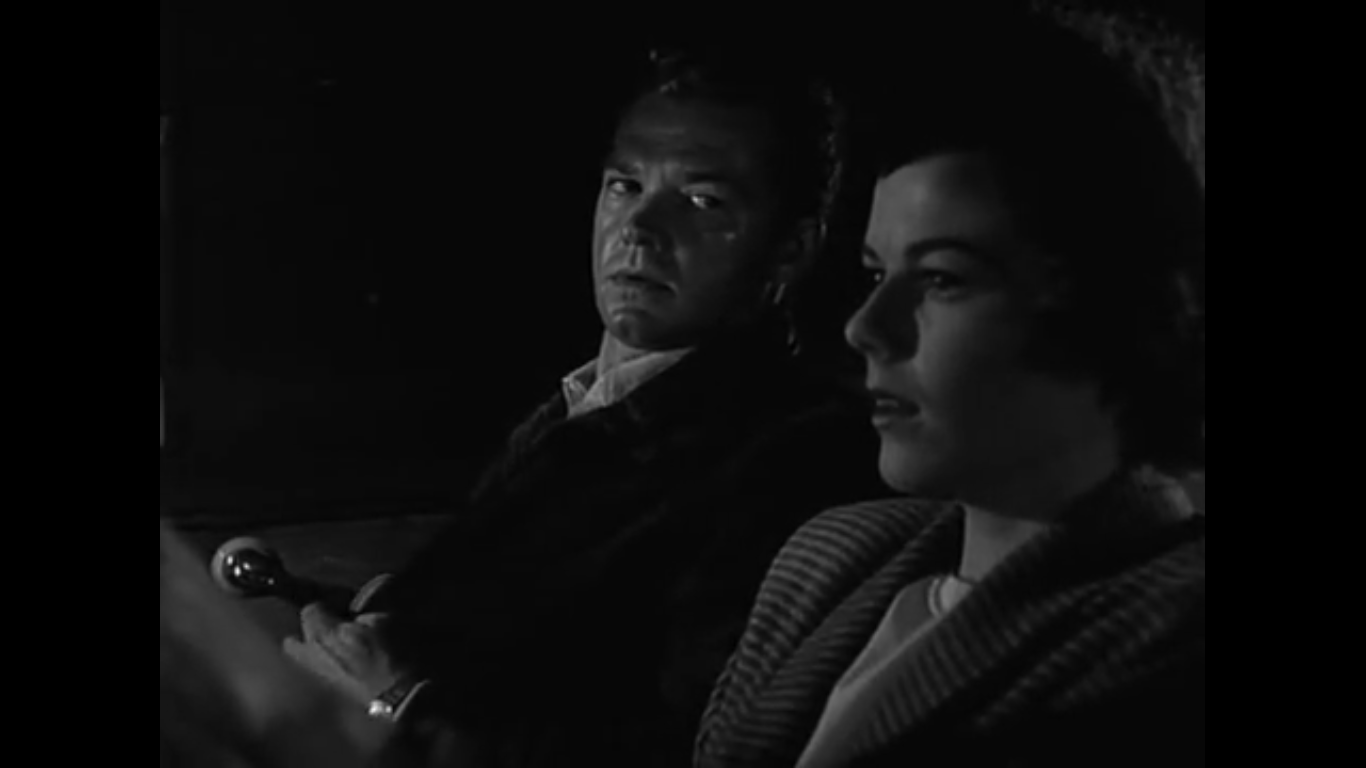
It becomes evident early on in the film thanks to severe shadows and a patchwork of light and dark. The story itself is incredibly contrived but the movie is saturated in voiceover and fatalistic dread thanks to a man (John McGuire) being sent up for murder.

The tenets of what would become noir are plainly evident. Still, there’s something organic about it. This is not premeditated; it simply happened with the confluence of talents and a bit of happenstance.

It’s fitting that while The Maltese Falcon feels like the most high profile distillation of noir as an American breed, Stranger on The Third Floor uses two of its primary culprits. By this I’m referring first to Peter Lorre.  He’s called upon to do an import of his psychotic killer in M complete with his gaunt hand crawling up an apartment door frame. He’s hardly as slimy and therefore as conflicted and interesting as Joel Cairo; it’s his slinking foreignness that conjures up menace in the eye of the viewer.

However, there’s also Elisha Cook Jr. who plays one of his more reticent types a bit different than his blustering henchman Wilmer. However, they would both become integral figures to the movement even if it were only for their association with that individual film.

Although the movie’s a quickie, it still finds time for mini flashbacks as the inevitable noose of noir gets tied ever tighter around our hapless hero’s neck. The finest moments are when he’s overtaken by the nightmare of his conscience with men in bowlers chomping cigars start to cross examine him, and he falls apart inside his own head. As such, it’s probably more intriguing for its place in film history than as an undisputed piece of art.

3/5 Stars

The Mask of Dimitrios (1944)

The Mask of Dimitrios feels like an old world adventure story centered around a phantom figure who becomes the picture’s version of a MacGuffin. Zachary Scott turns up mostly in people’s recollections as a precursor to Harry Lime, the man everyone wants to find.

Although the movies could hardly be made today, there’s something about Warner Bros. and it’s aesthetic and stable of actors that was made for transporting western audiences all over map. The movie literally globetrots around the world.

It’s a pleasure to have Peter Lorre offered a bigger piece of the film’s pie at this point in his Hollywood career.  He’s allowed to be a far more genial and charismatic figure, a writer of detective fiction and a seeker of this great mystery because he has time for such whims and frivolities if only they pique his interest.

Then, Sidney Greenstreet turns up ominously both a friend and a foe. They form a tenuous alliance after the fat man all but ransacks the other man’s room. Greenstreet and Lorre feel like unlikely cinematic bedfellows as it were, and yet they feel inextricably linked for all posterity. They feel a bit like the Laurel & Hardy duo of Warner Bros. crime pictures based on physical characteristics and also their palpable rapport.

Here there’s no Bogart in the limelight and Scott, while a headliner, is mostly the enigmatic engine behind the picture so they are allowed to anchor the story. Thus, what makes the movie are the same cloak and dagger elements that make a romp out of The Maltese Falcon where characters have motives and unseemly sides, but it feels more like unadulterated fun rather than totally depressing drama. This is a testament mostly to our two worthy protagonists.

The Verdict (1946)

The Verdict feels totally indicative of the evolution of Don Siegel’s career, a road paved with many well-remembered films, and it all began right here. We’re met with a foggy London frequented by Sidney Greenstreet with every constable and upstanding gentlemen bidding him good evening. It’s a long way from Dirty Harry although the picture is equally indebted to the criminal justice system.

This comes in part because Greenstreet made a lapse in judgment by sending an innocent man to the gallows. Instead of feeling altogether remorseful, he’s seems more intent in proving the incompetence of his supercilious successor.

It feels like a chatty picture once Peter Lorre and the rest get involved, drinking and quibbling about politics and social reform. There’s a rather vindictive pretense as the two men despise one another.

Lorre, now with a bigger billing, is allowed a broader portrayal of gravitas and jocularity. He’s the picture’s most welcomed source of inspiration. He’s found casually wondering in on murder scenes and eavesdropping in closets as it seems he has nothing better to do. What’s more, he makes it look like a grand old time as everyone else is hustled and harried going through the paces of the drama.

Because there is a murder, a murder queued off by the raging score before we’re even aware that anything has happened. The newly enlisted police chief at Scotland Yard is called to solve the mystery right quick. He proceeds to question his suspects, distrusting everyone, and keeping them all under surveillance, including a nosy housekeeper and a spirited night hall singer.

The whip pans over the faces when the verdict is made feels like a dose of Don Siegel, and the kind of visual octane he would give his movies for generations to come. Although there’s a danger with all the Victorian exteriors, the picture might easily feel stuffy. However, there’s enough noir and a surprising amount of wit sprinkled throughout to give the film a shelf life.

It somehow manages to play on both Greenstreet and Lorre’s reputation as shifty villains by first casting them as our protagonists and then making us second guess their motives again and again. It’s a perplexing picture with a dose of mystery and some twists. The fact that it’s ludicrous seems beside the point because it’s the wild ride of the experience offering the most impact.

3.5/5 Stars

Vincente Minnelli’s Films (1946-1955)

Undercurrent (1946)

Undercurrent hardly holds a substantial place in any noir conversations partially because Vincente Minnelli’s reputation in part seems antithetical to the dark style born out of chiaroscuro and German Expressionism. His background was squarely in luscious art design and stage productions.

Likewise, the combo of Katharine Hepburn and the two Roberts: Taylor and Mitchum, is not one that quickly springs to mind. However, there are some merits to it simply for the sake of it being different; not dramatically, these types of psychological women’s pictures were very much en vogue during the ’40s.

It’s the pieces assembled that feel unique if somewhat ill-suited. Still, the curious hybrid of tones and talents certainly is a historical curio more than intriguing to the invested party.

I almost have trouble buying Hepburn as a reticent, uncomfortable outsider among the D.C. elite her new husband Alan (Taylor) knows, a woman holding drinks in hand just waiting for someone to talk to. But if I don’t completely believe it, she does earn my empathy.

Mitchum, the legendary mule of RKO was simultaneously earmarked for 3 or 4 pictures at the time, and so he doesn’t show up in Undercurrent until much later. Still, he has the benefit of casting a Rebecca-like influence over the picture.

After an hour of building him up, we finally get sight of Mitchum, and we know where this story is going. Because he’s a real human being and fairly innocuous to the eye. As the presence of Mitchum begins to exert itself on the picture, the marital bliss of newlyweds grows more and more harrowing by the minute. We have a picture in the same vein as Suspicion and House on Telegraph Hill.

Despite choosing the part, the constraints of the role don’t feel totally in line with Hepburn’s talents. She isn’t a shrinking violet or the kind of timorous beauty befitting Joan Fontaine or even Ingrid Bergman. Robert Taylor is mostly adequate in the vengeful husband part. He flip-flops efficiently between these stints of gracious charm — a perfect husband and lover — then, becomes clouded by these perverse streaks of jealousy and rage.

3/5 Stars

The Pirate (1948)

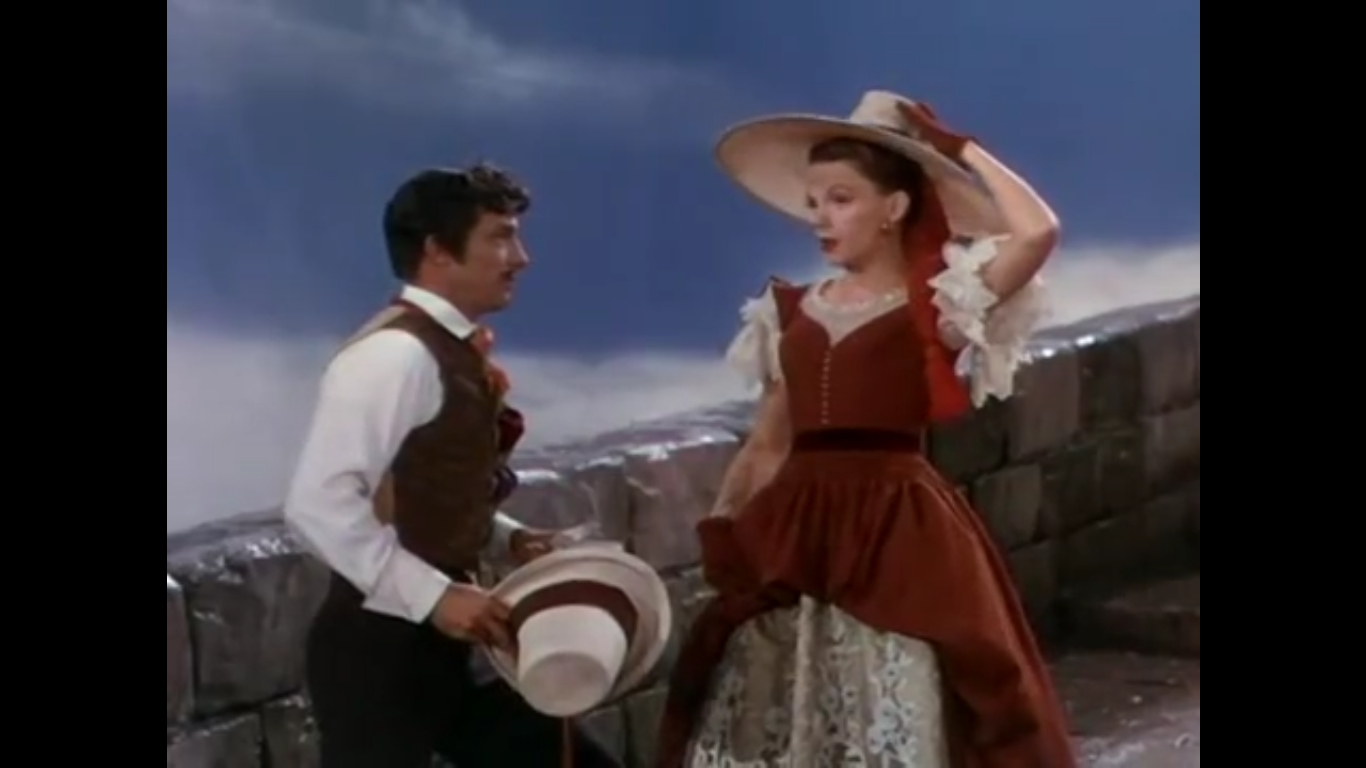
It’s plain that The Pirate is born out of the traditions of the 1940s Hollywood lineage like Blood and Sand or Black Swan, even Gene Kelly’s own Three Musketeers. However, between the bright evocative staging of Vicente Minnelli and the instant performance-driven rapport of Garland and Kelly, it works quite splendidly with what it has to offer.

Today it doesn’t hold much of a reputation, and I would stop short of saying it’s a minor masterpiece. What we do have is a picture banking on the charisma of its leads and a certain pictorial opulence supplied by its primary mastermind.

Kelly, taking all the niñas of the town by storm, is full of allure and his usual magnetism as he twirls, leaps, and bounds between all the pretty girls. It’s all about the patter between the stars as he plays the foxy street performer, and Garland is the put-upon maiden who is betrothed to another man. His vocation gives the director license to use these elements of theatricality and faux drama to tell the story.

What do I mean? It could be a story of tragic, unrequited love. It might just as well be a tale of marauding pirates, and yet somehow, between the song and dance, it becomes a kind of tongue-in-cheek comedy of two lovers perfectly suited for one another being thrown together.

There are moments where Garland and Kelly seem to be playing in a separate movie, or at least they are in on the joke with the rest of us, even as they mess with each other. Trashing his apartment feels like the highest form of romantic tension only for the drama to become slightly heady again: Kelly is set to be hung as the dreaded pirate Macoco. Is it a first to have a musical number performed under a hangman’s noose? I’m not sure.

Thankfully, he gets some stellar support. While I’ll be the first to admit “Be a Clown” feels like a less funny prototype for “Make em Laugh,” if you’ve never seen the Nicholas Brothers, it’s a small recompense to see them join Gene Kelly and get some commendation in the spotlight as his momentary equals. It feels like a flawed but heartfelt apex to a picture that could be described in much the same terms.

3/5 Stars

Madame Bovary (1949)

Madame Bovary is the kind of trenchant literary work the Production Codes would go to all costs to declaw. In one manner, it’s somewhat remedied by James Mason’s framing by providing a mostly blase narrative device to enter the story.

Even as something leaner in budgeted black & white (one could hardly confuse The Pirate with Madame Bovary), it’s still the same Minnelli. The ball sequence spelling the ascension of Emma (Jennifer Jones) as a society darling, while somewhat compact, exudes an impressive opulence.

The director makes sure to follow Jones’s incandescent form as she prances and waltzes her way across the dance floor with great distinction. Her gown alone is enough to make the upper classes stand up and take note. The dashing Louis Jourdan is certainly more than aware of her. It’s totally taken up by the kind of swirling euphoria also holding a place in the oeuvre of Marcel Ophuls — Letter from an Unknown Woman and Earrings of Madame Despring instantly to mind.

It becomes more and more of a gothic drama as things progress, overtaken by gales of wind, thunder, lightning, and an incessant downpour of rains to go with the equally tumultuous score of Miklos Roza.

However, more importantly, Emma becomes possessed by all of her own ambitions and preoccupations. She is emotionally distant from her husband (Van Heflin), absent from her child, and totally involved with other men. She entreats them to take her away from such a dreary life, constantly prone to these histrionic gestures of love and loss at the hands of her suitors and husband. They hardly know how to respond to her.

If the terminology was present at the time, she is cut out of the cloth of some kind of femme fatale, albeit born out of the annals of classic literature. Moreover, she is a woman who never seems to know what she truly wants. She sends out an array of mixed signals — living a life made up of so many contours and emotions — and never settling on anything honest.

It’s as if she’s fashioned a kind of fantasy life for herself woven out of her own personal whims though she remains self-destructive to the very last iota of her being. There’s something unnerving about her and Jones plays her as such; it’s easy to understand how society was scandalized by her because she does not live by societal norms. Mason’s concessions for her character aren’t enough to totally wipe out the harrowing impact of the performance.

3.5/5 Stars

The Cobweb (1955)

“What happens if you go into town to the movies? You start screaming or something? They’d think you’re a critic, that’s all.” – John Kerr as Steven

If it’s true you can make a screwball comedy like Easy Living (1937) about a fur coat falling from the sky, then it’s equally possible to make a portrait of psychological horror about drapes. The Cobweb busies itself with the vast array of interpersonal relationships taking place on the grounds of a psych ward. Richard Widmark does his best to aid his patients in their recoveries as he juggles familial and boardroom responsibilities. It’s no easy balancing act.

For a film that is mostly disregarded, it’s easy to clump it together with something like Executive Suite (also produced by John Houseman) with one of the most phenomenal assortments of players one could hope to cobble together during the golden era of Hollywood.

Lilian Gish is at her most ornery but lest we forget, she truly is the queen of the movies. Charles Boyer and Lauren Bacall are equally crucial touchstones of film history, playing two respective love interests as Widmark struggles to connect with his wife, Gloria Grahame. Even ’30s scream queen, Fay Wray, has a brief appearance in a picture that boasts Oscar Levant and then the up-and-coming talents of John Kerr and Susan Strasberg.

In one scene with all the various folks blocked throughout the room, it’s almost difficult to distinguish who’s a patient and who’s not, but if we are to appreciate this drama, it doesn’t half matter. Widmark falls for another woman. Grahame flaunts her charms and goes looking for love from Boyer, who is now mentally compromised. Gish is incensed about having her opinions disregarded. Some of them are petty and others are stricken with loneliness and actual psychoses.

The palette becomes such an evocative way to color the emotional undercurrent and elements of suburban life, not unlike some of Nicholas Ray‘s work or something like Strangers When We Meet. The visual world is beautiful; still, it lets loose an environment full of pain and inner turmoil. Although Minnelli handles his characters deftly, there’s no place for the film to go but toward a hysterical fever pitch.

3.5/5 Stars

Cabin in The Sky (1943), Georgia Brown, and Lucifer Jr.

Like Stormy Weather, it’s a slightly unnerving form of mimesis as Cabin in The Sky sets about depicting the lifestyle of Blacks. There’s not a white folk to be seen, and yet there’s no doubt they have been integral in developing this musical fantasy out of a Faustian-like folk tale.

It’s telling that two of the only other mainstream films with prominent onscreen representation of Blacks were the religiously-tinged musicals Hallelujah and Green Pastures. Whether real or imagined, there was this perceived sense that Blacks were only identified with these limiting salient features. This was their only utility onscreen and thus, Hollywood kept on representing them in a narrowly defined manner.

It’s not like this is simply a modern observation with renewed enlightenment of the 21st century. First-time director Vincente Minnelli noted it too in a later interview, “If there were any reservations about the film, they revolved around the story, which reinforced the naive, childlike stereotype of blacks…If I was going to make a picture about such people, I would approach it with great affection rather than condescension.”

The eponymous Cabin in the Sky number is a perfect example of how Minnelli subtly develops the cinematic space, in this case expanding the intimate moment of his leads into a much broader chorus of singers. At least pictorially, the director seems to have his performers’ interests in mind.

In the opening moments, a booming minster calls upon two of his local parishioners: the devout housewife Petunia (Ethel Waters) and her backsliding husband Little Joe (Eddie Anderson), a hapless man prone to worldly vices like gambling. He wrestles with the devil on the daily while his bright-eyed wife prays ardently for the Lord to look with disfavor on his gambling and sure enough, he never wins a plugged nickel.

Be it box office repeatability or plain ignorance, there is no contest. Blacks had very few outlets in movies. But the talents are undeniable. It’s intriguing to think that while Jack Benny was performing in a Nazi satire like To Be or Not to Be, Rochester was finally getting out of his shadow, albeit playing a role that pretty much stayed true to his usual characterization. In both cases, it might be difficult to teach old actors new tricks, harder still is getting an audience to accept them as such.

In its day, the NAACP lauded the film. Most of the performances have a jaunty affability; it’s not about a lot of bells and whistles, the wall of orchestral sound notwithstanding, but it’s an agreeable diversion. One cannot help but see Ethel Waters as emblematic of the film: all smiles while she belts out “Taking a Chance on Love.” She brims with pious candor even as the actress looked to punch up her rather thankless role and give it more substance (and religious morality).

Somewhere between Hellzapoppin’ and Stormy Weather, we have a Faustian struggle done up with the musical trimmings and the stereotypical religious leanings of the time. The film can be considered using the same paradigms as a film like Here Comes Mr. Jordan or even A Matter of Life and Death, in this case, exemplified by a chorus of Black angels and Black demons doing a bit of spiritual jousting.

Little Joe is a simple fellow. His only aspiration, when he’s not lounging in a hammock, is to become a hotel elevator operator much to his wife’s delight (The picture makes a constant punchline out of his illiteracy).

At his wife’s behest he’s busy with the process of “getting saved,” and he has an appointment with repentance, but some of his gambling partners show up on the steps of the church ready to collect their outstanding debts.

God’s General and Lucifer Jr. (Rex Ingram in a particularly gleeful performance) use Little Joe as a spiritual battleground. I’ve known it for some time but haven’t had a reason to acknowledge Rex Ingram of late. It’s a pleasure watching him because he seems in on the joke more than he is a victim of the scenario like so many Black performers.

His Idea Men in Hotel Hades include none other than Louis Armstrong and two of the most troubling figures in 20th-century representation of African-Americans: the googly-eyed Mantan Moreland and bubble-headed Willie Best. They deserve more care and nuance than I can provide, so for the time being I’ll defer to others.

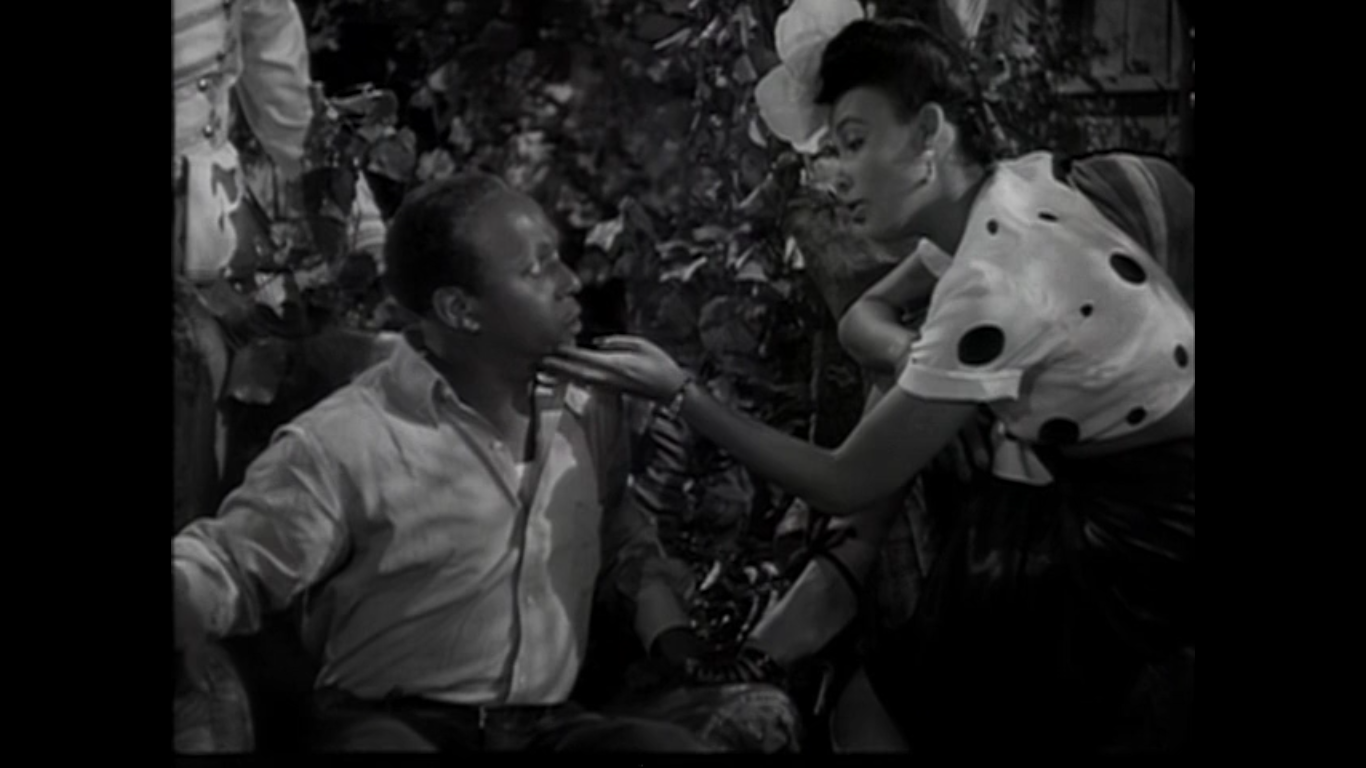
While there scenes in the hellacious office are talky and promote more dubious theology, they spin a couple of webs to entangle Little Joe. First, there’s sweet Georgia Brown. Lena Horne dons her best perfume and polka dots to knock his socks off.

She’s introduced with a sultry jazz motif, moseying along as Ingram plays the serpent kicked back on her bed, whispering little intimations into her ear as if by chance. Horne positively melts the celluloid as she coaxes Rochester toward the path of vice in “Life is Full of Consequence.” It becomes a marvelous dueling duet between the two performers forming one of the core conflicts of the film as Little Joe yowls, “I’ve been burnt more than twice.”

It hardly matters that a bubble bath scene deemed too racy for the era was totally excised. Horne leaves her mark, and it’s a memorable role. However, she deserved better in her career going forward.

Lucifer Jr. is surprised by the human’s steadfast fidelity to his wife and so Louis Armstrong dreams up a new scheme (“Give a man money. Watch him act funny”). An Irish Sweepstakes engenders consequences and misunderstood intentions of its own. It seems secular society has won out as represented by the blasphemous (and ridiculously fun-looking) halls of Jim Henry’s. It’s a hangout full of exuberant snapping, swinging, and Duke Ellington himself.

The overwhelming, overflowing of the moment is a joy to be a part of highlighted by the dapper dancing extraordinaire John Bubbles (John William Sublett). In his hat and cane tap dancing ensemble, ostensibly, it’s hard not to see echoes of Fred Astaire and in truth, in the early days the famed white hoofer was taught and no doubt patterned his style after his Black contemporary.

When Bubbles and Horne get these glorious close-ups to sum up a couple of their numbers, it feels deserved like a resounding show of recognition of careers that were never going to garner the plaudits of their white counterparts.

While not everyone will likely appreciate jazz being equated with worldly debauchery, it serves as a convenient metaphor. In contrast, religion seems regressive and prudish, anti-fun, with a God who is a cosmic killjoy.

The musical’s catastrophic ending is some humdinger. It doesn’t seem like typical Minnelli until we’re met with the aftermath, and we see how wonderfully conceived this smoke-filled, jagged-edge pile of rumble is as a newfound visual labyrinth.

Again, it’s not to be taken too seriously, but Little Joe’s life is reflected as a mission to balance the books in order to get through the pearly gates. After all, the heavenly ledger must be rectified. It’s mostly Hollywood hokum.

Instead, I feel compelled to end with something that moves me. Rock and Roll pioneer Sister Rosetta Tharpe sang the gospel spiritual “Journey to The Sky,” which conjures up a similar metaphor and begins like so:

There’s only one thing that I long for
When I reach that heavenly land
To see my Jesus in His glory
As I go from land to land
There’s only one thing that I long for
When I reach that heavenly land
And I know, I know we shall see Him
In that sweet, oh My Lord, peaceful rest

3.5/5 Stars

Colbert and MacMurray: Gilded Lily, Take a Letter Darling, Egg and I

One of my latest ventures was to view a handful of romantic comedies of the ’30s and ’40s, many with screwball elements, and you could not broach this territory without eventually crossing paths with Claudette Colbert and Fred MacMurray. They starred in 7 films together throughout the decade and also paired opposite some of the most prominent stars of the era (including Clark Gable and Carole Lombard).

Here are three of their movies, two that star both of them, and one with Fred MacMurray in the lead with another worthy romantic partner:

The Gilded Lily (1935)

It opens on a park bench with MacMurray and Colbert chewing the fat as they share a bag of popcorn. What it does is create this instant familiarity going far beyond the bounds of the film as we’re thrown into their relationship that feels more platonic than romantic.

Thus, it’s not so much about the build-up to a prototypical relationship but the chafing that comes with their differing feelings. He has the hots for her. She loves him as a friend but still seems to be looking for her prince charming.

Prince Charming comes in the form of Ray Milland, a rich British aristocrat who’s come to America incognito. You can immediately imagine the complications arising from the fact Peter (MacMurray) is a nosy newshound and the other man has a secret to hide. They’re still to be cast as true romantic rivals and there’s already a tense undercurrent between them.

Meanwhile, Marilyn finds herself having to choose between two men as Lord Charles (Milland) promises a life of cultured sophistication. But Peter is always there, her ever-faithful confidante, and he’s also not going down without a fight.

He churns up the news mills to turn her into a household celebrity and the whole world seems to know her name. Even Charles is tickled by her world-class notoriety, but this is only a paltry imitation. If it’s not evident already, she needs a man who wisecracks, buys her popcorn, and wants to love all of her, whether she’s a big shot or not.

I’m still a bit smitten by the movie’s public bench premise because it allows our stars to do what they do best: laugh at the world together. No one can break their bond, and it teases out new contours to the Colbert-MacMurray partnership.

3.5/5 Stars

Take a Letter Darling (1942)

Although he does have a devoted following, Mitchell Leisen still does feel like a mostly unheralded director in broader circles. Take a Letter Darling is another modest feather in his cap, and it has numerous charms.

The gender norm-bending premise was actually quite intriguing for the era and MacMurray and Russell are more than up to the task of sparring in and out of the office. She’s a high-powered businesswoman who enlists a male secretary who can help her land her deals. He has a very important job: keeping jealous wives satisfied as she trades shop talk with their husbands.

There’s an obvious level of emasculation to the part, and MacMurray is more than game for it as he becomes the laughingstock of the secretarial peanut gallery. You see, he’s MacGregor’s fourth man and she’s running out of options. Still, it’s a lucrative way to bankroll his true passion: painting.

If Claudette Colbert was in fact originally earmarked for the part, I think I’m still partial to Russell in this particular role. I just find her brand of delivery perfectly metered for any kind of antagonistic comedy. And there’s a sense it builds on the kind of workplace dynamics she stirred up with such legendary fervor with Cary Grant in His Girl Friday, between quizzical glances and whipsmart repartee.

I will admit that Take a Letter Darling loses some of its comic edge when it turns saccharine, and the inevitable romance materializes. Until this point, the movie uses its premise to mine a plethora of laughs only to peter out as it makes Russell shed her authoritative business acumen for warm, fuzzy feelings.

However, while the final act can’t quite maintain the same level of comic tenacity, it also doesn’t whimper out as much as I was expecting. Yes, MacGregor wants her man back, but in typical Russell fashion, she crosses paths with him out on the road and comes armed with pebbles. She’s not going down without a fight, and she won’t totally acquiesce. It’s against her nature.

I feel like womanhood, especially in the ’50s, is glazed with this perceived antiquated patina, but watching the likes of Russell, Barbara Stanwyck, Jean Arthur, or even Irene Dunne during the ’30s and ’40s, provides a more nuanced landscape. It wasn’t all marriage and motherhood. They managed to grapple with the lives of modern working women in numerous ways. While Take A Letter Darling is no unsung masterpiece, it’s still easy enough to extend the recommendation.

3.5/5 Stars

Egg and I (1947)

Egg and I is based on a popular real-life memoir by Betty MacDonald, but for anyone who doesn’t remember it, it’s easy to pitch it as the original Green Acres — a Hollywoodized version of Grant Wood’s American Gothic. The fact it began with source material explains Claudette Colbert’s conspicuous introduction to the audience.

Otherwise, much of the movie is forged through comedy of the situation much like the wacky ’60s comedy with mostly mild and goofy trifles to contend with. The long-standing screen chemistry of Fred MacMurray and Colbert anchors the movie as its most imperative asset.

They’ve bought themselves a dilapidated house that’s riddled with leaks during the first rain. And once they’ve hunkered into their new home, next come the daily rituals that come with tending to a farm, and its livestock. They have lots to get used to. However, there’s also the local anthropological element.

Before the “Rural Purge” in the early ’70s, in deference to more urban entertainment, Hollywood has long mined comedy out of eccentric country bumpkins. Egg and I was no different introducing audiences to the first incarnation of Ma and Pa Kettle who became a bit of a low-budget institution in their own right with Marjorie Main and Percy Kilbridge.

One of the representative moments involves the local hoedown where men of all shapes, sizes, and dancing styles whirl Colbert around the dance floor, leaving her feet sore and her ears talked off. However, her greatest concerns are the advances of a local beauty (Louis Albritton), who her husband must do business with. She’s worried it’s a bit more than business, but if you watch him look at her, it does feel a bit silly.

I found the movie to be a bit too long and a tad more twee than it was gripping. Especially because Green Acres had numerous episodes and seasons to engage with analogous themes and character tropes to greater effect.

However, there are a few rewarding moments. It’s easy to recall the almost deceptively moving solidarity when the whole town bands together to loan the couple resources after a devastating fire obliterates their livelihood. For all their flaws, it’s a reminder of the close ties of small communities, and it makes Egg and I easy to root for even if it is mostly light-hearted recreation.

3/5 Stars

Joan Crawford: Possessed, The Damned Don’t Cry, Harriet Craig

In our ongoing exploration of Joan Crawford and Bette Davis’s filmographies, here are three more films building on Crawford’s renewed critical success in the 1940s after Mildred Pierce (1945) and Humoresque (1946).

Possessed (1947)

Possessed opens with Joan Crawford wandering the city streets past cable cars and hamburger joints with a far-off look in her eyes. Although I should briefly clarify this is Possessed from 1947 (as the actress made an earlier movie with the same title). The unknown woman is searching for a man named David, and instantly we have the pretext for our story.

There’s a  wonderful extended POV shot of Crawford being wheeled into the hospital as she is overtaken by a catatonic stupor, and the doctors try to piece together what to do for her and who she is.

If they’re in the dark, then we at least learn a little bit more about her. David (Van Heflin) was a man in her former life, in love with a piano and a parabola but not ready to marry her. He doesn’t want to be tied down and his ambitions lie in his work and a job up in Canada.

She’s obsessed and crazed with him, and the thought of him leaving her forever. Instead, she resigns herself to a life with her employer (Raymond Massey) who has lost his wife and has sent his kids away to school.  Crawford’s not a villain, but how this relationship blooms, there’s another obvious reference point. It’s apparent how the movie blends and finds itself at the crossroads of Double Indemnity and Mildred Pierce.

As her mental instability takes over, it’s almost as if a scene from Mildred Pierce is playing out in her head as she duels with a vitriolic stepdaughter. However, while this feels more like a facsimile of the prior’s year success, it’s really Hefflin who steals the picture’s other half.

Because Possessed finds Hefllin at his most caddish and cold (“My liver rushes in where angels dare to tread”). He has wit like Johnny Eager, but he’s also willing to run roughshod over Crawford without any amount of remorse. He’s a hedonistic, self-serving creature, and it only becomes more evident when the impressionable Carol (Geraldine Brooks) gets drawn in by his casual wiles.

They get married and Louise becomes more paranoid and hallucinatory by the hour. This movie is bookended by her descent into mental turmoil, and it’s hard not to laud Crawford for her genuine alacrity for the part making the rounds of psych wards and facilities just so she could provide greater authenticity. No matter what feels antiquated to our modern sensibilities, the movie is worthwhile for her performance, which seems to come in sharper relief with each subsequent layer of her ever-shifting personality.

3.5/5 Stars

The Damned Don’t Cry (1950)

The film’s title was ripped from a Eugene O’Neil quote, and it gets at the poetic essence of the movie more than its particulars. When a racketeer’s carcass is found ditched near a desert resort, it sets off alarm bells and triggers a search for a missing oil heiress played by Joan Crawford.

The impetus of her entire existence in the film is summed up in a single scene of definitive exposition.  She lives alongside her husband, parents, and their little boy near the oil fields where her husband works. It’s a meager life. They can’t afford pleasure. And so when she splurges to get their son a bright new bicycle, her agitated husband (Richard Egan) tells her to take it right back.

The bike effectively becomes a vehicle for their marital conflict since they are scrimping and saving just to make ends meet. However, it’s also a token of tragedy in Ethel’s life searing her with wounds she will never forget. She leaves her past behind to make a new life for herself as an individual because her corner of familial bliss looks to be dead.

As the story progresses, it feels like a bit of a throwback for Crawford from the ’30s and her days as a driven working girl making a go of it. She learns quickly how to play the game to get ahead, modeling and then doing some overtime with out-of-town buyers after hours.

Then, she literally meets a man, a CPA (Kent Smith), at the water cooler. She winds up sprawled out on his desk asking for a cigarette and making his acquaintance with her self-assured flirtations. She has some misguided notions about his importance and yearly take-home pay. Either that or she confuses her acronyms.

In other words, he hardly has the money to bankroll the evening he has unwittingly been escorted to. Still, she goes to bat for him putting Martin in contact with some of her other “friends.” It starts out with the men discussing business together behind closed doors with Lorna left in the drawing room withing for their return. It feels oddly uncharacteristic because we know Crawford will get into that room eventually (and most likely dominate it).

George Castleman (David Brian) is the kingpin at the top, an elegant self-made mobster fascinated by art and antiquities. He’s trying to keep his cronies in check, the most headstrong of the bunch being Steve Cochran, who’s running the racket out in California. This is not Martin’s world, but Ethel has gotten him into it, and for the time being it’s lucrative enough.

But with her innate ambitions, Crawford’s character always has her sights set on the next prize. With the help of the society pages, she turns herself into the newly-minted heiress Lorna Hansen Forbes.  Going forward, the movie blends the world of some of Crawford’s Pre-Code working-class drams with that of 711 Ocean Dr., another ’50s film concerned with wires, bookies, mob influence, and of course, California desert getaways.

Here it’s a more hands-on approach. For most of the film, Cochran waits in the wings brooding, but he gets his moment in California with some filming even taking place at Frank Sinatra’s own home made up in mid-century modern. Crawford has them all. The whole crux of the drama is composed of these spokes radiating out of Joan Crawford leading to four men who are attached to her at different times.

It gets so overblown and preposterous, and yet you can’t quite look away because the dilemma is made plain. She’s ingratiated herself with so many people to get what she wants, and since she’s caught between so many options, for the first time in her life, she’s not sure what to choose.

Everything must succumb to a bombastic round of Production Code comeuppance where all retribution is neatly doled out and moral ambiguity is left to languish. It makes for a hearty round of theatrics but also a minor disappointment. Because we’ve seen these tactics used in this kind of forced storytelling so many times before. Still, you can’t take the film’s title away. It’s one for the ages. Moreover, Crawford seems more than worthy of it.

3.5/5 Stars

Harriet Craig (1950)

“How many ways do you lie Harriet?” – Wendell Corey

In Harriet Craig, Joan Crawford plays the quintessential domineering lady of the manor. Before we even see her onscreen she has her whole staff in a tizzy as she rushes off on a last-minute visit to her sickly mother. If we can make an early observation, she’s a bit beastly.

Wendell Corey makes her stand out all the more thanks to his free and easy charm as her husband. He’s rarely been more likable playing gin rummy with the elderly Mrs. Fenwick, a woman of good humor and a light in her eye.

As Crawford’s opening perfectionism slowly burns off or at least is put aside, Harriet Craig somehow gives off the sense of an early sitcom of the era. It has to do with the setting and the world — the way the spouses interplay — and it doesn’t seem like the scenario could possibly boil over into something cataclysmic.

At first, Harriet feels nitpicky and fastidious. These aren’t negative qualities on their own per se, and her husband coaxes out brief moments of good humor. However, it becomes evident how deeply manipulative she really is.

Suddenly Harriet Craig becomes a blatant subversion of the portrait of post-war suburban bliss. Walter is offered a job to work with the company over in Japan. It’s a big promotion, and he’s elated. Harriet finds ways to derail this threatening source of change.

She drops a few intimating remarks to keep her orphaned cousin (K.T. Stevens) and her husband where they can serve her best. She gets snider by the day trying to preserve her life under glass.

One of the few who sees through her is the perceptive housekeeper Mrs. Harold, who has faithfully shared Walter’s family for years, but recognizes just how much Harriet is a canker. Her household is all a sham cultivated by its primary architect: Harriet.

Eventually, her pyramid of well-orchestrated deceit begins to tumble as all her half-lies and casual mistruths are found out. In all her neurotic pride, she’s prepared to rot in that house. The irony of the picture is how she’s tried to control everything — she’s particular about every iota of that place — and now that she’s made her own mausoleum, she has to lie down in it. That home is all she has.

I’ve never ventured to watch Mommie Dearest, and far be it from me to pry the fact from fiction, but part of me wants to know how the core faults of Crawford’s character were indicative of her real self. Part of me likes to believe she intuitively made the role into something that resonated with her, whether she fully recognized it or not.

3/5 Stars