
 Like the fella says, in Italy for 30 years under the Borgias they had warfare, terror, murder, and bloodshed, but they produced Michelangelo, Leonardo da Vinci, and the Renaissance. In Switzerland they had brotherly love – they had 500 years of democracy and peace, and what did that produce? The cuckoo clock.
Great films ring anew each time you see them. Or in this case, they twang with the oddly disconcerting strains of zither strings. The Third Man is such a film that continually asserts itself as one of the golden classics of the 1940s. But we must set the scene.
There’s an image of a great city–a formerly great city–blown up, diced up, and quartered. The first syllable of dialogue glibly carrying a twinge of irony lays the groundwork for the entire plot really. This is Post-war Vienna. It’s where the blown out buildings strewn with rubble can exist with the elegant remnants of royal dynasties. A land of black marketeering and shifty-eyed collaboration between wartime allies. It’s deception and ambiguity to the nth degree not only evident in the people but the very social structure they find themselves in. Everyone’s got an angle, a secret to hide, and a reason to hide it. There’s a consistently fine line between right and wrong and the storyline is ripe with incongruities and dissonance that, if nothing else, are disconcerting.
It struck me that this is the original Chinatown except it doesn’t simply act as a mere metaphor. We actually get enveloped in the atmospheric Vienesse world that feels invariably gaunt and hollow. It’s a world that’s flipped upside down and with the hapless American western pulp novelist Holly Martins (Joseph Cotten) as our guide, we become just as mixed up as he does.
He’s come to the town for the prospects of a job offered by an old school chum Harry Lime. But Harry’s not there to meet him. In fact, Harry’s not anywhere. He’s dead. But everything is clouded with that same ambiguity. The military police led by Inspector Calloway (Trevor Howard) and his right hand man (Bernard Lee) are still investigating Lime’s prior dealings on the black market in tainted penicillin. Meanwhile, Martins obviously goes blundering around trying to learn anything he can because these men are obviously incompetent. He scouts around for eyewitnesses and several of Lime’s acquaintances. Most of all he’s taken with Harry’s gal Anna (Valli) who is also torn apart by the death of her Harry. They bond over that although Holly soon becomes infatuated with her as she remains in love with a man who is gone forever.
This is the disorienting world that we are thrown into by Graham Green and director Carol Reed. Where heaven is down and hell is up. Ferris Wheels ever turning, rotating through their cycles. Dutch angles giving every figure a contorted view. We never see anyone for their face value and we can never assume anything. Because there’s always something lurking in the shadows.
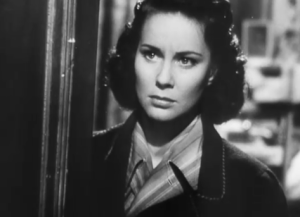 Joseph Cotten is surprisingly compelling as the poor, unfortunate stiff and it’s hard not to feel sorry for him in his ignorance because we can relate with him. Alida Valli is striking as the aloof beauty who nevertheless has an unswerving affection for her former love that remains the only joyous thing in her current existence. Then, of course, there’s Orson Welles as the charismatic myth of a man–arguably the most intriguing supporting character there ever was even if it’s mostly thanks to the legend created by those who knew him.
Meanwhile, Carol Reed’s film is stylish and simultaneously dingy around the edges another gritty entry in the annals of film noir with some of the most beautifully pronounced shadows in the history of film. The final setpiece through the dank cavernous underworld of the Viennese sewers is a fitting place for the Third Man’s climatic moments to play out. It epitomizes all that has been going on above ground so far.
Then in a strikingly Deja Vu moment, the story ends much as it began in the exact same place with the exact same people but now there is so much more tension underlying each character. Feelings now buried in the dirt.
And in his final shot, Reed is fearless. He plays a game with the audience, giving them their final shot but instead of bringing it to a rapid conclusion he lets the gravity of the situation sink in before it’s gone in a fit of wistful melancholy. It ends as all films noir should with one man dead, another man smoking a cigarette, and the girl walking off with neither of them. It’s about as bleak as you can get but then again we’ve already spent the entire film getting accustomed to this lifestyle. This is only a day in the life of a city like Vienna. This is what life is in a post-war zone.
5/5 Stars
Note: I will say that I rewatched the film on Netflix and I would vehemently dissuade others from doing the same (at least if they’ve never seen The Third Man before). Because one major change they made that you would hardly even think about is adding subtitles in some crucial moments. When I saw the film multiple times before the lack of subtitles only added to my general sense of confusion in the face of ambiguities, much like Holly Martins faces himself. Subtitles take some of that away from us as an audience. In this case, the subtitles are tantamount to colorizing black & white movies or resorting to pan and scan. They can easily ruin the experience.
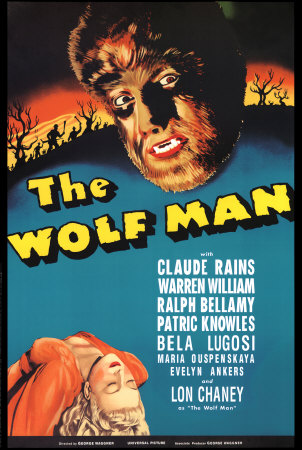 Even a man who is pure in heart, and says his prayers by night; May become a wolf when the wolfbane blooms and the autumn moon is bright.
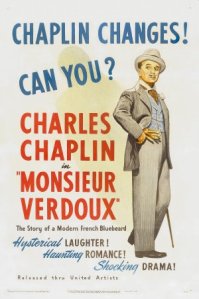 Prior to the making and release of Monsieur Verdoux Charlie Chaplin had undoubtedly hit the most turbulent patch in his historic career and not even he could come out of scandal and political upheaval unscathed. To put it lightly his stock in the United States plummeted.
 Cat People has one of those sensationalized B-picture premises and there are moments when its meager aspects let slip that this is a low-budget effort, but within those restrictions, it moves with a certain purpose and chilliness. It’s true that producer Val Lewton had a B-movie renaissance going on at RKO Studios and Cat People is one of his treasures.
 At Oliver’s work, talk around the water cooler is made compelling in that his best pal and colleague is the sensible Alice (Jane Alexander) always ready to lend a listening ear. She’s genuine in accepting Irena for who she is because she can tell that Oliver earnestly loves her. But at the same time, she serves as a contrasting figure — someone who is completely different than this enigmatic creature.
 Initially, I Remember Mama comes off underwhelmingly. It’s overlong, there’s little conflict, and some of the things the story spends time teasing out seem odd and inconsequential at best. Still, within that framework is a narrative that manages to be rewarding for its utter sincerity in depicting the life of one family–a family that feels foreign in some ways and oh so relatable in many others.
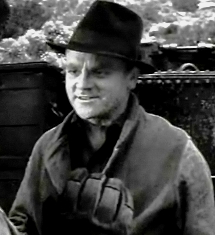 White Heat burns like hot coals even today as the epitome of incendiary cinema. It’s a gangster picture from master Warner Bros. craftsman Raoul Walsh that’s volatile and intriguing, highlighted by the always fiery James Cagney as a crazed man-child with a mom complex.
 John Garfield was never the most dashing of leading men but nevertheless, he was always thoroughly compelling as ambitious working class stiffs during the 1940s. He had a straightforward tenacity about him like he had to fight his way to the top. At the same time likable and destined for trouble right out of the gates. You can cheer for him and still rue the decisions that he makes. That’s what makes his foray as boxing champ Charlie Davis all the more believable. His aspirations are of a very real nature and they give his character a genuine makeup.
 Films Noir often find their hooks in lurid titles but also in metaphor. Ride the Pink Horse fits into the latter category as pulled from the pages of Dorothy B Hughes and adapted by Ben Hecht & Charles Lederer. The horse can be taken in the literal sense as one of the wooden animals that go round and round on the local carousel but there’s some symbolism in this opulent creature. In some distant way, it’s the fantasy of a different life that every man seems to crave when he doesn’t have it. But still, he strives and grinds to get closer and closer to it. More often than not he does not succeed in finding so-called contentment.
 And it’s from these opening moments that we try to get a line on Gagin by watching his every move and word. He’s brusque and abrasive with almost crazed features — constantly suspicious, demanding, and sour. He had a little too much cyanide for breakfast (although he does like fruit cocktail). Just as we watch him with interest, his probing eyes case every joint and every person he comes in contact with. Because, if it’s not obvious already, he’s not come to San Pablo for R & R. He’s come to town to avenge his dead army buddy, who was double-crossed and put out of a commission by a very big man (Fred Clark).
 Just as there is a cultured femme fatale (Andrea King), her counterpoint is the tentative Pila (played sympathetically but rather unfortunately by Wanda Hendrix), who floats in to watch over Gagin even when he doesn’t want her around. She stays anyways.
 Our introduction to The Mortal Storm feels rather flat. Bright and bland in more ways than one as we become accustomed to our main storyline. Professor Viktor Roth (Frank Morgan) is held in high regard all throughout the community as a prominent lecturer at the local university and beloved by his colleagues and family. The year is 1933 and the Bavarian Alps are still a merry and gay place to live. That’s our understanding early on as the Professor celebrates his 60th birthday with much fanfare and receives a commemorative memento from his class.
 Its title suggests that this film might be something like Lubitsch’s Heaven can Wait but The Devil and Miss Jones could easily hold the title as the original version of Undercover Boss. Although its main function is on the romantic and comic planes, it also has a bit of a social message behind it that signals for change.
 4 Star Films