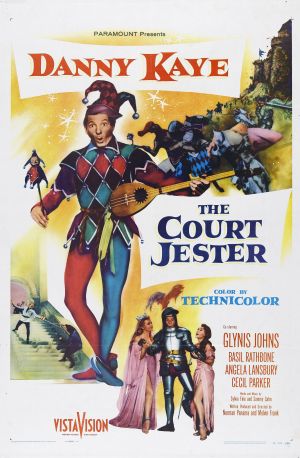
The Court Jester (1956)

ad192-thecourtjesterposterStarring Danny Kaye with Glynis Johns, Basil Rathbone, and Angela Lansbury, this comedy of errors has a man posing as a court jester in order to assist the true heir to regain his throne. After infiltrating the castle, Kaye unknowingly gets mixed up in a murder plot, falls under the spell of the witch, and must complete his mission, all the while posing as the funny man. However, he finds himself accidentally jousting for the king’s daughter as well as dueling while his beautiful accomplice tries to bail him out and save their plan. Despite all the mishaps, more often then not everything turns out right and that goes for the ending too. Danny Kaye is hilarious and some of the scenes are classic including the snapping spell and the chalice from the palace. It is certainly evident after watching this film that life could not better be!

4.5/5 Stars

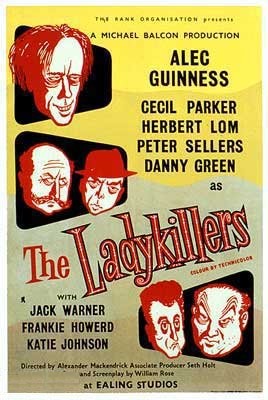
The Lady Killers (1955)

c0838-the_ladykillers_posterStarring Alec Guinness, this is a unique and often hilarious black comedy caper film by the Ealing Studios. The adventure begins with the quirky criminal mastermind, Guinness, renting a room from an old woman. Soon his masquerading accomplices arrive. The five of them plan to commit a robbery and when the day comes things start off smoothly. However, they have the unknowing old woman pick up their prize and chaos follows her. The men get the money but before they can escape the lady accidentally finds out. The latter half of the film follows the double crossing antics of the criminals as they try to run off with the money while trying to figure out who will do the unpleasant job of knocking off the lady. Needless to say they don’t succeed. I was wary of this movie at first but it was actually very enjoyable because of the comedic and odd scenario. Keep your eyes on a young Peter Sellers as well as Herbert Lom.

4.5/5 Stars

Rear Window (1954) – Alfred Hitchcock

02805-rearwindowposterStarring James Stewart, Grace Kelly, and Raymond Burr with director Alfred Hitchcock, this is a superb film that takes place in a very limited space. L.B. Jefferies (Stewart) is a professional photographer who is incapacitated in his flat with a broken leg. All he has to pass the time is watching the people across the courtyard. Although he very rarely interacts with them, he slowly begins to know them just by spectating. Pretty soon he realizes something is amiss when the annoying wife across the way is no where to be seen and her husband (Burr) is acting strangely. With help of his ravishingly beautiful girlfriend (Kelly), Jeffries tries to uncover the truth. Everything escalates when Lisa breaks into the man’s apartment and it finally peaks in a climatic confrontation. In the end all is well and Jeffries realizes his true love. This is one of my favorite films because of its unique setting and it is possibly Hitchcock’s best. He takes an environment that is so confined and then makes a very entertaining and suspenseful film with it.

5/5 Stars

High Noon (1952)

14bd7-high_noon_posterThis may not be the greatest film of all time, but it is certainly one of the greatest westerns gifted to us so generously by Fred Zinnemann. It tells a very simple story, yet it is, in fact, so powerful simply, because of the hero it depicts. In its time it also served as a condemning allegory of the finger pointing going on in Hollywood.

*May Contain Spoilers

The film tells the story of Marshall Will Kane, who is willing to face his foes even when no one else will help him. Gary Cooper plays the newlywed lawman, who must flee town or face the killer coming on the noon train. He resolves to do just that, despite the pleas of his loving wife (Grace Kelly). The sheriff scrambles against the clock to get help. However, no one is brave enough to face the enemy with him. Even with the odds against him, he faces them in a showdown. Cooper is outgunned, but not outmatched — heroically prevailing.

This film is so powerful, because it is full of human emotions, and it feels so real since the events unfold almost in real time. The somber ballad, sung by Tex Ritter, also helps to create the mood right from the opening credits. In fact, I must admit that multiple times I have found myself humming or crooning the words, but then again I suppose it makes sense since the song is woven into the very fabric of the film.

The score by Dimitri Tiomkin utilizes the tune throughout to complement the images of the town. In that respect, “Do Not Forsake Me, Oh My Darlin'” is not just a song, but an important piece of this story. It is easy to forget the supporting players since Cooper often steals the show. Nevertheless, there’s Lloyd Bridges, Grace Kelly, Katy Jurado, Thomas Mitchell, Lon Chaney Jr.,  Harry Morgan, and even a young Lee  Van Cleef. Many have pasts with Kane that we cannot expect to fully know. All we can understand is the here and now that causes a person to weigh their options, and either follow or go against their conscience. Kane and then his bride both did what they thought was right even when others would not follow suit.

It struck me how simple the story is, and yet on the other side, it is a complex allegory that critiques humanity. Will Kane is a man, who helped make the town what it is, but when trouble comes and the odds are bad no one is willing to help him. Besides the obvious positives like a good story and a heroic protagonist, this film stands out because it feels so human. Here we are as an audience watching the events unfold almost minute for minute. Then we see the various town folk and their fear of getting involved, and to make matters worse a lot of them are Kane’s very good friends. It makes us question what we would have done in their position. Because some of them were obviously good people, who were scared to be involved. Of course, during this time McCarthyism was prevalent and it is suggested that this film alluded to that. However, whatever you think it is still unquestionable that High Noon is a powerful film, a love story, and at its simplest a classic western.

5/5 Stars


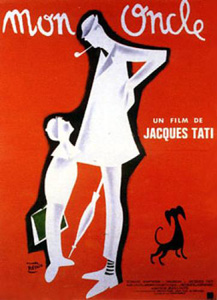
Mon Oncle (1958)

32cfb-mononcle_posterStarring and directed by Jacques Tati, the film revolves around the bumbling but kind-hearted Monsieur Hulot, as he interacts with his relations and young nephew. We follow Hulot as he navigates through his life in France. His sister and brother-in-law live in an ultra modern home complete with automated machines, a fish-shaped fountain, and cold-looking furniture. In contrast, there’s the carefree Hulot whose only possessions seem to be his ever present pipe and umbrella. He struggles to cope with everything modern and bungles in his brother-in-law’s factory. However, most importantly he seems to enjoy life and he is liked by all including Gerard, his nephew. This film is enjoyable because of the little things. You have the often repeated theme that brings to mind Parisian cafes. There is satire, odd architecture, little dogs, the use of or the lack of sound, many caricatures, and most importantly of all Hulot himself. It would seem to me he bridged the gap between Chaplin and Keaton with Mr. Bean. Too bad more people do not know about him.

4.5/5 Stars

Mr. Hulot’s Holiday (1953)

01c54-les_vacances_de_m_hulotDirected by and starring Jacques Tati, this is the original film that introduced the bumbling but kindly Mr. Hulot. He finds himself staying at a beach side hotel full of various different tourists. The film is not so much about plot but instead it focuses mostly on Hulot’s many antics. Whether he is paddling a kayak, playing tennis, changing a tire on his beat up car, trying to mount a horse, or accidentally setting off fireworks, Hulot is bound to cause laughs. This film is unique because as with Tati’s other works the pacing is not fast. That means we are able to relax and enjoy this vacation along with Mr. Hulot. We can take in the many sounds and images while we also watch this likable bumbler. Maybe Tati did not know it at the time but he created a memorable persona in Hulot who has his own distinct movement and attire. Without talking at all he leaves such a tremendous mark. If there was ever an influence on Mr. Bean I think the origins would definitely start with Monsieur Hulot.

4/5 Stars

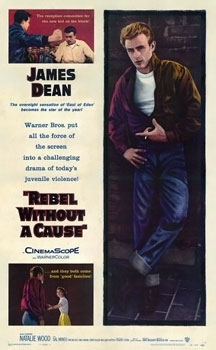
Rebel Without a Cause (1955)

A film starring James Dean, Natalie Wood, and Sal Mineo,  with direction by Nicholas Ray, Rebel Without a Cause follows three teenagers, who are confused and conflicted about their lives. 

The initial sequence rolling behind the opening credits has the inebriated Jim Stark lying in the street fiddling with a toy monkey. Then, he is brought into juvenile hall, and simultaneously the story gives us a glimpse of not only the rowdy Jim, but discontented Judy, and the distant boy Plato. Each one has their own personal pain, and thus this film from the beginning really focuses on three rebels, who embody the adolescent generation. James Dean is Jim Stark: the new kid on the block, who is constantly moving with his parents. In the station when his parents retrieve him, there is obvious tension on all fronts, which include heated arguments, and outbursts on the part of Jim.

The morning after being brought in he meets Judy only to get mixed up with her friends. Stark however also befriends the isolated loner Plato, who was in the station the night before. The trouble with the other teens starts with a switchblade contest during a school excursion to Griffith Observatory, but the stakes get bigger when they compete in a “Chickie Run” over a cliff. Stark lives but the other boy, Buzz, dies in the accident. Everyone flees the scene before the police arrive.

Stuck between a rock and a hard place, Dean and Wood’s characters gravitate towards each other. Their parents seemingly do not understand them, and so they find comfort in each other instead. Their new found friend Plato tags along as they hold up in an abandoned mansion for the night. They spend the evening lounging around, making light of their parents and just talking. 

However, all does not bode well when some of the high school thugs come looking for Stark. Plato flees the scene with a gun, and soon he has policemen on his tail. Plato is in a paranoid and unstable state. Jim tries to console him and bring him out peacefully. But despite his best efforts, tragedy strikes one final blow.  All is not wasted, however, because Jim’s father (Jim Bachus) vows to be a better and stronger parent than he was before. 

Following his breakthrough in East of Eden, Rebel would be the movie that defined Dean’s short but iconic career. His line “you’re tearing me apart!” would further define the angst felt by many teens at the time. There is a certain aura around this film for some reason, maybe because of Dean’s portrayal that is at times so moody, and at other times so subtle, but powerful nonetheless.

I think part of the credit must go to director Nicholas Ray, who gave Dean free reign to improvise and develop his character in the way he saw fit. The film is tragic in another sense because all the primary stars died at an early age. Dean’s is the most remembered, but Mineo and Wood, both died extremely young as well. In Rebel Without a Cause, they all gave memorable performances and there are other notable players in this film including the usually comedic Jim Bachus and a very young Dennis Hopper.

I think Rebel ultimately survives today because it tells a universal tale of a generational divide and a divide between young people fighting peer pressure. In the heads of teenagers the world can become jumbled and between school, fitting in, and home life it can be a struggle. This film dramatically illustrates that fact. So maybe the kids look different, the cars are older and such, but the struggles of Jim Stark, Judy, and Plato are still relatively the same.  I must say this film really makes me want to visit the Griffith Observatory too, because it became such an integral part of this film’s story, and it is still around to this day.

James Dean only had three major film performances and you could make a case for which was the best. I think it is safe to say that this role was his most iconic. It’s hard not to identify him with his red jacket, blue jeans, and the ubiquitous cigarette. He was the Rebel Without a Cause.

 
5/5 Stars

The Night of the Hunter (1955)

83767-nightofthehunterposterDirected by Charles Laugton and starring Robert Mitchum, Lillian Gish, with Shelley Winters, the film tells the story of a preacher who epitomizes a wolf in sheep’s clothing. While serving a short sentence in jail, this “preacher” (Mitchum) learns from another man who is to be hanged that he hid $10,000 near his home. Intent on finding it, the fanatical man slithers his way into the life of the man’s widow (Winters) hoping to find the money by using her kids. They are adamant to not tell where it is and they soon discover what kind of man he is. After he murders their mother, the two children flee down the river. There they are taken in by a hospitable Christian woman (Gish) who has other orphans. They grow to love and trust her as their own mother. However, the sly preacher is bent on taking them away along with the money. Gish realizes his evil and has none of it. In the final scenes it is proved that love always wins over hate. This movie is certainly chilling, and disconcerting but the latter half I found especially good. Laughton deserves credit and the acting was good as well.

4.5/5 Stars

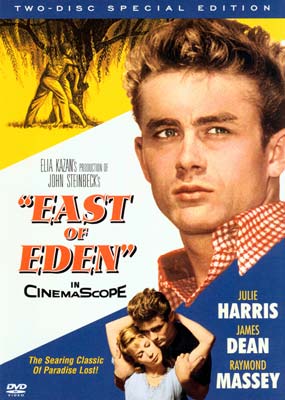
East of Eden (1954)

In his first great film role, James Dean plays a rebellious son named Cal Trask who lives with his father and brother Aron in Salinas. Directed by Elia Kazan from the Steinbeck novel, the movie chronicles Cal’s struggles in the shadow of his favored brother Aron. Despite good intentions at first, Cal is constantly rejected the praise that his brother garners. Thus embittered, he lashes out at his brother, falls for Aron’s girl, and turns their father’s world upside down. With his performance Dean brings alive the character who is himself an allegory for Cain. Julie Harris, Raymond Massey, and Jo Van Fleet all deliver good performances that play off Cal. Overall this is a classic adaption of a classic author. 

 4/5 Stars

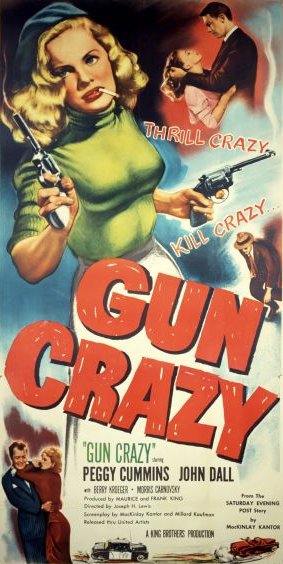
Gun Crazy (1950) – Film-Noir

Starring John Dall and Peggy Cummins, the film opens with a young boy who is infatuated with guns. After stealing a gun from a hardware store, Bart is sent to reform school even though his friends and sister testify he would never kill a living thing with it. Bart spends some time in the army and finally returns home grown up. He goes to a carnival with old friends and meets a female sharpshooter. She gets him a job and they grow close only to be fired from the carnival. They get married and are happy for awhile but then she gives him a choice. Either they start robbing stores fro money or she will leave him. Reluctantly he agrees and they begin to get a little money robbing stores and gas stations. It is not enough so she convinces him to pull one last job so they can live a content life together. They begin working at a meat packing plant in preparation. The day arrives and they succeed but then Laurie shoots two people out of fear much to Bart’s horror. They must split up and the manhunt begins. The FBI track them down and the only place to go is back home. His old friends plead with him to surrender but they flee into the mountains with the authorities hot on their trail. They are trapped and Laurie is desperate once again but Bart cannot bear it anymore. Despite the tragic ending Bart ultimately redeems himself but it is too little too late. This was a precursor to Bonnie Clyde and it has its share of tense moments.

4/5 Stars