Mirror (1975)

the mirror 1975.png

Andrei Tarkovsky has already left such an indelible impression on me even after only seeing a couple of his films. This already makes it very easy to place him atop that ever fluctuating, never quite established, constantly quarreled over, list of the greatest filmmakers of all time. He’s subsequently one of the members of the fraternity with the least recognition; the key is visibility or lack thereof. Because once you see his work, even if it doesn’t completely speak to you, something is released that’s all its own with a singular vision and the unmistakable brush strokes of an auteur.

There has never been a film more fluid and uninhibited in the distillation of memory than Mirror as it slowly slaloms between the past and the present, enigmatic dreamlike movements with unexplained conversations and encounters, spliced together with bits of wartime newsreels and spoken poetry.

In order to even attempt to ingest any of this rumination at all, there’s a near vital necessity to shed all the traditional forms and languages that you have been taught by years of Hollywood moviegoing.

Not that they are completely excised from Mirror but it’s never driven by logical narrative cause and effect. Rather it’s driven by emotion, rhythm, and feeling — what feels intuitive and looks most pleasing to the eye.

It’s precisely the film that some years ago might have been maddening to me. Because I couldn’t make sense of every delineation culminating in a perfectly cohesive, fully articulated thesis, at least in my mind’s eye. It’s far too esoteric for this to happen. But this unencumbered nature is also rather freeing. There’s no set agenda so as the audience you are given liberty to just let the director take you where he will.

To its core, Mirror gives hints of a very personal picture for Tarkovsky as it memorializes and canonizes pasts memories and shards of Soviet history. Because they are tied together more than they are separate entities. And yet, as much as it recalls reality, Mirror is just what it claims to be. It is a reflection. Where the world is shown in the way that we often perceive it.

The jumbled and perplexing threads of dreams, recollections, conversations, both past and present. Childhood and adulthood, our naivete and our current jaded cynicism, intermingled in the cauldron of the human psyche. Back and forth. Back and forth. Again and again.

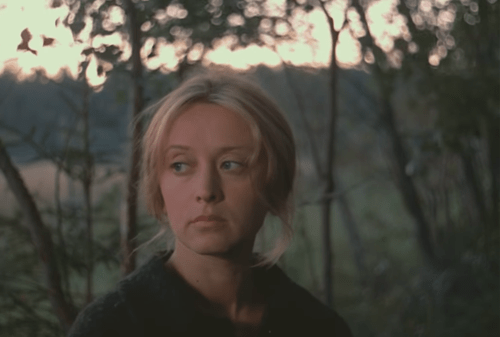
Because what we watch is not simply about one individual. As with any life, it’s interconnected with others around it. A woman (Margarita Terekhova) sitting on a fence post during the war years in an interchange with a doctor. In the present, Alexei, our generally unseen protagonist, converses with his mother over the phone. We peer into the printing press where she worked as a proofreader. Rushing about searching for a mistake she purportedly made. Regardless, it hardly matters.

In the present, Alexei quarrels with his estranged wife on how to handle their son Ignat. The fact that his wife is also played by Terekhova is more of a blessing than a curse. In a passing remark, he notes how much she looks like his mother did and it’s true that she is one of the connecting points. Even as she embodies two different people, the performance ties together the two periods of the film. Visually she is the same and that undoubtedly has resonance to Tarkovsky.

As the film cycles through its various time frames so do the spectrums of the palette. The color sequences have a remarkably lovely hue where the greens seem especially soft and pleasant as if every shot is bathed in sunlight. It’s mingled with the black and white imagery as the story echoes back and forth, past and present, between different shades and coloring. But whereas these alterations often provide some kind of cinematic shorthand to denote a change in time, from everything I can gather, Tarkovsky seems to be working beyond that.

Because there are scenes set in the past that are color, ones in the so-called present that are monochrome, and vice versa. It’s yet another level of weaving serving a higher purpose than merely a narrative one. If I knew more about musical composition I might easily make the claim Mirror is arranged thus — the cadence relying more on form than typical cinematic structure.
mirror 2.png

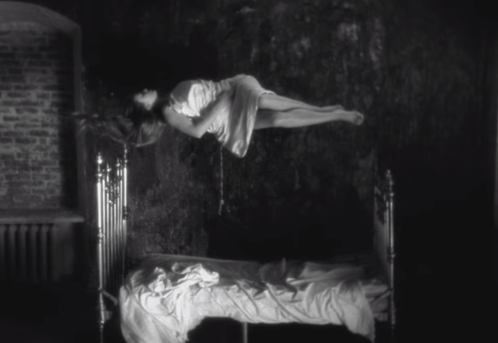
That and we have Tarkovsky’s long takes (though not as long as some) married with his roving camera that nevertheless remains still when it chooses to. The falling cascades of rain are almost otherworldly in their spiraling elegance. The wind ripping through the trees a force unlike any other though we’ve no doubt seen the very same thing innumerable times. Fires blaze like eternal flames. Figures lie suspended in the air, isolated in time and space. Each new unfolding is ripe for some kind of revelation.

We also might think our subjects to be an irreligious people but maybe they still yearn for a spirituality of some kind. I’m reminded of one moment in particular when, head in her hands, the wife asks who it was who saw a burning bush and then she notes that she wishes that kind of sign would come to her. If there is a God or any type of spiritual world, the silence is unappreciated.

I recall hearing a quote from the luminary director Ingmar Bergman. He asserted the following, “Tarkovsky for me is the greatest, the one who invented a new language, true to the nature of film, as it captures life as a reflection, life as a dream.”

The words are striking to me because you could easily argue Bergman’s films also had such an ethereal even refractive quality. Look no further than Through a Glass Darkly (1961) or Persona (1966) and this is overwhelmingly evident. And yet he considers Tarkovsky the greatest.

This isn’t the time or place to quibble over the validity of the statement. But it seems safe to acknowledge the effusive praise the Soviet auteur has earned for how he dares play with celluloid threads and orchestrate his shots in ingenious ways. He exhibits how malleable the medium can be as an art form while never quite losing its human core.

4.5/5 Stars

Badlands (1973)

badlands 1.png

I’ve always maintained a great admiration for Terence Malick, even after only seeing two of his most renowned pictures, Days of Heaven (1978) and Tree of Life (2011). This a testament to his intuitive understanding of the image and how gloriously sublime it can be. It’s true his pictures seem to exist in their own strata, part reality and then this heightened stratosphere verging on the ethereal.

Now I’ve seen a third, his arresting directorial debut Badlands, and it remains obvious that though his career has progressed, his films at their very essence have remained the same. Malick is a Texas native who attended the AFI Conservatory and became a pupil of Arthur Penn.

It’s true you can see a cursory similarity in content between the likes of Bonnie and Clyde (1967) and this picture because we have the archetypal love-on-the-run narrative. But there’s hardly any confusing them in terms of execution.

Penn’s picture is upbeat, sensual, and almost flippant with these youths in revolt. It does feel like a kind of a statement for the 1960s. But Malick’s film is entirely matter-of-fact, a bit detached, and mystical. Even the music plays into this almost timeless quality that sets it outside of a specific timeline even as it functions as a kind of period piece.

We have a vacant serenity playing a backdrop to all the action with canvasses bathed with soft hues of light. As best as I can describe it there’s a dreamy, gossamer-like tint to the imagery. It feels warm and welcoming at first with a calm cadence until it no longer can exist as such.

Aided by Sissy Spacek’s innocent gaze of mundane wonderment in the world, it’s a southern story of the grimiest sort, which somehow winds up being a fairy tale romance in her eyes. Her voiceover is what holds the film together and never allows it to lose this illusory quality.

Loosely based on The Starkweather case, Kit Caruthers (Martin Sheen) is a high school drop out who collected garbage for a time and fashioned himself after James Dean’s rebellious reputation. He introduces himself to the hesitant, naive Holly Sargis (Sissy Spacek) who nevertheless finds him intriguing. Though many years her senior, they start accompanying one another, much to her father’s chagrin (Warren Oates). He knows the boy is no good.

Kit was never someone to let others dictate his life for him and with cool calculation, he moves forward with a plan, taking Holly with them as he goes out on the road. They commence a life together out in the open and it feels a bit like Robinson Crusoe. It’s no small coincidence they read Kon Tiki while lounging in a tree house they have constructed by themselves. It’s a far cry from its predecessors at this point.

Like Bonnie and Clyde, Badlands is a film depicting killings dotted across the land and yet they are, again, matter-of-fact, even forgettable, which seems terribly callous to admit. But there simply is not the same blatantly violent, in your face, bloodshed of the earlier picture. Continually any amount of drama is replaced with a trance-like dreamscape, aided by the fact writer, producer, director Terrence Malick was never one for intricate, pulse-pounding plotting.

badlands 3.png

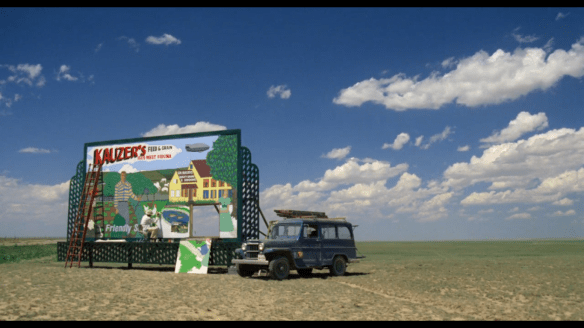
He is a filmmaker and he gifts us indelible panoramas of America. A billboard set up against rolling prairies and the most glorious of cumulonimbus clouds. Naturescapes cultivated with luscious greens that might be found in Rohmer’s Claire’s Knee (1970) and frolicking easily at home in the works of Renoir. Conversely, we have a house burning that feels like an otherworldly funeral pyre. The old must burn to give way to the newfound promised land Kit and Holly are embarking for.

While the image is always paramount in a Malick film, one could argue the music also has a hallowed place with Carl Orff’s “Gassenhauer” adding this oddly tinny, adventurous note to the score. Then, Nat King Cole’s “A Blossom Fell” provides an immaculate encapsulation of romantic ideals whether our fugitive lovers are driving, dancing, or just taking in the scenery. It’s perturbing to have something so melodious play in the wake of such brutality.

To say the film reaches a conclusion is slightly deceptive. More so, it simply fades away. Finally, some local police catch up with them. First, they send a helicopter and then a police car is dispatched. Holly is left behind and caught. She recounts how she moved on with her life after Kit, getting off on her charges and marrying the man who defended her. And Kit was caught too but it came on his own terms. He accepts it with his usual unemotional equanimity.

Watching Martin Sheen in these moments is riveting because he seems content with how things have run their course. As friendly and personable as you might expect and yet capable of such dehumanizing evil. It’s the dissonance of these scarring acts of aggression followed by him pragmatically fielding questions with the media and then being shipped off to his execution with his guard wishing him well. How can such a man exist?

There is no reason to Kit. He simply commits to actions, which are completely detached from any feeling. And yet he is simultaneously capable of some amount of human connection and camaraderie. It leads me to surmise he is a character who could never exist outside the context of celluloid. There you have part of what makes him such a compelling study. Because other films have already filled out the contours of disillusioned antiheroes and killers to our heart’s content.

Like any admirable filmmaker, Malick provides us with a novel distillation of age-old themes. He makes the accepted paradigms feel fresh and perplexing again. Thankfully for us, he’s never ceased going down a road paved with his own vision and personal preoccupations. Because at its best, his individuality is capable of speaking to willing audiences in fundamentally unique ways.

4.5/5 Stars


Aguirre, The Wrath of God (1972)

aguirre the wrath of god 1.png

The making of Aguirre, The Wrath of God might be as rich in myth as the film itself which charts a semi-fictitious story of Francisco Pizarro’s expedition to discover the golden kingdom of El Dorado. Not only was it the beginning of director Werner Herzog’s notoriously stormy partnership with Klaus Kinski, but it was also shot entirely on location in Peru — a logistical nightmare in its own right.

Herzog purportedly penned the screenplay in a matter of days while riding the bus with his football club. Meanwhile, many of his resources including his camera and film stock had been purloined from Munich Film School years earlier as required tools of his trade.

In conception alone, it proves titillating as a piece of Spanish history from the point of view of a monk, Gaspar de Carvajal, traveling in a pioneering convoy led by the crazed adventurer Aguirre. But it is colonial history by way of West Germany circa 1972.

The opening images are some of the most breathtaking in the film or maybe in any film. We are instantly hooked as angelic tones herald from above and shrouds of mist engulf the mountaintops. Legions of men and natives weave their way down through the treacherous territory. It feels instantly recognizable.

Because I recall hiking up the side of a mountain one Christmas vacation with friends. As we wound our way up and I could see the edge and the drop off below, I realized rather matter-of-factly, “I really don’t like heights that much.” It comes with playing minds games. Caring too much about where you’re feet are and imagining yourself taking a false step and ending up in the chasm. Tossing some biodegradable object down there is certainly invigorating as it spirals down until you think to yourself that might just as easily be you.

Some of those same friends, more adventurous than me would actually go on to hike Macchu Pichuu the next year. Long story short I wasn’t available but I’m not sure if I would have joined the trip. Far from simply being a long-winded illustration of my cowardice or lack of adventurousness, I think it somehow makes sense in relation to the mesmerizing introduction of Werner Herzog’s Aguirre, the Wrath of God.

There are those same perilous heights presented here simultaneously awesome and equally harrowing. For good measure, we watch a container of what looks to be chickens dropped and go hurtling down to the rocks below with a crash. We half expect a couple of people to follow.

This trailblazing along the Amazon River totally embroils them in the muck and the mire. Slaves are seen clumsily carrying a cannon and a lady’s litter in the most forsaken of places. It’s absolutely ludicrous. Next, they tackle the rapids on hastily constructed rafts. If you’re prone to seasickness don’t even dare watch the sequence which is yet another instance of fully enveloping cinematography.

The camera spattered with water is continuously bobbing up and down enough to make even a viewer queasy. The incredulous thing is we are only an outside observer and yet we get impacted so. It becomes increasingly apparent Werner Herzog will readily allow himself to suffer for his art. Not just in this picture but from everything I know Fitzcarraldo (1982) too. He doesn’t fudge on any of the locations. Why do this to himself? Just look at the results for your answer.

Green screens, CGI, studio lots. None of those methods could give us anything half as real as this picture. They seem positively quaint and nondescript compared to the astounding atmosphere he’s able to capture. It’s the same authenticity here validating such laborious works as Apocalypse Now (1979) or The Revenant (2015).

aguirre the wrath of god 2.png

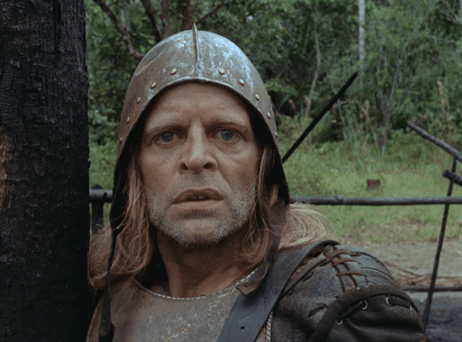
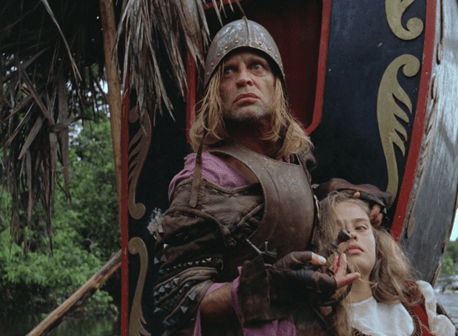
Meanwhile, Kinski totters around the space half like he’s drunk, the other half pure craziness. The film benefits by this razor-thin dividing line between fiction and reality not simply in its environment but also in its actors. He reminds me of the animal magnetism of Toshiro Mifune in a picture like Seven Samurai (1954). You can’t help but keep your eyes on him for the next unthinkable thing he’s about to do.

The weight of Kinski’s crazed performance comes mostly out of the fact that we constantly expect him to do something completely unhinged. He treads dangerously right on the precipice of sanity ready to jump at any moment. Furthermore, Herzog never leaves him alone. His face is constantly being examined time and time again because personal space is all but nonexistent.

Aguirre, The Wrath of God settles into a status quo that is far more pensive than I was expecting. The narrative is full of insurrection but more pervasive is the ever-present dangers suggested by negative space, undoubtedly swimming with stealthy savages. And the fear of the great unknown never ends.

People are killed or die with little fanfare. Those soldiers still living suffer from fever and malnutrition. Their king propped up by Aguirre is an oafish lout. In the figure of Caravajal especially one is further reminded of the oppressive guise Christianity took in this age like many others before and after. Outsiders come in with such a hypocritical superiority complex.

In the end, the only thing Aguirre commands is a raft swarming with monkeys, frankly one of the most indelible images in the film and a fitting point of departure. Though it’s mere coincidence, I watched Terrence Malick’s film Badlands (1973) recently. What it shares with Aguirre which is so captivating is this illusory quality. We have a framework of a conventional tale, in this case, an adventure into the dark murky depths of uncharted territory. And there are moments when we have mutiny, death, starvation, momentary battles but what sets it apart from anything else is the imagery.

Like Malick’s picture, it verges on the dreamlike in a way that is utterly hypnotic. The power is not so much in the excess of things happening one after another but in this continual, unswerving articulation of near monotonous insanity.  In both films, a certain kind of madness takes over and becomes the new status quo. Somehow Aguirre manages to be so immersive and yet leave us still feeling so detached at the same time. The descent into hellish depths is a shared experience, as much documentary as it is historical fiction. But it is also a hallucination.

4.5/5 Stars

NOTE: This is my entry in THE GREATEST FILM I’VE NEVER SEEN BLOGATHON hosted by MOON IN GEMINI!


Tristana (1970)

tristana 1.png

In the Hebrew Pentateuch, the Levitical law lays out a framework of precepts quite clearly that the people were meant to follow. One iteration can be paraphrased like so: If a man marries both a woman and her mother it is perversion. There must be no wickedness among you.

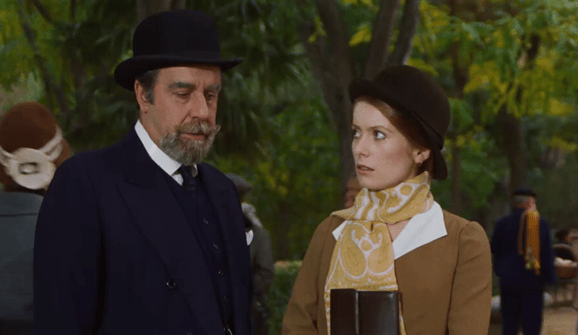
Doing a once over of the Spanish elite Don Lope (Fernando Rey), we see in him a man who came out of nobility and nevertheless lives a fairly humble life for the very fact that he’s never held a day job. He’s upper class by title and pretense only. Subsequently, his moral makeup is very much the same as he nobly provides a home for an orphaned ingenue (Catherine Deneuve).

Like his status, it is nearly all for show. It’s under the pretense of charity and the guise of a gentleman that he takes in the young Tristana, still in mourning following her dear mother’s death. Don Lope touts himself as a gallant defender of the weak and undoubtedly sees himself as a dying breed of man. Still, as his devoted housekeeper, Saturna remarks, when it comes to women he’s got horns and a tail. It’s hardly a secret.

We note the times in Spain during the 1920s or 30s. It is an irreligious generation as reflected in the deterioration and lack of importance placed in the church bell tower which used to be crucial to the daily rhythms of people’s lives. Now they’re too distracted by other pleasures.

Don Lope for one, does not concern himself with issues of money. Haggling is of great distaste to him. Instead in the quiet corridors of some great cathedral, he asks Tristana for a clandestine kiss. It’s the root of his perverse desires. Afterward, he makes troubling statements like, I’m your father and your husband and he seems to wholeheartedly believe them.

So despite the presence of Deneuve, in some respect, the narrative is more akin to Viridiana (1961) than Belle de Jour (1967) with Rey once more involved in a romantic tryst where he seems to be the main proponent of the relationship.

His spiritual beliefs come down to a few basic points including the assertion that Jesus was the first socialist and that the real priests are the men who look after the weak, fighting against hypocrisy and the powerful. He’s not altogether wrong but the words prove ironic coming from his lips. Because we know full well his own seemingly incongruent behaviors.

Still, it’s too true that we can equally criticize the advice of the local priest. However benevolent he might be, his words to Tristana stands in the face of what seems to be inherently right. He knows full well what Don Lope has done and yet he does next to nothing to protect the girl. All he can entreat her is to stay with him because he seems to have changed and treats her well enough.  That is all.

Fernando Rey’s character is obviously problematic to grapple with even if the performance itself is of merit. Because he’s this baffling mixture of old-fashioned values which give the pretense of respectability and honor. He’s not outrightly despicable, masking his indiscretions well. Perhaps because in his own mind’s eye these are hardly sins at all.

In realizing this we’ve come to what’s most problematic about him. Because he’s created his own code, in a sense, since there is no universal moral code that he falls back on. He is a strict adherent to moral relativism. You see, usually religious people, people who grew up in faith have something to check themselves with — Levitical law for instance.

Far from being legalistic, grace was in theory supposed to accord adherents the ability to forgive others but also be forgiven and live in complete freedom if they were penitent. But Don Lope can’t be troubled with religiosity, the commandments, and dos and don’ts of the church are all he sees. They seem so restrictive. Undoubtedly because most of the people living by them misinterpret their intentions and as a result carry on repressed even harshly ascetic existences. And yet in disregarding the same, Don Lope’s own “morals” cause him to step over accepted boundaries.

Thus, his relationship with Tristana from the day he betrays her innocence is forever tainted. And there is no grace there and no sense of repentance as if he actually did nothing wrong, and so he doesn’t really change. It only serves in making his victim more bitter by the hour.

Rey’s performance might be the most crucial but being partial to Catherine Deneuve there’s no question that her transformation from a young grieving woman of such pure naivete is striking. Because she’s so innocent only to become tarnished by Don Lope’s behavior. She’s a far cry from the woman she arrived in his home as — both physically and mentally. It’s taken its toll.

She is plagued by morbid dreams but Bunuel has gotten a great deal more subtle with his surrealist diversions skillfully weaving them into the framework of reality with seamless aptitude. There are individual moments that you don’t realize are actually dream-like until the bubble has burst and you’re out of them.

So the film utilizes a fairly straightforward narrative for Bunuel but that must be taken with a grain of salt. Because it’s contorted along the same lines of subversion and social norms that the Spanish director is usually fond of lambasting with his typical iconoclastic verve. It’s not always blatant in this picture but still evident.

Ultimately it becomes a story of revenge as Tristana finds love with another man (Franco Nero) and yet still feels trapped by Lope. As a result, her heart grows hard and full of resentment toward the old man who ruined her. To return the favor, she is all but ready to ruin him. It’s a lovely sentiment.

In reading some over the career of Luis Bunuel I’ve realized the correlation between him and Alfred Hitchcock in a couple areas. First, they were very much visual filmmakers who knew what they were shooting before they ever got on set. The movie was already inside their heads and made. They simply needed to use the actors and equipment at their disposal to get it done.

Furthermore, thematically since they both had a Catholic background and a slightly sardonic wit, you often see touches of those sensibilities throughout their pictures. Hitchcock in the likes of Rear Window (1954) and Vertigo (1958), also considered themes of sexual obsession and deep-seated vices which Bunuel held a similar preoccupation with. I’ve always held a preference for “The Master of Suspense” but I must still pay my deference to the latter as a tirelessly inventive filmmaker who proved to have remarkable longevity.

4/5 Stars

Blazing Saddles (1974)

Blazing_saddles_movie_posterThough it’s easy to be a proponent of Support your Local Sheriff for its sheer scatterbrained zaniness, Blazing Saddles has that and something more to offer, making it arguably the greatest western satire of all time. Brooks took part in all facets of the film as was his normal prerogative and he sets up the introduction with Frankie Laine belting out the main theme with a tremendous gusto that evokes the grandeur of the West. It makes it ten times funnier when the film actually begins to hit its stride. Because it sounds like a western in the beginning, it even looks like a western, and it goes through many of the plot cycles that we’ve grown used to, but in other ways, it’s so fundamentally different.

The most obvious demarcation Blazing Saddles takes in telling its tale of the Old West involves the very fact that Bart (Cleavon Little) is made acting sheriff of the quaint frontier town of  Rock Ridge. In actuality, it’s all part of a nefarious scheme by the local man in black Hedley Lamarr and his right-hand thug Taggart (the iconic Slim Pickens). Hedley Lamarr uses the incompetent, womanizing governor as his pawn to get the new sheriff installed so the town will be sent in an uproar and he can swoop in and buy off all their land. After all, none of the white folk could possibly hope to live in a town with a black sheriff.

So that is the main conflict at the center of Blazing Saddles and it’s absolutely ludicrous and at the same time still somewhat unnerving and telling about American society. Mainstream white society did not really know how to cope with African-Americans and other racial minorities in some ways and even more so they didn’t know what to do with their own amount of messy history. Because it’s true that even in film, the mythic Old West was not very good to Native Americans or Asians and African-Americans were all but nonexistent. And in his film, Brooks takes all of that on thumbing his nose at every archetype as well as political correctness (although that term undoubtedly did not exist as prevalently as it now does throughout our culture).

Supposedly the writer’s room was utter mayhem for this film with Brooks certainly at the center of the mix with the likes of Richard Pryor and Andrew Bergman also heavily involved. No matter the amount of chaos, however, the film does come off fairly well. It’s laden with purposely absurd anachronisms like Count Basie’s orchestra, for instance, a medieval hangman’s noose complete with a medieval hangman, and of course, droves and droves of Nazis and other baddies who answer Hedley Lamarr’s call for criminal types of all descriptions.

There’s a local dance hall singer (Madeline Kahn) who does her best Marlena Dietrich knockoff from Destry Rides Again, while Mel Brooks even manages to portray a Yiddish-speaking Native American who allows the segregated black wagon train to pass as the whites get attacked.

Gene Wilder takes on a typically understated role as the town drunk and deputy who shares some traces of Dean Martin’s role in Rio Bravo. Meanwhile, the locals (all named Johnson) gather at their place of worship to have a plaintive dialogue about what they are to do to protect their good names a la High Noon. So there you have it. That’s the film in a very small nutshell as Bart must try to calm the townsfolks fears and quell his enemy all the while trying to not go crazy with all the racist white folk.

Be warned that this film does have funny segments but it also happens to be fairly crude which is not necessarily a surprise. Still, it’s obviously something to consider before watching. But it does seem that sometimes comedy such as this is able to enter territory that we’re squeamish to go in our everyday conversations and more serious moments. Because in some sense maybe comedy can poke fun at all the things we take so seriously — the things we need to lighten up about and connect over by the very fact that we’re all human beings.

However, it can also be pointed, ribbing its audience as it highlights the very things problematic not only in our past but in our present too. And that’s one of the most redeeming things that can be taken out of Blazing Saddles. Sure, you can take it simply as a raucous, inane, often vulgar western comedy from the estimable nut Mel Brooks, but it also speaks a little bit to film’s ability to enter into areas that we as a society still need to address.

The use of the “N” word throughout the film personally makes me tense as that word has so much history and a racial charge going through it. But when Brooks used it, apparently with the vehement backing of Cleavon Little and Richard Pryor, you could even argue that its very use takes some of the power away from those who wish to use it perniciously. But that’s necessary dialogue to have.

The best scene in the film has to be near the end, at the studio, as the camera pulls back and we realize we’re only on a film set. An absolute doozie of a pie fight ensues at the commissary to punctuate the utter tumult that is going down thus far and Hedley is pursued by Sheriff Bart and the Waco Kid to the film’s premiere. In the end, they get their man and ride, err, are driven off into the sunset. The fitting ending to arguably Mel Brooks greatest cinematic achievement.  If John Wayne’s any litmus test, Duke famously told Brooks being in the film didn’t fit his image, but he would be the first in line to see it. That gives you a good idea of what you’re in for.

4/5 Stars

Slap Shot (1977)

slap-shot-2

The question is, what to do with Slap Shot? It’s grungy, dirty, and foul-mouthed. Bloody and violent. Did I mention profane and boisterous? Loud and obnoxious? Yet somehow there’s still something idiosyncratically lovable about this board busting hockey film. Is it wrong to call it an adult version of The Bad News Bears? After all, the men that the film follows are actually real professional hockey players. Not some kid looking to play at their local gymnasium. Except hockey’s still not the biggest sport (not even today) and the Charleston Chiefs are a minor league club if I’ve ever seen one.

But it’s precisely that quality that keeps us around. Because we all gravitate towards the rejects and the bottom dwellers. The people we can easily feel sorry for and who simultaneously make us feel a little bit better about ourselves.

In bringing George Roy Hill back with Paul Newman and surrounding him with quite the cast of lug heads, epitomized by the gloriously violent Hanson Brothers, Slap Shot somehow became a cult classic.

Player-manager Reggie Dunlop is in the twilight of his career. It’s hardly a secret that the Chiefs aren’t doing so hot and it looks like this might be their last season. It’s a fairly abysmal existence for all involved then Dunlop has the bright idea to let go of any inhibitions. Soon he has his boys brawling with everyone imaginable. Opposing players, fans, referees, anyone who is living and breathing. The funny thing is that this new style of play actually elicits winning results and the public loves them for their brutality.

One perfect illustration of this chaotic pandemonium occurs when the opposing goalkeeper goes diving over the boards to continue his showdown with Paul Newman. They shared a few choice words beforehand. That’s putting it lightly.

But these are also the same group of guys who leave every battle bloodied and bruised. The same group of guys who wind up playing cards on the bus or get mesmerized by the latest corny soap opera on television at the local watering hole. They’re a sorry lot who also happen to be ridiculously funny at times.

It’s the rowdiest of films with at least a couple screws loose. If we were to be pretentious I guess who would chock it up to Slap Shot having “Character.” But I’m not sure if it would be too far from the truth to blame this film for leading the charge in legions of awful R-Rated comedies with no merit whatsoever.

Even with Slap Shot, there are some rather interesting tonal shifts. It’s as if Nancy Dowd’s script looks to get sincere once or twice. Or there were thoughts of getting dramatic. But then the gloves came off and the sticks were thrown aside and there was a collective “Nawww!” from all involved. Not surprisingly this was one of Paul Newman’s favorite roles because he’s not just a ne’er do well or an old crotchety wise guy, he’s a legitimate scuzzball.

Also, it doesn’t hurt that Slap Shot’s soundtrack is now synonymous with the bouncy infectious notes of Maxine Nightingale’s 1975 classic “Right Back Where We Started From.”  The added addition of Fleetwood Mac doesn’t hurt it either. So, yes, I would hardly call this one a revered classic, and I’m still digging around for some redeeming qualities. I’ll let you know. But Slap Shot never claimed to be anything of those things.

It’s unashamedly crude. Gratuitously violent but so over the top as to be comic and there’s not even the slightest attempt to cover any of this up. It could be that Slap Shot is one of the more honest portrayals of human nature. Humanity loves sports. We’re often losers and outcasts with few redeeming qualities when you really get to know us. That’s by no means a promotion of Slap Shot but more of a qualification.

3/5 Stars

Solaris (1972)

solaris 1.png

Now I can finally say that I have entered the cinematic world of Andrei Tarkovsky and I am better for it. Solaris somehow traces the lines of a paradox rather remarkably. It’s a sprawling epic of nearly 3 hours and yet hardly ever feels overlong. It moves through its rhythms contemplatively but never feels too slow. And though it’s a sci-fi story, it never loses sight of its human components which remain its guiding light to the end.

To Tarkovsky’s credit, he’s able to retain the film’s continual ability to mesmerize again and again and he never lets up. I know for certain viewers this will be dull monotony–even for me at times–but for others, it’s pure magic. Repeatably fascinating for both its enigmatic mysteries and revelations. Because it delivers both up willingly to the engaged viewer.

Like any master painter, Tarkovsky begins the film by laying down his base coats. We’re introduced to enigmatic psychologist Kris Kelvin while simultaneously accustoming ourselves to the director’s naturalistic imagery — glossy and distinct. It’s in these opening moments at the home of his father back on earth where the audience gains more insight and Kris prepares himself to mount a journey to the space station orbiting the planet Solaris. Only three crew members still survive there and the psychologist is being sent to check in on them and continue to expand the reaches of human knowledge. That’s the idea at least.

However, when Kris gets to the space station it’s far from welcoming, austere and dilapidated thanks to poor upkeep. Now only two crew members remain, the curiously odd Dr. Snaut and the cold cynic Dr. Sartorious. Both men will give Kris very little information about the general state of affairs. And he only learns later that his colleague Gibarian committed suicide for some inexplicable reason.

But the film enters its most perplexing stages when Kris receives a visit from a mysterious woman — her name is Hari and for reasons unknown to us, Kris is very close to her. And his emotional state from that time forth is constantly being manipulated by the presence of this special visitor. He’s frightened of her. Then in love and completely devoted to her well-being. And despite the adamant insistence of his colleagues, he will not believe her to be an apparition. He holds onto the fact that this woman in front of him who is constantly self-destructive and in the same instance totally devoted to him, is the woman he knows and loves. But the question is not so much whether or not that is true, but what Kelvin will do with all that has been thrust upon him as a result.

On the whole, Solaris is a visual treat but not due to grandiose visions of space.  Instead, Tarkovsky blends color and sepia footage into a patchwork while juxtaposing the environmental beauty of underwater vegetation with the dour interiors of the space station. And the suspension of disbelief is maintained through the use of simple special effects and the underlying fact that this film is not really reliant on pyrotechnics of any kind. It’s about people. An equally remarkable observation is the fact that Tarkovsky seems to be self-assured enough to have his characters play their roles with relative restraint. Numerous times they face away from the camera. In other films, directors would be afraid of such a tactic, but here it only works to heighten the amount of intrigue.

It’s a philosophical and psychological study that happens to take place on a space station. And that’s really like any of the great sci-fi movies of our times. They’re not really about science-fiction or technology or robots or any of that. They’re only another mode to tell the most human of narratives even in the outer reaches of the galaxy or in futuristic worlds.

It’s also highly reductive to call this Tarkovsky’s 2001. In deference to both films really. In fact, the director did not see Kubrick’s film until well afterward and I think I too would side with his conclusion that 2001 is a little bit too “sterile.” While 2001 is a decidedly grand narrative of exploration and technological advancement, you can easily make the case that Solaris is a film most precisely about the incredibly human emotion of love. Although it’s also about the human search for some kind of truth much in the same way as its predecessor, it’s also far more personal. Solaris feels more intimate and true — perhaps even more closely tied to some of Ridley Scott’s themes in Blade Runner. Particularly his examination on what exactly separates man and machine when they share striking similarities.

As far as sound goes, there is a score to Solaris, but Tarkovsky only utilizes it at the precise moments, more often than not foregoing typical music for either electronic distortions or perhaps even more boldly complete silence. He also gives nods to the great Flemish master Pieter Bruegel using his work in the set designs inside the space station.

Truthfully, it’s easy to peg Solaris as a pessimistic movie but it’s as preoccupied with morality as it is with the pursuit of knowledge. It’s as much about the innate human desire for love as it is psychological torment. And its ending strikes a note of poignancy and bitter despair in the same instance.  But if you want profound cinema that stays with you and marinates in your mind then look no further. I will certainly be returning to Tarkovsky sooner rather than later.

5/5 Stars

A Clockwork Orange (1971)


a-clockwork-orange-1“He will be your true Christian: ready to turn the other cheek, ready to be crucified rather than crucify” ~ Minister of The Interior
Anthony Burgess’s A Clockwork Orange began as a troubling book and it becomes perhaps an even more troubling film full of volatility placed in the hands of Stanley Kubrick.

At its core are many deep-rooted issues of violence, morality, and free will all coming to the fore because of one teenage hoodlum and his rehabilitation from a life of savage juvenile delinquency.

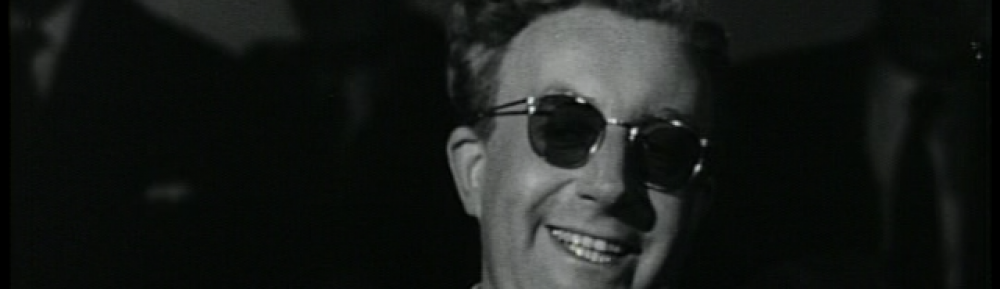
Whereas Burgess created this parable in all sincerity to consider these very issues of morality, it’s easy to get the sense that Kubrick simply found this moral conundrum a fascinating exercise in itself. You only have to look at Dr. Strangelove to see his proclivity towards wicked wit or only to venture with 2001 to observe his penchant for deep philosophical paradigms wrapped up in the science fiction.

A Clockwork Orange has all of that and it’s a perturbing practice in both satire and science fiction. It hums with classical music and synths, shot with distorting wide-angle lenses, while also modeling Kubrick’s perfectionist tendencies.

Malcolm McDowell’s voice-overs as the main hoodlum Alex DeLarge are a major component of the film’s structure, recalling the phraseology and world developed in Burgess’s original source material. For instance, Beethoven becomes Ludwig Van. Droogs are friends. Horrorshow is good or well. Then, Ultraviolence and the old in-out don’t need much explanation.

In fact, during the course of this film, Alex takes part in equal measures of both, causing havoc with his friends and bedding a pair of girls. There is seemingly no end to his depravity and the fascinating part is that he seems to enjoy it all.

That is, until, the government steps in to reform him. Alex is sent from prison to the Ludovico Medical Facility where he is to be issued a new variation of aversion therapy. And this is where, rather ironically, the famed sequence of Malcolm McDowell, eyes wide, screaming at the images passed in front of him entered the public consciousness. His corneas actually getting scratched in the process and the images forever ingrained in our society from that point forward.

But all of this early depravity, followed by his rehabilitation are only the beginning.  And it’s in these interludes that Kubrick tries to impress upon us the idea of Alex being our hero. It’s a difficult thought to deal with. But that’s of little consequence compared to the moral issues that hang in the balance here.

You cannot watch this film and not only feel somewhat dirtied but also saddened at what man is capable of doing. And it’s not only in the case of one man to another, or a small group to another. But, in this case, an entire bureaucracy of people systematically ridding their streets of crime. It’s a strange question maybe, but the question must still be asked, at what cost is all of this? It deserves our attention.

And to try and tease out some answers it seems crucial to look back to Burgess because although these are questions that undoubtedly intrigued Kubrick as well, but it was Burgess who first brought them to the fore. In this case, the author’s own religious background seems to have telling implications for this moral tale that he wove. He intended A Clockwork Orange to be a parable of what defines free will and forgiveness from a Christian perspective in particular.

What is goodness or forgiveness if we lose our free will — if we are only machines — functioning without beating hearts and all that is human within us. What kind of good would the greatest act of love in the universe be if it was done out of compulsion — not genuine love and charity?

In the case of Alex DeLarge, he no longers craves ultraviolence or his former lustful desires for women, but it has nothing to do with a change of heart. He’s simply learned to be repulsed by them. Kubrick’s picture is darkly perverse and the film ends not with the promise of the novel but a thoroughly downbeat ending that rings hollow.  It becomes obvious that Alex’s core desires have hardly changed. He’s simply been conditioned to know what is “good” and “bad.” That’s perhaps an even more terrifying reality than one of violence and evil.

The story goes that when Gene Kelly crossed paths with Malcolm McDowell he coldly walked away because it was in this film that his iconic tune “Singin’ in the Rain” was notoriously tarnished. But really this entire film is a dark blot and it’s truly horribly dismal to watch at times.  I cannot even manage to watch it in its entirety. Not simply for its graphic nature, but the tone that it endows. While Alex DeLarge is far from a sympathetic protagonist, it’s hard not to pity him — poor fool that he is.

3.5/5 Stars

Trafic (1971)

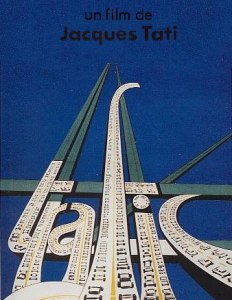
TraficWatching films with French treasure Mr. Hulot (Jacques Tati) is a wonderful experience because, in some respects, it feels like he brings out the child in me. And if history is any indication — I’m not the only one — others feel this sensation too.

It’s not sophisticated humor. The laughs are not dependent on any amount wit or mature understanding, but it’s universal. Everyone, whatever age, language or temperament, can laugh along with Monsieur Hulot.

Once more it’s easy to see his debt to the great silent stars and his use of sound is always impeccable yet still outrageous in the same breath. It accentuates anything on the screen with auditory hyperbole that is absolutely brilliant. Any sound imaginable is amplified in Tati’s memorable everyday comedic symphony of noise.

If you wanted a plot Trafic, as expected, has very little. Mr. Hulot, for a reason not explained to us, is now working for an automobile company named Altra that is preparing for a big car show in Amsterdam. He along with a truck driver named Marcel and Ms. “Public Relations” (American model Maria Kimberly) must weather the roads and every hiccup imaginable to make it to the show on time. She streaking in her bright yellow convertible and they riding in their truck cursed with flat tires and an empty gas tank among other ailments. It’s hardly a spoiler to say that they don’t quite make it there on schedule.

Jacques Tati was always one to playfully nudge at our modern culture obsessed with technology, expedience and, of course, automobiles. However, there’s nothing terribly vindictive about the way he goes about it. In contrast to the images of hustle and bustle and “progress,” there are also a great many that take comfort in the tranquility of farm life or quaint cottages. Everyday people and their mundane lives that, while idiosyncratic, are in no way inconsequential. He is a director who makes us appreciate people more. Mechanics, old couples, even cats, and dogs.

Many viewers undoubtedly will remember the crazy traffic jam with cars careening everywhere, hubcaps and tires rolling every which way and so on. It’s comedic madness. In fact, for numerous reasons, it’s easy to juxtapose Trafic with an earlier French film of a very different sort, Jean-Luc Godard’s political satire Weekend, which has some massive traffic of its own. And Tati creates comparable chaos, mischief and so on but I prefer his method of execution. Because he finds the charm and humor in every situation — even a car accident (with the multitudes simultaneously relieving the cricks in their joints). There’s no spite, cynicism or anything of that sort. He doesn’t feign pretentiousness, choosing instead to remain comically genuine right to the end.

That’s why there’s something so endearing and satisfying about Mr. Hulot. He remains unchanged and unmarred by the world around him. We can count on him to be the same as he ever was — the same hat, the same coat, the same pipe and the same hesitant gate. Maybe his adventures are not the most titillating. Some people admittedly will not like Trafic. It’s either too meandering like Monsieur Hulot’s Holiday or too jumbled compared to the exquisite patchwork ballet that makes up Tati’s earlier masterwork Playtime.

But, no matter, Tati is still a joy for what he brings to the screen, for those who are acquainted with his work and those who are willing to join an ambling adventure full of small nuggets of humor. Here is a film that through inconspicuous nose picking, windshield wipers, and road rage tells us more about humanity than many other more ostentatious films are able to manage. Trafic is certainly worthwhile.

4/5 Stars

Love on the Run (1979)

love on the run 2You can’t just do anything at all and then say ‘forgive me!’ You haven’t changed a bit.” ~ Colette

The prospect of watching Love on the Run saddened me and not for the reasons you might expect. Not because it’s noted as the weakest film in Truffaut’s famed Antoine Doinel series, although that it is. Not because it utilizes a clip show rather like a lazy sitcom as some will undoubtedly note (although this does actually give way to some rather entertaining reminisces as Antoine crosses paths with two old acquaintances). And it’s not even because this is the last film in the series and Truffaut never got around to any more installments before his death in 1983. Though that is sad.

The truly heartbreaking thing about this film is not even the fact that Antoine and Christine (Claude Jade) are getting a divorce although that is at the core of it. It’s that Antoine, who has long been the focal point of these films with his certain brand of charming charisma, really has not changed a great deal.

Time and time again, his superficial relationships with women are explored and time and time again his self-destructive habits hardly seem playfully entertaining but if you want the most honest answer, it’s all rather disheartening.

He has a new girl who we meet in the opening credits. Her name is Sabine. She’s young, radiant, very pretty and works in the local record shop. If we didn’t know any better we could easily make comparisons between her and Christine.

We see that little boy from 400 Blows and even that same young man looking to win the affection of a cute brunette named Collete. However, now a few years down the road, none of that panned out. He’s terribly selfish, undeniably a cad and always trying to say he’s sorry to save face. Sabine says it well when she calls him a pickup artist (You sure have a strange idea about relationships. You seem to only care about the first encounter. Once they’re together it’s all downhill).  

However, if we look again we remember that Doinel’s home life was hardly a prize, schoolmasters were unfeeling and his mother passed away — the only real family he had in the world.
Maybe, love on the run 1Antoine Doinel is a character who thinks only in the cinematic and it is true that he often functions in a bit of a faux-reality. He seems normal but never quite is. He seems charismatic but we are never won over by him completely. Still, we watch the unfoldings of his story rather attentively.

Like all the women who he tiptoed around with, as an audience, we have liked him but never truly loved him — an important distinction to make. And coincidentally, we also see right through him. Perhaps because he’s often too much like us or other times not enough like us. It’s hard to put a finger on which one it is exactly.

We leave the film essentially where it began. Antoine has once more been scolded by his girl and made up. It’s difficult to know quite precisely how to feel about that. Love on the Run is worth its nostalgia, woven in between the most recent moments of Doinel’s life. While his character is trying, he is still strangely compelling. But at this point, it’s hard to know what to do with him. Nevertheless, Francois Truffaut was unparalleled in the continuous narrative he was able to craft — flawed, personal and most certainly memorable.

3.5/5 Stars