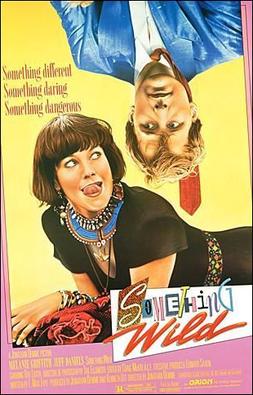
Something Wild (1986): Happy is a Yuppie Word

SomethingWildPoster

One of my favorite bands penned a song called “Happy is a Yuppie Word.” I never spent much time dwelling on the meaning of the statement, but as I grow older, it somehow takes on more pertinent meaning. If I remember correctly, Bob Dylan gave an interview with Rolling Stone magazine where he said essentially the same thing. In fact, I wouldn’t be at all surprised if the song took its cues from one of America’s foremost bards. I start here because Something Wild comes at us ready to bulldoze the Yuppie conventions we come to attribute with the 80s and 90s. That is Happiness as this quantifiable qualifier for the richness of one’s life.

Look at Charlie Driggs (Jeff Daniels). He’s the picture of middle-class success and respectability. He’s rising up in a formidable firm. He’s always reasonably dressed in a suit and tie. He has his pager on hand for important reminders. And yet there are inklings of chinks in his armor. After all, he is human.

He still wears his wedding ring, but his home life isn’t quite as idyllic as he would like the world to believe. Likewise, sitting at a perfectly conventional cafe, he has an urge to do something really, incredibly outrageous! He steps out without paying his check!

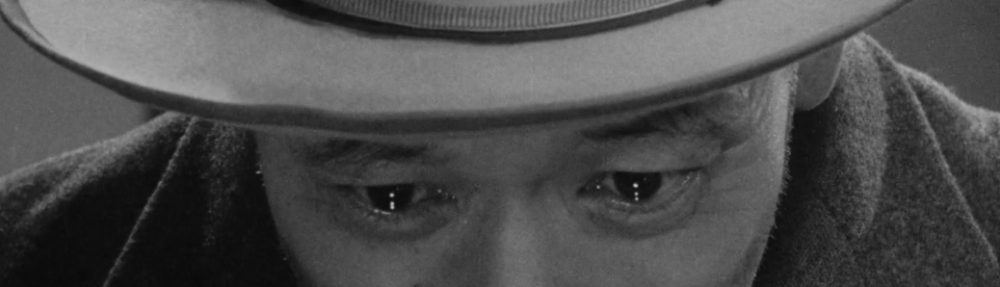
Except no one seems to notice…aside from one pair of perceptive eyes. They belong to the one person who will change his life forever. Meet Lulu (Melanie Brooks). Her look is unmistakable with a Luise Brooks-inspired bob and sunglasses — an air of self-assured confidence. She could rat him out. Instead, she offers to take him for a little ride.

From here on out Something Wild becomes a road comedy-screwball hurricane propelled by a giddy soundtrack and Lulu’s total rejection of Charlie’s middle-class monotony. They go careening down streets and racing down the highways and byways blasting The Troggs “Wild Thing.” What follows are scenarios replete with shenanigans, handcuffs, amorousness, and more unpaid checks.

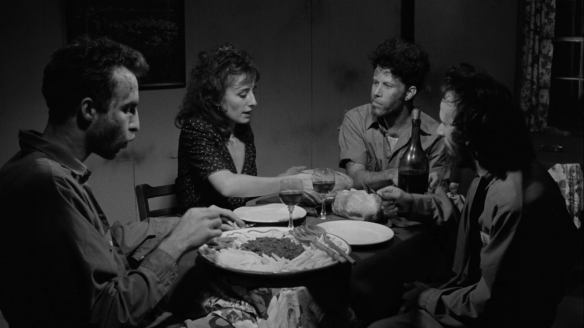
And yet if Lulu comes off as a glitzy, laissez-faire call girl, she slowly begins to show more of herself, including her real name: Audrey. She proves herself to be far more three-dimensional and far more of an innocent human being. She takes Charlie to visit her mother where they masquerade as a married couple in front of mom. But there is no malintent. The charade is purely out of a desire to please the good-natured woman. Then, Audrey brings him to her high school reunion — celebrating the spirit of ’76 — complete with performances by The Feelies.

If anything, these series of scenes hint at where the film might be going as it slowly sheds its craziest inclinations. In fact, the film takes its major tonal shift with the introduction of Ray Liotta as Ray Sinclair — Audrey’s former love. But there’s more. Previously the movie was frisky with a dollop of lunacy. Now Something Wild stands poised to takes a bitter turn.

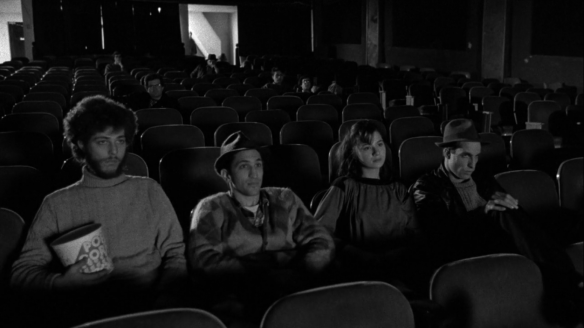
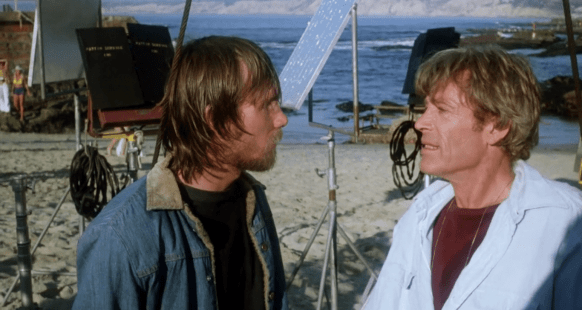
We suspect it from the moment Liotta enters. He’s handsome and charismatic, but there’s an instant menace to him — behind his eyes and his cajoling tone — the way he handles the part in a kind of underhanded way. Reference to his prison sentence gives a bit more heft to his reputation. But it really comes to a head when he robs a gas station.

Of course, Lulu and Charlie did much the same before. This isn’t to totally absolve them, but Ray’s brutal brand of reality plays in stark contrast to the carefree mad-dash infractions Daniels and Griffin were accustomed to before.

This is a stone-cold crime with consequences, and there’s no longer anything left to laugh at. Crime, all of the sudden, isn’t a lark; it’s something callous. And with its ugliness, all the leisure and fun is siphoned out of the picture. It’s given up its roots in pure, zany screwball to be something else — less warm and fluffy in conception.

Charlie gets shoved around, beaten up and bloodied, and Ray ultimately goes off with Audrey — to take her back as his own — threatening that he’d better stay away if he knows what’s good for him.

Even though my education in Demme is brief, my inclination is a desire for him to go toward the film’s initial tone. Because it’s the idiosyncratic touches that function best for me. They do not alienate my sensibilities. For instance, Charlie proves himself to be the most conspicuous trailer when it comes to the art of the tail.

He sets up on a street corner with a new wardrobe across from Ray and Audrey’s hotel room. For me, it’s scenes like these where Demme really shines; he has a sense of geography and how to use it to build a full-bodied world around our characters. He captures his hero in his car snoozing or peering out from behind a pair of binoculars.

But the church behind him, the store across the way, even the folks lounging at the pool make this feel like vibrant pieces of humanity albeit in a fairly relaxed town. He uses this same motif later when they finally have their fated confrontation at a genial family restaurant. The only reason Charlie gets enough gumption to actually face Ray and Audrey has to do with the reassurance that some local policemen are sitting at the table just across the way. These are the quotidian joys of the film at its very best.

However, this is a story that never quite rests on what is easy or comfortable. Because in itself this would be the antithesis of what it is looking to shoot down in the form of yuppie culture and all its signifiers. There must be another fanatical reverse in fortune. It’s genuinely terrifying. Far from spoiling it, I will leave you to it so that you might experience it for yourself.

Instead, my mind goes to this. For how merciless and scummy Liotta feels throughout the picture, Demme extends him the ultimate courtesy. The climactic moments are unnerving in a way. I hope I haven’t said too much already.

But in a single moment, Liotta is allowed to look into the camera his eyes full of surprise — a sign of weakness for the first time — and that one shot nearly single-handedly makes us feel sorry for him. It’s a hard sell, but we’re almost there: Having compassion on a seemingly irredeemable man.

The movie settles into a new normal. The moral, if we can call it that, seems obvious. To grab life by the horns — with warmth and spontaneity — within some framework of reason. Something Wild lives up to its name even tonally as it seesaws around. It wasn’t quite what I expected or what I might have wanted, but this could easily play in its favor for someone else.

Demme still shows himself to be a genuinely humane director. He likes people and with comic verve and music, he’s capable of whipping up something quite enjoyable. What is more, he shows himself willing to go somewhere else with characters.

I am slowly learning more and more about his oeuvre, but Something Wild suddenly makes a film like Silence of the Lambs feel less and less like an outlier. The jump is not too far to make, and we come to understand his movies even a little bit better. If you humanize a gangster, could it be the next step is to connect us with a serial killer? Wild Thing, indeed.

But I started out by talking about Bob Dylan, and it’s as good a place to end as any. Happy is a Yuppie word. It’s something fleeting — momentarily attainable — and then stripped away from us.

Dylan suggests a change in paradigm: between blessed and unblessed. Could it be that Charlie would agree? Because whatever assails Audrey and him, they are no longer dictated by the world’s measures of happiness. They can live by a new standard — a standard that is not dispositional or material. It’s based on us and whether or not we are prepared to search out the joys and blessings of life no matter the turmoil. That’s something wild. It can flip your world upside down.

3.5/5 Stars

Swing Shift (1984): Underrated Classic with Caveats

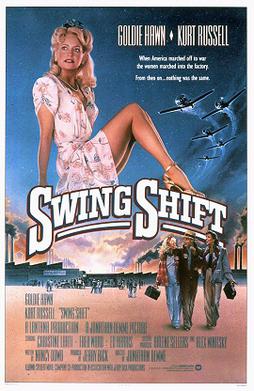
Swing_shiftAside from films actually produced during the war years, I’m not sure if I can think of a film that highlights the homefront to the degree of Swing Shift. The soundtrack is also perfectly antiquated (sans Carly Simon) fitting the era and mood to add another definite dimension. It effectively takes us back with the auditory cues of Glenn Miller, Hoagy Carmichael, and the rest.

We read in our history books about Rosie the Riveter and women gaining a newfound freedom as they fell into work formerly held only by men. But here this reality is put into practice in a manner that makes tangible sense.

The events of the war happen to them as they walk along the pier, sit in their living rooms, or do their work. Instantly they become current events.

We understand the certain amount of independence women would have been allowed in this time, where they were given a part to play in the struggle against the Axis powers. War can simultaneously cause deep wells of tragedy and bring us the greatest joys.

Our relationships become entrenched with a profound camaraderie and yet we can hurt the ones we love. We change and they change. Things very rarely remain the same after something so cataclysmic.

There are several intentional and formative relational dynamics in Swing Shift. It is about two working women: Goldie Hawn and Christine Lathi. They are by each other’s side through the thick and thin of friendship. Putting in a solid day’s work and then getting dolled up to go out on the town. They’re inseparable. However, sometimes it’s relationships like these that can suffer the most.

It is about a husband (Ed Harris) and a wife (Hawn): one going off to war and the other staying behind — prepared to walk alone. This isn’t what they were planning, but it’s happened and they move forward through the paces of it the best they can. And yet life gets in the way — where time and space separates them — and makes the waiting and the worry all the more difficult.

It’s about a woman and a man who cannot contain the genuine feelings they foster for one another (In real life Kirk Russell and Goldie Hawn fell in love and never looked back). Because he is present, in the flesh, good-natured and available in a way her husband never was — even when he was around. And yet Lucky (Russell), when he’s not riding his motorbike or playing the trumpet, is a wounded soul in his own right. War only works to exacerbate the clouded emotions of the day and that goes for all these relationships. They are interconnected issues.

But I think this is the best compliment that can be paid to the story. Because sometimes it looks a bit like a TV soap, and the story doesn’t always fall together, and yet there is a broader sense of what this movie is and what the focal points must be. This I believe we can attribute to Jonathan Demme. It’s meant to be more than conventional romance and we get tastes of that.

I say tastes because Swing Shift also has to be one of the most notorious cases of artistic tampering, right up there with The Magnificent Ambersons or Terminal Station. Warner Bros., at the behest of Goldie Hawn, edited the movie and reconstructed the story after Demme had finished principal photography.

Aside from story or continuity questions causing a few head scratches, the issues seem to go deeper still. I am by no means an insider, but from what I can gather, Hawn’s version tried to center the story around her and Russell. There’s an obvious reason for this. They have more than chemistry. They have romance. However, it also attempted to simplify her image and rectify any conflict we might have with her character. In essence, the goal was to make her more likable.

It causes her to maintain some sense of moral dignity and still the movie ends on an unfulfilling, empty note. It’s as if some kind of greater catharsis was possible, and we are robbed of it all with a final tear and a whimper. The resolution is not quite a cop-out as it is an exercise in indecision. The picture dissolves when something more complex, something more evocative, was probably called for and just waiting to be excavated.

Someday I hope the Demme version might go back into circulation, not just so we can see the movie as it was meant to be seen, from the untarnished vantage point of its creator. That’s part of it. But there’s also a sense Demme attempted to develop something more full-bodied and well-contoured.

Hollywood is always obsessed with primary action — the characters at the center of the story — but so often what is most interesting is what remains on the periphery. The supporting characters or the elements of the world that make it come off the screen and feel real.

One is reminded of the moment a smartly dressed soldier boy comes up to one of the swing shift members (Holly Hunter). He’s there to give her the horrible news, and she knows it before the words leave his lips. She falls onto him and he apologizes — he’s never done this before. How horrible and pitiful and lovely it is because it feels so innocent and honest.

Moments like these are a testament to a movie with so much to offer, bubbling up under the surface. It’s a shame it was so badly mangled. We must be thankful for what we have and hold out that someday we might get to see the cut that kept to Demme’s vision. Here’s to hoping. For what, it’s worth, Swing Shift might well be an underrated classic with a couple substantial caveats to include.

3.5/5 Stars

Parenthood (1989): It’s a Mess and That’s Okay

Parenthood_(film)_posterThere’s something apropos about baseball having such a central spot in the storyline of Parenthood because this is a movie wrapped up in the American experience from a very particular era. Yes, the euphoric joys and manifold stressors of parenting are in some form universal, but Ron Howard’s ode to the art of childrearing is also wonderfully indicative of its time.
What is more relatable than wrangling the whole family to go to a ball game together?  Gil (Steve Martin) and Helen (Mary Steenburgen) Buckman corral their family together, gathering all the stuff, and making sure the little ones don’t get run over by oncoming traffic as Randy Newman drawls his theme song. Piling into the family van and loading up to head home is a process unto itself. In one way, it’s a treat and an ordeal all rolled into one. A lot like parenting.

In fact, with its subject matter considered, this is not your prototypical Ron Howard movie, and by that I mean it feels more overtly personal in nature. Certainly, Clint Howard gets his usual cameo, but the story speaks more about experiences — experiences of the worries and the joys that overtake you.

They become a focal point of this story as the adults try to navigate life together with three kids and a large extended family.  To a lesser degree, Little League baseball also becomes an integral part of life with Gil coaching his son Kevin’s team. It’s a different indicator of life as his boy is constantly made fearful of messing up.

He’s hardly the next Ozzie Smith or Ryne Sandberg. And when you’re a kid, the respect of your peers makes or breaks everything. You don’t want to be the one to let your team down. Could this all be part of the issues Kevin has according to his teachers?

However, as the roving ensemble is introduced with a patchwork of interrelated stories stitched together, you begin to appreciate the problems visible everywhere. This is imperative. They are part of what makes us human, and the full-bodied cast is what makes the relational dynamics sing.

Helen Buckman (Dianne Wiest) is a single mother just trying to get close to her kids with a distant son (Joaquin Phoenix) who won’t talk to her and a daughter (Martha Plimpton) who’s gone and got shacked up with a real airhead (Keanu Reeves). It’s like her life is crumbling all around her, and she must learn to hold it together, the best she knows how. This is her life.

Nathan Huffner (Rick Moranis) and his wife Susan (Harley Jane Kozak) are raising their daughter to be some sort of savant and her IQ runs circles around her cousins. She’s also simultaneously missing out on all the joys of being a kid. Her mother becomes overwhelmed by their strict parenting regimen, and it begins to leave a toll on their marriage. It’s so very easy to forget your priorities — how you ever fell in love in the first place.

Then, there’s the rather cantankerous Jason Robards. He’s fond of his youngest child Larry (Tom Hulce), the black sheep of the family because he’s lively and fun. Even dad is surprised when his boy returns home with a young son named Cool and a raging gambling problem; it’s got him in bad with some dangerous thugs.

Can you imagine the family dinners that these people have? There’s so much going on and yet they’re probably not all that far removed from our own family holidays. At least the spirit is there — something we can latch onto — and probably relate to.

However, it’s the party scenes allowing Steve Martin to showcase his comic chops as he takes on his cowboy persona to captivate all the kids and earn their appreciation while upholding his son’s reputation. It’s an emotional high in the bipolar ride you go through as a parent. Like any parents, they dream their little darlings will be valedictorians, and other times they fear that they might just as easily turn into a shooter. Often reality strikes a middle ground.

It’s far from flawless in its narrative, but that’s the point. It gets so bad Martin is going batty lashing out at his wife and everyone else. His son’s emotional anxieties have him worried. He’s stressed by a workplace that feels totally opportunistic and callous. Now, his wife’s supposed to have a baby and the news feels more like a burden than a gift.

If life doesn’t radically change, then perspectives certainly do. Robards and Martin have a surprisingly poignant conversation while sitting in the Little League dugout. Father talks to son about how there is no end zone in life. Your children and the people around you are there for good. And you’ll love them no matter what. It’s one significant moment of sentiment among many others.

In this way, Parenthood confidently modulates between drama and pathos, humor and romance, then circling back again. If little has changed from the beginning to end, then certainly their perspective evolves. It has something to do with embracing this beautiful chaos of life. Enjoying the ride as opposed to fearing every jolt of turbulence.  Sometimes the simplest wisdom can be the most profound if you let it.

Grandma says she’s always appreciated the rollercoaster to going round and round on a merry-go-round. Parenthood is the rollercoaster and that’s a compliment. It feels alive and idiosyncratic in a way one does not usually attribute to Ron Howard’s more recent work. It’s a refreshing take and probably a high point of his directorial career. I am not a parent myself, but I can only imagine how its observations would take on new resonance after becoming one.

3.5/5 Stars

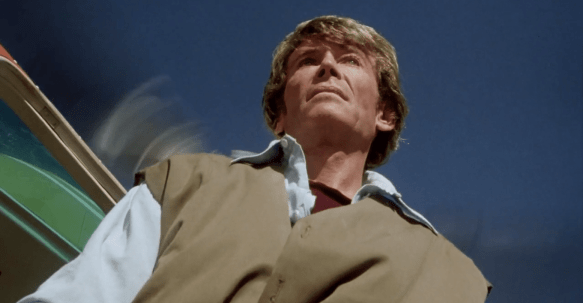
Melvin and Howard (1980): A “Good” Samaritan and A Millionaire

Screenshot 2020-05-16 at 71643 AM

The opening sequence of Melvin and Howard takes on more and more meaning the longer the movie goes on. It’s very simple, really. We open up with some joyrider on his motorbike tearing through the desert, taking on every jump through the arid wasteland with reckless abandon.

As one might suspect, his foolhardy stunt bites him in the butt; he winds up in a spill, leaving him incapacitated in the middle of nowhere. It’s night and pitch dark now. Thankfully, there is a good samaritan who picks him up. As he gets closer and pulls the injured man into his car, we get a better look at him. He’s a scruffy-looking man well-advanced in years.

Here we have the inauspicious introduction of Melvin and Howard. Melvin (Paul Le Mat) is really a nobody, but he does have a sense of decency, picking up this old man without any pretense or sense of knowing who he is. Because Howard (Jason Robards), is Howard Hughes — the eccentric, aviating millionaire.

They talk and share something genuine between two people. Howard’s resistant at first. He doesn’t want to take part in Melvin’s friendly chatter nor does he go much for singing songs. Melvin nevertheless obliges with the tune he mailed into a music label for. They took his lyrics and supplied a tune. The outcome birthed a new Christmas classic, “Souped-Up Santa’s Sleigh.” Howard’s exterior cracks briefly as he relents and proceeds to hum a few bars of “Bye Bye Blackbird” in response.

The scene doesn’t look like much, but it plays extraordinarily well. Then, just like that, they part ways. At the request of Howard, Melvin drops him off out back of a hotel — the old man still hobbling and beat up. But he’s adamant this is where he wants to be, so Melvin relents.

We think this is just the beginning, and it is, yet we never see Hughes (or Robards) again (well, almost). But it’s this moment of initial connection and humanity that not only informs the rest of the story but sets the tone for Jonathan Demme’s free-flowing biography of a little guy.

If you want to think about it in such terms, it’s an off-center Howard Hughes biopic where the central character is a man named Melvin, who reflects a different cross-section of society. It’s the kind of story you wouldn’t think would get the Hollywood treatment and yet here it is, and the director gives it the kind of love and affection necessary to make it feel lived-in and sincere.

Here is a man who lives in a trailer. His wife Lynda (Mary Steenburgen) is a sweet woman and together they have a darling daughter who only sees the best in her folks even if their flaws are forever visible.

These are the flaws that keep the life of the Dummars in a constant state of disruption. Whether it’s money troubles, due to Melvin’s spendthrift philosophy, or Lynda’s working of the seedy nightclub circuit, there’s a great deal of dysfunction in their family life. But at their core is a near-oblivious simplicity and so even as their life is a bumpy ordeal, there’s something endearing them — making us wish the best for them.

He’s visibly repulsed by her work — he doesn’t want her flaunting herself in front of strangers. His home life is humble, but he gladly sits in front of the TV with his daughter feasting on pop tarts and bacon. Lynda never seems to dislike Melvin; she just knows it’s not possible to rely on him. So, over the course of the picture, they get divorced, then remarried, complete with one of those throw-em-together hotel wedding ceremonies for $39.

Screenshot 2020-05-16 at 64801 AM

If it’s not evident already, Melvin & Howard is a film that seems continually preoccupied with the desert backroads and small-towns of America. Where the country music is ubiquitous and people live simple, unadorned lives. Where Melvin’s chances to earn the mantle of milkman of the month get threatened or the car gets repossessed.

But there’s also an itinerant element — to pick up and go in search of new lives and new fortunes — and because the film chooses to stay with Melvin, the story itself takes on this antsy quality. Never being fully satisfied to dwell in one place. However, far from giving off a superficial impression, it winds up coloring a world with all sorts of genuine nooks and crannies.

It’s not a charmed life, but he meets it with continual candor. The reunited family gets by losing themselves in TV game show episodes of Easy Street, which become a kind of communal event for everyone. Lynda fulfills a dream by getting on the show as a contestant and feverishly tap-dancing her way through the Rolling Stones’ “Satisfaction” to the prize of $10,000!

Still, the family splinters again. Melvin picks up and moves to Utah after marrying a Mormon girl. They set up shop in a gas station. The so-called focal point of Melvin’s life feels squeezed into the end of this movie, not that it’s shoehorned into the story by any means, but it shows how his life adds up to something more than the media frenzy that soon overtakes him.

Because he was the man who had the unsubstantiated will of the late Howard Hughes dropped on his gas station desk naming him as 1/16 beneficiaries of Hughes’s fortunes. That added up to approximately $156 million! In the aftermath, he found himself brought into court to testify as his story was heavily disputed. It does sound absolutely ludicrous. 

How this seemingly unextraordinary individual could find himself at the center of something so grand and earth-shattering is a real-life farce. However, what lingers is the import of the first scene. Demme does well to return there if only briefly, to remind us what this frenzy was about.

Lest we feel slighted that this movie wasn’t really about Melvin and Howard at all (or at least mostly Melvin), in some way it says as much about Howard Hughes’ life by leaving out all the trumped-up treatment. It’s the romantic in me, but I would like to believe that even our momentary interactions with one another can be blessed.

It is possible to touch someone else, adding even a little bit of goodness into their lives. It’s this kind of goodwill to strangers that can stay with them for a lifetime, whether or not they include us in their wills or not. Who knows, you might be entertaining angels unawares, or misanthropic millionaires, for that matter.

4/5 Stars

Jean-Paul Belmondo: Up To His Ears, Le Magnifique, The Professional

Because of his meteoric ascension in Breathless, patterning his insouciant hoodlum on the Hollywood image of Bogart, Jean-Paul Belmondo is easily identified with his predecessor. He was a tough guy — gladly so — and he offered up a long line of memorable performances over a stellar career.

Pierrot Le Fou (Godard) and Le Doulos (Melville) quickly spring to mind, but then you only have to look at something like Leon Morin, Priest, where he plays the eponymous clergyman, to recognize the range he was capable of.

In honor of his career, we wanted to highlight three of his later action films. They are not his most acclaimed pictures, but they are defined by his legacy so it seems fitting to acknowledge them.

Up To His Ears (1965)

Up to His Ears is cut out of the same cloth as Philippe de Broca’s prior film with Belmondo from the year before: That Man from Rio. It’s a globetrotting picture all across the orient with madcap chase sequences and quite a few attempts at Bond-like intrigue.

Overall, it bends more toward dated gags and goofy antics than out-and-out thrills, and it seems mostly content with this. When they flee an onslaught of Chinese gangsters, Belmondo and company sneak down into a pillbox, down to an underground tunnel, and on and on. There always seems to be a fortuitous out for them.

If their good fortune and the fact they aren’t completely annihilated seems farfetched, then you don’t understand the ambitions of the film. It’s all sendup. Belmondo seems to be enjoying himself, and his adventures lead to a desert island with Ursula Andress. He can’t believe his luck.

Obviously, the movie cannot quite muster the same glory as That Man from Rio, but Belmondo is still a great action hero able to play the crazy comedic moments and still move through space with vim and vigor. It ain’t Godard, and that’s not necessarily a bad thing.

3/5 Stars

Le Magnifique (1973)

Also known as Our Man in Acapulco, and its dashing hero, Bob Saint-Clar (Jean-Paul Belmondo) feels like an amalgamation of ’70s era Bond (Moore and Connery) with a lot of Get Smart thrown in for taste.

Philippe de Broca’s at the helm again offering up some of the most self-reflexive parodies of the hypermasculine, suave international spy genre. It pulls out all the comic book scenarios — with dastardly villains et al. — and the resolutions, seeing our hero always prevail. He must live to fight another day.

Broca himself readily contributed to this spy phenomenon during the ’60s with Belmondo to boot. However, it’s so over-the-top to the point of being offputting. Then, we realize our secret agent is being dreamed up by a hack writer, named Francois (also Belmondo) on a strict deadline!

Suddenly it breathes new life into the premise with a renewed perspective, and these long-trod pulp-bound conventions become only part of the gimmick and, hence, only part of its appeal. Not to be outdone, he’s taken the English sociology student (Jacqueline Bisset), who lives across the way and dreamt her into his story as the beautiful Tatiana. His supervillain is none other than his own pompous editor (Vittorio Caprioli).

We’ve followed his story umpteen times before. Although he writes pulp trash for a rapt audience of many, his active imagination all but compensates for a fairly nondescript private life. He’s got a bit of Walter Mitty in him. In the most fated of meet-cutes, Christine (Bisset) accidentally picks up one of his works and finds herself instantly inspired for her college thesis.

Soon she’s dropping by to blow through whole shelves of his novels. And then the idealized man dreamed up on the page, must take a stand in his own life. For what it is — plagued by many of the shortcomings of its genre and the era — I can’t help but appreciate Le Magnifique.

It mostly comes down to Belmondo’s dual role and his rapport with Bisset. Again, they’re having palpable fun taking it over the top, and like any great screen icon, Belmondo gets the girl — twice.

3.5/5 Stars

The Professional (1981)

It feels like your prototypical dated ’80s blockbuster replete with gratuitous violence, a rogue’s gallery of heavies with all the other corny ingredients mixed in together. Belmondo is an agent, undercover in an African country, prepared to assassinate their leader only to be drugged and sent to a labor camp.

He escapes and ultimately returns to France as a kind of rogue operative on the lam. His former superiors want to do away with him, but he’s always one step ahead. He’s not going to be eliminated that easily.

Although it’s not a Bond movie, there are pretty girls, and he seems to know them all intimately all while slinking around to preserve his own skin and complete his objective. Belmondo is undeniable, handling everything from fisticuffs, stunts, and seduction with his usual roguish charisma. He never takes himself too seriously. It’s as if he’s in on the joke of it all and enjoying himself in each individual moment.

The final car chase changes my whole verdict of the picture because it really does take my breath away. It’s yet another showcase for Belmondo the consummate action hero, effectively taking the film by the horns and really living and breathing the part.

While the score isn’t prototypical Ennio Morricone, it gained a new life and legacy in The Professional. He receives what might be termed the briefest of homages as the film’s main leitmotif comes to life between crosscut closeups of its hero and villain a la Leone. It’s like a mini showdown transposed to the world of French secret agents.

There is so much of Bourne here beyond the car chase, and it comes down to the inexplicable predicament of the protagonist. He is thrown into a world that is not right-side-up, and his only choice is holding fast to what he knows. He’s smart and cunning, making a real go of it.

But sometimes the world in all its order and pragmatism doesn’t make a shred of sense. At least, to the very last minute, Belmondo looks cool doing his job. In a movie like this, surely that’s all that matters. Adieu, Jean-Paul. Thank you for what you gave us.

3.5/5 Stars

Down By Law (1986): An Offbeat Jarmusch Noir

Screenshot 2020-02-26 at 65844 PM

A raspy vocal emanates from the screen verging on spoken word as it sings to a mambo-infused rhythm. Casual tracking shots lead us by the local architecture at the pace of a car ambling along on a Sunday afternoon. I only confirmed after the fact this is Tom Waits singing his tune “Jockey Full of Bourbon” from an earlier album.

These are the streets of Louisana, and the man helping to capture these glorious, sweeping shots is none other than Robby Muller (probably most famous for his work with Wim Wenders). His partnership with Jim Jarmusch was just being established and it would continue well into the ’90s.

This is the opening prelude of Down by Law if you will. Because the real intimate stretches of humanity — at least the ones dwelling in this story — can be found in the dirty, dilapidated interiors and on the sketchy street corners. It’s these bombed-out, grungy aesthetics giving the film its layers of instant character.

Muller’s cinematography is an immediate asset and no matter the subject matter within the frame, he makes it feel captivating and strikingly beautiful, whether it’s a street corner, a jail cell, or a boggy bayou. We’re drawn to keep watching and relishing his images.

John Lurie is a pimp who feels like a nobody. He tries to act big only to get sucked into the shadiest of business deals. Tom Waits isn’t much better off as a disgraced disc jockey. His girl walks out of him in a fit of rage, and he proceeds to go drown his sorrows.

However, first, he must gather up his shoes from the street below where they have been unceremoniously tossed. The inhumanity of Gene Pitney’s record (I think that’s him) cast out into the street says it all — both the mood and the crispness of the photography.

I’m not sure if Tom Waits is an actor as much as he’s an enigmatic personality exuding something we can latch onto as an audience. Lurie’s not altogether intriguing to me, but with Waits there’s something different — something we want to find out more about.

The manner of this off-beat noir is now fully established because the mood is the key when plot feels almost secondary even tertiary in importance. The dialogue is laughable, but somehow it fits into this world gladly mixing both style and sendup of the past. And yet it’s only the most affectionate homage to bygone years with its chiaroscuro, smoky street corners, and fedoras to fill out a modern underworld.

It’s the kind of movie where a guy will just walk up to you on a deserted street corner and offer you keys to a Jaguar and a wad of Franklins to do his dirty work for him. Sometimes the dirty work has strings attached.

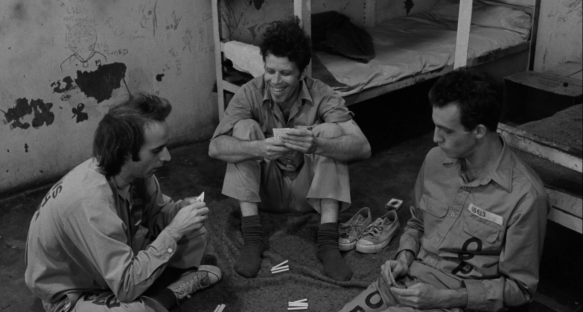
Pretty soon Zack’s in the can and Jack’s with him. What a sorry pair they turn out to be. But there is eventually a saving grace. Enter Bob. Aside from being another tribute to Jarmusch’s wildly diverse casting tendencies, Roberto Benigni holds the film together with his charming personality.

He single-handedly redefines the tone of the movie making it into a kind of reluctant buddy movie. Because his instant good nature, loquaciousness, and limitations with the English language give him the powers to add something radically different to the film’s cocktail.

If he’s ever the butt of the jokes as the foreigner, more often he’s the movie’s champion, a force of joy and goodwill bringing together two bunkmates of the most cynical and standoffish sort. When they start their giddy tirade — yelling at the top of their lungs — You scream, we scream, we all scream for ice cream, it feels like “Moses Suposes” antics taking over the jailhouse.

Even with the introduction of Benigni, there is this sense Jarmusch is once more working in these near-stagnant scenes involving shooting the bull or playing cards much like Stranger Than Paradise. It’s once more observational and altogether content in the idiosyncratic. The elliptical sense of filling the spaces in between is also surprisingly prevalent. The biggest example being, of course, the prison escape.

Tarantino would choose to not show the heist 6 years later in Reservoir Dogs. To some degree, Jarmusch beat him to the punch as far as genre deconstruction with a jailbreak movie missing its most crucial lynchpin. But for what he’s going for, it works wonders. It works far better by throwing away convention because he never rested on it, to begin with.

Soon they are fleeing through the bayou, then canoeing, then getting left adrift without any inclination where they are going. Thankfully, they find a bunkhouse in which to recalibrate (though it looks eerily similar to their cell). However, the real prize is when they happen upon Luigi’s Tin Top. In its own way, the restaurant is an oasis.

Screenshot 2020-02-26 at 8.03.43 PM

We had been through so much already, it completely slipped my mind that this moment was coming. It feels like a slice of serendipity. Here we have Roberto Benigni playing opposite Nicoletta Braschi as two Italians madly in love in the middle of nowhere. Again, they somehow operate outside the pervasive tone — the underlying stench — of the movie and its other characters.

However, what makes it feel fortuitous comes with context. They would wind up getting married 5 years later and remain so to this day as far as I know. Over a decade later, they would star in their most renowned foray Life is Beautiful, which pretty much bottled up everything disarming and magical about Benigni and enchanted the world over with its abundant good cheer and tenderness.

For now, they dance cheek to cheek in a lonely restaurant out in the boonies. It’s inauspicious while signifying something so much more. We leave them knowing they have a rewarding life ahead.

In the final moments as Lurie and Waits walk down the path, trees on either side, I couldn’t help but think of one of the greatest, most atmospheric noirs: The Third Man. Except as Jack and Zack split off at the fork in the road to forge their own paths, we can’t help but be reminded of Robert Frost.

Because Jim Jarmusch might as well be summed up as such. A noir aficionado with the sentiments of a poet. Down By Law is not quite bombastic pop culture pulp in the mode of Tarantino. There’s a distinct artfulness there that still never quite loses its idiosyncratic yearnings and inclinations.

4/5 Stars

Stranger Than Paradise (1984) and Jim Jarmusch

Screenshot 2020-02-17 at 3.40.27 PM

One of the most revelatory aspects about becoming more familiar with Jim Jarmusch is how international his films are. At the very least, there’s this sense of them putting a lens to a broader cross-section of society.

He is unequivocally American, but whether it’s because he’s a cineaste or driven to a global perspective through music or other interests, he paints with a canvass broader than simply the American experience. He also seems to understand the American experience is framed and colored by those who come to us. In fact, we are a melting pot, as Alexis de Tocqueville once noted, made up of all nations.

As a storyteller, Jarmusch seems drawn to what I’ve heard termed the “mearcstapa” — the border walkers — people on the outskirts. They could be expatriates, foreigners, or people who simply conceive of the world in a different manner than you and me. Although the term is recontextualized from its Medieval connotations, it does take on renewed meaning. In the case of Stranger Than Paradise, it’s a visitor from Hungary.

But if any of this dialogue runs the risk of making the story sound too rarified, rest assured, it is far from that. It’s a picture content in the simplest of moments. The plot as it were is born out of a statement. Eddie (John Lurie) has a cousin arriving and visiting him from Hungary. That’s it right there.

He feels put upon having her stay with him. He doesn’t show her the town. He doesn’t give her food. He’s the most inhospitable person in the world. But then again look at his life. He subsists off TV dinners and beer.

His only friend is Eddie, a shifty-eyed, flighty fellow who’s half-witted in a lovable kind of way. They spend time watching football, playing cards, drinking beer, or going to the races. That’s just about all they ever do. And it hardly changes with the addition of Eva.

Still, what the movie exudes resolutely is a style and an aesthetic, forming something more substantial than the sum of its modest parts. Because it’s certainly humble, and the antithesis of flamboyant production values, and yet it manages to supersede the simple nature of what is happening onscreen.

Take, for instance, the sequence where Eva is walking down the streets with her suitcases in hand to the tune of “I Put a Spell on You.” Screamin’ Jay Hawkins rumbles across the pavement, and it’s oddly mesmerizing.

Pairing this with the black and white cinematography, dominating the film with a dreary, dilapidatedness leaves a startling impression. It’s both the prevailing sense of the world and somehow complementary to the budget and resources he’s working with.

I am reminded of the early films of Rainer Werner Fassbinder because there is the sense of almost two-dimensional space in many of the scenes — simple but purposefully done. In the case of Jarmusch, there are hardly any cuts, with the shots put end-to-end and void of any other type of true editing. It’s the simplest form, really, cut together by way of black inserted between the sequences.

You could point out Jarmusch is making a kind of glorified short film, and that’s how the narrative began sticking the footage together in three segments. But the black in-between the visuals also function as a kind of ellipsis.

Because pretty soon Willie and Eddy get up and go from Brooklyn and road trip it out to Cleveland. Why? Because Eva’s there. She is a fellow sojourner, and so they take to the road in order to catch up with her. In one of his typically dorky observations, Eddie tells his buddy, “Before I met your cousin, I didn’t know you were from Hungary or Budapest or any of those places. I thought you were an American.”

Pretty soon they’re staying with the Aunt and back to watching TV and playing card games. Shooting the bull and chewing the fat like they always do wherever they go. Even miles away in the icy tundra of the Midwest they realize, “You come someplace new and everything looks the same.” Restless for some meaningful experience, they head off to sun-soaked Florida to seek something else.

Finally, there’s some action, albeit off-screen and pretty much only alluded to. The boys lose all their dough at the dog races. In her own absurd turn of events, Eva winds up with a mother lode in drugs. That could be a whole rabbit hole all to its own. Instead, they take a trip to the airport to set up another adventure…undoubtedly just as absurd as the last.

It might not seem like much, but that’s the entire charm of Jarmusch’s movie; he’s so very comfortable bending away from Hollywood convention. Where location shooting becomes more of an in-joke than of a particular commodity and characters and story are more likely conduits of style. In fact, to this day, he’s made a career out of it.

Now, Stranger Than Paradise feels a bit like Richard Linklater’s Slacker. They played as important catalysts for subsequent generations of filmmakers because they were unique and of their own time with their own vision. And part of their merit is having done it first — using the world at their disposal and creating something that stays with us however mundane and unadorned.

Part of the paradoxical charm of Stranger Than Paradise is how you could conceivably make a movie like it, and yet you couldn’t ever match its essence because Jim Jarmusch made it just so — distinctly individual and measured to his own personal liking. That’s what it has going for it even to this day. It’s unmistakably him.

3.5/5 Stars

Zelig (1983) and Gordon Willis’s Mimicry of Classical Hollywood

Zeligposter.jpgI never thought I’d be saying this about a Woody Allen film, but it feels more like a technical marvel than purely a testament to story or dialogue. Although The Purple Rose of Cairo did something similarly compelling, Zelig is literally a film relying on a look that is authentic to a time period. Allen even goes so far as using old-fashioned cameras, lenses, and techniques to try and get them as close to classic filmmaking as possible.

Preceding the cutting-edge footage in Forrest Gump, we have Woody Allen as his alter ego, Leonard Zelig, being inserted in all sorts of images. It’s spliced together in such a seamless way we wonder if some scenes were simply chosen because they featured a lookalike of Allen to fit with the rest of the film.

Shot as an obvious mockumentary, which could be likened to Citizen Kane‘s News Marches On segment, one might concede Zelig is humorous in a similar vein. It’s not like Take The Money and Run (1969), Sleeper (1973), or even Annie Hall (1977), each offering genuinely zany and laugh-out-loud gags.

By playing something so ludicrously out of left field, completely straight, Allen has his comedy. He goes to the furthest extreme to make this feel like a real Ken Burns-esque documentary complete with talking heads giving their dry, poorly lit commentary from the present. They lend this credence, this seemingly real-world ethos, to something so utterly ridiculous. This juxtaposition gets at the humor precisely.

The story itself isn’t much of anything at all, loosely tied together over the course of an hour. Zelig (Woody Allen) is a generally non-descript Jewish man (Allen’s usual archetype) with a curious tendency brought on by an undying need for approval.

Dr. Eudora Fletcher (Mia Farrow) is intent on helping him and confirming her findings that he is indeed suffering from a chameleon-like disorder, causing him to transform his appearance to assimilate with whoever he’s with. It could be politically, socially occupationally, even racially, as he is found speaking Chinese and frequenting an African-American jazz club in two separate instances.

In the good doctor’s presence, he conveniently thinks he’s also a psychologist trying to do therapy with her, even having a fine approximation of the vocational jargon. But this is just a cursory sign to a much deeper-seated issue.

It turns out he’s unwittingly duped tons of people with wives married, babies delivered, and all sorts of other feats and accomplishments undertaken in different lives. He’s the most interesting man in the world who consequently has no idea about any of his accomplishments.

The laundry list of real-life icons is too delightful to pass over from F. Scott Fitzgerald, Charles Lindbergh, Al Capone, Babe Ruth, Lou Gehrig, Bobby Jones, and the list keeps on going and going. William Randolph Hearts himself (a Kane archetype) and his mistress Marion Davies show up along with Charlie Chaplin, Clara Bow, Carole Lombard, Marie Dressler and a host of others I failed to mention. You get the idea. It’s among the ranks of all these folks, Zelig was able to take on his chameleon-like personality and win their friendship.

It also occurred to me that Allen always makes his admiration for Ingmar Bergman fairly obvious. Like the other director’s films, which are always inhabited by interesting female characters, Allen settled on his own muses in Dianne Keaton and Mia Farrow. Farrow in this picture, captured completely in black and white, even gives a striking visual approximation of Liv Ullmann in Persona. I’m not sure, but it seems too close not to be an obvious nod, albeit with a typical Allen twist. The added punchline is that Farrow’s character ultimately falls for her highly neurotic patient. It’s of little surprise.

Like many of the New York-based auteur’s work, Zelig doesn’t leave me with any nuggets I want to hold onto. Conceptually, it’s somewhat arresting and the execution is phenomenal. I can understand with all the credits to his name why Gordon Willis might have considered this to be one of the most difficult he ever undertook.

If I were the director of photography, I would want to pull my hair out too. But his work and attention to authenticity is probably the greatest takeaway from Zelig. Modern films pale in comparison when it comes to mimicking the past. There’s little to no contest. If nothing else, Zelig stands as the crown jewel of Classical Hollywood mimesis.

3.5/5 Stars

Note from September 2018: I did not address the allegations to Allen in this review, but I must acknowledge they now linger over any film of his we watch, especially those seen in retrospect. It’s a topic I do not know enough about, and I do not feel privy to the conversation, so I will leave it to others at the moment.

They All Laughed (1980): Peter Bogdanovich’s Melancholy Screwball

they all laughed 2.png

A version of this review was published over at Film Inquiry.

I recently watched an interview between Peter Bogdanovich and Wes Anderson reminiscing about the film. One of the most striking suggestions is the inferred sadness in “They All Laughed.” It takes its title from a song but while we think of laughing as an action full of joy, the past tense of the word sets it off. It is something transient — bound to change at any time. Unwittingly it becomes the perfect encapsulation of this most intimate project.

To describe it as a private investigator infused screwball romance is merely confining it to typical genre fare. Realistically, it is none of the above. At least not in the sense we might expect.

We have to play catch up with most of the story although we do settle in eventually. What helps are not only the characters but the actors themselves who are of a generally affable breed. We like getting to know them even when we don’t quite grasp their circumstances.

Also lets clear this up. This is not What’s Up, Doc? (1972). It’s lacking all the goofy witticisms of screenwriter Buck Henry or the wonderfully epic set pieces. Many have probably written it off because of this; furthermore, it was not very commercially successful upon its initial release (this must come with an asterisk).

However, They All Laughed is a surprisingly good-natured effort and some of the same cadence can be found, especially in Charles (John Ritter) and Christy’s (Coleen Camp) conversations, mirroring Howard and Eunice from the earlier picture. Names are swapped with every other sentence while their patter is frantic and harried in a similar manner.

they all laughed 7.png

Is it wrong to see a bit of Robert Altman’s Nashville (1975) in between the lines as well? Perhaps it’s the obvious strain of country music that cuts through the New York scene, of all places. If anything, it is a condensed version of the former film shot on the streets of New York with a skeleton crew and fewer actors. The same fresh near-improvisational feel is present with interweaving narratives.

Camp probably gets her best scenes not with dialogue but when she’s singing and simultaneously giving people wandering by an evil eye or a wink of acknowledgment. Like The Last Picture Show, we have another musical collage of classics composed of Jazz tunes of Benny Goodman, Louis Armstrong, and Sinatra with the more earthy diction of Johnny Cash and Waylon Jennings. It just works.

It’s not executed in the same fashion as Nashville, with fewer moving parts and lacking the same brand of weighty commentary underneath the humor but nevertheless, there’s something here. It’s memorable just for the characters and moments and themes of love Bogdanovich seems to be having a grand old time playing around with.

The relatively plotless meanderings might test the patience of some viewers, but if your itching for authentic views of New York and a handful of hi-jinks and neurotic characterizations, you will get some.

Ben Gazzara is the quintessential dashing philanderer who holds something quietly mischievous in his eyes while still providing a sense of regret. He has two young girls from his first marriage and rarely sees them. We understand the scenario.

they all laughed 8.png

John Ritter exerts his comedic chops as a gutless private eye on a tail. From a purely visual likeness, he can easily be seen as a stand-in for our director who was himself in love with Dorothy Stratten. Like Antoine Doinel’s attempts at private-eyeing, he seems like a hopeless case, but once again, the film is hardly about his day job. Nor is it about Gazzara, another P.I., or their partner in crime, the frizzy-haired, roller skating, joint -smoking pick-up artist Arthur (Blaine Novak).

It’s all merely a pitch-perfect excuse to further complicate the scenario by throwing all sorts of situations together. And if there are glimpses of Doinel in Ritter, by transitive property there must be Tati-like scenarios as well, not least among them positioning the viewers on the outside looking in at apartment buildings seemingly made entirely of glass.

Like the worlds of these French filmmakers (Jacques Demy included), the version of New York depicted here verges on the most agreeable of romantic fantasies where relationships are forged in meaningful even momentary encounters. There is a sense of preordained fate wafting through the air even as a wistful malaise lingers too.

Dorothy Stratten manages to be an ethereal beauty of simultaneous youth and maturity. Bogdanovich’s obvious affection for her is on display in every scene she is in front of the camera.  Meanwhile, Patti Hansen — Mrs. Keith Richards — has a part to play as “Sam” the cabbie, which is no less charming. It does appear as the world is made up of attractive women although she is someone with a different type of experience. She’s been around and you cannot phase her. There’s something simultaneously charming and disarming about her self-assured confidence.

they all laughed 3.png

But, of course, I must save the best (subjectively speaking) for last — it’s time to talk about Audrey — who gets top billing, understandably so. Though I barely recognized her at first behind her shades, she still maintains the same congenial elegance, even in eighties attire. If anything she’s more grounded. Somehow she almost doesn’t belong but she didn’t belong in Breakfast at Tiffany’s (1961) either and yet her warmth made the movie special.

In fact, it struck me momentarily, this picture is a full 20 years after Tiffany’s and New York, while it has evolved, still holds a nostalgia about it. Because looking back in time with rose-colored glasses, we cannot help seeing it in such a light — not like the grungy, noisy dump of the here and now.

With every one of these characters, there manages to be utterly transparent shades of reality. The details are there if you’re willing to look at them in the most personal light possible. It’s a prime case of when real life seeps into fiction and they feed into each other in a continuous loop. Where one ends the other seems to begin and vice versa.

Take each character and examine their reality and see what sings with the sound of truth. I think Bogdanovich would heartily acknowledge the best films and the best actors are in some way, shape, and form audaciously personal — in this way, they bear something and offer it to the audience.

But even in its themes of infidelity, heartache, and loneliness, They All Laughed somehow manages to cling to the humor found in its title. There is a pervasive conviviality that might feel counter-intuitive to both our plot and the location our story takes place. But it’s indisputably light.

Due to a lack of commercial success — Bogdanovich tried his luck distributing the film himself unsuccessfully — They All Laughed is considered to be one of the ending markers of The New Hollywood Era instigated by a generation of dynamic, young American directors. No one can completely blame him for his decision as he was stricken with immense grief at the time. Because of course, the aftermath of such a warm picture was marred with a tragedy of the worst kind — the murder of rising talent Dorothy Stratten. It proved to be the darkest possible closing note on this story.

Then, for New York a full 20 years after this film came out, The Twin Towers (visible in the opening credits) would be gone. There is so much suffering visible and yet invisible at the same time. Because They All Laughed is a film managing to capture a happy time even if a sobering road was waiting up ahead. Sometimes we need light, frothy movies to remind us of such things.

they all laughed 6

When Peter Bogdanovich revisited the film at a public screening, he was openly emotional to the point tearing up. One can gather it was not simply because of the pain at the loss of someone dear to him, but also because those were happier, dare we say more innocent years. We can never have them back as they were before. Still, no one can take away the memories.

For others on the outside looking in, The Last Picture Show, Paper Moon, or even What’s Up, Doc? might ring of superior film stock but it’s not too difficult to understand Bogdanovich’s own sentiments. This is about as personal as a movie can come even as its weaved into a hybrid private eye screwball tale. It’s not the content speaking, but the moments and happy accidents with friends and people he deeply cherished.

This palpable exuberance exuded by the director and his cast is infectious if also a bit doleful. Bittersweetness has to be one of the most maddening of human emotions. It points to something not yet satiated within us. We are always waiting for the next time we will laugh again or better yet when we never stop laughing.  The tears won’t hurt as much then.

4/5 Stars

Do The Right Thing (1989): The Legacy of MLK & Malcolm X

Do_the_Right_Thing_poster.png

The opening images are charged with the beats of Public Enemy matched by a provocative palette and a vibrant kineticism. One is reminded up a very particular point in time and a particular subculture — rap music is a part of it, certainly — but it’s indicative of so much more.

Because Do The Right Thing is shot on Spike Lee’s home turf in Brooklyn so there’s no denying the intimacy he has with the material. However, it was actually the obligatory “all persons and places” disclaimer that instilled the idea this film could be about any city. This could be Watts. This could be Detroit. This could be Ferguson. And unfortunately, in another year or two, it might just as easily be another city we’ll have to reckon with, whether due to prejudice or police brutality.

The film overwhelmingly succeeds in developing a world — that is a neighborhood — with the players who live within it. And in this regard, it does feel a bit like the Hollywood movies of old (which Lee is well aware of) where people have their types and their shtick. Take, for instance, the three stooges who shoot the bull on the street corner.

The stuttering Smiley is always making the rounds to pass out his personalized pictures of Dr. King and Malcolm X. The swaggery Radio Raheem does his own version of Reverend Harry Powell’s love-hate performance art for the benefit of the audience a la Night of The Hunter. It makes him as much as a thematic symbol as he is a larger-than-life character.

These relational dynamics feel authentically lived in, even going so far as casting his sister as his sister in the film. Likewise, the real-life couple Ruby Dee (Mother Sister) and Ossie Davis (Da Mayor), play out an antagonistic autumn romance on screen.

It gives the impression of minimal camera movements (aside from a few pans) because Lee cares about focusing on his characters head-on, photographing them in an often stylized manner with low angles. It’s not quite as precise as Ozu but having people placed up against their backdrops so overtly, it is hard not to remember. His own distinct visual language stands out emblazoned with color and the patois of his town.

Samuel L. Jackson is the groovy, smooth DJ, Mr. Senor Love Daddy, part Magnificent Montague, part Wolfman Jack. He provides the atmospherics — the soul — for the entire community, even as the heat hits record temps. It’s a portent of future attractions.

One doesn’t always think of Spike Lee as an actor per se, but it’s fitting he’s central to the action in Do The Right Thing because this feels like an extremely authentic context for him. Mookie’s current job as a lax pizza delivery boy allows him to mosey his way around the neighborhood.

Again, it acts as an invaluable narrative device to keep the story moving and yet it never feels totally manipulating. Each beat brings a fresh scenario worth discovering with every chocked sidewalk or spewing fire hydrant. Because this is a film about people and their relationship to one another.

Up until this point, the majority of the characters mentioned beforehand are African-American though that doesn’t necessarily suggest they have an entirely shared point of view. However, what gives Do The Right Thing it’s inherent conflict is bringing in a menagerie of starkly different individuals.

The prime example is Sal’s Famous Pizzeria, a pillar of the community’s social and economic scene, run by an Italian-American (Danny Aiello) and his two sons. There are the Koreans “fresh off the boat” running the grocery store across the street. Then the Puerto Rican subset of the community including Mookie’s put upon girlfriend and mother of his baby son, Tina (Rosie Perez).

Their problems and their passions feel like real 9-to-5 reality we are privy to. And the police who patrol the streets come off a bit oblivious, if not completely fat-headed. What’s gripping is how each one conveniently points their ire in another direction manifesting this never-ending cycle of bigotry.

Mookie can always be found repping number 42 (Jackie Robinson) and one of his street corner chums wears Magic Johnson’s 32. These are obvious cultural touchstones just as the white guy clamoring into his apartment wears a Larry Bird jersey. They represent the current social moment impeccably.

It’s as if everyone has misconceptions of everyone else. They are driven by ignorance and small-mindedness and no one is immune to this disease. In a telling conversation over the jukebox, Sal’s oldest boy, a general malcontent fed up with working in his father’s business (Richard Edson), talks to Mookie about how his favorite athletes and musicians like The Michael Jordans and Princes of the world aren’t just “black” they’re more than black.

Let’s put this straight. I think his assertion is totally absurd and yet I found myself thinking just before how ironic these African-American young men wearing Robinson and Magic because their lives and reputations feel so contrary to the young men who idolize them. That should hardly be seen as an offense against them.

Regardless, Buggin’ Out (Giancarlo Esposito) feels affronted because there are no brothers on the “Wall of Fame” next to Pacino, De Niro, and Sinatra in Sal’s. He wants to start a boycott and at first, it’s an admittedly ridiculous idea.

No one takes him seriously because most everyone loves Sal’s pizza pies. And in his softer more hospitable moments, he doesn’t seem like such a bad guy. But this is one of the greatest revelations, even normal people — especially normal people — can seethe with hate, anger, and fear. Because the heat is not only about upping the temperature, it proves to be our dramatic barometer. We know at some point the story must blow its top.

Sure enough, Buggin’ Out and Radio Raheem are talking each other up and wander into Sal’s ready to make a stand. It’s utter idiocy. They’re being a pair of punks. They know full-well what they’re doing and yet in the same sense, I don’t think they do. It’s as if they don’t see the writing on the wall. No one does.

And everyone is once again on a different wavelength. Like Cool Hand Luke, we have a failure to communicate. Violence ensues. The fuses blow and the images are relatably chaotic and terrifying as they verge of the brutal and tumultuous. It’s insanity.

Fire shoots up the building and there’s something deeply affecting about seeing the portraits of the likes of Sinatra and Sophia Loren being licked by flames. Again, they feel like odd figures of collateral damage. All of this destruction feels directed across racial lines but surely it’s misdirected. What’s the real problem? What caused such an evening?

Is it merely angst and discontentment with the situation? Are they really mad at Sal? Are they mad at his establishment? Did he really want this boy dead? Were the police acting out of pure malice, fear, or both?

In the aftermath of the violence, I couldn’t help but bemoan the Twitter age we now live in. If this film is any indication, physical violence and confrontation is not the answer. However, I feel social media has polarized us even more — making our communities even more fragmented and our modes of communication either echo chambers of like-minded enlightened people or rival camps we can so easily demonize.

I must even admit one of the ones exacerbating this problem is President Donald Trump himself. It seems almost prescient he gets a mention in the film because some would say he is emblematic of where our country has gone in 30 years’ time. Surely, a country coming out of the Reagan years would never have guessed the future ahead (including a black president).

Ultimately, to say this is a film about racism is too vague. It needs some unpacking, some grappling with what it really brings to the fore. The issues run deep. They are partly economical. There’s de facto segregation. They have to do with police and deep-rooted traditions of tension. Racism is something taught and learned creating a feedback loop or closer still a vicious cycle. I am hardly the person to explain them all. But I’m willing to listen to others — to dialogue.

Do The Right Thing is the most unnerving piece of cinema I’ve seen in some time and I mean that only as the utmost compliment. It’s a bold expression full of energy but also more profoundly still the unmistakable threads of humanity. It’s as ugly as it is honest. Honesty, in a sense, it feels like Lee is making a valiant attempt to call out the inhumanity while still empathizing with all sides.

This even is reinforced by the two contrasting quotes he fittingly pulls from Dr. King and Malcolm X, a final testament to the picture’s message.

I must admit I wasn’t surprised by the substance of Dr. King’s quote but I do acknowledge being slightly taken aback by the sensibility of the second quotation. It’s this same duality visible in the film. Where there is a problem. Each of these men and their stances and the worlds they come out of have inherent flaws. The issue is how we get together and solve them. History has shown how messy and complex they have been and will remain if we fail to do anything. Strike that. If we fail to do the right thing.

4.5/5 Stars

“Violence as a way of achieving racial justice is both impractical and immoral. It is impractical because it is a descending spiral ending in destruction for all. The old law of an eye for an eye leaves everybody blind. It is immoral because it seeks to humiliate the opponent rather than win his understanding; it seeks to annihilate rather than to convert. Violence is immoral because it thrives on hatred rather than love. It destroys community and makes brotherhood impossible. It leaves society in monologue rather than dialogue. Violence ends by destroying itself. It creates bitterness in the survivors and brutality in the destroyers.”–Martin Luther King, Jr.

“I think there are plenty of good people in America, but there are also plenty of bad people in America and the bad ones are the ones who seem to have all the power and be in these positions to block things that you and I need. Because this is the situation, you and I have to preserve the right to do what is necessary to bring an end to that situation, and it doesn’t mean that I advocate violence, but at the same time I am not against using violence in self-defense. I don’t even call it violence when it’s self- defense, I call it intelligence.”–Malcolm X