Donnie Brasco (1997)

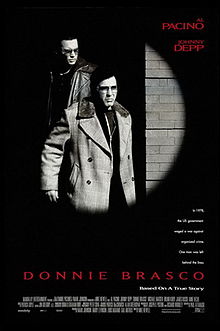
220px-Donnie_brasco_ver2In the tradition of such films as Serpico, Goodfellas, and even The Departed, Donnie Brasco is another worthy addition to the gangster canon. You have a necessary mainstay in Al Pacino, playing the veteran and streetwise hit man Lefty. He’s been around and is claimed to have 26 “whacks” to his name. One fateful day he took Donnie under his wing and the two became real pals. Better than that they were family and Lefty vouched for Donnie, bringing him into his life and his business. It’s just that his business revolves being a member of one of the mob families.

The story is twofold, however, because Donnie Brasco’s real name is Joe Pisone, and he is an undercover agent for the FBI. However, in order to do his job he has to be gone for months on end. He checks in and has a tape recorder on his person, but for all intent and purposes, he is a member of the mob. They think he’s one of them which Pistone’s superiors are delighted about, but he also begins to relate to them and see himself pulled into their reality.

Long months away from his wife and kids do not help their marriage or his family life. Whenever he drops in their life, he’s cold and detached. His wife expects something more. She wants her husband back, but all he has for her is a fiery temper courtesy of the crowd he hangs out with now.

He follows their crowd from New York, down to Florida trying to get a cut of the land there, but after getting ousted by the cops, they must head dejectedly back to New York. Several times Joe almost gets his cover blown, but even more perturbing he stops checking in with his superiors. His wife is bearing the toll of his absence and tries to content herself with thoughts of him being dead. It’s easier to take.

Meanwhile, young hopeful Sonny (Michael Madsen), with the help of his cronies, knocks off his rival and things are looking up for the whole lot of them. Donnie knows however that there will come a point where he will be pulled out and that will be the end of it. He tries to give his new found friend and confidante Lefty a way out. He offers money to his pal, in a last-ditch effort to get the vet to leave this life behind. Instead, they follow through with the hit that they’re supposed to.

The irony of this story is that Joe Pisone gets a medal and a $500 check for his services to his country. He spent however many months and years in this high tension, high-stress environment and that’s what he gets. You can see him scoffing at it. His marriage is essentially shot to hell. He lost one of the best friends he had and that’s the end of it.

It’s great having Al Pacino in this film because he along with Robert De Niro will always embody the gangster to me. Except instead of playing the steely Michael Corleone, he’s the more world wearied type. Bruno Kirby sounded so much like Joe Pesci that it was almost uncanny to me. And it was a pleasure to see Johnny Depp in such a role since he is so often remembered for his quirkier roles. Here he truly seems to show his dramatic acting chops, and the camaraderie between him and Pacino is palpable in their scenes.

4/5 Stars

Shall We Dance? (1996)

shallwedance1Shall We Dance is a film with important ties to American culture such as the King and I and The Drifters, but it has far more important roots in its native Japan. Thus, its remake starring Richard Gere and Jennifer Lopez undoubtedly loses some of the cultural significance of the original film.

Because Japan is a nation of etiquette, good manners, and the like. They act as a whole society, not as individuals. They care about honor, modesty, and how others will perceive them. They work hard for long hours. Men bring home the bacon and wives faithfully serve their husbands and families. Ballroom dancing in a culture like that is about as compatible as oil and water. Men and women are not to show affection — sensing it instead — and holding hands or saying “I love you” is out of the question. Thus, a mode of expression where men and women are meant to be so close and intimate has a stigma attached to it.

When a seemingly successful businessman, Mr Sugiyama (Koji Yakusho) spies a girl in the window of a dance studio, he has no intention of learning the art form. All he wants is to get close to this mysterious beauty. Of course, he has a wife, a daughter, and a good job, but he feels trapped in his life. He has nothing to give him joy, nothing to make him feel alive, just the monotonous rhythms of office life.

shallwedance2In fact, his first jaunts in the dance studio are rather comical, because his ineptness is magnified by his two classmates, one rather rotund and the other short and squat. It’s as if he’s learning to dance with Laurel and Hardy by his side. In fact, a great many characters have tremendous personality on the whole. Ms. Tamura is Shohei’s sagely teacher, who constantly builds him up with encouragement. Mr. Aoki is one of the work colleagues, who also moonlights an extravagant aficionado of the rumba. They are only a few in a vast company of supporting players.

But of course, this is a sort of faux-love story. Think Ginger Rogers and Fred Astaire and you get the idea. Except in the Japanese society, the only place you dare talk about dance is in the men’s room with no one around. Stripping away everything else this film is about finding self-expression, especially in a society that has a complex relationship with such an idea. Mr. Sugiyama eventually revels in his chance to dance, practicing steps on the platform waiting for the subway, improving his posture in the rain, or even conspicuously tapping his feet on the ride home.

Mai the beautiful object of his desire is aloof, with glassy eyes, and often feels like the antithesis of Japanese women in many ways. She is strong, straightforward, and physically imposing in a graceful way. As an audience we know essentially the road this film will traverse. Mr. Sugiyama must go through a transformation just as Mai must because they are not the same two people we first met looking out from their prospective windows.

shallwedance3What became most interesting to me was this idea of the affair. Mr. Sugiyama’s wife feels like she has been cheated on and her husband agrees with her openly. However, as an American audience, we look at this plotline and see no sex or anything like that. In essence, it depends on how you define an “affair.” For instance, if we look through the lens of an Astaire & Rogers film, their musical comedies were romances, but they could never show characters sleeping together due to the production codes. So the evolution of a relationship had to be illustrated through dance – the courtship, the conflict, and ultimately the passion. Perhaps Shall We Dance is a little different, but if we look at dance in this symbolic way, this was a film about an affair.

More importantly, however, it is a film about reconciliation, self-expression, and really breaking out of the status quo. Those are themes that ring true, although they might be easier to swallow in an American society.

4/5 Stars

The Virgin Suicides (1999)

VirginSuicidesPosterIn her debut, Sofia Coppola fashions the 1970s with a washed out wistfulness that feels like a distant memory — lingering for a time — leaving a few far away remembrances to be eulogized and reminisced about.

Her film is really about two groups. There are the Lisbon girls who live with their militantly authoritarian parents and then the neighborhood boys who look on with awe. These girls are the unattainable prize that all of these young men are entranced by. They are not besmirched or dirtied by the ways of the world, stuck in the ivory tower of their parent’s home. It’s almost as if they come out of a dream, so pure and in the same way so provocative.

However, things get shaken up when the youngest daughter attempt to commit suicide and then in a free moment she jumps out of the window and meets death by the metal fence posts below. Red flags should be going up everywhere, but stubborn Mrs. Lisbon only becomes more stringent in her moralistic ways. She should be trusting her daughters, allowing them certain freedoms, but she only takes away more. And reluctant Mr. Lisbon does nothing to stop her. He just lets it be.

Only allowed to socialize at one dance under strict guidelines, the girls relish this opportunity and so do the boys. They finally get their chance with a different class of girl. But after the smitten Lux breaks curfew, all the sisters lose all contact with the outside world. The iron gates go down, and she never gets another moment with high school heartthrob Trip. On top of that, their mother makes her burn all her records in another strict turn.

Lux defies her passively in any way possible as she and her sisters try and maintain contact with the boys on the outside. But there is a point for any person where this type of confinement, this type of prison, gets to be too much. The girls reach the end of their rope and take the only way out they can see.

Oddly enough, most of the boys have little personality, but the focus is the Lisbons and specifically their daughters. The Virgin Suicides was partly intriguing because it never seemed to take on some dramatic tone and it never felt all that personal. I felt so far away. As Carol King mournfully sang, “Doesn’t anybody stay in one place anymore. It would be so fine to see your face at my door. Doesn’t help to know you’re so far away.” That’s exactly what this film does. It doesn’t allow us to get close and that aloofness lent itself to the intrigue we have in these girls. We’re pulled into their story along with all these young boys.

3.5/5 Stars

Nobody’s Fool (1994)

NobodysfoolEarlier this year I wrote a piece on the evolution of acting that I envisioned as a case study of sorts. The second wave of actors I attempted to analyze included the likes of Marlon Brando, James Dean, and Paul Newman.

It is this last figure I wish to look at again in the context of Robert Benton’s 1994 film Nobody’s Fool. In all areas, this drama meanders along following town grump and crotchety ne’er do well Sully Sullivan (Paul Newman), who works as a freelance construction worker in a peaceful, snowy New York getaway. So, by all accounts, it seems like it should be a complete and utter bore, but it is not thanks, in part, to Paul Newman and his array of supporting players.

As I have watched more and more films in the last half a dozen years or so, there has been an ongoing trend where I tend to care less and less about substantial plot and more and more about characters. Don’t get me wrong, I love a taut thriller or an engaging mystery story, but the films that really do it for me have memorable performances that reflect a bit about the world we live in. Sometimes I even feel like a broken record, because I reiterate this fact so often, but I believe it to be the truth.

In other words, it feels utterly superfluous to go in depth about this film’s plot. It’s about a no-good Paul Newman, who left his wife, left his son, and never turned back. Now he must accept the path he chose and decide whether or not to spend his waning years finally getting to know his son and grandkid. It’s not rocket science by any means, and the film certainly feels dated, but Newman strangely does not, although his hair is a little bit whiter.

Now back to the generation of actors he came out of. They were the young, moody band of men brought up on the method that taught them to grab hold of emotions and experiences to be projected on the screen in each role they took. Dean was legendary, but his career was cut short. Brando was a giant, but slowly fell from grace and his waistline grew. Newman was famously married to his wife Joanne Woodward for over 50 years, started the charity Newman’s Own, and continued having a media presence in the late 20th and early 21st century. In other words, he aged gracefully compared to many of his contemporaries.

nobodys1

Nobody’s Fool falls closer to the tail end of his career, but he has the same gleam in his eye or maybe it’s that sour smile with a hitch in his giddy-up. But it feels genuine, it feels relatable, and it feels very much like the Paul Newman many people know and love. I know I do. He’s so often a malcontent or a bum and yet we cannot help but root for him.

He also has some wonderful moments to work with the likes of Jessica Tandy, Bruce Willis, and Melanie Griffith, among others, because first and foremost this is a film about relationships. These are people who have made mistakes and who are not always the wisest, but somehow we still appreciate them with all their faults and peculiarities. I guess that’s what the small-town mentality does, in a way.

You get to know everyone and you come to accept them for who they are. Stealing a snowblower, playing cards, drinking a beer, or buying your daily trifecta ticket just feels commonplace. That’s life.

3.5/5 Stars

Review: Schindler’s List (1993)

Schindler's_List_movieWhat is there to say about Schindler’s List except that it is necessary viewing for its depiction of Shoah, suggesting that, literally, out of the ashes beauty and hope will rise. It would be rather callous to call Steven Spielberg’s film pure entertainment. True, he comes with a pedigree that includes such escapist classics like Jaws, Raiders of the Lost Ark, and Jurassic Park. However, Schindler’s List is a far different creature and it is arguably his most significant film. It is so moving on a heart-wrenchingly beautiful level. Because great films are more than entertainment, pure and simple. They are affecting, tapping into some deep well inside of us that causes us to laugh, to cry, and have feelings.

Schindler’s List shows us the horrors of the Holocaust without dumbing them down. We see those getting shot. We see the naked bodies. We see the mass graves and the billowing ashes. It can be hard to watch. Abrasive in its content, but not in its form. The film itself is beautifully cast in black-in-white with the most moving of compositions by John Williams and poignant performances by many. But permeating through all of this is, of course, the tragedy, but with the tragedy comes the hope which is crucial to a story such as this.

Spielberg’s reference point is one man named Oskar Schindler (Liam Neeson), who not only was a war profiteer and womanizer but a member of a Nazi party. He’s not afraid of ingratiating himself with the right people to make a pretty penny off the imminent war because in his mind it’s all good business acumen. And aside from his affiliations, what’s not to like about him? He’s well-groomed, a gentleman, and charismatic. It still would be a far cry to call him a hero, at least not yet.

With his main motive still being money, he makes contact with a Jewish man named Itzhak Stern (Ben Kingsley) who not only has the bookkeeping abilities he is looking for but also connections to the black market and Jewish investors. So as the ghettos in Poland fill up to the brim, Schindler is quick to capitalize, offering the Jews more practical resources in exchange for their money. They get something, but he’s the big winner. He begins to set up his factory for the production of pots and pans which proves to be a lucrative business, especially with most of the bigwigs on his side. At the same time, he takes on Jewish laborers since they’re cheap, and Stein is able to save them from a fate of a concentration camp or being shot.

Our primary villain, Amon Goeth (Ralph Fiennes) is ordered to start a new camp and just like that the ghettos are closed and the Jews are forced out. He is a despicable creature and a sadist to the max, exemplified by the many people he shoots from his balcony in the mornings. There’s no provocation for it. He just does it because he can. He is not the type of man you can seemingly deal with normally, and yet being a man with immense charisma, Schindler does just that, all in the name of business.

But Schindler too sees the chaos, destruction, and killing that is going on. He can not try to underplay it now since he has seen it all firsthand. But there is a point in the film where his focus slowly evolves from a desire to make money to actually saving Jews from complete annihilation. The most obvious moment occurs after he sees the little girl in the red coat lying in a wagon, dead. Moments earlier he had seen her scampering through the streets, an innocent beacon of color amidst the chaos. What is the world coming to when a girl such as this can be killed for no apparent reason? It begs for a response from Schindler. He can no longer be a passive observer and so he does take action.

With the aid of the ever faithful Stern, Schindler is able to construct a list of over a 1,000 Jews to save from the concentration camps. As the war is going poorly for the Germans, Goeth is ordered to transfer his prisoners to Auschwitz, and although Schindler almost loses all his workers, he is able to save them by literally buying all their lives from Goeth. He spends his entire fortune to save them as well as ensuring that his armament plant does not actually make any working shells. It’s bad business, but it is all in the name of one of the greatest acts of humanity he could perform.

In one final word to the people, Schindler protects his Jews one last time, daring the Nazis working at his factory to kill them or go home to their families as men. They silently choose the latter, and he flees the camp as a war profiteer.  He breaks down looking at the few possessions he has left suggesting that more Jews could have been saved with them, but the Jews in front of him, represented by Stern, point out the great good he did. They bestow upon him a ring with the inscription: “Whoever saves one life saves the world entire.”

He is gone now and the story of Schindler’s Jews is not yet complete, because they do not know where to go, but they head out with purpose making their way towards the future. And it is in this moment that their story stops being a memory and breaks on into the present. It is a wonderfully powerful device from Spielberg that evokes an overwhelming flood of emotion. In a line of solidarity, the Schindler Jews walk forward toward the grave of Oskar Schindler. Nothing can quite explain the feelings pulsing through the body as we watch actors and their real-life counterparts laying stones on the grave of this man, much like the Israelites laying stones down in remembrance of what their God did for them.  In one final moment, Schindler’s wife lays one final stone and Liam Neeson lays downs a final rose and we see his imposing but solitary silhouette off in the distance. It’s magnificent, to say the least.

Out of the many scenes that become ingrained in the mind, there were two that especially resonated with me. One of them occurs when the children were trying to evade capture and imminent death. In such a life or death situation they willingly resolved to literally swim in the urine of the outhouse. Another scene that got an immense reaction from me was when all the naked women, with their hair now cut off, are herded into the showers. Both they and the audience think this is the end of their lives so it is almost a cruel trick when water begins flooding from the shower heads. I’m not sure the last time I have felt so much anxiety as an observer. It’s hard to discount.

There are so many great performances big and small, but Liam Neeson and Ralph Fiennes are both superb. We always love a good anti-hero or at least a complex one, and Oskar Schindler fits that bill beautifully. Also, we love the same in our villain, and I must say although I absolutely despised Goeth for all his evil, I must admit that somehow I still felt sorry for him. He was only a cog in the machine, a lonely man who was really so insignificant, in spite of what he wanted to believe. He shoots Jews, beats them, and yet can have such a twisted and somehow intimate relationship with his Jewish maid Helen.

For over 20 years this film has been a beacon of hope and fragment of truth from a period of history that contains so much darkness. Hopefully, it can continue being that touchstone to the past so that there is never the danger that anyone would forget these catastrophic events, but also the heroes like Oskar Schindler who through their actions were able to do a great deal of good.

5/5 Stars

Terminator 2: Judgment Day (1991)

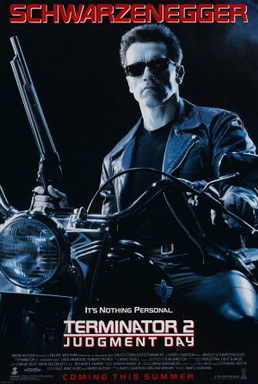
Terminator2posterBack in 1984 a strange life form came to earth in search of Sarah Connor and ultimately left a trail of destruction. It’s the same terminator (Arnold Schwarzenegger) who now shows up in the year 1991 intent on getting the right clothes, transport, weaponry, and cool shades to aid in the completion of his new mission. It’s the same terminator, except not really because he has been reprogrammed to protect young John Connor who will be the future savior of civilization as we know it. Right now he is a 10-year-old juvenile delinquent living with foster parents. His mother, the aforementioned Sarah Connor, is locked up tight in a mental institution after the events in the previous film.

But there also is a second more highly advanced terminator that Skynet has sent to assassinate Connor, and it becomes obvious that he is in grave danger. Both cyborgs converge on his location, and he flees with the help of his new found guardian. The terminator is programmed to listen to him and over time they form a bond with John teaching him slang (ie. the famed “hasta la vista baby”) and perhaps more importantly that he cannot kill everyone he sees.

They go to rescue Sarah from captivity on John’s bidding, but the other terminator has the same idea. The resourceful mother has plans of her own that are disrupted by witnessing her former executioner with her son close in toe. It’s all very confusing as they must alert her to the real danger and escape the present dangers.

Sarah leads them out of the city to the home base of a loyal friend who can give them resources and, above all, weapons. She sets her sights on Miles Dyson, the man who unwittingly developed the technology that would end in “Judgment Day.” In a fit of vigilantism, she mercilessly goes after the innocent man, for his work which would cause millions of future deaths. It takes the arrival of John and the Terminator to get her to calm down.

With Dyson’s help, they head to his office to destroy the prototypes for good, but they get a little company and it turns into a firework show complete with pyrotechnics and blockbuster explosions.

Yet again the shift-shaping, poly-alloy terminator pursues the trio and this time they are trapped inside of a steelworks. It’s a fitting locale for a desperate showdown with a wounded Sarah, a battered Terminator, and a thoroughly frightened John. Some last-ditch heroics finish off the futuristic assassin, but that is hardly the end of the story. John must say goodbye to his friend and probably the best male role model he’s ever had. He was a faithful companion to John, and he, in turn, came to understand why humans cry. There are just some things that cannot be expressed through words, protocol, or any type of rationale. The future is still to come, but at least for the present is safe.

I am unabashed to call Terminator 2 thoroughly enjoyable, because it embraces the fundamentals of a great sci-fi blockbuster, while never quite losing its human component. Perhaps we could have used more character development and less action, but the characters played by Linda Hamilton, Edward Furlong, and Arnold Schwarzenegger have enough depth to make them work proficiently. In fact, they are icons by now and I can understand why. James Cameron certainly knows how to develop thematic spectacle to the nth degree and this installment is no different. This sequel is bigger and better than the original 1984 film, which is a testament to not only the special effects but the story and characterizations. Hasta la vista Baby. Until next time anyway.

“If a machine, can learn the value of human life, maybe we can too” ~ Sarah Connor

4.5/5 Stars

Jerry Maguire (1997)

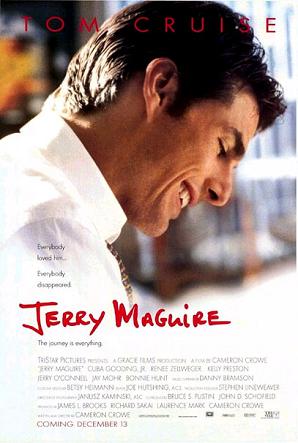
Jerry_Maguire_movie_posterJerry Maguire is your typical feel-good sports story, but it has a different angle. The eponymous character, Jerry (Tom Cruise), is on top of the sports industry. Not as a player, executive, broadcaster, or anything like that, but as an agent. His job is to make his clients the big bucks and protect their interests while also thinking about his own. He’s constantly on the phone cajoling and soothing big time egos so they stick with him and do as he desires. A lot of it is a flattery game, and Jerry is the best of the best whether it’s face-to-face or over the phone. He knows how to play the game.

In a brief moment of so-called weakness, however, he writes an impassioned memo after he realizes he has gone away from his initial values of being a sports agent. The idealistic magnum opus he comes up with late one night is well received and yet it signals a real hitch in his career, even if he doesn’t know it yet.

He gets let go at his agency, and he struggles to hold on to any clients he can, but slowly, bit by bit, they leave him. First one, then two, and then on and on they went. When a top prospect leaves him it looks like Jerry is sunk. And then there was one. Loud-mouthed, prima donna Rod Tidwell (Cuba Gooding Jr.) known for famously uttering the phrase, “Show me the money!”

All the while, unassuming single mom Dorothy Boyd (Rene Zellweger) buys into his dream when no one else will and in the process, she begins falling in love. He’s not quite at the same place she is however.

Jerry Maguire is invariably sad, but it is an ultimately uplifting look at the sports drama told from the sidelines which are still chock full of drama, conflict, and romance in its own right. By consolidating and getting smaller, Jerry learns what is truly important. He finds who his true friends are in Rod and Dorothy. And he learns what it means to truly love someone, not only in a cheesy romantic sense (You had me at hello), but as a true blue friend.

So although not always a great film, Cameron Crowe’s story holds some of the same sensibility of Say Anything… and Almost Famous. It shows that something as big and blown up as professional sports can always be brought down to a more basic level of humanity. It falls somewhere in between films like The Blind Side and Moneyball and that’s not necessarily too bad a place to be.

3.5/5 Stars

“And I’m free, I’m free fallin'”

Clueless (1995)

CluelessHere is a high school teen comedy that is actually quite entertaining. Based off Jane Austen’s Emma, the story gets a 90s face lift. Cher is the quintessential ditsy Beverly Hills girl. She is popular, beautiful, and she knows how to dress. However, perhaps most importantly of all we learn over the course of the film that she has a heart.

Initially she loves to play the matchmaker and she takes on pet projects while trying to find a relationship of her own. In end she finds her true love sitting right in front of her all the time.

The film is propelled by a memorable characterization by Alicia Silverstone who is balanced out nicely by a young Paul Rudd. Cher’s voice overs throughout the entire film work swimmingly and there is a bit of a fairy tale ending. Not to mention some sagely advice and hip jargon.

Now I know never to go for a Monet. AS IF! I’m not that clueless.

3.5/5 Stars

Review: The Shawshank Redemption (1994)

ShawshankRedemptionMoviePoster (1)This film originated from a Stephen King novella called Rita Hayworth and Shawshank Redemption. The actress actually does play into this movie and her famed hair flip from Gilda even makes a memorable appearance. However, the shortening of the title not only simplifies things, but it refocuses the film on what it is all about. You guessed it. At its core, Shawshank is about the redemption of one man who would never let his hope or ardent spirit be quelled. That man is the memorable, but generally unassuming, Andy Dufresne (Tim Robbins).

His story began back in 1947 when he was put on trial after being accused of riddling his unfaithful wife and her lover with bullets in his drunken rage. We see bits and pieces of what happened, but not everything. Andy quietly maintains his innocence, but he is dealt two back-to-back life sentences in the Shawshank state penitentiary.

When he gets there initially he looks to be a pushover, not ready for the dark recesses and the harsh reality that is prison life. In his typically smooth mode of voice-over, Morgan Freeman, as camp grifter Red, recalls when he first set eyes on this man. He didn’t know it then but Andy would prove to be a life-changing acquaintance, and he also proved to have more guts than Red was expecting.

They first cross paths when Andy comes to Red inquiring about getting a rock hammer and Rita Hayworth. Red obliges and these trinkets allow Andy to shape rocks to form a chess set. The poster goes up on his wall and others soon follow. He’s a man who always strives to stay busy, and he never lets his circumstances get him down.

It doesn’t come easy though because the local prison gang christened “the sisters” are used to getting their way with any inmate they cross paths with. Andy is not one such individual, and he pays the price, receiving beatings on multiple occasions. Still, he keeps on living and ultimately makes a name for himself by providing tax advice for one of the most notorious guards. It’s after this specific moment when he wins a round of beers for his mates that they begin to see the extraordinary individual in their midst. He goes by the credo, “Get busy living or get busy dying.”

Following his own words to a tee, Andy begins to prove his worth and earn respect as he gives tax advice to many of the prison attendants and guards. Even the hypocritical warden uses his services to keep his finances and office in order.

Andy is also transferred from doing grunt work to helping the aged prisoner Brooks in the library. It’s a step up and unprecedented in the history of the prison, but then Andy is truly special. After Brooks is released and tragedy strikes his life, Andy continues to improve things. He regularly writes his representative for funding so he can get more books and his work finally pays off. He also sets up a program so prisoners and workers alike can gain the equivalent of a high school education.

As the years pass, the prisoners get older and the posters change on Andy’s wall from first Rita, to Marilyn, and finally Raquel. About that time, a young prisoner named Tommy finds himself in prison and all the old timers like his energy. Andy resolves to get the young man an education and Tommy, in turn, shares some potentially life changing evidence with Andy. But it all comes to naught. The warden maintains his tyrannical reign and the defenseless Tommy is struck down.

Andy begins to lose some of his privileges as the warden starts to clamp down on him again by throwing him into solitary confinement for two months. When he gets out, Andy’s hope is still alive, sharing with Red about his dream of someday going to Zihuatanejo in Mexico to live in solitude. Red thinks it’s all folly, but agrees to do something for him if he ever gets out.

Then during an upcoming roll call, all of a sudden, just like that, Andy Dufresne is gone for good. To add insult to injury, he used his business acumen to stick it to the warden who is investigated by the police. Andy has the last laugh.

After so many rejections and denials, Red finally gets his parole and he looks like a mirror image of Brooks, a man who grew to know the Shawshank as his only way of life. It looks pretty fast and grim on the outside now. But Red has a purpose that Brooks did not, in Andy. He keeps his promise to Andy and rendezvous with his old friend.

Shawshank is a thoroughly engaging film and it works because of the performances of Tim Robbins and Morgan Freeman. Robbins acts as such a bright light despite his solemnity and subtlety. He is unceasingly upright;  the perfect contrast to this prison which is a vile, disgusting place full of corruption and violence. Freeman is the cynic and in many ways, he stands in for the audience. He wants to believe in a man like Andy as much as us, but the world initially tells him he cannot. However, Andy proves Red and the world wrong, by redeeming what has fallen. I can never get over that truth because it is such a powerful message told in such an engaging way.

4.5/5 Stars

Dazed and Confused (1993)

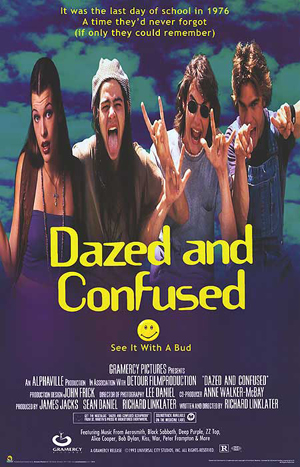
DazedConfusedThis film struck me as being very reminiscent of American Graffiti. It did for 1976 Texas, what the other film did with 1962 Modesto California. It has its own share of cars, a killer soundtrack, and ensemble cast involved in all sorts of vignettes and escapades.

School’s out and all that is left to do is live it up. However, as the kings of the school, the seniors have it easy. They get to subject all the new freshmen to initiation. Girls just get embarrassed, boys get paddled and you cannot choose your poison. You would think that all the seniors have the life that they want. After all, they have friends, they have good times, but for some of them they do seem to realize there is something else that’s missing. Of course right now they just want to have one epic good time.

This is one of Richard Linklater’s great earlier films and for the most part is was pretty good. He’s come a long way with films such as Before Midnight and Boyhood, but this is an important film if you want to understand where he’s come from.

4/5 Stars