Afire (2023): A German Summer Movie a la Rohmer

Christian Petzold is a filmmaker I was introduced to over a decade ago, and I would consider myself a passionate fan. I’ve seen every one of his films since then, and I would gladly share him with anyone who might listen. There’s some pleasure in championing a director who’s not as much of a household name as one might hope. 

The other wonderful thing about Petzold is what an ardent cinephile he is, but he’s also quite loquacious and charismatic. Obviously, English is not his first language, but he always does wonderfully candid and thoughtful interviews all across the festival circuit. I can imagine he would be quite the person to grab a coffee with. He’s shared on multiple occasions how he crossed paths with Abbas Kiarostami in New York City under such circumstances. 

Forgive me for burying the lede, but I appreciated Afire because, like many of the director’s earlier films, it does feel like it’s deep in conversation with the vast annals of cinema. 

This one in particular feels like a paler, pudgier version of an Eric Rohmer movie. Something in the vein of La Collectionneuse, Pauline at the Beach, or even A Summer’s Tale. I felt vindicated hearing that Petzold was in fact consuming some Rohmer films during the pandemic, but that was only part of his inspiration. 

Reading an interview he cited a significant reference point for his latest effort in People on Sunday. It’s not a film I would have considered in a million years because it’s well, almost 100 years old. But in regard to this allusion, he makes a fascinating observation. 

Unlike Hollywood, Germany doesn’t have a lineage of summer movies about the last day of school or hanging out at the beach with no adult supervision. There’s also no Summer with Monica or Eric Rohmer. 

With men like Billy Wilder, Edgar G. Ulmer, Fred Zinnemann, and Robert Siodmak — all creative collaborators in People on Sunday, they were forced to leave Germany. And when they moved to Hollywood in the wake of the Nazi scourge, their work got harsher with the likes of Detour, Lost Weekend, and more film noir.

The summer had vanished not only from their filmographies but from Germany as a whole. The nation rarely got this opportunity with the ascension of the Nazis and this historical backdrop gave rise to many of the specters which have haunted most of Petzold’s oeuvre.

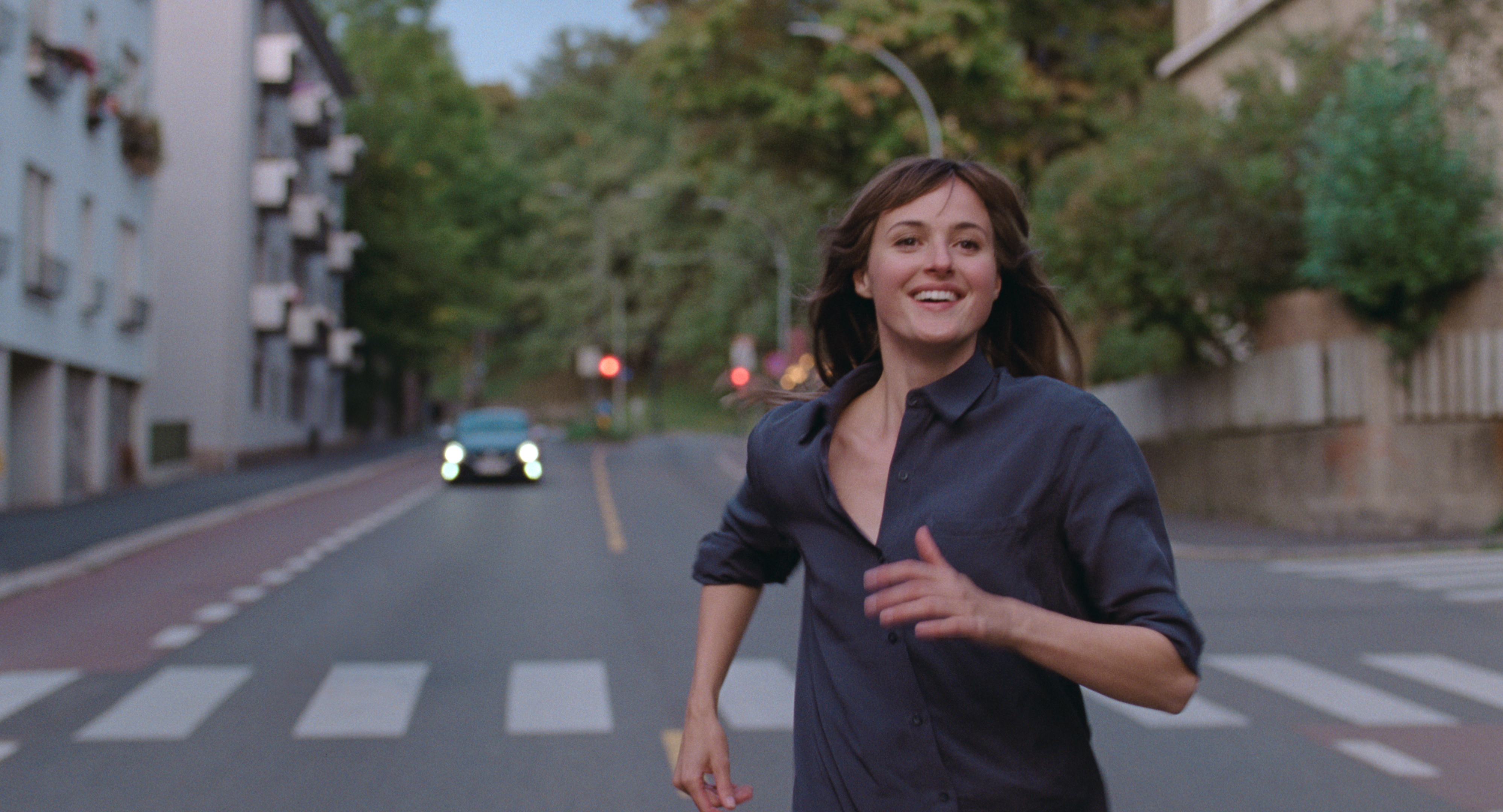
If you wanted to make a case, Afire is actually Petzold’s most comedic film to date and his closest to romantic comedy. Leon (Thomas Schubert) is staying at his friend Felix’s idyllic summer home out in the forest near the Baltic Sea. They think it’ll be a great place to get away: Leon needs to finish a manuscript and Felix (Langston Uibel) has an art portfolio to complete though he seems far more at ease and prepared to make the most of the tranquil surroundings. 

It starts out as the vacation from hell we might all be familiar with to different degrees. First, their car breaks down, they get lost taking a shortcut, and it looks like Leon might be stranded out at night in the forest with no cell signal. Felix goes off to make his way to the family cabin. 

Eventually, they get there. Except it turns out they won’t be alone. A co-worker’s daughter has set up shop; we don’t know for how long or why. We just know Leon’s plan for an uninterrupted getaway is catastrophically ruined. Strike two. 

The walls are thin and you can hear everything…It makes sleeping very hard and Leon’s even grouchier than he was before. The incessant bugs and the impending fires don’t do much to lighten the mood. 

Leon also seems genetically predisposed to be a moody, pretentious misanthrope of the first degree. Felix is good-natured and thoughtful. He would never think to impose himself on others or make a stink. It comes naturally to Leon. 

The camera takes on his surreptitious gaze which makes me uncomfortable as he spies on their housemate out in the yard before ever officially meeting her. Still, nothing he does can negate Paula Beer. In her work with Petzold, she always comes off as such a charming and intelligent performer who gives so much to the camera. 

Between her last film Undine where she played a modern-day mermaid, and Afire with its landscape ablaze, there’s this pervasive sense of the classical elements permeating the collaboration. It’s this lovely amalgamation of the deeply modern with the primordial. It makes one wonder where Petzold and Beer might go next. 

In the previous film, she was a docent focused on Berlin’s history of urban planning. Here Nadja works at an ice cream stand doling out flavors of “Smurf” sherbet. She’s disarmingly straightforward, cutting through any pretense. It makes her immediately attractive as a personality.

Whereas Leon’s a perpetual excuse machine. He never swims or takes anyone up on anything. He’s the kind of person you try to be nice to by inviting them to stuff even if you don’t want to, and then they decline so many times, you feel exasperated. They’re too blind to recognize you’re trying to do them a favor.  

Leon should be a lost cause, and yet even if we don’t particularly like him, we can empathize with him, and I think all his acquaintances in the movie make us appreciate him a little more. 

Later, at an open-air dinner, he lashes out at the rescue swimmer Devod. He feels like a stereotypical beefcake, and yet belies the image making Leon all the more uncomfortable. Because their new acquaintance was sleeping with Nadja, but he seems like a genuinely nice guy. These don’t have to be mutually exclusive. 

At first, Leon’s defensive about sharing his work; I recognize what a private and vulnerable thing it can be, and still, I wouldn’t give him that much credit. After Nadja asks to read Club Sandwich, he eventually relents. One suspects it becomes a mechanism to try and get closer to her and into her good graces — a way of covering his growing insecurities.

Leon’s also made a big deal of setting up time with his bespectacled editor (Matthias Brandt) to review his new work. He’s an older veteran, not unkind, but extremely busy. It turns out the full weekend they were meant to have together has been whittled down to one full day and some change. After Nadja invites Helmut to dinner, Leon grows jealous when it seems like everyone else gets a piece of him too. 

He takes great interest in Felix’s art portfolio – the one that Leon either didn’t get or totally disregarded. Then, Helmut trades poetry with Nadja; she recites her favorite poem, “The Asra.” It comes out she is working on a Ph.D. in Literature on Heinrich von Kleist’s The Earthquake in Chile (What she terms the “quake of representation”). 

Leon’s pettiness feels like a symptom of his own making. He knows Club Sandwich is crap. Nadja was honest enough to tell him as much. But he tried to dismiss her criticism; she’s only an ice cream seller. 

He never thought to ask her about what she might be studying. And now with the recognition that not only is this girl better looking than him but also perhaps smarter as well, it’s more than his fragile ego can take. 

Everyone else seems casual and comfortable, enjoying the throes of what summer has to offer. He’s the only one in obvious crisis, slowly imploding until the world around him joins in. 

The fire which was always hinted at continues to rage ever closer. Ash falls over their world like a ruinous dusting of snow. The boys go to tow their car with a tractor. Helmut starts to convulse on the lawn and Nadja takes charge to rush him to the hospital.

I noticed one particular jump cut in the editing involving Leon. He realizes he’s made a huge mistake; he’s been selfish and incapable of doing almost anything. What’s more, what will Nadja think of him? 

The raging conflagration brings with it human tragedy that strips away any remnant of sun-soaked vibes and focuses our story on its purest elements. As we should expect, it goes darker, but there’s another turn in the story. Our perspective changes subtly.

Nadja and Leon are called into the hospital again. There’s pensive voiceover narration to go with the images, and we realize intuitively even as the actions happen in front of us, somewhere in the present or future Leon is writing a new novel. 

I’m led to question if it’s still callous that he seems to be writing the story as the events seem to be happening or is it the most authentic thing he’s ever done? I’m not sure.

Later, he sees Nadja again from a distance. Some time has passed. We’d like to think he’s changed, and we know he’s wracked with guilt. Their eyes lock in recognition. Petzold cuts before there’s anything else, and it feels like the quintessential ending. We can fill in the rest with whatever we want.  

I’m still trying to get my feelings in order, but it delivered like Petzold always seems to. It’s deeply observed and engaging with its perceptive vision of humanity and interpersonal relationships. But what makes it richer comes with how the writer-director takes a simple premise and simultaneously imbues it with all this intertextual meaning. 

His references are not always overt, but couched within his stories are the echoes of his nation’s films as well as literature and mythologies – many of his projects over the years have been adaptations of much older work. In our current age of cursory knowledge and vapid fads, he’s a refreshingly thoughtful filmmaker. I’m still holding out for that coffee someday, preferably at Berlinale. 

4/5 Stars

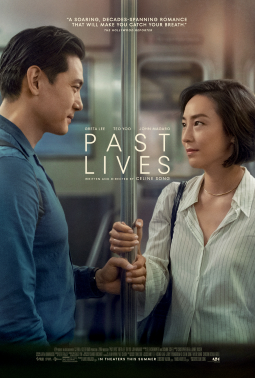
Past Lives (2023)

A version of this review was published on Film Inquiry.

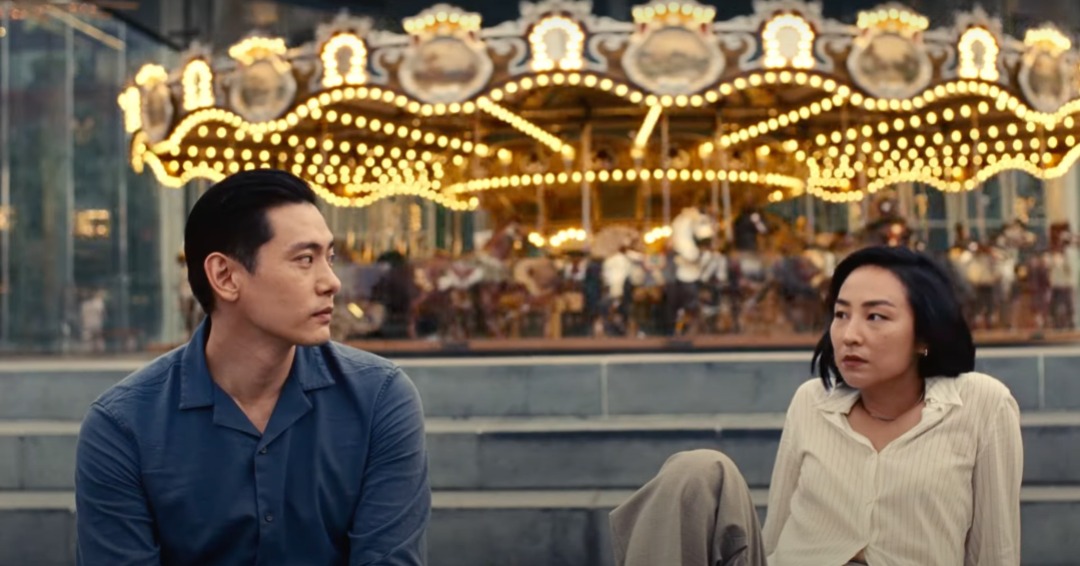
I’ll admit that in our modern world and hyperactive lifestyles full of constant distractions and competing spectacles, I’m thankful I was able to watch Past Lives the old-fashioned way. I sat there in the dark with other strangers uninterrupted by the chaos of the day. It was an uneventful weekday after work with no baggage or preconceptions. And I sat there prepared to imbibe what it had to offer.

The movie is the epitome of contemplative, meditative cinema. In a different context, under different circumstances, I can see the spell of the movie being neutralized and the surrounding chaos. As is, I was met head-on by what it had to offer.

The opening scene almost feels like a mini Godfather moment a la Gordon Willis. The golden hue of the lighting, the camera slowly moving toward a subject in the foreground as voices offscreen speak so we can hear them. It’s a brilliant device to set up the scenario. A male and a female voice chat back and forth. They’re people watching from the opposite side of a bar as a Korean man, a Korean woman, and another white man sit together in quiet conversation. What a strange trio they make.

It’s true that in such moments there are so many stories you could draw up to try and justify the scenario. Celine Song takes an entire movie to explain it to us. The heart of her story opens with two young kids in South Korea. They’re competitive when it comes to their grades, always dueling between being 1st and 2nd in their class. Hae Sung makes Na Young cry by beating her out one day, but regardless, they always walk from school together. They haven’t quite figured out what romance is, but there’s a closeness between them. They’re fast friends.

However, when her dad decides to immigrate overseas, “Nora” must relinquish this friendship for whatever the future holds. In camera, we watch their diverging paths as they trudge their separate ways. She will go first to Canada, and then America to seek out her dream of winning the Nobel Prize. He will stay behind in Korea.

Song’s use of time is self-assured and brazen. She’s loose and elastic with it bravely allowing her story to cut 24 years into the past before fast-forwarding 12 years and then 12 years again. But these jumps in time feel subtle and right with the perfectly applied sense of space and context. We never feel like we’re being rushed. The elliptical nature of a single cut is imbued with so much power.

They reconnect by chance 12 years later, thanks to Facebook, and rekindle a friendship over Skype. This specific moment in time feels intentional. Long-distance friendships or even relationships are hampered by the shoddy technology. What we have now cannot totally replace in-person interaction — we all know that — but it’s lightyears ahead of what we had even 10 years ago.

Nora’s life is taking her into the literature circles of New York including a writer’s retreat for up-and-coming talent. He is attending a good school in Korea. They’re amazed to see each other: they’re changed and yet nothing has changed. If you’ve ever had a similar experience you know this paradox to be true.

Song conjures up this idea of In-Yun or destiny which infuses Korean culture and implies something between people in their past lives together. In modernity, it might only be utilized as a pickup line, but for sincere, starry-eyed lovers it might just carry some weight and lend a sense of comfort. Any interpersonal connection may apply.

There is a sense that Hae Sung and Nora are in their very specific orbits and they are not prepared to fight the inertia around them. Nora takes the first step and asks to stop their online rendezvous. It’s too painful to live in the uncertainty with little hope of change. She takes a leap of faith in her career meeting fellow writers with similar ambitions. One of them is named Arthur (John Magaro). Their orbits are leading them in the same direction and so eventually they get married.

Lying in bed together having one of those late-night conversations on the edge of consciousness Arthur asks her one of those what-if questions about where she ended up. She responds matter-of-factly, “This is my life.” She seems satisfied with that. Her husband admits something else to her. Sometimes he hears her talk in Korean while she’s sleeping. It’s heartbreaking to hear him admit that she dreams in a language he can’t understand…It’s not wrong nor does it mean they can’t make their way together, but it matters to him. Because he wants to know her intimately. It’s important to him.

I have issues with Lost in Translation, but there is something about that film that sticks with me — the loneliness and malaise — as much as the Tokyo streets I dearly love. As best as I can describe it Past Lives, is born out of this same tradition. There’s a delicacy and dignity to these people. It could bend so many directions — choose so many roads — and in the end, somehow it chooses the bravest one.

In another film, in another world, maybe in a past life, there could be a passionate love affair between two people who seemed to be destined to be together. These are the stories our culture seems to eat up because they make us feel good and vindicate our desires to live out our best lives — the lives that make us feel the most validated regardless of others. Or it could be a sordid melodrama where the Korean couple cross time and space and the white spouse is cast off like the cultural patriarchy readily pulling them apart. The movie wryly acknowledges this narrative trope. Of course, none of this is true.

Past Lives foregoes all of these ideas while simultaneously tapping into the longings many of us have deep in our hearts and still allowing them to play out in meaningful reality. It feels true and right, like things are meant to be. We can see this story occurring naturally with genuine people. And the emotions engendered feel beautiful.

Of course, 12 years after they broke off their internet relationship Hae Sung finally comes to the U.S. — to New York. Ostensibly it’s for some rest and relaxation, but everyone knows his only reason for being there is to see Na Young again. Their reunion is pregnant with all sorts of import, and they visit the Statue of Liberty together surrounded by a sea of couples. Just imagine how it is when he finally meets the man Greta ended up marrying. Uncomfortable doesn’t even begin to describe it. There’s so much more here.

I could write a whole exploration of code-switching and cross-cultural communication, international dialogue, and subtitles in film. However, I will only say Past Lives replicates the joys and genuine struggles of existing in this world in-between cultures and languages.

Greta Lee is such a phenomenal conduit of this drama, and she takes every scene with a self-assured composure full of warmth and feeling. Teo Yoo has a forthright candor morphing from a boyish heartthrob to a man still grappling with unresolved feelings.

John Magaro could easily be a whiny-voiced annoyance — the white evil of the movie — and yet it’s a credit to his humanity that we like him and even empathize with him (especially if we don’t speak Korean like this viewer). It’s almost like we’re there sitting at the bar in what feels like a private conversation that we don’t understand. It feels a bit awkward, but there can also be a connection there. If you will, it’s in-yun.

Nora cries at the end of the movie. Her husband takes her in his arms as they walk back up the steps to their apartment. The perceptiveness of this moment cannot be simply attributed or articulated. I don’t have the capacity to totally explain what emotions have come to the fore. All I know is that they are there. It’s perplexing, but in the way I like my movies to be.

In Lost in Translation, I’ll never know what Bill Murray whispered to Scarlett Johannson. Here we’ll never know what could have happened or why she’s crying exactly. Maybe she doesn’t even know herself. But living out that ambiguity feels key and ultimately true to the human experience.

We’re always looking to discern what our future will be. Religious people question God’s plan for their lives. And often we have the nagging thoughts of what-ifs and how things could have been. Perhaps I’m the only one who thinks like this. But Past Lives seems to suggest this is not the case. I’m still mulling over the movie, but I’m glad I saw it. Hopefully, you will be too.

4.5/5 Stars

Oppenheimer (2023)

Being a history aficionado I pored over American Prometheus by Kai Bird and Martin Sherwin, which provided the inspiration for Christopher Nolan’s latest film on J. Robert Oppenheimer.

So many ideas were swirling around my brain when I entered the theater, but the first is obvious and it’s where Nolan begins: In Greek mythology, Prometheus took fire from Zeus, gifted it to humanity, and then was castigated for it.

Obviously, it’s easy to cast Oppenheimer as one of the most important figures of the 20th century since he was the “Father of the Atomic Bomb,” but he was also one of its greatest tragedies. There’s a scale and scope to this narrative woven right into the very fabric of history.

My other thought is a far more intimate detail but equally telling. Although he spent much of his time teaching at Berkeley and Cal Tech, Robert had a deep abiding love for the wide-open New Mexico territory where he kept a ranch and often went horseback riding. It was the first time I realized that Los Alamos and the outpost for the Manhattan Project was not some arbitrary place chosen by the government. It held such deep ties to who he was as a human being and what he held dear.

American Prometheus is a vivid and fascinating historical tome, but one can imagine the difficulties in adapting such a massive work. Nolan comes at it ferociously turning the historical details laid out before him, into something unequivocally cinematic.

A whole movie could be borne on Cillian Murphy’s face and it is. Between his vivid eyes, gaunt contour, the porkpie hat, and pipe, there’s something instantly iconic about him. He’s haunted and profound even before he says or does much of anything.

It’s dizzying watching Nolan develop the rich world around Oppenheimer packed with substance — a real world of real people and events we get to experience firsthand. This immediacy is key and although I’ve read the book, I don’t think you’re required to keep it in your back pocket.

The movie creates a complex constellation of relationships. These include important people in his life personally like Jean Tatlock (Florence Pugh) and his future wife Kitty (Emily Blunt) or his intellectual heroes such as Niels Bohr (Kenneth Branagh) living before us. I appreciated how we are thrown into his existence without true introductions or pretense.

He also punctuates the drama with mid to minor cameo parts taken on by notable actors like Josh Hartnett, Casey Affleck, Gary Oldman, and Rami Malek. This punch of celebrity does yeoman’s work in creating recognition in his audience regardless of historical knowledge.

Oppenheimer’s early life comes whizzing by us with so many stimuli and swirling jumps in location and setting that it feels like the cross between a globetrotting action movie and the roaming panoramas of late-period Terrence Malick. Nolan trusts the audience and expects them to pick up the pieces.

What differentiates Nolan’s work from his source material partially comes down to the visual flourishes at his disposal but also the ingrained structure he uses to mold it to his own vision. He effectively creates a narrative tension between fusion and fission as denoted by the alternating scenes of color and black & white framed by the two contrasting hearings.

The director has noted Amadeus (1984) among his reference points for his latest project because it is a character study functioning in a kind of duality. Mozart’s exasperating genius is framed by the point of view of his rival Salieri. Albeit our “Mozart” feels far more sympathetic, and our “Salieri,” well, you must make up your own mind.

Nolan does something narratively brilliant by providing us Strauss’s perspective juxtaposed with our protagonist. Lewis Strauss was a member of the U.S. Atomic Energy Commission and played a crucial role in Oppenheimer’s government clearance being stripped in 1954.

I read the book and despised Strauss as well as the prosecutor Robb (Jason Clarke) because of what they had done to Oppenheimer. But Nolan for a time strings me along even with this pre-existing knowledge so I begin to empathize and even get inside the interior life of this man. The doubts set in. Perhaps I misconstrued the facts as I remember them. He’s not all bad.

And yet when the vindictive pettiness that was there the whole time comes out again, it was somehow a shock and also an affirmation of everything I thought this man to be. Still, Nolan was able to encapsulate and still obfuscate this strange dynamic between these two men.

Robert Downey Jr. also must be given credit in a role that relies on his acting chops more than his wry charisma. I’m not always a fan of actors aging into roles like this, but I’m sure he’s going to surprise more than a few folks in the audience.

As the movie hurtles toward the apex of the Trinity test with the race against the Nazis at full tilt and Oppenheimer shouldering this massive project alongside General Leslie Groves (Matt Damon), we all know innately where we are going. These moments speak for themselves. I wouldn’t dream of trying to distill this suspended moment in time with a few inadequate lines. You must contend with it yourself.

However, with all that happens in Oppenheimer, I’m still trying to figure out if the structure works exactly because we spike with the Trinity test and still must witness the hearings and Oppenheimer’s gradual martyrdom.

It certainly maintains a breakneck pace that kind of overwhelms you in a way that’s never boring. The lengths of scenes, the cross-cutting, and the non-linear jumps through time and space are probably the writer-directors greatest attributes.

Ultimately the meeting between Einstein and Oppenheimer that Strauss only caught the tail-end of becomes a kind of lynchpin moment plucked out of time. In some ways, it does feel like a continuation of Dunkirk and Nolan’s deep commitment to the manipulation of time. Chronologically this is relatively early in the story and yet he somehow builds it to be the beginning of the end exploding into our current modernity.

There they stand on Princeton’s campus together meeting again. Oppenheimer reminds his elder of his biggest fear: That the construction of the bomb would conceivably set off a chain reaction destroying the world.

“What of it?” Einstein asks.

Oppenheimer responds, “I believe we did.”

It’s a sobering ending as nuclear imagery engulfs the screen once more. Because as an audience in the 21st century, we must reckon with a changed future imparted to us by Oppenheimer and his colleagues. Although the atomic bomb didn’t actually blow up the world as some feared, it birthed a reality in the wake of The Cold War and McCarthyism hysteria we are still coming to terms with today.

The film feels more grotesque and shocking than I’m accustomed to in Nolan’s oeuvre or perhaps I just blocked out the grimmer corners of his work. He’s certainly not squeamish about the darkness.

When “Oppie” is beset by a gymnasium full of cheering people and the horrors building up around him or he faces interrogation and his intimate trysts with Jean Tatlock merge and all but play out for everyone to see, I was perplexed, even disturbed. I didn’t want this and I go so far as to say I didn’t need the explicit nature, though Nolan probably has his reasons.

I’m not sure if it can be hailed as his magnum opus, but in some ways, Nolan has done the unthinkable by making a potentially stodgy historical piece into a gripping blockbuster. In the age of superhero movies, studios have mostly assumed historical genres are dead. Likewise, by shaking up a prosaic biopic form, the director alights on something that’s narratively audacious even when it falters.

That’s why he’s remained one of our most beloved filmmakers over the last decades. He makes big movies for thinking people, and if nothing else, I hope Oppenheimer acts as a clarion call for more thoughtful tentpoles in the industry. The audience seems to be more than rewarding his efforts.

4/5 Stars

More Film Review of 2022

I watched so many films in preparation for award voting, I almost forgot I had written other capsule reviews at the end of last year. As this year’s award cycle comes to an end, I thought I might as well share my thoughts on some of 2022’s other releases.

Elvis

Elvis is a schizophrenic biopic full of decadence and a giant performance from Austin Butler. He’s cast as an atomic individual with gyrating hips and supernatural energy imbibed by Black spirituals – the Holy Spirit as transcendent superpower. Likewise, homage is paid to inspirations like B.B. King and Sister Rosetta Tharpe, and a bit like The Great Gatsby, Baz Luhrmann develops this cultural collage with the nostalgia given a contemporary facelift via Eminem and Doja Cat. The cradle-to-grave blueprint almost feels too monumental with the biggest leap coming between Elvis’s enlistment in the military in 1958 to his cultural nadir in 1968.

I’m intrigued by the decision to frame the story through Colonel Powers, though I didn’t entirely appreciate the execution. Tom Hanks seems to pull us out of the movie in a disconcerting way. The images themselves can feel plastic albeit underpinned by Butler’s sympathetic moodiness. Somehow this seems to work well, and he goes for it in all manner of ways from the vocals, to the costuming and the fluctuating register of his voice. 

I have one primary qualm: although we tear through so much territory with Luhrman’s quintessential panache, we get very little time to actually appreciate these characters, nay, even get to know them. Elvis and Priscilla share a few solitary scenes of heartbreak and tenderness. Still, the rest of the movie feels more like an aesthetically pleasing clip show or montage projecting the aura of Elvis. Because he was such a gargantuan figure. The film gets that right.

But it never demystifies him in a way where we can get to know him and fully empathize. The most gripping moment might be right at the end when Butler fades out, and we suddenly realize we are looking at the real Elvis in his last performance of “Unchained Melody.” He gasps for air, he looks like an incoherent wreck on stage, and yet when he starts to belt out his song, we are reminded he was touched by something sublime. Perhaps Luhrmann wasn’t far off the mark after all.

Women Talking

Women Talking has a powerful theme at its core – a noble theme – and it takes it on with quietude and immense consideration. It is based on Miriam Toews’s novel dealing with a Mennonite enclave in the aftermath of a revelation: the men in their religious colony have been drugging and raping the women, and attributing it to the supernatural. The title somehow makes an implicit suggestion: men should be slow to speak and quick to listen – at least quicker than we normally are. And Sarah Polley creates this arena for all sorts of personalities and viewpoints to chafe against one another. It can be painful, but there’s also some catharsis found in this space up in a dimly lit grain silo. 

Although its tone is different, the nature of the material reminded me of last year’s Mass. These are self-contained dramas; they could have easily been performed on the stage instead of celluloid, and yet the breadth of the performances wields immense power. If you run down the gamut of Rooney Mara, Claire Foy, Jesse Buckley, et al, there are innumerable emotions – piousness, vengeance, and hurt. There is no easy way to parse through the trauma.

In one scene, a young girl questions the excommunicated man, August (Ben Whishaw), if his family was cast out because his mother questioned God. He makes a distinction: She did not question God; she questioned the power and the rules made in the name of God. These are the accoutrements Kierkegaard might have labeled Christendom, and many of them are rancorous having nothing to do with the teachings of Jesus Christ.

Aesthetically I’m still trying to parse through its washed-out color palette, and while I understand what it’s trying to accomplish, somehow it detracts from the film. It’s not just ugliness for uglinesses sake, but it feels like a visual faux pas or at least a missed opportunity. In Women Talking a sense of scenery and landscape comes out most in the final minutes as we recognize we are watching an exodus to a land they do not know. The resplendent scoring does leave a sense of anticipation and hopefulness in a film offering very little optimism otherwise. 

Nope

“I will cast abominable filth at you, make you vile, and make you a spectacle” – Nahum 3:6

The meta-irony of the movie should not be lost on us. Jordan Peele has created a spectacle movie about our collective obsession with spectacle. I’m certainly not the first to notice, but it’s telling he names his sibling duo OJ (Daniel Kaluuya) and Emerald (Keke Palmer). He effectively weaves together allusions to OJ Simpson’s trial and car chase with the Emerald City out of Frank Baum’s beloved fantasy. Somewhere in the mix, we’ve found the perfect cultural touchstones for what we end up witnessing.

But the best part of Poole’s films is how he gives us what we desire as an audience with the genre expectations and still, he finds time to grapple with deeper thematic ideas. It morphs into a kind of Sci-Fi revisionist western as OJ looks to maintain his father’s Hollywood stunt riding and horse business under mysterious circumstances. Poole grafts them into history – including the images of Edward Muybridge – even as he begins to redefine images of Blacks in the West, if not necessarily the representation of the western in cinema itself. Still, if you look closely, you’ll quickly spy the very intentional posters of Duel at Diablo and Buck and The Preacher, two westerns both starring Sidney Poitier, in a genre that otherwise lacked black heroes. 

The movie’s horrors come at the cost of gut-wrenching voyeurism over gruesome tragedy, and I appreciate how the director creates an entire matrix for his story to swim in with a history paralleling our own. He also recognizes the imperative need for pervasive tension and not just jump scares. In fact, it can almost be said the film is slow in patches, although it’s all about creating this world. It involves a child star-turned-family attraction man (Steven Yeun) and a tech whiz who works at the now-defunct Fry’s electronics. It’s big and ambitious, and yes, a bit messy, but somehow all these disparate pieces build something in front of us.

Leave it to Poole to conjure up a predatory UFO using our rubbernecking against us. We are inundated with wreckage and upheaval that comes at the cost of our collective obsessions. So Nope serves up the writer-director’s genre thrills while never shirking the broader social commentary.  It’s this combination making his movies into what can only feel like cultural events. Only the audience can determine if he’s feeding into the spectacle machine or not and how you would like to respond to it. A faceless spectacle seeker chides OJ to make a name for himself, and it’s difficult not to hear this as an evocation of babel. It feels almost like the temptation on the flip side of the oracle in Nahum. Because we make a spectacle out of everything: TV show tragedies, carnival attractions, and certainly UFOs. 

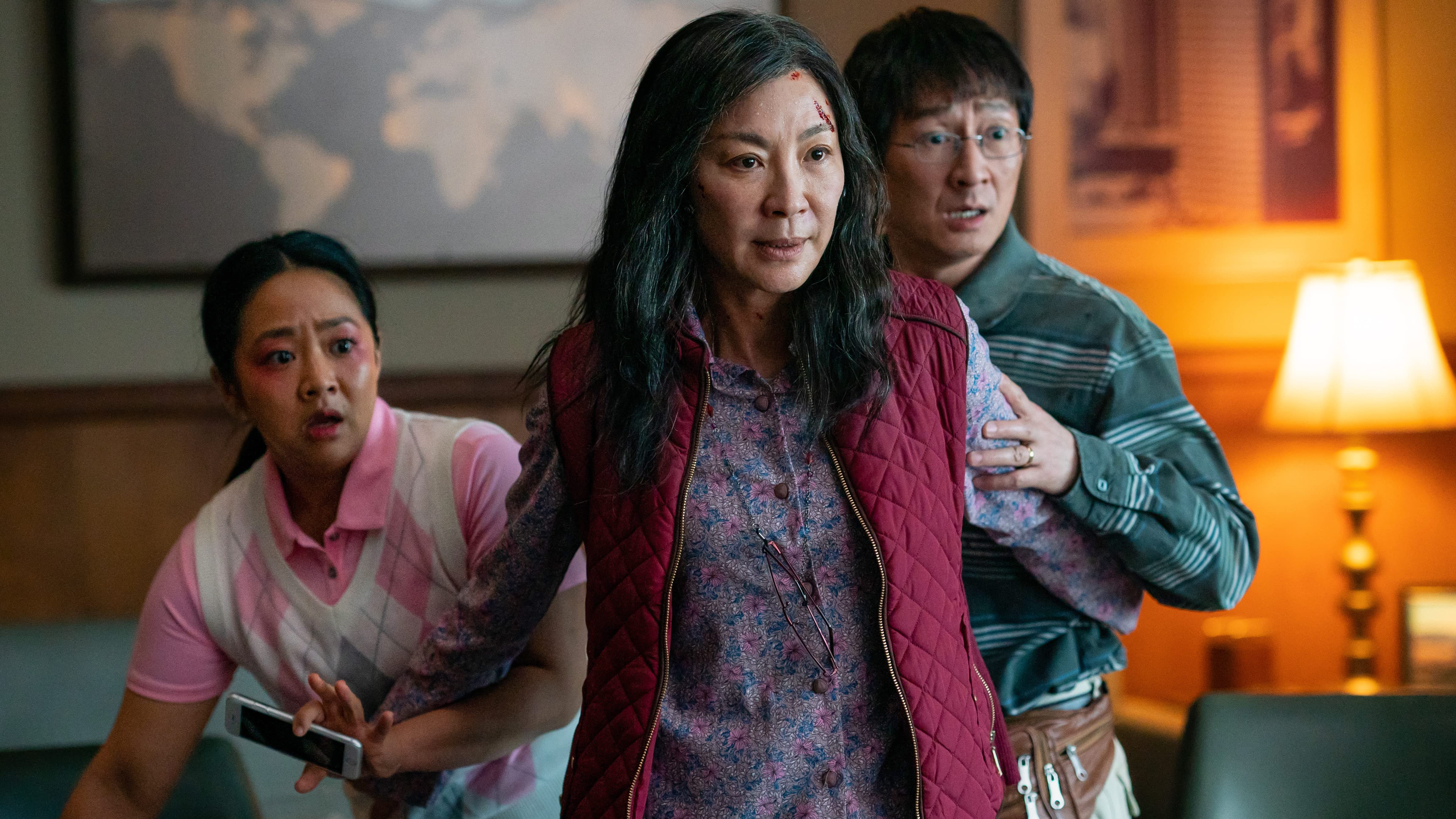
Everything Everywhere All At Once

I was hesitant about The Daniels thanks to their pedigree gleaned from twerking music videos and Swiss Army Man trailers. Still, they have grounded their outrageous proclivities in something I can appreciate, and EEAAO is their broadest film yet by its very design. In a generation swimming with multiverse movies, this outrageous creative tandem has conceived their own spin with a choose-your-own-adventure of a different sort starring a Chinese-American immigrant family front and center. 

As Michelle Yeoh, Ke Huy Quan, and James Hong are framed in an elevator together, I recognized this is the movie I always wanted to see and never get the chance to as a kid. It feels like a kind of much-awaited wish fulfillment within the Asian community: A beloved star taking on a role initially envisioned for Jackie Chan only to lend her own heartfelt and butt-kicking presence. A former child star who disappeared from in front of the screen thanks to the dearth of roles only to make a triumphant return. And a journeyman, utterly ubiquitous icon who finally garnered his due. And here they all are together cast as a family of genuine action heroes. And yet within these parameters of the family unit and what that means within this very specific context. We have stories like Crazy Rich Asians or The Farewell, and I continue to yearn for more and more of them.

What the Daniels bring to this space is an inexhaustible imagination taking creativity to its zenith with its share of gross-out scatological humor. Their sensibilities are not always to my liking, but it is a tall order to be all things to all people even with the aid of a multiverse. The movie pings through time and space with a wacky abandon flinging our heroine Evelyn into all sorts of circumstances before becoming an existential meditation on life. We only have one life left to lead: This one.

Family turmoil sends her spiraling and The Daniels evoke the impending nihilism with two rocks sitting next to the edge of the abyss, then pinatas swinging without self-determination, or finally a scribbled drawing without defined form or context. Surely the world is collapsing around us. But I can’t get away from this cast and how happy I am to see them together and how they fight mightily for some kind of solace and personal restitution. Because this is the film’s battle – a battle familiar to any of us with family. My final thought is only to consider the film’s sense of language and even how the end credits are written out with each actor’s family characters (along with the English). I’m not sure I’ve ever seen that before. Movie aside, these small recognitions feel like mini revelations. 

Till

“I keep asking myself why is this happening. Why did he take my child from me? What am I supposed to do?”

There’s something classical in Chinonye Chukwu’s techniques. For anyone familiar with the killing of Emmett Till, it could be a gruesome story, and yet in the moments where she could go for the visceral jugular, she goes for tact and a level of forbearance. Tension and the ache that comes with our own imaginations and the empathy welling up inside of our hearts are more than enough. In fact, it’s probably more potent.

In making it a mother’s story about Mamie Till-Mobley (Danielle Deadwyler), it doesn’t strip away any of the power or detract from the focus. Instead, it’s made supremely evident Mamie has such a stalwart moral constitution and an unwavering faith. Her son’s horrific death at the hands of southern racists was not something to cripple her. Instead, she carried his mantle with bravery so the whole world might be opened up to the despicable hate still festering in American society. What’s more, Emmett’s funeral – honoring an irrepressible boy lost far too soon – was met with the resoluteness of the old hymn: “It is Well with my Soul.” It could easily sound like religious folly unless you have a deeper understanding like Mamie about what her purpose was. 

Sadly, it’s hard for the film to climax after the egregious moments surrounding Emmett’s death, with a court case that feels all but inevitable in its conclusions. Still, the closest thing to a revelation might be when Mamie turns and sees the image of her son in the flesh smiling in front of her again. To her, this was not wishful thinking but a galvanizing belief that she would one day see her boy again. I don’t know any other way you could move forward and keep from being inconsolable. There must be a groaning even a yearning that the aberrant hatred of this world is not the final word. Justice will ultimately roll down, and she vowed to fight for it on this side of eternity until she saw her boy again.

Emily The Criminal 

If you’re a 20-something saddled with debt or trying to make a go of it in a gig-driven economy, Emily The Criminal might hit home. It’s centered on an L.A. that does seem to exist under the surface and still somehow exhibits a very specific milieu riffing off the focused austerity of someone like Michael Mann. 

It’s a modern-day neo-noir in a sense as we watch a young working professional live two parallel lives leading her deeper and deeper into one of the dark underbellies of the city. Although she aspires to be an artist, Emily currently works for a catering service, and when a coworker gives her a tantalizing tip – $200 for an easy hour of work, it sends her on her dramatic journey. For all those with fond memories of Aubrey Plaza as the misanthropic Parks and Rec intern, she upends expectations once again driven by a sense of listlessness and desperation. The world of credit card fraud mills and dummy shoppers is so tantalizing to the outside observer and depending upon your station in life, it’s a hop, skip, and a jump away from our own experiences. 

The romance between Emily and her general enabler and guide Youcef (Theo Rossi) feels like one of the most unlikely pairings of the year and still, it works to feed the film’s drama and lend it an emotional credibility. Because it feels like the film teeters perilously on the precipice of easy stereotypes, and yet it somehow comes out intact. Like all great neo-noir films, there is a grittiness to the picture where we feel and sense the danger; it is tactile and yet we can’t bear to look away because it has a grip on us.

I recall Christopher Nolan’s advice about finding ways to hide your budget with the weapons you use. Guns are pretty important for a crime picture, but they also come with their own production pitfalls. Nolan used hammers in his debut, and to that point, I’ve never seen Exacto knives and tasers used to such stirring effect as they are in this picture. They act as a practical extension of the world and the everyday menace ever-present. Plaza continues to show her abilities and no doubt will earn a new following from those who never conceived her as this kind of crime hero. She’s good and somehow her reputation for darkly comic sensibilities is given an even more incisive edge. What’s more, it looks to be just the beginning. 

RRR

At first, RRR seemed like a package of shoddy pyrotechnics, CGI, and over-embellishment, but about an hour in I began to rethink these cursory perceptions. There’s a sense that S. S. Rajamouli is effectively rejuvenating the epic biopic with newfound energy in a way Hollywood hasn’t managed for some time. Perhaps we’ve been too afraid to try with Marvel acting as such a comforting security blanket for the industry coffers.

Still, RRR, one of the priciest Indian productions ever, has gone for the fences and proved itself to be a lucrative international sensation without quite caving to the lowest common denominator. It maintains its own very specific identity as a Tollywood film albeit dressed up with all the aforementioned action and special effects. But out on the dance floor with our two heroes leading the charge with “Naatu Naatu” and a host of women in 1920s ballroom dress, there’s something dynamic and alive about how brash and rambunctious it is tearing through conventions. 

I’m by no means an expert on this cinematic space. Until recently I didn’t know there was a Tollywood to go with Bollywood; I’ve seen Lagaan, some of the films by Ray, and a few others. What’s excellent about RRR is that you don’t need a specific pedigree. You just have to open up your arms and enjoy what it has to offer. I found myself initially unmoved and bored with the tedium of its swooping and exploding action.

I can get this from the western shores of Hollywood. And it’s easy to acknowledge these characters are hardly realistic, and yet our own industry sustains itself on a steady diet of comic book characters so it seems quite unobliging not to welcome two more onto the world stage. Beem and Raju are capable heroes, and they work as an exercise in contrast – not only as physical specimens but also with their personal histories and how they manifest in their interlocking journeys.

The opening and climax of the film feel overwrought with action spectacle, and it wasn’t of particular interest. It’s for those with their popcorn looking for this kind of thrill. I was much more compelled by the middle of the picture with Beem bursting into the British compound and having to face his brother now cast as his utter antagonist. Because not only does he exhibit a Robin Hood-like daring, going into the enemy’s midst, but we can also sense the import of each of their arcs.

Initially, it’s about their growing relationship and the tension because their secret is separating these two friends. But then it becomes physical, and it’s impossible to untangle the action from the emotion.  Because at its very best RRR is able to speak into our universal longings for brotherhood and seeking out justice in a world often dominated by violence and blatant disregard for the vulnerable. Folk heroes like these somehow tap into our deepest longings since they are capable of doing everything we long to do but can’t.

Marcel The Shell with Shoes On

As a PBS-bred kid, there’s kind of a no-frills stability and general integrity coming with the name PBS. And although 60 Minutes had its lightning rods, there’s something almost solace-like about how it features in this snail-sized story. Marcel The Shell is the kind of benevolent content we need more of in our news stream. I use content because this is the parlance of the new millennium as we have the proliferation of stimuli trying to capture our eyeballs and constantly vying for our attention. Watching Marcel the little Youtube sensation my sister introduced to over a decade ago feels like a bit of a marvel. The brainchild of Jenny Slate and Dean Fleischer-Camp feels positively quaint by today’s standards, and it reflects how rapidly internet years speed by. 

If I’m honest, I’m not sure if there’s enough here for a feature, and yet…I’m not angry because in bringing Marcel to the fore again, we get a quiet meditation on the simpler things in life. As Slate becomes the little guy’s mouthpiece, the faux documentary gives us innumerable fresh pearls of wisdom. For instance, an audience is not a community. One feels vulgar the other involves personal investment. Likewise, by some obscure paradox, Marcel notes it’s easiest to rest when you have a party in your home and you go upstairs to a quiet room knowing there are people around you. As a raging introvert who acknowledges my need for people, I know this to be true.

Lesley Stahl feels like one of the unsung stars of the year and Isabella Rossellini is the consummate professional. How a film about a pretend shell with googly eyes could become one of the year’s most heartfelt explorations of losing loved ones is beyond me. But with “Amazing Grace” playing in the background and the methodical rhythms of the movie, it offered a lot more than I was expecting. Sometimes the unassuming packages become all the more meaningful. 

Favorite Films of 2022

It was another strange year at the cinemas, but there was a lot to appreciate.

Here’s a list of some films I enjoyed in 2022 and you might too. I’ll probably be releasing some other capsule reviews at the beginning of the new year. Let me know what you think!

No Bears

Of late I’ve been considering the films that leave an inexorable impact on me. Certainly, they entertain and compel us in some fashion as a viewer, but oftentimes the best, most daring projects utilize the medium of film in some unprecedented way – using its limitations and reflexivities to birth something new and meaningful into the world. I can think of few recent films fitting this category better than No Bears.

German director Werner Herzog always likened the filmmaker to a resourceful vagabond able to pick locks and prepared to spend a night in jail if it means getting the right shot. At least in his estimation, there’s such a thing as good trouble. Director Jafar Panahi takes this to his own extreme as he’s had his own well-documented run-ins with his home country of Iran, which has previously forbidden him from shooting movies. Given Panahi’s mentorship with the revered Abbas Kiarostami, it’s difficult not to draw a line between their work. In something like Close-Up (1990) we are dealing with the almost imperceptible dividing lines between filmed fiction and reality – that which is staged and fanciful and what we might term documentary. 

It does seem like Panahi is somehow dabbling in a fiction willed into reality. But it’s more unnerving than we can imagine even if he’s well aware of the ground he’s treading. His “fictionalized” version of himself struggles to direct a movie remotely across the border in Turkey, while he must remain in the country, dealing with woeful internet connections and kerfuffles with the local populous. We recognize a world around him divvied up and made insufferable by boundaries, borders, rules, and traditions so much so that words and reason seem arbitrary and even religious rites and oaths lack any kind of inerrancy.

He’s currently under arrest by the Iranian government and the dark irony is bracingly apparent. There’s both a bravery and a brazen cavalierness to it all. No Bears contends with both the cultural hypocrisies and the ethics of such a tradition as moviemaking. Sometimes things aren’t meant to be captured and held captive by a camera. Sometimes the camera captures nothing – only the innocuous and the quotidian – still, that doesn’t stop it from being feared. 

Decision to Leave

Decision to Leave is a transfixing tale meditating on the voyeuristic nature of both love and murder. But it’s not just about these themes; it’s about how romance and murder are cut together and potentially become inseparable within this indecipherable realm of the police procedural. It’s certainly not a film without precedent when it comes to the subject matter. It focuses on a detective (Hae il Park) investigating a crime with his primary suspect being the Chinese wife (Tang Wei) of a Korean businessman — a man who recently died in a climbing accident.

It works in the same spirals as Hithcock’s Vertigo as we watch the detective become more infatuated with this enigmatic cipher of a lady. His vocational obligations of interrogation and surveillance fluidly become a personal obsession. It walks this nervy tightrope between bleak romantic drama and dark noir while utilizing exquisite cuts between the past and the present with a precision fluidity bringing to mind something like Antonioni’s Passenger. We are obviously in able hands as our protagonist struggles to stabilize after being sent reeling by the effects of this mesmerizing woman.

Director Park Chan-wook taps into a great many elements that have made fatal noir romances a lasting pillar of crime cinema including entries like Memories of Murder and even Gone Girl. But I became particularly fascinated with how it dealt with this cross-cultural relationship. Somehow Tang Wei perfectly modulates her performance between the innocent heroine and perceived aggressor, and the space is muddied by all the ambiguities that come with interactions totally lost in translation. It weaves together a genuinely tragic romance on an emotional plane full of pathos with a mystery thriller ratcheted up by immense tension.

But there’s also a poeticism to the movie going beyond mere visual aesthetics. These motifs probably deserve further consideration – I’m thinking especially of the juxtaposition of imagery between the mountain and the sea – even as the film itself has much to offer a ready audience. The subsequent ending exhibits the fated doom deeply entrenched in the noir tradition. Otherwise, on a broader scale, Korean cinema continues to offer the world stage numerous dark, surreptitious delights. This entry just happens to be a canny hybrid of all of Park Chan-wook’s earlier predilections ready for consumption.

Aftersun 

You will not find anything spurious or mean-spirited here. In its place is a tableau built out of an intricate array of personal observations. Charlotte Wells has effectively harnessed one of the most powerful attributes of film: its capacity to capture time in a bottle both refracted through our memories and the frames of celluloid space. Many of us are familiar with home movies. Our fathers may have captured them or we gathered our friends together to make some two-bit swashbucklers (even Speilberg’s Fabelmans is deeply indebted to them).

But I was also reminded of this year’s 3 Minutes A Lengthening. Because Wells has dealt with time in a similar manner. In honing in on a moment — this seemingly mundane weekend between a father and his daughter — the director has collapsed a relationship down to its essence in a way most of us can intuitively understand. For many of us, time has probably gotten away with us, and we look back on childhood with warmth if not a glassy-eyed longing. 

Paul Mescal leads the father-daughter tandem with a kind of composure that feels ageless and still constantly unfathomable. He is a man caught between fatherhood and a life he seemingly lost as he navigates his own insecurities through meditation and Tai Chi. What makes it work is how present he seems in the moment. He’s not a perfect father by any means, but he seems like a genuine one – he desires to be available to his daughter. However, the bountiful shared history only works if he has an able foil, and Frankie Corio has a lucid precociousness we see in all the finest child stars – exuding naturalism directors can only dream of.

Because her point of view is so crucial to this piece. Rather like a mundane Fallen Idol (1948), it is through her eyes that we must both mediate between past memories and the present. We appreciate her childlike gaze and also the ruminations of her older avatar. In truth, we are all navigating this in between amidst the past and present, the living and the dead. It might seem drastic but surely this is what movies are for – allowing us to grapple with these very things in the most poetic way possible.  

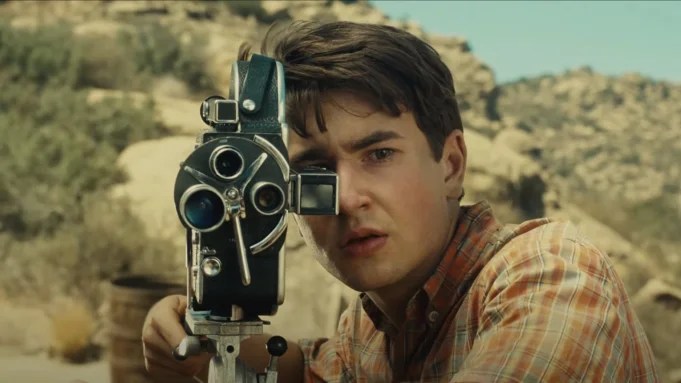
The Fabelmans 

It’s easy for films about a filmmaker’s own experiences to come off a bit narcissistic, but what better way is there to write what you know? In the case of Steven Spielberg, he feels like a generally beloved figure and so this act of self-reflection feels as much like a gift to the audience as it is a visual autobiography. In other words, I doubt many will begrudge him for taking the opportunity. Many have pointed out that Spielberg’s films always have some semblance of divorce and fractured families at their core.

Upon watching The Fabelmans, my mind drifted to the interview Speilberg did with James Lipton for the Actor’s Studio. Lipton connected how in Close Encounters of a Third Kind, humanity communicates with the aliens by making music on their computers – subconsciously Spielberg seems to be tapping into his childhood: His father the kind, pragmatic computer scientist, his mother the free-spirited artist. An entire oeuvre of movies would not exist without their influence and Michelle Wiliams and Paul Dano bring them to us with tender aplomb.

Late-period Spielberg has given us great period pieces like Lincoln and Bridge of Spies. For me, these lack the immediacy of his earlier works, and yet, again, I hardly begrudge him because there’s still a wide-eyed joy to each new project. He hasn’t lost that fervor and that’s even more evident when tackling his own family, though he’s now a more seamless technician than ever. In recreating many of his real childhood films, we recognize all the seeds of ingenuity, and it’s possible to see the invention plucked out of necessity.

Whether it’s crashing trains or school bullies, movies gave Spielberg a conduit to take control and gain mastery over what he could not fully comprehend. He’s warned, “Art will give you crowns in heaven and laurels on earth, but it can also leave you lonely.” It’s a heady portent even as he watches his parents’ relationship disintegrate in front of his eyes and through celluloid (It felt like a far more heart-wrenching version of Antonioni’s Blow-Up).

Still, for any cinephiles or budding directors, it’s easy to see this man (or boy) as a kindred spirit. It’s like a code – carbon dating his childhood by the movies he watches – and sure enough, we see him enthralled by John Ford’s The Man Who Shot Liberty Valance (1962). What’s more, in an inspired piece of casting, the old master makes a cameo. It depicts another piece of mythology deeply steeped in Spielbergian lore. As they say, the rest was history. Jaws, E.T., Indy, Jurassic Park, Schindler’s List and so many more. What a lineage to celebrate. I feel like I know him better than ever before because he has done something far from self-aggrandizing; he has let us in with a level of profound transparency.

Banshees of Inisherin 

I recall watching a documentary called Godspeed about an American priest who was transplanted to Ireland as his new parish. It was a culture shock because outside of the hustle and bustle of the big city or even comfortable western suburbia, he was forced to live a very different sort of life – one of very close proximity. They always say you can’t pick your family, but in a tiny society like this, you can’t well pick your friends either. That story focused on how such a lifestyle forces you to be known by those around you.

Somehow Martin McDonough deals in some dark inverse of this. What if the person you know most in the world – the one you call your dearest companion and drinking buddy – now wants nothing to do with ya’? What are you supposed to do and how do you react in these circumstances? Banshees of Inisherin is a fable and a character study relying mightily on the written wit of McDonaugh’s bleak quill, and the quibbling, deeply heartfelt performances of Colin Farrell and Brendan Gleeson.

The panoramas of Ireland are right out of a storybook like we expect them, but this is a harsh, acerbic tale, which also happens to be astutely funny. I’ve not always been a ready audience for the Irishman’s work, but somehow I appreciated this far more than I expected. Sometimes being kind is far more potent than leaving a creative legacy – sometimes that is the legacy – and yet McDonough doesn’t stop there. He leaves his feuding rivals to their own devices. And we are left to pick up the pieces (including a ghastly array of severed fingers).

My own first name is Irish Gaelic and with that comes a modicum amount of pride. It feels alive and pulsing with all sorts of history I cannot begin to articulate. Because McDonough and the majority of his cast have Ireland in their blood, somehow it adds profound layers to this story. It’s as if they understand the intimacy and pain of this landscape in almost unknowable ways. Their world is full of rich lineage and a fierce sense of identity which is as much about community as it is about strife and civil discord. It really does feel like a constant battle. 

Guillermo Del Toro’s Pinocchio

It plays like the anti-Disney version of Pinocchio, and it’s more than vindicated in its creative choices. There’s nothing sanitized or streamlined about any of its contours and though I have not seen the Robert Zemeckis version, the source material does seem to fit Del Toro more intuitively. It feels like it can be an earthier more generous version of the tale without saccharine sentiment. The beloved story is placed against the backdrop of 1930s fascism and this measured creative decision evokes something of Jojo Rabbit if not Fellini’s Amarcord, even as Pinocchio is generally a narrative of childish disobedience and ultimate redemption.

Pinocchio is created by Gepetto out of the tragedy of the war and although he’s a beloved creation, he’s a seemingly horrid little boy. To be a fully animated, living, breathing human being is to know the fallibility of the human frame and the depths of death and tragedy. It’s no coincidence Gepetto spends much of the movie toiling away to rebuild the crucifix for the local church. Here is a symbol of the need for absolution even as Pinocchio’s ever-growing nose is a glaring reminder of how often he falters.  

As a child, I abhorred, not the Disney film, but Carlo Collodi’s original children’s book because Pinocchio is such a reprehensible tyke. Del Torro gets that right and his world is fanciful, but not while totally disregarding danger and ugliness. Because this is what the world of fairy tales was made for beyond tangible history and Mussolini. Fantasy sets up parameters for a space outside of our own that nevertheless deals with the most unspeakable and difficult issues that children know to be true so that within this context of safety, they might come to terms with them.

While there’s a talking cricket (Ewan MacGregor), a scowling monkey (Cate Blanchett), half-dead bunnies, and a warty behemoth of a leviathan, what really speaks to us are themes of friendship, fatherhood, and ultimately, sacrifice. As best as I can understand, this is the eucatastrophe Tolkien speaks about where all sad things become untrue. 

Hit The Road

Hit The Road is probably the most genuinely funny movie I’ve seen and part of this is because of the dubious undercurrent. This unease goes unspoken for much of the story, but we recognize it’s there as something that has precipitated this entire journey. I found myself giggling all the way through because each of these characters feels so fully realized with all the quirks and idiosyncrasies we can appreciate even as they feel perfectly calibrated to gripe and annoy one another to no end.

The grousing father with his cast. A chatterbox son who elicits headaches. A mother with maternal instincts constantly worrying about her kids. And an older brother holding onto angst about his future. It’s true these are the markers of a family on a long road trip. But while it’s convenient to provide a comp like Little Miss Sunshine, Panahi is of his own mind and goes off toward a destination of his own design. 

 Rarely do I feel this genuine sense of danger while watching modern films, but whether it’s Tom Cruise’s stellar real-world feats in Top Gun or the societal backdrop of Hit The Road’s Iran, there’s a sense of unease – as if this film in its very conception is a marvelous act of daring expression. Later, the little boy recounts a scene out of the Batman movie where the Scarecrow uses “fear gas.” He’s disregarded by the adults because he doesn’t realize the real weight of his older brother going away.

Again, so much of this is ambiguous and these choices are important. There’s also the decision to shoot another crucial scene from a pronounced distance so our main players feel like mere comic specks on the canvass, but the humor is never far removed from heartbreak. I can’t get the image of the mother driving and singing at the top of her lungs with a forced smile on her face because it’s her only armor against tears. This movie melds both emotions so exquisitely; all that’s left is to marvel at the impact and be totally disarmed. 

Saint Omer

There’s a necessity to Saint Omer’s opening sequences following a literature professor (Kayije Kagame) as she recounts to her class France’s post-war history of shaming female collaborators by shaving their heads for all to see. She makes particular mention of Marguerite Duras’s writing of Hiroshima, Mon Amour – how the author was able to turn these memories of ignominy into a kind of “state of grace.” These moments might feel like a digression, but as the story builds, they become the groundwork for the entire narrative placed before us by director Alice Diop.

Saint Omer has to be one of the most moving courtroom dramas I’ve witnessed in some time. It forgoes using the courtroom premise to build a contentious ever twisting thriller. Movies like this are often won in their grandstanding moments on the stand. Here there’s a completely different approach; this is mostly an understated character piece. 

A French-Sengalese mother and grad student (Guslagie Malanga) is up on the stand for abandoning her 15-month-old baby. Her child eventually washed up on the beach dead. Given the gruesome circumstances, she offers measured, unblinking responses to every line of questioning. Her top almost blends into the wood paneling behind her. We watch as both her shortcomings and her tragedy are laid bare before us and slowly churned through by the pragmatic nature of the courts. The results are imprinted with all sorts of responses, both explicit and implicit, coming from witnesses, judges, jurors, and most stirringly the defendant’s lawyer. “We are all chimera,” she says.

As the proceedings march on, Rama, our literature professor and entry point, grows increasingly affected. She too is Sengalese, also in an interracial relationship, and she identifies deeply with this woman on trial, both for her relational shortcomings and the little indignities she faces. Nina Simone’s “Little Girl Blue” feels like the perfect summation for me in ways that can barely be articulated. This movie is slow, even plodding to my sensibilities, and yet I’m still trying to come to terms with it.

After Yang

Kogonada’s Columbus was a revelatory experience for me because not only did his exquisite work with The Criterion Collection translate to a gorgeous visual aesthetic, he seemed to make the movie I always wanted but had yet to receive. John Cho headlined a picture, and it was a movie about substantive issues. After Yang is a moving follow-up as the director takes a short story and turns it into grounds for how we consider issues of family and grief by way of Yasujiro Ozu.

In his future, Kogonada has created a definition of family in this multicultural world of ours, represented not by rigid uniformity but by vibrant individualism still bonded together by the human qualities of parenthood and care. I know it well and watching After Yang there’s an immediate kinship of a daughter who is grafted into this family like trees brought together by nature. It is natural, and it’s the way we’re often given to explain what adoption looks like. 

Although After Yang is ostensibly about a young girl coping with her feelings after her family’s beloved robot shuts down, again, like Columbus, Kogonada is able to explore so much more. Her father (Colin Farrell) is able to reach back into the android’s memories and recognize his own shortcomings, which also come with startling epiphanies. It might be a mundane conversation they share over tea out of a Werner Herzog documentary or the wide-eyed wonder in which this technosapien (Justin Min) interfaces with the world.

Ironically, media often considers tales where it is the technology pulling us out of our rooted place in our world and society, if not totally undermining it altogether. But perhaps it also has the capacity to bring us closer, whether it’s to our spouses or our children. After Yang is ultimately a hopeful exploration and one worth further consideration. Science fiction such as this requires a resolute belief in the beautiful necessity of human relationships. I want more of it. 

Apollo 10 and ½: A Space Age Childhood

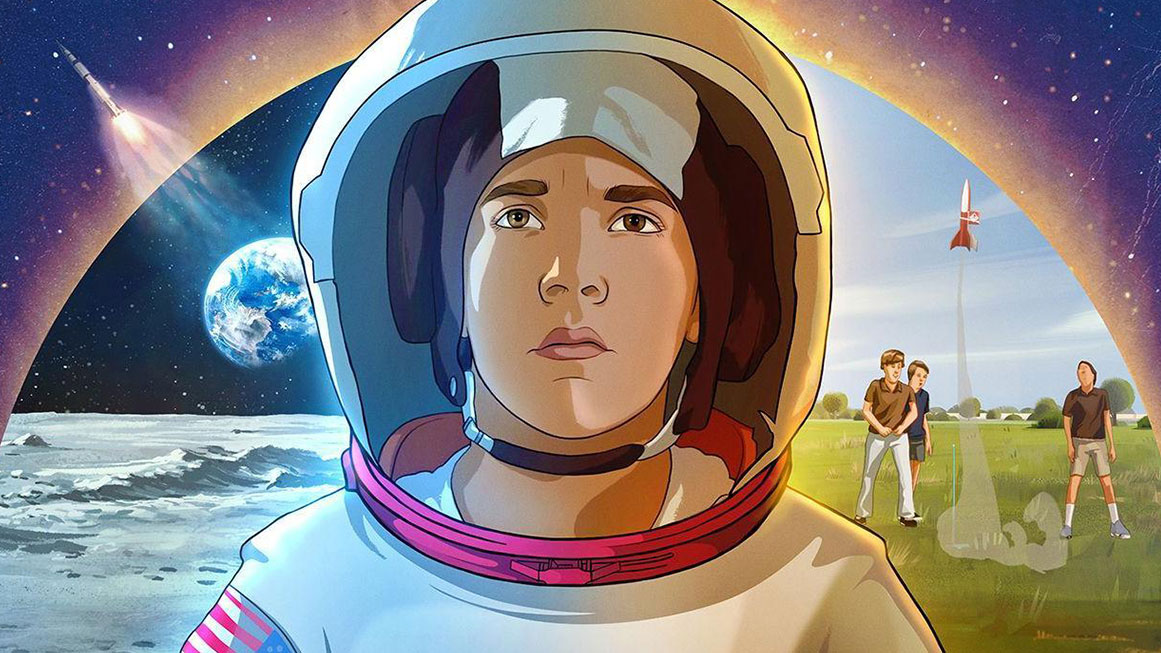
Ever since the early days, Richard Linklater has been intrigued by the capabilities of rotoscoped forms of animation. It certainly gives Apollo 10 and ½ a very distinct visual aesthetic. But what makes the film truly gratifying are the wafts of nostalgia visible throughout its frames. Backed by a Wonder Years-style voiceover from Jack Black, we’re able to fall back into the ’60s of Linklater’s childhood while being inundated with all the pop cultural touchstones and everyday realities that came with life in 1969. NASA and the upcoming moon landing seem to be on everyone’s minds even as siblings and families concern themselves with school or the new records to add to their personal collections (be it The Monkees or Herb Alpert’s Whipped Cream). 

I’m a sucker for these trips down memory lane, and not just because I like to wear rose-colored glasses. It has to do more with mimesis and getting to see a fully embodied representation of a time and era I can never know firsthand because I never lived through its banalities as well as its major cultural events. In fact, the rotoscope images accentuate this aura by giving us footage, TV shows, and even record albums we’ve seen before as secondhand artifacts, and still somehow through this animated mediation, they are rejuvenated before our eyes.

Linklater has always been noted for his interest in the mundane, in conversation, and in the depiction of passages in time. These are some of the joys of Apollo 10 and ½, but it’s also given to the flights of fancy that boyish imagination and space exploration seem to condone. We’ve seen many similar meditations from filmmakers even in 2022 alone. Rarely have they seemed totally self-indulgent. Somehow this is another one that feels real, honest, and intimate. 

EO

There’s no way for EO to be viewed outside the cultural purview of Robert Bresson’s 1966 Au Hasard Balthazar, another tale about a donkey who bears the burdens of life. It occurs to me there are two kinds of people who undertake such a project. You’re either so full of the brash vainglory of youth, you have no fear or deference to your forefathers. The other option is you’re so along in years, you need not worry about what others think. You go ahead and make the movie anyway because Balthazar was a poignant film well worth paying homage to. 

At 82, Czech director Jerzy Skolimowski fits firmly into the latter category, and I’m so thankful we have this film from him. The longer it goes, the more entrancing it becomes with the four-legged EO as our ready conduit of both the anthropological world around him and also the tranquil, sometimes utter bleakness of nature. The comic inflections of social structures, soccer pitches, and what have you, feel adjacent to some of the great comedies of some of his Czech New Wave brethren. I’m thinking of Fireman’s Ball or even Closely Watched Trains, and yet this is a film made decades later.

He does feel like the last of a catalytic generation and while there is some melancholy that comes with this, it’s also a stirring testament to the labyrinthian journeying that comes with filmmaking. Somehow this donkey represents the road traveled quite well, and it’s far from a Balthazar redux. Skolimowski has enough experience and humanity to make EO stand on his own feet in deeply moving ways.  

Top Gun: Maverick (2022)

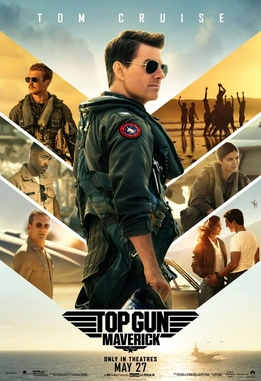
Although it might seem like I’ve sworn off all sequels, I realize there are a select few that are able to garner my affections. A movie like Top Gun: Maverick cares about its lineage, grappling with the past, and building an even more exhilarating future. In other words, it doesn’t feel like a myopic cash grab begetting movies that are soulless with their brand of easily merchandised fan service. Its primary intention seems to be galvanizing its legacy.

The care and concern are felt all throughout this movie, and it’s filtered from Tom Cruise all the way down to the last frame. He really is a marvel of cinema. A friend likened him to the Tom Brady of action movies, and while this is true in a sense, he seems to stretch the comparison to its limits. In an age where just about everyone seems to proclaim that the movie star as a box office entity is dead, he still manages to live on like a running, jumping, flying, motorcycle-riding freak of nature.

In truth, Maverick feels like the archetype for all his most iconic heroes, and if he came of age in a movie like Risky Business, almost 40 years ago, Maverick propelled him into another stratosphere of stardom.

But it’s Cruise’s own history as much as the character’s that bleed together in giving him such a rich and contoured backstory. Because how do you begin to separate the two? And Cruise’s gift to us is not only donning those aviators and jumping back into the cockpit; it’s far more ambitious than that.

I almost feel like I’m writing the same review I did for Mission Impossible: Fallout, but he’s always aiding our suspension of disbelief by submitting himself to all sorts of rigors in order to give us the most authentic experience. In Top Gun: Maverick he all but outdoes himself by filming in actual fighter jets and subjecting all his costars to a lot of Gs.  It’s just one example of something that cannot be fabricated for the screen. He’s giving us a palpable experience augmenting the cinematic reality and totally immersing us in the action.

But beyond its technical endeavors, it also feels like a well-balanced movie. Sure, we expect action, and Top Gun: Maverick provides that in ways its predecessor never could. We have callbacks to the same San Diego milieu, motorcycles, fast planes, and obligatory beach scenes. it’s all present and accounted for. However, its emotional poignancy feels equally important if not more so.

We’re provided some opening backstory to remind us of the man’s reputation lest we forget. He’s a rash hothead, who, despite all his exploits, has never broached the rank of Captain, but he also cares deeply about others. It’s the throughline of the entire movie.

When he is called upon by his old buddy Iceman (Val Kilmer), there is an obvious objective laid out before him. He must train up the best up-and-coming pilots in preparing for a suicide mission to destroy a holding of uranium in 3 weeks’ time. The parameters are set, and Maverick’s direct superior (Jon Hamm) makes it very clear that he was hardly the first choice for the job. Let’s just say his reputation proceeds him, and again, that is a very complicated thing to contend with.

While the man calling the shots only has eyes for this tangible objective, it’s Maverick who sees the end game.  He wants to bring these fighters home. And so when they fail in their training, it’s not merely a failed assignment, it represents the death of copilots and friends. Future uncomfortable conversations with loved ones. This is his bottom line. And why?, because Maverick knows precisely what it’s like to lose someone. As we all probably know by now, he lost his best friend.

While the original Top Gun felt mostly like a cultural curio — I never grew up with the original, and I appreciated the movie most for its San Diego locales — this movie has a newfound resonance.

Jennifer Connelly shows up as Penny Benjamin, a once-mentioned flame of Maverick. It feels like the token part of a love interest, but between its ties to the original movie and Connelly’s own confident candor, it creates an added dimension. Although Connelly came of age a bit later than Cruise (Career Opportunities springs to mind), she still seems to orbit in the same spheres, and she falls seamlessly into the part.

What is time if not a way to tap into memories and an audience’s goodwill toward characters? They have a history built into the earlier film, and it’s a pleasure to see it explored.

The same might be said of the reintroduction of Iceman Kazansky. Val Kilmer, who has famously struggled with throat cancer and lost most of his vocal abilities, is venerated with a hero’s welcome throughout the movie. By now, he’s become an admiral while remaining a stalwart ally of Maverick.

There’s something meaningful about tying Kilmer’s real life into his part because his backstory begins to become all the more real in our eyes. He and Cruise have a shared history together, both real and imagined, and when he entreats his good buddy to “let it go,” the simple words he types out feel like lasting pearls of wisdom.

I’ve all but failed to mention it thus far, but Top Gun and Top Gun: Maverick could not exist without the relationship of Maverick and Goose (Anthony Edwards) or Maverick and Rooster (Miles Teller). They are inextricably linked to the core dilemmas of the franchise.

The movie provides several pivotal choices for Maverick. It’s these decisions that the whole emotional axis of the movie turns on. Confiding in Penny, he says he either has a choice to send Goose’s son on the suicide mission or not allow him to go. Rooster would never speak to him again so either way, he loses.

But what makes this movie something more is the genuine outpouring of feeling. The final act has something special because it ties the movie together through its most profound relationship. If you’re like me, you realize Top Gun would not be what it is without the death of Goose, and it is this wound at the heart of two main characters: his best friend and his son.

Now they must reckon with the aftermath. What a spectacular thing it is to see. Full of sparks and bitterness and anger. Then fear, tough decisions, and the kind of sacrificial love that speaks to us in the deepest ways possible. It’s quality storytelling taking this central relationship echoed down through a generation and making it all the more impactful.

I was thinking throughout Top Gun: Maverick, we are never given an exact enemy. Pilots on the other side are faceless. There is no consequence to them other than how they affect the pilots we come to know and love. You could say this is a commentary on a world that’s more ambiguous than even the hard-bitten Cold War days of the ’80s. However, it’s also a reminder that this is a story ultimately about these pilots. They have a mission, yes, but the movie does its best work by tying these outcomes back to its characters on their most fundamental level.

Thus, any kind of resolution yields tenfold because it means far more than a target getting hit or some other seemingly arbitrary objective. If you’ve seen the original Star Wars (or Force Awakens), it’s nothing new.

But Tom Cruise — we like him. We want to see Maverick be Maverick against all odds. And he’s that and then some. Miles Teller has been under the spotlight for more than a decade now; he’s still got the same baby face, and I have to say I’m fond of him. Even a hotshot like Glen Powell, whose entire purpose is to make a nuisance of himself, proves his inestimable worth in the end.

I couldn’t help thinking when they touch back down on that aircraft carrier — having gone through the gauntlet — there’s a euphoria there that’s almost hyperbolic. It’s built out of close-ups, swirling music, and characters embracing who we grow to care about. But rather than get pulled out of the moment, we imbibe their joy and get stirred up because we want to be a part of their success and live vicariously through it. You could feel the energy surging in the audience.

And when it was all said and done, Top Gun: Maverick made me oddly patriotic and proud of my country. In recent years, we have learned how unchecked nationalism can become perverted and made into a far cry from what it was meant to be. Then, on the other extreme, patriotism is often scoffed at in the face of our societal sins.

But this Top Gun never feels like a trumped-up showcase of American exceptionalism. It’s not that superficial. All you have to see are those photos of Maverick and Goose or Maverick and Rooster. That’s what it should mean to be American. It can be fun, yes, but there’s also an import and a magnitude to our humanity. Caring for others well, risking our well-being for the sake of loved ones, and rising out of the ashes with mutual trust only to make us stronger.

I’d like to believe these tenets represent us at our finest and this film at its best. So please go and enjoy Top Gun: Maverick with your father, with your family, or with your friends. And whether you recognize it or not, perhaps it will move you in unexpected ways even as it offers up one of the best full-blooded action movies in recent memory.

4/5 Stars

More Film Reviews of 2021

Undine
Christian Petzold is the master of methodical cinema and with the conceit for Undine, he proves he’s more than up for imprinting his style onto a modern-day mythical fairy tale. He reunites again with Paula Beer and Franz Rogowski from Transit. Once more it’s a world from a distant past somehow planted in contemporary society. There are successive moments that feel so mundane it makes the scenes breaking the mold all the more startling.

They shatter an aquarium and lie sprawled on a coffeehouse floor. Undine pays a wordless visit to her former boyfriend as he does laps in his outdoor pool. The diver resuscitates her to the beat of “Stayin Alive” even as she resurrects him through some mystical romantic force. It borrows some visual language from underwater love stories like Creature from the Black Lagoon and Splash, but it’s also sculpted by the director’s unmistakable outlook from post-modern Berlin. What a pleasure it is to watch a filmmaker who doesn’t find a need to explain all his choices. We must watch them unfold and wait to be enchanted.

The Power of The Dog
The Power of The Dog is a fine film, and Jane Campion’s touch is deft in bringing her version of Thomas Savage’s 1967 novel to the screen. Benedict Cumberbatch plays a role almost antithetical to the image he’s slowly gone to work dismantling since the days of Sherlock and impeccably British dramas like The Imitation Game.

There’s something leathery and caustic about Phil Burbank, a man who has learned to lead the demanding life of a cattle rancher. And even as he remains skeptical of his brother (Jesse Plemons) marrying a new bride (Kirsten Dunst), and he openly belittles her tenderhearted son (Kodi Smit-McPhee), his persona continually erodes and shifts before us. It is a movie about a neutered form of masculinity. Although there aren’t too many pulse-pounding interludes, this element alone feels almost startling given the general conception of the western genre.

If there is any issue with the picture, it’s really no fault of its own. It’s simply not what I was expecting. But I don’t want that to totally sour my expectations. There’s a quiet tension to the picture as it goes through its paces. There’s no murder, no perpetual row of histrionic Oscar-worthy scenes of drawn-out drama, and it seems to continuously bend away from what is expected toward more nuanced observations.

It has the vistas one might expect from the West, set on a family’s ranch, and yet it’s strangely contained like it was perfectly suited for the Covid age despite being a 1920s period piece. Mostly it’s a film doled out in relational dynamics – this is its currency – the emotional and relational psychology that governs how people exist with one another. In The Power of The Dog, the evolution occurs gradually, over time, and it might just surprise you if not totally gratify your want for catharsis.

The French Dispatch
The French Dispatch is less of a narrative film and more of a clockwork cinema machine where we have the pleasure of watching Wes Anderson orchestrating his preferred world with its myriad of players. It’s an ode to the art of writing – the journalistic form – and its best spurts boast comic objectivity with a perfectly calculated and colored intricacy. The initial French milieu of Ennui-sur-Blase blended with this perspective feels almost Tatiesque.

It’s not so much a story as a style, and it’s an extraordinary style. Anderson is so singular in his aesthetic, and it seems so specific by now that it never wavers for a moment. We always know intuitively that we are existing fully in an Andersonian world as he splits his homage (or pastiche) into three distinct stories. Anderson’s stock company, which keeps ballooning while retaining all his own usual consorts, ensures the frames are full of familiar and eminent faces (even if some have next to nothing to do). There’s a trolly ride into a prison asylum that feels like it’s literally sagging under the weight.

There’s a droning literary nature to The French Dispatch as it dabbles in all sorts of creative whims. There’s Bill Murray as an avuncular editor. Benecio Del Toro and Lea Seydoux as a crazed artistic genius and his prison guard-turned muse respectively. Timothee Chalamet becomes a college-aged dissident plucked out of Godard’s Masculin Feminin (or David’s Death of Marat). The black and white mimesis and Lyna Khoudri are compelling if not the vignette itself. Jefferey Wright gives an amusing turn recounting a food column devolving into a kidnapping thriller. Oddly, there’s nothing to be taken too seriously in Anderson’s French Dispatch, which gladly gives itself over to ligne claire animation before writing its own editor’s obituary.

As an artistic achievement, it’s extraordinary though it lacks any true narrative absorption. We must appreciate the individual accents and moments, not a centralized sense of comedy or drama. By now Anderson’s vision is so well-attuned and everything is humming just as he likes it. He’s trusting his audience knows what they like too. Anderson connoisseurs should and for others, it could be a mixed bag.

King Richard
If King Richard were merely a rags-to-riches sports movie, I would hold issue with the fact there seems to be so little adversity on the road to professional success. However, to its credit, in an age where biopics need an angle if they’re ever going to see the light of day, here is a version of the familiar story that feels more like a character piece than your typical insurmountable sports story defying all odds. To be sure, it has all of that, but Will Smith, as Richard Williams, helps bring life to a deeply stubborn, idiosyncratic visionary, who helped cultivate his two daughters into the greatest tennis players ever.

I was chomping at the bit for more Venus and Serena, and Venus (Saniyya Sidney) grows into the movie as she gains traction in junior tournaments and then becomes one of the most sought-after endorsements while making her professional debut. In a conventional sense, these are the beats we expect, but the movie never totally pulls away from King Richard, whether he’s butting heads with his daughter’s well-meaning coaches (Tony Goldwyn and Jon Bernthal) or getting chewed out by his wife (Aunjanue Ellis) for his own delusions.

He’s not all saint and some grievances are aired, but no matter how odd his tactics seem, he still was a man of principles and someone who seemed to genuinely love his daughters. The adage holds true that it takes a village to raise a tennis player, but King Richard did something pretty spectacular. I’m not sure if this is Smith’s best performance, but the film will definitely resonate with the intended audience who appreciate this kind of uplifting story in a year where we could always use more. The fact that Serena is still in the cultural spotlight decades later still astounds me.

Nightmare Alley
Guillermo Del Torro’s version of Nightmare Alley vows for a methodical establishment of its world and characters. We get a sense of the carnie life and the 1940s sensibilities. The cinematic antecedents could be spouted off in passing like The Uknown, Freaks, and, of course, Tyrone Power’s own iconic turn as Stan Carlisle in Nightmare Alley (1947). While I don’t dislike Bradley Cooper, he somehow lacks the wheeling-dealing charisma of his predecessor. It comes with time, and yet he seems to play the role close to the vest until the drama really starts to capitulate.

They throw around the word panache though it hardly seems to characterize the kind of performance he’s looking to achieve. Willem Dafoe feels like a standout not solely due to the craggy contours of his performance. He feels like this film’s individual creation. Cate Blanchett is much the same taking arguably the juiciest secondary role from the original and turning it into a blood-red femme fatale.

This version does have the opportunity to be more shocking and vile in where it can take the material, and since it is hardly a contemporary picture, there’s a different kind of appreciation the set dressings can garner. A world seems to be resurrected before us. Del Torro’s chooses to draw out the story to become more of a psychological mood piece that lacks the more timely pacing of the earlier rendition though it does finally spiral into a dark abyss of its own making.

It’s this final chapter that earns the moniker of noir and though it doesn’t divert drastically from the original, the vision of its maker is unmistakable. He does his very best to make Nightmare Alley his own. I must admit I maintain a fondness for the original, and I’m not sure if he’s bound to find a broad new audience.

Last Night in Soho
There’s this sense Edgar Wright has been dying for this day: to curate a British Invasion soundtrack for one of his films. For him, this is all homegrown music. It’s set up immediately with a heroine named Ellie (Thomasin Mackenzie) who holds an obvious affection for all things retro – a college-bound fashion designer infatuated by Swinging London – and “World Without Love” feels like one of the quintessential anthems of the times (along with “Downtown”).

I was fond of Midnight in Paris because it reminded us that every generation wants to return to the good ol’ days. As Petula Clark also sang, “the other man’s grass is always greener.” But Last Night in Soho takes these sentiments and gives them the chilling tinge of horror. Nostalgia can be a deadly thing too.

It morphs into a nightmare of the sixties where the rose-colored glasses are cracked and whatever an immaculate soundtrack might suggest, we’re still left ill at ease by leering men and a kind of pervasively misogynistic culture. It’s precisely why a movie like The Knack..And How to Get It feels so offputting to me. Because you feel gross. Character identification becomes so crucial as we fill Ellie’s shoes and we empathize as the horrors engulf her and her surreal double (Anya Taylor-Joy).

It might just be the presence of Matt Smith, but there is a sense this could be an episode of Doctor Who in an alternate dimension while also paying homage to the old guard like Terrence Stamp, Diana Rigg, and Rita Tushingham. Still, it’s not like we were plucked out of one world and put in another. I also can’t remember ever seeing a Wright picture where there was such an obvious theme tied with the kind of unabashed entertainment he’s always capable of providing. The only problem is that in trying to derive a twisty payoff, he somehow muddles the meaning of the movie.

House of Gucci
Trailer expectations make House of Gucci feel like a mild disappointment. There’s a hope that Ridley Scott’s latest film might lean wholeheartedly into the camp to become a bizarre story of decadence and machiavellian wheeling-dealing gone horribly wrong. We are being sold a murder in the upper echelon of the fashion industry. I’m reminded of I Tonya, a surprisingly ingenious film telling a larger-than-life story with conflicting perspectives on recent history that formerly covered the tabloids. The movie pays off thanks to the weight of the performances and the stranger-than-fiction narrative.

House of Gucci has some performances that work well enough. Lady Gaga gives her role a real go of it, but far from being just a backbiting femme fatale, there’s attempts to make her character, a woman who married into the Gucci family, more of a human being. This is not wrong, and it can be lauded as she gels with her new husband (Adam Driver) navigating the hierarchy governed by his father (Jeremy Irons) and his uncle (Al Pacino). But in trying to be a genuine relational drama while also jostling for future camp status, it’s not able to capably manage either.

It feels impossible to have our want of theatricality sated while getting the sincerity too, thus the movie falls into this realm of overlong mediocrity. It’s not bad in its totality, but we leave the story feeling mostly underwhelmed, especially given all the talents assembled. Like Gaga, Jared Leto, who readily “uglifies” himself for the role, looks poised to go for the fences. However, it represents some of what I dislike about this approach to acting at times. There’s very little that feels real about it, and I kept on questioning why they could not get someone else – someone older – for the role. It’s disheartening because I didn’t know what kind of story Gucci was trying to tell, and it suggests maybe the team didn’t know the best story to tell either.

No Time to Die
Daniel Craig burst onto the scene with Casino Royale as a darker, more mercurial Bond for the 21st century, and it gave the franchise a level of rejuvenation and relevance in the arena of action movies. Vesper Lynd gave Bond a bona fide relationship that did not feel totally disposable but in grappling with Hollywood expectations, demanded to be disposed of. So the fact Bond is found at Lynd’s grave marker, conveniently also setting up the film’s best setpiece, feels like an early signifier of good things to come.

No Time to Die gives Bond an inkling of a back story and the weight of a human connection (with Lea Seydoux) that almost feels incongruous with his very image where women are merely objects and enemies are to be vanquished all in a days work. It seems only fitting Bond feels more human than ever given Craig’s history with the character. Despite its runtime, it’s not a gargantuan, earth-shaking film. The villains as they are (Christoph Waltz and Rami Malik) are fine if not totally out of this world.

Still, in our restricted era, there’s something appealing about a globetrotting thriller married with a character who seems to recognize the weight of the real world. Whether it looks suave and debonair or not, sometimes it takes vulnerability and sacrifice to win the day. Bond seems to have stakes that he never had, much less cared about, before. It’s up to the viewer to decide if they embrace this or not.

The Card Counter
“Forgiving another and forgiving oneself are so much alike.”
There’s often an austere quality to Paul Schrader’s cinema, whether it’s about a priest or a card counter. A lot of it is inert and internalized. They are meticulous with composition books, deep in thought, and always ready with a drink to nurse nearby. His heroes seem to live by a certain code and more than simply being religious, they operate on a level of penance for sins, both their own and the world around them. These might seem like weighty words to describe movie characters, but then Schrader is not your typical, average, everyday filmmaker.

There are no warm and fuzzy feelings in The Card Counter nor the kind of comedy release valve we’re taught to expect in our movies. Schrader doesn’t seem to have time or patience for this as he tackles heady, more existential topics. It’s cool and brooding in tone and atmosphere, mostly shot in the fake interiors of casinos.

It’s poker as a character study rather than the crowd-pleasing sports drama of Cincinnati Kid, and Oscar Isaac is our hero, a war vet who also served a stint in military prison. Now he devotes his life to counting cards and playing poker but not for the normal reasons. His backer (played by Tiffany Haddish) pointedly tells him, “You have to be the strangest poker player I’ve ever met.”

It also doesn’t have the feel of a 2021 film, and yet the space from its historical past is probably necessary. Because it dredges up the crimes perpetrated in Abu Ghraib. Will says, “Nothing can justify what we did” And he cannot change the past so he looks to watch over a young man (Tye Sheridan) and search after the man (Willem Dafoe) responsible for all the evil in his past.
The first time I heard Pickpocket evoked in reference to The Card Counter, everything clicked into place; it all makes sense because Robert Bresson’s film was at the center of the cinematic transcendental revelation that hit Schrader in the mid-seventies. He does his best to evoke some of that here. Once it’s mentioned, you can’t unsee it.

Passing
There is no movie without the performances of Tessa Thompson and Ruth Negga. There’s something delicate and tempered about the way they carry themselves through this movie only matched by the 1920s color palette. It’s a curious reference, but I was thinking how, like the black and white in Some Like it Hot, here it allows us to buy into the charade that this woman would play: living the life of a white woman.

The world conjures up images of The Cotton Club, a space where we don’t see Jim Crow segregation as much as these oddly stratified and “separate but equal” spheres of existence. Blacks build a vibrant community for themselves in Harlem out of the prying eyes of whites because it is a fragile peace. We meet Irene (Thompson) in a scene where she attempts to pass as white. The one person who catches her, Clare (Negga), does so because she has made a life of infiltration. She’s married a white man and effectively given up her past life for the preferential status she now owns.

Passing is a quiet film, and there are only a few scenes I can look back on. The opening scene could have been the set-up for a chilling race horror film. Scenes in the jazz club are alive with the energy of the age. And the ending has an anesthetized tragedy to it. As we watch the snowfall on the street, we realize this is a story formed in the silent void and not in vocal tumult. In the ever-shifting, always malleable, and confounding spectrum of human identity, there are so many adjacent conversations to Passing that I find fascinating.

Rebecca Hall must as well or she would not have undertaken this story as her directorial debut. I need more time with it, but I couldn’t help thinking I liked the idea of the story (and the book) more than I actually enjoyed the film. Then again, maybe it falls to the fact the movie was not the one I was expecting. It’s not an easily digestible message picture. Somehow it’s more nuanced and complicated. It feels like this deserves further consideration.

Favorite Films of 2021

This has felt like a strange year in movies, and I’m not even trying to make reference to the pandemic. 2020 had a bounty of great movies, and 2021 did as well, but it somehow felt different. Still, here are a handful of films that I enjoyed for various reasons. I want to go ahead and highlight them now as our new (old) year runs ever onward.

Some minor spoilers ahead…

Drive My Car
Ryosuke Hamaguchi is well-aware of what he’s doing when the title credits show up 40 minutes into a 3-hour movie. Because without this opening prelude about a husband and wife, the film, while never a dramafest, would lose a dose of its quiet power dispelled over time. It does take some time to hone in its ambitions since it never feels like the characters have an agenda in a movie sense. They have jobs and relationships, but they just seem to exist, share conversations, and slowly over time we get to understand them better, even appreciate them.

Our protagonist is a theater director and so we spend our time observing the mechanisms of a multilingual stage production of Uncle Vanya he hopes to put on in Hiroshima. His Korean assistant is a fascinating individual fluent in Korean, Japanese, English and throw in some Korean sign language. He’s indicative of an entire cast who connect through their art form.

Kafuku-san directs the production but opts to give the lead role easily earmarked for himself to a young man who is very familiar. It comes out later he had his reservations because “Chekhov is terrifying. When you say his lines he drags out the real you.” They might be the words of Chekhov, framed by a story from Haruki Murakami, but the fact that we struggle and cry and God has pity on us is a message of some hope. That we will look back on our current sorrow with rejoicing and finally find rest…

In a movie about many things, it becomes a story about how we replay our deepest regrets, and they stay with us, gnawing at our insides. If they lay dormant and generally unspoken in most of us then it’s even more common in Japanese culture. Living in Japan, I very rarely hugged people, and so Drive My Car has one of the most tender embraces I recall in recent memory. It takes so much, means so much, and the moment itself plays like an understated exclamation point if there can be such a thing. If you sit with the movie long enough perhaps you’ll know exactly what I mean.

The Tragedy of Macbeth
I have a fear of Shakespeare on par with anyone else who’s ever looked at the bard’s work with trepidation. His words can be as witty to the ear as they are mystifying. However, in watching Joel Coen’s latest adaptation of his work, it felt like we were given something new and formidable without making a total mockery of the text. For lack of a better word, it didn’t feel stagy or at least it blended the forms of the stage with elements that make it deeply cinematic because this is the language that Coen knows best.

It’s suffused into his very DNA as a filmmaker and cineaste. You never want to overstep your bounds, but there’s a cavernous immersion and at times claustrophobic drama to the picture. It’s a bit like watching some of Welles’s European works: The Trial was literally made in a giant hangar and Chimes at Midnight provides his finest adaptation of the Bard full of his own artistry. Coen resolves for black and white, but he also shoots entirely in these manufactured and measured interiors.

Denzel Washington and Frances McDormand fill up the spaces to great effect. We see their age, but also the intent behind their eyes. It’s fierce before devolving toward the crazed and maniacal. We see the fruit of such fateful decisions as portended by the baleful Weird Sisters (Kathryn Hunter).

There’s thumping sound design, murders of crows, whirling cauldrons, an army of trees, and gorgeous mise en scene reminding me ever so briefly of monochromatic De Chirico paintings. But most importantly, beyond the artistry and the performative qualities is a film quaking with ready-made danger. Because it’s a crime movie. It’s about treachery and paranoia in the name of power. I’m not a foremost mind on Macbeth, but this is something that stays with me.

Petite Maman

I couldn’t help thinking how the title made so much sense in retrospect and yet Petite Maman quietly ambushed me. Here is a film about a little girl and in the wake of her grandmother’s death, she helps her mother sort through effects. She winds up going off into the forest and befriending a young girl, who’s her spitting image. It’s no coincidence. In fact, this little girl winds up being her mother!

Given the premise, it would be easy to take this film in either one of two ways: Either we’re befuddled by this development or we accept it unabashedly. Employing literalism doesn’t aid the cause. And yet if we embrace what’s laid out before us, we’re opened up to all sorts of cinematic magic. Celine Sciamma chooses to do the latter. It is a quiet fairy tale without special effects – a modern-day incarnation like Pezold’s Undine – though even more simplified.

Still, where so many other movies have plot points and reversals to move the story toward a specific destination, Pettite Maman is one of the lucky few that just seems to happen in front of us, and we can experience the minor revelations as they come unhurriedly. Two young girls acting out their story or making pancakes together in a fit of giggles. There’s so much palpable satisfaction in experiencing these moments and part of this is borne in the adorable performances of the twins.

However, there’s also a level of kinship in the movie that feels infectious, and it’s given a deeper level of meaning in that this is a mother bonding with her daughter in some form. They are equals and they can meet each other on equal footing. What a gift this is, and I’m sure all parents would love for such an opportunity. It does feel a bit like a miracle of a film.

MASS
There’s an idiosyncratic way in which Mass functions; I couldn’t help reminiscing about the free-flowing ensemble in Patrick Wang’s Bread Factory though this is even humbler in scope. The staff of the church with their particular foibles effectively prepare the table for the main attraction.

Mass has the sensibilities of the stage. It plays like a mini 12 Angry Men where you have this petri dish of two couples, one still together, and one we believe might be split up. We have four folks in a room navigating emotional space in such an excruciating scenario, dancing around the tension wedged between them by circumstance. They both had sons implicated in a mass shooting: one a victim, the other the perpetrator.

These are characters clearing their chests (and their minds) as they debate and discuss, slowly beginning to open up and let their own private hurts come to the fore. What I appreciate about Mass the most is how it doesn’t feel like a monumental drama, and it would feel like a lesser film because of it partially because any grandstanding would not fit the humble intimacy of the space or its budget.

Like Lumet before him, Fran Kanz, who utilizes some quicker cuts and an active camera nearing an hour in, is not about manufacturing drama. He trusts his material and his cast. These are theater actors so they know how to carry themselves. We witness forgiveness manifested in excruciating seemingly insurmountable circumstances. It’s fragile and imperfect.

There’s no clear mark of clarity or complete healing. This can never be achieved. What matters is the incremental steps that have taken place in this back room. But these events themselves are cushioned by the surrounding moments reminding us life is continuous; it keeps on moving. Even as our hurt lingers and grief waxes and wanes, we must find a way to muddle through as best as we can.

Bergman Island
When the name of Bergman comes off the lips of the locals it initially sounded unidentifiable to my ear, but over time it becomes familiar and like this film, the entire world begins to suffuse into our consciousness. The island of Faro just happens to be where one of the great masters of cinema made his home. It’s hallowed ground albeit idyllic and unassuming.

Could it be an enchanted space where the muse comes down to christen men and women in their creative endeavors? More likely the battle rages as per usual as a filmmaking couple (Vicki Krieps and Tim Roth) look to work on their latest projects. It becomes a landscape fit for this kind of pensive cinema, a meditation on love, art, and the creative process.

There’s a certain dissonance when the artists we love don’t behave well in real life. Strangely the lot we are given as human beings, having our fractured souls reflected back at us through a glass darkly, doesn’t make it any easier to come to terms with the outcomes.

Certainly, there are layers to be appreciated to the movie if you are familiar with the shadow cast by Bergman and his work, and yet I imagine there’s a different kind of mystifying quality of you don’t know him because it is a bit like he is floating around the edges of this movie like a spectral presence. We get to know him somewhat – see the spaces he frequented – and yet although this is intimate, it’s still rather like we’re trespassing on someone who is no longer with us.

Instead, it becomes about inspiration and conceiving movies. What holds us back and makes us anxious. We come to have life mimicking art or at the very least becoming the launching pad for stories. There’s a level of magic even seeing Chris’s movie materialize before us in the flesh. But it goes deeper than that where the creator gets to see her creations materialize before her. If there was something morose and at times oppressive about Bergman’s cinema, the film acknowledges these by sheer proximity, and yet Mia Hansen-Løve makes a dreamy film full of longing and warmth. It feels much more like the beginning of My Summer Monika than the end.

Belfast
It seems like every filmmaker has a personal story inside of them, and it’s a pleasure to receive Kenneth Branaugh’s latest offering Belfast. My face lit up immediately because from the first note I knew intuitively we were being blessed with the voice of Van Morrison. As we fall back into the late 60s, we appreciate the rhythms of a close-knit community nevertheless embroiled in The Troubles and the faultlines of Catholic-Protestant conflict.

The corollary to High Noon throughout the film including Tex Ritter’s ballad felt deeply moving. Because as someone who has cherished that film in my youth, it feels almost more universal to me than hearing Morrison. It has to do with those boyish inclinations – to want to see the world through the black and white mentality of the West. There’s a fork in the road and two obvious directions toward good and evil. Of course, rarely is it that easy to delineate.

Through the chipper, innocent eyes of Buddy (Jude Hill), we see events as only he can. His parents are not perfect, and yet to him, they are larger-than-life heroes, beautiful, beloved, and strong. Likewise, movies are revelatory, life-changing experiences like flying cars in Chitty Chitty Bang Bang. I’m not sure if the black-and-white images were something I necessarily needed, but the choice to put the scenes in the movie theater in color almost makes it worth it. Because it is in this space where Branagh suggests we can find magic, wonder, and sustenance to take back into our lives. This is a film where the little moments speak the loudest.

Spencer
Kirsten Stewart has grown steadily in my esteem thanks to her evolution from movies like Adventureland and then Cloud of Sils Mar. She continues to venture out into a territory fit for a consummate actor who looks to stretch herself and take on new and varied roles with worthy collaborators. Spencer is no different and she proves herself, not unsurprisingly, game for the task of taking on Princess Di.

I have to keep on getting my early notions of Stewart out of my head because with each new role she seems to exert herself as an ever-watchable performer and even walking the tightrope of the part that might so easily have pitfalls. Given the subject’s public persona, somehow it’s easy enough to buy her, and she falls seamlessly into the world with her mannerisms and the intonations of her voice.

It also helps Pablo Larrain’s film is a fable and not a biopic. Normally this term leaves room for Hollywood license and interpretation, but here the limits have been stretched even further as Spencer becomes more and more a character piece inside one woman’s splintering isolation on the eve of Christmas.

She begins to relate with Anne Boleyn, who had her head cut off for another woman; Diana can see the dissolution of her own marriage and her impending divorce before them with her own husband all but absent and Camila just off at stage right. Her relationship with her two darling boys is warm and affectionate. It only puts the rest of her royal world in sharp relief. If you don’t recognize the suffocating circumstances at first, it becomes supremely evident as we follow Diana at the hip. This is not a life we would wish on anyone.

Test Pattern
Test Pattern showcases a filmmaker with a level of bravery, and I don’t mean that primarily because of subject matter, although that is part of it. Because this is a film about an interracial couple (Britanny S. Hall and Will Brill). It is partially about the perplexing bureaucracy getting in the way of a resolution – the woman goes through a traumatic sexual assault – her boyfriend wants to get her answers. It leads to chafing, anxiety, and a relational tiff not because they don’t love each other but precisely because they do.

But the level of bravery comes with a filmmaker who is willing to hold their camera; it stretches out moments to the point of excruciation. It makes us uncomfortable and nervous waiting with the characters, breeding another form of empathy as we exist in the scenes alongside them caught up in their personal drama.

There’s nowhere to hide, and Shatara Michelle Ford doesn’t try to. What’s most petrifying is the fact we are left with no obvious resolution. Our couple, once so united and for one another, now feels listless and uncommunicative. Given the context built up for them at the beginning of the movie, it feels like the most troubling place to leave them. Again, this is brave. It’s not a giant send-off with a fight, but we feel this helpless sense of isolation even as they share the same space together. There’s no easy fix for what we have witnessed. It’s a sobering reminder for us all.

CODA
Coming of age films are a recurring pleasure of mine. They often traffic in very familiar ideas and tropes. CODA is no different, and it comes out of the East coast lineage of Mystic Pizza. It stars a young heroine (Emilia Jones) looking to find her voice, whether that’s by literally joining her school’s choir or sharing her feelings for the boy who doesn’t know she exists (Ferdia Walsh Peelo).

She has an impish best friend and a demonstrative teacher with a heart of gold as two primary talking partners. However, what sets the movie apart is her family life. The pun of the title becomes evident in this space. Because she is a child of deaf adults (Marlee Matlin and Troy Kosur).

She’s ashamed of how shameless her parents seem and also frustrated with how tied down she is to them. She lives by the lie that they are helpless without her that she can’t go off to college and leave them. Ultimately, she wants to protect them. The movie’s at its best not forcing conflict and leaning into these relationships.

Her budding boyfriend points out just how much he envies her because her parents actually love one another and their ramshackle abode is actually a home. CODA’s mixture of fishing milieu and glossy glee club covers don’t cater to my whims, but there is so much surrounding these nominal cliches making CODA wholly worthwhile. And any passing chance to get an earful of Marvin Gaye, Tammi Terrell, or Joni Mitchell is something to be appreciated.

Sing Street (also with Walsh-Peelo) was a favorite of mine. This is yet another movie where music becomes such a vital life force, and it can lead teenagers in pursuit of remarkable dreams. It’s the family in this movie that feels even tighter and altogether more extraordinary because we see very few like them put to film.

The Worst Person in The World
The title of Joachim Trier’s latest film is easily misconstrued to mean “bad,” whereas the suggested hyperbole is more about failure. We’ve all been there, feeling like we’ve flunked out of life. Julie is in her quarter-life crisis, pondering her career outcomes, her current relationship status, and the lukewarm feelings she has about having children at the moment. It feels a bit like The Graduate without a Mrs. Robinson. She has two men in her life, first a comic artist, older than her, who brings stability, and then a more carefree barista who she meets quite by chance.

There are times where it is scatological, moments where it’s downright trippy, but there’s also some serendipity sprinkled in. I think of the sequence when the world seems to stop – humanity is at a standstill, and we see two lovers existing together totally present with one another in the expanse around them. It shrinks their world down in such a romantic way. Still, life goes on. It becomes about so much more than a romance or even the arc of one character. It’s about the men in her life too.

Trier said, “The films George Cukor made, like The Philadelphia Story, were films not only about finding the right partner but existential films, films that dealt with important life choices.” It’s hard to totally dismiss the inspiration because The Worst Person In The World becomes a film about insecurities, about how we become petty, and even as people leave our life, the memories of them are never completely gone.

It’s progressively all the more evident that being the worst person in the world is simply a marker of being human. That is to say, we have all been there; we can all relate in some capacity. We’re all the worst person in the world. This is the greatest gift of Trier’s film, and Renate Reinsve gives a performance worthy of this superlative.

Attica

If Summer of Soul was one of the most joyous discoveries of 2021 — a piece of Harlem’s culture all but relegated to a historical waste paper bin, then Attica has to be one of the most devastating. In some ways, they seem to run parallel. Whether it’s my own ignorance or 50s years of mild suppression, my only inkling about the uprising is the famed evocation of Al Pacino in Dog Day Afternoon.

I didn’t live through those current events, but seeing them excavated in this documentary was deeply unnerving, and rightfully so. It brings together many of the eyewitnesses from all sides who were present during those days. Prisoners took control and found hostages, they brought their demands before prison leadership and waited only for negotiations to break down. Finally, everything spiraled toward premeditated chaos

I can’t explain what happened exactly and even though this event is notorious somehow the gravity and atrociousness of this third act of history still scalded me. It highlighted this uneasy gulf between the sides. You had discontented prisoners, the majority black, being subjugated and just wanting some human dignity — the rights Americans are supposed to be accorded. Their requests were not all unreasonable. Then, on the outside you have families worried sick over husbands, uncles, fathers being held hostage. It’s possible they might never see them again. The consequences are steep and racial tension is magnified.

We are forced to reconcile these spaces as viewers and come to terms with this void between them full of unrest and entropy that no one could have foreseen; not the news cameras or the mediators. And yet we cannot deny the facts. Something horrible happened, beyond belief, and we are forced to grapple with it. It makes me hope and pray for empathy and true justice even as I question the inevitability of violence sometimes. If there is so much humanity within the frames of this documentary, how did it still culminate in Attica? Each of us must point the question back at ourselves.

Dune (2021): The Archetype for Modern Sci-Fi

For being such an influential piece of Science Fiction storytelling, I must admit I have very little history with Frank Herbert’s Dune. I was aware of David Lynch’s adaptation, and I’ve recently been dipping my toes into the impressive mythos of the original novel. 

It works in archetypes that feel exceedingly familiar because they’ve helped lay the groundwork for modern sci-fi as we know it. In a contemporary landscape that’s shifted toward stories highlighting the universality of heroism, there’s something intriguing about a story willing to dig into the ancient monomyths that have remained foundational for many cultures. 

There’s the tradition of the chosen one – in this case, young heir apparent Paul Atreides (Timothee Chamalet) – who has untapped potential as well as pedigree that might make him the Messiah who has been prophesied about for generations. 

This overtly spiritual language would certainly inform the worldbuilding of Star Wars and the hero’s journey of Luke Skywalker, conceived by George Lucas and ultimately captivating the world over. This is how Dune indirectly affected my entire childhood and I see it so clearly now. 

Because Dune’s reputation precedes it and for people like director Denis Villeneuve, the passion for this material is palpable. Obviously, his aspirations are to do justice to a piece of literature while giving it a visual resonance for a new generation. 

As this is the man who gave us the worlds of Arrival (2016) and Blade Runner 2049 (2017), Dune is hardly an aesthetic surprise. I know, since he is an avid cinephile, Lawrence of Arabia is a major touchstone for his latest film, and given the indelible desert locales, the comparison seems inevitable. After all, both of these films aspire for vast grandeur with the kind of scope other films merely dream of. 

Villeneuve’s sleek metallic drabness serves him again. It’s at one time immaculate and sometimes a bit soulless. However, this is less a full-on criticism and more so indicative of epics in the 21st century. In other words, it doesn’t have the vibrancy of Lawrence or the golden hues. Still, there’s a vague kind of wonder when we watch it blending real-life locations with digital magic while also underlining this ominous sense of oppression.  

My mind drifts easily to the oddly bewitching bagpipe and drum-infused score of Hans Zimmer. Like the organ in Interstellar, this rather unique choice does wonders in providing a layered soundscape to evoke the ever-expanding world in front of us. Zimmer’s work takes the individual images and transforms them into a full-bodied experience, lending some drama and emotion to a mise en scene otherwise running the risk of aloofness. 

Equally important is how famed elements like the sandworms or bits of technology are realized onscreen. Oftentimes this can be a detriment because these visions no longer live in the mind’s eye, once a creator has brought them into reality. However, that doesn’t mean we can’t marvel both at Herbert’s imagination and also how they have been brought to us. 

Although Timothee Chalamet is not my favorite actor, he functions as a fine avatar throughout this movie. Because he is the character Villeneuve identifies with, and he is our way into a story. Paul’s father (Oscar Isaac) and his family are displaced and called upon to govern the planet of Arrakis vacated by the Harkonnen, a brutish people who gained exorbitant wealth, but not without repercussion. 

Like all the grandest stories, it has this galactic scale but maintains a level of relational intimacy. It could work in no other fashion. It’s a pleasure to see Rebecca Ferguson given such a striking role that at first glance feels so subordinate but is almost covertly imbued with so much power. Because she is a member of the line of female Truth Sayers, even going so far as to pass down their sacred abilities to her adolescent son. In some fashion, Paul is a two-culture kid, different from others, and situated to be a priestly king, blending his two unique bloodlines. This pervasive biblical language is hard to totally dismiss. 

Stellan Skarsgaard and Charlotte Rampling show up almost unrecognizably and since I have no context for their characters, I appreciated their level of menace. It makes no difference whether they are good or bad. They are not to be trifled with. Jason Momoa arguably has an easier role, but still, he must be a likable mentor figure and a formidable warrior. He handles both with casual aplomb bringing a refreshing lightness to the movie which could otherwise be a completely dour affair. 

It is these characters against this backdrop who begin to suggest the primary thematic ideas passed down from Herbert and taken up by Villeneuve. There are themes ranging all over the spectrum from familiar social and political dynamics, wars of cultural influence, and certainly religious omens. There’s is something somehow Medieval and Machiavellian about it. It is a world of royals, serfs, and fiefdoms, and stratified hierarchies jockeying for survival. 

As alluded to before, one of the most overt representations has to do with the Fremen, a people native to the desserts of Arakkis who called the sand-swept world home long before their captors came to rule it. The Fremen, identified with a mostly illusory Zendaya, are rather reminiscent of the Tusken Raiders, although they are more charismatic and given a human face. They are fierce, loyal, attuned to the desert, and they know the treachery that comes with betrayal and the fundamental struggle to survive. 

The most unsurprising spoiler might be that this is, in fact, only part 1 of what’s envisioned to be a long saga. I’m hopeful that it might lithely move through the imminent films ahead instead of totally obliterating everything in its wake like a giant sandworm. Because this is the perpetuated fallacy of many serialized blockbusters. Hopefully Herbert’s work won’t suffer the same grisly fate signified by bloated runtimes and oversaturation. If you remember, David Lean only ever made one Lawrence of Arabia, and somehow I’m content with that.  Star Wars is a slightly different story, but that’s a subject for another time.  

4/5 Stars

More Film Reviews of 2020

A Brazen Riff On 'Groundhog Day,' 'Palm Springs' Is Better Suited For The Small Screen | The ARTery

Since I watched more contemporary films than I usually do for award season, I put together some capsule reviews. There’s not too much rhyme or reason to these, but I thought I would include them here. Let me know what you thought of these movies. Thank you!

Palm Springs

In some serendipitous twist of fate, Palm Springs feels like the film made for the year of the pandemic — where the days are recycled and we are besieged by all the existential questions the world has to offer. It’s not just Groundhog’s Day redux because while Andy Samberg and Cristin Miloti spark romantic chemistry, the key is how they are stuck in a wedding day time loop together.

There are two ways to go about it: either accept the status quo or rage against it in the pursuit of something better. It speaks to love and intimacy and marriage in a way that wades through the refuse and the raunch and comes out with a resolute optimism. Life’s not just about finding your “Irvine.” It’s also made better when you find someone to walk alongside, especially when it’s for an eternity. 

The Way Back

If you’ve seen Hoosiers or any of those sports movies of old, there’s nothing particularly new about The Way Back. In spite of this, there’s something compelling; it’s borne on the performance of Ben Affleck — the inner demons of his character and this fractured road to redemption. It means something genuine and true to people who have played sports — been filled with that indescribable elation — and those who have been subjected to tragedy. It’s not just Affleck, but there’s a quiet and reserved profundity to many of these performances. I appreciated it a great deal more than I was expecting. 

Promising Young Woman

It grieves me that a film like this is deemed relevant in our contemporary society and of course I have no argument to the contrary because it’s true. Although the pieces of plot and fluctuating tone never totally gel with me, Carey Mulligan gives an evocative showing as per usual. I’m particularly fascinated by Fennell’s use of the thriller genre as a commentary, which feels perhaps more incisive than a one for one based on a true story expose might be.

All the pieces are there, the twists and turns, and the stings to a misogynistic society. But rather like last year’s Joker, I still rue the fact we’ve come to such a place in contemporary cinema — another discomforting representation of man’s inhumanity of man — much less man’s inhumanity to woman. It’s not like we were totally unaware of it before. However, we’ve given ourselves over to the vindictive nihilism of it all. I hope and pray for restoration. 

Mank' Official Trailer: Netflix Brings David Fincher Back to Theaters | IndieWire

Mank 

The film itself boasts a bounty of Classic Hollywood references and the kind of mimesis that might well turn moviegoers into black and white junkies. Alas, for me it had the opposite effect and despite any amount of technique and artistry by David Fincher, there never was a sense of true suspension of disbelief. Like Trumbo or Hitch, and other films before it, regardless of some notable performances, it all felt a bit like play-acting. And of course, such material cannot be taken as gospel. It’s a movie about movies after all.

But somehow the picture also lacks movie magic. I never felt truly captivated. For a film that took a closer, more personal look at one of the architects of that grand monolith Citizen Kane, somehow I wished the film had taken a more intimate even mundane scale. Oldman is winsome, but I couldn’t help flashing to Seyfried and Collins. Somehow their characters proved his most fascinating talking partners, though many have all but forgotten them in the shadow of Orson Welles and others.

Wonder Woman 84

Although it’s slow to get going and the pieces don’t always feel totally cohesive, there’s still a modicum of relish to be had from Patty Jenkins’s latest actioner. The 80s are not simply set dressing and eye candy, but they provide the perfect apex of consumer culture. Beyond hairstyles and workout regimens, it’s the emerging generation of instant gratification. Comfort and easy fixes are the world’s salve for any number of discomforts. But society still manages to splinter at its seams into an unfathomable entropy.

Diana (Gal Gadot) is once more a mighty protector of the nations, but the absence of Steve (Chris Pine), leaves a void in her life. This is her version of discontentment. While it never delivers the emotional import of its predecessor, it does attempt to synthesize some moderately intriguing thematic ideas. The ultimate temptation comes with the devil telling her she can have everything she wants. It becomes a tension of trading out selfish gain for a kind of utility, even personal sacrifice in service of truth. Wonder Woman’s greatest strength once again is her perceptive empathy. This doesn’t fail even when the blockbuster does. 

The Truth

While it provides a radically new context for Koreeda’s cinema, the quietly meditative quality that pervades his work is still present. The content feels foreign to us, but the form is familiar. Logistically, you can only imagine how the principal members were able to pull it off without a shared language. Still, cinema prevails. It’s steeped in this history, real and imagined, as the real-life legacies of Deneuve and Binoche, in particular, provide a richer backdrop for the film. Within the context of this tenuous mother-daughter relationship, it’s hard not to consider aspects like the tragedy of sister Francoise Dorleac or the missed opportunity to work with Hitchcock.

However, as Deneuve has her granddaughter brush her hair, we see the actress’s face in the mirror, and it must give us pause. She’s older but poised and immaculate as she has been for generations.  It’s so easy to impart our own desires of what the movie might be. After all, we have some of the greatest talents in French cinema. In comparison, Koreeda’s picture feels slight and deliberate. But for the gracious viewer, all these elements might just play to its advantage. 

Christopher Nolan's 'Tenet' Hopes to Kick Off Moviegoing Again - Variety

Tenet

Christopher Nolan is a director with unparalleled ambitions in the realms of narrative. It’s true Tenet is firmly entrenched in the traditions of Memento and Inception as he sculpts with time, in this case inverted, like we’ve rarely seen it before. It brings together many of his fascinations and folds them into a globetrotting spy thriller. There is so much here. We sit back, our minds racing as we take in the spectacle and look to play catch up with the story.

Because it is a puzzle and cipher for us to break as John David Washington, Robert Pattison, and Elizabeth Debicki are all implicated. There’s only one problem; it seems like comprehensible emotional stakes are missing altogether because we spend the whole time trying to crack Nolan’s code. There’s room for nothing else. If you’re contented with the perplexity of it all, the pincers through time might be enough, but I have an inkling a myriad of people will be dissatisfied. Still, others will feel he’s outdone himself. He’s a director always up for a new challenge.  

Da 5 Bloods

Da 5 Bloods stands at the crossroads of Vietnam and the black experience carved out across a tumultuous half-century of American history. There can be no other soundtrack than Marvin Gaye’s What’s Going On. Spike Lee is made to tell this story and he uses the tableau of newsreel footage to lay the groundwork for our story if it’s not already inculcated within our collective consciousness. It’s an impassioned collage of history, culture, and the like from Apocalypse Now’s “Flight of the Valkyrie” to John Huston’s Treasure of The Sierra Madre.

There are moments where the scripting feels corny and even the special effects feel abruptly unpolished. However, it revels in these moments of b-grade thrills creating a vehicle for a band of brothers to reunite in one last mission.  As our Bogey stand-in, Delroy Lindo positively seethes. Although when he marches off into the woods bellowing out the words of Psalm 23 or embracing his long-lost comrade Stormin’ Norman (Chadwick Boseman), there’s a semblance of healing rising up through his veins. He aids in making the movie about something substantive.