Review: This is Spinal Tap (1984)

thisisspinal1Director Rob Reiner makes an appearance in his own film as documentarian Marty Di Bergi. It’s tongue in cheek, but no one seems to have told Spinal Tap or anyone else in the film for that matter. For all intent and purposes, they are a real band with a real camera crew following their every move. The lines between fiction and reality are very easily blurred, because Spinal Tap seems more legitimate than some bands that come together, with one original album attached to the film and two subsequent albums that followed. That’s the funny part, or maybe it’s sad, depending on how you see it. It mocks, it parodies, and it attempts for the overly-dramatic, and yet it doesn’t fall too far from the actual music industry.

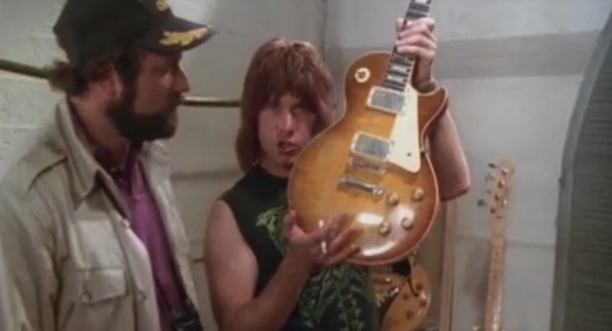
This mockumentary, rockumentary, or whatever you want to call it, follows Spinal Tap during their not-so-long-awaited tour in the States. Their trajectory mirrors all the great rock bands of their day and age. Right now they’re in the Zeppelin or Aerosmith stage, but led by their two founding members David St. Hubbins (Michael McKean) and Nigel Tufnel (Christopher Guest), they started a skiffle band back in Mother England. It was a humble beginning, with numerous arbitrary name changes, a hippy phase (much like the Beatles), and finally the genesis of their big-haired, hard rock 1980s persona. After all, their amps go up to eleven, one higher than the typical amplifier. They’ve cranked things up to new levels, but it doesn’t help that they’re album Smell the Glove is getting some negative backlash for its cover art.

What follows is a less than promising tour with failed autograph signings and malfunctioning props onstage. All the while, the immature musical nucleus of the band Nigel and David begin fighting. It feels very Lennon/McCartney and their Yoko Ono is David’s girlfriend Jeanine (June Chadwick). When their original manager quits in a huff, Jeanine steps in and things keep on going downhill. Bassist Derek Smalls (Harry Shearer) just seems like he’s along for the ride, and their most recent drummer is just happy he hasn’t met the unfortunate fate of spontaneous combusting like his predecessors. No one seems to care about the keyboardist Viv. Ain’t it the truth.

Then, the fateful day comes when the band splits up, or at least Nigel finally leaves having had enough of it all. But as they play second-bill to a puppet show at an amusement park in lovely Stockton, California, the boys realize they need Nigel back. Although the U.S. wasn’t too welcoming to them, they look to have a bright future in Japan with popular hits like “Sex Farm” “Big Bottom” and “Stonehenge.” They’re very popular over there, and of course, their amps still go up to eleven.

4/5 Stars

That Thing You Do! (1996)

thatthing6Recently I’ve seen a lot of films about music, musicians, and the like. There’s Llewyn Davis, who seems to have talent and yet gets little recognition for what he does. There’s the street musician in Once, who also has a lot of talent and we like to think that he makes the big-time, although the film leaves his fate open-ended. One is steeped in melancholy and the other has a raw beauty. Tom Hanks directorial and screenwriting debut That Thing You Do! seems to have very little in common with those films except in that features music. But that deserves some explanation.

Hanks’ film is a nostalgic trip for anyone wanting to get sent back to the 1960s via the 1990s. It’s a thoroughly enjoyable little romp that revolves around a group of typical teens in Pennsylvania, who go from a small-time talent show to one-hit wonders touring the state. But that’s exactly it. They’re one-hit wonders, who lack the talent of older more experienced musicians. In reality, they’re just a group of kids, still wet behind the ears, and just excited for the ride they are about to embark on. Even over the course of the film, their one smash hit, the eponymous “That Thing You Do!” can feel repetitive, and it is easy to realize that this is not the type of music that real connoisseurs want. It’s for the masses. The shrieking girls and the guys who want to dance with the shrieking girls. It’s certainly superficial, and yet there’s something quaint and at the same time infectious about it.

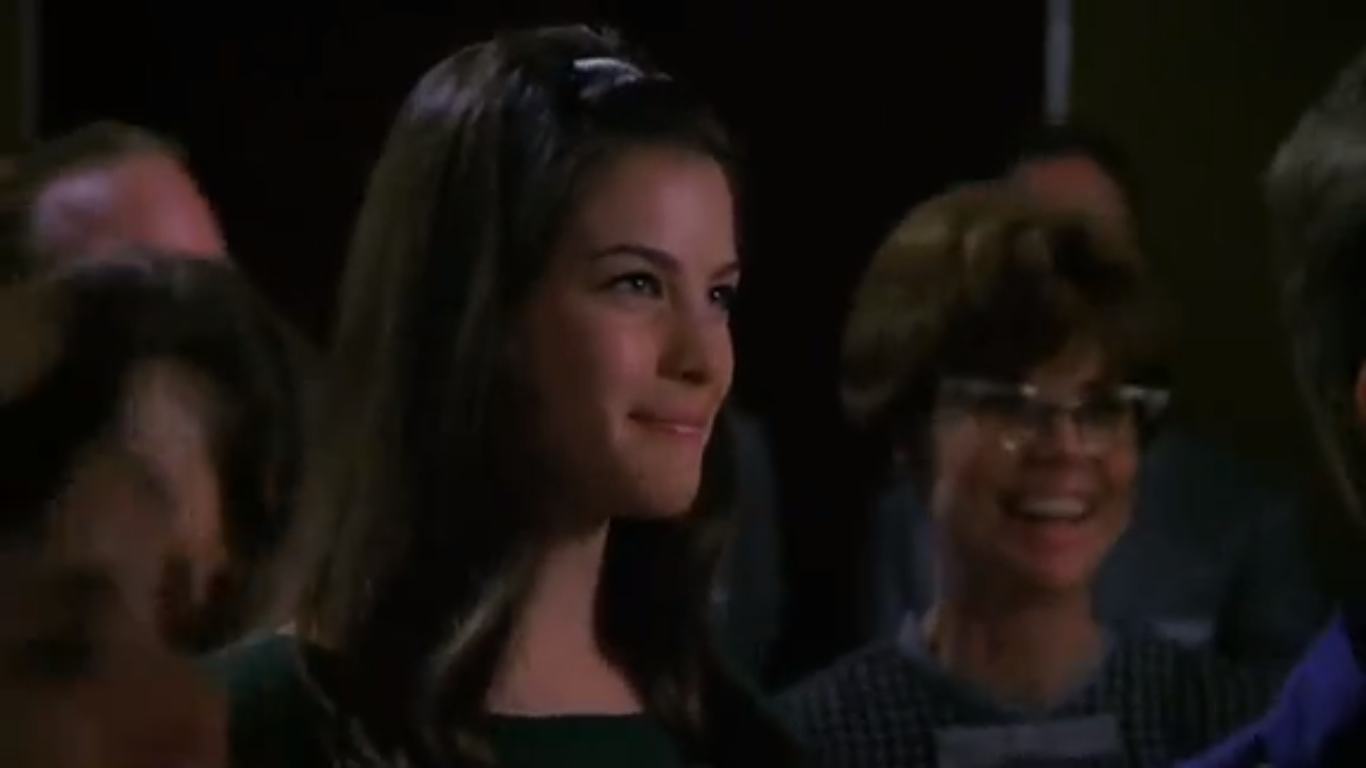
thatthing2We can readily get behind this little band christened The Oneders and modified to The Wonders for easier pronunciation because they’re a lovable bunch. Their members include appliance seller-turned flashy drummer Guy (Tom Everett Scott), lead singer and serious-minded Jimmy (Jonathon Schaech), the jokester Lenny (Steve Zahn), the “other guy,” and, of course, the ever-present Faye (Liv Tyler).

In many ways, they shadow The Beatles. They ditched one drummer for a better one. They both lost their first bass player. Their first hit took a ballad and sped it up to great effect. The little similarities are undoubtedly put there by Hanks, but with all the similarities it only serves to point how different these boys are. They’re not going to end up music royalty like the lads from Liverpool. And that’s okay.

thatthing3We can get satisfaction out of their first airplay on the radio or the genesis of a romance that we were always expecting. In a way, this film is like a lesser American Graffiti even going so far as giving its characters an epilogue. It takes us back to that time and place, makes us feel good, and gets a few of us nostalgic for the olden days. Although, the old televisions and dishwashers don’t exactly look like fun now.

But let’s get back to that romance. The film Starter for 10 had a similar enigma when it came to the blond or the brunette. I suppose you could call it a trope, but on one side you have the primped and provocative Charlize Theron and on the opposite side of the spectrum is Liv Tyler, who acts as the honorary fifth member of the Wonders. She is constantly faithful and encouraging in the boys rise to the top, and they are better because of her. That’s the kind of girl you’re supposed to get and the right guy gets her.

3.5/5 Stars

Note: I watched the version of the film with 39 minutes of added footage and what it really did was develop these characters a little further so you grow to appreciate them even more. Otherwise, I’m sure the original cut gives you the same narrative so either version is probably fine.

Pillow Talk (1959)

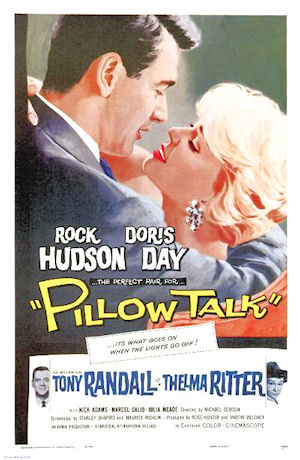
Pillowtalk_posterIt’s the original Rock Hudson Doris Day Rom-Com, with the seemingly perpetual split screen, to match the party line that constantly weaves its way through the story. It’s technicolor, it has an infectious title track, and it’s absurd wackiness somehow adds up to a boy-gets-girl happy ending.

The imposing and dashing Hudson plays songwriter and major playboy Brad Allen, before masquerading as tenderhearted Texan Rex Stetson. But how does he get there? What causes him to play such a ludicrous part? It comes in the form of Jan Morrow, our peppy platinum-haired interior decorator who has had just about enough of her party-line partner, the estimable Mr. Allen.

Her often swanked housekeeper Alma (Thelma Ritter) doesn’t mind eavesdropping and swooning along with all the other impressionable women he romances over the telephone. Jan, on the other, thinks it’s sickening behavior for a man. She would never allow herself to be taken in by such a cad.

Of course, there’s more to the story since one of Jan’s clients, the neurotic millionaire Johnathan Forbes (Tony Randall), is madly in love with her. There’s another wrinkle though, that’s far more important. He knows Allen from his college days. When Brad gets his first view of Jan, she’s an absolute knockout and he wants to win her over, but she hates his guts, at least over the phone. Enter a sweetly sincere Texan and she is swept off her feet surreptitiously.

Brad manages the charade for some time, but for the comedy to work, it must all come crumbling down. In this case, as expected, Ms. Morrow and Mr. Forbes figure things out at almost the same precise moment. It looks like Brad is sunk for good. There’s no hope for such a louse. But then again, if Pillow Talk ended there, it’s audience would be left muttering despairingly and crying inconsolably. The exclamation point comes when Hudson pulls his bride-to-be out of her bed and forcibly carries her through the streets of New York. It sets the stage for some quips perfectly at home in a quaint bedroom comedy plucked out of the 1950s.

Day and Hudson were stupendously popular with the populous and this film would begin their string of pictures together. Although they never reached the excellence, or more aptly, the above-averageness of Pillow Talk, they have remained relatively popular even to this day. Ms. Day was always a fan favorite and rightly so with her impeccably powerful voice, raucous comedic performances, and self-assured charm. And she’s still with us bless her heart! It will undoubtedly be antiquated and overly saccharine to many, but if you have a soft spot for either  Rock or Doris, then enjoy it without reservations. It’s a rather entertaining guilty pleasure.

3.5/5 Stars

Brad: Look, I don’t know what’s bothering you, but don’t take your bedroom problems out on me.

Jan: I have no bedroom problems. There’s nothing in my bedroom that bothers me.

Brad: Oh-h-h-h. That’s too bad.

Punch-Drunk Love (2002)

punchdrunk1When Paul Thomas Anderson said he was making a comedy with Adam Sandler, people undoubtedly scoffed at him. I know I would have if I had known about this film back then. However, he proved that you should never question him as a director. Much like a Kubrick or a few other auteurs, I’m not necessarily the biggest fan of Anderson, but you have to admit his films are interesting and very much their own entity.

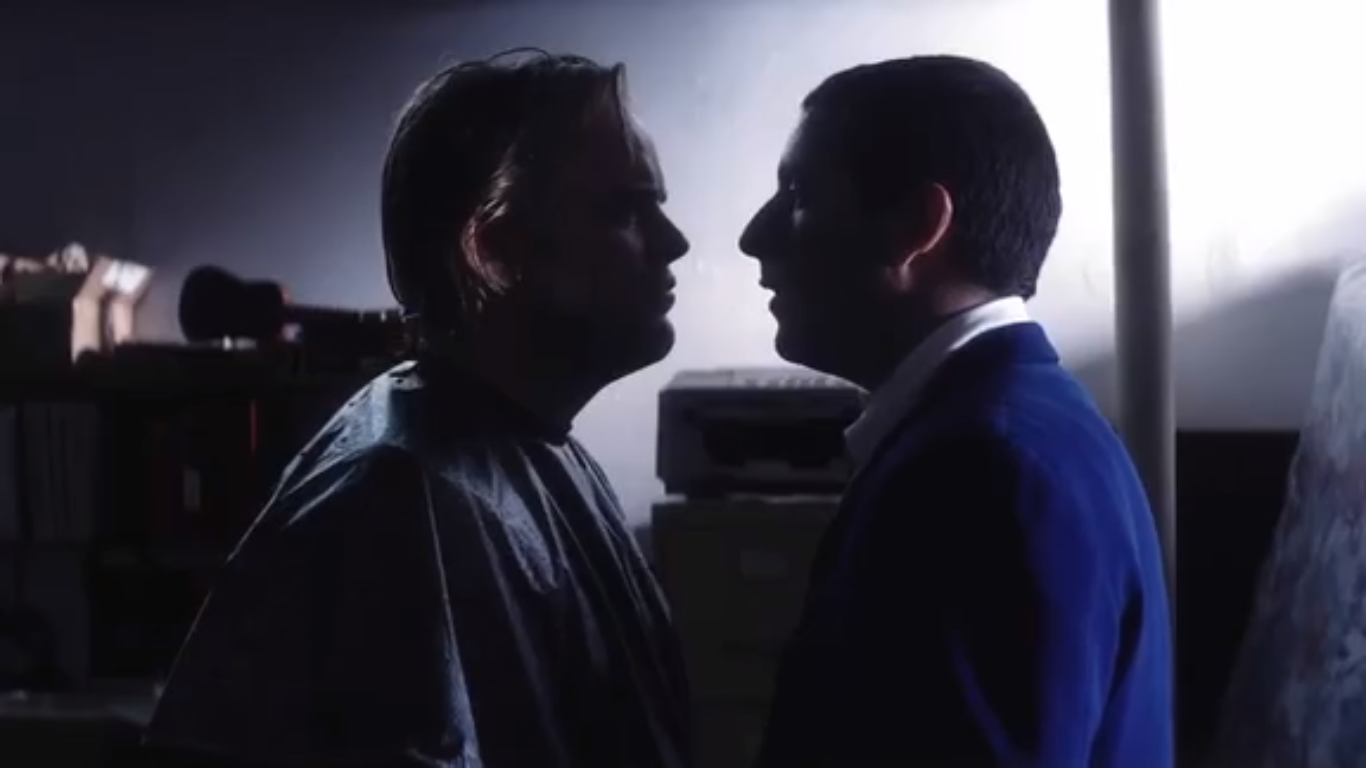
Punch-Drunk Love is a comedy certainly, but not in your typical sense. It’s a romance, but it’s not quite like any romance I’ve ever seen. Thanks to the bolstering performance of Adam Sandler, it’s whimsical and odd. He plays Barry, a rather passive and antisocial type, who seems constantly quelled by the dominating personalities of his many sisters.

He’s obsessed with buying up pudding for a chance at frequent flyer miles, he picks up a harmonium tossed on the road-side, and most of all he’s lonely, but he’s not comfortable going on dates. His sister tries to set him up with a nice friend of hers who happens to be British (Emily Watson). Barry rejects an offer to go out to breakfast with them and out of loneliness calls a phone sex line. Out of stupidity, he hands over his credit card info, and the rest becomes a big scam that he can’t escape.

Thus, his work phone at the office is ringing off the hook from a girl trying to steal his money. His sister is continually trying to set him up, and Barry seems to live in his own little weird world at times, overflowing with his own personal odd ticks and quirks. He also has an anger problem, meaning he’s bad news if you give him a hammer.

punchdrunk2At times the film is thoroughly unsettling and nervously, uncomfortably funny, thanks in part to Sandler, but also the pervasively weird sound design that utilizes the harmonium. At his core, Barry is a lonely and confused man, aren’t we all, and it reveals a depth to Sandler that many probably have not seen before. It helps that the sweet Emma Watson makes us believe he is likable and in truth, he is somewhat endearing in how he can get lost in an apartment building or always wears the same blue suit. He even follows her to Hawaii for the sake of love. But don’t get any wrong ideas. This is nowhere near the realm of 50 First Dates.

3.5/5 Stars

Galaxy Quest (1999)

Galaxy_Quest_posterGalaxy Quest might be a kitsch homage to all things Star Trek and Star Wars, but that’s the secret to its unequivocal success. It stands on the laurels of its campy fun which it wears as a banner like all the Trekkies and Star Wars fanatics it looks to pay tribute to.


The film opens in the days before international comic cons and crisscrossing social media connections when nerd culture was still highly prevalent, but perhaps not as refined, and dare we say trendy, as it is today. People dress up in costumes, dote over their heroes, and let the fantasy worlds flood into their lives. It’s like they forget those worlds aren’t real. Or are they?

The crew of the NSEA Protector has been off the air for well nigh 18 years, but they attend a Galaxy Quest convention in order to milk the franchise for all its worth. By now most parties involved are fed up with these shallow, superficial roles they were forced to dawn all those years ago.

Daryl Mitchell was the boy genius Lt. Laredo piloting the ship and has by now outgrown his part, only being remembered as the precocious kid he used to be. Alan Rickman is the intelligent Klingon-like Dr. Lazarus, and yet by this point in his career, he hardly deigns to play such a tacky part. He would be much more lauded on the Shakespearian stage, and he’s long been tired of his role as the only alien member of the crew. Tony Shalhoub is the crew’s even keel tech the very un-Asian Sgt. Chen. Meanwhile, Sigourney Weaver is the dumb blonde whose only job is relaying information from the computer to her commander, while in real life she’s assertive and miffed by Jason Nesmith’s cavalier attitude. She’s not the only one. And as the nucleus of it all is our Captain Kirk, our William Shatner, a pompous, showboating celebrity who doesn’t know when it’s time to hang up the towel, Jason Nesmith aka Peter Quincy Taggart.

The behind the scenes turmoil that they are going through is necessary and for these characters to find themselves they must go on a hero’s journey. They must actually go on a real galaxy quest and in the ensuing adventures they cease being actors donning roles begrudgingly, but they actually begin to believe in the parts they are playing. They grow closer to the people they portrayed on screen and as a result grow closer together as a real-life television crew.

The peaceful Thermian people represent all those alien species in the vast galaxies who have ever needed a savior. The crew of the Protector, although caricatures, represent all the heroic ensembles that have ever graced the silver screen. They’re petty, insecure, and unskilled, but they still manage to succeed and we’re cheering for them all the time with dopey grins plastered on our faces. Even Sam Rockwell, a young, insecure extra who doesn’t want to die at the end of the episode gets his chance, and as an audience, we wholly relate with the audacious nerd Justin Long who is able to help his heroes on their greatest mission yet.

Is this a tacky, sentimental, melodramatic space opera? Most certainly yes, and yet we would not want it any other way. What it goes out to do, it does very well and that is better than plenty of other parody films floating around out there.

“By Grabthar’s hammer, by the suns of Warvan, you shall be avenged!”

R.I.P. Alan Rickman, you will be dearly missed.

3.5/5 Stars

Fargo (1996)

fargo1The Coen Brothers have always been an interesting case for me. I admit that there are still a lot of their films that I wish and need to see. Films like True Grit and Fargo I find thoroughly enjoyable or at least passable, but they do not completely resonate with me. However, I certainly respect them as writers, directors, and auteurs, because they know the lineage of film as a medium and they have their own unique way of approaching movies. It’s often clever, unique, and carries a wickedly funny tone no matter their subject matter.

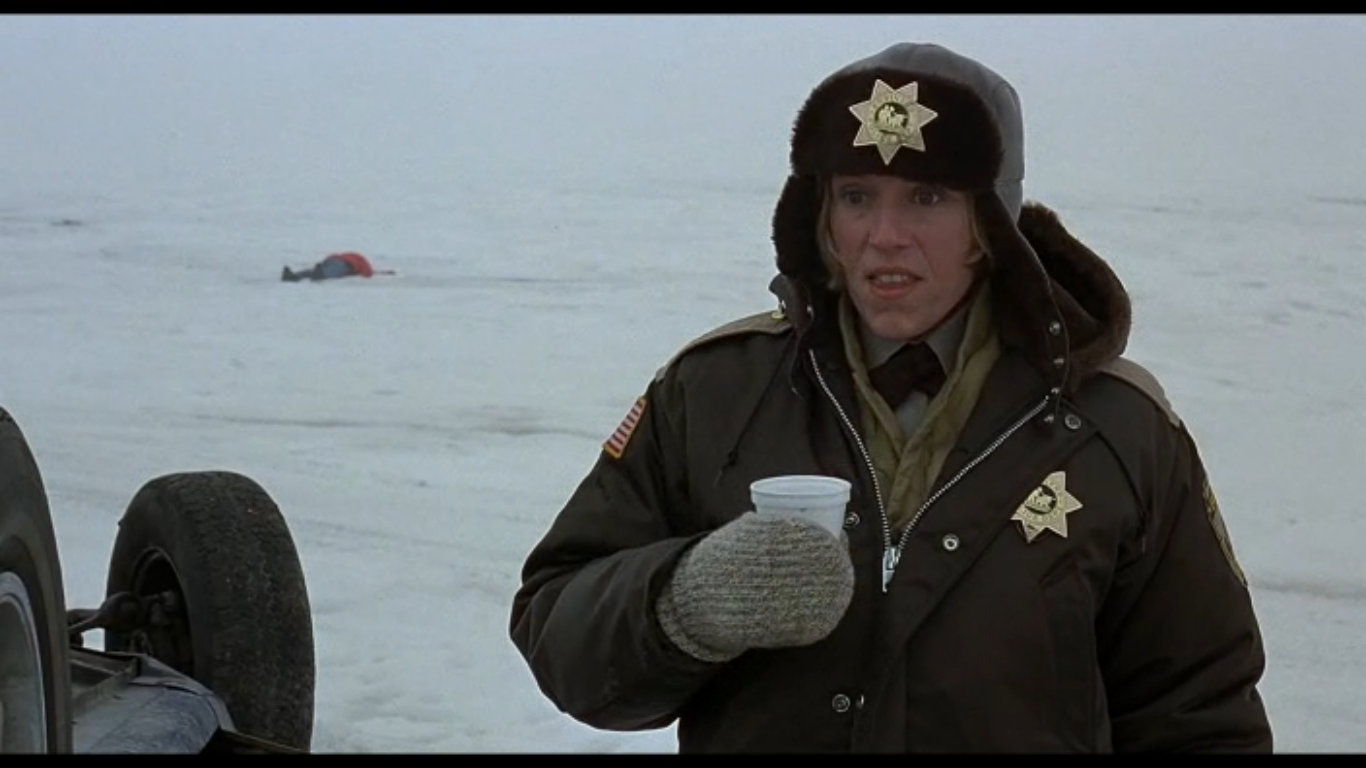
Fargo is arguably their greatest work, following a kidnapping and murder investigation that involves Fargo, North Dakota and Minneapolis. William H. Macy is your standard Midwestern dupe Jerry Lundegaard, who makes an honest living selling cars. However, there’s another area of his life that’s not so honest. He’s in desperate need of money; we don’t know the reason, but he has resolved to hire two men to kidnap his wife. It doesn’t make much sense to the audience or the easily agitated crony Carl (Steve Buscemi). However, Jerry has a rich father in law with the necessary funds to bail out his daughter. And so it goes.

Except after the deed is done Carl and his taciturn accomplice Gaear get stopped by a highway patrolman and things are downhill from there. Murder, and blood, and more murder, all on a snowy Minneapolis evening.

The next morning pregnant cop Marge Gunderson (Frances McDormand) leaves her hubby and heads to the scene of the crime where she quickly pieces together the turn of the events. The search is on for the vehicle, and she questions a couple of prostitutes who aren’t much help except pointing out one of the men was “funny looking.”

Meanwhile, everything is falling apart on Jerry’s end with his father in law and he even gets paid a visit by Gunderson. When the drop finally does take place, Carl is livid when he is met by Wade instead of Jerry. He’s not messing around and neither is Jerry. Crime scene number 2 is set up. Carl finds a snowy locale to bury the payoff and heads back to the cabin, but he’s about had it with Gaear and the feelings are mutual.

Meanwhile, after a disturbing meeting with an old high school classmate Mike Yanagita (a rather troubling performance by Steve Park), Marge decides to question Jerry once again, and this time she gets somewhere. The reunion with Mike sets something off in her head.  Another tip eventually leads her to Gaear and his friendly neighborhood wood chipper. Being the pro-cop that she is, Marge subdues the culprit and gets an ABP out on Jerry which leads to his arrest. After a successful day at the office, it’s back to fast food and tv in bed with her loving husband Norm.

Fargo, to its credit, exudes a Midwestern charm thanks to all its colloquial “You betchas, darn tootin’s, heyas”, and so on. Perhaps most effectively it mixes the mundane and the violently shockingly in one pot of inspiration. The two-pronged story following two very different worlds somehow meets in the middle amidst all the improbability. The Coens start the film off labeling it as “based on a true story” and that opening statement had many people tricked. I myself was taken in the first time I saw it because however outrageous the following events are we trust the words of the filmmakers guiding us. And in the characters of Marge, Jerry, and most everyone else there is a charm or normalcy that feels so familiar. Thus, the Coens could get away with such outrageous plotting, because it so often felt grounded in truth.

4/5 Stars

Begin Again (2013)

beginagain1Unfortunately, John Carney’s Begin Again loses the unassuming charm of his earlier musical effort Once, with higher production values, bigger names, and a more crafted sound. However, it still rides easily on the charisma of its big-name stars Keira Knightley and Mark Ruffalo. They are two individuals who have their lives wrecked and this crazy, fractured mess of a city becomes the perfect backdrop for two equally broken lives.

The film opens with differing perspectives on one point in time at a bar in New York. Dan Mulligan used to be a big recorder label exec maybe 10 or 15 years ago, but now his partner has pushed him out because he hasn’t acquired any new clients in ages. He’s all washed up and his family life isn’t much better. He’s estranged from his wife (Catherine Keener) and hardly sees his teenage daughter (Hailee Steinfeld). Given the situation, he heads to the bar to drown his sorrows after an awful day in and out of the office.

beginagain4Meanwhile, Gretta James (Keira Knightley) arrived at that same nightclub by very different circumstances. She is the girlfriend of up-and-coming pop singer Dave Kohl (Adam Levine), but she has a penchant for songwriting on the side. It’s nothing major and yet she certainly has a passion for it. However, with increasing busyness and the fame going to his head, Kohl and Gretta have a falling out. The first place she can turn is her old friend (James Corden) and he invites her to a night of music which she reluctantly agrees to.

That’s how she ends up in front of the microphone playing one of her personal tunes for the mildly interested audience. And yet one man is very interested. Dan is almost pulled out of his stupor by the song’s beauty and he immediately goes over to sign her. She thinks it’s a joke or at least she’s not at all interested in the fame. She independent and she wants to keep her work her own.

But he’s eventually able to cajole her into a unique musical endeavor. They won’t record her songs in your typical studio, but instead, all of New York will be theirs for the using. Thus, the joy of music brings a ragtag group of musicians and aficionados together to make something special and ultimately beautiful.

beginagain5Gretta is able to straighten things out with her boyfriend content with where she leaves them. As for Dave, he gets back with his wife and there is a newfound connection forming with his daughter thanks in part to his new friend’s undue influence. In some sense, this film has a Lost in Translation type friendship. Two very different people in two very different life stages, but they have one important connection. In this case music, and it could be made into something romantic, but it doesn’t force its characters into that.

I’m a bit doubtful that they had splitters back when Ruffalo was first with his wife, but what do I know? No matter, it makes for a fun jaunt through New York listening to the tunes of Sinatra, Wonder, and Casablanca. If you are a lover of music, Begin Again is a thoroughly enjoyable film. It begs the question, what do you do the music for? What’s at the heart of it? Is it about the money, the fame, or the pure joy that comes with creating and sharing your craft with those who you hold most dear?

3.5/5 Stars

Review: Top Hat (1935)

tophat1Perhaps Astaire and Rogers most famous film together, Top Hat has them in top form once more, seemingly defying gravity at the full peak of their powers. The beauty of their partnership is that they’re able to tell the progression of a love story through dance, but they do it with such ease and grace it looks like so much fun. For a brief moment, you almost forget what the plot line of the movie is even about. It doesn’t seem to matter. All that matters is these two harmonious beings in perfect unison with each other.

But for those who take some interest in the plot, it is once more a simple screwball story of mistaken identity and romantic entanglements. Jerry Travers is supposed to perform in the show of one Horace Hardwicke, played impeccably by the stuttering Edward Everett Horton. However, Jerry gets smitten with the girl downstairs, but she gets the wrong idea. After all, he is staying in Horace’s suite. They rendezvous in Italy at a lavish gondola getaway where they meet up with Horace’s wife Madge, the always entertaining Helen Broderick. She’s playing matchmaker for Jerry because he has a girl named Dale Tremont (Rogers), who she wants him to meet. Of course, they already know each other, but again she mistakenly believes he’s Horace.

It’s all very awkward, however, all Travers knows is that he’s infatuated with this girl so he goes headlong after her. She’s aloof with him and eventually tries to marry the overly-honorable Alberto Beddini as a defense. Horace over the entire course of the film is bickering with his butler Bates (Eric Blore) and it seems like he’s constantly getting thrown under the bus. But this time Bates does something that makes everyone happy. All that matter is that Astaire and Rogers are back together because in their universe anything else would be unthinkable.

Astaire’s opening number “Fancy Free” is especially lively setting the tone of the story, while “Isn’t a Lovely Day” taking place under the gazebo in the rain is an important starting point for the love story. “Top Hat, White Tie, and Tails” honestly is not one of my favorite numbers, but it is worth it alone to see Astaire twirl around with his stick using it to develop rhythm and act as almost a third leg.

An American classic from Irving Berlin, “Cheek to Cheek” is undoubtedly the apex of this film, because by now our stars are in love and in this dance they have entered almost a suspended state of bliss personified by their floating forms. All the other players fade away and the dynamic dancing duo gracefully glides into heaven together.

The final number “The Piccolino” is rather decadently extravagant to match the flamboyant set, but again when all else fades away and we are left with only Astaire and Rogers, that’s when the scene truly feels magical. It’s as if within all the noise there is once again a moment of beautiful intimacy. But intimate in the sense of two wonderful performers being seemingly so connected in their art form. They hold the sinews of the screwball romance together if only through their exquisite dances.

Most opinion on film is essentially subjective, and in my opinion Swing Time (1936) from the following year is a stronger picture. It has a few more memorable numbers and it is perhaps a little more well balanced all around. Although you do lose Edward Everett Horton for Victor Moore, a lot of the other players remain the same. Also, Top Hat‘s script feels a little weaker, not that it’s of great importance. Because after all, most people don’t go into a film like this ready to analyze the script. We want to be dazzled by two of the great icons of Hollywood, as much now as during the Depression years, and they certainly do that to perfection.

4.5/5 Stars

Review: Swing Time (1936)

swingtime1I wondered to myself, after watching Swing Time once again, if anyone else might have easily taken Fred Astaire and Ginger Rogers’ places as films greatest dancing couple, and then I quickly discarded this heretical idea. They appeared in 10 films together with this film directed by George Stevens being there six pairing. By now they’re a well-oiled, beautifully elegant dancing machine.

As with many of their films the genre is a hybrid of a screwball comedy and a musical which of course most importantly showcases their legendary dancing prowess.

Astaire is the carefree gambler and hoofer “Lucky” Garnett who gets duped out of his marriage by his buddies and must head to New York to prove himself to his fiancees’ father. He goes off with his faithful friend “Pop” (Victor Moore), who also has a penchant for card tricks. They have nary a penny in their pockets and he meets a pretty young dance teacher (Ginger Rogers) over a stolen quarter.

From her point of view, he just won’t stop leaving her alone and he just wants to get the chance to dance with her. Astaire and Rogers’ first number together, “Pick Yourself Up,” is a peppy piece that sets the bar for the rest of the film. They swivel, glide, and sway, perfectly in sync, orbiting one another. And for the rest of the film whenever they dance together they never seem to lose that innate connection.

As far as the screwball aspect goes, Lucky is tight on money resorting to gambling for some new duds, but his chance to dance with Penny is his big break. They just need an orchestra to accompany them. The only problem is someone else owns the orchestra and the orchestra leader Ricardo is also madly in love with Penny. In a shady set-up all across the board they draw cards for the contract and “Lucky” wins. He and Penny have a growing connection, but he still feels guilt based on his attachment to his fiancee Margaret. And of course his life catches up with him and Penny finds out while simultaneously the orchestra is taken away from him.

It must happen this way so they can realize how much they mean to each other and share one final dance together. Out of all the misunderstandings comes a lot of big laughs and in the end, everybody thinks it’s funny. Since Ricardo loses his pants, Penny decides to marry Lucky after all and everything is right in the world of Astaire and Rogers.

You don’t necessarily watch a film like this for the acting, but thanks undoubtedly to the studio system we have a colorful supporting cast including the two-timing but lovable Pop, Mabel is a wisecracking riot in her own right, and although his screen time is short, Eric Blore is enjoyable as the hissy dance studio boss Mr. Gordon.

“The Way You Look Tonight” is an absolute crooner classic and aside from the initial number it can be heard throughout the film in refrains. The same goes for “A Fine Romance” which feels antiquated, but it still manages to be thoroughly enjoyable in all of its reprises. But the main attraction is, of course, the dancing, from the personified joy of “Waltz in Swing Time” to the graceful gliding of “Never Gonna Dance.” If you set aside the unfortunate blackface for a moment the Bojangles shadow dance is a stroke of creative genius that gives off an amazing result while showcasing Astaire’s individual skill.

From someone with two left feet, this film makes me want to at least attempt to dance because Fred Astaire and Ginger Rogers turn dancing into an almost mystical experience. How does he prance and twirl so effortless on the floor? How does she do it equally as beautifully and in heels no less? It looks like they’re having so much fun and yet, in reality, they practiced for hours upon hours to get it right.  Amazing stuff.

4.5/5 Stars

Review: Shop Around the Corner (1940)

Shop-Around-the-CornerA quaint, unassuming film, especially up against other more lavish Ernst Lubitsch works like Trouble in Paradise and Heaven can WaitShop Around the Corner still manages to be in the upper crust of romantic comedies — even to this day.

The story revolves around a little shop in Budapest run by the often curmudgeon and excitable owner Mr. Matuchek (Frank Morgan). Every morning he comes to open up shop and nearly every day he has something to complain about whether it’s his workers or the lack of business. His right-hand man is Alfred Kralik (James Stewart) who has been a diligent clerk in the store for well nigh nine years now.

He confides in his older colleague and friend Mr. Pirovich (Felix Bressart) that he has begun correspondence with a mysterious lady friend who was looking for a partner with whom to discuss culture and all the higher forms of art. Kralik is intrigued as he wants to expand his mind and he seems to have found his perfect match.

Meanwhile, the status quo gets shook up a bit when a Ms. Novak comes into the shop. At first, she gives off the sense of a flustered shopper, but in a matter of moments, she proves herself as a shop girl, acquiring a position even without a vacancy.

Over time, his relationship with Ms. Novak becomes increasingly more antagonistic, to begin with, because she wears a blouse unsuitable for the workplace. The prospect of his first meeting with his secret correspondent has Kralik on edge in expectation, but when he cannot sneak a peak, Pirovich looks for him and delivers a stunning revelation. It is, of course, Ms. Novak.

In such a way the dramatic irony begins as Kralik understands just who this girl is, and she continues to brush him off as the stiff, bowlegged man from the shop around the corner. Mr. Matuchek has unspoken problems of his own that cause him to abruptly fire Kralik, his most faithful counterpart. But their relationship is patched up and the crackerjack clerk gets his position back and then some.

There’s still the matter of Ms. Novak because he truly does feel something for her, even showing up at her home to see how she is getting on after calling in sick. It’s in this moment that she reads one of the letters in front of him. One of his letters.

Then, right before Christmas everything his bustling and busy in the little shop. All seems right as Mr. Matuchek is in good spirits with a Scrooge-like transformation for the holidays. He even winds up with someone to share a festive holiday meal with. It seems that Kralik has a fiancee and so does Ms. Novak. As it is Christmas they both try to leave the other on a positive note, and Klara goes so far as to mention her initial crush on her colleague. This then becomes the critical moment for Kralik as he still knows something she doesn’t. He frightens her stiff about her mystery man and then reveals him to be her pen pal. All it takes is a carnation in the lapel. She gets it right then. They embrace and share a kiss.

Although Stewart is far from a Hungarian clerk, he does exude a pleasant commonness, better than any other actor of his era. As such, he has the perfect demeanor and presence to portray Kralik, a man who seems altogether ordinary, although he certainly is more than meets the eye. Margaret Sullavan seems a generally forgotten leading lady, but there is an airy, almost ethereal quality to her. In real life, she proved to be difficult at times, but here she somehow fits rather remarkably with Stewart. The two leads prove to be adept sparring partners in Lubitsch’s altogether effortless romantic comedy.  It truly reconciles the lines between ideals and reality which allow two people, such as these, to fall in love for real.

4.5/5 Stars

Klara Novak: All my knowledge came from books, and I’d just finished a novel about a glamorous French actress from the Comedie Francaise. That’s the theater in France. When she wanted to arouse a man’s interest, she treated him like a dog.

Kralik: Yes, well, you treated me like a dog.

Klara Novak: Yes, but intead of licking my hand you barked.