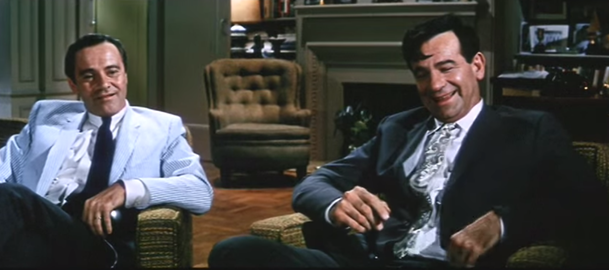
Yesterday, Today and Tomorrow (1963)

Yesterday,_Today_and_TomorrowThis is the lightest of any De Sica film I had seen up until this point and interestingly enough it was split up into three narratives. The first one follows a woman who continually gets pregnant in order to avoid going to jail, but after seven kids, the toll is too much on her jaded husband. Needless to say there is a happy ending.

The second tale follows a superficial socialite with a Rolls Royce. She ditches her cars as quickly as she ditches her lovers. Although the story does not go very far it is easy to see she is a snob used to getting her own way. Ironically a humble man would in many ways be too good for her.

The final vignette follows an amiable prostitute as she befriends a young man destined to join the clergy. However, he becomes smitten and so she must do her best to encourage him to continue his calling.

That really is only the basics, but it was certainly enjoyable to see Sophia Loren and Marcello Mastroianni in three separate roles playing off of each other in different ways. They reflected three very different walks of life and three varying relationships mixing a great deal of humor with a few more somber moments. All in all it was fairly enjoyable.

4/5 Stars

Birdman (2014)

Birdman_posterIn the opening shot, a man is in his tidy-whities levitating in midair. This is one of those films that can never be figured out completely or never fully dissected in its entirety. It’s a meta film on a whole lot of levels. You could say that Michael Keaton is playing a version of himself named Riggan Thomson. He used to be a superstar in the popular superhero series Birdman. That ended back in 1992. Now he’s old and washed up attempting to revive himself in an adaptation of a Raymond Carver play. Robert Downey Jr. is the guy with the type of box office draw that he used to have.  He is constantly fighting his own inner demons that play like the voice of the Birdman in his head. The character he used to be is so closely tied to his identity that Riggan has trouble getting away from it.

The film follows the loss of one of their lead actors to an accident, and there is a rush to find someone else before their first preview showing. They want Michael Fassbender or Jeremy Renner and yet they do get lucky in Mike Shiner (Edward Shiner). However, much like Norton in real life, Shiner proves to be a handful, but also a star performer who the public love. Riggan needs him and his best friend and lawyer Jake (Zach Galifianakis) pleads with him to say with Shiner. All the previews are a disaster: Mike breaks character over some gin and he tries to have sex with actress and former lover Lesley (Naomi Watts) on stage. To add insult to injury, Riggans locks himself out of the theater and thus begins his frantic pilgrimage through Time Square in only his underwear.

birdman1Riggans wrote, directed, and acts in this play to overcompensate for all his failures. He even refinances his house to cover the cost. He’s spent. His daughter and former drug addict Sam (Emma Stone) is his assistant, and although they don’t see eye to eye, they try to be real with each other. She too is a screw-up, but she sees in him someone who confuses love for adoration. He worries about relevancy, fading away, and he is scared to death that he might not matter. In as many words, she tells him to join the club because every member of humanity has these same fears nearly every day of their existence. He is no different.

Following the final preview, critic Tabitha Dickinson says she will tear his play apart because he is one of those Hollywood celebrities masquerading as an actor. After a rough evening, the Birdman comes back to haunt him before the big opening.

Then, opening night comes and Riggan seems strangely aloof on a night with so much riding on it. He does the unthinkable when in his final scene he uses a real gun and points and fires it at himself. The crowds are as surprised as the viewer before bursting into thunderous applause. Riggan has unwittingly become a sensation on Twitter and on the theater circuit.

The story ends in the hospital with Riggan reconciling himself with his daughter Sam. It looks like it could take a fatal turn because the specter of Birdman still remains, and yet along with Sam we get to see something extraordinary, and at the same time ridiculous, happen. They don’t call him Birdman for nothing.

Birdman has received a great deal of notice for its cinematography that was spliced together to look like one continuous shot. At first, it feels a bit gimmicky watching the camera self-consciously spiral around the actors, but it slowly becomes the routine. It feels like a Goodfellas tracking shot on steroids, and it certainly hearkens back to Hitchcock’s Rope as we often find ourselves following characters from behind down hallways or going from interiors to exteriors. It’s certainly a different perspective of the world.birdman3There are moments that it looked like Edward Norton or Emma Stone might steal the show, but by the end, it is still evident that this is Michael Keaton’s film. This is a story about his struggle. This is his version of Sunset Boulevard that he must overcome. It also has an overarching blend of magic and realism that makes it hard to parse through what the true reality is. But by the end that is far from necessary, because this is a meta experience that is layered and inverted in such a way that makes it fascinating. We think we have our feet on the ground, firmly planted, but we never do, and we are never allowed to.

At times it feels rather like we are in Manet’s painting Bar at the Folies Bergere. It becomes difficult to tell if we are in the audience are simply part of the film. We lose ourselves in the metaness that acts as the thin dividing line between what is real and what is fictitious. There is a cinematic magic in that just as there is a kind of supernatural energy in Riggan Thomson himself.

However, he does not get wholly lost in that, because he is a messed-up human being like the rest of us. No matter how mystical he is, there still is an unmistakable resonance to his story. Thomson would be happy to know that he is relevant just like we are all relevant in some way, shape, or form. It’s all subjective. It just depends on who you ask or what critic says what. In reality, it doesn’t really matter a whole lot.

Honestly, it failed to hit me until afterward,  Birdman is a humorous film where the humor often gets forgotten behind the more philosophical and human aspects. There’s nothing quite like it. It takes its cues from Sunset Boulevard, Jean-Luc Godard, Dr. Strangelove, Batman and undoubtedly so much more, but it is distinctively the creation of Alejandro Gonzalez Inarritu.

4.5/5 Stars

Review: Playtime (1967)

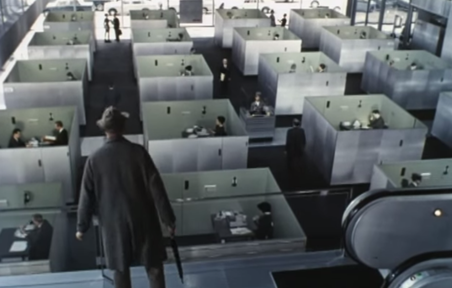
playtime1Playtime is a film that really can be broken into a number of set pieces elaborately constructed by director Jacques Tati. The vignettes begin, surprisingly enough, in an airport terminal, and a group of excited Americans are getting ready for a Parisian vacation. Mr. Hulot (Tati himself) is waiting to have a meeting in a glass office building, however, he soon gets lost in a maze of cubicles, playing cat and mouse with his contact.

Quite by accident, he wanders into an international trade exhibition and the tourists just happen to be there too. While there they are introduced to the latest gizmos, gadgets, and inventions to move society forward. They include silently slamming doors and retractable glasses. In typical Tati fashion, he gives us a glimpse of the old world from Mon Oncle. All that is left is one meager flower stand and a brief reflection of the Eiffel Tower.

Bumping into an old war buddy, M. Hulot is invited over and thus begins a long sequence in an apartment building. What makes it unusual is that the audience is left out on the street, but we can see multiple interiors through the glass. Thus, the conversation becomes unimportant, and the charades inside paired with the street noise is all we notice.

One of the most substantial sequences takes place in a place called The Golden Corkscrew. It is a packed house and the nightclub barely seems prepared for such an evening. Tiles are loose, food runs out, a band member comes late, the chairs leave marks on the backs of patrons, and much much more. Hulot stumbles in and comes in contact with several previous acquaintances. He also makes a few new friends including a boisterous American and a friendly female tourist.

After the crazy night, the morning comes and Hulot says goodbye to his new American friend but not before leaving her with a parting gift to remember her memorable time in Paris. It may not be the Paris of old, but it is still a cheery place made by its people who still remain the same even when the times change.

Jacques Tati’s Playtime took numerous years to complete and it was the most expensive French production at the time. It makes sense though because it truly is a magnificent piece of cinema. It is full of beautifully choreographed sequences and elaborate sets. Mr. Hulot often finds himself wandering through this labyrinth of modern Parisian humanity. Tati teases us, however, filling his world with Hulot doppelgangers.

Even when the gangly protagonist is on screen, he often pops off and on for minutes on end. He is no longer the primary focus of the film. Tati also takes great interest in the sterile modern society of glass, steel, and technology. The screen is filled with a wide array of individuals, which makes it fascinating to simply people watch. Furthermore, Tati almost refuses to use closeups, thus allowing the camera to capture more.

Playtime is slightly slower, to begin with than I remember, but it has wonderfully subdued humor paired with social commentary. Tati’s film may not have a lot of decipherable dialogue, but there sure is a great deal of noise. His sound effects seem to rival The Three Stooges in comical impact, often filling the void usually devoted to talking. It is moments like these where you see similarities to the old silent comics like Chaplin and Keaton.

Playtime is all about the minutiae and these moments are probably exhibited best at the nightclub. So much happens and much of it goes unnoticed, but oftentimes when you pick up on something the payoff is great because you slowly begin to notice more and more. Tati does not have to announce it, but he puts it there to be seen. For instance, there is the fish that is never served but is constantly being seasoned. Then, the doorman who opens the door without any glass. Finally, there is the waiter who gets all the ripped, torn and otherwise ruined articles of clothing. Together all these moments create some immensely funny sequences.

Another thing about Tati’s film. There is really no conflict. He is addressing the changing times, but at its heart, Playtime is just that. Light-hearted recreation.

5/5 Stars

Support Your Local Sheriff (1969)

2e4c1-localsheriff5Funeral sequences are a mainstay of the western genre because they give us a chance to peer inside of characters and examine the time and place that is the west. It can be tough, hard, and most certainly brutal. Support Your Local Sheriff is a barrel full of fun because it takes many of these set pieces and subverts them for the sake of humor.

It opens with one of these typical solemn wakes for a man that no one seems to know or care much about. All too soon everyone is distracted by a speck of gold and mayhem commences. It sets the tone for the entire film and the people we will soon become acquainted with. All the action is wonderfully exaggerated by a frantic harmonica-laden score with jaw harp included. It’s twangy madness that works to a tee. But enough of that.

The mining town of Calendar is a wild, untamed place built for the sole purpose of mining. The rough and tumble Danby Family seem to have a monopoly on the gold trade controlling the only road out of the town. It’s a big mess.

That’s the climate that Jason McCullogh walks into (James Garner) on his way to Australia. After seeing Joe Danby (Bruce Dern) kill a man, he decides to sign on as the town’s sheriff. Town “mayor” Olly Perkins and his entourage are surprised that any person would want to take the job, but after seeing Jason’s marksmanship they giddily agree. Quickly he astutely breaks up mud fights, puts Danby in jail and finds himself a deputy in Jake (Jack Elam).

Most of the rest of the film follows Pa Danby (Walter Brennan) and his two nitwit sons as they try and get their equally dumb baby brother out of prison. It’s followed by a long line of hired gunman who all fail out knocking the sheriff off.  Jason also has encounters with Perkins’ often ditsy daughter Prudy (Joan Hackett). It would be wrong to say that Prudy is the only whimsy one, because it feels like everyone in town has a screw loose, from the hero to the villains.

That’s what makes Support Your Local Sheriff so appealing. James Garner is as charming a wisecracker as ever, but on a whole, this film is full of comedic misunderstandings, caterwauling, and stupidity with an ignoramus around every corner. There’s a jail without bars, villains who are wimps, a girl who hides in a tree and lights herself on fire, even a protagonist who seems bent on heading off to the real frontier in Australia. What?

Thus, this rewriting of your typical western trope of a man taming the west works out quite well and in many ways feels like a precursor to Blazing Saddles. It was a lot of fun to have two personal favorites in James Garner (The Rockford Files) and Harry Morgan (MASH) in a film together. Joan Hackett was a lot of fun too. I really want to see more with her (ie. Will Penny, The Last Sheila).

3.5/5 Stars

Zombieland (2009)

0e860-zombieland-posterI am not big on Zombie films and so I went into this one not expecting much a great deal. I still do not really like the Zombie genre but there were some decently funny moments here having to do with the rules Columbus (Jesse Eisenberg) has for surviving the apocalypse. The long lasting search for Twinkies, and of course a random cameo by a prominent funny man were a few more highlights. Woody Harrelson is good at playing the gruff type and Little Rock and Arkansas have a lot of personality which does the film a service. Remember rule #1: Cardio. Very important to survive during a zombie apocalypse if it ever comes to that.

3.5/5 Stars


The Way Way Back (2013)

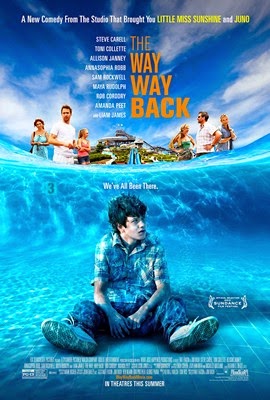
adcf5-the_way_way_back_posterI’m not one to usually laugh out loud during movies but for some reason I felt this sensation during this film. There were a lot of things that seemed to suggest that I should have rated this film lower but I could not help but give it four stars. Maybe it is the nostalgia it created or the typical coming of age story made interesting by some solid characters. Maybe it just reminded me of the times I use to go to water parks. I’m not sure.

Duncan has a life that I would not envy with a Step-father who calls him a 3 out of 10. However, he finds meaning and acceptance where he never expected to. The ending might be bittersweet but it was mostly sweet. There were a lot of supporting characters in this one. A lot of them only popped up on screen for a bit but for the most part they worked well. I think Liam James and Sam Rockwell stole the show though. Their camaraderie really made this film!

4/5 Stars

The Ghost Breakers (1940)

9c09c-the_ghost_breakersYou have two great leads in Bob Hope and Paulette Goddard for this horror comedy film. It is not the best film of either of them by a long shot and it is not much to write home about but if you like the stars you will probably get some laughs out of this one.

It is a dark and stormy night in Manhattan when Mary (Goddard) learns that she is the new owner of a supposedly haunted island. Larry (Hope) on his part is a radio man who is soon on the run from mobsters after a comment he made on air. After a shooting Larry finds himself face to face with Mary and she helps him out of a pickle. Soon she boards her ship heading for her island and he has no choice but to tag along. There everything comes to fruition and the Ghost Breaksers take on the haunts and the dangers of Castillo Maldito. This is a good example of the horror comedies of the 1930s and 40s. Hope was better with Crosby and Goddard was better with Chaplin, but this film certainly has some hilarity.

3.5/5 Stars

What About Bob? (1991)

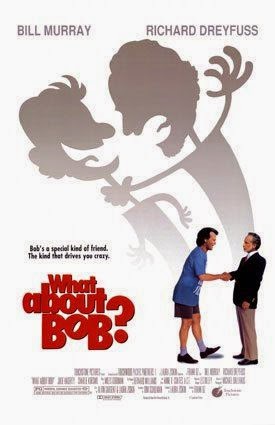
1f90d-what_about_bob_filmI was not sure I would like this film because honestly Bill Murray is not usually one of my favorite actors. However, his portrayal of Bob Wiley, a man with every phobia imaginable, is maybe his most lovable. True, he is annoying and neurotic, but he means well. In many respects he reminds me of Jimmy Stewart as Harvey because both characters were able to captivate most of the people around him. Only with Bob he got under the skin of one man and that man was his psychologist Dr. Leo Marvin (Dreyfuss). Bob tags along on Dr. Leo’s family vacation and that is where the conflict really gets started and the laughs begin. Every moment that the doctor loses his sanity continually builds up  until the stress of Bob is just too much to take! All in all this was a pretty entertaining film and I gained a new found respect for Bill Murray.

3.5/5 Stars

Bananas (1971)

ad341-bananasIn the vast realm of Woody Allen films Bananas feels more like Take the Money and Run (1969) with its zany comedy than his later films which often take on a more somber and philosophical note.

A South American assassination with play-by-play commentary by Howard Cosell is the epitome of this film’s humor. A coup de’tait follows in the banana republic of San Marcos and somehow Fielding Mellish (Allen) fits into this picture. He starts out as an inept machine tester, gets beat up on the subway by thugs and falls for a female activist named Nancy (Louise Lasser). In order to impress her he heads to South America and winds up joining a revolutionary group.

Now somehow made president of the rebels, he heads back to the United States to gain support and funds. However, he ends up on trial and things are not looking too good for him. However, he gets back with Nancy and she agrees to marry him. The films ends with the consummation of their marriage book ended nicely by commentary by Howard Cosell once more. Woody Allen has always been a comedian and Bananas truly fits its title. It is utterly wacky.

3.5/5 Stars

Auntie Mame (1958)

32347-auntie_mameWith Rosalind Russell reprising her role from the stage, this film is made by her scene stealing portrayal. The film opens when a rich man dies suddenly and his young son is sent to live with his Auntie Mame. She is a social, energetic and free-spirited woman. Despite the fact that Patrick was raised proper, Auntie Mame soon teaches him how to enjoy life and they grow close to each other.

However, Patrick is taken to a boarding school against the wishes of his aunt. They still remain close as Mame tries to get work and then she meets a southern gentleman. Patrick is growing up as Mame travels the world with Beau. He is killed in an accident so Mame returns home to work on a memoir. She soon realizes how grown up her little Patrick is because there is a girl he is intent on marrying.

Mame does not voice her displeasure with this upper class girl and her superficial parents. Instead she invites them all to dinner and by sabotaging everything Mame makes Patrick realize he is not like these people. He once again embraces her idea that life is a banquet and most poor suckers are starving to death. You have to get out and live a little.

This film was shot almost like a stage play and I found it rather long but Russell is superb and she holds the film together nicely.

4/5 Stars