Jewel Robbery (1932)

jewel robbery 1

It’s the old story. A pompous old coot is bragging proudly about his new unstoppable, indestructible system of invisible lights he has put in place to stop even the most skilled burglars. No sooner have the words left his mouth and we already know he’s doomed. Sure enough, not a moment goes by before a clerk rushes in to inform them that the impossible has happened. Someone has absconded with all the jewels. The man proceeds to fall backward in shock.

Next, we meet the “Wavishing Kay Fwancis” as she leaves the suds of her bathtub behind upon hearing the news that there’s been another brazen jewel heist pulled on one of the most foremost jewelers in Vienna. She breathes a sigh of relief when she hears which one. You see she has aspirations for a beautiful diamond from Hollanders. But for now, her pride and joy is still safe.

You can instantly gather what kind of person she is as maids and manicurists dote over her every need. Dressing her and primping her and giving her a makeover as she gossips with her best friend. But despite the decadence showered upon her, she craves something else. Namely, a strapping man who is exciting and who will carry her off to some romantic rendezvous.

Francis navigates these hoops so assuredly in such a way that we believe her in the role. There’s no denying her to be a very elegant lady. But the perfect counterpoint is her naive quality. Maybe it’s even partially based on her slight predilection to pronounce her Rs as Ws (Hence her affectionate nickname). And she acknowledges that even in her own eyes she is both shallow and weak despite holding qualities that might make her a generally decent human being. There’s still time.

When she goes to purchase her coveted diamond like a giddy child in a candy store, she’s in for a very rude awakening. If it wasn’t the 1930s it would feel like a western stick up masterminded by a gentleman criminal who is played by none other than, you guessed it, William Horatio Powell. But he’s a cut above your typical heavy. That’s obvious enough to see. He’s a robber who enjoys a good waltz playing on the phonograph while he’s looting the joint and some trivial chit-chat to make the atmosphere more relaxed.

You get the sense that Powell is relishing every line of dialogue and he’s so congenial with every word of it. It works wonders as he runs verbal rings about his cohorts completely commanding the stage from thence onward. Not to mention passing around his dandy case of cigarettes with something extra special.
jewel robbery 2.png

In fact, being brutally frank, William Dieterle’s film stalls when it lacks Powell and Francis together. While not dismal, the supporting cast doesn’t provide the same electricity or charm as our leading item. Perhaps that’s a good thing because we like them onscreen together. We want them to be onscreen. And we get our wish when he calls upon her at home. It’s all very daring and forward but he wants to use her safe to hide his loot. However, there was also something about the lady too that made him come see her again. Call it fate if you will.

Alas, the police are after him and he must flee. She plays the victim and plays the part well. But secretly she knows her true feelings. We do too and we know that Powell will slip away because in a picture with a tone such as this anything else is inconceivable.

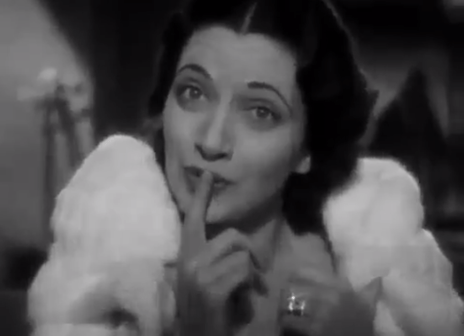
The final stroke of inspiration is in the closing shot where we see something that stands in the face of classical Hollywood convention. Kay Francis looks straight into the camera and puts a finger to her lips boldly breaking that invisible fourth wall. All that has transpired thus far will be our little secret. There the picture ends. With a rendezvous in Nice in the works. If a single image can elevate a picture and leave a lasting impression, Jewel Robbery is a fitting example.

3.5/5 Stars
Crime Wave (1954)

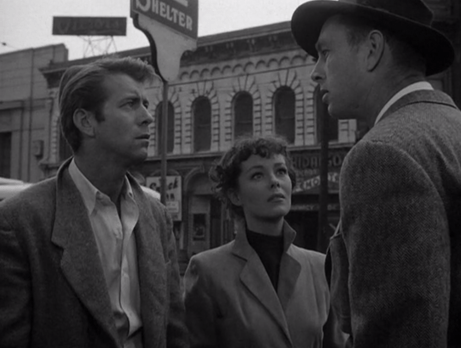
crime wave 1.png

The opening gambit is wonderful. It’s marvelous. You can’t blame me if I get a little…Well, anyways if you thought that squeaky-clean Doris Day could never turn up in a film noir you were gravely mistaken.

In this particular case, a jovial gas station attendant has her blaring loud on the radio right before he gets whaled on. Crime Wave makes its intentions fairly clear right from the beginning. Here is yet another arbitrary noir title that tells you next to nothing. That’s what this first scene is for. It tells everything to us in visual language.

A trio of San Quentin convicts are pulling bank jobs dotted all the way up and down the coast of California and this is just one of them. But a cop has been killed and they ran off with the cash register’s contents.

I had to do a serious double take because my eyes must have passed over Charles Bronson’s name in the credits. Seeing him young and tough as ever is like seeing an old friend — even if he’s playing a thug.

He’s an ogling and ill-mannered brute as can only have a life in such a darkly cynical world. Meanwhile, Ted De Corsia is the ringleader who has been sitting on his scheme for years now. But they need someone to call on — a new home base for their operations after one of their men gets a bullet in the gut.

Just like that, reformed jailbird Steve Lacey (Gene Nelson), currently working as an airport mechanic and married to a nice respectable girl (Phyllis Kirk) hears his old life calling. It’s the old Out of the Past (1947) conundrum. You never truly escape the specter. So he gets netted once more by his old mates and slowly dragged back into the crime world he hoped to never look back on.

But even in his attempt to maintain his path on the straight and narrow and remain on the right side of the law, one momentary lapse in judgment is all that it takes. He tells his wife to keep a pact with him. A man came to their house and that was all. He doesn’t want to be implicated any further so he leaves out the shady doctor who took the cash on the dead convict’s person. It seems such an easy bit of information to divulge but then again, the world is twisted in knots of confusion. He’s paranoid and distrusting of everyone. Perhaps he has every right to be.

Two dueling philosophies seem to present themselves from the side of the law. Police Detective Sims (Sterling Hayden) holds fast to that old adage that “Once a crook, always a crook” while Lacey’s kindly veteran parole officer seems to think that “sick men get well again.” And as the film seesaws back and forth we are forced to consider both trains of thought. The cop with no heart for ex-cons or their wives, while the parole officer entertains more sympathy. But it’s hardly enough.

However, that plays precisely in its favor as a gritty picture rooted in realism while still overlaid with a cinematic crime story inspired by a Saturday Evening Post write up. The film presents a world where the cops are as cunning as the villains and in a sense, they have to be.

It has the imprint and the contours of an L.A. that existed at one time — though now eroded and reconstructed through the years — but this is a stylized vision of it all from Andre de Toth. The streets and names might be all too real from Glendale to San Diego but the events and accents are not — overrun with stray cats and dogs — not to mention the colorful mugs of pet doctor Jay Novello (some might remember his nervous-types on I Love Lucy) and the forever crazed-faced Timothy Carey.

It becomes a sort of neorealism with the Hollywood touch even in its ending which while not a complete sellout definitely caps the film with optimism. And in that moment, maybe Crime Wave gives us a hope for the real world. Maybe cops and robbers don’t look all that different. Maybe they both are prone to corruption and vice. But maybe justice can still be enacted.

If this film was all about morals it wouldn’t be worth much to many movie audiences. Thankfully it’s a gripping picture that places us right into the scenario like all the great caper films and it gives us a hero to empathize with. The visuals are presented as a stellar piece of added everyday reality. Search this one out if you’re a fan of small-time gems.

3.5/5 Stars

Shack Out on 101 (1955)

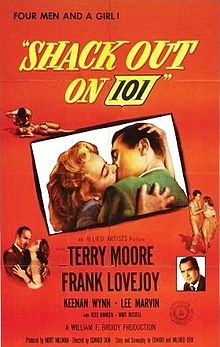
Shack_Out_on_101_film_posterLike a Cry Danger (1951) or a Private Hell 36 (1954), this low budget film noir flick is such a joy to watch because it wears what it is right on its sleeve, clear out in the open. What we get is an utterly absurd paranoia thriller that also happens to be a heaping plate of B-noir fun.
It’s a dirty, grimy picture about a dirty, grimy place. The cook behind the counter’s named Slob (Lee Marvin) and he has a dirty mind and disheveled look to match. He’s constantly at odds with the owner of the roadside shack (Keenan Wynn) and they make countless verbal barbs at each other time and again. You get the feeling that they relish jawing and putting the other man down.

Meanwhile, though the joint might not be one of the most frequented attractions there is some traffic from PCH and it brings in a few regular visitors.

The day-to-day “Hash Slinger” and longtime waitress Kotty (Terry Moore) is in the middle of a rapturous romance with a local professor Sam Bastion (Frank Lovejoy), and she’s beyond ecstatic to be going with someone who is a real man — intelligent and gentlemanly. Though recently he’s been especially occupied with work.

The traveling salesman Eddie (Whitt Bissell) with a nervous streak nevertheless remains a tried and true friend. He and George (Wynn) both made it through D-Day together and since then he always makes a habit of coming by the old place when he has a free moment. Kotty and the Professor take kindly to him too. He’s just that kind of amiable fellow.

Shack Out on 101 shines most obviously amid its small talk because there’s an invention to the dialogue that’s delightfully slovenly and colloquial. It’s full of the types of dialects, jabs, and put-downs that fill our everyday conversations in a way that feels thoroughly authentic and brings each character alive as they sit at the counter.

There might be two men standing in the front of the diner on a slow day lifting weights and talking about how muscles are for amateurs. Pecs are what real men call them.  Then they proceed to show off and compare their physical attributes. No reservations whatsoever.

Later on, they try out the latest fashions in spearfishing attire as they dream about the mythical “Pancho” who they’ll soon spear in the tropical waters off the coast of Mexico. Little do they know how close that is to the truth. Except there’s no need to go to Mexico. The catch is right at home.

When the film actually gets preoccupied with its plotting, it starts to go cockeyed and crazy. Admittedly, fallout from the Cold War must have been on everyone’s minds because, like Aldrich’s Kiss Me Deadly (1955), this picture too tries to play the nuclear angle. It’s hardly effective though I suppose it needed a broader, more concrete story to add a certain amount of intrigue and this one is complete with spies and government secrets.

Still, in the end, it comes out pretty thin. What we truly relish as the audience are not the attempts at drama but the way the film manages to make its apparent lulls invariably interesting and even how it manages to have asides at all given its infinitesimal running time. Sure, it won’t win any awards and the joint is a real dive but that’s all part of its cruddy charm. For a B-picture, this cast is quite the array of talent.

3.5/5 Stars

The Killers (1964)

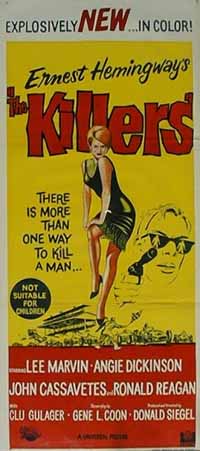
The_Killers_(1964_movie_poster).jpgAfter an opening to rival the original film noir The Killers (1946), though nowhere near as atmospheric, Don Siegel’s The Killers asserts itself as a real rough and tumble operation with surprisingly frank violence. However, it might be expected from such a veteran action director on his way to making Dirty Harry (1971) with Clint Eastwood.

With hitmen (Lee Marvin and Clu Galagher) as the motors for the story, they help maintain a similar flashback structure to the original film taken from Hemingway’s short story, except this time their inquiries are a little more forceful than anything the insurance investigator managed in Robert Siodmak’s film.

Furthermore, to fit better with the cultural moment boxing is traded out for race car driving as our fateful hero in this instance is Johhny North (John Cassavetes) a tragic figure who got caught up in love and wounded in the same instance.

Still, Cassavetes even before he was a director of great repute, he made for a quality acting force because the intensity always seems to burn in his eyes and it serves him well here yet again.

He and his mechanic partner (Claude Akins) are intent on winning a big pile at the racetrack but Johnny gets caught up in a romance with an alluring beauty named Sheila Farr (Angie Dickinson) who can’t get enough of him. But she also happens to be pretty closely connected to an unscrupulous “businessman” who conveniently pays the bills for her. If Johnny knew any better he would get out of there as fast as he could but she’s a knockout who seems to want him and he wants to believe in her sincerity.

Ronald Reagan takes on the uncharacteristically grimy role as the corrupt Jack Browning which interestingly enough would be the actor’s last Hollywood role before switching his sights on politics first as governor of California and then down the road aways as the president of the United States.

Like his predecessor so many years before, The Swede (Burt Lancaster), Johnny (Cassavetes) gets played for a bit of a stooge and as embittered as he is after a faltering racing career, he inserts himself into Jack Browning’s (Reagan) get-rich-quick bank job which is bound to spin out of control. Adding insult to injury Sheila is right there searing through him like she always used to. The imminent results speak for themselves concerning hitmen, dames, and everyone else who could possibly be caught up in the dirty business.

There are isolated moments where the drama gets laid down a little thick and yet for a film that was initially supposed to be a TV movie, this effort really is an enjoyable neo-noir despite being starkly different than its predecessor. In fact, that allows it to stand on its own two feet and even if it’s not nearly as good, Siegel’s film is still quite thrilling. Thankfully this one lives up to its name and it goes out as deadly as it came in which usually bodes well for a crime picture.

Part of that goes down to the acting talent because it feels like there’s no real throwaway role and everyone has something to keep them busy. Lee Marvin has top billing and he takes up a post that feels like it just might be the precursor to the enigmatic crime spree of Point Blank (1967). His performance along with Clu Gulager’s are undoubtedly the coolest bar none and yet they aren’t even in the majority of it.

That privilege goes to Cassavetes and Dickinson who light up the screen and play their character types impeccably. The same might be said for Claude Akins or Norman Fell. The only odd spot is Reagan but then again maybe that might only be my bias since I’m so used to seeing him be presidential.

3.5/5 Stars

I Am A Fugitive From a Chang Gang (1933)

IAmaFugitivefromaChainGangSullivan’s Travels (1941) and Cool Hand Luke (1967) were two films that took a fairly extensive look at what a chain gang actually was in cinematic terms. Meanwhile, Sam Cooke’s eponymous song made almost in jest has added another layer to the tradition.
Nowadays Chain Gangs seem a bit archaic and a part of the uncomfortable history of the South only to fall a few rungs below the injustice of Jim Crow Laws and the like. But the pre-code drama with its sensationalized title, I Am a Fugitive From a Chain Gang, was nevertheless dealing with issues very pertinent to the age and its story was semi-autobiographical in nature.

Just as this film, directed by Mervyn LeRoy, has undoubtedly been lost among other titles of the 1930s, it seems that Paul Muni as an actor has generally fallen out of the public spotlight when classic actors are concerned. Because in his day, on stage and screen, he was considered one of the finest performers that the world had to offer setting precedents that actors have followed for decades onward in terms of preparation, research, and commitment to roles still further exemplified by his extensive costume and makeup work.

Brando is supposed to have said himself that Muni was the greatest actor he ever saw and though the man upon reevaluation has been accused of overacting, there’s no denying the repute he held in his day and watching Chain Gang there’s little doubt that he carries the picture.

In its essence, this is a film of unfortunate circumstances embodied through incisive drama. James Allen (Muni) could best be described as a wide-eyed dreamer. Coming back from WWI he wants nothing to do with his old factory job, intent instead to try his luck as an engineer. But his family cannot understand how he can be so ungrateful. Still, he heads off on his own to “seek his fortune” but what beckons him is the life of a drifter and it goes alright until the fateful day where he finds himself implicated in a small time bank robbery that he never saw coming.

Still, the police only see the reality and he was the one with his hand caught in the cookie jar so their justice is swift — 10 years of hard labor. It’s in these initial interludes where life on a chain gang is painted grimly and dour. There’s nothing to be hoped for in such an existence where the food stinks, you stink, and there’s little respite from the work.

Understandably Allen is discontent and he becomes one of the few that makes a break for it and lives to tell about it. In fact, what’s more, his future becomes a bright spot as he rises up the ranks of an engineering firm and makes a bit of a name for himself. But opportunistic women and a murky past do not bode well.

Yes, he has become a credit to society, turning his life around completely, but the sticklers for law and order want him to pay off his debt and finish out his sentence before a pardon is to be enacted. He does the honorable thing and expects the gentleman’s agreement in return but instead, he watches the gates clink behind him for good.

Our protagonist is led through an existence of seeming futility that finally hits the lowest depths. By the film’s end, you almost forget that he was one of the doughboys who made it home from the war to end all wars with its plethora of disillusionments only to become a fatality at home.

It ends in the same forlorn crossroads as a picture like The Blue Angel (1930) or Nightmare Alley (1947) except maybe it’s even more akin to Fritz Lang’s seething crime drama You Only Live Once (1937) because in both cases a system of justice that is held in the highest regard, namely America’s system, is shown to be riddled with flaws that go to the core of what true justice is. It all but fails him.

This film does not even begin to unpack the reality that most of the men on the chain gang are African-American, readily choosing the perspective of the white man in almost all accounts because this is the 1930s. So even a picture like this that dredges up important issues for its day is still flawed if you look at it now from a bird’s eye view.

One other qualm with Chain Gang, oddly enough, comes with its short running time. With all of its supporting characters, it never seems to build any kind of rapport with any of them and each new female lead hardly feels substantial enough. Still, yet again, it is Muni’s film and he’s generally up to the challenge as our cinematic surrogate traversing each ruinous twist in his life. He’s put through hell twice and no man should have to deal with that. It’s not human.

4/5 Stars

Logan Lucky (2017)

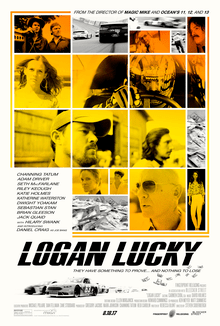
Logan_Lucky.png

On a surface level, Logan Lucky is diverting for the basic fact that it proves to be the utter antithesis of Steven Soderbergh’s Ocean films as far as heist pictures go. As one savvy newscaster notes within the film, it’s Oceans Seven-Eleven, if you will.

Sure, the novelty of a red-neck heist is probably enough to get us started but the execution and the characters of interest make it far more than a run-of-the-mill endeavor.

What’s evident is that there’s a quirky down-home absurdity to seeing these country bumpkin types filled by actors like Channing Tatum, Adam Driver, and especially Daniel Craig. Adam Driver’s not necessarily a classically handsome performer but he’s even more unique armed with a fake appendage and a fairly free and easy personality.

Tatum likewise is a miner saddled with a hard hat and a limp of his own. He’s a fairly sorry individual who gets laid off from work and has been estranged from his former wife for some time. The glory days as a high school quarterback with NFL aspirations didn’t really pan out. Still, he loves his daughter, loves himself some John Denver, and cares about his family. We can buy into liking such a figure.

Because even in their less than perfect life, an everyday dignity is attributed to both Logan brothers that feels relatable in human terms.  Even with these characterizations and as breezy as the scenario might seem at times, there’s still a kernel of truth buried under it all.

After being equated with Bond for so many years, there’s also this underlying sense that Craig relishes this opportunity to play such a weirdo as Joe Bang, a prison inmate with a penchant for salted eggs. His southern twang and bleached hair mask Craig’s usual British sentiments while his rap sheet leaves little doubt that he’s the man to help pull off the job, supremely capable of concocting homemade bombs out of gummy bears, salt substitutes, and bleach wrapped in a plastic bag.

Of course, the only problem is that he’s still in prison. Nothing for it but to break him out. Clyde gets himself sent to prison and starts their plan in motion. He and Joe orchestrate the perfect escape while the inmates cover for them by instigating a riot.

Meanwhile, on the outside, Jimmy gathers the talents of his sister Mellie behind the wheel (Riley Keough) and Bang’s two cockeyed yet surprisingly competent brothers (Brian Gleeson and Jack Quaid) to bring all the pieces together in a remarkably efficient operation organized on meager means.

However, somehow, through it all, there manages to be that continued dose of humanity on display and an uncertain amount of depth to our everyday antiheroes. Look no further than the former flame and physician assistant that Jimmy sends a donation to or his joy in seeing his little girl go off script and sing his favorite song at her beauty pageant. You aren’t going to find those scenes in Oceans Eleven (2001) or Baby Driver (2017) for that matter.

But the payoff is the kind of double-take ending that makes us rethink the events we have witnessed, suggesting that things are not always as they appear. Still more satisfying than any of that is that Jimmy still has his family and there’s this sense of closure to it all. We can sit back with a smile on our face and really take a moment to appreciate all that has transpired. No better place to end up than the old watering hole Duck Tape. Classic.

One of the film’s major pluses is the number of characters who just randomly seem to pop up within its frames. Foremost among them is Hilary Swank as a government investigator, an almost unrecognizable Seth Macfarlane as a batty racing promoter, and Sebastian Stan as his health-conscious driver. Fans of The Office and Parks and Recreation will also see a couple strangely familiar faces.

By my own admission, I have never considered Steven Soderbergh in the upper echelon of filmmakers but there’s no disputing his station as a skilled craftsman and Logan Lucky proves once more that he knows how to assemble efficient entertainment of quality and levity. Expect both in this much-appreciated riff off your typical sleek heist confections.

It’s perfectly fit for laid-back blue-collar, NASCAR-cheering, John Denver-loving Americans.  The kind of people who know full well that some days are diamonds and some days are stone. Logan Lucky is a crime film carrying that kind of sentiment.

3.5/5 Star


Inherent Vice (2014)

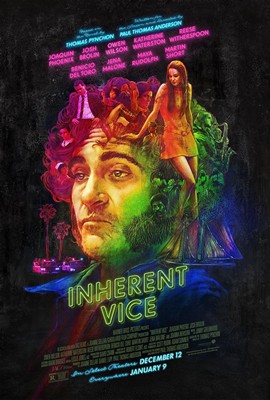
Inherent_Vice_film_posterIt’s not something you think about often but stoners and film noir fit together fairly well. Why more people haven’t capitalized on this niche is rather surprising. Think about it for a moment. Film noir in the classic sense is known for its private eyes, femme fatales, chiaroscuro cinematography, and perhaps most importantly a jaded worldview straight out of Ecclesiastes.
Some of the greats are also notorious for utterly baffling plots that come to no clear conclusion. Still, rather than chocking it up to faulty storytelling, these unfathomable aspects only lead to a greater ambiguity. Thus, you can imagine what occurs when our point of reference is on something. You take something that is already indecipherable and make it absolutely impossible to discern reality because there’s no sense of knowing what is actually real even before funneling down to specific plot points. Inherent Vice is precisely that film, a neo-noir bathed in rays and full of dopers.

Paul Thomas Anderson makes this affectionate and supposedly quite faithful adaptation of Thomas Pynchon’s novel connect most obviously through voice over. It captures a certain rhetoric — the poetic lyricism that manages to anchor the plot in some bewitching way — while also providing a great deal of latitude in storytelling which the narrative gladly capitalizes on.

This private investigator, Doc Sportello (Joaquin Phoenix),  is a benevolent stoner. His girl Shasta flutters back into his life and like they always do she comes as the bearer of bad news — a flower child in trouble with a lead for him to follow before she disappears into the night. Being a private eye he follows up the loose threads but he’s not necessarily a good private eye or a generally judicious one and that doesn’t bode well.

It’s pointless to try and tie everything together. In fact, this is as good a time as any to disclose that Reese Witherspoon, Benicio Del Toro, and Owen Wilson all show up but it’s almost possible to forget about them.

Doc investigates some vague leads about one real estate owner Mickey Wolfmann who has disappeared, gets word of a mysterious syndicate called the Golden Fang while searching after a member of a cult, and subsequently gets hired to find a missing husband. His worst enemy and greatest ally simultaneously is Detective Bigfoot Bjornsen (Josh Brolin). All the cases get resolved without the least bit of satisfying closure.

Still, the incomprehensible plot highlighted by absurdities is almost something that needs to be expected from a film such as this built out of the tradition of The Big Sleep (1946), The Long Goodbye (1974), and even Harper (1966). It’s another knowing riff off of the private eye pictures of old.

The bottom line being that precise malaise. It’s easy to lose it amid the stoned out status quo, characters medicating themselves on smokes and drugs and drink. They seem happy enough. At the very least they’re not torn apart by anything. And yet the very fact that Doc in particular witnesses so much — unveils so many things — and remains despondent is indicative of the whole story.

It’s an understated chill comedy that is meant to mesh rather ironically with the film noir world and like Altman’s film before it, there’s this lovely incongruity that works so well. All highlighted by the very fact that we fail to truly discover what is fact and what is fiction.

Everything is taken in stride rather nonchalantly by Doc who ambles along with his various leads in the relaxed manner that will remain his calling card. His attempts at scribbling down notes only result in random word clusters. But, and I hesitate to say this because it might give the wrong impression, in some sense, it does feel like we’ve seen this humor before in Airplane! (1980) and The Naked Gun (1987).

We like Doc. If he wasn’t high all the time, he’d probably be a pretty nice, cognizant, charming fellow but his response to all that is around him is rather pathetic and pathetic in the way of a dog with his tail between his legs. Flailing to the will of corrupt cops or allowing the vices of others to rule the day. But then again, what is he supposed to do in this world? The everyday villains are too many, the mountain to overcome is too high, and so he slowly sinks back into his fog. It’s a nicer, more comforting place to be than the world at large.

Cross that with Neil Young’s ambient jams in “Journey through the Past” and “Harvest” or the laid-back radio plays of 93 KHJ including The Cascades, The Association, Sam Cooke, and Kyu Sakamoto and it goes down pleasantly. As do the agreeable touchstones of Adam-12 and “Three Hour Tours” on primetime television.

It provides the film with a bit of the nostalgic haze that still manages scintillating vibes of sunny Southern California. But no one need remind any of these characters that this is the same beach paradise that saw the egregious murders committed by the Manson family, the shooting of Bobby Kennedy, the Watts Riots, and so on and so forth.

Taking a hit can sustain for a momentary high. Embracing your girl in the pouring rain can remain a fond memory. Music can float through your brain lazily. Television makes a nice diversion. The pursuit of money and power can drive a life for a while. But surely life is more than all of these — the things we use to mask the hurt and the pain we are subjected to as human beings — the numerous distractions in this “postmodern” world of ours. Surely there’s gotta be more…

4/5 Stars

Review: Rope (1948)

rope 1.png

Rope’s title sequence is composed of your prototypically serene establishing shot. But really, you could not have a more unique and in some sense unnerving picture. It was Alfred Hitchcock’s first foray into Technicolor and it’s quite the looker as are the beautifully constructed backdrops that spice up the mise-en-scene for this glorified stage play.  He also busied himself with camera set-ups in an effort to shoot the picture as near to a single take as was possible with the technology of the time. He actually “cheated” a bit by splicing segments of film together at intentional breaks to give the effect of continuous motion. Still, it’s an impressive endeavor all the same.

But the experiment is twofold both behind and in front of the camera. It’s all a reworking of the murderers Leopold and Loeb, two affluent students who succumbed to Nietzsche’s superman complex. The project was an early script by playwright Arthur Laurents penned from an adaptation by Hume Cronyn, a Hitchcock regular in several earlier pictures (Shadow of a Doubt and Lifeboat).

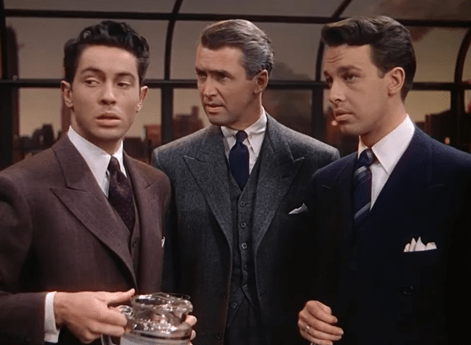
In this case, Brandon (John Dall) and Phillip (Farley Granger) are looking for the perfect victim in the perfect murder. Where murder is a crime for most men but a privilege for a few — like themselves.  It all begins with a shockingly graphic opening for the 40s that rips away any shred of upper-middle-class sensibilities put upon us by that establishing shot. It’s all a ruse.

The assertive, far more charismatic Brandon also happens to be the main architect pulling along the flighty Phillip into his little experiment.

The act of throwing a small get-together against this exhilarating backdrop proves tenuous because of the insidiously dark deed that Hitchcock has made his audience privy to. Otherwise, this would be a run-of-the-mill picture of cocktails and hor ‘d oeuvres. But underline it with a murder and it’s a completely different proposition altogether.

Their exhibition comes as little surprise from two men who are snobbish, entitled jerks. Their lives are so dull that they stoop to murder to see if they can be brilliant enough and brazen enough to pull it off, going so far as inviting their most astute mentor played by none other than James Stewart.

Though I enjoy him as much as the next fellow, Stewart does feel oddly out of place in this film and within this role of Rupert. He seems to know it too. Nevertheless, Hitchcock would find far superior uses for him in due time.

There are also a couple knowing winks to the sinisterly attractive James Mason (a future Hitchcock collaborator) who is conjured up to do battle against the dreamboats Erroll Flynn and Cary Grant by a few admiring partygoers. Of course, no one seems to take into account that they have Jimmy Stewart right in their stead.

We begin to feel for Janet and Kenneth two schoolmates who have been used in the game. She is soon to be engaged to the formerly eligible David. Kenneth was the beau she was with before he broke it off. Now their lives are manipulated just like the late boy’s father who is also invited to the gathering.

Rupert proves that he knows something’s afoot not that it’s all that difficult to see Granger’s character slowly coming apart at the seams. Alcohol hardly helps his unstable demeanor. It becomes a showdown with his two pupils but he could have never expected this. It’s on this level that Rope is thoroughly troubling. It’s in this way that we begin to understand why Nietzsche might have been troubled by his own conclusions. There is little hope in this conception of the world.

Simply put, the film is dour to its core. It has no heart and in that sense, Jimmy Stewart does not feel at home within its heartless frames. The charade falls short for these very reasons. Though it’s technically ambitious, it doesn’t quite manage that perfect Hitchcock balancing act of crime mixed with wit. There’s no way it can with such a worldview.

Still, Rope shows, if anything, that Hitchcock is never complacent, always looking for the next great challenge. That is one of the many reasons that we still hold him in high regard as one of the foremost directors of any age. Because even a callous film such as Rope is worth seeing.

3.5/5 Stars

Side Street (1950)


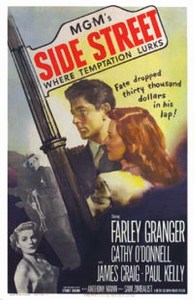
SideStreetposterThough director Anthony Mann later made a name for himself with a string of Westerns pairing him with James Stewart, it’s just as easy to enjoy him for some of the diverting crime pictures he helped craft. Everything from Raw Deal (1948) to T-Men (1947), He Walked by Night (1948), and of course this little number.
Another simple pleasure gleaned from Side Street is the second teaming of the two young starlets Farley Granger and Cathy O’Donnell who made such an impression together in Nicholas Ray’s sensitive drama They Drive By Night (1948)

We begin this particular picture with a flyover of New York City and the “Voice of God” narration comes off as another installment of The Naked City (1947) because it too takes to the streets, shot on location in the city of a thousand stories with thousands more waiting to happen.

There’s something engrossing in this style of storytelling which takes interest in several seemingly unextraordinary, unconnected individuals and then over the course of less than an hour and a half slowly ties together all the threads of their lives into one cohesive narrative.

There are some calling cards of crime pictures including sleazy extortion, a body fished out of the East River, and the police who are working the beats of the case and trying to keep the frenzy of journalists at bay. Paul Kelly and Charles McGraw head up the police procedural angle.

But the man we come to know the best is unassuming postman Joe Norson (Granger), who becomes extra jumpy after unwittingly stealing thousands of dollars when he thought he only swiped a few bucks to buy his wife a mink coat. He’s just a poor, small, unimportant little man in the scheme of things. An “Average Joe” if you pardon the expression. He’s not supposed to be embroiled in such a story. It’s a bigger can of worms than he could ever imagine and there are consequences.

Other people of interest are wealthy businessmen, crooked lawyers, cabbies, bar owners, bank tellers,  journalists, cops on the verge of retirement, nightclub singers, and at least a few ex-cons, all the usual standard bearers.

Joe’s wife is in the latest stages of her pregnancy and shortly her baby is on the way but her husband has made up a fanciful story about a new out-of-town job that’s loaded him with cash. Of course, she has no idea what’s going on and nor does he. He asks a near stranger, the man who runs the local bar to hold the cash for him. He says it’s a nightgown for his wife.

But Joe’s not a criminal. His guilty conscience is too much for him so he goes back to the office to plead with them to let him return the money. Of course, they have as much right to it as he does. What follows is a cat and mouse chase across the city. First, some thugs tail Joe looking for the $30,000. Then, Joe and ex-convict George Garsell look for the bar owner who has all but disappeared and conveniently the money’s gone too.

As the police are also involved, they want both men, believing they are complicit in different murders that have been committed. Joe has just enough time with his wife to explain his predicament. Still, he got himself into this mess and he holds the belief that he is the only one who can make it right.

What follows is a culmination of all the events thus far as all the character arcs begin to bump up against each other. Namely, Joe, a local nightclub singer (Jean Hagen), and the last man that Joe wanted to see, Garsell himself.

Side Street closes out with a lively car chase near The Third Avenue El that predates many of the revered classics from Bullitt (1968) to The French Connection (1971) years later. The full weight of the title’s meaning, subsequently makes itself increasingly clear as squads of police cars look to close in on the criminal’s getaway taxi. Of course, what makes it compelling is the fact that Joe is right in the thick of it all to the very last avenue…with a loaded gun pointed at his head. Thankfully there are no speed bumps in this one.

3.5/5 Stars


Review: Strangers on the Train (1951)

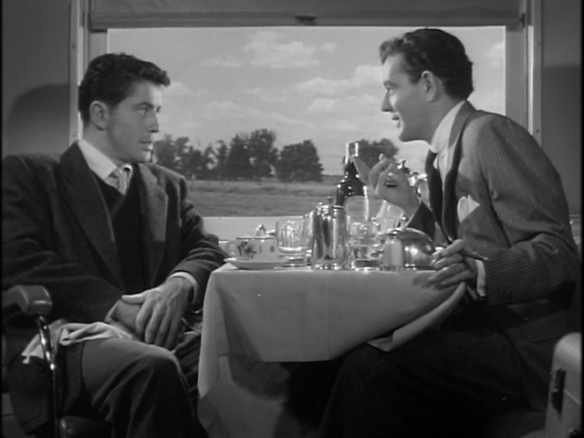
Strangers_on_a_Train_-_In_the_dining_car.png

Strangers on the Train is conceived in its first few minutes of dialogue when the charismatic bon vivant Bruno (Robert Walker) ingratiates himself on tennis player Guy Haines (Farley Granger). Bruno is a big idea-man, constantly talking and thinking and wheedling his way into other people’s lives because he does have a way about him. He makes it easy for others to like him and then they let their guard down after a row of trivial jokes and he’s got them. That is until they begin to see something else entirely in him.

In this particular instance, he schmoozes Guy’s ego. He’s a big tennis star. Bruno has read up on him and knows all about him. At first, it’s mere flattery but as the conversation continues it gets more and more unnerving. Bruno seems to know a little too much almost to the point of obsession.

Still, he manages to keep the other man’s attention just long enough to share his greatest idea — imagine for a second that two men who meet quite by chance (on a train for instance) were to trade murders — leaving no motives or connections for the authorities to trace back to the culprit. Of course, the whole idea soon falls apart if not everyone is equally invested. It doesn’t work if only one individual takes such a ludicrous idea seriously.  That’s where uneasiness begins to set in.

Robert Walker’s performance might rightly be one of the greatest performances in a Hitchcock film in terms of the sheer chill factor. He’s a psychopath, somehow misguided and tortured by issues that never truly get resolved. A great talent with so much promise was lost far too young when he died tragically the same year this film was released.

But equally important is Farley Granger’s more subdued performance, that quiet sensibility that makes him an easy target for someone as magnetic as Bruno. With another actor such as William Holden (initially considered for the part), the dynamic falls apart for sheer implausibility and as a result, the film would not function so effectively. We soon believe that a relationship such as Guy’s and Bruno’s could actually exist and that shred of reality makes the tension all the more unnerving.

Due to its foreboding cinematography courtesy of longtime Hitchcock collaborator Robert Burks and Bruno hanging over Guy constantly like an expectant specter, it`s easy to trace the line of film noir sensibilities here as the darkness seeps into Guy’s picture-perfect life.

But what’s fascinating is that Bruno initially aids his newfound friend — he assists him in getting the life that he’s wanted for a long time, an existence that is respectable, complete with a beautiful woman. Anne Morton (Ruth Roman) is the daughter of a respected Senator (Leo G. Carroll) and her upbringing and general concern reflects a stark improvement in Guy’s social standing.

Is it safe to say that it’s fairly easy to harbor a crush for Roman who exudes a refined decency, even if she’s not quite Hitchcock’s icy blonde? Place her up against Guy’s opportunistic and cavorting wife and Bruno’s action could almost be considered a service. Almost… Still, Bruno spins his charisma into a deadly threat, ultimately evolving into Guy’s worst nightmare.

Meanwhile, Patricia Hitchcock sometimes feels like she is used as a plot device but nevertheless even in that aspect alone she is crucial to this story. She also doesn’t quite fit into the Morton family but her very characterization reinforces many of the themes her father is playing with often using visual language.

The most acclaimed shot for its sheer stylized perspective is the scene of Bruno’s act of murder. It’s done in only a moment, silently, and without much fanfare. The woman’s glasses fall to the ground cracked and we see the reflection of the events at hand. It’s pure Hitchcock but the entire sequence is a masterstroke in buildup.

Bruno is tracking his unsuspecting prey. He follows her into a carnival. Past the booths and the rides, by popcorn vendors, into the tunnel love and finally to a darkly lit meadow where the deed is done. But without the buildup, this continuous cutting between the man and the woman, the scene has little impact. Hitchcock gave it increased stakes bolstered by true suspense.

But what he does equally well is cross-cutting not only his two main characters but their very actions. The opening introduction showcases this contrast of personalities with Bruno and Guy. It never ceases. They’re constantly placed opposite each other intersecting and crossing each other. Yet Hitch emphasizes these conflicts visually on multiple occasions which completely justifies why his main hero was written as a tennis player.

The fact that Guy is in the thick of a match during one of the tensest segments is magnified in how the camera cuts between Guy and his opponent back and forth with the audience, line judges, and everyone else spliced in for good measure. It mirrors the very same conflict he’s still tied up in with Bruno just as the gradation of black and white reflects the good and evil that separates and at the same time connects the two men.

You can always count on Hitch to bring the goods and yet again Strangers on the Train ends with a whirling, whizzing, shrieking bit of pandemonium — a real slam-bang finish courtesy of the Master of Suspense. Over 65 years later it hasn’t lost much of its impact blending a sense of real-life spectacle with genuine thrills. And like Hitchcock’s greatest films this one works on multiple planes visually, psychologically, metaphorically, narratively, and that frees us up to enjoy it in whatever way we please. That’s the sign of a quality movie from the foremost of creators.

5/5 Stars