The Treasure of The Sierra Madre (1948)

4d2bb-treasuremadrePutting Humphrey Bogart in his element once again, The Treasure of The Sierra Madre is another wonderful adventure film. Directed by John Huston, it tells the story of three men who join together in their search for an elusive treasure in Mexico. At the beginning, they are in good spirits eager to become wealthy. However, when they finally strike it rich they find it is not all it is cracked up to be . The situation escalates and they become paranoid of each other. Finally, Bogart’s character Dobbs is pushed over the edge and commits a malicious act out of desperation. Seemingly as an act of karma, he meets with another form of justice. However, it seems that by the end no one actually wins. A surprisingly good film, Sierra Madre takes your usual treasure hunt and realistically depicts man’s greed which often can overpower everything else. Bogart was supported nicely by Walter Huston (the father of the director) and Tim Holt.

5/5 Stars

The Maltese Falcon (1941) – Film-Noir

4ef67-falconmThis archetypal film-noir directed by John Huston, stars Humphrey Bogart as the detective Sam Spade. After an initial conversation with a mysterious woman, that same night two men end up dead. As Spade tries to understand what is going on, it puts him in contact with a paranoid little man and another man who is trailing him. All of them have something to do with a black bird and the situation gets more complicated when Spade meets the fat man. Rather surprisingly Spade ends up with the falcon but of course there has to be a twist. Soon enough the truth comes out of Brigid O’Shaughnessy and Spade coldly does his work. This film has great characters played by Mary Astor, Peter Lorre, Sidney Greenstreet, Ward Bond, and Elisha Cook Jr. The directing is good as well as the cinematography. This is the film that finally made Bogart a star and he would never look back.

5/5 Stars

Bonnie and Clyde (1967)

b1a0c-bonnie_and_clydeStarring Warren Beatty and Faye Dunaway, with director Arthur Penn, the film chronicles the crime life of a group of notorious gangsters during the 1930s. Clyde Barrow (Beatty), a small time thief meets the beautiful young girl Bonnie Parker (Dunaway) and together they begin robbing banks. Soon they enlist the help of a dim-witted mechanic C.W., and then Clyde’s brother joins the fray bringing along his wife. They have a string of successes and they become infamous nationwide. Soon they begin to bicker among themselves and the police start to buckle down. In a shootout Buck is shot dead and Bonnie, Clyde, and C.W. just barely escape. However, their actions eventually do catch up with them and thus ends the story of these two figures depicted as anti-heroes. This film is significant because it was influenced by the French New Wave but it in turn ushered in a new era of American film . It has a unique combination of comedy, romance, violence, and of course banjo music.

5/5 Stars

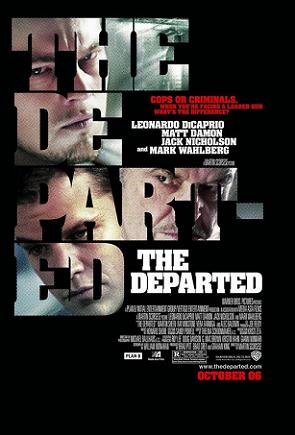
The Departed (2006)

Directed by Martin Scorsese and starring an all-star cast including Matt Damon, Leonardo DiCapprio, Jack Nicholson, and many others, this is a crime thriller with an interesting concept. The plot has to do with two young men who were in the Massachusetts Police Academy. One is tailored by the Irish mobster Frank Costello to become a mole within the police. The other is called upon to infiltrate the mob before he graduates. Thus begins their dangerous assignments as each tires to find the rat in the other organization while also working to stay out of reproach. Costigan is able to get close to the vile Costello while Sullivan is part of the Special Investigation Unit and also begins a relationship with a psychologist. They must secretly keep contact with the other side but it becomes increasingly treacherous with one encounter leading to a chase and another in the death of a police captain. The heat is on as both men try and reveal the other mole. During a cocaine pick up Costello is traced to the spot and a chaotic shootout ensues. Everything seems calm again and yet Constello’s mole is still around and bent on erasing Costigan from record. They agree to meet on a roof top and from that point on the film moves so rapidly it is almost impossible to take in what happens. Everything seems confused and corrupted but ultimately it does not pay to be a rat. This film has a lot of coarse language and violence but in Scorsese’s hands it is still an intriguing film to watch.

4.5/5 Stars

To Catch a Thief (1955) – Alfred Hitchcock

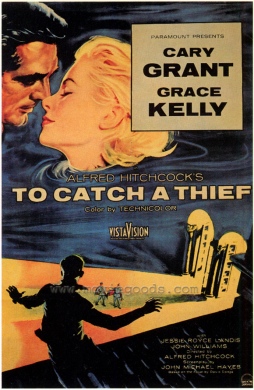
1b4d6-to_catch_a_thiefStarring Cary Grant and Grace Kelly and directed by Alfred Hitchcock, this film follows the life of a former cat burglar who is accused of thievery in France. An outbreak of thefts seem to point to John Robie and he seeks refuge with some old friends. He plans to clear his name by catching the real thief. He learns that a vacationing mother and daughter have the most expensive jewels and he strikes up a relationship. The daughter realizes what he is and goes on to tempt him to steal her valuables. When they actually go missing she suspects him. Trying to figure out what is going on Robie struggles with a possible burglar who falls to his death and he attends a ball with Francie who has pronounced her love for him. After a clever switch Robie waits for the real perpetrator only to be surprised. As a thriller and romance this is a fun film. The cinematography is excellent and Kelly’s wardrobe done by Edith Head is memorable. Cary Grant and Grace Kelly are certainly a memorable screen couple.

4/5 Stars

Dial M for Murder (1954) – Alfred Hitchcock

Directed by Alfred Hitchcock and starring Ray Milland, Grace Kelly, and Robert Cummings, this film tells the story of a married woman who has fallen for another man. However, her suspicious husband finds out and decides to have her murdered. Through a series of events he finds his murderer and sets everything up for the following evening. His plan goes awry and his wife lives so he must rush to cover up all his involvement. In the ensuing days Kelly’s character is accused of murder even though she was simply defending herself. She finds herself facing death and yet the clever police detective figures everything out. He realizes her innocence and traps Milland in his own plan. With the typical Hitchcock style and solid acting, this movie is full of many suspenseful moments and it became an early example of film making for 3D.

4/5 Stars

Where the Sidewalk Ends (1950) – Film-Noir


*May Contain Spoilers
Starring Dana Andrews and Gene Tierney with Karl Malden and director Otto Preminger, this film follows a ruthless police detective. Mark Dixon is notorious for his strong armed tactics and he is given orders to cool it. That same evening a mobster holds a crap game and things blow up when Tierney’s estrange husband fights the man on a lucky streak. The police catch wind of it and arrive finding the man dead with the husband gone. Dixon finds the husband and tries interrogating him but instead he accidentally kills the man. He must elaborately cover his tracks and when the police gather evidence it all point to Tierney’s amiable father. Dixon knows the truth and as he falls for Tierney’s character he tries to help her father’s case. In a last ditch effort he writes a letter of confession and tracks down the mobster to face death and close the case. However, he gets out alive and everything turns out fine except for his conscience. He has the letter opened and the truth comes out. Andrews and Tierney were paired again after Laura and I have to say I really enjoyed this film because of the tragic hero Andrews portrays.

4/5 Stars

Laura (1944) – Film-Noir

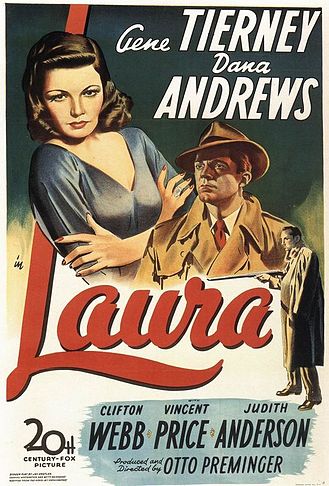
fb137-laura23234If you have never seen Laura, I would first advise you to watch it and then look at my review afterwards. I do not usually do this but with Laura I think you should watch it beforehand. Enjoy!

*Contains Spoilers

Directed by Otto Preminger and starring Dana Andrews, Gene Tierney, Clifton Webb, Vincent Price, along with Judith Anderson, this is a great film-noir. With its voiceover narration, flashback, close-ups, shadowy atmosphere, plot twists, and hard-boiled detective, Laura is intriguing. From the beginning, this recently murdered woman who has a portrait on the wall, fascinates us. We follow the detective (Andrews) as he questions the columnist who helped make Laura succesful (Clift), and the playboy she was going to marry (Price). Soon Andrews finds himself also falling for this woman. However, everything changes when Laura reappears with seemingly no knowledge of any murder. After this development Andrews tries even harder to get at the truth with much difficulty. On a hunch he seems to crack the case however Laura is still in danger. In the final climax all is right again with the conflict over Laura.

5/5 Stars

The Thin Man (1934)

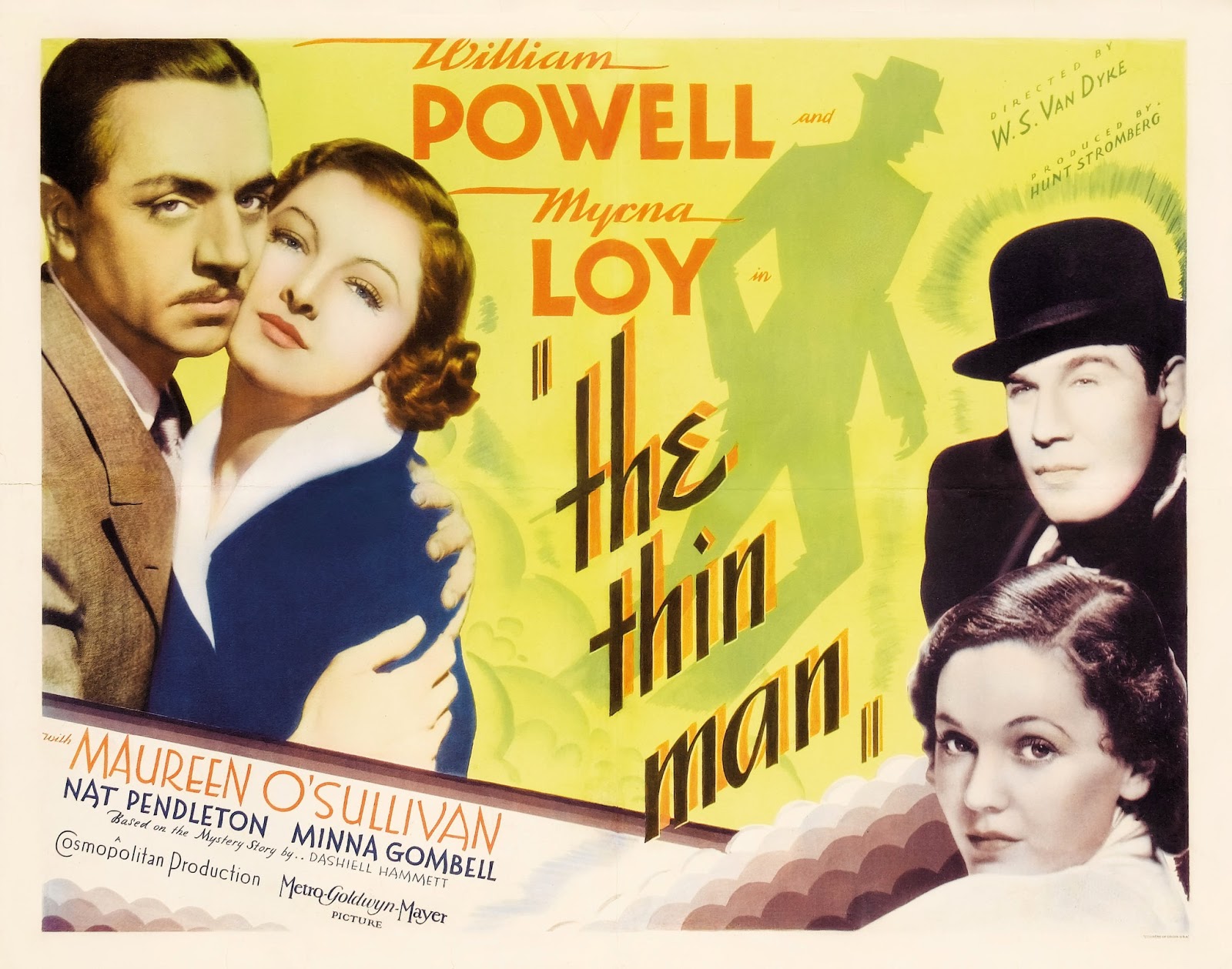
c6713-poster_-_thin_man_the_02Starring William Powell and Myrna Loy and adapted from a Dashiel Hammet novel, this comedy-mystery follows a former detective and his rich, loving wife. At first Nick Charles is reluctant to go on a case that revolves around a thin man who he knew and who has disappeared. The police believe he is the culprit behind the three subsequent murders. Other mysterious events and the many suspects, leave both the police and audience unsure. After the constant begging of Nora, Nick follows a hunch and joins the case. He seemingly makes a break through and he and Nora hold a dinner with all the suspects. There the truth is discovered and the culprit is found. This is like a screwball comedy that is further complicated by the mystery. Powell and Loy play off each other very well and the supporting cast is good.

4.5/5 Stars

One Flew Over the Cuckoo’s Nest (1975)

This is a powerful film from the 70s that has such an intriguing conflict between Jack Nicholson and Louise Fletcher. There have been many chilling villains in the annals of cinema, but Nurse Ratched was arguably the coldest and yet understated of them all. She makes this a true battle for supremacy. Nicholson is supported very nicely by the rest of the cast who he helps to rile up.

*May Contain Spoilers

Originally adapted from the novel by Ken Kesey, the film tells the story of a criminal interned in a mental hospital, because he thinks it will be “life on easy street” with a bunch of crazies. Jack Nicholson plays this Randle McMurphy, who goes in ready to live easy and challenge authority whenever he can.

Meanwhile, the doctors observe him seeing if Randle really belongs. As he grows accustomed to the institution, he becomes the instigator of the other patients. Whether they are playing cards, talking with the group, taking medication, getting their exercise, or taking a fishing trip, he always looks to get his way and have the other patients rally around him. However, he must deal with Nurse Ratched, a cold and iron-fisted woman, who keeps everyone at bay believing it is for their own personal well-being.

In fact, she chooses not to send McMurphy away because he is their problem and Ratched is ready to deal with him in the way she sees fit. Not even McMurphy seems able to prevail over Ratched and her tactics in the end. He starts a riot in the ward after they are not allowed to watch the World Series, and as the final straw, he holds a wild Christmas party with girls and alcohol. He plans to get away in the aftermath with his new-found friend “Chief,” only to wake up in the morning to a very displeased Ratched. Her pressure causes one unstable young man to commit suicide, and with the opportunity to escape right in front of him, an enraged McMurphy strangles the nurse, only to be subdued. Things quiet down and the patients revert back to their old ways with “Mac” nowhere to be seen.

One night he is returned and in a Deja Vu moment, the Chief goes to talk to Randle, only to see a blank look on his face. Ratched’s methods have seemingly won. However, Chief is able to use Randle’s plan to escape and keep the hope alive. Nicholson was backed by a stellar cast including Louise Fletcher, Danny Devito, Christopher Lloyd, Brad Dourif, Will Sampson, Sydney Lassick, and William Redfield.

Although this film is rougher around the edges, it reminds me of the earlier dramatic classic 12 Angry Men, because both films have wonderful casts that are able to create such tension through their collaborative performances. Much like Henry Fonda, Nicholson is the undisputed star, but all the other players make this movie truly extraordinary. Early on there are some definite comedic moments, but the film begins to get darker as the story progresses, and Ratched gets more and more strict.

Furthermore, this film is shot in a realistic almost bleak documentary-like style that really adds to the film. It is almost difficult to watch the scene where Randle chokes Ratched because it is up-in-your-face and graphic. Despite, the fact that the ending is depressing, there is still a hint of hope. It is one of the things that makes One Flew Over the Cuckoo’s Nest so riveting. Much like many of the patients that inhabit the facility,  the mood constantly swings like a pendulum from humorous, to calm, to bleakness, and finally hopefulness.

5/5 Stars