Frenzy (1972): Cleaning Up The Streets

Screenshot 2020-07-28 at 5.28.11 PM

There we are gliding across the River Thames making our way toward the regal facade of Tower Bridge. Where’s one apt to find a more picturesque view of London? It’s definitely an auspicious return to his native land for the Master of Suspense.

Frenzy is without question a singular Hitchcock movie taking him back to his roots in the ’20s and ’30s — not just the days of Stage Fright (1950) or The Man Who Knew Too Much (1956) — something like The Lodger (1927) or Sabotage (1936) springs to mind.

Of course, it’s a different England. It’s gotten bitten by the bug. Certainly one of them was Swinging London and The Beatles, but even as the old world, the small-town world continues to pass away, there’s a sense this same progression is being documented in Frenzy.

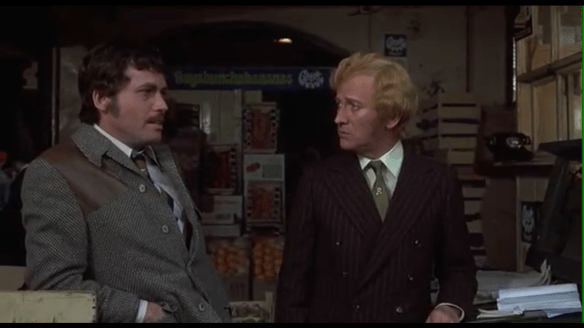
The characters knock around town at all the pubs, street corner grocers, and everywhere else in Convent Gardens — what’s left is a remnant of Hitchcock’s boyhood world. The director’s father was a grocer, and thus, it’s a return to his roots in the most Hitchcockian way possible: replete with murder.

A charismatic civil servant stands atop his soapbox with a rapt audience rallying the people they’ll soon clear the rivers and canals of society’s refuse — pollution will be banished — and right on cue, there’s an interruption from the masses. He gets preempted when an onlooker realizes something bobbing in the river: A woman’s body with a tie twisted around her neck.

Irony notwithstanding, it causes a surge through the crowds as gossip about the rash of necktie murders throughout town. In this way, the traditions of Jack the Ripper have been modernized and remain alive and well in contemporary London.

It’s not only these onlookers but acquaintances in pubs and any other random passerby who all have a callous, morbid curiosity about them — their conversations are overwhelmingly about the killer — and they come off darkly cynical.

The men from New Scotland Yard for their part are on the lookout for a sexual psychopath and a social misfit who might be easily categorized. Because what better way than to put criminals in a box to understand them?

Right about now we must introduce our protagonist, who also becomes the obvious target of all this foreshadowing. We are led to believe Richard Blaney (Jon Finch) an acerbic ex-RAF man who is the obvious culprit, although, for the time being, he’s unsuspected.

Still, after his ex-wife, who runs a new-fangled matrimonial agency is brutally murdered, unbeknownst to him, the forces of the plot are already out of his control. It’s as if the film is cruelly conspiring to ensnare him like all the most crippling of Hitchcock’s man-on-the-run thrillers.

The police are looking for a fugitive with a tweed jacket with patches on the shoulders and elbows. It’s true all pieces of circumstantial evidence, motive, and eyewitness accounts point to Blaney. At every turn, he looks to be guilty and he does very little to help his case. A hotel bellman tips off the law, and then the testy bar owner (Bernard Cribbins) he used to work under accuses him further.

He does have several allies in the generally morose landscape. One is the local barmaid Babs (Barbara Massey), who stands by him in his innocence. Another is Johnny Porter, a buddy who gives Richard asylum, despite the chastisement of his suspicious wife.

Although Johnny feels like a far too convenient character — he implicates himself in a potential crime quite readily — but let’s not allow this to detract from the story. Dick does have one other friend: a local grocery worker named Bob Rusk (Barry Foster), who gives him free handouts and tips at the races, among other things.

Frenzy is the most visually grisly and unnerving Hitchcock picture with a kind of in-your-face depiction of the murders. In this regard, it seems uncharacteristic of the man who often seemed the king of simulated gore and suggested horror.

The Shower Scene in Psycho is the unadulterated pinnacle of this. Where the intensity comes in the layering and total manipulation of all the formalistic elements. Frenzy is on the complete opposite end of the spectrum showing everything far more explicitly. It almost seems to lack the elegance of a Hitchcock picture — Blaney and Bob are earthier types than we’re used to.

Still, in one of Frenzy’s most telling shots, Hitch literally pulls the camera down the stairs out into the street just as we recognize that the dastardly deed is being done. It’s a second murder, and he makes us painfully aware of it without ever putting us inside the room. The same cannot be said in the other instances.

However, what truly sets the picture apart is how Hitchcock scrapes the dividing line between psychotic killer and despicable human being so close that nobody wins. Because Dick’s yet another man on the run framed by fate. The only difference is he’s a wholesale cad. Whether he’s innocent or not is immaterial here. He might be The Wrong Man, but he’s no Henry Fonda and he’s certainly not Cary Grant.

The movie wraps up briskly and abruptly. There’s hardly time to catch our breath though Hitch does put us out of our misery. Our “hero” is exonerated, and the police apprehend the criminal, all in a matter of seconds. All this might be true, but it doesn’t make the world any more livable. There’s still refuse in the waterways and rubbish in the streets. Not only is the nostalgic world Hitchcock knew disappearing — this is sad in itself — it does feel like the world itself is a tawdry, cynical place.

To be fair, this might not be the director’s perspective — he holds a far more perverse sense of humor than mine — but when I look at this world it’s far from comforting. I’m a bit of an anglophile so there’s an appreciation in seeing familiar faces like Clive Swift (Keeping up Appearances) or Bernard Cribbins (Doctor Who), but maybe I’ve been watching the wrong things.

Then again, Hitchcock always did suggest the dark desires and inclinations of society conveyed through this lens of macabre amusement. Now his depictions are simply sharper and more direct.

In other words, the legacies of Jack the Ripper or Jekyll & Hyde aren’t dead. Over time, we just got better at trying to dissect them, and we’ve become increasingly more numb to their depravity. Could it be presumed innocence no longer matters? We’re all on the run. We all go a little mad sometimes. We’re all guilty of something.

3.5/5 Stars

Uptight! (1968): Jules Dassin and Ruby Dee

Martin Luther King Jr. was assassinated on April 4th, 1968. Uptight was released in December of the same year. It’s a rather unnerving circumstance because the movie was conceived well before the horrid tragedy, and yet this cataclysmic moment haunts the picture. If the struggle for unity was a tough proposition before, how do you begin to make sense of the moment afterward? Now a story that didn’t necessarily need this specificity was inextricably linked to very real events. The film in its updated form literally begins with the wake of MLK.

Only recently did I recognize two separate films that recontextualized Irish struggles during The Troubles with the black experience in the 1960s. John Ford’s The Informer became Uptight with Ruby Dee and Carol Reed’s Odd Man Out turned in The Lost Man with Sidney Poitier.

Although I don’t know enough about the nuance and minutiae of these respective histories, I am fascinated to learn if this was merely a coincidence, a marketing strategy someone actually employed, or a small cog in a broader genre conversation.

Jules Dassin and Ruby Dee are easy to tap as the primary architects, one a causality of The Hollywood Blacklist that forced him into European exile, and then Dee, along with her husband Ossie Davis, were two of the foremost black performers and social activists of their generation.

Given this context, it’s not surprising, the film hardly made a blip on the broader cultural landscape. In an era of COINTELPRO, this movie seems more timely than many people realize and a testament to that might just be that very few people recognize the movie. This is not the type of film that would get championed because even today it bristles against some prevailing sensibilities and causes us to reconsider the trajectory of our nation’s legacy.

The FBI purportedly had informants in the crew who helped them keep tabs on the production. The crew, including its director, was predominantly white while the movie was financed by one of the big studios: Paramount Pictures. This is the context of a picture that floundered at the box office.

The film itself is set in Cleveland, Ohio where tensions are high. The nonviolent philosophy of MLK has been brutalized, and the rest of the black community seethes with rage, understandably so. It sets the groundwork for fiercer insurrection. The emerging leadership believes it’s time for a new vision to take its place.

Growing sentiments of disillusionment are made clear early on: “The man from love got his head shot off, and all those people learned nothing.” And they derisively criticize what’s come before:  “Cry, march, pray, that’s the way to win Whitie’s heart.”

Crucial to the film’s core dilemma is the character of Tank (Julian Mayfield). The movie resculpts Victor McLaglen’s carousing tragic turncoat into an even more pitiful figure if it’s possible. Because McLaglen is at least physically imposing albeit neutralized by drink and his own weak-willed failings. Tank here feels like an even sorrier figure. James Earl Jones, who could have been slated for the role, is a muscular, stronger stage presence. Somehow it wouldn’t work in the same manner as Mayfield.

He’s a wretched cast-off grappling for some sense of belonging and searching for people around him who will trust in him and let him be an integral part of their lives even as he backslides. One is Johnny (Max Julien), a member of the local militant movement, but also a lifelong confidante. It seems like the tides of the times are moving and they will leave stragglers like Tank behind unless they get with it.

Ruby Dee plays the other crucial part as Laurie a single mother who carves out an existence for herself as a prostitute. I’m not sure if they’re immediately plausible as a romantic pair, although there’s a kindred spirit between them that feels real with affection as well as reproachfulness. Dee’s imbued with both playing a woman trying to eke by as the world continues to writhe around her.

Because there’s a heartlessness in the face of the impending revolution. Roscoe Lee Brown feels simultaneously crass and charismatic as a man who has gotten fat off a career as a police informant. Black men on street corners stand on their soapboxes preaching black power to the restless masses. Women preach an unswerving Christian rhetoric from their posts. The movement itself is represented by the quiet authoritarianism of a cool cat simply known as B.G. (Raymond St. Jacques).

A deserted bowling alley becomes a forum to air grievances and discuss courses of action within the differing factions: those who believe that Selma, Birmingham, and lunch counters are all old hat. Then, there are others still trying to keep the social doctrines of Dr. King alive maintaining there are legal channels to pursue change for the broader black community.

In this dialogue, one of the most intriguing figures is Teddy (Michael Baseleon). He feels like a James Reeb or James Zwerg type, a white man, and yet a man who earned his stripes in the tussles of Dr. King and Civil Rights. He’s been through the maelstrom. He’s counted the cost and yet to the emerging generation of young black power leaders, his skin betrays him. His ex-communication, even peacefully, from this space, seems to signify a point of no return. None of them know how prescient this will prove to be.

Because under the neon lights of Cleveland’s nightlife, Tank makes his Judas choice — to turn in his best friend — literally trudging through the muddy water of the gutter. He’s been besmirched both inside and out.

The film leans into campier moments from the bar where Tank lives it up and then the local arcade where he has a blast in the shooting gallery before scaring the heebie-jeebies out of some bubbleheaded whites in the funhouse. Blacks and whites alike seem to only exist to string out Tank’s delusions, becoming these grotesque stereotypes as reality (and morality) begin to fragment around him.

The wake for Johnny is one of the most arresting sequences where Dassin again exerts his influence over the material. I’ve rarely seen a sweatier face than Julian Mayfield as he drips all over the scene. The low angles stack towering figures all around that make Tank quake with fear in the presence of everyone. It’s a strangely tranquil space that he fills up with his totally unhinged paranoia as his guilt sets in and closes in around him like a noose.

And then he shares a scene with Ruby Dee running to her for comfort. I can’t quite describe the moment: she’s flailing, gasping for air through the tears, and trying to smack him until she falls over on top of him. She loathes him and loves him and feels sorry for him all at the same time.

As the story is stretched out, I got the sense, even as it remained pretty close to John Ford’s film, that Uptight deserved its own resolutions and universe with a level of nuance fit for its current events. But as we come to understand, this is more poetic and not a stab of purely social realism; it allows us the pliability to accept everything that happens on their own terms.

Whereas John Ford was going into expressionistic territory with inspiration nicked from people like F.W. Murnau, Dassin employs his own kind of stylized language to make sense of a story that he’s an outsider to and also probably still deeply sympathetic towards.

To that end, there’s no churchly absolution to absolve Tank from his sins. He’s literally left in a dirt heap, another sorry life, and another black man left for dead. The upbeat Booker T. and The MGs finale can’t do anything to negate the breadth of this tragedy. Even years later, as a nation, we’re still coming to terms with these events. Because we live in a progressive society encouraging non-violence, and yet in the face of inaction — when nothing seems to change, the call for a more aggressive response is hard to rebuff.

Uptight is not the film I was expecting, but my hope is that more people can see it as a segue into conversations. It tackles the issues of 1968 more overtly than the majority of films of the era. Although it hardly reaped the reward at the time, surely it deserves more consideration now. And if nothing else, it’s another crowning testament of two underrated icons: Ruby Dee and Jules Dassin.

4/5 Stars

The Informer (1935): John Ford and Victor McLaglen

The opening title card sets the stage in strife-torn Dublin in 1922 with a reference to Judas, the man who betrayed Jesus Christ to be killed. The allusive nature of the story becomes apparent only with time, connecting with John Ford’s own deeply religious inclinations as an Irish Catholic.

I won’t say Ford’s able to make a soundstage more atmospheric than the real place because reality would provide a grittier, more authentic ambiance, but here we have the mist, large vacant sets, and crumpled up newspapers that flutter around like tumbleweeds. It’s Dublin as can only be conceived in the dream factories of the studio system. 

Some might forget before John Wayne was one of his primary avatars, Victor McLaglen came to represent Ford’s version of hardy masculinity even earlier, and it’s no different here. Even when he was displaced in later years, he still found time to turn up in the director’s pictures, most notably in The Quiet Man and his cavalry trilogy. Ford never seemed to forget actors who had put in their service with him.

As The Informer set down its roots, it feels a bit like watching Hitchcock’s England pictures from the ’30s. You can see the early brushstrokes of the master, but it’s almost as if the technology hasn’t quite caught up with their ambitions and the capabilities of what they’re yearning to do. Sound, color, lighting, and the like would improve in the ’50s and ’60s as would both men’s budgets leading to some of their finest achievements and a plethora of the most lauded pictures Hollywood has ever known.

For now, they work with what they have and manage to spin a decent cinematic yarn all the same. Because necessity is the mother of invention; still, it’s also about how you utilize the time and resources on hand to make something as substantive as possible.

The Informer was made for RKO probably due to the fact no one else was willing to take a chance on it. It’s a meager picture in many regards, and this is easy to forget since it was a stunning success during that year’s award season. But it was a film made for a relative pittance over the course of a couple of weeks plus change.

While one would probably never call it Ford’s most profound achievement, you can tell he’s put his blood into it — his history as a proud Irish-American — and its core dilemma is a powerful bulwark to build a film around and an acting performance.

Gypo Nolan (McLaglen) is a man caught in the middle of civil unrest plaguing the lands since their inception. The British think he’s with the Irish and the Irish think he’s with The British. Mostly he’s out for himself just trying to subsist and earn himself a bit of merriment. Still, he can’t scrounge up a job from either side. It’s far from a desirable place to be.

He does have a few friends: Katie (Margot Grahame) is his lady although because he’s not good for much money, she works as a streetwalker to scrape out a living. Still, she’s devoted to the big lovable oaf. Another is Frankie McPhillips (Wallace Ford), a wanted hoodlum for the IRA resistance and a brother in arms for Gypo. They’ve grown up together and as is the prerequisite for a community like this, their friendship is forged in a life lived in proximity. Gypo loves the man, but he’s also penniless with no prospects.

It’s not exactly 30 pieces of silver, but Gypo makes a rash decision to sell out his friend — this isn’t so much of a spoiler — because this becomes the context for the rest of the movie. He’s tortured by his conscience even as no one suspects him in the wake of the tragedy he instigated against his friend and the man’s grieving family.

His only defense is to swim in self-absorbed debauchery. It gets him out of the moment providing a brief escape from his guilt. He belts a policeman and another lad on a street corner before wrangling fish and chips for a whole host of onlookers in a show of drunken generosity thanks to his newfound wealth.

In another scene, he stumbles in on a hotsy-totsy establishment run by a local matron where all the men and women wear top hats over drinks, conversation, and other things. He bowls them over with his rowdy entrance pushing down pipsqueak and gathering pretty girls up around him. These all feel like a part of his mental smokescreen.

Behind the scenes it’s a much grimmer scenario as the pragmatic Dan Gallager (Preston Foster) sends his cronies out into the streets to track down Frankie’s betrayer. This isn’t a mission of mercy. They live in a kill or be killed economy, and they’re prepared to take the necessary actions to preserve their cause against traitors, even those with deep roots in the community.

The drunken Gypo is pulled into a meeting with another suspect (Donald Meek) as the truth is slowly sussed out. The tribunal standing by has echoes of M, though it’s now been superimposed by this sense of Catholic guilt and justice.

McLaglen makes his way through the entire movie boisterous, gruff, and drunk like any good McLaglen performance except this easily must be the bar by which to judge all others. It’s either a really good job of acting or Ford helped him get into the part with a little trickery and added encouragement from the spirits. At least that’s how the story goes. Either way, it works with the actor dispensing this trail of blustering, sniveling, disoriented guilt, and gravitas making the picture go.

Dudley Nichol’s script doesn’t necessarily employ great prose — it’s not a thing of beauty — but Ford is able to utilize its framework to tell a worthy story. The final images culminate in the ultimate biblical picture.

Gypo stumbles into a church with one final chance to pay recompense for his sins. He gains absolution from the Mother (Una O’Connor), standing before the Crucifix, arms outstretched (May God Have Mercy on His Soul). The sentimentality doesn’t feel like typical Ford — though he could certainly be deceptive about it — and this form of religious iconography is something relatively apparent even in his final picture Six Women.

The Informer’s unparalleled success paved the road for him ahead with many great entries to come. Ford certainly was a master in blending classical storytelling with his personal vision. It shows how personal filmmaking can break through the barriers and resonate with audiences on an impactful level.

4/5 Stars

The Incident (1967): Psychological Torture on a Train

Before there ever is an incident to speak of in Larry Peerce’s film, we open on the lowest scum of the streets, played by Martin Sheen and Tony Musante, shooting pool and kicking up any trouble they can manage. Between catcalling after women and ambushing pedestrians for 8 lousy bucks, they’re still starved for more action.

It’s all a game to them, an adrenaline rush to get their Sunday night fix before the week sets in. What’s most telling are the perspective shots that can best be described as sociopathic POVs. Even momentarily they get us inside their heads, and we realize just how debased they are.

The opening display shows us who we are dealing with and what we are getting ourselves into. Because they all but evaporate from the movie for a time. But in the back of our minds, we know they will not be gone forever. It’s inevitable that they will return to wreak some kind of havoc.

The rest of the movie is an act of building out from here. We meet other supporting players from other cross-sections of society. There’s the husband and wife (Ed MacMahon and Diana Van der Vlis) who stayed out late with their daughter and quibble about hailing a taxi or not.

Another elderly couple (Jack Gilford and Thelma Ritter) bickers about their grown son who seems to have a perfectly situated life with a wife and kids and still seems ungrateful. Then, there the young lovers — the guy’s quite the Romeo (Victor Arnold), and he’s only interested in a girl if she puts out. His tentative girlfriend (Donna Mills) feels pressured but also anxious to win his aggressive affections.

If it’s not evident already, almost all of the characters come in couplets because there is something poetic and practical about it. Everyone has a talking partner, someone to nag and gripe with over the course of the movie. They all have their petty problems and individual relational dynamics.

These are the seeds of conflict, ready to combust under the right circumstances, and they do. One of the more light-hearted pairings includes two soldiers (Beau Bridges and Robert Bannard) who are currently on leave visiting some of their parents. Just wait…

We can see what the screenwriters are working towards already. All these stories are slowly interwoven together, crosscutting between each individual pair as they make their way to their respective train stops. Each group has its bit of business to take up as they file aboard all but oblivious of everyone else.

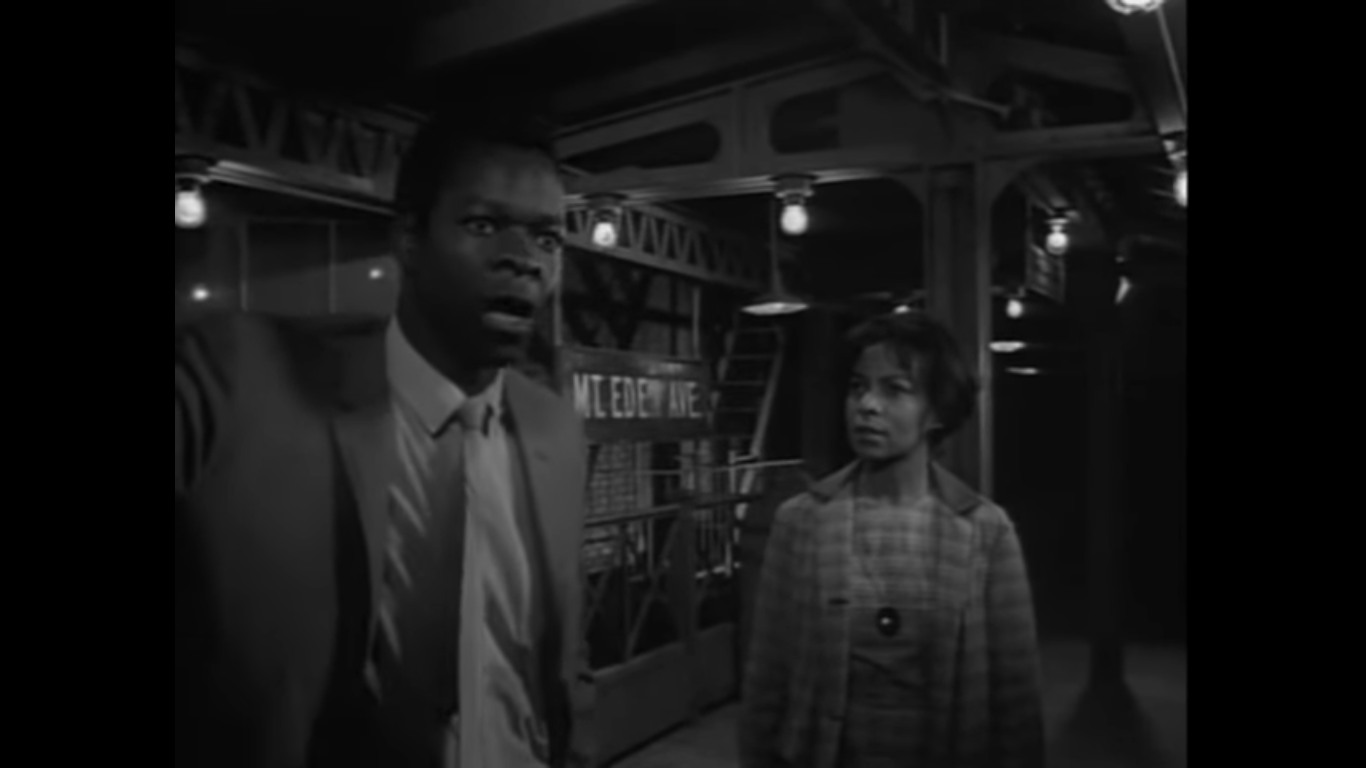
Although the black and white does wonders in making the film feel older than even its release year of 1967, there’s probably one thread that signifies the cultural moment better than most. Brock Peters and Ruby Dee play opposite one another, not as a groveling black couple but as a husband seething with militant desires and his high-minded social working wife who evidently listened more to Dr. King than Malcolm X. Even here we see the tension stretched out taut between them.

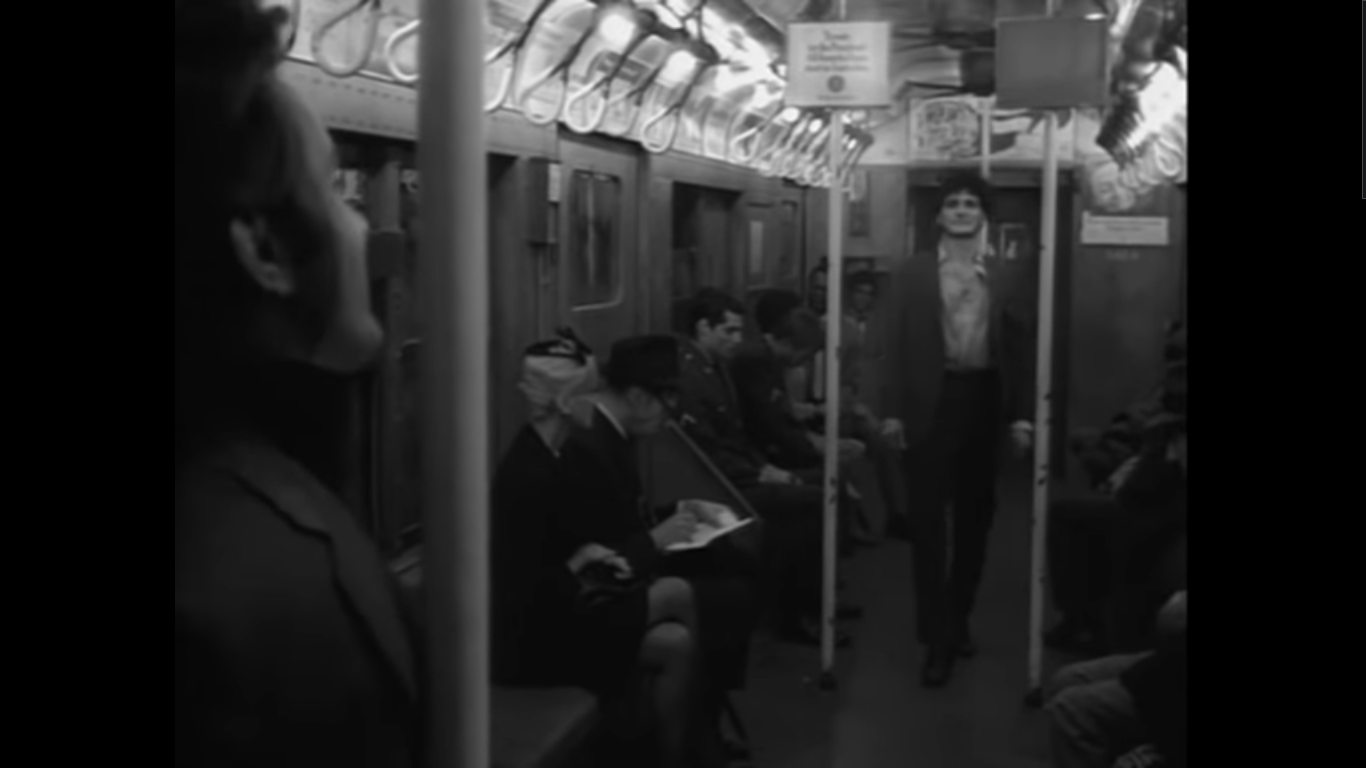
What coalesces almost feels like a psychological experiment put to film. Sure enough, Joe (Musante) and Artie (Sheen) come on the scene cackling and drinking like they have all night — going crazy and swinging their way through the train car like a pair of monkeys. For anyone who’s ridden the subway, you can witness some weird things to be sure, but there’s an immediate knee-jerk reaction to mind your own business.

This movie tests these principles whether it’s Good Samaritan syndrome or the diffusion of responsibility. The crux of our story is triggered when the two malcontents accost a homeless man snoozing on the train, prepared to light his boot on fire. Only one bystander (Gary Merrill) tries to casually get them to stop their antagonism, and it’s the first time where the invisible bubble is broached. When he encroaches on their anarchic freedoms, they look to intimidate him.

What’s made plain throughout the movie is the horrifying indifference as the thugs have free rein to perpetrate infractions and humiliations on the people around them. Sheen now is the big name of the two thugs, but Musante is arguably the most chilling, giving a performance that makes the insides crawl with its cruel manipulation. He literally walks through the camera, lumbering around and ruling the car like a vindictive prison warden where the prisoners are now running things.

Although all these moments of duress feel compartmentalized; no one is let out of their incisive games,  and each group is hustled and harried with all sorts of mind games laced with the threat of menace. Old men, old women, children, pretty girls, soldiers. Each one has a weakness and some pressure point to be prodded.

Oddly enough, this is the black man’s paradise watching white people degrade and torment each other for his personal pleasure. Little does he know, he can’t be an impartial observer forever. He too is thrown headlong into the fiery inferno. He too comes face to face with a mortifying breaking point.

By the end, Sheen and Musante aren’t human anymore, and not just because they are movie characters. They feel like evil demons looking to undermine everyone and bring their victims faced to face with their greatest fears and humiliations as they systematically make their way through the car triggering just about everyone.

There’s no conceivable end to this movie other than Beau Bridges taking on Martin Sheen as they look to beat each other to a pulp. It seems almost prescient because these men would become fairly big names in future generations, but for now, they represent the youth movement and where it could take us in the ’70s.

The aftermath of the picture feels equally indicative of the times. When the police rush on the scene, they are quick to apprehend the one black man and pin him down, only to realize their mistake and amend it in the heat of the moment.

There’s something poignant about the final coda: The drunk remains sprawled out on the floor and each and every bystander steps over him. It’s like one final symbol to show the threshold they’ve bypassed. There’s no turning back and whether they realize it or not, The Incident might embody an event that will haunt them for the rest of their lives. They managed to live another day but at what cost? It’s the kind of trauma causing heroes to come out of the woodwork and others to totally capitulate.

It feels like a film perfectly caught between two decades. It’s grittier and more audacious than I was expecting. But then again, this is a low-budget film and the year is 1967. We’re already getting Virginia Wolf, The Graduate, Cool Hand Luke, and Bonnie and Clyde, the forerunners to a generation of New Hollywood films that would blow the cover off what was permissible in the Hollywood scene. The Incident has some of that, but it also has a wealth of players and a premise that feels planted in a different era.

I recently watched The Silver Thread and it has the same distinction. Although it’s far less graphic, these are films totally suspended in time, hearkening back to the ’50s and still somehow forewarning the films of the future. The Incident, in particular, feels like an antecedent to Mean Streets, Badlands, The French Connection, and even Taking of Pelham 1, 2, 3. It’s fascinating to see glimpses of this emerging generation, especially in a film that, while rarely being discussed in a broader context, is still full of genuine heart-stopping drama. 

4/5 Stars

In The Heat of The Night (1967): They Call Him Mister Tibbs

In The Heat of The Night is a testament to the collaborative nature of Hollywood. We watch Sidney Poitier step off the train. Haskell Wexler’s cinematography gives an instant texture to the world so the sweaty atmosphere is almost palpable around him.

However, one of my immediate recollections of the movie is always Ray Charles and Quincy Jones who help in creating a truly remarkable soundscape. Charles sings the title track (with lyrics by Alan & Marilyn Bergman) setting the mood for one of the formative movies of a turbulent decade.

Although Rod Steiger becomes one of the film’s primary focal points as the gum-smacking, narrow-minded Sherrif Gillespie, it’s Warren Oates, one of the generation’s finest character actors, who’s our entry point into this community.

He’s a police officer sitting at a diner drinking a cola as the scrawny, beady-eyed attendant shoots a pesky fly with his slingshot. It’s a sweaty night in Spartan, Mississippi and already despite these mundane activities, there’s an uneasy equilibrium to the place.

Poitier has to navigate the film’s space all alone for the majority of the movie. There’s a black family who puts him up for a night, a servant (Jester Hairston) who looks at him a bit disapprovingly, a phantom black woman (Beah Richards) who runs a business at night, and of course, the host of blacks working the cotton fields. Otherwise, he’s all alone, isolated and alienated from those around him as a blatant outsider. His only solidarity is in the score and soundtrack.

If it’s not apparent already, In The Heat of The Night continues a conversation that automatically puts folks at odds and in opposition to one another. You have blacks and whites. You have North and South. You have rich and poor. All of them are visible in the movie.

For blacks in particular there are these daily barbs of indignity pervasive throughout the southern culture and totally baked into the system. Norman Jewison’s film (and Stirling Siliphants’s script) only has time to acknowledge some of them, both explicitly and implicitly.

It’s plain that when an influential man is found murdered, the first person suspected is the black man sitting at the train depot. It’s a guilty ’til proven innocent economy. Black men must also suffer the subtle humiliation of being called “Boy.” An out-of-towner like Tibbs will never hope to get a hotel. And even after weathering any number of indecencies, he finds himself cornered and physically intimidated.

The whole movie is about this even as Poitier reluctantly stinks around to bail out the less-experienced, backcountry police force. He’s doing them a favor that very few people are ready to accept.

In The Heat of The Night can theoretically be distilled down to two defining moments. The first is in the police station where Gillespie is railing on him, badgering him for all he’s worth. He asks what they call him in Philadephia and he seethes, “They Call Me Mr. Tibbs! Poitier’s trademark intensity proves so gripping it’s maintained lasting resonance all these years later.

However, the film’s other defining moment is presaged by a lawn ornament calling to mind Flannery O’Connor’s wince-inducing short story “The Artificial Negro.” It’s found in an establishing shot of the Endicott Estate. Mr. Endicott (Larry Gates) owns the local cotton industry and effectively keeps the southern ecosystem alive and well from the antebellum days.

I hadn’t recalled how Tibbs trades small talk with Endicott when they pay him a house call in his greenhouse. They share a conversation about orchids, trading vernacular, and it feels amicable, at the very least. This is what they call southern hospitality. But then an ugly undercurrent is revealed and the conversation turns. Tibbs asks one question too many and gets a scathing response.

The old boy takes offense at being questioned on his own property, by a black man no less, and he lets him have it with the back of his hand. This is relatively unsurprising — another unseemly relic from the old days. What makes the moment is how Poitier strikes right back without a moment’s forethought or hesitation. It’s electric, and it’s as if all the years of southern tension are being brandished in one spontaneous reaction. It’s a show of righteous indignance, pride, and dignity. It’s also just such a human response.

Whether the moment was in the script, added later, or proposed by Poitier seems almost immaterial. It’s the fact that the moment is forever crystallized in cinema giving it a lasting cultural currency.

However, Norman Jewison’s movie does court a few more ideas. Oustide Gillespie prods Tibbs, “You’re just like the rest of us, ain’t yuh?” Poitier might be a shining knight, but his character is still wounded, proud, and simmering with pent of emotions submerged just below the surface. He wants to put Endicott away and make him pay. Gillespie’s just trying to do a job, but Tibb’s drive is something more personal. He’s looking for vengeance. It’s also enough to warrant deadly backlash.

I recently heard an interview with Jewison reminiscing about Poitier and the filming of In The Heat of The Night in the wake of his passing. The director said the following:

“I’d wanted to shoot in the South; the book takes place in Georgia and we’d moved the story to Mississippi for the movie. But we had to shoot it in a town in Illinois, called Sparta because Sidney would not go south of the Mason-Dixon line. He and Harry Belafonte…they had been arrested and attacked by guys in pickup trucks, so he refused to shoot down South.”

“Later in the shoot, I wanted to shoot some exteriors in actual Southern locations, so we talked about going to Tennessee. ‘I’ll give you four days, Norman,’ Sidney told me. So we all went down to this small town with one hotel…and it was ‘whites-only.’ So all of us, the cast and crew, ended up in a Holiday Inn a little ways away, which allowed both Blacks and whites.”

“And I’ll never forget, these pickup trucks came into the parking lot in the middle of the night, honking their horns and waking people up. I got a little nervous, so I called my crew and told them, “Get the biggest guys in the grip department and electrical department, get them over to Sidney’s room right now, we have to protect him.’ Then I called Sidney’s room and I said, ‘Don’t worry, Sidney, we will take care of everything.’ He said, ‘I’m not worried. I’ve got a gun under my pillow.”

“So the first one of them comes through my door, I’m going to blow them away.’ Thank god nothing happened, but this naive director from Canada suddenly understood the extent of American racism. I began to really get just how vicious things were.”

I’ve heard In The Heat of The Night labeled as a do-gooder film, but this seems to minimize not only the movie but Poitier in particular. I find it to be a fundamentally gripping police procedural and this is without thinking about a specific message potentially being crammed down our throats.

This is a testament to the unnerving milieu of the southern town being evoked. It’s the cinematography of Haskell Wexler that feels alert and alive in how it lights and considers the fully-colored spaces. It comes down to this antagonistic rapport of Steiger and Poitier, two very different actors who prove themselves to be exceptional sparring partners as mediated by Norman Jewison.

Surely Poitier had no illusions about what he was portraying. Jewison’s remarks make this very plain. And so he took his image and his part in the movie very seriously. Is it a fantasy about blacks bending over backward to help whites, and then irredeemable racists being redeemed right in front of us? You could say that. But even this seems to oversimplify the picture and sell it short.

This is the movie where Poitier burned with righteous anger and slapped a white man in retaliation, out of his own human pride. Surely isolated moments like these belie any facile interpretation. Because I can’t totally disregard how these scenes make me feel on a fundamental level — how they move me.

How can I have failed to mention Lee Grant, who was finally allowed to leave the Blacklist behind and prove her chops improvising some heart-rendering passages opposite Poitier. They show her ache and his tender concern toward a grieving widow, but also a fellow human being. It’s like some kind of dance they do together.

Or consider how Steiger, still chewing his cud, tells Virgil to “take care.” It’s not much; the exchange is almost sheepish, but it’s trusting we understand the implications. If it’s not an apology, then it’s some form of an olive branch.

This movie doesn’t remedy “the race problem” as it was called in generations past. Its fissures are still supremely evident and ugly. Still, these human exchanges with Poitier at the center, model something deeply healing. To see them on the screen feels validating and also like a balm. Righteous anger has its place, truth has its place, and so does seeing the inherent dignity in others. Rest in peace, Mr. Poitier. You were one for the ages.

4.5/5 Stars

Sidney Poitier: For Love of Ivy, Lost Man, Brother John

In honor of the inimitable Sidney Poitier, I spent some time revisiting a bevy of his finest films and also some underrated ones that were new to me. Because he was a prominent archetype for a black movie star, when he was often the only one, it’s fascinating to see the roles he chose at different junctures in his career and how they evolved and played with his well-remembered screen image.

He will be dearly missed, but he left a sterling career behind well worth our consideration. Here are three films you may not have seen before:

For Love of Ivy (1968)

As best as I can describe it, For Love of Ivy, features Poitier and Abbey Lincoln in their version of a Doris Day and Rock Hudson rom-com. It starts out a bit cringy. Lincoln is the maid of the most hopelessly oblivious white family. Mom and Dad are completely blindsided when she says she wants to quit so she can actually have a life with prospects.

Instead of listening to her, the two teen kids ( a hippy Bea Bridges and bodacious Lauri Peters) scheme to set her up with an eligible black man. They know so few, but Tim Austin (Bridges) settles on Jack Parks, a trucking executive because he conveniently has some leverage to get Jack to give Ivy a night on the town. Some awkward matchmaking (and blackmail) ensues to bring our couple together.

Hence how Lincoln and Poitier become an item. But even this dynamic has some unprecedented delights. They eat Japanese food together and visit a club that positively scintillates with ’60s vibes as seen through Hollywood’s eyes. It’s the age-old ploy where the transactional relationship morphs into real love until the truth threatens to ruin the romance. Again, it’s not exactly new hat from Robert Alan Arthur.

Still, with a happy ending and equilibrium restored, Poitier, who helped develop the story, is trusting his audience can read between the lines of all the dorky craziness. For what it is, the movie plays as a great showcase for Poitier and Lincoln. Since there are so very few movies like this with black leads, it feels like a cultural curio. If the mood strikes you, some might even find a great deal more agreeable than Guess Who’s Coming to Dinner because it doesn’t take its own social importance too seriously. It’s mostly wacky fun.

3.5/5 Stars

The Lost Man (1969)

The Lost Man features an edgier more militant Poitier because there’s no doubt the world around him had changed since he first got to Hollywood in the ’50s. He’s cool, hidden behind his shades, and observing the very same world with tacit interest. It’s a world ruled by social unrest as his black brothers and sisters picket and protest the racial injustices around them only to be forcibly removed by the authorities.

Robert Alan Arthur’s film shows a brief focused snapshot of the social anxieties of the age. It becomes more convoluted when Jason and some other members of the organization rob a local bank. Their motives are in some ways philanthropic as they hope to use the funds to get some of their friends out of prison and support their families on the outside. But it’s also an overt act of insurrection in their battle against a broken system.

It also puts lives in jeopardy, culminating in a frantic murder as the police hunt for the perpetrators in the botched aftermath. Jason flinches in a crucial moment and must spend the rest of the movie as a fugitive nursing a bullet wound. These all feel like typical consequences in a crime picture circa 1969.

However, one of the most crucial and fascinating relationships in the movie is between Joanna Shimkus, who is a social worker, and Poitier. We don’t get too much context with them, but it’s an onscreen romance that would predate their marriage in real-life. Their rapport complicates the story because she is a white woman who is so invested in this community like few people are, and she effectively brings out a gentler more intimate side of him.

Although it’s not necessarily pushed on us, their interracial romance puts them both in jeopardy because it’s not the way the world normally operates. The ending somehow gave me brief flashbacks to Odd Man Out, but Poitier’s marriage with Shimkus would last well over 40 years! It’s the best denouement this movie could ever hope to have.

3/5 Stars

Brother John (1971)

Brother John feels like one of those characters who is a cinematic creation. He joins James Stewart’s Elwood P. Dowd and anyone else who was ever sprinkled with something special that enchants the world around them, whether they’re angelic or extra-terrestrial. But Brother John is a different version for a different generation, and he’s played by none other than Sidney Poitier.

He provides a quiet catharsis for a black audience as a cipher of a man that no one can get a read on. The film itself has a no-frills TV movie aesthetic that somehow still gels with its ambitions.

John comes back to town when he gets news of his sister’s death. The last time he came back was when there was another death in the family. The local doctor (Will Geer), who brought John into the world, is curious about where he comes from and where he goes, but no one takes the old man too seriously.

Still, the police manage to hound him because they’re suspicious of someone they cannot easily intimidate and put in a box. The doctor’s self-promoting son (Bradford Dillman) also needles him in his attempt to gain local prominence. The town’s leaders are looking to quell a factory from unionizing. All of this feels rather mundane in detail. John seems to have nothing to do with any of it.

They remain uncomfortable with him because he’s so inscrutable, well-traveled, knows a myriad of languages, and finds no need to divulge all the shades of his character. He’s contented this way, spending time with family and even calling on a pretty schoolteacher (Beverly Todd) who asks for his company. He won’t play by their preordained script.

There’s one painfully excruciating scene where some cops pay a house call on a black family. The man of the house is left so powerless as he’s subjugated and persecuted in his own home in front of his kids. John is at the table too. Quiet at first. Almost emotionless. Is he just going to sit there or spur himself into action?

In this uncanny moment, he goes down to the basement with one of the officers and proceeds to whoop the tyrant wordlessly with a bevy of skills the backwater lawmen could never dream of. It’s the kind of power exerted over malevolent authority that one could only imagine in your wildest dreams.

As such, Brother John fits in somewhere analogous to the Blaxploitation space but as only Poitier could do it. He wasn’t the same bombastic militant cool dude a generation craved for and received in Shaft or Superfly. He still has his measured exterior, and yet he equally makes quick work of any antagonists: racists, malcontents, white, black, or otherwise. It’s a bit of a boyish fantasy watching a hero vanquish all evildoers quite spectacularly. But, after all, this is what movies are for.

3/5 Stars

The Criminal Code (1931): Howard Hawks in The Big House

Screenshot 2020-07-03 at 4.26.44 PM

Although this is still a very early talkie, you can already see Howard Hawks developing a more intricate sense of dialogue which he would be known for in his pictures — most notably His Girl Friday. In the opening scene at the police station, we have dialogue piled on top of each other between pinochle and the lastest crime being called in over the telephone.

It’s a wonderful melding of both character and exposition being delivered fluidly in a manner that supplies us so much in such a short amount of time. Soon the two quarreling cops are on the scene at a nightclub where a fellow was knocked off.

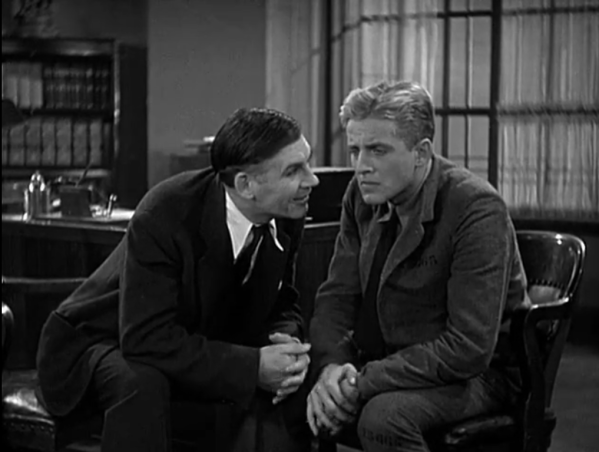
The by-the-book incumbent district attorney, Mr. Brady (Walter Huston), sees an open and shut case, although it’s a rotten break involving a kid and a girl, and another man is dead. He concedes this and yet the law is his Bible — an eye for an eye, somebody’s gotta pay mentality — going back as far as the precepts of Hammurabi in ancient times. He’s not willing to budge an inch.

He unceremoniously consigns a young man (Philips Holmes) to 10 years in prison as penance for his wrongdoings. Even it if was only one false step, the law says he has to pay for his deeds. There is no other recourse. Time passes and prison life has gotten to him, left him stir-crazy and ragged. He’s no longer the fresh-faced kid he once was and news of his dear mother’s passing is yet another blow.

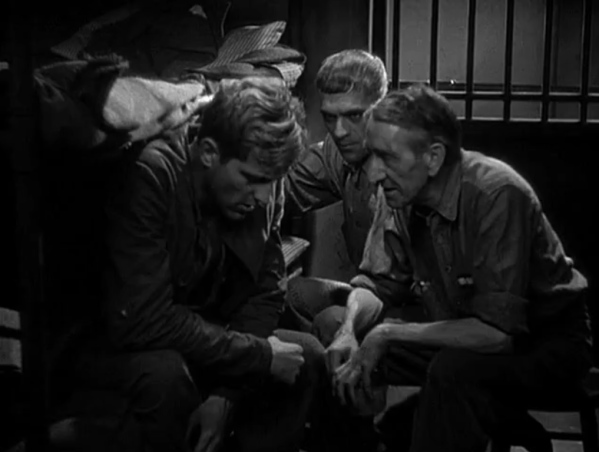
His bunkmates try and watch out for him and settle his nerves, but they’re not totally sympathetic. How can they be? Some of the men put in there by Brady feel duped. There’s this pervasive sense of restlessness and unease.

This prevailing mood only grows worse when Brady takes on the role of the new warden in the prison. The incarcerated mob ignites with yammering in the jail yard because the new man has come to town, and he was instrumental in putting so many of them away.

Brutal law and order are maintained by Gleason, the paunchy head prison guard, who’s not above threats and psychological intimation. There’s one in every big house, and he has a standing appointment with Boris Karloff’s Galloway.

In fact, Galloway is loaded with the kind of menace Karloff thrived on throughout his career, and he becomes a stellar conduit throughout the movie even as Gleason represents all that’s wrong with authoritarian power trips. They have a mental duel going on that takes a while to come to fruition.

One bright light is Constance Cummings, a genial countenance of stylish propriety and beauty. Her very presence comes to represent so much in the movie, and it’s true she represents both a beacon and a sliver of hope for Robert. If nothing else, he wants to be in her presence — just to see her and talk with her — because she makes him feel human again.

Screenshot 2020-07-03 at 3.52.46 PM

The narrative wouldn’t be complete without a botched escape attempt, but what’s more intriguing are the consequences. Because the stool pigeon, a sniveling squealer named Runch gains the ire of the entire compound and there are rumblings of unrest. Retribution is brewing in some form.

Robert does his best to stay out of it, but he’s also not prepared to help the canary. In the resulting drama, he’s implicated while maintaining his innocence. It also puts him wholly at odds with the warden who looks to get him parole. Still, he’s beholden to the law in all things. It’s guided his entire life, his entire career. Leniency is not in his vocabulary.

Whereas Robert has become beholden to the other side and the honor among thieves, if we can call it that. You don’t rat and you keep promises because what good is it if you can’t keep your word? It shows his personal integrity. For his reluctance to speak he’s put in “the hole” and subjected to the malevolence of Gleason.

Although there is a standoff and the kind of finale we expect, the crux of the story — all its thematic ideas — come in this earlier portion. Because Mary returns from her time away and what it does is provide perspective. She loves this man, Robert, even though he’s never said it outright. She knows he is the one, and it causes her to confront her father with the truth.

Father and daughter have it out in civil discourse in the first moment where they aren’t pals and actually stand up for their personal prerogatives and what they believe to be right. While it’s not exactly Scarface, Hawks does a stellar job of grounding a tale of crime and punishment once again with a familial relationship. Phillips Holmes isn’t a particularly enthralling actor, but between the likes of Huston, Karloff, and Cummings, there’s a fine array of color. It more than deserves a spot as an unsung Howard Hawks picture.

3.5/5 Stars

Big Deal on Madonna Street (1958): A Heist Comedy of Errors

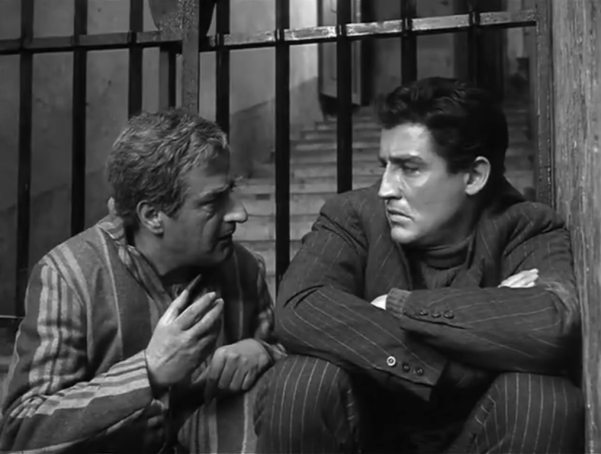
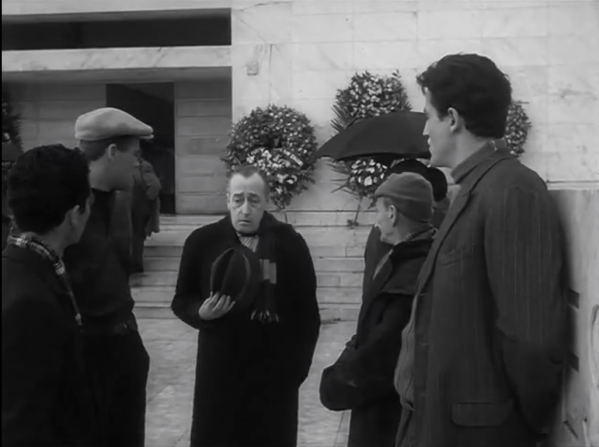
big deal on madonna street

If you need only one scene to be indicative of everything Big Deal on Madonna Street exemplifies as a caper comedy, the opening scene puts it out on a platter, ready for consumption.

A shrimpy man with a mustache waits on the street corner as a lookout while another named Cosimo (Memmo Carotenuto) busts open a window to hotwire a car. Except he totally bungles getting nabbed by the cops for his efforts. Even as the alarm goes off, he’s too much of a stiff to make a break for it. Now he’s on the inside, and he deserves it, if not for his botched crime, then at least for being a numbskull.

But he’s also an idea man looking to get out of the can as soon as possible. The job now is finding someone to be his scapegoat. It’s not as easy as it sounds. Everyone has their underlining excuses. A wife already in prison. A baby to take care of. Previous prison time. It’s difficult to scrounge someone up when all your dopey friends are two-bit crooks.

Finally, they settle on Peppe (Vittorio Gassman), a beefcake with a glass jaw. He has no prior record and with a dead-end boxing career, he could use the dough. So he goes into the police precinct, lays out his sob story, and proceeds to get handed a prison sentence of his own. Now he’s in the clink to keep Cosimo company.

He requests at least the common courtesy to know why he had to end up in prison in the first place. Cosimo tells him about a golden opportunity in the form of a heist. He’s got it all planned in his head, sans all the gory details. Regardless, it’s going to be the crime of the century, or the decade, or the year, or maybe the month…You get the idea.

When he finally gets on the outside on parole, it’s now Peppe who gathers the usual suspects together to put their plans into action. Their first mistake is probably taking their cues from a lug head, but they’re desperate and a little loopy themselves.

Soon they’re casing the joint and making sure they know what they’re getting into. It’s all very “scientific,” but not quite foolproof. They’ve watched one too many crime movies. The first professional they actually cross paths with is a safecracker (Toto) — a real pro — but he just gives them advice; he’s not actually prepared to take on the job for himself. He’s got his own parole to think about. And so he supplies them some of the tools of his trade and wishes them well.

big deal on madonna street

Normally heist stories are constructed in a very specific manner. There’s the planning process, then the heist, and the reversal where everything goes haywire. Big Deal is made entirely in its foundation — the best-laid plans that have no choice but to go awry — and their continued complications and digressions only make the scenario more hilarious. Rest assured, we foresee the problems before they ever come to a head. How can we not? But they proceed to get worse and worse.

The vacant apartment they were going to use as their in-road has been filled and so they look to woo one of the tenants so they can gain access. Peppe dons his most charming persona to get a foot in the door, except he goes and falls in love with a maid (Carla Gravina) he’s supposed to be romancing, getting jealous of her steady row of suitors. Then, she gets herself fired and the whole reason she was of value to them in the first place goes out the window. Peppe still loves her.

What ever happened to Cosimo, you ask? He finally gets out, intent on his cut, only to then seek vengeance on his former compatriots, going so far as to ambush Peppe in the carnival’s bumper cars. The youngster Mario (Renato Salvatori) starts his own forbidden love affair with the chaste younger sister (Claudia Cardinale) of one of their co-conspirators. Soon he loses heart and drops out. The family man, Tibero (Marcello Mastrianni), struggles to take care of his son. He also gets his arm broken nabbing a camera for recon. Worse yet, the camera’s worthless.

Their luck never gets better, nor should it. When it comes time to synchronize their watches, of course, they don’t have any. They’re either too expensive or already hocked. A lover’s quarrel heats up, and with it, the lights go on, cutting into the crew’s surreptitious activities up above on the rooftops.  Their timetable is abruptly derailed.

Big Deal on Madonna Street milks comedy from the telling observation that life is never picture perfect and even the most tightly wrought plans have a way of being unraveled or upended by the most unsubstantial wrinkle. These fellows aren’t exactly master criminals to begin with so their brand of setbacks more than fit the size and scope of the crime.

When they do finally get inside, there are leaks. Noises. Cats. Midnight snacks. Major miscalculations. They continue bumbling their way through every waking minute and we wouldn’t have it any other way. Normally heist films go horribly amiss at the most inopportune moment. In Big Deal on Madonna Street, they shoot themselves in the foot countless times, and still, they go for it anyway.

You’ve got to admire their dogged determination and this motley crew is quite likable. It comes from knowing they are criminals who never will succeed. They are armed with a prevailing obliviousness. We can laugh at them and like them, and watch them stumble off into their lives, after having made a complete mess of everything.

Part of this comes with walking with them in their lives and seeing them as common folk with all the foibles that come with small-town life. What a lovable pack of misfits and malcontents they are and we learn them to appreciate them for precisely these reasons. They’re unequivocally silly. If nothing else, they provided their audience with some quality entertainment. As a heist film shot as a comedy of errors, Madonna Street has never quite found its equal.

4/5 Stars

Marnie (1964): An Inflection Point in Hitchcock’s Career

marnie red

“You don’t love me. You just think I’m some kind of animal you trapped.”

Forgive me if you disagree, but Marnie has wrapped around it the full confidence of Alfred Hitchcock with all his trick and thematic ideas. Its use of visuals to cue the action. The intensity of both color and the swirling score of Bernard Hermann (indeed, his final with Hitch), creating this almost obsessive fever dream.

Tippie Hedren returns as an icy, calculated blonde more like Vertigo than The Birds, and it feels like with the talents at his disposal and his harnessing of all the studio system has to offer, he’s able to make it sing like a finely wrought orchestra. While not his best film, it stands proud and tall next to his most identifiable works.

If we are to tinker with the auteur theory, we must also acknowledge cinematographer Robert Burks, who had worked on over a dozen Hitchcock pictures. This would be his last. Then, editor George Tomasini, who had a stellar run with “The Master of Suspense” in his own right, would die in 1964. One could see how you could easily situate Marnie as the end of one of the most fertile periods of filmmaking and also the most terrifying.

These words are chosen purposefully. Because Marnie is not another man on the run thriller or even a game of romantic cat-and-mouse like To Catch a Thief. It fits into the lineage of the Vertigos and Psychos where it feels like Hitchcock is dipping into perturbing territory, partially because it feels self-reflexive, and it deals in the potentially grotesque and unseemly sides of humanity.

Marnie opens on a bag. The back of a woman walking to a train station. We don’t see a face before we cut to a man who bemoans a bank robbery. His secretary ran off with some of his funds.

Eventually, we learn this woman is prone to such behavior. She’s taken many such jobs and undoubtedly committed many such infractions under different aliases. However, her true name is Marnie and like a dutiful daughter, she turns up on her invalid mother’s doorstep to check in on her, give her gifts, and try to earn more of her affection.

Because it becomes immediately apparent this woman has attachment and mother issues; she’s an independent woman yes, who is also independent of men, but she hangs onto her mother’s love. Even covets after it and clings to it jealously when maternal affections are directed towards a neighbor’s little girl. And then, she leaves as quickly as she arrives.

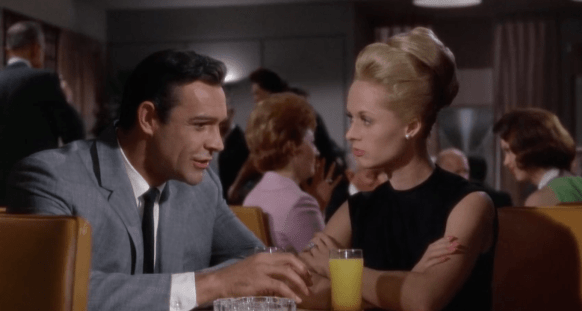
marnie connery and hedren

Her cycle begins again when she’s up for a new job at Rutland & Co. The exchange during her interview would be banal if not for a certain undercurrent, the dissonance at the core of the entire picture. They’ve done business with her former employer, but she has no way of knowing that.

The one man who knows her secret is there too. His name is Mark Rutland (Sean Connery). He looks on rather bemusedly as she explains her backstory to her interviewer. Something about a deceased husband and leaving Pittsburgh behind for more demanding, interesting work. As Rutland watches her, it serves a kind of dual-purpose, giving rise to our conflict while also highlighting this kind of queasy sexism in the workplace. Where women are hired as objects and often viewed as such.

He knows and still hires her out of curiosity — is that the case? However, there’s something more — a kind of kleptomania — and Hitchcock funnels the entire movie through Marnie’s private obsessions. So as a secretary drones on about some HR forms, we are busy watching the office manager pull out his key and unlock the safe. We vicariously take on the obsessions of Marnie — caught in the same vortex thanks to Hitchcock’s camera — a camera that enters a fevered frenzy whenever she sees the color red. It’s akin to Jimmy Stewart’s Vertigo in how it totally usurps the picture in an instant.

On a very different note, it’s always a pleasure to see Mariette Hartley, a personal favorite in TV reruns, and assuredly in Ride The High Country. But it is Diane Baker who might be the unsung hero of the movie and Hitchcock, if anything, sets her up as an integral figure to cement the film’s core drama. She is Marnie’s foil and ready to protect Mark even as she’s intent on winning him over.

But the relationship between Rutland and Ms. Edgar continues to vacillate, exemplified by very pointed snatches of dialogue. Take for instance, Rutland’s training in Zoological science or as he puts it “instinctual behavior.” He likens predators out on the Sahara to “the criminal class of the animal world,” and he’s as fascinated by Marnie as he is passionate about her.

They go to the races and then to see his father’s stables maintaining these implicit themes of husbandry and animalistic desires raging through Marnie’s core. She cannot help these impulses.

It’s true the film boasts some phenomenal wide shots: The first I’m thinking of is inside the stable before cutting to a close-up to the passionate embrace of our romantic leads. The second is an exercise in irony. Marnie is in the midst of her first burgle of the company safe. She snuck out of a bathroom stall after hours. Just around the partition, the night cleaning lady goes about her duties. To each her own.

For several minutes it is a silent movie. No music. I don’t think Hedren makes a sound. Because of course, Hitchcock is milking the moment only to magnify it seconds later. It reminds us how marvelous he was at punctuating the drama, lest his filmmaking ever be mistaken for realism.

Marnie continues in its duplicity as Rutland first accuses his employee of her theft and then comes right back around with the proposal of marriage. It drudges up the unseemly realities of sexual harassment and powerlessness as Marnie cries out about how she can’t bear to be handled by men. She doesn’t want to get married. It’s degrading. Even animal.

“You say no thanks to one of them and then bingo, you’re a candidate for the funny farm.” It breaks my heart even as I feel implicated in the issues. No, I wasn’t born then, but the indiscretions against women have not totally been expunged at least while men still have lust in their hearts. Hitch is part of the problem. I am part of the problem by any sin of omission or even passivity.

Before there was a mystery plot to hang its hat on in Vertigo or the money propelling Psycho. With Marnie, it hardly feels as if there’s a pretense to the often demented predilections of humanity. Husband and wife are “playing doctor” and free association with Marnie feeling as if she’s continually being needled by her spouse’s callous analysis. Is this love or torture?

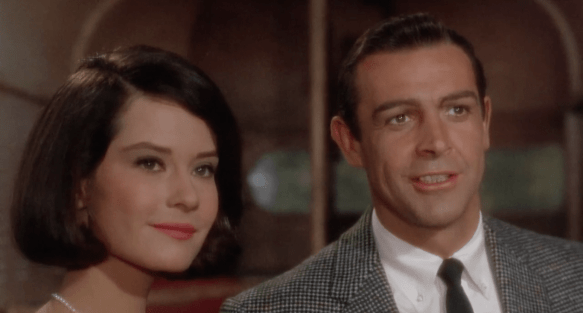
diane baker and sean connery marnie

We mentioned Diane Baker before and it’s worth acknowledging her again. She is slightly impetuous and a bit impish — ready to go to war for her man. Hitchcock even gives her a line to mirror Norman Bates from Psycho as she offers observation on Marnie (A girl’s best friend is her mother). But she also eavesdrops because it’s this that allows her to know the film’s main secret and look to bring it to the surface.

The next sequence opens with that unmistakable Hitchcock high angle, at the party. It’s Notorious rehashed and yet instead of a key in the hand, it is the front door because through it will come a very important person: Someone who can implicate Marnie and unravel the stasis Mark has willingly corroborated for her. They must find a way to get out of this, to come to a mutual agreement, or else Marnie is sunk.

I must admit, this and the sense of suspense anticipated by the climax, are of the most intriguing since the psychology the final flashback relies upon feels too convenient. Maybe Hitchcock does not really care about any of this. It is a bit like Spellbound, but now it feels even more antiquated, whereas the moments leading up to the reveal of the trauma are contorted and alive, horrifying and convicting all at once.

Others could do it better, but I would be remiss not to mention the storyline of Hedren and Hitchcock, who harassed her all through the shoot. It’s an unsettling reminder of how he would control women and beyond that, how toxic masculinity has fueled our society and industries like Hollywood. It reveals the underlining brokenness in many of us that come out compulsively. It’s almost like we do what we do not want to do or we give ourselves over to them entirely. And what a nightmare that is.

Psychology cannot completely dispel our fears nor does it warrant a society and social spheres where men take advantage of women and where women feel fearful and scandalized. Forget his films. Hitchcock himself is emblematic of problematic fissures in society. That’s a great deal of what makes his film’s so disconcerting.

However, just as he tanked Tippi Hedren’s career, Hitchcock would never quite be the same. Not because of this mind you, unless there was some force of karma working against him I’m unaware of. Instead, the industry was changing and also the structures around him that he had to work with.

Torn Curtain and Topaz are passable films with glimpses of his cinematic eye, but they never amount to the same kind of intoxicating, bewitching drama we would see during his high point during the 1950s and early 60s. Of course, Frenzy was what some called a return to form, but it was, again, back in his native England so it’s obviously laced with a different flavor. His final film was in 1976 — Family Plot — and if it wasn’t evident already the industry had changed.

By then, he was a revered master but more of a relic than an up-and-coming auteur. No, Marnie feels like an inflection point as if it’s catching his very particular genius in a moment in time. It’s also a startling caveat to the career of one of the most lauded directors Hollywood has ever known. We cannot fully speak about one without reflecting on the other.

3.5/5 Stars

The Trouble With Harry (1955): Hitchcock, Humor, and The Macabre

jerry mathers trouble with harry

Idyllic is the word for The Trouble with Harry, and it positively crackles with the autumnal delights one can only know in locales where the seasons give way one to another.

Alfred Hitchcock’s filmography boasts many opulent and gorgeously shot sequences, but Trouble With Harry might have some of the most supernal. Part of this comes from the fact it comes in such stark contrast to his environs in Northern California.

Because the East Coast — Vermont in particular — affords him a very particular canvass and he uses them to full effect. The story goes that he went so far as to have leaves pinned back onto trees to try and replicate the shots on a sound stage. Whatever the techniques it boasts something distinctly tangible.

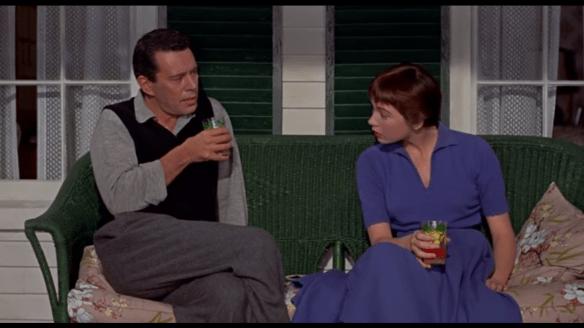
If the locale is not entirely functional, it still manages to be another integral character in the story just as the satisfying crunch of leaves underfoot or the thought of a lemonade out on the porch conjures up visions of a very specific sort. But of course, all of this connotation would be for naught if it was not juxtaposed with the typical Hitchcockian proclivity for the darkly macabre.

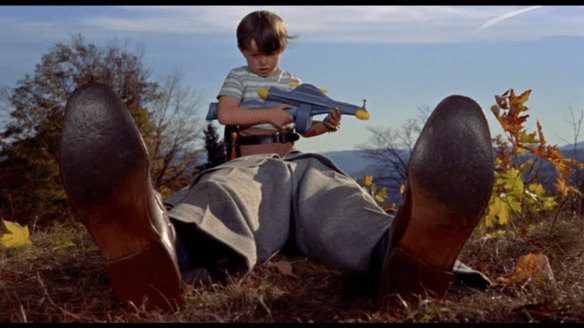
The Trouble with Harry might offer his lightest touch — it’s spritzed more evidently with humor than a great many of his movies — but the blackness at its core cannot go unnoticed. Take, for instance, that opening sequence. It’s emblematic of the whole picture. There’s tiny Jerry Mathers freakishly young (even before the days of Leave It To Beaver).

He’s running off on some boyish adventure his toy gun in hand, only to stumble upon the corpse of a man named Harry. The man’s nicely dressed. Laid out in the middle of an open pasture. More importantly, he’s dead.

Hitchcock employs a trick from the painterly masters using foreshortening to make the man’s body envelop the screen as the little boy stares down at him rather inquisitively, ready to run off and tell his mother. From the outset, Bernard Herrmann’s scoring is both rigorous and rather jaunty, perfectly in tune with the sense of place and tone.

But this is no conventional tale of malice or ill-blood. It is, however, the Macguffin to kick our story off. Edmund Gwenn is another fellow who comes upon the body quite by chance — he was out shooting rabbits unsuccessfully — could it be a stray bullet that took Harry out? He thinks it’s better not to risk it and decides to drag the body to more secluded terrain.

However, he’s met by one of his neighbors. John Michael Hayes’ script does splendidly in moments like these. It’s able to place small-town pleasantries up against a grisly murder as if it’s a small trifle — a mere afterthought to be dealt with in the manner of a pothole or a roach problem. In the end, Captain Wiles (Gwenn) and Ms. Gravely (Mildred Natwick), a kindly spinster, set up a date for afternoon tea with the promise of blueberry muffins and genial company.

forsythe macLaine trouble with harry

What of Harry? It’s true the whole world seems to turn up to find him. Soon little Arnie returns with his mother (Shirley MacLaine), and she hardly bats an eye. A local professorial fellow — his nose always in a book — trips over the body without much of an acknowledgment. Even local artist, Sam Marlowe (John Forsythe), has time enough to sketch a crude portrait of the dead man.

He’s your conventional starving artist. Kindly Ms. Wiggs (Mildred Dunnock) puts his particularly exuberant paintings out for sale near her Emporium, though he doesn’t stir up much business from the cows lingering across the pasture.

Ms. Rogers meanwhile is a twice-widowed young woman, and she admits her last husband was too good to live. She’s pursued by Mr. Marlowe even as the old-timers look to start courting in their own way.

The source of the frivolity and the casual delightfulness comes in painting the town as Hitchcock does — this combination of coloring the idiosyncrasies of the quainter side of life as well as the open-air mise en scene, whether pure illusion or not.

What’s lovely about Hitch is the way every movie becomes a sort of game or puzzle in its own right. Because The Trouble with Harry will never be held in the same regard as many of his most obvious successes — movies from this same period of time — but it’s ceaselessly interesting.

Audiences of the 50s would have had a time pinning it down in a conventional sense because it employs fairly frank dialogue whether riddled with innuendo or not, but it also lacks the kind of obvious star power big studios often banked on to sell tickets. Surely Hitchcock could have garnered the best talent and yet he chose not to.

This is a character piece, and it wasn’t meant for the Cary Grants or Jimmy Stewarts of the world — at least not in 1955. It called for something more mundane. And what of the humor? First of all, there are certain expectations from “The Master of Suspense,” and it’s hard to say they are met; it’s almost like he swapped the formula. He leads with the comedy with accents of suspense and the macabre.

A body buried and excavated, put back in the ground, and exhumed time and time again over the course of the day. It’s the film’s prolonged gag. One of the things that makes it feel continually comedic is the lack of a true villain of any consequence.

The closest candidate is Royal Dano, a slightly curmudgeonly sheriff who has a penchant for old cars. He’s sniffing around, always on the side of law and order. No, this is most definitely a comedy, and the two couples join forces to keep their local secret. Because they know quite literally where the dead bodies are buried. Though it’s quite possible none of them is the actual culprit. It’s typical of Hitchcock that his inclinations of Vermont are informed by murder instead of moonlight.

He is, after all, the man who keenly observed that the medium of TV “brought murder back into the home where it belongs.” The Trouble With Harry plays with the same form of morbid levity.

3.5/5 Stars