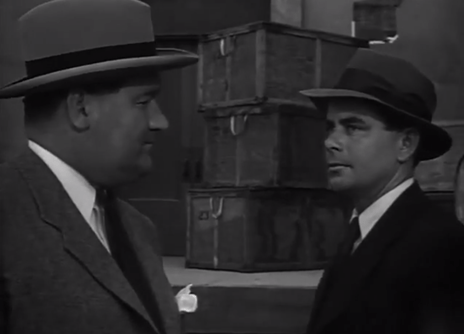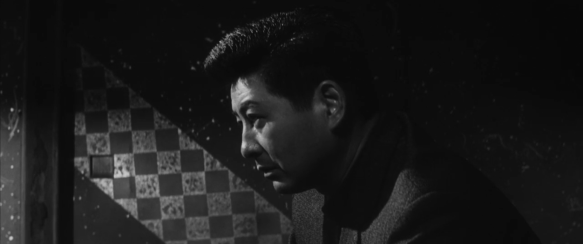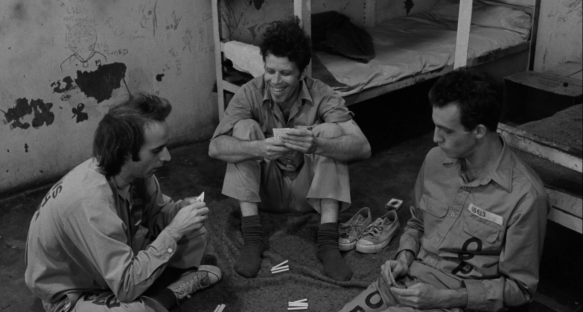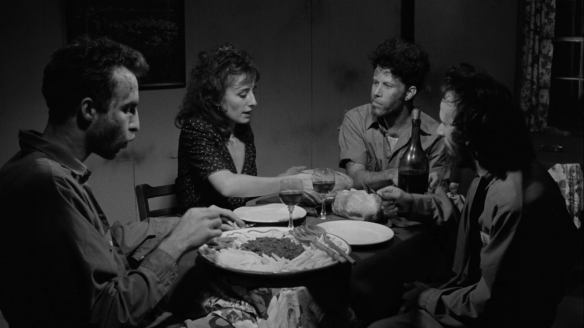
The Threat (1949): Starring Charles McGraw

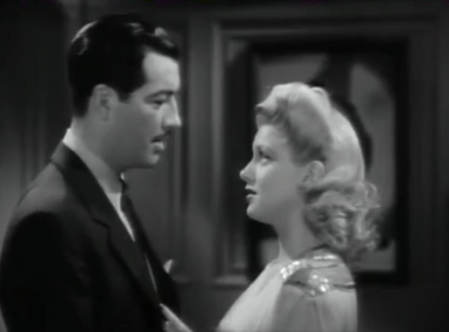
ThreatPoster.jpgThe beauty of a picture like this comes with the efficiency of the drama with a prison breakout occurring under the opening credits. Soon we learn a notorious, shadowy criminal named Kluger has broken out of Folsom prison.

The convict once vowed to kill both the detective and district attorney who worked to put him away and he doesn’t take the threat lightly. He means to carry it out.

When he finally does show his face, Charles McGraw, makes an indelible entrance almost bursting the seams of such a lowly movie. He’s so imperative to the movie’s meager claim at success destining him for thug greatness for all posterity (and a few hardboiled heroic turns once he’d paid his dues).

Felix Feist’s latest thriller is at its best putting forth its claustrophobic kidnapping scenario strung out with tension and genuine terror. Our so-called heroes are a fairly drab bunch including a career cop and family man, Ray Williams (Michael O’Shea).

In contrast, McGraw maintains the film’s gruff core more than willing to throw his weight around as he plans the rest of his getaway and subsequent revenge. To the movie’s credit, he’s liable to do anything he deems advantageous to his plans, doling out orders to his cronies, and forcibly throwing around anyone he wants. He doesn’t care about others. They’re disposable goods.

It starts with the old moll (Virginia Grey) he thinks has double-crossed him, then his two old adversaries, and finally the unwitting delivery truck driver who proves integral to his proposed plan to weasel his way past the police dragnet and network of roadblocks.

However, the tension is borne in the intervals in-between where they must wait around. First, at a house and then out at an old shack in the desert, until their buddy, Tony, drops in with his plane. Both sides are hanging on edge, either for fear of being killed or the threat of being captured.

There’s one shot, in particular, slyly setting up the dynamics of the film’s finale to come as the camera peers down into the shack they’re holding up in. With time running out, our drama must escalate. Red coaxes the gun away from one stir-crazy housemate just to turn around and use it in the next. There’s no prevailing mercy or level of sentiment, whether it’s a man or woman. It’s this continual unpredictability making for a sweaty, nasty little climax.

The plot’s breakthrough revolves around a long shot — a nice bit of circumstance — and it is by any stretch of the imagination.  I’m not sure if the logic exactly checks out, narratively speaking, though it’s easy enough to turn a blind eye for the sake of the action. You don’t necessarily seek out The Threat to feed your desire for taut scripting.

My only real qualm is how this film ends like so many others I’m seen recently where a happy ending is only obtained through a wife’s pregnancy. It is a bit of shorthand to say something about the American Dream circa the 1940s and 50s — and new life is such a precious thing — but it seems like such a tiresome trope when it’s used as a crutch so often.

Up to this point, The Threat genuinely lives up to its title mostly in part to Charles McGraw. If you’re a fan of the minor film noir icon, it’s a must-see. Otherwise, it’s best to look elsewhere for diversions of a higher caliber.

3/5 Stars

The Devil Thumbs a Ride (1947): Starring Lawrence Tierney

the devil thumbs a ride.png

Felix Feist is a relatively obscure figure today and the only reason I’ve come to him has to do with two B films he was attached to, The Devil Thumbs a Ride and The Threat released two years later.

As a Southern Californian, I might obtain more glee out of name recognition than other viewers. It comes, quite literally, with the territory. These types of second-bill features hit the ground running. In this case, The Bank of San Diego gets its pockets picked by a thug.

So much is evoked stylistically, and we are reminded how integral signs become as a shorthand and cost-effective device for these quickie B-movies. Feist scripted the movie as well as directing, and we might sum it ups as a Hitchhiker’s Guide to Hell courtesy of garble-mouthed tough guy Lawrence Tierney. He certainly doesn’t skimp on his brand of scowling, unrepentant, hard-ball, and the picture is indebted to the cloaked menace he provides.

Because he’s the forger-turned-bank robber now on the lamb from the rousing authorities. Not unlike Detour (1945), it’s some fateful or cinematic force landing him in the car of a happy sap and devoted family man (Ted North) just off a joint birthday/anniversary with his best buds in San Diego. It looked to be a real gas, and he’s grinning from ear to ear. He might still be feeling the buzz from the merriment, but he’s sane enough to drive. The contrast is set up immediately, and they develop a fairly easy-going rapport since they cancel one another out.

They make a pit stop at a gas station as “Fergie” calls in on his adoring wife telling her to synchronize her watch for “3 hours and 26 minutes and 42 seconds.” Doing my own mental calculations, freeways (and automobiles) must have been a lot slower because today you could probably be doing San Diego to L.A. in 2 and a half hours (without traffic). When one of the passengers notes the driver is almost pushing 70 MPH, that might give us some indication.

Even as we eavesdrop on his conversation and Morgan snaps at the fresh-faced gas station attendant (Glen Vernon), the movie exudes the rudimentary pleasures of seeing mundane aspects of life circa 1947. The telephone. The music playing on the radio. The garb the gas station clerk wears. Each detail, whether only a studio embellishment or an authentic accent, adds something to the picture. Because elements of it are familiar to me and yet so far removed from the world I know.

the devil thumbs a ride 2

In the process, they pick up two dames looking for a lift — one of them a husky-voiced blonde (Betty Lawford) the other a diffident brunette (Nan Leslie), again juxtaposed for dramatic effect. Now our story on wheels is loaded up not unlike Arigato-san (1936) or Stagecoach (1939), albeit to a lesser degree.

In the ensuing moments, the slighted and eagle-eyed station attendant calls up the police because he thinks he’s spotted the man they’re looking for. Of course, he has. On the other end of the line, the dogged but good-natured police break their perpetual off-duty poker game to jump back into action. Roadblocks are set up all over the coast and the veteran detective on the beat (Harry Shannon) takes along the overzealous youngster to apprehend the criminal.

Staying true to actual geography, they make their way up the California coast from San Diego. First, Oceanside, then San Clemente, and then placing roadblocks at both “Capistrano” (San Juan Capistrano) and near “Laguna” (Laguna Beach). What’s more, the carpoolers set their course for a friend’s place in Newport — Newport Beach that is — and they wind up hitting all the local hot spots from my childhood. Santa Ana even gets a mention.

They set up shop in the bachelor pad in the harbor, although there’s no Bogey or Duke Wayne to be had riding the waters. All we get is a doddering night watchman (Andrew Tombes), a wild array of near-screwball antics, murder, and then ensuing hostage situations. Come to think of it, based on what we were promised, it pretty much measures up.

While the characters are cliched to the max and their reactions are a bit wonky, especially after rolling over a cop in pursuit, it’s easy to take delight in the cumulative effect. A title like The Devil Thumbs a Ride should be some kind of tip-off and between Tierney’s minacious countenance and the sheer shoddiness behind many of the lines of dialogue, there’s an odd tone developed. It can be near-screwball one minute, and then instantly plunged back into thriller territory.

The family man gets in hot water with his wife thanks to the conniving blonde jumping on the hone extension. The Devil still has his eyes on the other girl even as he’s anxious to wait it out and let the situation die down. Even as the cops start closing in, there’s a sense something explosive is going to happen. Because when agitated and cornered, outlaws have a habit of lashing out in a desperate struggle to survive. They don’t much care who gets in their way.

Much of The Devil Thumbs a Ride feels mediocre, but if you’ve never been acquainted with Lawrence Tierney or you’re game for a bit of post-war time capsule filmmaking, there are a few modest delights crammed into its 62 minutes.

3/5 Stars

Lust For Gold (1949): Biography of a Deathtrap

lust for gold 1.png

The movie opens with a score raging with dramatic tones fit for a title like Lust For Gold. The resulting narrative ploy is not a new one either, suggesting the details of this “unusual situation” were substantiated by historical records and legends of Arizona. It’s meant to provide this obvious sense of real-world ethos.

We find ourselves at Superstition Mountain. A severe voice, strung out with the same dramatic intensity of the music, paints a wild portrait of this horrible place — Satan’s art gallery in the rocks.

His name is Barry Storm (William Prince) — a real figure — and yet for all intent and purposes, conveniently fictionalized to narrate the tale for us. Unfortunately, the man isn’t able to pull off the voiceover like a Bogart or Mitchum. It lacks the hardboiled lip or the inherent sense of noir malaise.

It’s possible to mention noir, even when our prerequisites are more aligned with a western because we are dealing in terms of avarice and the greed found within the human heart. These are the building blocks for any respectful film noir of old where humanity runs amok with murder and deceit. In any regard, this is what the hope is.

Still, Prince comes off lacking from the outset because as an actor he’s a bit of an innocuous blank slate. Even if this is purely how he is meant to function, there’s nothing impressionable about him. But it also falls partially to the anatomy of a faulty story with dialogue practically regurgitated to us to get our pulses going. The effect is moot.

Still, this version of Barry Storm does serve one solitary purpose if only to toss us headlong into this narrative. He’s part unwitting victim, part fresh-faced raconteur and adventurer looking to dig up the famed treasure once belonging to his distant relation “The Dutchman.”

He crosses any number of people among them cocksure explorer Floyd Buckley (Hayden Rorke) and two fellows who act as deputies under the local sheriff: a relaxed fellow named Covin (Will Geer) and the quietly observant Walter (Jay Silverheels).

To their credit, they are the first people who bring some color of any sort to the picture. However, even Geer’s own recounting of the Dutchman legend — delivered in a casual, conversational manner — isn’t able to rescue the dialogue which feels just as straightforward and didactic as before.

The real meat and potatoes of the movie come with a substantial flashback moving the action to 1880, and it couldn’t come soon enough. Because it’s at this juncture we are reminded Lust for Gold has a surprisingly stellar cast, and the best patches of drama come with the biggest stars. Regrettably, they’re never able to assemble in full force spread out across the years as they are.

Glenn Ford is reteamed with Edgar Buchannan from Framed, although this time they’re a bit more dubious and hardened, following the trail of a mythical gold mine. If you were to fashion an approximate reference point the movie, functions a bit like Treasure of The Sierra Madre Lite with everyone gold crazy and opportunistic.

Glenn Ford is not much of a Dutchman. His accent or lack thereof could have used some sharpening if he was really looking to commit, but perhaps, more importantly, he shows himself capable of some vindictive fury before the days of The Big Heat. This is what the story must rely on.

He’s the man who ends up the victor with all the gold to himself and no one else left alive to challenge him when he checks his wealth in the nearest outpost. The whole town’s envious of his cache, and the news spreads rather hilariously through the local gossips. They want a piece of the action because it’s far too much wealth for one man, but he clings to its with near-violent secrecy. There’s not one male or female who’s going to get him to open up about it.

That doesn’t keep them from trying. The best bet is one Julia Thomas (Ida Lupino), an educated woman who nevertheless runs the local mercantile and doesn’t have much hope of going anywhere. Her useless husband (Gig Young), hasn’t done anything to alleviate their situation. So, much to his chagrin, she’s prepared to slip off her wedding ring and weasel her way into the miner’s affections.

It works quite well and as with any of these old star vehicles, the movie is most enjoyable when we have Ford and Lupino together. They were both seasoned performers in all the grungy corners of the genre pictures even if this is a hybrid. But what sets them apart is how they both have desires. Sometimes opposing, sometimes convening, and their feelings for one another do become complicated.

To her credit, Lupino plays a far more nuanced part than a simple seductress. She is tired of her life. She is tired of her husband. She’s ready to take things into her own hands, and yet there is some amount of feeling dwelling within her. The Dutchman, for one, is happy to find someone to hold, someone to share his native tongue with. It’s the human face slipped in with the pervading moments of avarice.

Because in the end all parties are pitted against each other in a testy competition for the goods — both in the past and present — weathering seismic avalanches and showdowns up in the rock crevices. Some of these moments, especially crammed within the middle of the story have the pulse of compelling action. It’s only a shame this hybrid noir offering must be so hampered by its own plotting device.

3/5 Stars

The Undercover Man (1949): Starring Glenn Ford

the undercover man 1.png

The Undercover Man gives off an early vibe akin to Anthony Mann’s T-Men thanks to a disclaimer reading something like this: Behind the big headlines are stories of ordinary men and women with extraordinary courage. This picture concerns one of those men.

However, the title is a bit of a misnomer. It is about government treasury agents, among them Frank Warren (Glenn Ford) and George Pappas (James Whitmore in his debut), but the real “undercover man” is the stoolie looking to spill the dope on the Big Fella — a stylized, faceless take on Al Capone.

As is, Joseph H. Lewis’s picture plays as more of an updated (or out of date) riff on the Untouchables and the Capone story. Instead of guns constantly blazing, they’re trying to get to the mob kingpin another way: His taxes. Thus, it relies on the persistence of our protagonists to see the story to completion.

While the characterizations are worthwhile — Glenn Ford was born to play these types of stalwart tough guy roles — the documentary-styled drama itself feels mostly stodgy and uninspired. Especially given the B mavericks pedigree for punchy and rather unnerving material with unconventional flourishes, it’s rather disappointing to admit this one feels quite run-of-the-mill — at least content-wise.

Lewis still develops engaging scenes from the outset including the botched rendezvous staged at the train station. After their crackerjack chomping canary gets it unceremoniously, Warren finds himself back at square one and growing testy by the minute. Because the mob has a hand in everything, and they’re leaning on everyone.

It goes beyond police corruption or paying everyone off. Even as they run around looking for leads, there are tight lips all around, because everyone’s scared. They have good reason to be. They’re suspicious of authority as much as organized crime. What assurance do they have their lives will not be impinged upon.

One of the movie’s most inspired figures is lawyer Edward O’Rourke (Barry Kelley), a paunchy, beady-eyed besuited fellow who oozes sliminess from his generally sociable demeanor.

While he’s not an out-and-out criminal type, he also has no morals. One foot is planted in the good citizens league and the other gladly helps the gangsters keep their stranglehold by wheedling out of all signs of trouble. He seems to also glean great delight by watching the government agents stand down, their hands normally tied. He always has a smart response for them.

Still, Frank’s latest mark, Salvatore Rocco (Anthony Carus) — an AWOL husband who is currently courting a showgirl (Kay Medford) — looks like his exorbitant greed might provide a bite. He’s willing to squawk for adequate compensation. Purely a two-bit opportunist. There’s only one way to deal with him…It’s one of the movie’s best set pieces as the informant races off, his daughter, Warren, and his assailants, all sprinting after him through the midday crowds.

For Warren, the job always gets in the way of his lovely marriage, and he and his wife (Nina Foch) especially suffer for it. They barely get any time together, and the rest of the time he’s crammed in a lousy hotel room bickering with his colleagues. Back amid the tranquility of his home life, he resolves to give up the whole business because the safety of his wife seems like too high a price to pay in the pursuit of justice. The visual dichotomy between the two spheres is especially evident due to Burnett Guffey’s characteristically stark photography

His decision could be the unceremonious end to the picture, but we get a bit more — a nighttime visit. It is the obvious entreaty for him to consider the crusade. He’s not one to see evil and run away with his tail between his legs.

None of this is much of a surprise as we cycle through yet another bookkeeper, this time one Sydney Gordon (Leo Penn), who is on the lam with his newlywed wife (Patricia Barry). The question is whether or not they can convince him to talk and if he does agree, can they even protect him?

The last few minutes are worth seeing through to the end specifically because the action falls on the two most compelling characters in the whole story. For the first time, our hero has O’Rourke on the back foot forcing his hand. He really is the crucial piece since, with the sides drawn up between the good guys and bad, he plays like the wild card. The ending is a foregone conclusion, although, on the road, there are several tense confrontations predating the more action-dominated days of Robert Stack’s Untouchables.

3/5 Stars

Jean-Paul Belmondo: Up To His Ears, Le Magnifique, The Professional

Because of his meteoric ascension in Breathless, patterning his insouciant hoodlum on the Hollywood image of Bogart, Jean-Paul Belmondo is easily identified with his predecessor. He was a tough guy — gladly so — and he offered up a long line of memorable performances over a stellar career.

Pierrot Le Fou (Godard) and Le Doulos (Melville) quickly spring to mind, but then you only have to look at something like Leon Morin, Priest, where he plays the eponymous clergyman, to recognize the range he was capable of.

In honor of his career, we wanted to highlight three of his later action films. They are not his most acclaimed pictures, but they are defined by his legacy so it seems fitting to acknowledge them.

Up To His Ears (1965)

Up to His Ears is cut out of the same cloth as Philippe de Broca’s prior film with Belmondo from the year before: That Man from Rio. It’s a globetrotting picture all across the orient with madcap chase sequences and quite a few attempts at Bond-like intrigue.

Overall, it bends more toward dated gags and goofy antics than out-and-out thrills, and it seems mostly content with this. When they flee an onslaught of Chinese gangsters, Belmondo and company sneak down into a pillbox, down to an underground tunnel, and on and on. There always seems to be a fortuitous out for them.

If their good fortune and the fact they aren’t completely annihilated seems farfetched, then you don’t understand the ambitions of the film. It’s all sendup. Belmondo seems to be enjoying himself, and his adventures lead to a desert island with Ursula Andress. He can’t believe his luck.

Obviously, the movie cannot quite muster the same glory as That Man from Rio, but Belmondo is still a great action hero able to play the crazy comedic moments and still move through space with vim and vigor. It ain’t Godard, and that’s not necessarily a bad thing.

3/5 Stars

Le Magnifique (1973)

Also known as Our Man in Acapulco, and its dashing hero, Bob Saint-Clar (Jean-Paul Belmondo) feels like an amalgamation of ’70s era Bond (Moore and Connery) with a lot of Get Smart thrown in for taste.

Philippe de Broca’s at the helm again offering up some of the most self-reflexive parodies of the hypermasculine, suave international spy genre. It pulls out all the comic book scenarios — with dastardly villains et al. — and the resolutions, seeing our hero always prevail. He must live to fight another day.

Broca himself readily contributed to this spy phenomenon during the ’60s with Belmondo to boot. However, it’s so over-the-top to the point of being offputting. Then, we realize our secret agent is being dreamed up by a hack writer, named Francois (also Belmondo) on a strict deadline!

Suddenly it breathes new life into the premise with a renewed perspective, and these long-trod pulp-bound conventions become only part of the gimmick and, hence, only part of its appeal. Not to be outdone, he’s taken the English sociology student (Jacqueline Bisset), who lives across the way and dreamt her into his story as the beautiful Tatiana. His supervillain is none other than his own pompous editor (Vittorio Caprioli).

We’ve followed his story umpteen times before. Although he writes pulp trash for a rapt audience of many, his active imagination all but compensates for a fairly nondescript private life. He’s got a bit of Walter Mitty in him. In the most fated of meet-cutes, Christine (Bisset) accidentally picks up one of his works and finds herself instantly inspired for her college thesis.

Soon she’s dropping by to blow through whole shelves of his novels. And then the idealized man dreamed up on the page, must take a stand in his own life. For what it is — plagued by many of the shortcomings of its genre and the era — I can’t help but appreciate Le Magnifique.

It mostly comes down to Belmondo’s dual role and his rapport with Bisset. Again, they’re having palpable fun taking it over the top, and like any great screen icon, Belmondo gets the girl — twice.

3.5/5 Stars

The Professional (1981)

It feels like your prototypical dated ’80s blockbuster replete with gratuitous violence, a rogue’s gallery of heavies with all the other corny ingredients mixed in together. Belmondo is an agent, undercover in an African country, prepared to assassinate their leader only to be drugged and sent to a labor camp.

He escapes and ultimately returns to France as a kind of rogue operative on the lam. His former superiors want to do away with him, but he’s always one step ahead. He’s not going to be eliminated that easily.

Although it’s not a Bond movie, there are pretty girls, and he seems to know them all intimately all while slinking around to preserve his own skin and complete his objective. Belmondo is undeniable, handling everything from fisticuffs, stunts, and seduction with his usual roguish charisma. He never takes himself too seriously. It’s as if he’s in on the joke of it all and enjoying himself in each individual moment.

The final car chase changes my whole verdict of the picture because it really does take my breath away. It’s yet another showcase for Belmondo the consummate action hero, effectively taking the film by the horns and really living and breathing the part.

While the score isn’t prototypical Ennio Morricone, it gained a new life and legacy in The Professional. He receives what might be termed the briefest of homages as the film’s main leitmotif comes to life between crosscut closeups of its hero and villain a la Leone. It’s like a mini showdown transposed to the world of French secret agents.

There is so much of Bourne here beyond the car chase, and it comes down to the inexplicable predicament of the protagonist. He is thrown into a world that is not right-side-up, and his only choice is holding fast to what he knows. He’s smart and cunning, making a real go of it.

But sometimes the world in all its order and pragmatism doesn’t make a shred of sense. At least, to the very last minute, Belmondo looks cool doing his job. In a movie like this, surely that’s all that matters. Adieu, Jean-Paul. Thank you for what you gave us.

3.5/5 Stars

Pale Flower (1964): A Stylish Japanese Noir

Screenshot 2020-03-13 at 84635 PM

The images aren’t unfamiliar to those acquainted with Japan’s metropolis. A voice surmises over images of the bustling train station. “Back in Tokyo. 3 years. It makes my head spin. Why are so many people crammed into cage-like boxes?”

I couldn’t agree more with our narrator. The sentiments aren’t lost on me from my time living abroad and riding those very same trains with some of those same people. However, he goes further still.

They are strange animals, their faces lifeless — even dead. Later on, he equates step-fathers with pigs and young lovers in a darkened movie theater are much the same. His is quite the high view of humanity. If all of this feels detached and unequivocally unfeeling, then you’ve caught on to the despondency at the core of Pale Flower.

We realize we are in the presence of some sort of present-day philosopher. Of course, Muraki (Ryō Ikebe) just happens to be a member of one of the local Yakuza gangs. This is his turf. Someone has died since then — someone he killed — but otherwise, nothing has changed. It’s the same place he left during his stint in prison. He returns to the gambling dens to seek out the former crowd.

What’s immediately apparent about Pale Flower, at least from a visual perspective, is the texture of the images. They are pristine and drop-dead gorgeous if generally detached. They come off as silky smooth as their protagonist, who sits down with the other gamblers just like old times catching the eye of a lucky young woman (Mariko Kaga) with quite a winning streak.

Already, it gives off the smoky, self-assured vibes of an old Paul Newman or Steve McQueen movie — something like The Hustler or the Cincinnati Kid — films that had atmosphere and residual cool in spades.

It starts with our hero Muraki. If he’s a little of Newman, he might be a bit of Robert Mitchum too with a cigarette perched between his lips. Or he’s casually walking the streets in his shades like a mature Alain Delon. In a word, it’s the kind of confidence you don’t teach. It feels like it’s been inbred.

As a filmmaker, Masahiro Shinoda displays a few of the same characteristics. Some of his shot selections are awesome feats quickly garnering appreciation. I would be remiss not to mention an overhead shot of all the players gathered around the gambling table, a bold portrait of visual symmetry. It requires a resolute confidence in what your frames have to offer on their own merit.

Recently, I watched Seijun Suzuki’s Youth of The Beast, and it showcases a very different kind of artistry. He willfully blows through all the rules with a blatant disregard and bombastic energy verging on the absurd. This is his calling card throughout his most well-received offerings like Tokyo Drifter and Branded to Kill.

Shinoda’s film takes an entirely different approach, sliding casually through conventions without ever losing their sense of cool. Both give us defining portraits of yakuza cinema, but there’s a seriousness even a solemnity present that carries through, down to the black & white imagery. Suzuki would rarely be caught dead with such dourness. Here it works.

It’s also totally reinforced and enhanced by its use of sound, whether clocks, flowing water, clacking tiles, whatever it may be — there’s something about the cadence adding a pace and an innate rhythm to the beats of the story. They’re not always fast, but there is a purposeful confidence in them as they move from one to another. And sometimes, there’s silence — just street noise or feet clopping — other times the bold screeches and scrapes of the score.

If we’ve skimped on plot, it’s because Pale Flower doesn’t necessarily need much to remain effective. Aside from gambling houses, Muraki can be found at the racetrack or paying a visit to his old boss — an unassuming, aging man who takes frequent trips to the dentist.

Coming back, the faithful mobster has come to realize some things have changed in his absence. The two-sided gang war serving as the bulwark of the underworld now has a third party from Osaka complicating the works as they gain ground.

He’s also got a girl waiting for him — a girl who loves him — even as a sensible salaryman asks for her hand in marriage, and Muraki gets distracted by so many things. There’s his work and then other women. For one, Saeko the doe-eyed baby-faced beauty leaves quite an impression wherever she goes. Maybe that’s what happens in an entirely paternalistic society. Regardless, Muraki takes particular interest in her.

She, for one, is young and totally bored with life, riding the highs of gambling, although they can never get quite high enough. One is reminded of the compulsive steadily rising addiction and gambler’s fallacy at the center of Jacques Demy’s Bay of Angels.

Still, Saeko needs something else. She’s insatiable. When she can’t gamble anymore, she lets herself get carried away racing down the highways — drunk on adrenaline — and when that still doesn’t satisfy, she needs something more to get off on. She and Muraki in some ways are alike. Up to a point.

He scoffs at the ghostly-faced gangster Yoh. He’s a sleazy dope addict, who always sits in the corner like a gaunt specter. His brand of small-time criminal is a far cry from what Muraki knows. Saeko is drawn to him because he is a concrete gateway to drugs, her latest hobby.

Then, one day Muraki’s ambushed by a young punk at a bowling alley, and he proceeds to beat him to a pulp as other thugs drag him off to the tranquil melody of “Mona Lisa” playing the loudspeakers. It means very little to him even as he considers the cause of the pitiful retribution.

He opens up to the girl. I killed a man I had no reason to kill. It was just a business matter; his number came up. He felt the same exhilaration in the act of violence. It made him feel alive. Now he plays cards because what else is there to do? It’s as defeatist as it is depressing.

At the same time, Muraki’s not the most charismatic figure. He’s not about to be a PR man or make amends for past grievances. It’s not his style even as he’s called on to fill in for the boss in their latest business proposition.

However, this is not all that unnerves him. There’s an eery confrontation in a back alleyway showcasing the apogee of the film’s style. He has nightmares about Saeko, feeling more protective of her than ever. Worst yet, their cohort Tamaki is knifed.

The boss calls out his men. Someone needs to avenge the death of their own and everyone’s hesitant to take on the job. It falls on the shoulders of the one man who is a traditionalist — unswerving in his devotion to duty, honor, and all those unflinching codes.

Very rarely does it feel like the plot is imposing its will on the movie. Much of what Shinoda is doing is not only an exhibition in style but totally invested in creating a tactile world. This allows the pervasive worldview and the characters to dictate what we spend our time seeing and doing.

Gambling, driving fast cars, smoking, and throwing around a bit of shop talk in bars and backrooms. There’s not much to it on paper, but you have to witness it to really appreciate what’s being accomplished.

Even in the lingering moments, we begin to realize we’ve very rarely seen Muraki do anything. Instead, it’s his reputation that proceeds him, including his three-year jail sentence. And yet to watch him in his natural habitat, there is a certain dignity and undoubtedly a kind of code dictating his life. He feels beholden to something.

His final actions are as dutiful as they are fated. He knows what he is going to do, and the scene gives way to what feels like a choreographed dance, playing to the music as only a Yakuza film could pull it off. It’s gut-busting and shocking as a solemn final coda to the film. In some perverse way, it’s his final passionate offering to Saeko. And there is obviously a consequence.

He pays for his crime with another stretch. While he’s on the inside he hears the news. Saeko is dead. His pale flower gone. Muraki’s nightmare proves more prophetic than he’d ever wish to acknowledge. And why should it matter now? It doesn’t. It makes no difference who she was. Life cannot be redeemed by a few all-encompassing words. Not “Rosebud” nor “Pale Flower.”

After all, life is, in the words of the characters, “pointless.” For those folks lifeless on the train. For the young women deadened by drugs. For the gangsters beholden to a code and a lifestyle that feels so senseless. It’s noir sentiments laid bare in the heart of Japan.

4.5/5 Stars

Drive a Crooked Road (1954): A Malibu Sunshine Noir

Drive_a_crooked_road

“On a clear day, you can see Catalina.”

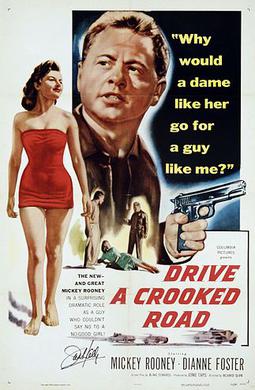
Drive a Crooked Road might best be labeled as a So-Cal sunshine noir, and it easily has a place at the counter next to Shack Out on 101 and equally grubby fare.

Because under the right circumstances, it’s easy to see how Mickey Rooney could make a darn good noir protagonist. Like one of the genre stalwarts — Elisha Cook Jr. — he’s small in stature. Visually, he’s a bit of a pipsqueak and if you strip away his typical magnetism, the confidence, and charisma of a lifelong entertainer, there’s something quite fragile and forlorn there.

Rooney, for all his successes and the serpentine nature of his career, does himself credit here, reinventing his image once more. Eddie Shannon is the kind of guy who gets stepped on his entire life and takes it. He’s a lowly mechanic with far-off dreams of racing a European job at Le Mans. His other prominent feature is the scar on his forehead as if to mark him as a kind of social outcast.

Admittedly, his life is nothing more than fixing cars by day and going back home at night to a mantle lined with childhood trophies. It’s as if they’re compensation, a way of telling himself he is a big deal after all as he kicks back on his bed.

I won’t make any claims that the actor-turned-director Richard Quine is a virtuoso hand, but I do enjoy a handful of his films with varying themes. What draws together some of the better ones are his collaborators. Kim Novak made a startling debut in another sordid noir of the same year Pushover. Then, he had a good many collaborations with both Bill Holden and Jack Lemmon, just to name a few.

What Drive The Crooked Road shows off is his substantial collaborations with future mainstream directing giant Blake Edwards. Rooney, a fellow youth actor, was a holdover from their days together working on the screen as some of the industry’s promising talent. The greatest joy is how it shuns the prevailing song-and-dance, happy-go-lucky entertainment they normally stuck their name to and gladly takes a divergent path.

As good a place as any to start is with a femme fatale (Dianne Foster). She comes by the repair shop one day to get her car fixed up. That could be the end of it, but she has other plans. So Eddie pays the good-looking dame Matthews a house call.

It’s immediately apparent she’s shamelessly flaunting herself. First, on the lawn then, hanging over the side of her convertible, and finally, right next to him as he digs under the hood. Barbara makes her presence known, as it were, and she has total command of the scene.

This perceptible dynamic is so crucial as is Rooney’s diffident performance if the story’s to come off. How visibly uncomfortable he feels being around her — making eye contact with her flirtations — as she chats him up on the way to sunbathing above Malibu. It implicitly coaxes him out to the water’s edge.

Because even as his whole existence is uncomfortable in her very presence, he desperately wants someone as beautiful as her to give him the time of day. The fact she actually paid him notice gives him hope.

If it’s not obvious already, this bit of come-hither interplay devolves into a not so unfamiliar ploy used most definitively in Scarlet Street. Edward G. Robinson’s Christopher Cross was a suffocating nobody as well with nothing but his art. Kitty (Joan Bennet) exploits him for all he’s worth on the behest of her boyfriend (Dan Duryea).

In Barbara Matthews’s case, she’s operating on behalf of her major love interest, the dashing and charismatic, if generally despicable cad, Steve Norris (Kevin McCarthy). He and his smart-aleck buddy (Jack Kelly), don’t immediately strike one as a criminal types. And yet their high-living, bon vivant ways, and impatience with the normal tenets of capitalism cause them to buck the system.

They’re looking to rob a bank, a handy joint they scoped out while spending their summer vacation in Palm Springs. You could say the crime fits the criminals. The only problem is a driver. They need someone to navigate the windy backroads from Palm Springs to San Diego. Someone with handles who can help them make a quick getaway since time is of the essence. That’s why they called on Barbara to reel Eddie in.

However, she’s the only one to realize what is really happening. They label him like all the rest as an ugly little guy, a lonesome little animal; and it’s true by the world’s prognostications. But Matthews sees more being around him. There’s an earnestness, a candor in how he interacts with her.

She calls it devotion, a terrible kind of worship because he’s fallen for her irrevocably hook, line, and sinker. It’s pretty much instantaneous since the first moment she ever gave him the time of day. He’s not a normal mark; he’s completely given himself over to him, totally vulnerable. One can only imagine what he might do if he finds out he’s just a sucker.

Of course, her conspirators fail to heed her warnings. After all, what could a born loser do to them? So Eddie comes aboard, brought into their confidence, initially hesitant until Barbara leverages everything so he thinks he’s doing this for her. 15,000 smackers could do a lot for them. He studies their home movies religiously in an effort to gain a lay of the land in preparation for game day. Once more, he’s devoted because he thinks she wants this. It’s not for himself but to earn her affections.

Again, Barbara is overcome by misgivings about the entire operation. In her own way, she tries to give him a way out — knowing where they are headed listening to Eddie’s big talk about driving better than he ever has, doing the job so he can get the money she wants. He couldn’t see he’s being played unless he was hit in the head with it. That’s what it takes.

One of the greatest investments of the film really comes with Foster’s performance. Because at first, she feels like a prototypical noir vamp, merciless in how she uses her feminine wiles, and yet, if we can coin the phrase, she is a tender femme fatale.

Take, for instance, one scene where Eddie makes an impromptu house call to see her. They’re supposed to stay apart for the good of the mission and still, he cannot bear to be away from her. She comes out into the living room, closing the bedroom door to meet him.

At first, I thought she closed her door behind her to cover up something — maybe a male visitor lurking behind. But it’s simpler than that, even more innocent. Finally, Eddie leaves and she goes into her bedroom and cries. Whereas Kitty’s laughter was mistaken for tears in Scarlet Street, here the tears are real, there’s this conflicted tenderness present.

But of course, all this must be put on hold as the day of the bank robbery arrives. They make their best-laid plans, intercepting the route of the usual bank employee. In another quality creative decision a la Gun Crazy, we are forced to wait out the job from the getaway car with Eddie and Steve. It comes off without a hitch because it’s not primarily a heist film at all.

If that were the case, everything would need to go awry at this point. The question remains, Why do we hold off? Because the true pearl in the oyster is how the story is not solely about the tension of the bank robbery and whether they will succeed, though that becomes of great interest. Encompassing all of these genre elements is really the underlying character piece.

What will Eddie do? What will happen to him at the end of said crooked road when reality sets in and he finds out he’s been used. Because it’s not a question of if but when it will happen; eventually it does.

There’s the confrontation, the reveal, the turn of events. You’ll have to witness them for yourself. The images resonate most deeply with me. A car overturned on the beach, the tide lapping up against the shore in the background. There’s not a more fitting summation of the film’s juxtaposition of elements — that is sun-soaked, Malibu beachfront noir.

The final interludes bring to mind another paranoia piece of the atomic age, Kiss Me Deadly, and far from jumping off the deep end, Quine’s picture has its own misanthropic edge. Where the beach, shrouded in shadows, provides the perfect landscape for a devastating capitulation. It’s a testament to his core players, Rooney and Foster in particular. I’ll never look at Mickey Rooney the same way again.

3.5/5 Stars
Down By Law (1986): An Offbeat Jarmusch Noir

Screenshot 2020-02-26 at 65844 PM

A raspy vocal emanates from the screen verging on spoken word as it sings to a mambo-infused rhythm. Casual tracking shots lead us by the local architecture at the pace of a car ambling along on a Sunday afternoon. I only confirmed after the fact this is Tom Waits singing his tune “Jockey Full of Bourbon” from an earlier album.

These are the streets of Louisana, and the man helping to capture these glorious, sweeping shots is none other than Robby Muller (probably most famous for his work with Wim Wenders). His partnership with Jim Jarmusch was just being established and it would continue well into the ’90s.

This is the opening prelude of Down by Law if you will. Because the real intimate stretches of humanity — at least the ones dwelling in this story — can be found in the dirty, dilapidated interiors and on the sketchy street corners. It’s these bombed-out, grungy aesthetics giving the film its layers of instant character.

Muller’s cinematography is an immediate asset and no matter the subject matter within the frame, he makes it feel captivating and strikingly beautiful, whether it’s a street corner, a jail cell, or a boggy bayou. We’re drawn to keep watching and relishing his images.

John Lurie is a pimp who feels like a nobody. He tries to act big only to get sucked into the shadiest of business deals. Tom Waits isn’t much better off as a disgraced disc jockey. His girl walks out of him in a fit of rage, and he proceeds to go drown his sorrows.

However, first, he must gather up his shoes from the street below where they have been unceremoniously tossed. The inhumanity of Gene Pitney’s record (I think that’s him) cast out into the street says it all — both the mood and the crispness of the photography.

I’m not sure if Tom Waits is an actor as much as he’s an enigmatic personality exuding something we can latch onto as an audience. Lurie’s not altogether intriguing to me, but with Waits there’s something different — something we want to find out more about.

The manner of this off-beat noir is now fully established because the mood is the key when plot feels almost secondary even tertiary in importance. The dialogue is laughable, but somehow it fits into this world gladly mixing both style and sendup of the past. And yet it’s only the most affectionate homage to bygone years with its chiaroscuro, smoky street corners, and fedoras to fill out a modern underworld.

It’s the kind of movie where a guy will just walk up to you on a deserted street corner and offer you keys to a Jaguar and a wad of Franklins to do his dirty work for him. Sometimes the dirty work has strings attached.

Pretty soon Zack’s in the can and Jack’s with him. What a sorry pair they turn out to be. But there is eventually a saving grace. Enter Bob. Aside from being another tribute to Jarmusch’s wildly diverse casting tendencies, Roberto Benigni holds the film together with his charming personality.

He single-handedly redefines the tone of the movie making it into a kind of reluctant buddy movie. Because his instant good nature, loquaciousness, and limitations with the English language give him the powers to add something radically different to the film’s cocktail.

If he’s ever the butt of the jokes as the foreigner, more often he’s the movie’s champion, a force of joy and goodwill bringing together two bunkmates of the most cynical and standoffish sort. When they start their giddy tirade — yelling at the top of their lungs — You scream, we scream, we all scream for ice cream, it feels like “Moses Suposes” antics taking over the jailhouse.

Even with the introduction of Benigni, there is this sense Jarmusch is once more working in these near-stagnant scenes involving shooting the bull or playing cards much like Stranger Than Paradise. It’s once more observational and altogether content in the idiosyncratic. The elliptical sense of filling the spaces in between is also surprisingly prevalent. The biggest example being, of course, the prison escape.

Tarantino would choose to not show the heist 6 years later in Reservoir Dogs. To some degree, Jarmusch beat him to the punch as far as genre deconstruction with a jailbreak movie missing its most crucial lynchpin. But for what he’s going for, it works wonders. It works far better by throwing away convention because he never rested on it, to begin with.

Soon they are fleeing through the bayou, then canoeing, then getting left adrift without any inclination where they are going. Thankfully, they find a bunkhouse in which to recalibrate (though it looks eerily similar to their cell). However, the real prize is when they happen upon Luigi’s Tin Top. In its own way, the restaurant is an oasis.

Screenshot 2020-02-26 at 8.03.43 PM

We had been through so much already, it completely slipped my mind that this moment was coming. It feels like a slice of serendipity. Here we have Roberto Benigni playing opposite Nicoletta Braschi as two Italians madly in love in the middle of nowhere. Again, they somehow operate outside the pervasive tone — the underlying stench — of the movie and its other characters.

However, what makes it feel fortuitous comes with context. They would wind up getting married 5 years later and remain so to this day as far as I know. Over a decade later, they would star in their most renowned foray Life is Beautiful, which pretty much bottled up everything disarming and magical about Benigni and enchanted the world over with its abundant good cheer and tenderness.

For now, they dance cheek to cheek in a lonely restaurant out in the boonies. It’s inauspicious while signifying something so much more. We leave them knowing they have a rewarding life ahead.

In the final moments as Lurie and Waits walk down the path, trees on either side, I couldn’t help but think of one of the greatest, most atmospheric noirs: The Third Man. Except as Jack and Zack split off at the fork in the road to forge their own paths, we can’t help but be reminded of Robert Frost.

Because Jim Jarmusch might as well be summed up as such. A noir aficionado with the sentiments of a poet. Down By Law is not quite bombastic pop culture pulp in the mode of Tarantino. There’s a distinct artfulness there that still never quite loses its idiosyncratic yearnings and inclinations.

4/5 Stars

Johnny Eager (1941): Taylor and Turner Spark Dynamite

Screenshot 2020-01-08 at 91406 PM.png

“Are you thinking of allowing her to play Roxanne to your Cyrano?” – Van Hefflin to Robert Taylor

Pretty faces don’t always add up to a quality movie and if you want to find where the faults lie, you might look between the players and the script then split the difference. Johnny Eager has all the Classic Hollywood trappings that very well could have made it dead on arrival — especially years later.

Because our protagonist has a name that only exists in the movies (or Hollywood for that matter). He’s a gangster from the old days formerly clad in the finest of threads and raking in the dough. To this day, he’s unrepentant or at least blatantly honest about how he feels; he’s no chump, even despite a stint he did behind bars.

Now he’s on the outside on parole making a go at propriety as a cabby. After this preliminary bit of eye-opening exposition, the story has all but telegraphed its intentions, really no fault of its own. It doesn’t take much imagination to put a reformed Robert Taylor and a curious young sociology debutant like Lana Turner together.

They meet through his parole officer: a white-haired, benevolent picture of authority. He seems to believe every man is capable of reform and human goodness if only given a chance. His secretary, on the other hand, gives Johnny the stink eye. Lisbeth Bard can hardly take her eyes off of him.

Of course, none of this is on the level because Johnny is busy getting into his old rackets, including an ambitious plan to resurrect the Algonquin dog races to make a killing out of it. Simultaneously, he’s double-dealing, getting his sister and bratty niece to masquerade as his alibi. They’re nicely compensated of course to play up a squeaky clean picture of domesticity.

One has to laugh. The authorities must be idiots and Johnny accordingly plays them for fools. He’s a modern-day Machiavelli and this combination of authority, guile, strength, and charm makes Johnny Eager come off a bit more significant than a walking caricature.

It’s true Taylor had caught ahold of something in his career and whether or not he was considered a negligent actor and merely a pretty face, he brings a definite machismo to the screen more than capable of knocking off everyone else around him. He’s without a doubt the center of the action despite the plethora of scene stealers around him.

But one cannot forget the diffident school girl played by Turner, quoting Cyrano de Bergerac and sporting a hat to beat them all. What overtakes her exactly? Is it some compulsion to flirt to convert a wayward soul? Is it simply yearning passion? Whatever the reason, the film is full of “inamorata” — men and women lovers.

Not least among them is Van Heflin who’s quite the educated fellow, quick and rich on the prose, especially when he’s soused with liquor. Jeb is Johnny’s most faithful friend for reasons the movie never puts to words. But whereas everyone else is either a hired ally, a paid stooge, or an easy rival, Jeb stays by him because he has no one else.

The film is at its most engaging tracing the lines and mixing its reference points between literate dames and men pontificating with a grandiloquent verbosity while the thugs rattle off their own barb-wire jargon prickling the ears. They tumble around inside the head as the most unrealistic and simultaneously peculiar cocktail of discordant voices.

Heflin does very little compared to the other forthcoming gruff, garble-mouthed, shifty-eyed types, and yet he doesn’t need to because the words flowing off his lips play like riffs off the rest of the film. He seems to relish every soliloquy he gets to run off, and it definitely leaves an overall impression.

But the real fire is between Taylor and Turner for as long as they get on screen together. Aside from Johnny’s clandestine activity, Lisbeth Bard’s step-father happens to be a crucial man. Edward Arnold aptly plays the domineering and vengeful district attorney, who just so happens to be situated in the most convenient place in the movie. He helped put Eager away in the penitentiary as a service to the public. Now Johnny’s looking to stick it to him with Lisbeth implicated in his own crimes.

Could it be he never loved her at all? It always functioned as business over love? Regardless of his motives, enemies become accomplices as he leverages his new position to open up the long-dormant dog racing track. Everyone across the board has got an angle. What sets Johnny apart is his self-serving shrewdness, never blinded by sentimentalities such as sacrificial love, grace, or a guilty conscience.

Meanwhile, Lisabeth is overtaken by mental frailty and paranoia. She’s not bred for the cutthroat gangster’s life like Johnny. Her tragic hysteria forces him into a type of hero’s choice. It’s what all Hollywood movies ask of their protagonists. Something is required of them in the end.

In its day, Johnny Eager was a stirling success, and if history is any indication, it might have one of the most tragic days in American history to thank. It premiered in Los Angeles on December 9th, 1941. For those keeping tabs, this is two days after Pearl Harbor.

It heightens the dramatics just enough to bring out of the realm of reality and into the spaces of escapism. Where illicit romance can shoot off like fireworks on the screen between two scintillating specimens like Taylor and Turner. They were TNT as the contemporary advertisements so aptly framed it. They were the eye candy; they were the distraction to take the masses away from the tragedy right outside those cinema doors.

In a short time, the movies would be acting as a comment on the world at-large and the war at-large with propaganda machines spinning on all cylinders. For now, they still act as a counterpoint saying something about the state of a nation by not saying anything at all.

The story ends in a somewhat comforting manner, ultimately capping off with a Hollywood moralism that made sense, creating heroes out of gangsters far away from the chaos of sneak attacks and brazen days of infamy. It just goes to show life is more ambiguous and thus more complex than a movie.

3.5/5 Stars

Max and the Junkmen (1971): Un Flic With a French Connection

max and the junkmen 1.png

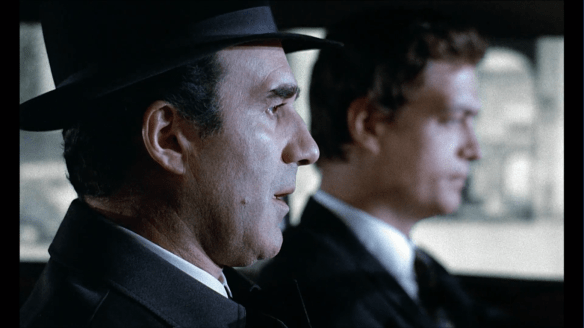
I couldn’t help being reminded of Melville’s Un Flic catching the opening of Claude Sautet’s movie. There’s a policeman, 80 grand missing, and two dead after a heist. It’s not the events that are the same, but the initial sensibilities, the palette, even the world they exist in.

Because Sautet’s hero of choice is Michel Piccoli and not a dashing, virile specimen like Alain Delon. More fallible, morose, and passionate in both his failures and his underlining convictions. In fact, Piccoli’s Max, ironically, shares more in common with Popeye Doyle from The French Connection, exhibiting an unassailable nose for catching criminals under any circumstance.

However, because he hails from across the pond, Max never seems so abrasive and thuggish — there’s a cunning restraint to all the tricks he pulls. In a former life, we learn he used to be a judge but after letting up on a would-be-murderer, he turned his back on the career. Now he catches the criminals where they lie — obsessed with “cast-iron proof” as the chief inspector (Georges Wilson) ruefully observes. He fits somewhere elusively in-between those prior reference points.

For some, Max and the Junkmen might give off the pretension of a talky picture. We get news of this opening heist that ruins Max’s reputation — his informant gave him misinformation — and yet we never see anything. Instead, we are met with the aftermath, in the patrol car, getting word from his superiors, having a meal where he broods over his failures and what he plans to do about them.

Finally, something happens. Max runs into an old acquaintance who deals in scrap. It’s what he’s been waiting for — a spark — and an idea has been conceived in his mind. He’s all but inscrutable as he readies his plans.

All we can do is wait and in the meantime, Sautet explores more of this cinematic space; it’s livelier and more organic as exemplified by Saidani’s Cafe — the people, even the colors are more vibrant.  And while they’re no doubt constructed in some fashion, there’s not the same singular sense of a world being totally sculpted to a vision like Melville’s, even down to the sartorial touches and the bushido-like ethics.

Still, to his credit, Sautet tackles the heist film in a way I’ve never seen and that deserves some recognition. Of course, we’re on the side of the cops instead of the robbers, not an altogether revolutionary perspective on its own. However, as time progress, we realize how cunning the cops are and how foolishly naive the criminals play opposite them. Each of these men is given an introduction of sorts as a policeman relates who they are. It’s not a lot, but it seamlessly tells their stories and bonds them to the audience.

They’re strictly no-name hustlers caught in the pincers of a calculating beast, men barely deserving the title of criminals at all. It’s this element teasing out the almost comic connotation in Max and The Junkmen. Under slightly different circumstances, it could play as some sort of farcical caper.

It’s not merely a contrivance of a story, it’s a totally contrived crime on the inside just so a cop will have an excuse to bring some two-bit, low caliber nobodies in. This is the anatomy of a heist where he’s planning how to nab them even before the idea has ever entered their simple heads to attempt robbing a bank.

This is how far Max will go because we realize soon enough he’s going through his elaborate setup just so he can nab someone — just so he can regain some semblance of justice  to right his reputation. He does it through the means of a woman.

max and the junkmen 2

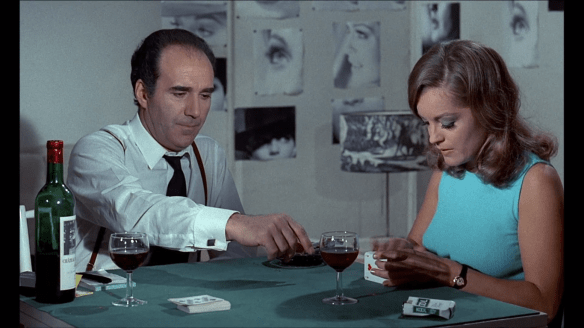
All these plans begin rather deliberately, setting their course and biding their time. However, once Piccoli and Romy Schneider get together the film alights on a compelling relational path. We want to see how they will interact with one another, how their curious relationship will be resolved because hanging in the balance are romance, crime, and justice. Any number of things.

However, we must acknowledge something. Romy Schneider is a cinema icon even outside of the bounds of any of her pictures. Her mere presence feels ubiquitous somehow. It’s easy to liken her to a bit of Dietrich or Betty Bacall, but instead of a husky voice and mid-century roots, she’s all 1970s, liberated woman. And yet with the generational difference, under the surface, human beings are still very much the same. Sautet seems most enamored with this reality. Her voice is softer though defiant when necessary. Independent and still trusting and vulnerable at its core.

Because Max sets up a scenario to totally exploit her. He’s a banker searching out female company, knowing full-well Lily’s boyfriend, Abel (Bernard Fresson), is one of the junkmen he’s gotten a line on. They build trust. He pays her well. They don’t do anything. She finds him peculiar and yet they keep on meeting. Then the hints start coming out slowly. He starts dropping information to make its way down the line. And finally, she takes the bait innocently, as the willing mechanism with which Max looks to nab these crooks. And what’s worse is that they also take to it so easily.

He’s got everything he wants. The police in the precinct have been notified. They’ll block off the streets. There’s an inside man at the bank. They’ve closed it off. It’s the epitome of overkill. The dumb fools haven’t got a prayer.

It’s around this time the shades of Notorious come into sharper focus. The so-called villains feel like the victims. The woman of ill-repute is the betrayed stooge. Our proposed hero somehow feels like the most antagonistic character of them all, and he’s so blinded by his task, when he feels twinges of love for someone, even as he’s manipulating her, there’s this inner crisis of conscience.

Hitchcock lets his protagonists walk out the front door in a harrowing bit of showmanship. Max and the Junkmen has its own devastating finale, which proves wrenching, if not altogether unexpected. Romance has a way of complicating any methodical situation we devise as human beings. Max is tripped up in the same manner. He cannot be a cold-blooded pragmatist even if he wants to; he chooses tragedy instead.

One almost forgets that the whole course of the movie was a flashback because, when it started, we hardly knew who Max was nor that his life would involve a woman who would touch him so.

By the end, getting all the answers doesn’t matter anymore; we’ve been shaken to our core with lives capitulated to unceremonious ends. Like Un Flic or The French Connection, Max and The Junkmen has no space for a happy ending.

4/5 Stars