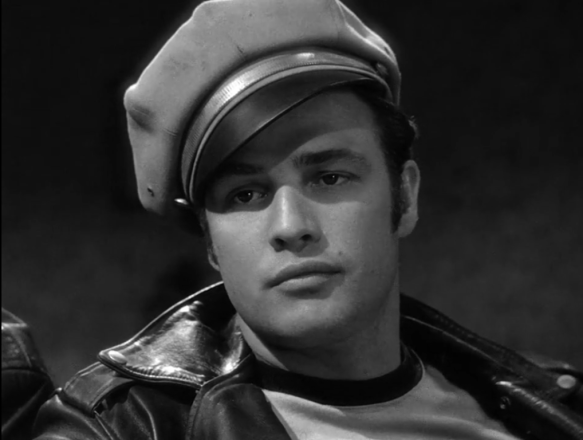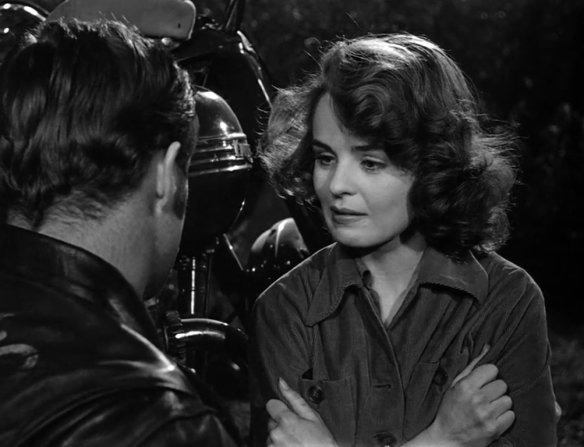
The Wild One (1953) and Brando’s Rebel Icon

the wild one brando

The Wild One will never be lauded as a great movie, but it most certainly proves a seminal one even if you give a cursory glance over what would soon come in its wake. These were not only high school and gang-infused dramas of delinquency and adolescent angst, but it’s an obvious antecedent to the likes of Roger Corman pictures like The Wild Angels (1966) or even one of the most pioneering counterculture relics: Easy Rider.

A Streetcar Named Desire made Brando into an instantly revered actor, but The Wild One helped solidify him as a cult hero. A few years before James Dean — shades, leather jacket, riding a motorcycle — he’s the epitome of anti-establishment, and he found an immediate audience. Not only with the general populous but also for icons who would follow on his coattails like Dean and Elvis.

Like the gangster movies of the 1930s, The Wild One is purported to be a cautionary tale, and yet it can’t help but make the pack of motorcycle lug-heads highly intriguing. It doesn’t altogether glorify them; still, we want to watch them, and we can’t help but turn and look.

Their rank and file are made up of some unusual characters. Would you have ever thought Alvy Moore (Green Acres) and Jerry Paris (Dick Van Dyke Show) would start out in a motorcycle gang?

Aside from Johnny Strabler’s (Brando) instant tuff guy image, projected over the opening credits, their reputation is galvanized as a unit when they defiantly saunter across a racetrack in the middle of a lap. The motorcycles veer to miss them as the crowds yell for them to move it.

They nick one of the trophies on their way out as the police usher them away. They know an unruly mob when they see one. There’s nothing for it but to send them out of town so they can terrorize the next stop further down the road…

Because, of course, that’s exactly what happens. The can gets kicked down the road for someone else to deal with. They wind up bringing their pervasive mayhem wherever they go, in this case, a sleepy town’s main street. In a couple of minutes, they instigate a traffic accident and proceed to hoist the always curmudgeonly Will Wright out of his automobile like a band of obstreperous boy scouts.

The mealy-mouthed sheriff (Robert Keith) is pushed around like a sack of potatoes while a local businessman sees this as an opportunity, coaxing the boys into his establishment with cold beer, steaks, and music. They willfully oblige, led by their leader who instantly becomes smitten with the pretty waitress Kathie (Mary Murphy).

In this jukebox-filled, bar counter milieu, their brand of insurrection verges on Don and Cosmo-esque ribbing a la Singin’ in the Rain, where they pull the wool over on the “squares” with their jive and absurdly crazy lingo. They even take turns dancing with a pair of local flirts.

Who else would ride lead on a rival motorcycle mob but Lee Marvin? He plays it over the top with a healthy injection of disorderly conduct like a thuggish circus performer in stripes and goggles. Chino’s both a rival and one-time drinking companion, having it out with Johnny in the main plaza. Their point of contention: the pinched trophy.

With Chino hauled off to jail along with a local loud-mouth, the situation escalates to a precarious tipping point. The evening brings raucous insubordination as the untethered bikers run roughshod over the town with renewed abandon.

It’s slightly painful to watch if only for the extent of the overkill as they run the switchboard operator out of her office, commandeer the keys to the jail to intern a new prisoner, and generally overwhelm the city limits in every conceivable way.

Wrightsville wasn’t built to handle an incident like this. Sheriff Bleeker is in way over his head and his well-meaning but diffident demeanor has no reign over the chaos. It’s taking them to the brink.

The hoodlums systematically pull the beauty salon apart, dancing and prancing and goofing off. But it’s also premeditated. Because this sets the stage for them to chase after the most attractive and genteel girl in town, first mobbing her and then chasing after her on their motorcycle as she flees down the street. It’s a different type of social terror and especially in the modern-day, it’s particularly perturbing to be complicit to the moment even as a powerless viewer.

the wild one 1

That’s the one key to Brando’s portrayal. He’s a nonconformist against all forms of authority, and yet he still manages to cleave rather nonchalantly to some kind of romantic code of conduct. In a sense, he rescues her only to whisk her off on his motorcycle to some deserted park. She’s tired, not ready to put up any sort of fight. The progression from here seems obvious.

And yet in some curious about-face, The Wild One flips its primary stereotype on its head creating a curious aside. Kathie intimidates him with her breeding, and then, she simultaneously wants to go off somewhere with Johnny and leave the town behind. Both developments feel unexpected. It happens so fast, too fast even, if this wasn’t the heightened reality of a B-picture. For this reason alone with can forgive the moment.

Because the movie constantly corkscrews its logic this way and that to a dizzying degree. The out-of-towners began as the obvious aggressors only for the townspeople to turn on them, giving them a taste of their own medicine. Nothing lines up in terms of what is fair or just. All that is rational spins further and further out of control. It’s part of the intrigue of the movie — a bit like gawking at a car accident — you can’t turn away.

The town, which has sat passively by for some time, is bent on taking retribution into their own hands. They form a posse and go after Johnny pummeling him and taking him to what can only be called their lair. Their tactics have turned ugly as well, and they categorically fail in carrying out justice until a real authoritarian figure (Jay C. Flippen) comes in to excavate the truth.

As it stands, one man is dead and Johnny is accused of murder. The irony is in this drastic turn. Half an hour before we would have convicted Johnny ourselves on reputation alone. Now he is made to look the victim — albeit an ungrateful and belligerent one.

The Wild One concedes in a final moment where Brando finally cracks a smile. The words “Thank You” still don’t come out of his mouth, but he relinquishes a bit of his bad-boy aura momentarily. However, it’s the movie leading up to this point that would help propel the outlaw biker genre forward and make Brando more than a mere stage phenomenon.

Laslo Benedek is not a well-remembered director, and yet he puts together a brassy picture utterly alive with punk sentiment. However, equally importantly, its sense of grungy low-budget drama is not completely devoid of streaks of good humor. For its day, you can see the spikes, and now it’s a simple pleasure for how conspicuous it feels. It’s ripe for parody, yes, but it was also a template for its many descendants. You can hardly consider one without the other.

3.5/5 Stars

Viva Zapata (1952): A Mixed Message of Revolution

viva zapata 1

The place is Mexico City. The year 1909. A contingent of rural farmhands pays a visit to their eminent leader to intercede on behalf of their neighbors. They live a life of poverty and injustice as others gorge themselves on the riches of the land.

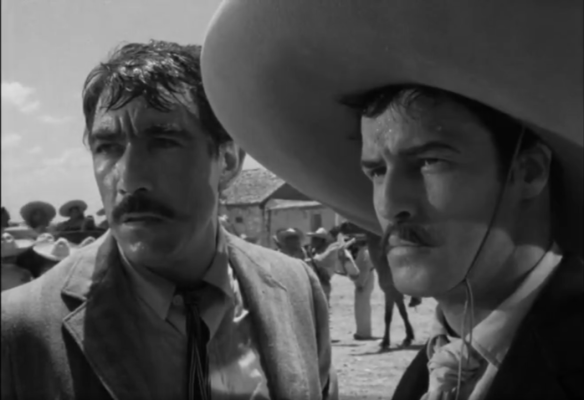
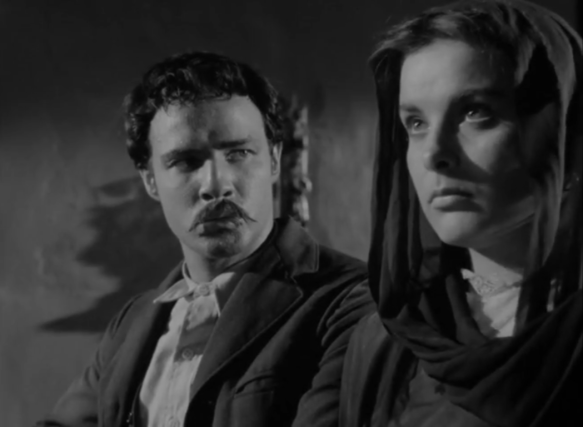
For all his progressive well-meaning, it still is a rather sour note seeing Marlon Brando playing national hero Emiliano Zapata,  especially with Anthony Quinn just left-of-center as his brother Eufumio. It seems like a casting opportunity missed just as the movie itself has so many blatant blindspots.

From the outset, these underlying issues slightly neutralize everything Vivia Zapata tries so desperately to embody, a lot of which is of a visceral nature. An old man is dragged across the dusty roads with a rope around his neck by government soldiers. He’s finally hacked free with a machete only to go careening into a cornfield — one of the first visual casualties onscreen.

Likewise, the peasantry begins clacking pebbles together ominously in the wake of horsemen taking their leader away. They are starting to mobilize and unite under a banner of liberty and equality. The grassroots are surging into action.

It’s evident Elia Kazan is searching out a sense of realism between old-school tintypes and post-war neorealism. He’s navigating a way to humanize Zapata as a sympathetic champion of the rural farmer but also make him seem authentic in his visible plight.

Despite its vast reservoir of talent, it falls flat or at least becomes undermined by the faces in the picture that look anything but realistic. It stands out sorely (even comically) against a canvass striving for this intimate, engaging paean of the Mexican revolution.

Furthermore, the story feels like it falls on the wrong side of the border for John Steinbeck who might know the migrants and cannery workers of Salinas and Monterey well, but the universality of that experience doesn’t always directly translate to the aspirations or patois of Mexican farmhands.

Jean Peters is someone I’ve grown to admire and yet as a virginal love interest, although she’s candid enough, the part still feels compromised. The worst infraction goes to Joseph Wisemen, in particular, who sticks out like a sore thumb or for that matter Mildred Dunnock who would do better in John Ford’s pictures. However, now that the air is cleared, we can leave these grievances where they lie and move forward to something more optimistic.

Like all revolutions girded around a cause, we witness how it ably mobilizes the entire population because they are fighting for something they’d willfully die for while their adversary is just striving for containment and holding onto what they already have. They’re radically different perspectives.

My knowledge of Mexican history is so woefully superficial having Zapata and Villa in the same film does me a service. Otherwise, I would probably have them confused. What’s curious is how the film works in passages of time — these almost elliptical increments — where we see more of the aftermath of each subsequent stepping stone in the struggle than grasping the moments themselves.

There are skirmishes in the cornfields and the forests — merciless executions carried out on both sides to enact discipline and reign in radicals, but most of the movie is a social and moral exercise.

viva zapata 3

Zapata aligns himself with land reformer Francisco Madeira who, for all his idealistic shortcomings, seems relatively sincere in returning the land to the common man. However, he comes up against a self-serving mentality embodied by the tyrannical General Huerta.

The themes to be explored are of a valiant nature. Zapata’s trying to raise up a society and a world for his people of freedom only for it to be dictated by war, continual violence, and national corruption.

There’s this very cynical undercurrent to it as well even as Brando’s protagonist fights with a certain dogged and principled idealism. For him, this is a righteous war never sullied by personal gain or public veneration. And yet other men on both sides are only out for their own consolidation of power and their own vainglory. The few allies Zapata has are either compromised or killed.

One thinks of his own brother, Eufumio, who becomes disillusioned by their continual crusade never seeming to end. And sob driven by desperation and drink, he sets himself up as his own private dictator exasperating the mechanisms they had long been warring against. It signals the beginning of the end as their relations splinter at the seams.

Because one cannot live a life like Emiliano Zapata’s without expecting some form of vindictive retribution. For every man who cherishes his name, exulting him as some kind of national savior, there are still more who censure him as a degenerate outlaw.

Although Pancho Villa (Alan Reed) suggests some kind of middle ground — a way to fade off into the background — though this in itself even feels like an illusion. What little I know about Pancho Villa tells me he did not reach the ripe old age of a white-haired man.

However, in its final push, Viva Zapata does not totally repudiate its own message as the name Zapata becomes the ammunition — the brush fire to set the whole countryside alight — so the revolution might continue in the hearts and minds of the common man. It’s a stirring idea just as this film has a great deal to offer in terms of both talent and theatrical motifs.

Ultimately, it proves a mixed message between its roster of dated performances and conflicting aspirations to appeal to a certain progressive ethos. What helps take the sting out of it comes with the realization Kazan and Brando’s collaboration in On The Waterfront was just around the corner.

And Anthony Quinn, though he faced hardships in his career, didn’t do too bad for himself going forward. He was, after all, one of Hollywood’s most unique and versatile talents and a served him well in a truly serpentine career. At the very least, Zapata should lead to a fitting appreciation of him to go with some of its most admirable ideas in service to the downtrodden.

3/5 Stars

The Barefoot Contessa (1954): A Cinderella Story

Screenshot 2020-04-18 at 51159 PM

While it shares elements with the earlier Pandora and The Flying Dutchman in both its techniques and the mystique projected around Ava Gardner, The Barefoot Contessa ultimately evolves and settles into the narrative rhythms one might expect from its creative partners.

Jack Cardiff returns to give Ava Gardner phenomenal lighting and color — flattering her complexion — beams bursting with radiance and vibrant pigmentation. The extraordinary tones of the cinematography are married with Joseph L. Mankiewicz’s penchant for substantial but well-wrought dialogue and a kind of suave dinner repartee dating back to the days of All About Eve. Likewise, the spine of the story is derived from a very conspicuous novelistic device — starting at the end to illuminate the beginning.

Because someone has died. There is a funeral in the gloom of a rainy day in Spain. Although rain falls mainly on the plain, that is no concern of ours. Instead, we meet the onlookers from many walks of life, all sheltered (for the most part) under their respective umbrellas.

Humphrey Bogart is Harry Dawes a veteran movie director and screenwriter halfway around the world from Hollywood & Vine, attending the funeral of one of the industry’s incandescent starlets who burned out far too quickly.

As is commonplace with many of these self-reflexive industry portraits popular specifically during the 1950s, you begin to suspect where stories gleaned their inspirations by weaving fact and fiction together into a new amalgam of the Hollywood dream factory.

This tale of a nightclub singer in Madrid rising to the heights of Hollywood is hardly a far cry from other real-life origin stories. Rita Hayworth was reborn as a screen goddess and eventually married a prince. Lana Turner was discovered at a drug store counter or the likes of Linda Darnell and Ava Gardner herself had Hollywood contracts thrust upon them at such an early age. In other words, this wasn’t just another wishful Hollywood story. There are obvious antecedents floating around the industry.

The world is instantly placeable. Flamenco guitar. The unmistakable Enzo Staiola from the Bicycle Thief as a busboy (in Spain no less). What sets Maria Vargas apart is her startling frankness, hardly enamored with the movie industry.

She makes a startling first impression as much for what she won’t do as for what she does. Because she’s a very hard girl to see — not easily swayed by Hollywood glitz — and terribly grounded when it comes to what she wants for her career.

The wheeling-dealing P.R. man Oscar Muldoon (Edmond O’Brien) talks up what she has to look forward to, continually dabbing his forehead with his hanky from his exuberant bouts of hyperventilation. Meanwhile, the tense and controlling financier, Kirk Edwards (Warren Stevens), sits by expecting everyone to cave to his will.

He’s no Hollywood wunderkind, but he has money to finance the industry’s next big hit. His money speaks and so Dawes and Muldoon follow his lead. He makes the world turn. Maria Vargas knows no such convention. She is the master and perfecter of her own destiny.

Harry’s the first person she feels akin to; he’s a real person without throwing around the pretense of his purported fame. Meanwhile, she’s not completely ignorant of the movie industry, throwing around the names of Lombard and Harlow, Lubitsch, Van Dyke, and La Cava from the golden days.

Even as the lovely dancer sets her sights on Hollywood, she carves out an individual path. She began as an untouchable with no interest in the enticements of men or romance promised by the industry around her.

Because she knows who she is and her grounded roots are signified by her affinity for having her feet in the dirt. You can’t easily change someone to the core of their being. Though she’s not Spanish nor does she exude the qualities of a girl from humble means (looks can be deceiving), Garnder makes the most of it.

There are men jockeying for her affections (or at least ownership of her career) among them Kirk and a frivolous Latin American gigolo, Alberto Bravano (Marius Goring). He is little better, enslaved by his own excesses be it gambling or drink. The man who admires her from a distance and subsequently takes her away from the place is Count Vincenzo Torlato-Favrini (Rossano Brazzi), the closest thing to a decent man she’s ever had in her life thus far.

barefoot contessa 1

Harry remains a steadfast friend and a protector of Maria when the world seems full of ravenous wolves and superficial opportunists. He knows Maria better than most; she owns an acute Cinderella complex, looking for her Prince Charming, even if the glass slippers were never meant for her. The Count seems to be the man. Alas, in life midnight often strikes and there’s no way to reclaim the time. Her fairy tale ends in tragedy.

No fault of her own, I never felt the weight or magnitude of Maria and the loss of her life. The way the story continually circles “the round” of funeral guests somehow hinders us even though the myriad of perspectives are meant to help us comprehend her better.

I found myself wanting more Bogart or at least more O’Brien, who gives an impeccable showbiz send-up, but when topics turned to the other men in Maria’s life, the story grows turgid and uninteresting — partially alienating the audience. They were never established in the same way nor do I have the kind of instant rapport with Goring or Brazzi that I instantly feel for Bogart.

Most regrettably, Gardner’s performance is never truly allowed to cast a spell of enchantment aside from a few intermittent scenes. Yes, once again, she’s remarkably beautiful and Jack Cardiff’s camera does wonders to ignite her God-given features in an extraordinary light. When she dances with gypsies or wanders through grand estates in luxuriant gowns, she has powers to entrance the audience.

However, her actual performance — going beyond her casting as a Spaniard — never seems to play to her true strengths. If I may be so bold, I never consider her much of an actress, but she’s at her most sublime playing shades of who she really was or at least what her reputation made her out to be.

I look at Pandora and the Flying Dutchman, even in its heightened state of reality, or Mogambo and The Night of The Iguana, and I feel like I know and understand Gardner a bit more intimately in and through her performances. Perhaps this is precisely the point, but in The Barefoot Contessa, we only know her due to the recollections of others.

For me, she is merely another portrait of inevitable rising and falling human tragedy. Unfortunately Hollywood has engendered many of those storylines. She feels more like the postscript to other people’s stories than the definitive protagonist of her own biography.

Because a Barefoot Contessa is such a stirring image, both dissonant and complex, well-worth eulogizing about. Sadly, it never harnesses all its assets, and when the credits roll it feels inconsequential at best and at worst disrespectful.

Such a woman deserved a better remembrance. If nothing else, it’s a sad commentary suggesting a woman’s legacy is made by the men who helped shape her and are consequently the ones who live to tell her story. The Pygmalions might live in regret, but it is their creations who are buried in the dirt. “Che Sara Sara” feels like too pat an answer for this tragic Cinderella story.

But, after all, this is Hollywood we’re talking about where it’s tempting to mold everyone into easily digestible, one-dimensional media icons ready for immediate consumption. For all their glamour and tabloid-worthy headlines, Rita, Lana, Linda, and Ava (as well as any other Hollywood casualty) were human beings too.

3.5/5 Stars

Pandora and The Flying Dutchman (1951): Love Across Time and Space

ava gardner pandora 4

Albert Lewin’s romantic fable opens in Esperanza on the Mediterranean coast of Spain. If the director is a generally unknown name, then Jack Cardiff might just as easily draw your attention with his distinct, intoxicating color tones. It’s true the picture opens with a wonderful shot perched from a bell tower. It’s sounding the alarm and, true to form, all the local populations are flooding the beach.

As we get closer, we see what has elicited such a rapid response: a boat beached on the shoreline. How it got there is really the whole reason for telling this story. Geoffrey Fielding (Harold Warrender) is a distinguished and learned fellow of linguistics and ancient antiquities who was an observer of these curious events.

However, he also proves an apt entry point into the story, which is fundamentally obscured from the outset. The erudite chap helps us out by recounting the details, how they happened from the beginning. Breaking with Hollywood convention, for some puzzling reason, he speaks directly to us, and it’s just as well. The movie is replete with these kinds of mystifying pieces of logic.

Whether it’s something in the water, the air, or just the script, characters float through scenes in this mesmerizing near-dream state. Nearly every male, in particular, orbits around a woman named Pandora (Ava Gardner) as if she is the Sun at the center of their solar system. Drunkards, race car drivers, artists, matadors — it’s all the same — and the gorgeous nightclub singer from the Carolinas seems to welcome their advances.

While Pandora Reynolds is not Ava Gardner exactly, it’s difficult not to see how the part plays on her own reputation — one of beauty, high times, and carousing with a penchant for drama. She famously moved to Spain to get away from Hollywood (and probably Frank Sinatra) only to make a life for herself abroad.

Again, this is not an exact representation of Gardner, but Pandora tosses men around like playthings. She gets emotional highs off other people’s passionate pronouncements of romance. She’s also an impertinent even impetus woman who measures love in the most reckless ways with a hedonistic comprehension.

One man (Marius Goring) turns into a blithering alcoholic falling over himself with jealousy. Another man (Nigel Patrick), madly in love with her, gladly pushes his most prized possession — a racing car — off a cliff into the oceans below as a show of devotion. She agrees to an impromptu marriage in its wake. He’s proved his undying commitment at her behest.

However, there is someone else, a Dutchman named Hendrik van der Zee (James Mason), who is quite different. She is drawn to him; his ship is anchored off the coast and she swims toward it — the solitary light it casts in the night sky. For the first time, someone is unphased by her allure and the directness she goes about her affairs.

In fact, he somehow knows more about her than she knows about herself. He’s an artist painting her or at least painting Pandora and her box as she is a present embodiment of a creature who was incarnated eons before. In this way, Pandora and The Flying Dutchman evokes a broader scale by turning a belle, Pandora Reynolds, into a transcendent archetype. It trades worldly coincidence for the heights of mythology.

When Mason and Gardner witness each other for the first time — both garnering a striking closeup — we know we’re in for something ignited with the flames of passion.  Because they’re both the picture of attractive Hollywood A-Listers. Mason, of course, started out in the U.K. and this is a British production but he would hop the pond soon enough.

mason and gardner 2

From thenceforward, the movie is ruled by this uncanny lucidity bridging the years between encounters across time and space. Mason brings with him an aura of his own, and there’s a newfound mystical ecstasy around the frames.

Still, there is some semblance of reality. Pandora Reynolds is to be married. Another past suitor, a cocksure Matador (Mario Cabre), is quick and bold in his new professions of love. Whereas the Dutchman lets her go, the bullfighter tries as brashly as he can to pull her away from the man she is betrothed to. He probably believes rightfully so that she doesn’t truly love her fiancee. It’s more of a token agreement based on his devotion.

Because while the racecar driver is a miserable sot and probably oblivious to the kind of wavelength all the other characters seem to speak and react on, the Matador knows who his true rival is. It goes unspoken and yet he goes to the Dutchman to have it out.

In one of the most curious scenes splitting with any shred of reality and narrative logic, there is a confrontation, a murder, a nightmare — whatever you want to call it. And yet inexplicably the story wakes up the next morning as if nothing has happened.

James Mason and Ava Gardner and Geoffrey take their places at the bullfight only to watch the famed Matador get gored to death. The fates of love are not working in his favor.

If you’ll remember, Pandora and The Flying Dutchman opened with the beaching of a ship with bodies aboard. In the end, this hardly seems to matter. It is material only on this celestial sphere we call earth where living and breathing are of the utmost importance. This is a story not so much concerned with such mundane themes. Instead, it tackles love on this cosmic scale spanning the centuries even the millennia and brings people together like ships passing through the nights of time.

They conquer death — and we are led to believe even eternity — for the sake of their all-encompassing love. The grandiose metaphors are always arresting and make one’s heart swell with an appreciation for the throes of romance. Gardner and Mason aren’t a bad couple to hang our hopes on in this regard even if the narrative shards feel thin or at the very least discombobulating.

It’s more an exercise in Delphic style than it is riveting storytelling and yet there is something moderately powerful in working in ambiguous shades of dream-like reality, where players walk around in this heightened state bursting with almost obscene amounts of color. Romance is considered in these glorious arenas of speed racing and bullfighting and then stretches across great fathoms of time into the annals of history and myth itself. There’s nothing subtle about it, and visually it’s too gorgeous not to appreciate on that level alone.

3.5/5 Stars

The Night of The Iguana (1964) and The God-Shaped Hole

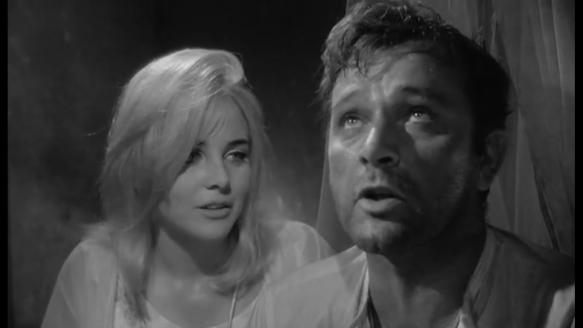
night of the iguana 2

It’s a Sunday morning in St. James Episcopal Church. The minister pulls his sermon from Proverbs 25:28: “A man without self-control is like a city broken into and left without walls.” But there is an elephant in the room, an unspoken force coming between the shepherd and his sheep. He starts to stutter before he erupts in an indignant tirade lambasting his parishioners.

There’s something unsettling in seeing Richard Burton as a minister. I would have felt a similar unease with Peter Finch as a preacher (he was a surgeon in A Nun’s Story). Although it’s true, the similarly resonant actor, Richard Todd portrayed one of the most sincere clergymen ever in A Man Called Peter.

But Burton has the largest and most volatile personalities of all three.  So when he loses his train of thought during his Sunday sermon, perched from his pulpit, it’s not altogether unwarranted watching him implode on the spot. We expect as much.

It feels like Reverend Lawrence T. Shannon (Richard Burton) has inherited the lectern from Barabara Stanwyck in Miracle Woman, though his conflict is more difficult to sort out. It’s as much about the watch-dog hypocrisy in his own church as it is his personal crises of conscience. We don’t know what his presumed sins are, but as the pews clear and he thunders down the aisles, he calls out the fleeing congregants, denouncing them thusly:

“You’ve turned your backs on the God of love and compassion and invented for yourselves this cruel, senile, delinquent who blames the world and all that he created for his own faults! Close your windows. Close your doors! Close your hearts – against the truth of our God! ”

Be that as it may and totally regardless of his innocence or guilt, the next moment we see Shannon, he’s fallen to a new low — taking a busload of Texas schoolteachers down through Mexico so he can serve as their tour guide past all the religious relics below the border.

night of the iguana 3

What a sorry figure he is — a tortured, broken, smarmy man just trying to get by. This portrayal is generally enhanced by the realization that Richard Burton, though he probably grew up in The Church of England, was at the very least a cultural atheist. Nor does he come off as a ministerial type. He was notorious for drinking like a fish. Meanwhile, his highly publicized off-screen tryst with Elizabeth Taylor was commanding the contemporary tabloid covers. It all fits into this conflicted, mercurial performance of his. Hardly likable but strangely compelling for all its wild instabilities.

James Garner is said to have turned down the role because “it was just too Tennessee Williams” for his taste. He’s not wrong and frankly as much as I love him to death, the part wouldn’t have fit. Burton can carry it off because his demons, whether real or imagined, are far more visible onscreen.

However, there is another pressing question. How in the world do you get the creative marriage of John Huston and Tennessee Williams? I’m not sure if you could call it a perfect match, but it’s ceaselessly interesting. It’s a new side of Mexico — in the fishing village of Puerto Vallarta — well after The Treasure of The Sierra Madre. Consequently, the setting seems a bit left-of-center for typical Williams fare even as the sordid dramatic content is much what we would expect. In the middle somewhere the two men meet.

The words from Proverbs are easily recalled as the disgraced Reverend finds himself being pursued by a loquacious young blonde (Sue Lyon continuing in her Lolita vein). She finds him easy to talk to and fascinating — his life is engaged with people’s souls and yet he’s young and virile. Charlotte takes a dip with him innocently enough and still notes she could never do this with the preacher back home in Texas.

It’s the first sign of hot coals. He wants nothing of her coquettish advances even as the acerbic chaperone Ms. Fellowes (Grayson Hall) watches him like a hawk — ruling over the girl with an iron fist of ascetic repression. It makes her a tiresome thorn in Shannon’s side; he’s about ready to go mad. Eventually, he does.

Having just about enough of their campfire songs and rigid drudgery, he shanghais the busload of priggish Baptist schoolteachers, taking them on a harrowing ride, bumping their way down the dusty backroads. He screeches to a halt, jumps out, rips out the distributor head, and proceeds to streak up the hillside with his suitcase. They might as well be in the middle of nowhere.

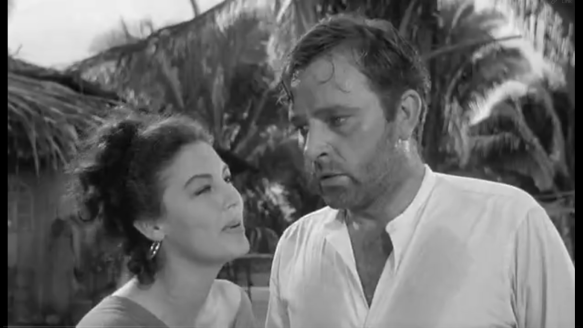
For the sake of this movie, they are not. The tropical Costa Verde hotel is hidden up in the forest overlooking the water, and it just happens to be run by an old friend of Shannon’s. Fred is dead, but his wife, the larger-than-life Maxine Faulk (Ava Gardner), is still running the place. She’s an earthy force to be reckoned with indebted to Gardner’s lively showing.

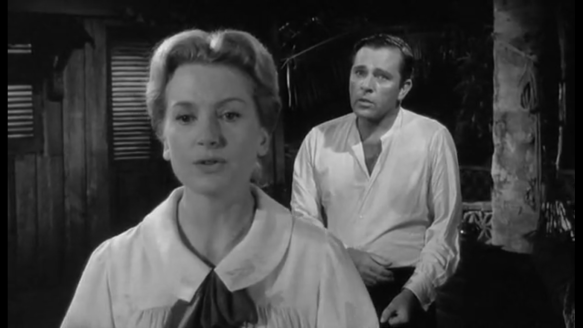
If not for her, Burton would probably steal the show, but he’s met with another gale storm of enduring cheerfulness and utter obstinance. Their impact is such you almost forget about Deborah Kerr. Sure enough, she appears on their doorstep as the peripatetic painter, Hannah Jelkes, who travels with her grandfather, a diminutive, 98-year-old poet.

night of the iguana 1

Though the other two dominate the screen, she quietly commands it. When Gardner and Burton get to shoving the drink cart at one another, it is Kerr who becomes their unofficial mediator. Because she is a voice of reason, an artist with a pensive gaze, and a surprisingly lucid perspective despite her meager lifestyle.

Later Charlotte bursts into Shannon’s room yet again causing him unwanted torment as she tries to get him to go away with her. She’s very good at stirring up men’s hearts and instigating mini scandals in the process. In another scene, a fistfight for her affections breaks out between the tour’s bus driver (Skip Ward), and some local boys replete with music, maracas, and stereotypical flourishes. Huston plays it for a laugh. It’s inconsequential if not altogether inane.

Because it is from the stage, The Night of The Iguana does seem to stall. Eventually, the bus leaves without Shannon and the second half of the story feels like an existential dialogue more than anything else. It could be a dead-end, though on the merit of our three established stars, it remains something intermittently though-provoking if not entirely compelling.

The curious thing is how the adversary melts away. True, the bus leaves with both his temptation and condemnation and yet he has pity even on his adversary. “Miss Fellowes is a highly moral person. If she ever recognized the truth about herself it would destroy her.” He recognizes her as another conflicted, constricted creature — a fellow Iguana tied up to a post.

With the bottom dropped out of his life, Shannon wants to swim to China, seemingly a handy euphemism for ending it all. He’s taken to the brink of his wits, lashing out at Maxine and anyone else who will avail him. It’s Kerr who rules the final act amid the paucity of moral rectitude. She perceives that his version of Golgotha is on a green hillside overlooking the water. His cross being strung up in a hammock on the verandah. In comparison, it seems like a fairly cushy alternative. She strips him down to who he really is.

Far from condemning him, Jelkes feels strangely sincere and genuine, particularly for Williams. She perceives that his problem revolves around “The need to believe in something or in someone — almost anyone — almost anything.” It’s Augstine or Pascal’s God-shaped hole rehashed. Likewise, she deflects his metaphors. She is not a bird but a human being. Nothing human disgusts her except if it’s unkind or violent. What extraordinary statements they are, and Kerr delivers them with a perfectly composed performance.

As each person tries to decipher their own religion or least some semblance of existential understanding, whether through legalism, drink, or sex, even cutting Iguana’s lose as a private act of personal Godship, she’s the one character who brings down the thoughts and words of the wise and makes them feel foolish.

For a film suffused with a great deal of religiosity, she’s startling unprepossessing. And yet in her words and in her humanity are the roots of something bountiful and beautiful in their very simplicity. It’s the kind of simplicity that can help loosen the Iguana from the hitching post, where we find out by sojourning, it’s possible to fill up the vacuum inside each and every one of us.

4/5 Stars

Seven Days in May (1964): A Twilight Zone America Strikes Close to Home

Sevendays_moviepThe opening images of Seven Days in May could have easily been pulled out of the headlines. A silent protest continues outside the White House gates with hosts of signs decrying the incumbent president or at the very least the state of his America.  We don’t quite know his egregious act although it’s made evident soon enough.
The scene at hand rapidly escalates to violence. There’s an immersive cinema-verite quality to the mob that breaks out between rival protesters. It instigates the film’s overt sense of technical style even if it’s not always straight to the point.

What becomes imperative to John Frankenheimer’s movie is how this showmanship frames the performances at its core because the movie is driven by its robust melange of characters. Fredric March is president Jordan Lyman. He’s getting middling reviews for headlining a nuclear disarmament deal with the Soviets. This includes backlash from his highest-ranking military officials, and they’re not going to sit around while he lets America get annihilated.

It might seem like a slightly peculiar (if not entirely unfounded) reaction, seeing as in real life so many people would soon call for peace. Except in this world, the Cold War is literally reversed; now they have peace, and the outcome still remains the same. Everyone’s suspicious of what might really be going on behind the Iron Curtain.  If it’s not evident already, Seven Days in May effectively becomes an off-shoot of your typical Cold War doomsday drama.

Somehow it seems fitting Rod Serling adapted the script from the titular novel because this is a story planted in an inconspicuous and generally subtle near-future. It is its own Twilight Zone in that the logic feels slightly tweaked from what contemporary America was familiar with. At any rate, it’s concerned with an entirely different outcome than President Kennedy was currently faced with. What makes it truly startling is how much of a hop, skip, and a jump it feels from reality.

While it’s unfeasible to totally encapsulate public discourse during the early 1960s of the Kennedy administration, it’s often true movies act as an echo chamber of the times, reverberating the current issues in fundamentally different ways. I cannot speak to the anxieties Seven Days in May explicitly illustrates. But there are tinges of very real conditions, be it public protests and national marches (with the civil rights movement) and certainly the ongoing frozen-over politics of The Cold War.

Foremost among the detractors is General Scott (Burt Lancaster), who adamantly believes nuclear disarmament is a dubious peace — a sign of America’s weakness as they roll over and cave to Soviet interests — leaving the nation vulnerable. And it’s not an isolated opinion with close associates including Colonel “Jiggs” Casey (Kirk Douglas) sharing his line of thinking.

However, even their own private allegiances dictate drastically different courses of action. There would not be a movie if “Jiggs” did not uncover General Scott’s covert operations. Namely, a garrison of men training at an undisclosed facility in El Paso. It’s the first of several red flags.

The Colonel immediately brings a line of communication straight to the top triggering mistrust and paranoia as the inner circle of the president is overtaken with consternation. Although he seems admittedly quick to sound the alarm, it is indicative of the times. Especially because their fears of a military plot to take over the government seem overwhelmingly well-founded. Such a coup d’etat on the oval office almost feels unthinkable in the modern age of America; maybe this fits a more Twilight Zone sense of our government structures.

Regardless, Lyman heeds the warning and sends one of his closest allies, old southern boy, Ray Clark (Edmond O’Brien), to check out El Paso. Another oval office insider (Martin Basalm) ends up tracking down the one standout from the conspiracy — an admiral currently based out of Spain — who gives a signed statement of foreknowledge. Meanwhile, The Colonel is asked to continue in the uncomfortable position of an informer. The President must bide his time until he can back up the claims, lest he be seen as a raving madman by the general public.

While Lancaster might have the more high-profile post, it is Douglas who feels like the sinews holding the movie together, and rightfully so, because he was one of the major forces behind the film’s production. To his credit, it shows his ability to play a more restrained part — close to the vest — which still remains deeply impactful.

His scenes with Ava Gardner feel like a minor side note to this covert conspiracy of international importance, and yet it’s a tribute to both of them; it feels real and devastating in its own right. Their shared context means something.

Given the era, it’s hard not to consider the likes of Advise & Consent and then the more nuclear-oriented dramas like Fail Safe and Dr. Strangelove. And of course, John Frankenheimer had a well-documented pedigree with the political thriller from one of the most high-profile contenders, The Manchurian Candidate, and the criminally overlooked Seconds a few years down the road.

If we were to take his loose trilogy and compare it with Alan J. Pakula’s trifecta of thrillers from the 1970s, we can somewhat trace the evolution of the genre from one decade to the next.

As Lyman notes, the electorate is looking to elect a personal God for the duration, whether a McCarthy or a General Walker. They clamor for such a person to assuage their fears. The enemy is not other men but the nuclear age. We suspect infiltration and that the enemy is trying to blow us off this rock. Not until later would our own government be implicated, and then big business and our own systems be seen as a source of the problems.

Some of the best scenes take place in the privacy of the oval office because we sense the tension provided by the stakes. However, the whole drama is brought down to a manageable scale that can be quantified and understood through human relationships.

The intimate confrontation between March and Lancaster is probably a pinnacle of the storytelling, far more impactful in fact, than watching a full-scale conflict play out. Instead, it’s the whole movie hinging on one showdown between two incomparable forces, and what a showcase it is.

What makes the film smoke with legitimacy is how both men suggest, in their heart of hearts, that they are right and justified in what they are doing. And that’s what the great actors can do. Lancaster, in particular, is easy enough to cast as the power-hungry, possibly sleazy villain with a Napoleonic complex. But Lancaster’s ferocity is only matched by his steely delivery. There’s never a suggestion he is phoning in those lines of dialogue. They come off real and true and unflinching.

In the eleventh hour, there’s a sigh of relief and an equally perturbing sense of unease. We conveniently never find out if the peace treaties were a ploy by the Soviets. All we’ve done is live to fight another day. Tomorrow could signal oblivion. For this early in the decade, it feels surprisingly downbeat signifying the times certainly were a-changin’. The shift was inexorable.

4/5 Stars

*I wrote this review well before events at the Capitol on January 6th, 2021. 

The Long Gray Line (1955) and Martin Maher

the long gray line 1955 Tyrone Power

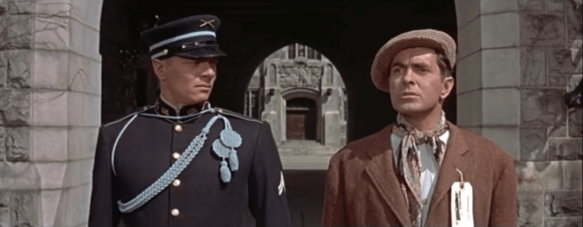
There’s no other way to put it. The West Point imagery of The Long Gray Line is smart from the outset, and if nothing else, it instills this sense of admiration in the military sharpness of this storied institution. However, although this is a hagiography from John Ford, it feels more full-bodied than a typically blasé biopic.

For one thing Tyrone Power, more so than an Errol Flynn or some of the other earlier idols, proved his candor for meatier roles that might showcase what he could do. And between the likes of Nightmare Alley and Witness to the Prosecution is a picture that probably gets less fanfare written about it. His portrayal of Martin Maher, a lifelong West Point man, is both endearing and surprisingly comic even as his brogue is quick to take over the picture.

Because it is a biography as only John Ford could manage it. He employs broad humor from fisticuffs to falling plates to brawls in the manure pile while assembling all his surrogate screen family together — paying his usual homage to his Irish roots in the process. If none of this particularly piques your interest, it’s probably not for you. Because if we can say anything about The Long Gray Line, there’s no doubt about it. This is another quintessential John Ford picture.

West Point is fit for Ford because you have this underlying sense of tradition, honor, and camaraderie. The drills, men dressed in their uniforms, and the very architecture produces wonderful elements for Ford to exercise his glorious stationary wide shots. However, it’s not merely about composition but motion and people being galvanized together through shared experience, be it song, dance, or the rigors of military drills.

Moreover, it covers such an expansive time frame and yet it feels free from a lot of the typical narrative pitfalls. There’s a general sense it’s more content with the details and observations of life than stringing together a story of dramatic event after dramatic event each comprised of their own life-altering meaning.

Instead, what we see is totally fluid without needing to explain itself, and as we’re not dealing in huge historical events, but one man’s extraordinary life, this lassitude works quite well.

It considers time, acknowledges how life is ordered by time but is never a slave to it.  The guiding light is a meditation on tradition more than a pure devotion to realism. Mind you, there are a few winks with the camera to Pershing, Knute Rockne out on the football field, even Harry Carey Jr. portraying a young version of incumbent president Dwight D. Eisenhower.

We also methodically follow the train of Marty’s life from a “fresh of the boat” Irish immigrant to a bumbling waiter, an up-and-coming athletic coach, and then a corporal training up the youthful cadets and helping instill in them the pride and responsibility of their station.

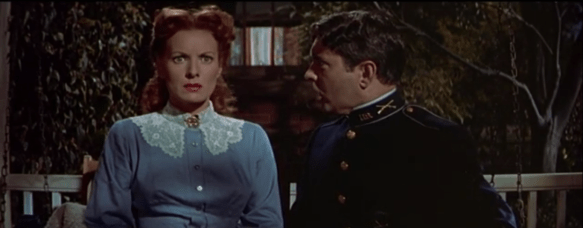
The Long Gray Line Maureen O'Hara Tyrone Power

Soon after Marty’s arrival, Mary O’Donnell (Maureen O’Hara) arrives from the old country to serve as a cook for a local family. Ford delivers their so-called meet-cute in such a curious manner it could be out of a silent movie. For someone known for talking so passionately, O’Hara nary utters a word, instead, punting one of Marty’s boxing gloves while he trains up the lads in the art. Of course, he can’t help but keep sneaking glances back at her. It’s the beginning of a lifelong love story.

With John Wayne not attached to the picture (Ford wanted him), some of Ford’s other usual suspects get their due chance to shine. Ward Bond is a fitting embodiment of the gruff but effectual Master of the Sword, Captain Koehler, who invests in Marty. The classes of cadets are sprinkled with the likes of Harry Carey Jr. and Patrick Wayne. While Old Man Martin (Donald Crisp) arrives from Tipperary soon thereafter.

Although not a Ford regular, the cast includes Robert Francis, who was Harry Cohn’s answer to the new rebellious class of actors, the antithesis of James Dean and his ilk. Sadly Francis’s career was no less tragic. The rising actor only appeared in 4 movies before dying in a plane crash in 1955. This would prove to be his last project.

The last impression of The Long Gray Line suggests how Martin is as much an institution as the institution itself. In this regard, one’s memories are quickly drawn to Mr. Chips because Marty Maher feels like an analogous figure for the halls of West Point. Ford shows his knack for visual articulation in how he instills similar themes.

Instead of a deathbed pronouncement of a life well-lived, we see it all in action. Marty is older now, white-haired, and coming up on 50 years with the school. He has old friends doting over him, and new ones helping set up the Christmas tree. They put up the decorations and busy themselves in the kitchen

Again, it’s this constant motion and movement leading us toward greater communal well-being. Where we are reminded how much stronger we are together and how much comfort can be gleaned in time spent with others doing all manner of things.

Surely Ford could not have meant any of this and yet that’s the beauty of it because it all feels very organic in nature — organic to how we live as human beings — and bearing the truth of real life. It’s not just the momentary yuletide cheer that draws me back to It’s a Wonderful Life, it’s the community and Ford gives Marty a hero’s send-off full of poignancy (and “Auld Lang Syne”).

Although he’s come a long way from Tipperary, the verdant greens of the landscape feel like an immigrant’s reminiscence of The Quiet Man now on opposite shores, but no less resplendent. His roots and the aspects of his character and the family he holds dear are never far away.

Watching the ending, as a grand exhibition is put on in Marty’s honor, is spectacular unto itself. There is this gravitas similar to The Quiet Man or even the final parasol twirls of Rio Grande where we feel like we have taken part in something substantial just in studying the faces of our leads from their regal posts. They feel like giants on the screen.

After all, we’ve been privy to an entire lifetime and The Long Gray Line keeps on going. True, there’s a temptation to see this as a monotonous even a depressing thing — how time marches on and how there will always be new recruits to replace the old. People leave. Even Marty Martin was buried on the grounds after his 50 years of service.

However, in the hands of Ford, these genuine realities of life somehow have a definitive meaning that feels worthwhile and grand. It’s by no means naïve in its perspective, and yet it seems to grasp the meaning, even the goodness, and the dignity, in such a place. It’s made up of the people as much as any kind of ideals.

What makes the film stick for me is how it is not a true cradle-to-grave epic nor is it a war picture. Ford had been in combat and had seen the Battle of Midway for goodness sakes. He wasn’t some wide-eyed idealist high on the glories of war. And yet his penchant is to still memorialize them in some manner through a lens he can understand, namely, the man, the myth, the legend: Marty Maher.

4/5 Stars

Mogambo (1953): John Ford Updates Red Dust

Mogambo

Whether it’s apocryphal or not the term “Mogambo” is purported to be the Swahili word for “passion,” although it’s difficult to know if this was only hearsay propagated by westerners (now including myself).

Regardless, it boasts an intriguing if altogether curious assemblage of talent. One would be remiss not to acknowledge John Ford as the story looks ripe for his kind of gripping panoramas. What’s lovely about the exterior shots is how it feels like a new prairie — a new landscape for Ford to photograph and bring his exemplary eye for portraiture and compositional space to.

Against this backdrop you have both people and animals living in this symbiotic give and take of aggression and nurturing — in some ways hearkening back to the primordial roots of Adam and Eve taking care of creatures in the Garden. Is it a stretch to wax lyrical in such a way? For another director, it’s quite possible, but because Ford was always the propagator of myth and parables it seems only fitting to use this language to describe the picture.

On a more pragmatic note, Mogambo is Red Dust transplanted to the African plains and maintaining the heavy influences of Western Imperialism. Though there is one fine concession, a “score” made up entirely of Congolese tribal music providing what feels like an authentic backbeat and rhythm to the movie. Otherwise, it’s a Hollywood Technicolor extravaganza in toto, albeit one delivered courtesy of Pappy Ford.

The plot isn’t of exceptional interest given the fact it already has antecedents in other movies, and it feels especially antiquated now. However, it’s also a double-edged sword as they don’t make any movies quite like this anymore, and so there’s a certain amount of novelty in the established panoply.

Vic Marsell (Clark Gable) is a big game hunter for pay in the modern world. Eloise “Honey Bear” Kelly — a real firecracker of a woman (Ava Gardner) — winds up at their secluded outpost on the invitation of a maharajah. The main problem is the man picked up and left without bothering to tell her. She’s good and stranded.

Her attempts to make her way back to civilization don’t work so well, and their outpost becomes quite the mating ground with the arrival of a callow man of learning (Donald Sinden) and his wife (Grace Kelly). You need not be a soothsayer to wager a guess what might happen in this sweltering country.

Ava Garner’s no Harlow gold, and she doesn’t have to be. If it’s not plainly obvious, she’s Ava Garder, a cloying, sassy icon in her own right more than capable of finding her place among the animals and everyone else on the African Safari.

She’s a barrel of laughs to have around, and she has a quip for every occasion be it Secretary birds or (Bobby) Thompson’s Gazelles. Consequently, she also proves herself to be an incorrigible pot-stirrer and, thus, the film’s most enchanting asset.

While Gable still feels adequate doing the rounds as his prototypical gruff hero (over 20 years after his initial success), Gardner gives off this sensual aura of sport and irreverence. Grace Kelly has the naive sheen of a prim and proper anthropologist’s wife out for an adventure, which of course, she is.

Given our players and Ford’s manning of the romantic drama, it’s the broader themes paired with the laid-back sense of fun — reminiscent of a Howard Hawk’s picture — that become the most agreeable moments.  This is before it burns with the imminent flames of passion.

Every detail and accent of the environment seem to reinforce the romantic tensions creating these parallels between mating rituals out in the wild and their human equivalents. It’s an open-air Noah’s ark. Every creature is looking for its respective mate.

Ava Gardner pacing with her parasol joined by the Leopard pacing in its cage. A lion in the bush growling for a lioness. Hippos fighting in the local riverbed no doubt over a female companion. There are even polygamous males in the local communities with tribal premarital rituals to guarantee fidelity.

In lieu of a flood, Mogambo swipes the famous storm scene from Red Dust, but it’s punctuated by a singular moment of its own. It’s the first sign of electricity. Gable yanks off Grace Kelly’s headscarf and brings it about her neck with a forceful tug. Nothing else happens, but the animalistic fury and the passion is obvious, matching both the animals and the weather right outside the window.

There is another element we could consider and as I don’t like to spend too much time on these things, I only mention it in light of the film. Garble and Kelly famously had a romantic fling on set. Far from being a real-life love triangle — Gardner was still married to a devoted Frank Sinatra at the time — the younger starlet went to her elder for worldly counsel. And she provided it. If intuition proves correct, Gable wasn’t a far cry from the man he portrayed in this film, at least when women were concerned.

The final act takes them out into the jungle in pursuit of gorillas, “the truest link between man and his primordial derivation,” although a local father might have a word or two to say on the origin of species — Man in particular. Soon thereafter, relationships get more complicated and they begin to splinter under pressure as per the expected conventions.

If I can make a summation, you come to Mogambo for how the milieu informs the romance and not the other way around. Length catches up with it in the end as the steaminess slowly burns off. What we are left with are the palette and the performances. It’s well nigh enough to make this movie spectacular entertainment. Fans of either Ford, Gable, Gardner or Princess Grace should at least prick up their ears. Although, in the end, Ava steals the show.

3.5/5 Stars

Ikiru (1952): Loving and Living

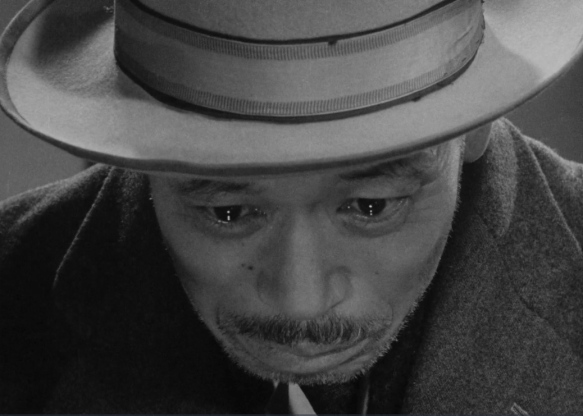
ikiru takashi shimura

“This man bears a cross called cancer. He’s Christ.”

Ikiru is instantly a tale of dramatic irony as we see x-ray footage and an omniscient narrator tells us matter-of-factly the signs of cancer are already obvious. Our protagonist’s work life hits hard as he’s a public affairs section chief — dangerously close to my own title — thoroughly buried in the bureaucracy of Japan.

The great tragedy is how he’s never actually lived. He’s killing time, stamping documents with his inkan (official seal). I know it well because I sat at a desk in Japan watching others doing much the same. There were fewer teetering paper mountaintops around me, but the sentiment holds true. All his will and passion evaporated over the past 20 years. How this happened is made quite clear. We are once again privy to the dizzying circular bureaucracy that I’ve been subjected to in my own lifetime, from college campuses and also living abroad in Japan.

Even as he portrays a man of such a sorry constitution, there’s something instantly endearing about Takashi Shimura. In fact, he has been a friend of mine for quite some time. Aside from Toshiro Mifune and Setsuko Hara, he might be one of Japanese cinema’s most instantly recognizable icons. There’s a glint in his eyes of warmth that so quickly can turn to melancholy. It serves him well in Ikiru as do his distinguished features and graying hair. The dejectedness up his posture, the glumness in his being, verges on camp but it never loses its purpose.

The greatest revelation is the composition of the film itself in the hands of Akira Kurosawa and his editor Koichi Iwashita. I never recalled the editing of the picture, cutting and shifting between time periods. The delight in his son Mitsuo’s athletic prowess only for it to be crushed seconds later on the basepaths. Then, there was the boy’s appendix operation, an event he was not able to stay around for. It paints the relationship with his son, drifting through time, as the world spins around him, and Kurosawa follows the motion to find the heart of his picture.

As Watanabe sinks lower, taking an unprecedented leave from work, leaving all the underlings to surmise the reason, he meets a lowly fiction writer in a bar. The man’s occupation gives him a bit of license to wax philosophical, and he’s more forthcoming, more whimsical than we’re accustomed to coming across, especially in Japanese culture. He tries to empower the dying man to live it up.

After all,  greed is a virtue, especially greed in enjoying life, and so they take to the night scene with reckless abandon blowing Watanabe’s savings in the process. For a night he tries on the life of a profligate and a drunkard with middling results. There are light-up pinball machines, rowdy smoke-filled beer halls, and lively streets overrun by women of the night. They proceed to make their way to every conceivable bar imaginable. As the montage and music roll on and on, I couldn’t help but recall The Best Years of our Lives.

It was a celebration under very different circumstances. A soldier comes back from V-J Day ready to live it up. But much like Watanabe-san, Al (Fredric March) is looking to put off the inevitable for a bit longer. It’s a lot easier to face this heightened reality than the morning after. It’s a diversion tactic.

In one space the two merrymakers totter up the stairs as couples dance cheek to cheek. Their destination seems to be the lively piano bar jumping with tons of western-infused honky-tonk rhythm and blues. But Watanabe-san subsequently brings the mood to a standstill as the house stops to watch him sing a melody born out of the melancholy of the past — reminding us life is brief.

To this point, he feels pitiful almost laughable, laid prostrate by his very drunkenness, and gallivanting around the streets to the sidewalk symphony of honking taxi cabs and the distinct notes of “Bibbity Bobbity Boo.”

The morning after is what we expect. Not only a hangover but real-life sets in and the baggage that comes with it. He realizes his son and daughter-in-law are completely absent. Not only absent; they are indignant about his behavior. Because of course, they don’t understand. He hasn’t told them anything.

Screenshot 2020-04-03 at 65225 PM

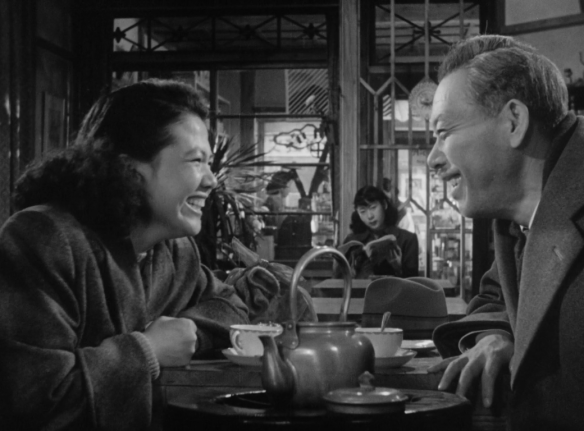
Instead, he gravitates toward the youth of his garrulous young colleague (Miki Odagiri) bursting with untapped spunkiness. The key is how she makes up for his lack of both humor and energy. She somehow uplifts him with her very spirit — teaches him what it means to really live — what it is to have giggle fits. From the outside looking in, without his context, it looks like a sordid romance or some odd preoccupation. It’s more innocent than that.

He recounts how when he was a little kid, he was drowning in a pond; everything was going black as he writhed and thrashed around in the deep void around him. He felt the very same sensation when he found out about his illness — all alone in the world — his son as distant as his mother and father were when he was in the water. Full stop.

Ikiru and the act of living life are split into two distinct segments. Much of it is expounded upon after the inevitable happens and Watanabe-san has passed away. It’s one of the most abrupt deaths in film history. But that was never the point. Death was inevitable. What mattered is how he used the time before. How he lived it out. This tangles with the existential questions of life itself with all its subjectivities.

It sounds callous to say Kurosawa uses the motif, but what unfolds, in narrative terms, is like Rashomon meeting an abridged Citizen Kane. It’s artful and extraordinary taking the recollections of all the observers in his life to try and make sense of this man’s final hours.

The extended scene that follows almost plays out like a parable for me; it makes the dichotomy so apparent even as it expresses so much about these human beings. His fellow bureaucrats shed no tears at his wake. They have no gifts or kind words for him. And yet a host of working-class women, women who only knew him for a very few hours, anoint his burial with tears and burn incense for him.

The rich and well-to-do have no humility, no need, no appreciation because they’ve allowed themselves to be insulated — they believe they’ve brought every good thing on themselves. Revelation falls to those who are less fortunate, who have spent their whole lives impoverished and low. They can appreciate how a simple action by a simple man can be ripe with the kind of profound meaning these men sitting around idly by will never comprehend (much less believe).

It’s admittedly out of left field, but one of the songs I was taken with last year was COIN’s infectious pop record “Cemetery.” Its most gutting line goes, ” Never made time for the family but he is the richest man in the cemetery.” The words terrify me to death, and they inform how I think about Ikiru — its purpose — the meaning of Mr. Watanabe-san’s final act of unswerving resolve.

It’s a warning and a cry, a pronunciation and a prayer for all those who are willing to pay it heed. What is life but to be lived out? There are only a finite amount of hours and days between “In the beginning” and “The end.” There’s no hitch on a hearse. All we can take away from this life is that which is given away. Ikiru must only be understood out of this profound paradox.

Because these men — these acquaintances sit on their duffs partaking of his family’s hospitality — trying as they might, to make sense of the mystery of his transformation. How could this be? What would cause a man to be so radically different even cavalier with both his time and his resources? They quibble about it incessantly as Watanabe-san’s actions make fools of the wise.

It’s really very simple. He says it himself even as he’s half doubled-over with pain, his voice on its last rasping legs, constantly being humiliated. “I can’t afford to hate people. I haven’t got that kind of time.” What if that was our mentality? When I look around me, who is my neighbor? It is anyone and everyone. Not just my friends but the ones who ridicule me — the ones who are hard to live with. What if spent less of my time criticizing and hating and more time loving and living. After all, aren’t they one and the same?

5/5 Stars

Arise, My Love (1940): Milland and Colbert

arise my love milland and colbert

“Arise, my fair love and come away” – Song of Solomon 2:13

The screenplays of Charles Brackett and Billy Wilder are often literal master classes in hooking the audience. They understand intuitively the construction necessary to bring us into a story so we’re invested. Take the opening of Arise, My Love. Yes, there’s some throw-away text about the Spanish Civil War in the summer of 1939. It’s in the aftermath, but then we’re introduced to a telling scene.

One of these soldiers of fortune, American Tom Martin (Ray Milland) sits in confinement as a father (Frank Puglia) from the local monastery pays him a visit. The firing squads right outside his annex make it painfully clear the hour of his own execution is imminent. Those aren’t rubber bullets. The man of faith feels some urgency to ask the prisoner if he even feels penitent — if he needs to clear his chest of anything.

All this sounds rote so far. Anyone could write this scene like so. Then, individuality sets in. Instead of contrition, he bemoans the fact he didn’t get into the action with Chamberlain and Hitler nor has he gotten a chance to take potshots at Nazis. It has the vitriolic gallows wit of Wilder setting up the gag.

Here’s the kicker. The inevitable is whisked right out from under Martin by the most unexpected of Providences. He’s been granted a pardon! It came through the pleading of his wife! It’s an obvious punchline if I know Wilder (and Brackett): he has no wife!

This plucky mystery woman (Claudette Colbert) is a reporter out for a story and boy does she has a way of making a doozy of a spread. They get out of the scenario thanks to her charm, his flying, and a bit of luck.

We are reminded the movie is planted squarely in its moment from the headlines about the Yankees in the World Series and the hunt for Scarlet O’Hara finally being over. Tom was among three American flyboys, who are a group of idealistic interventionists siding with the little guys against the big boys.

Paris, the city of amour, is still free from Nazi influence, and the pilot does his best to channel what’s already in the air. “Gusto” rebuffs him — albeit good-naturedly — because she’s an all-or-nothing gal. She knows if she says “yes” she’ll be head over heels. There’s nothing wrong with that per se. But she’s a career woman.

Now Claudette Colbert doesn’t quite strike me as a typewriter-plunking type like Rosalind Russell or Barbara Stanwyck — one of the boys as it were — but she comes off as deliriously happy. Because it feels like she’s in her element again in this world, whether or not it’s totally manufactured by Hollywood. As her slighted suitor sits in the Cafe Magenta just betting she’ll walk over from her hotel, she looks to climb the journalistic ladder.

She’s dropped with quite the gig: Special Berlin Correspondent. The previous correspondent was kindly asked to leave by the Nazis. Among other infractions, he went to a reception for Herr von Ribbentropp and yelled “Gefilte Fish!”

The agitated editor (Walter Abel) is a long-running trope, but here it works as well as it did anywhere else in that he provides yet another antagonistic force to push against our heroine. Although, given the state of the world, she hardly needs it. He more likely serves as a bit of comic relief.

Because while Tom decides to go off to Warsaw, Poland to fly with his buddies (“I’ve always wanted to drop something on Hamburg after I got ptomaine from that hamburger”), while simultaneously stealing a few more hours with Gusto, Hitler rudely kicks off WWII. They plan to get out of town on the fated S.S. Athenia. No one told them the battle for the Atlantic has already geared up. Though hit hard, they are luckier than most. At the end of the day, Tom and Gusto are still together (and alive)…

Screenshot 2020-03-30 at 81502 PM

If you humor me for only a moment, there is a habit that can get me into trouble. Reading other people’s reviews. I’m as insecure as the next fellow about my writing. I could never do it as well as so-and-so or why didn’t I think of that? That’s all that comparison gets you. Worse yet it can start infecting your own point of view if you consider other voices. Usually, I hold off until after my words are set in cement.

However, in a rare instance, I happened upon a contemporary review of Bosley Crowther, and it gave birth to some thoughts. He ends his piece on Arise, My Love in this manner:

“It is simply a synthetic picture which attempts to give consequence to a pleasant April-in-Paris romance by involving it in the realities of war — but a war which is patently conceived by someone who has been reading headlines in California. Miss Colbert and Mr. Milland are very charming when tête-tête. But, with Europe going up in flames around them, they are, paradoxically, not so hot. Same goes for the film.”

While I understand where Crowther is coming from, I will politely dissent, armed with hindsight as I most conveniently am. I’m often of the mind Hollywood folks are too self-important. How much influence do they really have? And yet even to look back at cinema in 1940 there is a sense there was real social importance in the movies being made — at least the ones that were truly aware of the cultural moment.

I am reminded Hitler was a cinema nut and Goebbels (derided briefly in this film) was deeply engaged in harnessing film for propagandistic purposes. Hitler even had a special prize for capturing Clark Gable. They really could be taken down a few pegs by the medium they too seemed to admire in spite of all their dementedness, and it’s quite a fitting mode of attack.

Think of Chaplin’s lampoon. Think of the various contours of Nazi menace explored in the likes of The Night Train to Munich, Foreign Correspondent, and The Mortal Storm from both inside and out. Hold Back The Dawn shows the implications on the American home front. Even the passing remark from Cary Grant in His Girl Friday to stick Hitler on the funny pages brandishes something momentarily powerful.

If Billy Wilder is not considered to be an integral part of this company, he deserves to be. Because Arise, My Love taps into the same immediacy available only in those uncertain months. He gladly sticks his nose out to be bitten and whether it was from the relative comfort of California, Wilder was not a stranger to personal heartache. He lost loved ones at the hands of the Nazis. It’s a personal context I doubt Crowther could have been aware of. Arise, My Love was promoted as a romance that could only happen in 1940, which is a key to its resonance; it’s effectively encased in the amber of the times.

The final interludes are in a forest, a pasture, as Colbert stands on her soapbox, as it were, in a lasting embrace with her love. It’s not as stunning as Joel McCrea’s delivery of Ben Hecht’s prose in Foreign Correspondent, nor is it Wilder/Brackett’s finest hour. But that’s just it.

For an effort that’s not even that well-remembered in Classic movie circles, Arise, My Love is a charming picture. The word proves apt for much of Mitchell Leisen’s filmography. And yet there is the undeniable wit and sophistication of its writers. Right down to its title. The full passage reads like this:

My beloved speaks and says to me:
“Arise, my love, my beautiful one,
and come away,
11 for behold, the winter is past;
the rain is over and gone.
12 The flowers appear on the earth,
the time of singing has come,
and the voice of the turtledove
is heard in our land.
13 The fig tree ripens its figs,
and the vines are in blossom;
they give forth fragrance.
Arise, my love, my beautiful one,
and come away.

So you see, it’s not only an inflection of passionate love but also naturalistic hope.

3.5/5 Stars