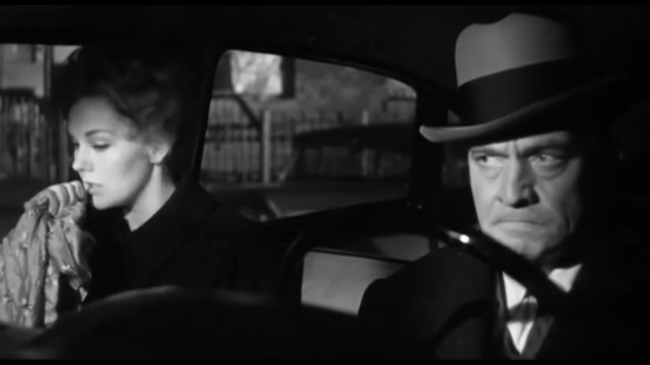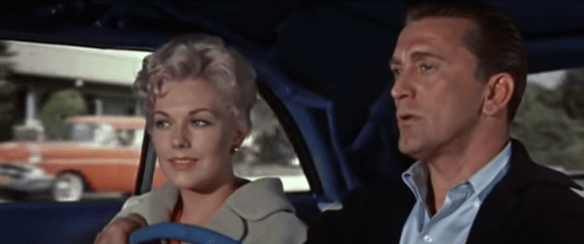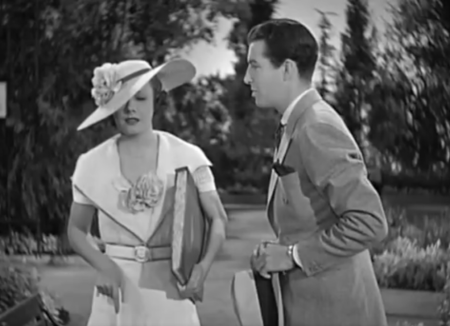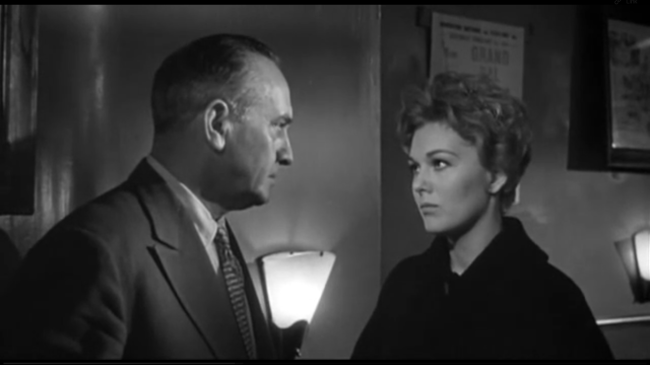
Strangers When We Meet (1960): Kim Novak and Kirk Douglas

Screenshot 2020-02-10 at 90848 PMRichard Quine’s Strangers When We Meet proves to be a Technicolor feast on par with much of what Nicholas Ray, Douglas Sirk, and Vincente Minnelli were putting out at the same time. A lot of the immediate joy comes with getting a feel for life at the time.

Certainly, it’s done up and made into a polished Hollywood middle class, but this serves the motives of the picture. In the meantime, we can busy ourselves taking in all the sights from the bus stops to the grocery stores, the cars, and all the mundane accents of life circa 1960. These would be all too easy to take for granted if not for the fact we are so far removed from that generation.

Kirk Douglas (who we just lost last week at age 103*) is an architect of some repute and though he doesn’t quite have 2.5 kids, he’s living the American Dream. He has a good job, a beautiful wife (Barbara Rush), and his latest project is being drawn up as we speak. Being a product of Douglas himself, Larry Coe is not about to have his vision compromised, and he’s imbued with a dogged bullheadedness evident in all facets of his life.

Kim Novak, in one respect, feels out of place as a suburban housewife and a mother. It’s not her obvious character type with that husky voice and golden allure of hers. And yet this dissonance serves her quite well as a woman who feels trapped and unfulfilled. The stoic aloofness she could always propagate says everything we need to know about her.

In her day, Kim Novak was seen as the answer to frisky and enticing Marilyn Monroe because while still alluring, she is also the antithesis. While neither is particularly far-ranging in their parts, their fundamental approaches are so very different.

Novak’s register is so low and, in a word, reserved. It’s nothing compared to Marilyn’s sing-song quality, but in a film like Strangers When We Meet one must wager it works far better. Even as she hardly feels like the domestic stereotype — as Marilyn does not — it somehow fits her prevailing qualities.

As Strangers When We Meet sets up its world and the relationships orbiting throughout the story, it becomes apparent the movie exhibits another facet of suburbia that complements Bigger Than Life, No Down Payment, or even Rebel Without a Cause. It’s this idea that even within these perceived oases of middle-class comfort, there is still a myriad of anxietieties and discontentments causing fractures at the seams.

Whereas Novak’s husband comes off as a loveless prude, Barbara Rush does her best to make the most of her marriage, romance, and all. She’s the one we feel the most sympathetic towards as it becomes all too obvious she might very well become collateral damage.

Because with two pretty faces as renowned as Kirk Douglas and Kim Novak — no matter who their spouses might be — we have a premonition that they will be getting together in some way, shape, or form. These are the unwritten rules of Hollywood moviegoing. 

I wasn’t considering it at the time, but they first cross paths at the bus stop because their boys are friends. It’s Innocent enough. Then, it’s the aisle of the grocery store. Larry stirs up the courage (or the brashness) to invite Maggie to see his latest work project.

If we wanted to be purely critical of the man, we could say he is taken first and foremost by her extraordinary beauty. Though I feel like his wife is lovely in her own way. The movie suggests there is a bit more to their affair.

It begins because Maggie seems to understand him; she seems to encourage him in his work — to be genuinely impressed and interested in what he does. Maybe it strokes his ego, makes him feel more important, more heard than he’s felt in a long time. If it’s true of Larry, the same holds for Maggie as well. This coalescing of passion is what brings them together.

Walter Matthau is initially underused and yet with his telling look and a few words, he can insinuate even more into this story. I’m thinking in particular of the moment he tells his neighbor, “We’re like furniture in our own homes. Next door we’re heroes.” He senses the angst on the surface and no doubt suspects the fire burning between Larry and Maggie.

It comes to a head during a dinner party Larry’s wife puts on. There’s a sense this is her admirable attempt to win her husband back, in their social spheres with their friends, and then later, behind closed bedroom doors. Because she’s not blind; she can see her man drifting away from her, and she’s not going down without a fight.

These inferences remain out on the fringes suggesting the wants and desires of the men and women even as guests drone about crabgrass and how all women dress the same these days. You have to look beyond all the obfuscation to appreciate the sequences for what they are.

Take, for instance, the striking scene where Novak goes into the bedroom to pick up her coat only to see the intimate space, her face in the mirror — and wish it was hers — wish she could be sharing it with Larry. In the same sequence, she happens upon his inquisitive young son. When he asks her name she responds with “Maggie” — the name his father calls her — that’s somehow more intimate and more a measure of who she is as a human being.

Ed Mcbain’s script is not at all squeamish about melodrama. The apogee comes when the sleazy Matthau gives Larry a taste of his own medicine charging into his home while he’s away and making clear advances toward his wife. His actions seem to defy logic.

Is he merely doing this to stir up Coe or is it a genuine play for Eve’s affections? I’m led to believe it’s the latter because as it happens, it’s a devastating confrontation, even as it teeters on this unnerving precipice. We feel for Rush, victimized like she is really for the entire movie, but here it all stands right there in her living room. Even for an instant, she feels so completely vulnerable.

The rain pouring down outside acts as a sympathetic indicator if not only a torrent of renewed drama. The overstimulated soundtrack doesn’t do the performances any favors, but they leave a melting impression; we must ponder the outcomes.

Because affairs can rarely maintain the status quo. Their very definition makes them into this novel entity in one’s life breaking through the presumed drudgery of the everyday. But there comes a point — a slip-up or a guilty conscience — where they must be brought to light.

Douglas spends the majority of the movie constructing his latest cutting-edge home for a gabby author played by Ernie Kovacs. It’s apparent this yet-to-be-finished structure is a metaphor for his life — his hopes and aspirations outside of the conventional suburban life he leads.

He finishes it too, fully realized in all its glory, and still, we watch Kim Novak drive off on her own. This isn’t Picnic. There is not even a faint flicker of hope of a reunion some miles off in the distance. This feels like a permanent departure. Where the characters have chosen the so-called “noble thing,” to preserve their families in lieu of their own private and clandestine fantasies.

The completed space is a bit like Mr. Blandings Builds His Dream House except it’s for a life (and a woman) he can never hope to have. It’s heartbreaking for any number of reasons. Not merely because they cannot be together. The layers go further. You wonder if their families can ever heal. How will this affect their children? What about their spouses? Is this just a temporary salve that will fail years down the road? We have no way of knowing. They are the ones who have to live with their choices.

3.5/5 Stars

*Note: I originally wrote this review soon after the passing of Kirk Douglas on February 5, 2020.

Down By Law (1986): An Offbeat Jarmusch Noir

Screenshot 2020-02-26 at 65844 PM

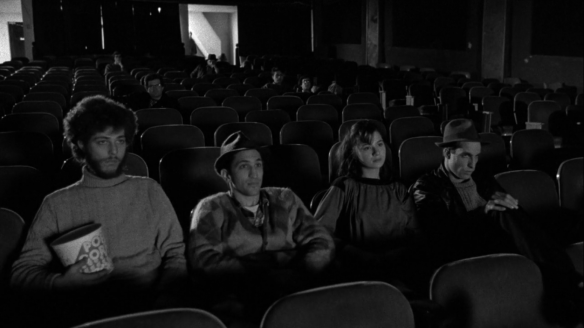
A raspy vocal emanates from the screen verging on spoken word as it sings to a mambo-infused rhythm. Casual tracking shots lead us by the local architecture at the pace of a car ambling along on a Sunday afternoon. I only confirmed after the fact this is Tom Waits singing his tune “Jockey Full of Bourbon” from an earlier album.

These are the streets of Louisana, and the man helping to capture these glorious, sweeping shots is none other than Robby Muller (probably most famous for his work with Wim Wenders). His partnership with Jim Jarmusch was just being established and it would continue well into the ’90s.

This is the opening prelude of Down by Law if you will. Because the real intimate stretches of humanity — at least the ones dwelling in this story — can be found in the dirty, dilapidated interiors and on the sketchy street corners. It’s these bombed-out, grungy aesthetics giving the film its layers of instant character.

Muller’s cinematography is an immediate asset and no matter the subject matter within the frame, he makes it feel captivating and strikingly beautiful, whether it’s a street corner, a jail cell, or a boggy bayou. We’re drawn to keep watching and relishing his images.

John Lurie is a pimp who feels like a nobody. He tries to act big only to get sucked into the shadiest of business deals. Tom Waits isn’t much better off as a disgraced disc jockey. His girl walks out of him in a fit of rage, and he proceeds to go drown his sorrows.

However, first, he must gather up his shoes from the street below where they have been unceremoniously tossed. The inhumanity of Gene Pitney’s record (I think that’s him) cast out into the street says it all — both the mood and the crispness of the photography.

I’m not sure if Tom Waits is an actor as much as he’s an enigmatic personality exuding something we can latch onto as an audience. Lurie’s not altogether intriguing to me, but with Waits there’s something different — something we want to find out more about.

The manner of this off-beat noir is now fully established because the mood is the key when plot feels almost secondary even tertiary in importance. The dialogue is laughable, but somehow it fits into this world gladly mixing both style and sendup of the past. And yet it’s only the most affectionate homage to bygone years with its chiaroscuro, smoky street corners, and fedoras to fill out a modern underworld.

It’s the kind of movie where a guy will just walk up to you on a deserted street corner and offer you keys to a Jaguar and a wad of Franklins to do his dirty work for him. Sometimes the dirty work has strings attached.

Pretty soon Zack’s in the can and Jack’s with him. What a sorry pair they turn out to be. But there is eventually a saving grace. Enter Bob. Aside from being another tribute to Jarmusch’s wildly diverse casting tendencies, Roberto Benigni holds the film together with his charming personality.

He single-handedly redefines the tone of the movie making it into a kind of reluctant buddy movie. Because his instant good nature, loquaciousness, and limitations with the English language give him the powers to add something radically different to the film’s cocktail.

If he’s ever the butt of the jokes as the foreigner, more often he’s the movie’s champion, a force of joy and goodwill bringing together two bunkmates of the most cynical and standoffish sort. When they start their giddy tirade — yelling at the top of their lungs — You scream, we scream, we all scream for ice cream, it feels like “Moses Suposes” antics taking over the jailhouse.

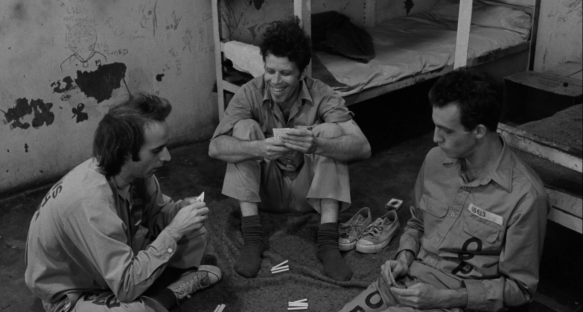
Even with the introduction of Benigni, there is this sense Jarmusch is once more working in these near-stagnant scenes involving shooting the bull or playing cards much like Stranger Than Paradise. It’s once more observational and altogether content in the idiosyncratic. The elliptical sense of filling the spaces in between is also surprisingly prevalent. The biggest example being, of course, the prison escape.

Tarantino would choose to not show the heist 6 years later in Reservoir Dogs. To some degree, Jarmusch beat him to the punch as far as genre deconstruction with a jailbreak movie missing its most crucial lynchpin. But for what he’s going for, it works wonders. It works far better by throwing away convention because he never rested on it, to begin with.

Soon they are fleeing through the bayou, then canoeing, then getting left adrift without any inclination where they are going. Thankfully, they find a bunkhouse in which to recalibrate (though it looks eerily similar to their cell). However, the real prize is when they happen upon Luigi’s Tin Top. In its own way, the restaurant is an oasis.

Screenshot 2020-02-26 at 8.03.43 PM

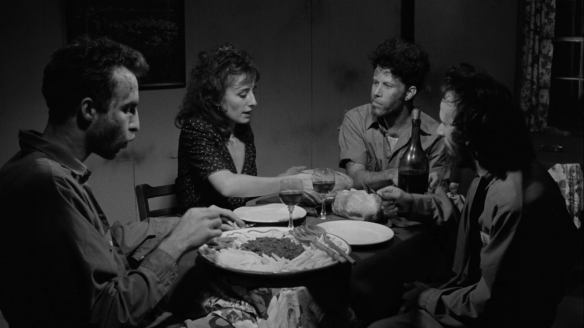
We had been through so much already, it completely slipped my mind that this moment was coming. It feels like a slice of serendipity. Here we have Roberto Benigni playing opposite Nicoletta Braschi as two Italians madly in love in the middle of nowhere. Again, they somehow operate outside the pervasive tone — the underlying stench — of the movie and its other characters.

However, what makes it feel fortuitous comes with context. They would wind up getting married 5 years later and remain so to this day as far as I know. Over a decade later, they would star in their most renowned foray Life is Beautiful, which pretty much bottled up everything disarming and magical about Benigni and enchanted the world over with its abundant good cheer and tenderness.

For now, they dance cheek to cheek in a lonely restaurant out in the boonies. It’s inauspicious while signifying something so much more. We leave them knowing they have a rewarding life ahead.

In the final moments as Lurie and Waits walk down the path, trees on either side, I couldn’t help but think of one of the greatest, most atmospheric noirs: The Third Man. Except as Jack and Zack split off at the fork in the road to forge their own paths, we can’t help but be reminded of Robert Frost.

Because Jim Jarmusch might as well be summed up as such. A noir aficionado with the sentiments of a poet. Down By Law is not quite bombastic pop culture pulp in the mode of Tarantino. There’s a distinct artfulness there that still never quite loses its idiosyncratic yearnings and inclinations.

4/5 Stars

Stranger Than Paradise (1984) and Jim Jarmusch

Screenshot 2020-02-17 at 3.40.27 PM

One of the most revelatory aspects about becoming more familiar with Jim Jarmusch is how international his films are. At the very least, there’s this sense of them putting a lens to a broader cross-section of society.

He is unequivocally American, but whether it’s because he’s a cineaste or driven to a global perspective through music or other interests, he paints with a canvass broader than simply the American experience. He also seems to understand the American experience is framed and colored by those who come to us. In fact, we are a melting pot, as Alexis de Tocqueville once noted, made up of all nations.

As a storyteller, Jarmusch seems drawn to what I’ve heard termed the “mearcstapa” — the border walkers — people on the outskirts. They could be expatriates, foreigners, or people who simply conceive of the world in a different manner than you and me. Although the term is recontextualized from its Medieval connotations, it does take on renewed meaning. In the case of Stranger Than Paradise, it’s a visitor from Hungary.

But if any of this dialogue runs the risk of making the story sound too rarified, rest assured, it is far from that. It’s a picture content in the simplest of moments. The plot as it were is born out of a statement. Eddie (John Lurie) has a cousin arriving and visiting him from Hungary. That’s it right there.

He feels put upon having her stay with him. He doesn’t show her the town. He doesn’t give her food. He’s the most inhospitable person in the world. But then again look at his life. He subsists off TV dinners and beer.

His only friend is Eddie, a shifty-eyed, flighty fellow who’s half-witted in a lovable kind of way. They spend time watching football, playing cards, drinking beer, or going to the races. That’s just about all they ever do. And it hardly changes with the addition of Eva.

Still, what the movie exudes resolutely is a style and an aesthetic, forming something more substantial than the sum of its modest parts. Because it’s certainly humble, and the antithesis of flamboyant production values, and yet it manages to supersede the simple nature of what is happening onscreen.

Take, for instance, the sequence where Eva is walking down the streets with her suitcases in hand to the tune of “I Put a Spell on You.” Screamin’ Jay Hawkins rumbles across the pavement, and it’s oddly mesmerizing.

Pairing this with the black and white cinematography, dominating the film with a dreary, dilapidatedness leaves a startling impression. It’s both the prevailing sense of the world and somehow complementary to the budget and resources he’s working with.

I am reminded of the early films of Rainer Werner Fassbinder because there is the sense of almost two-dimensional space in many of the scenes — simple but purposefully done. In the case of Jarmusch, there are hardly any cuts, with the shots put end-to-end and void of any other type of true editing. It’s the simplest form, really, cut together by way of black inserted between the sequences.

You could point out Jarmusch is making a kind of glorified short film, and that’s how the narrative began sticking the footage together in three segments. But the black in-between the visuals also function as a kind of ellipsis.

Because pretty soon Willie and Eddy get up and go from Brooklyn and road trip it out to Cleveland. Why? Because Eva’s there. She is a fellow sojourner, and so they take to the road in order to catch up with her. In one of his typically dorky observations, Eddie tells his buddy, “Before I met your cousin, I didn’t know you were from Hungary or Budapest or any of those places. I thought you were an American.”

Pretty soon they’re staying with the Aunt and back to watching TV and playing card games. Shooting the bull and chewing the fat like they always do wherever they go. Even miles away in the icy tundra of the Midwest they realize, “You come someplace new and everything looks the same.” Restless for some meaningful experience, they head off to sun-soaked Florida to seek something else.

Finally, there’s some action, albeit off-screen and pretty much only alluded to. The boys lose all their dough at the dog races. In her own absurd turn of events, Eva winds up with a mother lode in drugs. That could be a whole rabbit hole all to its own. Instead, they take a trip to the airport to set up another adventure…undoubtedly just as absurd as the last.

It might not seem like much, but that’s the entire charm of Jarmusch’s movie; he’s so very comfortable bending away from Hollywood convention. Where location shooting becomes more of an in-joke than of a particular commodity and characters and story are more likely conduits of style. In fact, to this day, he’s made a career out of it.

Now, Stranger Than Paradise feels a bit like Richard Linklater’s Slacker. They played as important catalysts for subsequent generations of filmmakers because they were unique and of their own time with their own vision. And part of their merit is having done it first — using the world at their disposal and creating something that stays with us however mundane and unadorned.

Part of the paradoxical charm of Stranger Than Paradise is how you could conceivably make a movie like it, and yet you couldn’t ever match its essence because Jim Jarmusch made it just so — distinctly individual and measured to his own personal liking. That’s what it has going for it even to this day. It’s unmistakably him.

3.5/5 Stars

Midnight Special (2016): A Story of Parenthood

Midnight_Special_(film)_poster

“These are words of the Lord…or the federal government.”

Derek Webb has a song called “Spirit.” For anyone with a religious upbringing, it might conjure up the “Holy Ghost” — the Helper meant to fill up Christian faithful as they worship God in their sanctuaries.

Webb is banking on these presuppositions when he turns the tables. Because of course, he’s talking about alcohol, and the gathering — the sanctuary he’s worshipping in — is a bar.

Watching Jef Nichols Midnight Special relates to this example for one very simple reason. It has the environment, even the rhetoric or liturgy many might recall from Sunday church services, and yet it’s been given an entirely new context. It suggests what a nefarious and deceptive thing cults and other dubious institutions might be by taking something so familiar and giving it their own tilt.

In this case, “The Ranch” is such a consortium of people; they feel like Luddites or Amish but given a bad name. Their head minister is Sam Shepard. His presence alone brings with it a bevy of connotations and previous traditions. Of course, he was famously featured in Terrence Malick’s naturalistic masterwork Days of Heaven. Shepard also helped conceive of Wim Wenders’s Paris, Texas, another catalyzing portrait of the near-mystical American mythos.

At least for me, there’s this implicit hope Midnight Special might be out to do much the same, having received the torch from its predecessors and then preparing to pass it on. Also because Jeff Nichols feels like one of the modern chroniclers of Middle America steeped in these same deep traditions of the past.

After all, we open in a roadside hotel room with an amber alert playing on the television. A little boy has been kidnapped and taken by two fugitives. Nichols uses these talking heads throughout the movie to do much of the expositional heavy lifting for him. Just about everything else he leaves oblique, and he seems satisfied with the overall vagueness.

In fact, the plot keeps the details purposefully obscured. Whether they are too obscured might be up for contention. All we know is this boy is being sought by a myriad of parties. He is in the care of a pair of fugitives with a conscience; it provides an inkling of who is really on the side of virtue in this muddled world.

Their names are Roy (Michael Shannon) and his faithful buddy Lucas (Joel Egerton). They can be characterized by their slow-walking, slow-talking demeanors — almost painfully so, but, again, maybe that’s the point. It’s excruciating to watch them.

They’re the ones being tracked by not only all manner of government agencies but members of the same cult that they used to be associated with. Their young charge is the prized possession of “The Ranch,” functioning as their presumed Messiah. March 6th is when they believe Judgment will come once and for all, and the day is fast approaching.

Meanwhile, the FBI swoops in on one of the religious commune’s meetings, only to clear the premises entirely. They conduct their own investigations of this extraordinary young boy, Alton, who seems to have transmitted government secrets. The NSA joins them in their search represented by a nerdy numbers-cruncher Paul Sevier (Adam Driver).

As played by Driver, he feels like a surprisingly average guy and if we are to understand anything about tropes, this is what makes him the key to the story. Because everyone else is clouded by protocol, rules, and regulations. The fact he is brilliant but also a lot like you and me, gives him the tools to understand other people and connect with them.

In some ways, they play on analogous themes to Arrival — simply wanting to understand those who are different than us. Leading with curiosity instead of fear. But he’s also a character who seems to function outside of everyone else in society. Rather like Truffaut in Close Encounters. It  almost feels like he has a higher calling altogether superseding convention.

To go with these other themes is a central idea of parenthood reminiscent of other stories bursting with all sorts of religious archetypes in their own right. Abraham loving his son dearly and yet being willing to give him up. Mary realizing her son was made for something far more than a temporal world. Even the Christian God who is acknowledged as giving up his only son for the sake of the entire world.

Roy is just a simple sort of fellow but he’s devoted to this boy believing his son has a purpose if only he can be protected. As Lucas muses, “Good people die every day believing in things.” Kirsten Dunst is the mentally exhausted mother who has been starved of the opportunity to love her son. It’s telling to watch her get him back only to struggle with the impending conclusion of the arc.

These elements are the most provocative of what the film has to offer, although they feel slightly underexplored in favor of a far more conventional Spielbergian homage. These are the tried and true even overfamiliar rhythms of sci-fi seen through the lens of Nichols. From the child-like perspective down to the government involvement, it’s a tale fit to the scale of an E.T. or Close Encounters.

Even as the performances of Midnight Special feel head and shoulders above Super 8, the other film somehow captures a bit more of the nostalgia and, dare I say, the childhood wonder of the Spielberg films — at least until Midnight Special‘s very last moments. Here it exterts itself as a bleak, bare-boned reimagination of the genre.

At the end of the day, maybe Jeff Nichols wasn’t entirely interested in any of these things. If anything, they all serve as part of his meditation on parenthood. Because when you take away all the dressings — the religious undertones and layerings of science fiction — what you’re left with is a fairly straightforward narrative.

It’s about knowing your child is special and wanting to protect them and hold on while slowly coming to grips with reality. You cannot always be there. You cannot always keep them from being hurt. And sometimes you have to let them go. Sometimes that’s the most loving thing you can do.

I’m still trying to decide if Midnight Special does an adequate job articulating all its things or if it’s merely me projecting my thoughts and feelings onto it. They might be one and the same. Regardless, I wasn’t fully satiated by Midnight Special, but does that really matter? Perhaps it is a litmus test of whether or not we have the true perspective to appreciate it. Who’s to say I’m not already too jaded to latch onto what it has to offer. I’ll let you be the judge.

3.5/5 Stars

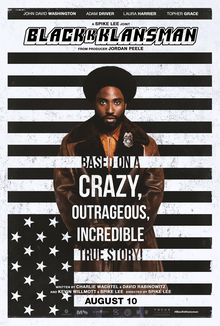
BlacKkKlansman (2018) and Historical Dissonance

BlacKkKlansman

Spike Lee is an incredibly intelligent and perceptive director so he probably knew what he was doing. However, when I see Alec Baldwin playing a virulent racist, spewing out slurs, there’s this odd contradiction. Somehow it loses its import if that is what it was meant to have. Because I know the man behind the mask is an avowed progressive. However, this dissonance, thanks to the extratextual association, might be equally compelling for different reasons.

Our actual narrative is based on a true story, albeit delivered in Spike Lee’s own definitive way. We open at Colorado Springs Police Department. Confident and ambitious Ron Stalworth (John David Washington), with a fly Afro, is looking to make a name for himself as a detective. Even in a place like Colorado, it’s a fairly big deal as they’ve never had another African-American police officer.

He will be the precincts Jackie Robinson, and he doesn’t bear the responsibility lightly. Still, he has the youthful entergy to take to the opportunity quickly. For one thing, he’s not looking to be stuck behind the records counter his entire life. He wants action.

His first taste — and his first real assignment — is infiltrating the rally held at the local college for Kwame Ture in order to keep tabs on local “subversives.” These are the days of Angela Davis, mobilization of university movements, and certainly The Black Panther Party. As such, it places Stallworth at a consequential crossroads of history. He plays peacekeeper on the side of law and order, while also looking to change the world from the inside for his “Brothers” who are rebelling against “The Man.”

It strikes me that the conservatives look at something like this with fear. Nixon catalyzed this very same silent majority with his exhortations. But both sides aren’t altogether different — at least how Lee manages to capture them. It feels like Patrice Dumas (Laura Harrier) and other ardent activists, with all their yelling and the raising of their hands in black power salutes, ultimately comes out of a place of restlessness, even helplessness.

Because out on the freeway, they get pulled over, berated, and harassed in the most denigrating of ways. Where whites are given unchecked authority over blacks and thusly abuse their power and the frameworks of society. This is what Ron Stallworth is at war with.

Lee composes the scene in such a telling manner. Because it opens with a song — one I know well and love for its cool vocality — and it’s set against the soft hues of a California panorama only to quickly evolve into the roadside confrontation between white cops and black citizens. Once more the director is working in formalistic contrasts that only help to deepen the disparate ties of his story.

However, he’s also a consummate world builder and not merely in creating a fantastical space, but also by taking us back somewhere we feel like we formerly knew. Looking Glass’s “Brandy” underscores another scene where Ron and Patrice are having dinner together, continuing the vibes, and for me personally, helping to accentuate this sense we are being transported into the ’70s.

All this lays the groundwork for what is at the core of Blackklansman. This is the next phase: infiltration of a different sort. Ron Stallworth will get inside the Ku Klux Klan. Of course, there are a few logistical barriers. Namely, the fact he is very much a black man. It’s an easy enough solution.

He builds up a rapport with none other than the Grand Wizard, David Duke (Topher Grace), on the phone using his “white voice,” while one of his Caucasian colleagues (Adam Driver) plays a version of him in person.

Again, the wink-wink parallels between Donald Trump and David Duke are put right there in case anyone should absent-mindedly miss them. Duke too wants to make America great again. It is what it is.

Still, one of the film’s best dynamics is built between the trio of Washington, Driver, and Steve Buscemi because, in spite of their differences, it helps them drum up an electric camaraderie. Aided by Zimmerman (Driver), Ron goes deeper, gaining the confidence of the white supremacists’ gradually, even as incessantly mistrusting types like Felix (Jasper Paakonen) always seems to be testing not only his loyalty but his mettle. It has the seeds of tense drama.

Certainly compared to the timeless visceral nature of Do The Right Thing as a human, social, and political indictment, Blackkklansman is no match. But despite his reputation and political bent, Spike Lee does ponder the dichotomy here as well. You have those striving for militant black power. You have those trying to hold onto the egregious relics of white supremacy. There are the complacent who see the bigotry and fail to do anything about it, even within law enforcement.

Ron is easy to gravitate toward as a hero because he is an African-American man looking to revitalize the police force and their often tarnished reputation. But thanks to Washington, he’s a genuinely charismatic, mostly not-threatening lead. Meanwhile, Duke embodies the ideas of white supremacism going mainstream and somehow becoming palatable, which is a far scarier thought.

But this is equally a story about identity. How we as human beings can be so blinded and narrow-minded. We are a people devoted to rituals and heritage — the way things have been. Where passing as white is seen as a superior outcome and many of us, no matter our background, are juggling identities. For instance, how do you reconcile being African-American and a police officer? It’s just one of the many questions. 

One of Lee’s other evocative exhibitions in crosscutting starts with Harry Belafonte as an old man recounting the horrible lynching of his youth to a rapt audience of mortified onlookers. Then, on the other side of the spectrum, we have the KKK assembly where David Duke makes his grand entrance to install “Ron” as a Klansman.

It’s a visual clash once again between White Power and Black Power. As a caveat, D.W. Griffith’s Birth of a Nation is a movie I have avoided for so long out of sheer apprehension. Not that I would succumb to it, but rather that it would repulse me. Not because I’m some enlightened being; it might actually force me to contend with complicated history. Because Nation as well as Gone with The Wind reflect how cinema itself is so firmly enmeshed with the ignominious prejudices of our nation.

And as such a powerful medium, it can be used to propagate and promote all sorts of messages. I’m not naive enough to believe Spike Lee is the universal soothsayer, and yet I appreciate how he’s willing to confront the issues that run generations deep in the very medium he calls his own.

My mind instead drifts to the very poignant and purposeful inclusion of Belafonte. Here was a man who acted as a cornerstone of the civil rights movement. Here is the man who fought tirelessly for greater, more complex representation for African Americans in movies along with compatriots like Sidney Poitier and Ruby Dee.

Here is a man at the center of a controversy in the 1960s because, Petula Clark, a white woman caught up in the raptures of their duet, touched his arm on live television. What an unfathomable world we live in. Again, we must question: how can this be?

It galls me there could be people who equate Christianity and “Men of God” to purely a white faith. However, it’s imperative to differentiate that the themes are not solely about holding white people accountable for past sins but actually ousting evil for what it is, then and now. It’s so easy for early-onset complacency to set in. The film’s line in the sand between the then and now isn’t exactly perfect, even as the presence of the real David Duke in the present bids us to take heed and consider soberly.

Blackkklansman is the kind of film you have to consider in light of all the many hallmarks we can laud Spike Lee for. It’s dynamic, boasting its share of humor; at times it’s brutal and trenchant in all manner of ways, slicing and dicing through its material to present us a singular vision and with that an ensuing message.

The story itself makes a brilliant punchline. Imagine. A black cop infiltrating the KKK! The final images are all but a living nightmare.  What makes the film is the continuously startling juxtaposition on display. This is what Lee offers us.The heavy lifting must be done by the audience, working to reconcile and wrestle with the space in-between.

4/5 Stars

Paterson (2016): Poetry in Everyday Rhythms

paterson 1

“Awesome. A bus driver who likes Emily Dickinson.”

This sincere pronouncement comes from a young girl — a fellow poet — as she leaves to go off with her mother and sister. She leaves behind Paterson (Adam Driver), a pensive bus driver, sitting on the brick wall, having gifted him one of her poems. Theirs is an instant connection. One of appreciation for observation, for words, for beauty.

Paterson is ripe with moments like this ambushing us with an understated resonance. Scenes of kindred spirits seeking each other out and finding some meaningful common denominator that they can relish together.

Jim Jarmusch feels like a man born of a different era — the last bastion of the old way. There are other directors who are older and more storied like Martin Scorsese or Clint Eastwood perhaps, but he is learned and the disciple of some of the great cinematic artists of the 20th century. We’re talking about titans as diverse as Robert Bresson, Nicholas Ray, and Sam Fuller.

He understands space and framing, how they define a composition. He’s not afraid of time or silence and how they can build into something revelatory. Normally, his creations might be defined as off-kilter and individual. He was very much at the epicenter of the indie film movement that revamped in the 80s. In fact, the true glory of Paterson is how pedestrian and how plain, how ordinary, and how pleasant it feels.

It’s actually not Emily Dickinson but William Carlos Williams who is Paterson’s favorite poet. There’s a self-reflexive nature to it. I know little about Williams work aside from the fact he has an epic poem called “Paterson.” And it’s true our story takes place in Paterson, New Jersey, where our main character acts as a stand-in for the town (and the poem) he shares a name with.

It’s an observational film just as Paterson is a man who watches the world passing by, existing all around him, as he drives his usual route. He is not someone the world normally esteems as an artist; he is a humble blue-collar poet. He fills up his days listening to conversations about Hurricane Carter or between a pair of high school anarchists (a nod to Wes Anderson’s youthful lovers in Moonrise Kingdom).

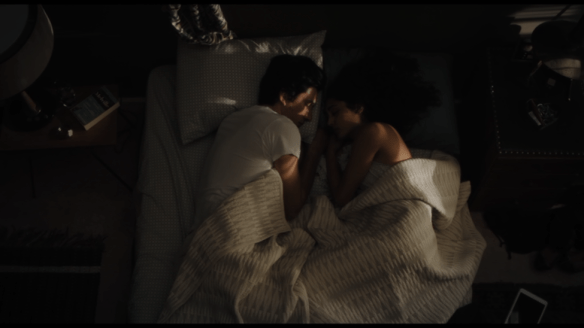
There’s not an antagonistic bone in the man’s body, and the movie happens to deliver a particularly warm portrait of marriage. As he spends his days working and nights tucked away writing or walking the dog, his wife (Golshifteh Farahani in a marvelous piece of casting) is swept up by dreams of cupcakes and country singing, even as she supports his writing. She is both the antithesis and the utter complement to Adam Driver.

Laura coaxes him to share his work and get it out so people can enjoy it as much as she does. Her palette and interior decorating are dominated by black and white, and she revels in her side hustles. Whether or not she becomes some great culinary or country music star seems immaterial. Paterson gently reciprocates the encouragement abounding in their household and what remains are modest joys.

The story is not beholden to typical structures of narrative. Although it does have something in common with the creation poetry of Genesis, working in the rhythms of the week in an unflustered, unhurried manner. There’s a tranquility to it all, displaying the innate power of habit and routine

Like clockwork, he goes out to walk the dog, a bothered bulldog named Marvin. We never ask to know why he does it. It’s become a kind of established fact. Just as the nightly stop at the bar to chew the fat happens. The conversations cover local heroes like Sam & Dave or Lou Costello. It feels inconsequential but somehow pertinent to the kind of syntax and meter the story is looking to evoke.

The poems read throughout the movie by Adam Driver in a deliberate, partially stunted diction are much the same, exhibiting this kind of straightforward, no-frills lucidity. He rehashes and molds them methodically before jotting them down in his hidden notebook. In fact, they are penned by Ron Padgett, a writer deeply admired by Jarmusch himself.

As someone who has dabbled in the art, you respect people who are brazen enough to become untethered from something so comforting as rhyme. Because rhyme gives you some sense that you are creating something beyond prose. It takes a braver, more audacious soul to strip it down and make it so closely reminiscent of normal everyday language and yet articulated and manipulated just enough that there is no recourse but to call it poetry.

Likewise, the dialogue throughout the movie is not realistic in nature. The words feel specifically chosen — very particular — not always right or real but given to their own cadence. There’s something so refreshing and freeing about it because it allows us to live our lives and feel they have meaning and significance in their very ordinariness.

Akin to the security guard in Museum Hours, here is a man living for more than a paycheck, and they both seem to see beyond the normal things that distract us — to somehow come to terms with beauty in the most extraordinary of places. And by this, I actually mean the ordinary places where others fail to look or cannot see.

I realized halfway through, Paterson has no cell phone; it’s part of what plants him into an altogether different era and makes him feel like a man Jarmusch might admire and heartily identify with. He lives a simpler, some might say, purer life without white noise and distractions.

However implausible, the moment that feels like a climax truly does burn deep, speaking as someone who has devoted a lot of time to writing — much of it unseen by the external world. To lose your work is a horrifying thought, but it also serves as a reality check.

It’s not so much devoting time to writing but having enjoyed the process — being able to uncover and appreciate and put words to what you have been so privileged to experience as a living, breathing human being. If we write and create merely to be remembered, it will never satiate. How much more can we relish the process if we enjoy every rhythm?

Because it’s exactly that: a process. As another character who traverses a tough world of his own admits to Paterson, “The sun still rises every day and sets every evening. Always another day.” It’s inevitable and a bit of a final exhortation — to Paterson and to all of us.

paterson 2
The final scene is the kind of cinematic loveliness you find in a certain brand of movie — the Museum Hours and the Columbuses of the world. Where there are interactions that are amicable, pensive, and beautiful.

They need not be rife with conflict or gargantuan stakes. They are found compelling for the mere fact they drink deeply of the wells of mankind and speak to who we are as people. Crossing cultures and borders and time and space to fuse human beings together.
It could be art, it could be architecture, it could simply be the need for human contact.

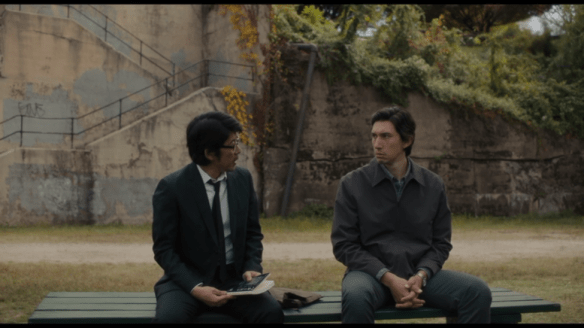
Here it’s poetry. A Japanese sojourner (Masatoshi Nagase) sits down at a bench with Paterson, and they share what can only be described as a moment — albeit a cinematic one — and it’s exquisite in all its unadorned subtleties.

We need one another and we can light the fire under others providing inspiration, hope, and subtle encouragement. Far from entertaining angels unawares, it might just as easily be that we can give a lift to a burgeoning artist or at the very least an unassuming one.

If nothing else, Paterson is a stirring reminder and a quiet call to appreciate and cultivate the beauty around us. We are in it together. Art need not always be a profession. Sometimes it fills the spaces in between bleeding out of people’s lives because they know no other way. They cook for sheer passion. They play music because they have to. They write out of some otherworldly compulsion.

This is art at its most elemental form, and we are all better for it. Paterson reminds us about the rhythms of life and how everyday ordinariness can be magnificent and more than worthy of our creative energies.

4.5/5 Stars

Till We Meet Again (1944): Directed by Frank Borzage

Till_We_Meet_Again_poster

This is my entry in the CMBA’s Hidden Classics Blogathon!

The movie is built out of the opening juxtaposition. A youthful nun with an angelic countenance (Barbara Britton) lifts up supplications to her triune God asking for prayers on their behalf — herself and the host of children and other sisters around them.

Their daily discipline is disrupted by a commotion down the road — Nazi soldiers firing after fleeing prisoners. It’s a signifier of tense times, but very real and pertinent ones in a French village plunged deep into Nazi occupation.

One of the girls asks Sister Clothhilde, “What happened outside?” All she can manage in response is that she doesn’t know, nor does she want to know. It suggests the core tenets of her character, maintaining all levels of religious piety, even her own serenity, above all else. She’s cloistered from the outside world.

Because it’s true the convent walls provide a buffer — a peaceful asylum — and for someone like the young sister it’s all she’s ever known and all she’s ever loved. Sister Clothilde is generally content with the amiable life of a nun, taking care of the young children in her dormitory with warmth and diligence. That could be the end of it right there, but as this is a movie, of course, there must be more.

The Reverend Mother has a rather pointed distaste for the Germans (enduring three wars will do that to even the most generous of spirits), but she and the local Major Krupp maintain their etiquette amid obdurate conflict. He has orders to make a search for runaway prisoners, and she is adamant about not opening her doors. For a time they can play the game easily enough, and Sister Clothilde can remain equally ignorant of the world outside.

However, all of this changes with the appearance of a wanted American pilot carrying vital information for the local underground. He all but appears out of nowhere, happening upon the sister quite by accident. In the darkness and the solitude, there is something strange outlined around them. It’s not menace nor romantic melodrama exactly but a yet to be discovered facet in their relationship.

Milland, terse and paranoid, wants to get to his contact and the sister wants nothing of his world. Ultimately, she has no choice but to become a part of it. There is no one else and so she instantly finds herself giving up her small comforts for a mission of immense peril that, coincidentally, takes her outside the walls she’s grown so accustomed to. She goes from a woman of faith to a full-fledged civilian on the outside, given a new name — that of Louise Dupree — and betrothed in marriage.

If there are all the nuts and bolts of a cloak and dagger thriller, these are never a part of Frank Borzage’s primary agenda. After all, he is a far cry from a Friz Lang or an Alfred Hitchcock. I’m thinking of Ministry of Fear or even Foreign Correspondent in particular. Also, although it’s not as robust as The Mortal Storm, Till We Meet Again becomes both an extension of that world and its themes courtesy of screenwriter Lenore Coffee.

What’s evident is Borzage’s forever visible sense of this kind of high-minded naturalism. Where they can momentarily forget the task at hand, that is getting to a distant airbase and freedom, so they can help return a wayward baby bird back to its mother. Is there a need for such a scene? In a word, no, but in Borzage’s conception, this is the more crucial matter because it denotes something elemental.

Man’s duty is not only to his fellow man but to the creatures on God’s green earth. The director gravitates toward acts of care and goodness as opposed to the needless destruction as represented by the Nazis in their brutish, insensitive clumsiness.

Even as they travel together and “Louise” comes to know John as a most intimate friend, she learns a great deal from his assertions. That God is everywhere: reflected in acts of beauty, nature, the vows of marriage, and the goodness that crops up in any person who lives in this world.

It comes through thanks to Milland gushing affection about the marvelous intricacies of marriage between two human beings in intimate union, babies, jam in the morning newspapers, and tripping over the slippers. To her own astonishment, he speaks the words with a kind of devoted reverence. “You say it like a litany — a kind of prayer.”

But to those who think of Borzage as merely a starry-eyed dreamer, the movie is still compelling when they are forced to evade the Nazis, now trailing them with ill-intent and more precise intel. The sense of dread is immediate, and there are stakes.

In another key scene, after she’s done so much on this treacherous journey, the sister makes one false step. Smoke billows out from a dimly lit room, and she rushes toward it to sound the alarm for John to make his getaway. Instead, out steps an old adversary showing himself from under the shroud of darkness.

She is from thenceforward intimidated and threatened in a way that feels so real you can just imagine have it was used against so many victims before her. She has committed an act of treason, put herself beyond the protection of her church, and acted as an enemy of the German Reich. Under such duress, she has every right to feel hopeless.

Instead, she makes a personal judgment, a double sacrifice out of this transcendental love of hers. It’s not simply romantic love but love wrapped up with ideals and goodness that must be shielded from the Nazis at all cost.

They escape to England with Milland, and she lets him go gladly. But the second sacrifice is the Christ-like one. If I have to spell it out for you then the allusion means nothing nor the cross she holds in her grasp. You have to see it for yourself.

Although it’s sublimely sentimental and swelling with angel’s song, this simply means Till We Meet Again is yet another definitive Borzage picture. It’s somehow fitting he would trace the line of religious iconography all throughout the picture even as a woman learns what her faith means in all walks of life.

Far from trivializing it, her vocation feels richer, bolder, and freer than it ever was before. And yet with Borzage, he’s not so much a champion of religious ardor as he is a believer in the grandeur available in life for those who readily embrace it.

These large, esoteric, unsearchable concepts whether they be spiritual, transcendent, or in other ways ethereal are there for the taking. For a humble movie, Till We Meet Again gets swept up with the same scope. Importantly, it’s kept accessible by the candor of Milland and the vestal warmth of Barbara Britton. Because it is once and for all a litany — a kind of layman’s prayer.

4/5 Stars

Magnificent Obsession (1935): Stahl Vs. Sirk Again

Screenshot 2020-01-12 at 85221 PM.png

As I continue my mini odyssey considering the differences between the melodrama of John M. Stahl and Douglas Sirk, one of the finest exhibit pieces is an early scene in Magnificent Obsession.

The beloved Dr. Hudson has died because the life-saving pulmotor he needed was being used on someone else. An irresponsible playboy, named Bob Merrick, is saved in his place, having capsized his boat during one of his typically drunken evenings. It just doesn’t seem fair. One man so good is lost and the man who probably doesn’t deserve to live regains his life. It’s a rather blatant allegory of Christian grace and it makes sense, after all, Magnificent Obssession was supposedly penned by a minister: Lloyd C. Douglas.

Here is my long-winded point. This plays as a critical scene in Sirk’s picture. We see Merrick on the water and we see it happen right in front of us. However, in Stahl’s rendition, it’s all over and done with after a few throway lines of expositional dialogue between doctors. It’s as if he’s purposefully shying away from the drama. It’s this quality that might save Magnificent Obsession from being a total bore.

I never gave much thought to it before, but Robert Taylor makes a modest approximation of Rock Hudson a few decades earlier. One could say Rock’s career was far more successful and well-remembered, but they both manage the smart-aleck ne’er do well quite easily. In both cases, this was one of the early movies helping to put them in the public eye as legitimate star power.

Regardless, a curious dichotomy is purposefully set up by the movie, with one man unseen a beloved martyr, and another one alive, the incorrigible playboy. Dr. Hudson’s goodness hangs over Merrick’s life — haunting him in a sense — making him feel even worse about who he is as a person.

Soon he’s struggling with self-loathing. Although it feels more complicated than that because he’s still overtly narcissistic; deep down he knows everyone dislikes him vehemently.

It becomes a movie of who Merrick falls into company with after sneaking out of the hospital against protocol. First, it’s Masterson (Charles Butterworth) who might as well be his comic sidekick unwittingly carried away by all his mischief.

Next, it’s Mrs. Hudson (Irene Dunne) the beautiful young wife of the man he indirectly killed. When he actually finds out who she is he feels even more ashamed to show his face in front of her. He just wants to get drunk and try to forget.

Then, by some curious bit of Providence, he winds up at the home of a stonecutter. The man happened to be a close friend of Dr. Hudson. Similar to Sirk’s rendition, he imparts the wisdom the good doctor provided him. He was taught how to make contact with a source of infinite power. If you think this sounds like a seance and pseudo-science, you’re not alone. It feels like the strangest introduction of religion into the storyline imaginable with electrical energy acting as some mystical metaphor for God.

This layman makes another fascinating statement that might not sound all that foreign to us today. He’s not interested in religion but interested in Jesus — the God-man — who was so successful in the science of generating human power. It’s as if he was a mere humanitarian or an entrepreneur in human capital.

I always have trouble dealing with these kinds of expressions in relation to the Christian doctrinal claims. It’s not that it’s simplistic; rather it seems to totally disregard some of the things this God-man purportedly said. They feel radical, unsettling, incisive at times — surely not warm and fuzzy enough for a movie like this.

Still, this pseudo-Gospel becomes a journey to find people who need help and then giving it to them. But, of course, there’s a catch. You must give to others in absolute secrecy — it’s a scrooge-like endeavor and there’s some truth in this kind of altruism, still, it feels laughable even folly to call it a theory to be followed.

It’s a kind of pay-your-way to the good person’s club, whether you believe in the afterlife or just in being a good person in a legalistic sense. Either way, surely we can agree these strict parameters seem suspect.

Regardless, Merrick somehow gets swept up by them as he vows to put this “theory” into practice. He’s done so much to injure and totally destroy Helen Hudson’s life through his own selfish negligence.

However, in a strange way, it’s as if he’s in pursuit of his dead rival’s wife. Although it might be totally out of the goodness of a changed heart, he looks to reconnect with her, and give her life new joy. It all feels rather twee in comparison to Sirk’s update, which at least swells with the kind of grandiloquence which seems, at the very least, self-aware.

As much as I admire Irene Dunne as an unsung and ever adaptable talent and my mild affinity for Robert Taylor has gotten a boost in recent days, Magnificent Obsession is rather hard to take. It’s an outlandish drama full to the brim with preposterousness that doesn’t even attempt to court any semblance of reality. Similarly, its religiosity, romance, and just about everything else feels sugar-coated and simplified. Somehow it hasn’t maintained its flavor as well as some of Stahl’s earlier efforts.

3/5 Stars

Imitation of Life (1934): Stahl Vs. Sirk

Screenshot 2020-01-12 at 84419 AM.png

The opening shot of Imitation of Life is memorable for its sheer novelty and the very simplicity of the space. It’s not an establishing shot of a place or a person. Instead, it’s of a rubber duck bobbing in the bathwater as a little girl whines about wanting her “Quack Quack” off-screen.

This is how we’re introduced to single mother Bea Pullman (Claudette Colbert) and her daughter. A moment later, an African-American woman, Delilah Johnson (Louise Beavers) shows up on her doorstep having mixed up an address (in her defense I’ve mixed up some avenues too).

In a matter of minutes, they’ve decided to join forces. They both lack money and resources, but they gladly make do with what they have, happy to share one another’s company as they raise their daughters together.

Bea starts setting up a shop on the boardwalk armed by Delilah’s secret pancake recipe and her own ambition. One of the movie’s more troubling caveats is how Delilah has little ambition in life and proves herself to be perfectly content looking after Bea’s home as her friend gets all the credit for her family heirloom.

While Delilah remains content sinking into the periphery, with $19 to their names, Bea takes a risk on their venture. They have to rent out the space, get a fresh coat of paint up, and of course, you can’t have a restaurant without furnishings. She finagles her way into all sorts of deals and alliances — one of her newfound associates happens to be a typically jolly Alan Hale. However, it’s the nasal-voiced Ned Sparks who gives them the $100,000 idea: “box it.” Immediately their business takes off with a sustainable reach.

Auntie Delilah’s Pancake Shop is bustling with business. It has a certain antiquated charm to it. The image is a combination of Aunt Jemima and some of the more troubling images out of Jim Crow minstrel culture.

However, the most intriguing — and the most groundbreaking — aspect of Imitation of Life is how it grapples with questions of personal identity throughout its run. These are questions that still manage to challenge and perplex me to this day. My heart breaks for Peola. She is Delilah’s light-skinned daughter who is ashamed of both her race and her mother.

Even as Louise Beavers’s role is dubious at times, reminiscent of some of Hollywood’s worst portrayals, Fredi Washington represents the hardship for African-Americans trying to break out of the molds set out for them. There were rarely roles of strength for the likes of Josephine Baker, a Paul Robeson, a Lena Horne, or a Rex Ingram, parts that fully illuminated their talents.

As with the later adaptation, this becomes the most intriguing piece of commentary, particularly in this instance since Washington actually identified as black and was proud of her heritage never choosing to pass as white. Her real life played as the antithesis of her character even as it comments on the hallowed place being white had in American society in the 30s and beyond.

Their stake in the pancake game blows up and as the exulted mastermind, our heroine becomes the Claudette Colbert one might be more accustomed to, glamourous and good-humored as ever. Warren William makes his dashing entrance at the party, and they’re smitten at first sight. It’s a particularly amicable role for him beyond his typical hard-nosed Rockefellers, and he proves adept enough at the characterization even if it’s not too stretching.

The budding romance with the ichthyologist is amicable if the most humdrum part of the picture. As is the return of a precocious Jessie from school. She forms a crush on her mother’s beau and you can fill in the rest. More interesting still is Peola totally repudiating her mother and with it, her identity, foregoing a prestigious negro college by looking to pass as white and get work in everyday society.

These are the biggest issues on hand, and it’s all romance and family in line with much of Stahl’s melodrama. He is not Sirk after all. But what exactly does that mean? Because thanks to both Imitation of Life and then Magnificent Obsession, it feels like there’s a need to try and decipher the variations in John M. Stahl’s work compared to Douglas Sirk. If nothing else, it might help get him out of the other man’s shadow.

There are obvious distinct differences in content — Colbert’s pancakes instead of Turner’s acting — although many of the same narrative beats are present. Sirk obviously eclipses this drama through sheer decadence, color, and all manner of staging. He was the maestro of using near-trashy spectacle to subvert his material, making it burst with new ironies. However, his picture also feels updated to somehow fit so distinctly into the civil rights conversation of the ’50s and ’60s.

Stahl’s earlier version is more sedate and straight while still being imbued with its own burgeoning power. We have to take it more sincerely at face value. So in a sense, for 1934, the story certainly pushes boundaries, and Stahl is capable of drawing out the subtleties with the typically raw candor we might attribute to many of his movies from the period.

Certainly, Louise Beavers’ funeral doesn’t have the color nor a Mahalia Jackson dirge, but somehow, again, it fits into the context of the surrounding scenes. There’s still indubitable pomp and circumstance to the solemn occasion. We feel this intuitively. We witness the casket being brought out of the church and black men in uniform, armed with sabers, guiding the procession.

This image alone plays interference against all the images of Stephin Fetchit, Willie Best, Hattie McDaniel, and even Louise Beavers propagating stereotypes of mindless, weak, subservient blacks. It gives off this innate amount of dignity.

After you’ve seen Sirk’s version, of course, it’s difficult to go back — it’s true Stahl’s version pales in comparison — and yet you could say this is almost by design. It’s as if his predilection is toward anticlimax or at the very least cushioning the blows of melodrama in an arena where Sirk would lay it on thick for all its worth.

Thus, we end not on the hard-hitting tears of a daughter but gay reminisces of “Quack Quack.” It’s like we watched two completely different stories: The white family and then the black family. Maybe that’s the point.

3.5/5 Stars

Waterloo Bridge (1931): Pre-Code Edition

Screenshot 2020-01-11 at 82932 AM.png

Many might best remember Vivien Leigh and Robert Taylor in the 1940 version of Waterloo Bridge. It’s immediately obvious this movie has a very different flavor from the outset. It’s an earthier more boisterous version of Waterloo Bridge before the Production Codes took their axes to the original material.

James Whale’s camera pans across a gay gang of chorus girls on the stage — they are alive and bursting with perky energy — putting on a show for their patrons. Behind the curtains and after-hours, the girls maintain the buzz as they chat in their skimpy Pre-Code attire. One of their ilk is Myra Deaville (Mae Clarke).

It’s delightful how the camera takes such a shine to our heroine though it’s so obvious to see she might play second or third fiddle to the band of big wigs and aristocrats in the world at-large. She really does feel like a nobody far away from home. Still, there’s something to be said for her way of life.

As is, London has a lovely artificiality that we can breathe in and still enjoy as the characters amble along the streets with car horns and horse carts to go with the post boxes and street lamps.

Likewise, the beats feel raw and unkempt in a way the 1940 remake would never have dared or been capable of to begin with. Somehow it takes on a grander more chaotic scale in the hands of James Whale. And yet the characters and vernacular are more casual even familiar.

Douglass Montgomery feels like an honest-to-goodness callow soldier boy. He doesn’t have the slightest sense of what he’s gotten himself into and with anything he does, there’s a latent fallibility you don’t get with Robert Taylor. He never feels endangered in the same way.

Likewise, Mae Clark is affecting yet generally capable of exuding an everyday ordinariness. We hardly remember her star compared to the likes of Vivien Leigh, who headlined one of the most grandiose, decadent epics of all time. Their trajectories and legacies could not be more disparate This is just the film to raise her reputation above one crackerjack scene playing opposite James Cagney and a Lemon.

She’s no star (the film coincidentally features a young Bette Davis), and the story seems to like it that way. Because both Clarke and Montgomery, by today’s standards, are hardly highly touted figures, but somehow they fit so genuinely here within the provided context.

It’s a youthful dynamic with a 19-year-old doughboy and the dance hall performer who’s been around. She also carries the forlorn look rather well even as Montgomery’s face is fresh and boyish.

They meet helping an old lady pick her potatoes off of Waterloo Bridge. It’s the same air raid from the earlier film with a certain frenzied uncertainty of war in the atmosphere. The gas runs out in her shabby apartment, and they talk to each other about their lives, mouths crammed with food.

It also cultivates a different dimension of ex-pats away from home. Because both Roy and Myra are born and bred Americans, and so there’s this inherent otherness they engender. It’s the type of visible difference that makes it all the more believable they would gravitate toward one another.

Furthermore, the film is not just consigned to the urban cityscapes but finds its way out into the countryside far from the signs of tumult and war. Because whereas the later version had the reverie of dance and “Auld Lang Syne,” this version needs its own escape valve, a respite before the final act’s guttural finale.

Here Myra is thrown in with Roy’s mother and an avuncular old step-father, hard of hearing and loving a good whiskey and soda. He’s a puttering scene-stealer — mostly because Bette Davis has nothing of import to do as an amiable sister. Her time would come in due time.

Meanwhile, the drama goes on behind the scenes as Myra is a woman of such genuine conscience — she admits she picked Roy up on Waterloo Bridge — she is no chorus girl. Though she could marry him, she chooses not to. She understands the mores of society and is willing to abide by them, even when it hurts.

You can call it the hooker with the heart of gold archetype to be sure, but what it really brings out is a culture so quick to label people as pariahs and outcasts — dirty and sinful folks not fit to be seen with the rest of God-fearing humanity. Then, behind closed doors, there’s gossip and what-have-you in the guise of propriety.

In the end, between passionate kisses, a crowded truck of onlookers shipping out to the front, and zeppelins raining down incendiaries, there’s not a moment to breathe before the curtain falls. This might be very well by design. Still, this movie zips along with a raw vitality worthy of consideration.

3.5/5 Stars