Fort Apache (1948)

fort apache 1.png

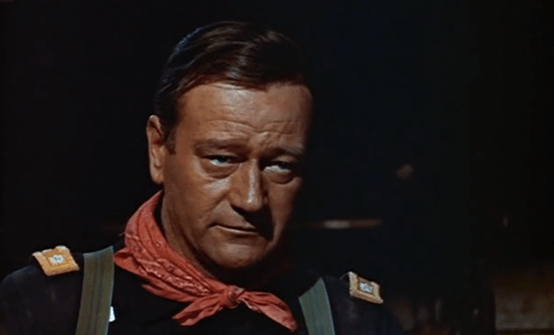
Fort Apache gives me the opportunity to consider one of John Ford’s most unlikely long-term collaborations with film critic turned screenwriter Frank S. Nugent. As with all Ford partnerships, it was oftentimes prickly but there’s no repudiating the impact. However, even the writer realized how improbable it was he would have such a hand in mythologizing the West alongside one of the great American masters. Nugent noted the following:

“I have often wondered why Ford chose me to write his cavalry films. I had been on a horse but once—and to our mutual humiliation. I had never seen an Indian. My knowledge of the Civil War extended only slightly beyond the fact that there was a North and a South, with West vulnerable and East dealing. I did know a Remington from a Winchester—Remington was the painter. In view of all this, I can only surmise that Ford picked me for Fort Apache as a challenge.”

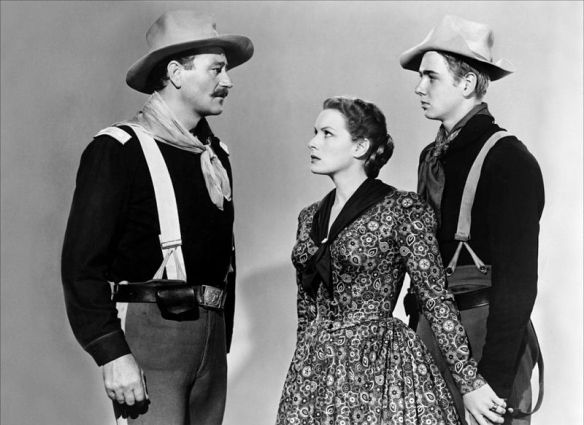
The picture opens with a particularly acerbic and icy Henry Fonda as Owen Thursday, newly assigned to the cavalry outpost at Fort Apache. One could make a wager each of Fonda’s characterizations in everything from You Only Live Once to The Ox-Bow Incident and even My Darling Clementine all culminate right here. Though he’s dismissive of the assignment, Thursday is nevertheless intent on upholding his duty. He rides along the bumpy roadways with his teenage daughter Philadelphia (an effervescent Shirley Temple) who is simply glad to be by her father’s side.

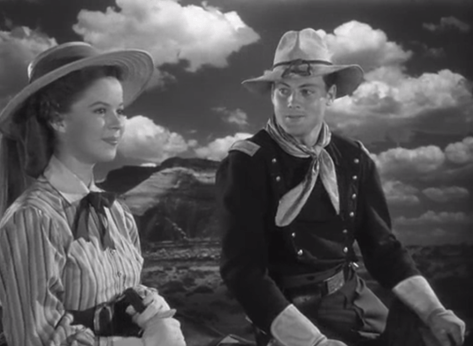
To understand the picture, it’s useful to know Nugent developed extensive bios for every character to flesh out who they were exactly. We have John Agar in his screen debut starring opposite his new wife in real life (Temple) and playing the newest commissioned officer to the fort, Second Lieutenant Michael O’Rourke.

fort apache 3.png

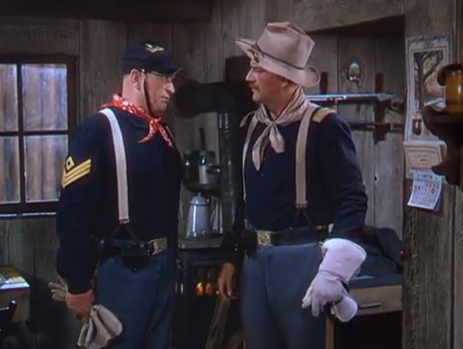
Life as a cavalryman proves to be a family affair and one clan has an especially substantial presence in the camp. The Lieutenant’s father (Ward Bond) is stationed there too with his mother, the older man serving as a Sergeant Major. Meanwhile, many of the veteran soldiers provide a close-knit community including Sergeant Festus Mulcahy (Victor McLaglen) who has been a lifelong friend to the O’Rourkes. Here we see Irish-American blood flowing through the picture as Ford heralds his own ancestors part in this historical landscape not only during the Civil War but long afterward. The pride in this shared culture is undeniable.

For most of its run, Fort Apache is the epitome of character-driven drama. Nugent’s meticulous character development overlaid by Ford’s own distaste for expositional dialogue provides the groundwork for yet another story operating in vignettes more than anything else. At any rate, the dialogue comes off clunkily at times while the romance between Philadelphia and Michael O’Rourke begins to blossom.

However, with her father adamant against such a union and astringent in all manners of his command, it causes an instant riff in the camp. One of his finest lines comes with inspecting his officers and noting, “The uniform is not a subject for individual whimsical expression.” He expects everyone to abide by the letter of the law and his unswerving personality is glacial on all accounts.

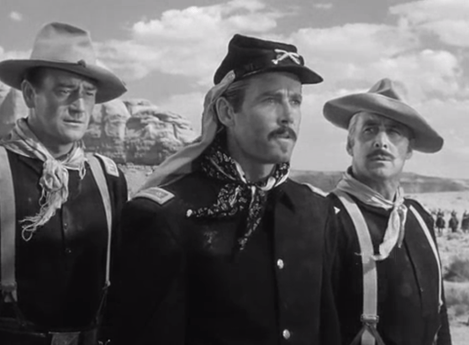
Meanwhile, the old reliable guard has fun with the new recruits. Among their ranks, rather unbelievably, is the veteran character actor Hank Worden. Then, the community of wives and sweethearts led by Mrs. Collingwood (Anna Lee) and Mrs. O’Rourke (Irene Rich) look to help Philadelphia make a home for herself. John Wayne is in the picture as well though he takes a decidedly secondary role as Captain Kirby York, striving to work under Thursday’s guidance with as much obedience as he can muster. However, the final act is Wayne’s as much as it is Fonda’s however.

It hardly needs to be said at this point but Monument Valley is awesome. Watching horses streak across the plains ferociously kicking up storms of dust never grows old. Nor do images of Wayne and Pedro Armendariz perched on a towering rock formation taking in the view. You can’t make this stuff up. The beauty is majestic as only natural topography can be without input by human hands or CGI — the way it was probably meant to be photographed.

There’s the impending threat of Indians making their way south. Telegraph lines are down again. So a visit is paid to the scruffy horse trader who is quite conveniently liaison between the American Indians and the government within the territory. Despite his contempt for Meacham, Thursday will not do anything about him nor does he attempt any diplomacy with the belligerent Cochise. He decides instead on the executive decision to make an all-out charge on the Native Americans forces who are waiting, guns cocked and ready.

fort apache 2.png

In the waning moments, Fort Apache becomes a more fully-realized, even emphatic indictment of recalcitrant and bluntly antagonistic leadership. Thursday holds a very entitled station — whatever he says, he says on behalf of the United States government — and no one else can say anything otherwise. What they do protest he backs up with regulations, honors, and code of conducts that might as well bury everyone.

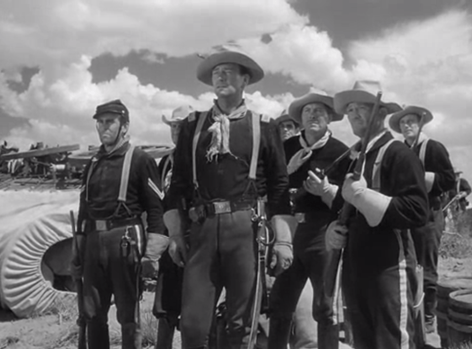
Instead of addressing any area of compromise as minor as it might be, there is a straight and decisive path cut through any issue. They ride toward their inevitable deaths. The final bugle sounds for charge and yet it’s hardly a battle, target practice is more like it, and the horrifying thing is most everyone knows it going in. But when a man such as Colonel Thursday holds the reins you reluctantly cave to his demands lest you be clapped in irons for insubordination — even when the decisions are near lunacy. York is the one man brave enough to stand against and lives to fight another day. Many others are not so lucky

If Custer’s Last Stand was anything like this, it makes complete sense and simultaneously becomes an even more terrifying piece of history. In what might be called an early precursor to the glorification of a hero’s legend in The Man Who Shot Liberty Valance (1961), much the same treatment is provided here for the far more dubious Owen Thursday. Once more Ford’s picture is able to get at this obvious discrepancy by pulling away and looking at the story from those folks who canonize history for all posterity. It’s oftentimes the newspaper men who are afforded that privilege. Whether their effusive praises are in order is another matter entirely and by the end, Ford Apache is a sobering portrait. It comes so far from seemingly homely even jovial roots within the compound.

So many lives were needlessly sacrificed so one man could be heralded a legend. The frightening thing is that Thursday was not a mere glory seeker; he fervently believed what he was doing was in the right. That kind of dogged methodology proved itself highly pernicious when no thought was given to discretion of any kind. It’s simply blind execution of duty. Whether it evokes Kant or not, I cannot help but think of one of the most famous examples of this in Adolf Eichmann, acting as a lowly Holocaust architect, who nevertheless proved the consequences of such a philosophy.

The dark horse of the Ford pictures, Fort Apache begins as one beast and comes out quite a different animal by the end. It so easily gets sidetracked, distracted, and lulled into different scenarios and there never is a true sense of urgency to keep the picture moving toward an obvious conclusion. Still, in the end, we get the finale and it’s unnerving as both a commentary and another projection of the mythical West. Somehow Ford stitches it together as a two-edged sword of both indictment and a moving paean to those passed.

4/5 Stars

The Horse Soldiers (1959)

the horse soldiers 1.png

The Horse Soldiers is the one and only teaming of John Wayne and William Holden in a story based on the raids of Colonel Benjamin Grierson during the Civil War. John Ford casts the story as a brand of folklore carried through the air by the songs sung on the trail by a regiment riding in their formation. “I Left My Love” and “When Johnny Comes Marching Home” are the two prime examples ringing out on more than one occasion.

Wayne is the journeyman military man who is intent on carrying out his mission. But his exacting, army first mentality soon sets him at odds with a newly assigned regimental surgeon from up north, Major Henry Kendall (William Holden), who is appalled by the conditions of the war. His vow to do his very utmost to save life ultimately butts up against the other man’s own sense of duty. It seems that they will never be reconciled.

Though Wayne rarely carries a firearm on camera, he does readily smack some people around. And yet these very discrepancies are an indication of why the man is so hard to figure. There’s a decency to him revealing itself in isolated moments even as he leads his men on a mission to decimate the enemy’s contraband by the most decisive means possible.

When William Tecumseh Sherman, whose name is thrown around at least a few times, famously asserted “war is hell” it was not a quip. I believe he meant it wholeheartedly, coming from a man who was willing to do what was required to win. Not out of malice but, on the contrary, out of a sense of duty. But that unswerving call to duty led him to undertake some pretty ruthless means — horribly cruel in their execution. A like-minded figure can be found in Colonel Marlowe.

He brazenly leads his men into the heart of Reb Country and they are eventually met by an onslaught of Confederates, as they snake their way far behind enemy lines. The irony is the fact that in civilian life the Colonel was a railroad engineer and now he must watch his men bend the southern railroad lines into “Sherman Neckties” to impede future transportation.

If Major Kendall is the initial manifestation of the opposition Marlowe faces, the next front comes courtesy of a southern belle named Miss Hannah Hunter (Constance Towers). Her tactics include a sly show of hospitality in an effort to pass secrets to her countrymen. As a result, the Colonel has no recourse but to bring her along on their raid, doing his best to treat her nobly, within reason; though she continues to despise his guts.

There’s a recurring theme as you can see with both Holden and Towers’ characters trying to decide what to make of this man. Although her part is hardly groundbreaking, a shoutout must be given to tennis extraordinaire and barrier breaker Althea Gibson for playing Miss Hunter’s loyal maid Lukie.

the horse soldiers 2.png

Political views in real life played into the heated character dynamics between our two stars, with Wayne’s overt conservative values completely at odds with Holden’s liberal leanings. While it might have helped the picture — to some degree — it meant the two vowed to never again appear together. Take it for what it’s worth.

Otherwise, The Horse Soldiers is as enjoyable as a Civil War film can be. Rather unbelievably, this is the only feature-length Civil War film that Ford would ever do. Pictorially it’s about as arresting as most anything he conceived during the period. However, this one doesn’t feel like a commentary or really like it’s trying to make any kind of statement. It’s also easy to call into question some of the character mechanics as detailed by the script.

There are some people who live and others who die. Good deeds are committed and likewise, evil. People hate each other and some fall in love. Sometimes in the same instance. Such is the blurred landscape of a “civil war” — a term that forever has been questioned due to its very oxymoronic nature.

John Ford himself was even more cantankerous than usual because his doctor had forbidden him from drinking and the loss of a stuntman in the climactic battle scenes only soured matters. It’s a fair assumption the picture may have suffered as a result with the director tiring of the project in the end, all but cutting production short. Regardless, it’s a generally agreeable adventure plucked out of history and touched up for the viewing public in exhilarating fashion. There needn’t be more to it.

3.5/5 Stars

Review: She Wore a Yellow Ribbon (1949)

she wore a yellow ribbon 1.png

“Never apologize, it’s a sign of weakness.” ~ John Wayne as Nathan Brittles

Instigated by one of the cataclysmic massacres of the West, Custer’s Last Stand, the word is sent by telegraph and pony express all across the country. Simultaneously, members of numerous tribes including the Sioux and Cheyenne are on the warpath. They have a new resolve to make war with “The White Man” who has continually lied and cheated them out of their land. It brings deep-seated issues at the core of American’s history to the surface.

However, for what initially appears a heavy drama, Ford’s picture comes off surprisingly light and quite comical in patches. Frank Nugent’s script forges a story about the U.S. Calvary at Fort Stark. Nathan Brittles (John Wayne) is counting down the days until his retirement not so much with anticipation; it’s all but inevitable. Because you see, he’s been in the service of his country for a good many years and it’s about time for him to step down.

John Ford gave Duke the part, realizing after Red River (1948), Wayne was not simply a warm body with an imposing presence; he truly was an actor by this point in his career. Resultingly, he makes Ford’s decision to cast him in a slightly more demanding role pay off handsomely. To his credit, he makes a fine showing imbuing the part with a certain world-weariness that comes with age but also immense good humor.

she wore a yellow ribbon 2.png

Victor McLaglen, as the burly First Sergeant Quincannon, calls on his Colonel every morning taking a nip out of the bottle he has conveniently hidden in the other man’s quarters, as they commiserate about their military careers coming to a close.

Meanwhile, the two hot-blooded young men under his command (John Agar and Harry Carey Jr.) turn foolish in their pursuit of the prettiest (and only) flirt in camp, niece of the commanding officer Allshard, Ms. Olivia Dandridge (Joanne Dru). Brittles observes with mild amusement as they vie for her affection, barking reprimands at them for their undisciplined behavior, while simultaneously stirring them on — noting that she wears a yellow ribbon in her hair denoting a beau. The question remains who she will pick and it becomes one of the film’s running gags as much as it is a source of easy conflict.

Initially, there seems to be little nuance in how the Native Americans are portrayed, prone to indiscriminate violence, yet at least, even for a moment, the film suggests it is not a cultural divide but one defined by generations. Young men are intent on making a name for themselves and finding glory on the battlefield. It is the old man who have gotten past that. They have seen how war ravages the earth and humanity. They are weary of such ordeals.

Nathan Brittles goes to Chief Pony That Walks (Chief John Big Tree) on the eve of his retirement to forge some fragile peace. But his old friend is powerless to do anything so Brittles takes yet another approach to save lives. It’s his one final gift to his men. Mind you, he was not required to take on any of this and yet a man such as Brittles would have nothing less because he cherishes his command and the men who ride beside him. They mean just as much to him as the U.S. Calvary itself has for well nigh 40 years.

What makes all these preceding events genuinely striking is the stunning Technicolor frames. The continuous processions over the plains are breathtaking panoramas with skies as immaculate as the western backgrounds themselves.  The most well-conceived moments come in capturing thunderbolts out on the prairie as Brittles leads his caravan on their mission with their two female cohorts.

In such instances, there’s a scope and grandeur that gives the impression of an intricate painting even more than a film and it’s true Ford and his director of photography purportedly drew inspiration from the works of Frederic Remmington. In this regard — and I’ll try to not overstep my bounds — Winton Hoch’s cinematography stands up to if not surpasses the imagery of The Searchers. Likewise, there are wonderfully decadent period costumes evoking the era nicely but as always John Wayne dons his worn in, one-of-a-kind pride and joy that he would wear until his Rio Bravio (1959) days.

Though relatively forgotten alongside more formidable offerings like The Searchers, Stagecoach, or even The Man Who Shot Liberty Valance, She Wore a Yellow Ribbon might just be one of Wayne’s most fascinating performances in a Ford picture. Not only is he playing a man 20 years his senior — and doing it with surprising credibility — he makes the old calvary man into a figure with true heart and soul. He’s not too hardened or unfeeling to hold onto lifelong friendships, enjoy a good joke, or grin at the young love that besets the hearts of the men under him. They respect him and he cherishes them in return.

she wore a yellow ribbon 4.png

There are numerous poignant moments as his tenure winds down but one of the finest comes when he gives his beloved troops one final inspection. They surprise him with a gift paid for by all of them — a solid silver watch with a remembrance on it. It’s a token of respect to a man they deeply admire. In a move that can’t help but conjure up George Washington himself, Brittles pulls out his granny glasses to read the inscription and we see yet again this great man of strength was, as we always suspected, a man of a certain sensitivity too. He’s deeply touched.

He rides off, a job well done, but as it so happens the cavalry is not done with him as trusty Sergeant Tyree (Ben Johnson) comes to fetch him one final time. Not by a long shot. She Wore a Yellow Ribbon is simultaneously an elegy to those who served and were lost in the line of duty and more specifically to a man who took great pride in his post.

4/5 Stars

Avengers: Endgame (2019)

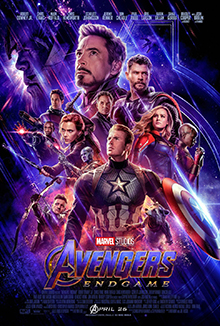
Avengers_Endgame_poster.jpgThe cultural event the whole world seems to have been waiting for has finally arrived. Avengers Endgame is finally open to the public. The secrecy can cease. The debates can begin. Disney can start raking in the billions. And I presume, on the whole, the general public can let out a collective sigh of relief. The studio hasn’t ruined the tightly shepherded franchise and for those with a share of skepticism, Avengers‘s “final chapter” does some things quite well. At the very least, it brings back the epics of old for one evening of entertainment. That in itself is enough of a compliment.

Certainly, at our most jaundice, one might contend Endgame needs to solely succeed in the area of wish fulfillment. Never has a franchise so effectively mobilized and harnessed the fervor of nerd culture around a film franchise (except maybe Star Wars and Disney owns that too).

Many of the same old grievances and world struggles are hashed out around tables and conference rooms led by the opposing ideals represented by Tony Stark (Robert Downey Jr.) and Captain America (Chris Evans). It’s true the expositional scenes with sciency jargon have the usual clumsy clunkiness. Films have never been known for their seamlessly technical dialogue.

The Russo Brother’s camera (gotta love ’em) is swirling around as much as ever. The compositions of scenes are rarely something we have time to appreciate as the images fly by with typical rapid-fire cutting. The superpowers are bigger, better, more colorful, and continue to leave the realm of reality behind for CGI visions, all the easier to rectify when you’ve made a mess of the world. Putting Humpty Dumpty back together again is so much easier with computers.

The jokes are there and the cultural references to Back to the Future and others are easy wins without any risk. Likewise, resident superhuman fighter pilot, Carol Danvers (a steely Brie Larson) seems like a convenient enough deus ex machina to piece the narrative back together in the wake of Thanos (Josh Brolin).

Are there plot holes? We’re working in convoluted increments of time so events get dicey and yet the narrative comes out mostly intact leaning into emotion rather than mere systematic logic.

It’s right here where Endgame manages to satiate our desires for — not just closure — but a meaningful denouement to this storyline. I am one of those to decry this lumbering beast at times and still as the hypocrite and movie fan that I am, there’s no way to be totally immune to this cultural force.

In the days when going to the cinema palace for a roadshow and being subjected to an earth-shattering moment seem all but behind us, this epic is the closest thing we have to such an experience in the 21st century. Gone with the Wind, Ben Hur, Lawrence of Arabia, Star Wars it is not. Still, it means a great deal to this generation. It functions as its own entity — a cultural touchstone for this decade.

The story does well to tap into this zeitgeist. Here’s a forewarning for mild SPOILERS. Endgame takes the genre of a time travel heist to layer upon the world we already know. Ant-Man (Paul Rudd) has mostly functioned in the periphery but now he is an integral piece because it is the technology he brings, created by Hank Pym (Michael Douglas), giving the remnants leftover a chance to right the past — this is their one-in-a-million chance as indicated by Dr. Strange (Benedict Cumberbatch).

Marvel screenwriting vets Christopher Markus and Stephen McFeely do well in essentially turning their latest story into a riff on a time travel heist film. It fits the context of how they might conceivably bring their friends back — not so much by changing the past — but creating an alternate reality of sorts where things can work out the way they were meant to.

Three task forces must go after the six infinity stones in the years before Thanos got a hold of them. We flashback to 2012 in New York with Tony Stark, Steve Rogers, Bruce Banner (Mark Ruffalo), and Scott Lang. This self-reflexive nature serves the story but also an increasing sense of nostalgia. Because I remember sitting in that theater having barely seen a Marvel movie before.

There I was in the first row with my friend Mike. I remember playing ultimate frisbee the afternoon before. I had marathoned Iron Man, Captain America, and Thor the previous night. College was starting in a few months. And it was the epitome of a summer blockbuster. This twofold experience is not lost on me. Both the movie and my experiences intermingle. We cannot separate them.

Then, a sullen Thor (Chris Hemsworth) with a Rip Van Winkle beard and giant beer belly must return to Asgard, witnessing its previous glory and seeing his mother (Rene Russo) only hours before she would be killed. They share a poignant moment even as the retrieval of the Infinity Stone and the presence of Jane (Natalie Portman) takes secondary importance. I didn’t mind because all I could remember was sitting in those reclining seats with Adam and Kayt during the midnight showing back in 2013.

Next, we moved on to our first meeting of The Guardians of the Galaxy. It was the summer of 2014 and I was back from college catching up with my buddy Nick. What a pleasant surprise we had watching a talking raccoon (Bradley Cooper) and a tree (Vin Diesel) jam out to Redbone. By this point, the plot feels almost unimportant. It can ride along on the dynamics of characters and my own nostalgia. In some weird way, it felt evocative of simpler times — even just fives years ago. It’s often how we manage to romanticize in hindsight, which works handsomely to the film’s advantage.

I bemoaned the fact in Infinity War, it felt like I didn’t care about these characters anymore — whether they lived or died. Endgame does its darndest to make us remember relationships, friendships, all the things making each one of these superhumans, gods, or otherwise sentient beings like us. The opening pre-credit hook is case and point. Hawkeye (Jeremy Renner) is teaching his daughter to shoot. His wife (Linda Cardellini) is getting the food together for a family picnic. It’s the antithesis of epic. But it feels real. There is instant recognition of stakes.

There didn’t seem to be any finality to Thanos decimating the world because it was a cliffhanger. However, there is no such weakness here. It earns its ending. No after-credits tease. No drawing the story out or pulling punches to undermine the impact of the final scenes. In fact, I’ll rip off the band-aid now. Beloved characters do die and there is no turning back time for them. They’re gone. That’s okay. It feels real and their deaths have meaning. And those still living move forward with lingering sorrow but also the hope of the future. They have roots, they have family, and lives to lead beyond the confines of a film.

Tony Stark and Pepper (Gwenyth Paltrow) have a daughter now. He worries about giving up his family — his last fragment of happiness — in order to alter the earlier events. And yet if we remember the brilliant egomaniac circa 2008, Tony is radically different now. His arrogance gives way to sacrifice, even as meeting his old man makes him appreciate his own dad (John Slattery) and how similar they really are — young fathers trying to do the best for their families as imperfect human beings.

Cap changes too. His almost untouchable emblematic image of Americanism was laid to rest. Not in some anti-establishment, unpatriotic turn. Instead, he became even more human in order to romance the love of his life (and mine!) Peggy Carter (Hayley Atwell) and cherish the dance of life together.

Chris Hemsworth’s fatty Thor might be the finest comic relief in the movie but he manages an evolution of his own as a character, realizing his lifelong need to be lauded by others will no longer rule his own life. He gives up his kingship for a worthy successor, Valkyrie (Tessa Thompson).

Nebula (Karen Gillan) and Gamora’s (Zoe Saldana) sibling dynamic is of less importance but Nebula is an integral figure as she tries to reconcile her former self with what she knows she can become. Even as Thanos waits for his pursuers in the biblically inflected “Garden,” tilling the earth, his daughter must come to terms with where she falls along this gradient of good and evil.

But are you ready? For all those who’ve been waiting patiently, you will be rewarded. There is the long-awaited behemoth death match to help realize the childhood aspirations of any boy or girl who has ever dreamt themselves a superhero warding off the evils and saving the universe either vicariously through their action figures or in their own imaginations.

It’s messy, full of explosions, and spastic choreography. Why harp on the faults because if you cannot consider it with the imagination of a child, the movie probably isn’t meant for you anyway. If anything, the eye candy gives an obligatory “moment” to all the heavy hitters, big and small.

Fortuitously, the film allows the time and space to wrap up its character arcs and call back all the relationships built up over 10 years of film. In another movie, the climax would have peaked too early but this picture is making up for two movies, if not far more. There is a great deal riding on these final moments for the very reason we expect satisfaction as an audience.

What felt so exhilarating about Endgame, again, was the very finality. I know there are more projects ahead with Spider-Man, Guardians, etc. but even with characters like Cap and Iron Man, we are reminded that sometimes things cannot go back to the way they were before. Life changes as do peoples and societies.

Cap dancing in the arms of Peggy for one last time (or the first) with the melody of “It’s Been a Long, Long Time” drifting through the air is enough for me. It’s the love story I always seemed to care most about and always longed to be realized in some gratifying form. Am I wrong to say this taps into some innate fairytale-like inclination? To want not just the happy ending but the reunion, the realization of lasting love.

I won’t say the Marvel franchise has always been a cutting-edge statement on the state of our world but it has been in many lives for a very long time — as an extension of our experience — sometimes it’s good and right to bring things to an end. How can you appreciate the times and memories you’ve had and really cherish them without closure? I thank Marvel for respecting its characters enough to give them this — to allow them to rest in peace — at least for the time being. It’s true that after the 22nd film we rested, briefly. Better late than never.

4/5 Stars
3:10 to Yuma (1957)

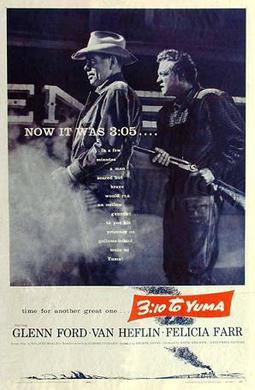
310_to_Yuma_(1957_film).jpgThe picture showcases a parched landscape of cacti and dusty trails — the arid terrain accentuated by purposely tinted photography. It’s aided by that bleak black & white palette courtesy of Charles Lawton Jr., just as Delmer Dave’s earlier western, Jubal (1956), was made by its vibrant imagery around Jackson Hole. Each fits the mood called for impeccably.
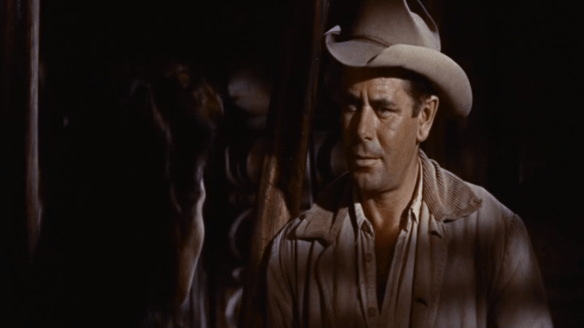
Setting the scene, you have Frankie Laine belting out the epic title track with his usual gusto; the opening gambit with focused precision initiates a holdup and the repercussions of such an act. This coach headed for the Arizona outpost of Contention is robbed and the driver killed. The culprits are Ben Wade (Glenn Ford) and his band of thugs.

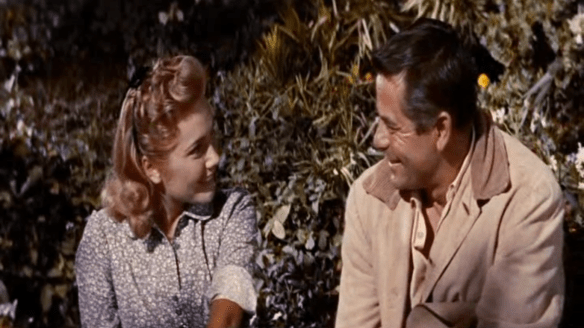
Felicia Farr is reteamed with Ford refilling the drinks of all the boys as they brazenly ditch the crime scene and head to a nearby saloon to drink it off.  The sparks fly between the pair as they’re both a little less saintly compared to the previous year’s Jubal (1956). Except their romancing isn’t the meat of the storyline. For that, we must turn to the other man who was indirectly affected by the robbery.

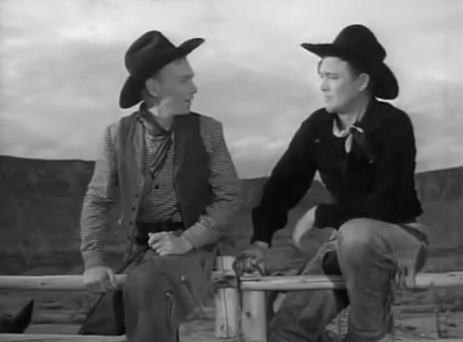
Dan Evans (Van Heflin) is a struggling rancher plagued by the local drought, but he and his two sons also witnessed the holdup go down. Pretty soon, Wade is captured and Evans signs on for $200 that will help him get by. Together he and another man, the town drunk, carry out the sheriff’s plan to transport Wade for safekeeping while they wait it out for the 3:10 to Yuma.

Lacking the edgier shoot ’em up qualities of its still thoroughly engaging remake starring Christian Bale and Russell Crowe, this original offering from Daves, with a story by Elmore Leonard, must be first and foremost a character study and it is an exemplary one.

It’s an assignment of such an intimate even personal nature although Evans only took it for the money. In one scene the outlaw sits around the family dinner table like a regular guest, except he’s handcuffed and the curious boy pipes up asking questions about him. Then Wade sits at the table and has a nice long talk with Mrs. Evans that almost makes him seem human. That’s just it. He’s done some bad things but it’s hard to get away from the fact he can be a rational, even decent person.

But the epitome of the picture comes near the end when the two men hold up together in a hotel room waiting for the minutes to pass, knowing full-well Wade’s men will be coming any minute to have it out. There’s a ticking clock plotting device in use like High Noon (1952) as one of his cronies (Richard Jaeckel) is milling about waiting for the reinforcements to come. But also everyone in town is anticipating the incoming train.

Glenn Ford evolves into the devil on the shoulder, constantly testing Evans through proposed bribery and parlor tricks that provide all sorts of distractions to wear down his captor. His coolness juxtaposes nicely with the antsy ranchhand with dynamics running analogous to The Naked Spur (1954). This time Glenn Ford is doing the continual psychological manipulation instead of Robert Ryan. Ryan is good but I think here Ford works far better across from Van Heflin.

As heroes, they are similar types (see Shane or Jubal) and that makes Ford’s corrupt turn still somehow mirror the other man. In a different life or maybe a different film, we could see how the roles might be reversed. For now, they must deal with claustrophobia that’s certainly exasperated by confined space but really exerts itself throughout the finale, even outdoors. It’s not so dependent simply on the physical location as it is the pressures bearing down on the character of Evans.

It’s a contentious proposition, no small coincidence that right there we have the name of the town but at least Dan is not standing alone… This quickly changes when the gang materializes and proves to be more formidable than initially suspected. Rapidly his backup, made of family men just like him, has quickly dissolved and it’s just him against a band of cold-blooded killers.

The final moments are an exhibition in heroism where it takes one man like Evans, bent in his personal resolve to see his job to completion, even as the deck’s stacked against him. Again, we have echoes of High Noon.

It’s true everyone continually hammers home the fact. By this time there’s no amount of obligation. The man who hired him on (Robert Emmhardt), his frantic wife (Leora Dana) rushes to get him to change his mind, even his prisoner tells him the same. And yet he sticks with it because one man has died — a man who granted might have been slightly misguided — yet he believed in some form of law and order enacted by the people for the people. That’s what makes Evans proceed with this near-suicidal mission. It has to do with moral rectitude and committing to what you deem to be right — even if there’s a cost.

Does the picture chicken out in the end? I’ll let you decide for yourself. Regardless, Van Heflin and Glenn Ford are in fine form and require the viewer to brace themselves for a tension-filled ride. One could argue 3:10 to Yuma is forged and won in their scenes together. Everything else is informed by this central relationship.

4/5 Stars

Jubal (1956)

jubal 1.png

There’s no doubt about it. Jubal boasts absolutely gorgeous imagery and how can you miss with a backdrop as majestic as the Grand Tetons and Jackson Hole, Wyoming? Its looming grandeur is evident in just about every single exterior shot — a continuous hallmark of classical frontier visions.

This element alone will quickly cause many western aficionados to recall one of the finest in the genre, George Stevens’ Shane (1953), which was also shot in the same area and consequently, exhibits a broadly similar plotline. However, that can be attributed to the fact westerns often busy themselves with tales of lone drifters riding toward new destinations in an effort to escape some unnamed force in their past. Jubal (Glenn Ford) is molded out of the same archetype.

Except Jubal winds up at the cattle ranch of the welcoming Sherp Horgan (Ernest Borgnine), who finds the other man frostbitten and proceeds to give him shelter and a cup of coffee. That’s just Sherp’s way, even though he’s a fairly prosperous man with a pretty wife (Valerie French), he’s instantly likable and beloved by everyone, in spite of his good-natured prattling.

The figure instantly positioned as an antagonist is Pinky (Rod Steiger) who right off the bat accuses the other man of smelling of sheep. He holds sheepherders in disdain but soon feels like his position on the ranch is under threat. Because despite being a newcomer, Jubal instantly makes an impression as a reserved but nevertheless trustworthy and hardworking ranch hand.

He gains the favor of Sherp even as he’s bent on moving on. That’s his nature. Delmer Daves serves as both screenwriter and director, adapting a story bearing the strains of Shakespeare’s Othello but again, like comparison’s with Shane, it’s true most stories have narratives scouring similar cisterns for inspiration. What matters most is what they offer us that is unique.

Ultimately, Jubal does decide to stay on a spell and the consequences are not unfelt. He conceals a buried hurt that supplies our character conflict. In some regards, as best as I can describe it, he fits too neatly into a box as it all comes gushing out when talking with a pretty ingenue played by Felicia Farr. As he discloses his deep-seated hurt, Jube readily acknowledges he’s never shared this boyhood trauma with anyone else. There’s something about her genial innocence setting him instantly at ease.

jubal 2.png

Her parents are part of an unnamed religious caravan searching for the Promised Land and Jubal is instrumental in allowing them to stay on the ranch, even as Pinky fights for them to move along. He’s continually looking to belittle and lessen Jubal in Horgan’s eyes by any means possible.

Meanwhile, the seductive onslaughts turned toward Jubal, coupled with slanderous verbal assaults from a jealous rival, look to take the man down one way or another. Yet he will do nothing to compromise himself. He stands firm with integrity but like Joseph with Potiphar’s wife, you know he will be blamed for something he had no hand in.

The whole film is really an exhibition in differing acting styles rubbing up against each other. Rod Steiger, of course, immersed himself in “The Method,” famously playing alongside Brando in On The Waterfront (1954). In Jubal, you can very easily see the early shades of Officer Gillespie, though Pinky is arguably worse as an animalistic brute with a bur in his backside.

You can also easily see how his animosity could have spilled over into everything and soured his working relationship with Ford and Borgnine, who maintain a more naturalistic even intuitive style. Regardless, each man feels well-suited to their respective parts.

The same can be said of John Dierkes as well and Noah Beery Jr., as genial as ever, playing on the fiddle as another ranch hand. Charles Bronson at first seems a curious even suspicious character although his purpose becomes evident as he becomes the go-between to vouch for others, knowing both the worlds of the religious pilgrims and the ranchers. Jack Elam is features though he doesn’t have much to do while Victoria French’s role relies heavily on her being a tantalizing seductress, constantly coaxing Jubal into some sort of romantic tryst.

The film is a testament to the intrigue found in continuous antipathy and an almost fatalistic sense of powerlessness in the face of inevitable doom. In other words, no matter how hard he tries, it seems like Jube will never be able to win.

My main qualm, however, is in the ending. I’m used to abrupt endings but the film seems to have delegated its time in the wrong ways. The beauty of the film thus far was its smoldering potential threat which led to some invariably dark turns. By the final juncture, we essentially know what will happen but we relish them coming to fruition in a cathartically cinematic fashion.

While Jubal gets the girl and clears his name, he only gets a very brief showdown with the continual thorn in his side, Pinky, before the doctor comes out of the shed to pronounce death with the other man being guilty of certain indiscretions.

So in very basic terms what could have been a more thrilling culmination is all but cut short. Vindication is made easy. Otherwise, the picture boils to the end thanks to the maddening rage of Steiger, which is capable of twisting every minor detail into more ammunition to try and sway the mob and bury another man in his premature grave.

The necessity is that Ford is and remains throughout the film a white knight, never has a lapse of character, and even goes after the good girl. It’s the circumstances that are constantly against him. It makes for a tumultuous and repeatedly helpless state of being for the entirety of the film. The blip before “The End” loses a bit of this tension but up to that point, Jubal makes good as a friction-filled western drama.

4/5 Stars

Wagon Master (1950)

wagon master 1.png

“Wagons west are rolling…” – Sons of The Pioneers

Despite being a tighter film, Wagon Master still bears the irrefutable mark of John Ford. Together with producer Meridian C. Cooper, he crafts a piece of work as near to a fully realized articulation of his vision as he probably ever achieved; this made it one of his personal favorites.

Because there is no one to answer to except for himself and if anything, in contrast to his career prior, it’s a freeing proposition. Wagon Master contentedly meanders along ever toward its destination with time enough to stop and visions enough to keep an audience engrossed.

Without John Wayne, the story instead finds able space for other worthy stalwarts of the Ford stock company and in this aspect alone it’s a fine showing. Ben Johnson’s athleticism on horseback is matched by a plain-speaking integrity proving both steady and unperturbed.

The beauty of the casting is the very authenticity of it. He’s the real deal as a one-time rodeo hand, stunt double for the biggest stars like Gary Cooper and James Stewart, and a certified roping champion. He performed all his own stunts in the picture including the well-remembered scene where he weathers a bucking bronco after Joanne Dru dumps bath water out of the rear her wagon spooking his horse. He stayed on for 10 bucks before getting thrown. That was only after a previous take had to be reshot.

Furthermore, Ford gives the other prominent roles to young Harry Carey Jr. who is Johnson’s trail companion and the more spirited of the two. While Travis and Sandy are intent on selling their stock and nothing else, they eventually agree to come aboard as wagon masters for a caravan of Mormons heading out West. The Elder, played by the venerable Ward Bond, is a man of faith who nevertheless has the raw courage and determination to lead his people on their journey. And he has his usual bearing which only blesses the story. In truth, it’s an obvious precursor to the heralded TV western, Wagon Train, also starring Bond for its first few seasons.

wagon master 2.png

Even as the search for the Promise Land subsists, lead by Sister Ledyard (Jane Darwell) and the sounding of her horn, it is Bond who has decency enough to stop for those in need. They end up running across a hoochie-coochie show made up of a swacked trio (Alan Mowbray, Ruth Clifford, and Joanne Dru) who, without any water left, tried to survive off spirits.

Though a group of social outcasts and equally proud, the Elder obliges to help them out even as their own resources are dwindling. Thus, the procession exuberantly races toward the first sign of water. Jumping off horses, dipping their hats in it, taking a nice cool drink for the first time in far too long.

Our two heroes, also begin to call on their lady friends. Travis tries to extend a gentlemanly hand to Denver (Dru), who defiantly rebuffs his advances and simultaneously Sandy starts eyeing a Mormon girl who already has a beau. In another interlude, a fist-fight erupts between the two young men which the Elder handily breaks up, only to wind up with his pants torn to pieces by a feisty dog.

What becomes evident in the stages of this story is how it is never truly about one individual but an entire community. Part of that comes with the absence of a marketable star like John Wayne or Henry Fonda — two regulars in Ford pictures. However, like My Darling Clementine (sans Fonda), there is this sense of the communal nature of civilization. This western on wheels brings together religious pilgrims, medicine show performers, and Navajo Indians who are all able to find a certain amount of common ground.

Dances become something not only proving to be a form of gaiety and lively human interaction; they might very well be a mechanism for how a bit of home is brought to new territories as a means of making them more habitable. It’s a sign of kinship.

Of course, every society has its outside stressors and in this case, the caravan is paid a visit by a band of glowering men led by a crotchety old-timer (Charles Kemper) winged in the arm. It’s a tenuous partnership at best as his “boys,” including James Arness and Hank Worden, are a testy and trigger-happy bunch. Even as he knows how dangerous they are, The Elder agrees to extend the olive branch, while Travis bides his time knowing now isn’t the time to act. Sandy can’t quite fathom this initial passivity but their forbearance is rewarded in the end.

A John Ford gunfight ensues and not unlike its brethren in My Darling Clementine, the exchange of bullets is efficient and to the point; it’s not meant to bear the entire weight of the picture. Instead, Ford settles back into a broader perspective, reinforcing the lyrical quality of his imagery with the vocalization of The Sons of the Pioneers.

I remember them most vividly from my days watching Roy Rogers serials, hearing the group sing their harmonies, and I do miss the throaty vocals of old folk western tunes like “Song of the Wagonmaster” and “Wagon’s West.” Though I hesitate to call Wagon Master, an all-out musical because that would probably give the wrong impression, it is indebted to its music much in the same manner of a High Noon (1952) or a Rio Bravo (1959). You cannot begin to separate the two.

4/5 Stars

3 Godfathers (1948)

3 godfathers 1.png

3 Godfathers is a Christmas western if there ever was one and it’s probably the most sensitive picture that John Ford ever made. Anyone familiar with Don Siegel’s short film Star in the Night (1945) might recognize basic similarities with this picture based on the same biblical motif of the three wise men.

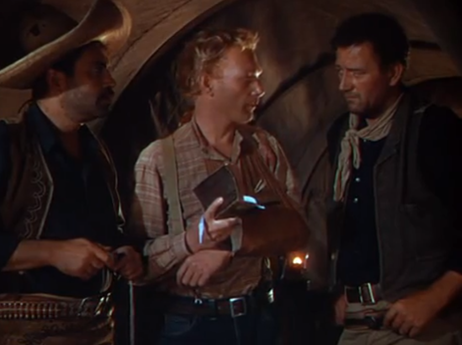
Ford honors his dear friend, the late, great Harry Carey even christening him the “Bright Star Of The Early Western Sky” and it’s very true. In fact, the director probably would have never remade the film if Carey had not passed away in 1947. The reason being that he had worked on an earlier version called The Three Godfathers way back in 1916 and the Ford-helmed silent Marked Men (1929). Not satisfied with just that, the director subsequently cast Harry Carey Jr. as The Abilene Kid alongside John Wayne and  Pedro Armendáriz. Although a big star in Mexico by this point, Armendáriz garnered little respect from Ford as you might expect.

The script penned by film critic turned screenwriter Frank S. Nugent with Laurence Stallings and Robert Nathan, takes the story of three lawless bank robbers and turns them into modern-day incarnations of the trio of kings from the advent story.

The heady combination of some on-location photography in Death Valley, as well as early Technicolor, gives Ford’s picture an impressive composition even as it can’t quite stand up to his most iconic images. The story as well is a mild even maudlin affair at times but for the very fact that Ford rarely seemed to inch into such territory — or Wayne either for that matter — it does come as somewhat of a treat to behold.

Because here we have three hoodlums, men of ill-repute who have robbed a bank and are on the lamb running for their lives. Ward Bond as the local sheriff — a decent man who also happens to be pretty shrewd — chases after our antiheroes with his hapless deputy (Hank Worden). Though they ride off, he cripples their water supply and looks to cut them off from any of the wells scattered across the territory. The lack of water could prove to be their downfall.

However, the story takes its most obvious turn when they happen upon a wagon. It turns out to not be completely abandoned as a one lies isolated and about ready to give birth to an infant son. Though she is too weak to continue she makes a vow with them that they protect her boy and make sure he grows up healthy and strong.

She doesn’t know their previous actions only the character that they exhibit in front of her and maybe it is even her angelic trust in them that causes each man to agree to this promise. All of the sudden they throw of the shells of their former selves and take on this seemingly virtuous task.

However, that does not make survival any easier living off the drippings of barrel cacti and traipsing across the salt flats with the noonday sun beating down. First, losing their horses in a ferocious maelstrom and with water scarce, they do everything in their power to take care of the child. Reading a baby book on how to look after an infant and bathing and feeding him. His Uncle William sings him “Gather at the River” as a lullaby. And all three men agree their godson will share their three names. Robert Hightower (Wayne) bickers with Pete about using Spanish around the baby. They want him to grow up American.

The Bible passage about finding a donkey to ride into Jerusalem gives some guidance fittingly as the child makes his pilgrimage to the town of New Jerusalem. We know that a miracle just might be in order.

The inevitable happens and Wayne must face off against Bond but what makes that dynamic far more meaningful is the child in their midst. Because Hightower’s care and concern for the child’s well-being reveals a side of him that is the complete antithesis of his outlaw persona. It’s a reflection that he is a redeemable figure and the film strikes a compromise between a really saccharine ending and cold hard reality. While no one will concede that it’s Ford’s best work, it’s nevertheless a fine vehicle for the talent and a thoroughly unique take on yuletide moviemaking.

3.5/5 Stars

Review: The Ox-Bow Incident (1943)

the ox-bow incident 1.png

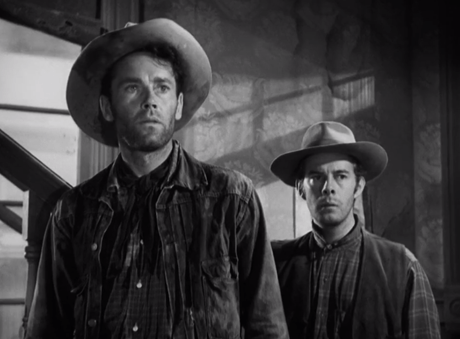
We know the score. Two drifters ride into town. They sidle up to the bar for some shots, looking for something to do in a lazy Nevada dust-hole. Their faces are equally familiar to anyone who has ever seen even a few of the old oaters. Feisty Henry Fonda as Gil Carter and his more even-keeled pal Art (Henry Morgan). Though folks question what they’re doing around, it comes to nothing except an exuberant fist fight for Fonda just itching for some thrills. He’s not disappointed.

Soon the community catches wind of the death of a beloved local named Kincaid at the hands of cattle rustlers. The wheels are set in motion as the sleepy town awakens and a lynching mob forms under the guise of a posse. With the sheriff out of town doing his duty and the local judge incapable of stopping them, they ride off looking for vengeance and some excitement to liven up their one-horse town. As the deputy illegally swears in the entire crowd as temporary deputies, our boys Gil and Art reluctantly sign on as not to draw more suspicion to themselves.

A Major Tetley (Frank Conroy) tries to take charge forcing his callow son (William Eythe) to join in as they begin their hunt. The two most reluctant and subsequently the most interesting additions to their party are the African-American preacher named Sparks (Leigh Whipper), whose own brother was lynched when he was a boy, and then the rational-minded Old Man Davies (Harry Davenport) who desires for true justice to be upheld. He is wary of the repercussions of a mob mentality.

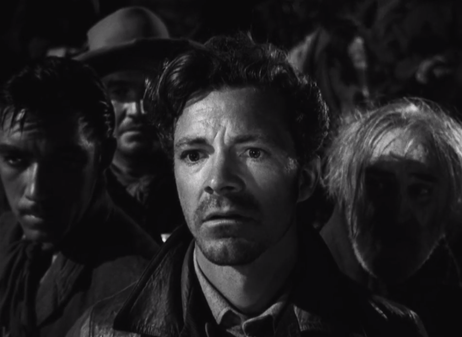
Ultimately, they happen upon three strangers and circle them like ravenous wolves practically willing them to be guilty. In these crucial interludes, Wellman deliberately focuses on close-ups instead of scenery to ratchet the tension. It’s evident the bread and butter of this picture are within the characters themselves.

The crowd begins peppering the suspects with questions though they’ve already drawn up their answers for them. It doesn’t help that the trio’s leader (Dana Andrews) must try and explain some extenuating circumstances, namely how he acquired some of Kinkaid’s stock, which he purportedly bought off the murdered man without a bill of sale.

True, the posse doesn’t go off absolutely nothing but the integrity of democratic justice, as flawed as it might be, in the day-to-day, still maintains people are innocent until proven guilty. It’s not the other way around. That’s key. It also calls for not dealing in emotions like anger and hatred but impartial wisdom. Again, that might be impossible to attain but we must try our best. Otherwise, the consequences are potentially dire.

William A. Wellman was so eager to adapt Walter van Tilburg Clark’s original novel he agreed with Daryl Zanuck to direct two other pictures that are now all but forgotten. The Ox-Bow Incident might be small but it’s no less mighty thanks to the teaming of Wellman and Lamar Trotti. In fact, its volatility was so great no one knew how to market it during the war years. How do you try and redeem the debasement of humanity originating out of our own traditions, even as we try and reconcile that with the evil going on overseas? It’s a tall order.

the ox-bow incident 2.png

The equally horrifying thing is the fact lynchings had yet to be exterminated from American society and the blood of such injustice still soaked American soil. Though this is a showing of three men getting hung, one white (Andrews), one old (Francis Ford), one Mexican (a defiant Anthony Quinn), this could have just as easily been racially charged with African-American victims.

Regardless of guilt or innocence, justice was never meant to function in this fashion where lawlessness is masked by perceived legitimacy. Nothing good can come of it. Fonda’s own memories drew him to the material as he supposedly witnessed the lynching of a man named Will Brown in Omaha, Nebraska on September 28, 1919. You can only imagine how the images scalded him for life. 12 Angry Men (1957) is indubitably another film which dealt with comparable themes very close to his heart.

His part, along with Morgan by his side, remains crucial because they essentially act as impartial bystanders and their choice is faced by anyone at the crossroads of such an issue. Because good can be quantified by commission and omission just as evil can be perpetrated through action and inaction.

The final wallop of the film is, of course, finding out what the actuality of the matter is — knowing full well they acted in error. To cap off the most moving showing of his generally hardboiled career, as the dying family man, Dana Andrews touches them from the grave with his words one last time:

“A man just naturally can’t take the law into his own hands and hang people without hurtin’ everybody in the world, ’cause then he’s just not breaking one law but all laws. Law is a lot more than words you put in a book, or judges or lawyers or sheriffs you hire to carry it out. It’s everything people ever have found out about justice and what’s right and wrong. It’s the very conscience of humanity. There can’t be any such thing as civilization unless people have a conscience, because if people touch God anywhere, where is it except through their conscience? And what is anybody’s conscience except a little piece of the conscience of all men that ever lived?”

Even if his words serve the film more than they are the authentic words of a husband, their affecting nature is undebatable. Every man standing around the bar sullenly has been given a costly lesson — a lesson requiring the lives of three men. It’s fitting for our two drifters to ride out of town just as they came in the same hound dog sulking across the road. And yet so much has changed. If anything our hero has found his conscience in a sea of injustice.

4/5 Stars

Review: Stagecoach (1939)

stagecoach 1.png

While the western hardly began with Stagecoach, one could go out on a very slight limb and say it became a more fully realized version of itself in the hands of John Ford; it all but grew in stature as a genre. This progression cropped out of the prevailing assumption of the day and age that the western was low-grade rubbish meant for no-name actors and meager productions. But Ford proved they could be ripe with so many more possibilities because he had greater ambitions from the outset.

We have John Wayne making a second go of stardom as the Ringo Kid, in what would prove a career bolstering performance, after some 70 films he’d already played in. He, of course, reemerged on the screen in a bold tracking shot and subsequent closeup that has all but impressed itself upon anyone who has ever witnessed the film. In this moment, Ford all but thrusts Wayne into the limelight as his star, for better or for worse, and Duke obliges thereafter.

Ford’s first excursion to Monument Valley proved to be love at first sight as he became so enraptured with the location — and why not — he would film there countless times in the future. It became synonymous with his finest work; he used it as the perfectly mapped canvass on which to express himself. One could argue that no director ever had a better setting,  more synonymous with his vision and sensibilities.

Forget the landscape and situation for a moment. Stagecoach might be one of the premier chamber pieces ever captured. Semantics aside, the picture relies heavily on a cast of characters filled out by archetypes and yet each actor involved is able to lend such credence to each individual role. We readily accept them as a whole ensemble almost seamlessly.

stagecoach 4.png

Apaches stirred up by Geronimo are an excuse for the impending threat looming over the title vehicle. Because it’s true that the stage must make its journey at some point, though the slightly chubby, whiny-voiced driver, Buck (Andy Devine), is hesitant about such a perilous road ahead. Riding shotgun for him is the no-nonsense Marshall Curly Wilcox (George Bancroft) who vetoes the other man’s blubbering.

However, if they were to go it alone with only some payload or mail delivery, Stagecoach would be robbed of some of its richness. Two of the first travelers to join them are both casualties of social prejudice and the snooty, self-righteous prigs of the Law and Order League. Dallas (Claire Trevor) is an ostracized woman of the street and then the scorned Doc Boone (Thomas Mitchell) is constantly living in a state of drunkenness.

Contrasting with the other woman is a lady of high repute, Ms. Mallory (Louise Platt), who is pregnant and yet resolves to meet her husband at his cavalry outpost. Her presence coaxes a gentleman gambler (John Carradine) to come aboard as he holds some innate sense of duty in protecting someone of her breeding.

stagecoach 2.png

We also have the impeccably named Donald Meek as Mr. Peaccock who is constantly having his name mispronounced while his samples of whiskey are continually finding their way into the Doc’s possession. He’s a calming force just as the entitled banker, Mr. Gatewood, protests just about everything.

If the types sound familiar it’s because you can draw a line between many of them and their progeny for years to come. But the beauty of the character dynamics is the evolution they undergo. We are not simply blessed by starkly different individuals brushing up against each other in close confines. In other words, of crucial importance is how they act toward one another and ultimately how they change over the course of this joint heroes journey.

Claire Trevor, fittingly, later remembered Ford’s chiding of Wayne, “Why are you moving your mouth so much? Don’t you know you don’t act with your mouth in pictures? You act with your eyes.” Watch the film and you understand his direction in actual practice. So much is said in unspoken looks and behaviors. Trevor seems especially adept in speaking with her eyes because everything she wants to say and can’t say comes through this very avenue. And whether John Ford would agree or not, The Duke’s eyes are equally telling.

Interiors are exquisitely framed and lit in such a way allowing the actors to be so expressive while space and staging are used to accentuate those same aspects. Take for example one sequence around a dinner table where two camps find themselves moving to opposite corners. You have the outcasts and the purportedly upstanding citizens opposite one another. Not a word is spoken but it is all played out through mere body language and positioning.

However, Whether the film completely realizes it or not there are other societal casualties, namely the Mexicans shown on the screen as well as the Native Americans themselves. Chris (prolific Mexican-American actor Chris Pin-Martin) at least has a voice but not much else. Meanwhile, it does feel as if the Indians are used essentially for a plotting device. There is no depth present in this regard.

However, the pursuit undertaken by the Apaches is filmed marvelously by Ford. In one particularly memorable long take, the stage lumbers into the distance followed by first four and then an entire wave of riders on horseback. It fluidly suggests immense menace and pace which never quite leaves the sequence.

They are reinforced by a couple shots that feel as if the stagecoach and the horses after it are all but trampling the camera. The sense of volatility is accentuated by the legendary stunt work of Yakima Canutt performing death-defying feats on horseback and hanging from the stagecoach. In the era before readily available CGI, it’s the kind of movie magic still capable of stopping a modern viewer cold.

stagecoach 5.png

But the picture does not end there. The city offers other issues that must be resolved. Namely, Ringo’s final showdown with the men who killed his father and kid brother. Also, he must find out what Dallas really is or at least what she is perceived to be.

However, instead of milking the reveals for pure melodramatics, Ford does one better, creating an atmosphere of pure beauty. But within that same framework is a cringe-inducing tension. Pulling his camera away from moments to dwell on reactions as much as actions and movements as much as dialogue. Some of his actors are even given close-ups all the better for studying every expression of their faces.

Because we can write up all that happens in Stagecoach in a matter of sentences. That’s not the engrossing or remarkable part of the picture at all. It’s precisely the way Ford has cast it as only he could. It’s exciting and moving and genuinely light-hearted but it chooses when a certain mood is called for, succeeding in evoking each at the given time like the most visceral vessels of entertainment manage to do.

Thankfully we had many more outings between Ford and Wayne. The director might have given his friend hell on the set but there’s no debating the fact they crafted some of the most iconic westerns together. The collaboration was imperative. Stagecoach rides on the laurels of many people, not least among them Pappy and Duke.

5/5 Stars