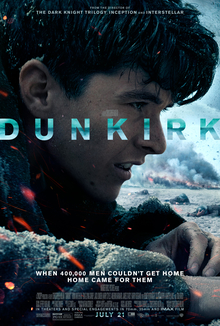
 Upon being thrown headlong into Christopher Nolan’s immersive wartime drama Dunkirk, it becomes obvious that it is hardly a narrative film like any of the director’s previous efforts because it has a singular objective set out.
It’s economical (shorter than many of most recent efforts) and the dialogue is sparse, sprinkled sparingly throughout his picture. After all, the main goal of this film is not so much to tell us a story — drawing up the lines as they might have been — but actually immersing us in that moment that was so crucial to British morale and ultimately the outcome of WWII.
As such, this is visual storytelling to the utmost degree and it comes off splendidly for the precise reason that film has always been a visual medium as much as we try and make it about dialogue. Because invariably dialogue is often used as a crutch while Nolan’s film relies almost solely on its images to tell its story and that’s a quality of filmmaking that is often lacking in the contemporary industry.
Backstories are all but left to the imagination and there’s immense power in that. Too often storytellers feel a need to spell everything out, providing all the perfect cookie cutter moments in order to hold the audience member’s hand so they comprehend it all. But has something as volatile as war ever been like that? I’m sure we can all answer with an emphatic “NO,” so why would a film be any different? Make people use their brains. Make them feel something viscerally. Leave them in the dark. Keep the outcomes ambiguous.
Likewise, there are no imagined interactions between the major figures at play whether Winston Churchill or Adolf Hitler. In fact, we never see a German’s face. We only see the results of their efforts to deter the British and cut off their escape route. As for Churchill, we never see the great English bulldog but his spirit wafts over the picture — certainly his words too — but it’s that spirit of resilience, that never say die attitude that speaks to his own character. That is enough.
Normally these type of decisions would signal a death wish but Nolan has been rewarded for his brazenness offering up a summer blockbuster that’s all but necessary. Because it tramples over much of the conventional wisdom that the industry has tried to impose on itself to reel in success. If there was any man to do it, Christopher Nolan certainly fits the bill.
There’s still very purposeful action playing out on three fronts. You have the soldiers actually stuck on the beach and in this case, we end up following a group of soldiers. Boys really. First, one who flees back to the beach after his compatriots are gunned down then joins with another boy to try and get aboard a battleship with a man on a stretcher. Finally, they get their chance only to get torpedoed out of the water. Treading in the oil-soaked ocean until someone can save them.
Then, there’s a trifecta of British Spitfires (led by Tom Hardy) traveling across the English Channel to provide coverage to their boys down below. Their exploits are documented with engrossing aerial shots that bring us right into their cockpits as they sit behind the controls looking to evade and vanquish their enemy.
Finally, we have the men of the home guard namely a father (Mark Rylance) and his two sons who answer the call to come to the aid of their young men stranded across the channel. You get the sense that they are riding into the valley of the shadow of death except that the valley of death is the sea and German U-Boats are waiting for them. Still, they push onward to rescue men coming by sea and by air. It too requires costly sacrifice.
Dunkirk’s soundtrack is magnified by ticking clocks and Hans Zimmer’s selection of screeching strings but it’s not necessarily developing the drama for drama’s sake. Again, there’s this underlying striving for authenticity.
One scene stands out in particular when the shell-shocked soldier (Cillian Murphy) asks if the boy he accidentally harmed is okay. He’s sorry now but doesn’t know the irreparable damage he has done. Still, the young man’s brother could lash out in anger. Instead, he takes the high road and tells him the boy is fine. His father grimly gives him a nod. He has made the most merciful decision for all parties involved.
It’s so easy to get caught up in the moment and you begin to understand to what extent these British soldiers were sitting ducks on the beaches of Dunkirk. Because you are right beside them in every waking moment. And if we understand the horrors and the selfishness that begins to breed as survival instincts set in then just as easily we comprehend the pure euphoria that comes over the men when the flotilla from home comes to their rescue.
Even in these moments what is striking is not so much that Dunkirk is a grand epic but it feels surprisingly intimate. Despite the anonymity that runs through a great deal of this film Nolan still gives us characters that we can attach ourselves to and they begin to resonate not because we know their person inside and out necessarily but we start to empathize with their positions first hand. When you begin to see the world as someone else sees it, it’s difficult not to connect. And that goes for everyone.
Because this was not just a war of soldiers from the army, navy, and air force. This was a war that involved nurses and the home guard and every other man, woman, and child who rationed their supplies and blacked out their windows all because of the collective war effort.
It’s often the most trying circumstances that bring us together so that we are no longer individuals but we become one. Dunkirk seems like precisely one of those galvanizing events that can forever be looked back on with pride. It personifies bravery, resilience, a stiff upper lip if you want to put it that way. And the significance in survival is that they lived to fight another day and ultimately with the other Allied powers they were able to quell the Nazis.
Some might come out of Dunkirk hailing it as one of the great war pictures of our generation, but truthfully it’s more so a survival story and a tribute to the fighting spirit that often dwells in the souls of men. In an age so often lacking in courage, fortitude, and honor those are the very attributes that rise to the surface and become most evident. Dunkirk is a striking reminder, not simply for the British people, but for us all.
4.5/5 Stars
 Before the exoticism of Casablanca, Algiers, or even Road to Morroco, there was Josef Von Sternberg’s just plain Morocco but it’s hardly a run-of-the-mill romance. Far from it.
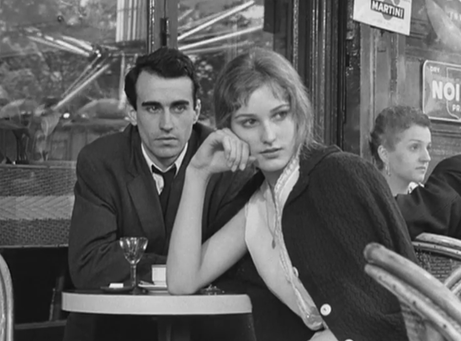 Pickpocket is an intricately staged, truly intimate character study from the inimitable Robert Bresson solidifying itself as one of his greatest works. As was his practice, Bresson took Martin LaSalle, a non-actor to be his leading protagonist.
 The opening credits of Vivre sa Vie commence with the opening note “dedicated to B-movies” and indeed many of Jean-Luc Godard’s best films could make the same claim. They’re smalltime stories about little people living rather pathetic lives if you wish to be brutally honest. This isn’t Hollywood.
 It’s a joy to watch Agnes Varda dance. Or, more precisely, it’s a joy to watch her camera dance. Because that’s exactly what it does. Her film opens in color, catching our attention, vibrant and alive as the credits roll and a young woman (Corinne Marchand) gets her fortune read by an old lady. She’s worried about her fate. We can gather that much and this is her way of coping. Superstition and tarot cards but she’s trying and the results are not quite to her fancy.
 Whaddya hear, whaddya say ~ Jimmy Cagney as Rocky Sullivan
 John Garfield was never the most dashing of leading men but nevertheless, he was always thoroughly compelling as ambitious working class stiffs during the 1940s. He had a straightforward tenacity about him like he had to fight his way to the top. At the same time likable and destined for trouble right out of the gates. You can cheer for him and still rue the decisions that he makes. That’s what makes his foray as boxing champ Charlie Davis all the more believable. His aspirations are of a very real nature and they give his character a genuine makeup.
 Father hear my prayer. Forgive him as you have forgiven all your children who have sinned. Don’t turn your face from him. Bring him, at last, to rest in your peace which he could never have found here. ~ Ida Lupino as Mary Malden
 Films Noir often find their hooks in lurid titles but also in metaphor. Ride the Pink Horse fits into the latter category as pulled from the pages of Dorothy B Hughes and adapted by Ben Hecht & Charles Lederer. The horse can be taken in the literal sense as one of the wooden animals that go round and round on the local carousel but there’s some symbolism in this opulent creature. In some distant way, it’s the fantasy of a different life that every man seems to crave when he doesn’t have it. But still, he strives and grinds to get closer and closer to it. More often than not he does not succeed in finding so-called contentment.
 And it’s from these opening moments that we try to get a line on Gagin by watching his every move and word. He’s brusque and abrasive with almost crazed features — constantly suspicious, demanding, and sour. He had a little too much cyanide for breakfast (although he does like fruit cocktail). Just as we watch him with interest, his probing eyes case every joint and every person he comes in contact with. Because, if it’s not obvious already, he’s not come to San Pablo for R & R. He’s come to town to avenge his dead army buddy, who was double-crossed and put out of a commission by a very big man (Fred Clark).
 Just as there is a cultured femme fatale (Andrea King), her counterpoint is the tentative Pila (played sympathetically but rather unfortunately by Wanda Hendrix), who floats in to watch over Gagin even when he doesn’t want her around. She stays anyways.
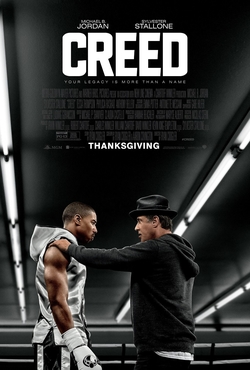 There’s a very special place in my heart for Rocky (1976) and I choose those words very carefully. The reason being, subsequent films lost the appeal of the original and I simultaneously lost interest in the franchise. Perhaps it’s because, after Sylvester Stallone’s breakthrough film, the series lost much of its unassuming charm. It was no longer an underdog story. It no longer felt as personal and intimate.
 4 Star Films