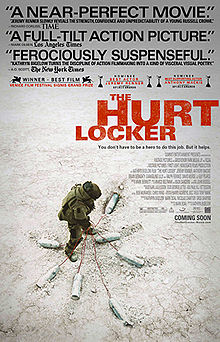
The Hurt Locker (2008)

220px-HLposterUSA2Being ignorant of the term “Hurt Locker,” I did a reasonable thing and looked it up. According to IMDb:

To put someone in a “hurt locker” is to physically mess someone up, badly. It is roughly synonymous with causing someone “a world of pain.” According to the movie’s official website, “In Iraq it is soldier vernacular to speak of explosions, as sending you to the hurt locker.”

Well, that about sums it up, and it does so, beautifully by getting to the core energy that pulses through this film. It gets dicey and intense when these highly trained individuals are put into the most volatile of situations. It doesn’t get more volatile than bomb detail, and how they maintain composure in such circumstances is a miracle, a testament to grit and willpower. That’s not to say they don’t go through their own moments of turmoil. How could you not, at least at some juncture?

It struck me that this film does not feel like a political statement, even less so than Bigelow’s other war epic Zero Dark Thirty. In a sense, that would be a major disservice to the men who fight, by taking all the attention off of them and instead placing it on agendas and politics. However, all of that is left to the politicians, and we simply are given a very small taste of what those fighting the War on Terror experience. Can we fully comprehend it? No, but at least now we have a better idea of how post-traumatic stress disorder can develop. The constant strain that these people are going through takes its toll physically and emotionally. Yet they still push through their tours in order to do the job that has been handed to them. They brave a world of suicide bombers and ambiguity that could quickly send you into the hurt locker. In that way, it reminds me of a modern take on Battle of Algiers, because not everything is as clear-cut as we would like it to be.

The Hurt Locker follows Bravo Company during the tour of duty. Their first disposal expert (Guy Pearce) meets with tragedy and his buddies are forced to welcome a new member to their team, Sergeant William James (Jeremy Renner). He hasn’t disarmed 873 bombs for nothing, but he maintains such a streak by being very cavalier in his conduct. He’s a maverick, a man who will unflinchingly ditch all communication in order to focus on the task at hand. He’s a bit of a loose cannon and that’s not always the best type of personality for such a tightly knit group. They have to be if they want to survive since such behavior can be the difference between life and death. There’s a camaraderie and a rapport that builds over time, but before that he causes his compatriots to squirm more than once, and when they squirm we’re positively crawling out of our skin.

Shot in Jordan, quite close to the real-life locales, there is a gritty and raw quality to how Kathryn Bigelow frames the world with the help of cinematographer Barry Ackroyd. It manages to be personal and unsettling all at once. In comparison, it’s invariably striking how stagnant American life is when James returns home.That’s potentially a good thing, but does it mean that we’re taking life for granted, or living eternally thankful for each day that we still have breath in our lungs? That’s what The Hurt Locker does. It gives us a deeper respect for these men and a deeper appreciation for life.

4.5/5 Stars

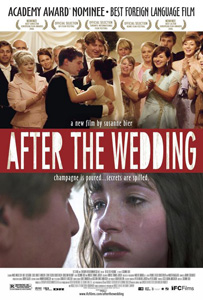
After The Wedding (2006)

After_the_WeddingThere is a scene in After the Wedding where the new bride Anna gets up and announces that it’s not usually customary for a bride to give a toast, but something is bound to go wrong at some point, so she might as well get it over with. It’s like she’s unknowingly cushioning the blow. She does not know, and the audience certainly doesn’t know, the gravity of what she says next. There are two people in the room who do. Anna voices how much she loves her parents even though she realizes Jorgen is not her real father, she cherishes him all the same.

I try and not use the label “tearjerker” lightly, but with this Danish film from director Susanne Bier, I mean it wholeheartedly. It cuts so deeply because there’s a bitter-sweetness to it that lingers, and that only occurs when you’re actually invested in characters. We meet Jacob first (Mads Mikkelsen), a middle-aged man, who seems to have built a rewarding life teaching in India. But on a trip back to his homeland, to hopefully acquire some funding, he comes across a familial secret that impacts him greatly. It all happens because the friendly businessman Jorgen invites his new acquaintance to his daughter’s wedding the following night. We get the film’s main jolt during the wedding and the whole story is never the same afterward because it flips everyone’s life upside down.

The next big revelation comes out when loving wife Helene presses Jorgen about his heath. Anna has her own problems when she walks in on her new husband with another woman. These up the drama, but it’s important to make it clear that this story doesn’t rely on soppy drama to maintain the stakes. The peaks are powerful, but even in the valleys, it keeps our interest. Certainly the melodrama is deeply jarring, however, it only delivers such an impact, because the people involved are far from one-dimensional cardboard cutouts. This could have easily becomes some Danish attempt at a telenovela and yet it does not. Far from it, Jacob, Jorgen, Helene, and their daughter Anna are figures, who we can almost feel the contours of. They bring to mind glimpses of friends or family perhaps. Generally good folks, who have made mistakes along the road.

In his past, Jacob acknowledges a drinking problem and sleeping with other women. Now he runs an orphanage in India and he’s matured greatly. Helene admits to not knowing all the answers for the decisions she made as a young woman. She probably should have done things differently, but the bottom line is that she loves her daughter deeply and is completely devoted to her husband. Jorgen might be a mogul and a powerful man, but he also has a deep devotion to his family. Seeing him with his kids you know he is a good father because he loves and provides for them in all possible ways. He actually makes time for them and it shows.

Hellene voices the audiences concern that all this drama is too great of a coincidence, but overshadowing that detail is something very heartfelt that Jorgen says. When he knows he probably doesn’t have too much more life ahead of him, he voices the sentiment that time is so utterly important. Furthermore, every relationship, every acquaintance we make, is important to life. Without those, life is meaningless. That’s the core of this film. It’s people parsing through the mess and finding what’s important. That’s what keeps Jorgen and Hellene together. That’s what makes Anne cherish her parents so deeply. That’s what makes it so difficult for Jacob as he weighs whether to stay in Denmark or go back to India.

4/5 Stars

Please Give (2010)

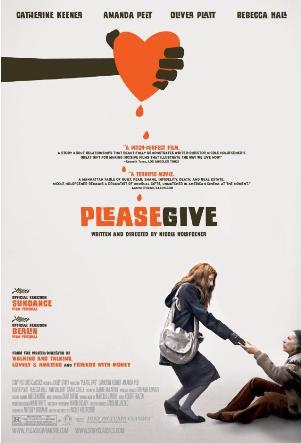
Please_Give_FilmWhat is Please Give about? The most succinct answer I can muster up is that it is about the simple rhythms of life. It’s about people rubbing up against each other, the neighbors you try and be nice too, but speak about behind closed doors. In writer-director Nicole Holofcener’s fifth collaboration with Catherine Keener, the latter is Kate, a woman who lives a life of uncomfortable dichotomy with her husband and teenage daughter.

Next door is the cranky grandma Andra, who is quite along in age, and she gets assistance from her granddaughters, who are both young professionals. Rebecca (Rebecca Hall) works as a radiology technician often spending her days giving mammograms, while her fashionable sister Mary (Amanda Peet) works as a cosmetologist. Their grandmother is not exactly the most agreeable person, and her acerbic nature earns the disdain of Mary and the quiet industriousness of Rebecca. They both have different ways of dealing with other people just as they have different ways of approaching love. Rebecca is quiet and looks for love in a nice young man. Mary constantly checks out the woman who stole her old boyfriend and embroils herself in an affair.

Meanwhile, Kate feels uncomfortable for buying Andra’s flat and waiting for her passing to start renovations. Likewise, in her joint venture with husband Alex, they buy people’s old possessions at estate sales and make major profits on their furniture. These issues along with a rebellious streak in her daughter, make Kate noticeably agitated, and she tries to overcompensate. She gives money to every homeless person she ever sees and tries to volunteer at numerous spots across town without much success.

The film suggests that we can tread a thin line on the margin of what is honest and what is termed “the ways of the world.” After all, if we balance it out with enough good deeds it ends up okay in the end, right? On her part, Kate has an odd way of dealing with her own sense of morality when it comes to her family business and the homeless on the street corner. Her husband is a generally agreeable man, who has no trouble with what they do, but he at least admits it, just like admitting when he flirts with other women.

Above all, I think Please Give boasts interesting female characters, in fact, they are the focal point of Holocener’s story, and it makes for a worthy character study in an industry that is often male-centric. Within these women is hypocrisy, pettiness, and a lot of insecurity, but it manages to be invariably funny as well as perturbing at times.

3.5/5 Stars

Greed (1924)

Greed3With some cinematic endeavors, there is simply an aura that surrounds them which informs how we look at them. Erich von Stroheim’s ambitious silent film Greed is such a picture. To this day, a full cut of the film has never been found and perhaps never will be, but it has survived in two versions. A four-hour cut which attempted to maintain the original continuity through stills and then a 2 and a half hour cut which I saw. So you could question whether I got the full experience of Greed or not, but that is almost beside the point because the essence of this film is summed up in the title. True, it could just as easily be called sin, avarice, grudge, humanity, or all of the above. But allow me to explain more fully what I mean.

The narrative follows a slow-witted man named McTeague (Gibson Gowland), who picks up the dentistry trade from a traveling doctor. He moves to San Francisco and soon becomes smitten with the cousin of his boisterous pal Marcus (Jean Hersholt). Trina (Zasu Pitts) is quiet and a bit timid around a man as intimidating as McTeague, but they make it work. Soon enough they’re engaged and a lottery ticket Trina picked up on a whim pays off handsomely. $5,000 to be exact and this is the 1920s! They’re getting on alright because McTeague is still working and his wife is very, very frugal. But Marcus feels entitled and a grudge over the money ensues. He wants part of the cut because he thinks he deserves some good fortune too. Things between him and John finally reach the boiling point and there’s no turning back. Rather than try and patch things up, Marcus decides to get into ranching and says goodbye to his formerly close friend, but not before serving up a little revenge. He sets the dentistry board on McTeague and since he doesn’t have a true credential, his right to practice is terminated.

The loss of John’s job is aggravated by the fact that Trina is increasingly stingy, never wanting to dip into her big payoff, even when they really need it. Gold in many ways has become her master, and it leads to marital turmoil. McTeague was always a big man, but usually quite gentle. But his inner fury is finally uncorked and in one angry outburst, he goes so far as to bite his wife.

Mac leaves only to come back again and the results are not pretty. Soon he has a price on his head and he makes his way as a fugitive into the desert. And thus, the finale is shot on location in Death Valley, the perfect place for a climactic showdown between McTeague and his old pal Marcus. Of course, money doesn’t help much when you’re trapped in the desert, or when you’re dead for that matter.

Obviously, greed doesn’t bode well, but this story is an interesting inversion of the typical plot line, because in this case it is the woman who has the money, and she’s the one that the greed eats away at. She becomes obsessive and even bitter about every last piece of change. But her money also has a ripple effect that reveals the pettiness, avarice, and begrudging nature that plagues both her husband and cousin.

So in order to enjoy this film, you need to have an appreciation for the spectacle that von Stroheim has developed and the commentary he has weaved through his narrative about greed. That in itself makes this film one to truly ruminate over because it suggests so much about the ugly side of human nature, and that has hardly changed in the past century.

The Sessions (2012)

220px-The_Sessions_posterI was a bit skeptical of this film at first, but I can say unreservedly that it boasts true heart and sensitivity. In many respects, it reminds me of another film about a man with a so-called disability, The Diving Bell and the Butterfly. In both, a highly creative individual is able to defy their physical barriers and truly impact the world around them.

In the case of Mark O’Brien (John Hawkes), he graduated from Berkeley destined to become a journalist and poet, the only difference with him is that for most of his life he has been confined to an iron lung that keeps him alive. It seems like an obvious roadblock to success in life, and yet not so for Mark because he faces each day with a sense of humor and even a spirituality that is impressive. He relies on his caretakers for so much and yet they enjoy helping him because he is a generally kind spirit. First, it’s the beautiful Amanda (Annika Marks), who he sincerely professes his love to and then there’s Vera (Moon Bloodgood), who while frank, is still deeply concerned with his well-being. Furthermore, the local priest (William H. Macy) is equally willing to listen to Mark’s confessions, not simply about sins, but more importantly his life on a whole.

Mark’s a very transparent individual, who attacks life with a positivity and tenacity that goes beyond the physical. Wit becomes his precious ally in facing every day, and he also takes great care in the relationships around him. He wants to live his life to the fullest, and he won’t let an iron lung impede him. Thus, he decides that he would like to try and have sex since he is still a virgin and feels that he might not have long left to live. And so, after consulting with his priest and acknowledging the sensitive nature of the decision, he tentatively decides to go for it. Cheryl Cohen-Greene (Helen Hunt) becomes his sex surrogate, and yet she is more of a therapist than anything else. She helps Mark become more and more comfortable in his own body and there is a beautiful vulnerability and openness to their time together.

The Sessions proves that there can be depictions of sex that can be as tender and sensitive as the characters involved. It’s not some vulgar act or a simple gratification of desire. It has more significance than that, just as these characters carry more significance. Father Brendan is not a perfect character just as Mark is not perfect, but we appreciate them for their geniality and light touches of humor. As for Cheryl, she does a great favor for Mark, and yet in the process she herself is deeply moved by this man in front of her. He’s seemingly so weak, so unassuming, and yet there is so much vibrancy to him.

The day Mark dies is sad for all of us and gathered at his funeral are all the people we expect to be there. The Father gives a heartfelt eulogy as all the women he touched sit in the pews looking on. The beauty of this story is that Mark finally did find love quite by accident, and he touched so many lives in the process. Though not a perfect film, The Sessions is heartfelt and that covers a multitude of faults.

4/5 Stars

Copenhagen (2014)

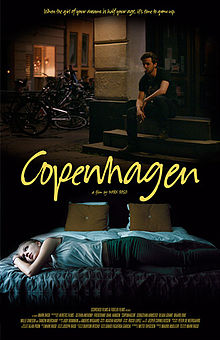
Copenhagen_film.jpegSometimes you attempt to make a mental pros and cons list to try and convince yourself in one direction or the other after watching something. Copenhagen was such a film for me. Bike rides through the city. Pro. At times this film loses its steam and flounders a bit. Con.

In truth, the narrative does feel pretty thin when it comes to the main character William trying to track down his grandfather in Copenhagen. William for that matter is a foul-mouthed and generally annoying jerk of an American for most of the film. Also, the weird romantic tension that builds between him and Effy is obviously uncomfortable, but the will-they-won’t-they component is key to the entire narrative. Because essentially this is a film about a grown man finally coming to age, with the help of a very mature 14-year-old girl, who acts as his guide through Denmark.

That being said, the scenery in and around Copenhagen is obviously a lot of fun to partake of, and it truly is the perfect place to ride a bike around, day or dusk. Furthermore, with her husky voice, feisty nature, and winning charm Frederikke Dahl Hansen makes this film with her turn as Effy. True, she’s playing a character quite a bit younger than herself, and yet she succeeds wonderfully and really thrives as the winning force in this film. Because, if we don’t like her this film has little hope of rising above its narrative foibles and the utterly annoying nature of its other main players. Effy makes us like William at least a little tiny bit by the end of this story. And that’s a major compliment to her. To his credit, Gethin Anthony is easy to dislike, but that undoubtedly can be credited to his acting. His character does come around in the end too, not so much because of the quest for his grandpa, but he learns what it is to be a man and to treat others with the respect they are due. Namely in this case a 14-year old girl, and also is his best bud, Jeremy.

So is this a film I would recommend… Yes, but I tried to lay all the cards on the table because you could easily enjoy this film or just as easily find it disconcerting and tiresome. I fell into both categories at different times, but there were some truly entrancing moments that are hard to forget. Effy is almost hypnotic during her singing session in the bar. And traipsing through an art museum becomes a fascinatingly intimate study of the human form. Perhaps now more than ever Denmark will be on my travel radar since it looked like an absolutely brilliant place to spend a summer.

3.5/5 Stars

The Earrings of Madame De… (1953)

MadamedeposterThe Earrings of Madame De…, in essence, feels like the perfect incarnation of an Ophuls’ film. In fact, sometimes I forget that Ophuls is actually German because his films are full of French sentiment. I mean that not because of their cast, although we do have Charles Boyer and Danielle Darieux, but more so due to the fact that his films are about elegant, melodramatic romances that fit the decadence of Parisian high society. For instance, in Madame De… Danielle Darrieux is positively swimming in luxury, whether it means dresses, furnishings, or especially jewelry. Materially her husband Andre (Boyer), a French general, has lavished all the worldly possessions upon her. Except that’s not what she wants. At least that’s not what will make her happy. She may be obsessed with the material, but even the material which she so desires is ultimately poisoned over time. Over time Andre cannot even win her over with trinkets and gifts. She cares little for the eponymous earrings until they come from her true love Baron Donati (Vittorio De Sica).

These are the same earrings that she sold to pay off a debt. The same earrings that Andre reacquired from the jeweler and then made the rounds once more. Ophuls said himself that he was drawn to this narrative because “there is always the same axis around which the action continually turns like a carousel. A tiny, scarcely visible axis: a pair of earrings.” And really it is a fascinating plot device that ties the entire narrative together, while also seeming to reflect the utter frivolity and triviality of it all. How can these earrings hold so much weight to one person? And yet that’s only the face value, because, to begin with, they are only an object to be coveted and maybe cherished. Over time they become a token, a symbol of true love and Louise gives them away to the parish because she no longer needs them. She has some notion now of what true love actually feels like.

For the majority of the film, Andre is forever civil with her. He knows that she does not really love him, and he even has time for a mistress on the side. He handles her opportune fainting spells and little charades with grace and at times amusement. But when he gets a hint at Donati’s relationship with his wife, he does what any honorable gentlemen would do. He’s indignant of his rival and builds a huge feud out of nothing. What follows is a duel and the rest is history.

Madame De… probably does not get as much acknowledgment as it should, because Ophuls was a champion of so-called “Women Pictures,” which actually take on the point of view of women, in an industry that’s so male-dominant even to this day. Thus, Madame De… is a little different in perspective, and it tries to hide all of its tragedy behind superficiality. It makes for an interesting lesson in romance and the female psyche. Yet again the director shows his immense affinity for staircases turning them into the personal playground for his camera. He loves to twirl, pirouette, and glide just as much as Louise and Donati do as they dance the night away at the ball. De Sica is a champion director in his own right, but it was especially fun to see him in front of the camera and he seemed an apt player opposite his costars. The worthy equal of Boyer and a suave love interest on top of that. There’s nothing more romantic than Danielle Darreux dreamily repeating to him, “I don’t love you, I don’t love you, I don’t love you.” The sad irony is that those words ring true with her actual husband as reflected by a pair of earrings.

4.5/5 Stars

The Wind (1928)

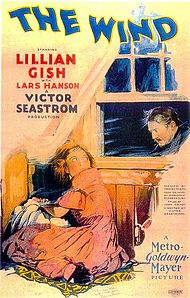
190px-The_Wind_(1928)The makers of The Wind took their content seriously. Filming commenced near Bakersfield in the Mojave Desert where temperatures fluctuated around 100 degrees. Eight airplanes where used to churn up enough force for the effect of swirling sand and much of the crew was forced to wear protective clothing while facing the elements. It sounds like a hardly pleasant experience and yet Swedish director Victor Sjostrom’s project with silent film goddess Lillian Gish proves transcendent to this day.

An early inter-title explains the film’s story of a “woman who came into the domain of wind,” and essentially that sets up this archetypal woman vs. nature story. Gish is our heroine Letty, who has come all the way from Virginia to live with her cousin. Why she would want to live in such nasty conditions is not clear, but she must have had good reasons. Every sequence you are reminded of this film’s title, because hats, hair, scarfs, are always blowing in the wind, no exceptions. Tranquility does not have a place in this film. Vast expanses of desolate terrain reign supreme and the men match the land. The first acquaintance Letty makes on her way out is the forward cattle buyer Wirt Roddy. He warns her of the treacherous country she is about to enter, but she is, after all, Lillian Gish. Nothing will stop her.

When she finally arrives at the ranch of her cousin Beverly, he is delighted to see her, but his callous wife and bratty kids are not so warm with their welcome. Letty also catches the eyes of two ranchers: The rugged Lige Hightower and the aging Sourdough. Both have a hankering to ask for her hand in marriage, and the dance in town seems like the perfect place for popping the question.

But a giant cyclone strikes leaving destruction in its wake, and the general public seeks shelter below ground as the men try and brace for impact. In the mayhem, Roddy declares his intentions and now there are three suitors vying for Letty’s affections. It’s good fun for Letty until the jealous Cora forces her out of the house. She doesn’t want Ms. Sly Boots wrecking her home as she surmises.

Letty needs someone to turn to and her first choice is Roddy, but he always was a grinning conniver, and he finally confesses he’s already married. That won’t do and she reluctantly chooses Lige. Although, since he is so rough around the edges, she doesn’t know how to relate to him. She certainly doesn’t love him, and he catches on pretty quickly when trying to kiss his new bride. Despite, a violent side, Lige proves he does have a grain of decency buried in the sand somewhere. He resolves to get enough money to send Letty back to where she came from and, he soon loses his scruffy beard.

Lige goes out in the elements out of necessity in taking part in a roundup. His wife initially pleads with him to take her along, but the conditions are too adverse and she is left behind, all alone between four flimsy walls which are supposed to defend her from the forces that be. A deadly Northern is coming, personified by a prancing stallion, but that’s not all. Roddy sneaks back to Letty intent on taking her away with him, and between the never-ending onslaught of wind and sand, along with her former suitor, Letty is beside herself. It’s a frantic struggle against the wild forces of nature, not to mention a craven man. However, being the heroine that she is, Lillian Gish find her gun and does what she has to do. As they say, absence makes the heart grow fonder, and thus when a jaded Lige gets home, he is surprised to be met by Letty with open arms. They share the original Titanic embrace, with the wind billowing around them, eyes closed, enjoying this moment of pure adrenaline. Even for the 1920s, Gish is a universal beauty, and there’s a pristine magnetism to her. I would never wish any type of harm or misfortune upon her. She has such a sincere face. Or maybe it’s a fragile frame backed up by courageous nature. Her struggles remind me somewhat of The Gold Rush or Steamboat Bill Jr. because in each of these films a character we truly care about is pitted against nature’s wind. These films have different effects, but each is powerful in its own right.

4.5/5 Stars

The Crowd (1928)

220px-Crowd-1928-PosterThe Crowd is a true piece of urban Americana, setting the standard when it comes to your average everyday American. King Vidor’s film lacks big-name star power and plays on a universal story similar to Murnau’s Sunrise. Our protagonist is Johnny Sims, who was fittingly born on the 4th of July. He’s the quintessential stand-in for anyone who has ever pursued the American Dream. He faces the death of his father at an early age and grows up getting lost in the masses of New York. With wall to wall skyscrapers towering above and a hopping city life, it’s easy to disappear.

This film is not Metropolis, but it is about a metropolis with the same behemoth sets swimming over the top with extras. In fact, at his job, Johnny looks like the original C.C. Baxter from The Apartment. He’s a cog in the giant mass of humanity, a little stop in the ever-churning conveyor belt.  Like Baxter, Sims becomes smitten with Mary, a lovely girl he meets on a double date with his joking colleague Bert. A lively night at a carnival and going through the tunnel of love cements their relationship. Soon they are married and heading off to the perfect honeymoon destination: Niagara Falls. This is where the love story is at its peak, riding on a wave of euphoria since these two are loved and in love. They feel indestructible, and there’s no one in the world that they would rather be with.

But as per usual, life happens to get in the way of love. Johnny isn’t too fond of Mary’s brothers and her mother, and the feelings are mutual. They just don’t see eye to eye, and they are skeptical of his prospects as a breadwinner. Matters are made worse during a tiff where Mary threatens to leave, and Sims does little to object. Their house is slowly falling apart, although they keep it together momentarily since she announces her pregnancy. That is the thin thread that binds them together.

Following their baby boy, comes a little girl, and finally, the raise that Johnny has been hoping for, but it’s not much. Things continue to be difficult as Johnny still waits for his ship to come in. His wife is annoyed with him and the meager prospects ahead. We are reminded that it’s not the big things but often the little ones that cause the most damage. Like little biting remarks that cut to the quick. And yet somehow, Johnny and Mary hang onto their romance.

In one scene she gazes down from the windowsill at him on the street below and they make up after a row. It’s rather reminiscent of Romeo and Juliet, reflecting that they still care about each other. But matters are not helped by the fact that Johnny seems pretty useless. On a beach holiday Mary struggles to get everything right, and despite her best efforts, it all turns out wrong.

Only a few years before Johnny laughed out loud at a man forced to humiliate himself carrying signs masquerading as a clown. How embarrassing! And yet a desperate Johnny winds up with a similar lot. It doesn’t help that personal tragedy strikes his family where they are most vulnerable. In its day it was actually considered obscene (for featuring a toilet), and it was far from a success due to a downbeat ending. This is a Pre-Depression world, and yet life is still far from easy.  And that allows The Crowd to stand the test of time fairly resiliently because it’s still possible to relate with its patriotism, its tragedy, and its resolute optimism.

4.5/5 Stars

Stage Door Canteen (1943)

stagedoorcan2

Director Frank Borzage’s Stage Door Canteen is a gentle-handed piece of propaganda. It plays out rather like a scripted 1940s wartime reality. It’s less a film and more of a historical relic commemorating the eponymous Stage Door Canteen in New York City. Thus, any effort to give it some sort of rating almost seems beside the point, because it was meant to be a rallying cry of comfort, entertainment, and escape from the war right outside. It met the general public right where they were and inundated them with mega star power. This wasn’t the only nightclub or film to do this either. The Stage Door’s west coast counterpart was the Hollywood Canteen, and it received a film treatment of its own in 1944.

In truth, the real nightclub was still in full use every day so the next best alternative was the RKO Lot in Culver City. That’s where it all happens like a day in the life. We follow three soldiers: the perfect cross-section of white red-blooded American G.I.s. Each one gets to dance and talk their last days away with a pretty girl serving as a hostess at the canteen. Each one of them will never forget it.

The entertainment is full of partial cameos, pop-ups, and performances from a plethora of stars. For even the most well-acquainted modern viewer, it’s hard to recognize all the faces and names that show up. Katherine Cornell, Count Basie, and Yehudi Menuhin are a few such figures who come to mind.

stagedoorcan1There are also strategic vignettes sprinkled throughout to boost morale and the camaraderie between allies. A few Brits can be heard taking part in the gaiety and making friends with our protagonists. A table of Hispanic soldiers takes in a floor show. One of our hostesses gets a moving letter from her older brother in the marines who is bent on returning to his family and proving that his training can outlast any “Jap” out there. There’s a last-minute marriage ceremony that we are privy to. Sam Jaffe introduces the audience to a few Russian allies, an Australian soldier has just returned from the front, and several Chinese air cadets get a rousing appreciation. Merle Oberon (the only actress close to being Asian in the film) gives them a stirring sendoff. Finally, Katharine Hepburn drops in for the premier cameo, to tie together all the loose ends and rally her fellow men and women to keep on keeping on for the sake of the country, so that the Allies might win the war.

From our modern day perspective, this might all come off like saccharine hogwash, but that’s not giving the material its due sensitivity. For that point in history, it was exactly what the American public was looking for. Today it’s a fascinating piece of remembrance. Then, it was still a story with a “to be continued” ending.

3.5/5 Stars