Review: Singin’ in the Rain (1952)

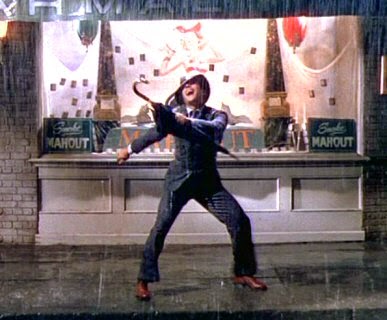
f7d3a-singin_rain I always seem to get goosebumps during Gene Kelly’s “Singin’ in the Rain” number, because each time I see and hear it, there is still a new magic to it every time. You see when I was young, before I knew all the classics, first and foremost, I knew this gem of a film. It is such a wonderful buildup to that moment with such personal favorites as “Make em’ Laugh” and “Moses Supposes.” Then you have the always popular “Good Morning” with not only Kelly but Donald O’Connor and Debbie Reynolds performing. Great stuff! There’s tireless choreography that goes into many of those sequences but it comes off so effortlessly and it brings us into the moment. There those wonderful, brief instances when you lose yourself in the music, the magic, and so on.

As the story goes, the three friends save the failing “Dueling Cavalier” by losing the simple “talkie” gimmick and making it a musical by dubbing the squeaky-voiced Lena Lamont (Jean Hagen). Cathy (Reynolds) no longer is a bit player, and she gains the acknowledgment that she deserves. Then Don Lockwood (Kelly) gets the girl who burst out of a cake. Cosmo Brown (O’Connor) is along for the ride staying with Don through thick and through thin, even calling him a cab when necessary. He’s a true friend in a million.

Although Kelly had a career with other high points (arguably never as high as this one), I am always slightly saddened that O’Connor and Reynolds never reached another apex like this in their subsequent careers. But they were both so great here, we must simply cherish this film for what it is.

Even to this day, the film holds up, and that is a tribute to the writing of Betty Comden and Adolph Green highlighting the infant Hollywood and the advent of talkies. In the same breath, it’s both a satire of the movie star culture and still a love letter to that same cottage industry. The only film with a similar dissection of Hollywood’s Golden Age is another 50s classic in Sunset Boulevard. The big difference is that Wilder’s film is chock full of drama and darkness. Singin’ in the Rain will always and forever be a light, fun musical with a lot of laughs.  It is constantly quotable whether it is “dignity, always dignity” or “I CAN’T stand it!”

Jean Hagen is always the butt of everyone’s jokes, but she is indeed very funny with the most annoying voice in the history of cinema (She can’t act, she can’t sing, she can’t dance. Triple threat). You also have other fine performers like Millard Mitchell as studio head R.F., and then appearances by Cyd Charisse and Rita Moreno who made a name for themselves as dancers in the ensuing years. And is it just me or does Donald O’Connor remind others of Danny Kaye? He not only cracks the jokes, but he is a wonderful all-around performer. Although O’Connor was undoubtedly a better dancer.

All in all, this is a timeless classic and it will undoubtedly keep that title for as long as people watch movies. Now I hope it starts pouring buckets of rain so I can go outside and stomp around in the puddles. I will let you know if I come down with pneumonia. But until that happens I’ll enjoy every minute of it. I entreat you to do the same.

5/5 Stars

A Woman Under the Influence (1974)

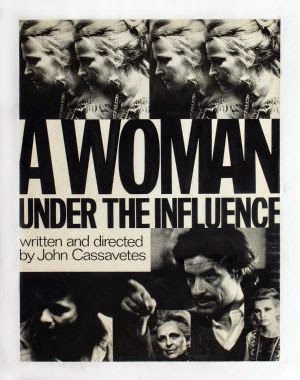
a6338-awomanunderinfluenceWow, this film from John Cassavetes was truly gut-wrenching and powerful. Gena Rowlands and Peter Falk are wonderful as Mabel and Nick. At their core they both seem like essentially good people. They love their kids, their family, and friends. Except Mabel’s problems tear them apart and in turn hurt the ones they love. The drama is not created my major plot twists, but the mundane and the typical. Dinner conversations, picking the kids up from school, gatherings with friends. This is when the film takes place and this is where we see their family unwinding at the seams. It is a personal story and the cinematography and the script for that matter are not polished. They are allowing us to see into this situation and thus the heartache and the pain washes over us and we become engaged with it.

Supposedly Richard Dreyfuss threw up after watching this film. Some may not be able to claim that same reaction, but there is no doubt that your heart goes out to not only Mabel but her children who are caught in the middle of it all. Even Nick, who can be a callous and even violent person is given a heart because he was portrayed by the great Peter Falk. This is definitely powerful stuff that is worth seeing.

This film may actually be more difficult to watch than some gorier films for the simple fact that it will hit the audience close to home. Literally. This is my first film from the director John Cassavetes and hopefully there will be more in my near future. Take a chance with this one because there is a chance that it is different than many of the polished Hollywood films you have seen in the past.

4.5/5 Stars

Review: The Best Years of Our Lives (1946)

15548-best2byears
Who in their right mind would make a film like this today? I mean it’s nearly three hours of incessant talking and character development. There are no explosions or special effects. There are not even any war scenes! And yet it is pure gold from William Wyler. He forces us to get to know these characters — all the details about them — and it is a pleasure.

In a year that boasted the likes of It’s a Wonderful Life, it is not simply a testament to the post-war sentiment, but also the power of this film, that led it to garner so much praise including a Best Picture Oscar.

Like Capra’s film, WWII plays a role here without actually focusing on the fighting. The effects of such a cataclysmic event were enough on their own.  The Best Years of Our Lives chooses to focus on the point of view of three returning servicemen. However, it would be selling the film short to suggest that is all the film is about. It revolves around deeper issues such as family, camaraderie, patriotism, and of course romance. Over the course of the film each man must navigate his own path, and much of those pathways have to do with their romantic relationships.

Al (Fredric March) has been married 20 years and yet he returns to a home with a wife and kids who seem more foreign than the battlefronts he fought on. His loving wife Milly (Myrna Loy) patiently allows him to become acclimated and stands beside him as he stands up for his convictions at his bank.

Then there is Homer (Harold Russell), the double amputee, who is bracing for the worst as he returns to his family and the girl next door named Wilma. His way of dealing with the situation is to avoid those he loves because by not letting them get close he thinks that will allow them to move forward with their lives. However, Homer completely misjudges just how much his girl loves him. Wilma is the real deal, and she is prepared to remain faithful to Homer no matter the circumstances.

The final relationship is perhaps the most complicated of the lot. Fred Derry (Dana Andrews) is the complete antithesis of Al. He has little work experience, and he was a young man who only knew his wife for a handful of days before he went off to war. Now it is all coming back to bite him because Marie (Virginia Mayo) is not ready to patiently wait around while the former soda jerk tries to find a job. She wants money, nights on the town, and good times. Sparks fly and Fred finds himself drawn more and more to Al’s daughter Peggy (Teresa Wright) since his marriage is a loveless one. This relationship is perhaps the most agonizing to watch as Fred is torn apart, but he ultimately gets the girl who will accept him for who he is.

“The best years of our lives” may have been during the war for some, but that really does not matter, because with the right attitude humanity is able to move forward to make the best of the future. That is one of the merits of this film, it exudes hopefulness and despite their different lots, each character is able to find a little slice of joy.

No one personality outshines any of the others, but on the contrary, all the players add up to the perfect combination. I will shamelessly acknowledge that Teresa Wright is one of my favorite actresses and over the last few years I have come to really appreciate Dana Andrews. They really do deserve more credit and I hope this film continues to get the praise it deserves. It is a delectable slice of cinema and Americana.

5/5 Stars

The Men (1950)

2c6ea-the_menI was really drawn into this film and I appreciated Zinnemann’s realistic style in capturing Marlon Brando’s powerful screen debut. I would have rated this film higher because the topic was interesting, the performances were good, the supporting cast was respectable, and so on. The only thing is although Brando is a good actor and I really love Teresa Wright, they just seem wrong opposite each other. Wright was made for a Best Years of Our Lives and Brando for Streetcar or On the Waterfront. I will say I was surprised to see a young Richard Erdman, who is known to modern audiences as Leonard in Community.

3.5/5 Stars

Saving Private Ryan (1998)

c1b38-saving_private_ryan_poster

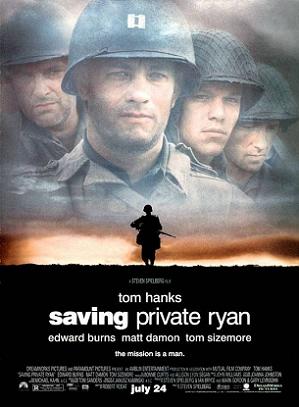
Telling an amazing story of bravery, Saving Private Ryan is both inspiring and moving. Beginning with the invasion of Normandy on D-Day June 6, 1944, the film follows a group of American soldiers as they look for a Francis Ryan. Since all three of his brothers are dead their mission is to find him and send the private home . Despite the dangers and the subsequent deaths of many comrades, they finally complete their mission after one last heroic fight. The movie flashes forward to the present day Ryan as he kneels at the graves of those brave men who saved him. Unsure he asks his wife if he lived a good life because those soldiers payed the ultimate price for him. With director Steven Speilberg, Tom Hanks, Matt Damon, and other good character actors, this is a powerful war film with great battle sequences as well as amazing heroism.

5/5 Stars

The Man Who Knew Too Much (1956) – Alfred Hitchcock

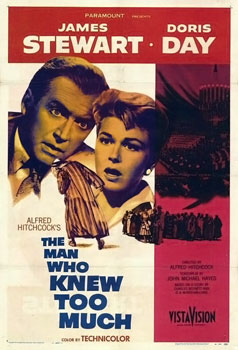
Starring James Stewart and Doris Day with director Alfred Hitchcock, the film follows the couple as they travel to Morocco with their son. Through a series of strange circumstances, Stewart finds himself learning a deadly secret from a dying man he just met the previous night. Soon his son is kidnapped and Stewart along with Day find themselves traveling to England in pursuit. Frantically, they try following leads and by the time they come up with one, the culprits are already gone before the police arrive. Their search finds them at the Royal Albert Hall foiling a plot and then they go to the embassy. Desperately, they keep up the search for their boy and it finally pays off, maybe. With the wonderful direction of Hitchcock and the song Que Sera, Sera, this film is quite good.

4/5 Stars

The Misfits (1961)


The Misfits is a film directed by John Huston and starring the likes of Clark Gable, Marilyn Monroe, Montgomery Clift, Thelma Ritter, and Eli Wallach. The story opens in Texas where a young woman is getting a divorce in Texas with the support of another divorced woman. After she goes through with the proceedings she feels bad but her spirits are lifted by a mechanic and then an aging cowboy who both find her extraordinary. She and the cowboy move into the half-finished home of the widowed handy man on his urging. Rosalyn and Gay slowly become closer and then he resolves to rope some wild mustang for money. Later, they go to a rodeo and meet Gay’s friend Perce who takes part in the dangerous proceedings. After a night on the town, he eventually joins the other two men in their endeavor. However, when they actually begin Rosalyn is horrified by the whole thing. In the end, Gay is back with Rosalyn but not without a great deal of strife over the horses. In many ways this film can be seen as prophetic and it certainly is historically important because it was the last film of both Marilyn Monroe and Clark Gable. Gable looks haggard and Monroe seems highly emotional, possibly hinting at their imminent deaths. Both the acting and the Arthur Miller script were commendable, and I think a good deal of credit has to be given to Eli Wallach and Thelma Ritter for their performances as well.
 
4/5 Stars

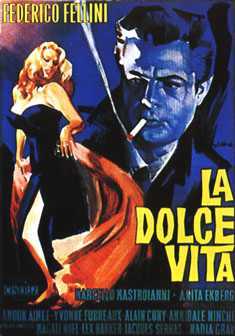
La Dolce Vita (1960)

bc0c3-la_dolce_vita_1960_film_coverartStarring Marcello Mastroianni and directed by Federico Fellini, this Italian film set in Rome follows a tabloid reporter named Marcello. If he is not finding a scoop with other ravenous reporters, he spends time with his wary girlfriend, falls for an American bombshell, talks with a cultured family man, or spends time with his good natured father who he does not really know. All the while he witnesses the lives of the rich and has many romantic relations. The underlining theme of it all is boredom,  unhappiness, and superficial lifestyles. This film is not really about a main plot but rather Marcello’s many different episodes and experiences. Some are funny and others maddening, but he muddles his way through. This film, much like Breathless, is international and chic. The cinematography and score are both effective in helping to create this feel.

5/5 Stars

Hud (1963)

Starring Paul Newman, Melvyn Douglas, Patricia Neal, and Brandon de Wilde, the film revolves around a principled, old Texas rancher (Douglas) who has the help of his orphaned nephew Lonnie (de Wilde) and his troublesome son Hud (Newman). Most of the film reveals the conflict between the father and his impatient and often immoral son. On the other hand Lonnie looks at his uncle with admiration. Then the cattle ranch is jeopardized by the possibility of hoof and mouth disease. When not working Hud goes wild in town and after one such night in a drunken stupor he is berated by his father and then makes advances toward the house keeper (Neal). Ultimately, the news about the cattle finally comes and the aftermath leaves Mr. Bannon dead, the housekeeper gone, and Lonnie on the road, with Hud all alone on his ranch. The primary actors were all very good and the black and white cinematography was especially striking.

4.5/5 Stars

The Hustler (1961)

Starring Paul Newman, George C. Scott, Piper Laurie, and Jacke Gleason, the film follows a pool hustler named Fast Eddie Felson (Newman). A cocky and skilled player, Eddie travels all the way from Oakland, California to face the legendary Minnesota Fats (Gleason). In an epic pool marathon with very high stakes, Eddie finds himself falling short. After his defeat, he wanders around a bit dead broke. Pretty soon Eddie finds a girl (Laurie) who has her set of problems just like him. But Eddie has the urge for pool again and to ultimately face Fats one more time. He enlists the backing of a successful, if not shady gambler (Scott), and they go off the Louisville to make some money. However, soon the fate of his girlfriend turns tragic. Eddie once again goes head to head with Fats, this time to prove he has changed and that he is indeed a winner. Overall this is a solid movie full of sports, atmosphere, and drama.

4.5/5 Stars