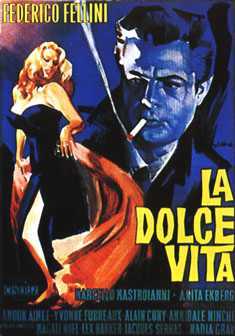
La Dolce Vita (1960)

bc0c3-la_dolce_vita_1960_film_coverartStarring Marcello Mastroianni and directed by Federico Fellini, this Italian film set in Rome follows a tabloid reporter named Marcello. If he is not finding a scoop with other ravenous reporters, he spends time with his wary girlfriend, falls for an American bombshell, talks with a cultured family man, or spends time with his good natured father who he does not really know. All the while he witnesses the lives of the rich and has many romantic relations. The underlining theme of it all is boredom,  unhappiness, and superficial lifestyles. This film is not really about a main plot but rather Marcello’s many different episodes and experiences. Some are funny and others maddening, but he muddles his way through. This film, much like Breathless, is international and chic. The cinematography and score are both effective in helping to create this feel.

5/5 Stars

Hud (1963)

Starring Paul Newman, Melvyn Douglas, Patricia Neal, and Brandon de Wilde, the film revolves around a principled, old Texas rancher (Douglas) who has the help of his orphaned nephew Lonnie (de Wilde) and his troublesome son Hud (Newman). Most of the film reveals the conflict between the father and his impatient and often immoral son. On the other hand Lonnie looks at his uncle with admiration. Then the cattle ranch is jeopardized by the possibility of hoof and mouth disease. When not working Hud goes wild in town and after one such night in a drunken stupor he is berated by his father and then makes advances toward the house keeper (Neal). Ultimately, the news about the cattle finally comes and the aftermath leaves Mr. Bannon dead, the housekeeper gone, and Lonnie on the road, with Hud all alone on his ranch. The primary actors were all very good and the black and white cinematography was especially striking.

4.5/5 Stars

The Hustler (1961)

Starring Paul Newman, George C. Scott, Piper Laurie, and Jacke Gleason, the film follows a pool hustler named Fast Eddie Felson (Newman). A cocky and skilled player, Eddie travels all the way from Oakland, California to face the legendary Minnesota Fats (Gleason). In an epic pool marathon with very high stakes, Eddie finds himself falling short. After his defeat, he wanders around a bit dead broke. Pretty soon Eddie finds a girl (Laurie) who has her set of problems just like him. But Eddie has the urge for pool again and to ultimately face Fats one more time. He enlists the backing of a successful, if not shady gambler (Scott), and they go off the Louisville to make some money. However, soon the fate of his girlfriend turns tragic. Eddie once again goes head to head with Fats, this time to prove he has changed and that he is indeed a winner. Overall this is a solid movie full of sports, atmosphere, and drama.

4.5/5 Stars

Dr. Strangelove… (1964)

17d85-drstrangelove1sheet

Living up to its name, this satire directed by Stanley Kubrick is quite peculiar to say the  least. The nation is on the edge of nuclear war because of a lunatic general (Sterling Hayden) who made the decision to override the authority of the president (Peter Sellers). Tempers flare in the war room as the leaders decide what to do. Will the Doomsday device be unleashed as Dr. Strangelove (Sellers again) supposes or will the bomb be stopped in time? One of the obvious highlights of this film would have to be Peter Seller’s performances as three distinct characters. George C. Scott also delivers a very respectable performance as a general advising the president. Then, there is Slim Pickens who is often remembered for the famous bomb riding scene. This film is good but in my mind it is not great. However, it does depict an era of tremendous fear brought on by the Cold War, thus making it historically important.

4.5/5 Stars

The Great Escape (1963)

Based on true events, this film describes the heroic exploits of POWs in a German Stalag during World War II. With extreme heart and teamwork the men take upon the task of making a massive escape. Led by Richard Attenbourough, Steve McQueen, James Garner, and Charles Bronson to name a few, they begin their monumental task. Despite adversity, their plan slowly becomes reality and escape is imminent. When the time comes over 70 men get away in the night, escaping secretly across Germany. However, relief is quickly replaced by tragedy as many of the escapees are shot or captured. Through it all the Allies struggle courageously against the Nazis. By the end they may be a little battered but they certainly are not beaten. Besides a wonderful ensemble cast, this film has one of the most iconic themes and chase scenes of all time.

4.5/5 Stars

To Kill a Mockingbird (1962)

Adapted from the famous novel, this film holds its own thanks to a stellar portrayal of Atticus Finch by Gregory Peck who embodied one of the most heroic screen personas because of his humility, his quiet strength, and his ability to understand others. Furthermore, this film covered the issue of prejudice when it was still a very explosive subject to many people.

*May Contain Spoilers

Adapted from Harper Lee’s classic, this film has a lot of things going for it. This includes a touching story and on of the greatest heroes of all time. It follows the recollections of Scout (Mary Badham) as she remembers her childhood with her older brother Jem and their widowed, lawyer father Atticus. The plot revolves most importantly around the trial of a black man for an accused rape of a white girl . The only man willing to defend Tom Robinson is Atticus because he feels it is the right thing to do. In probably his greatest performance, Gregory Peck portrayed a quiet yet courageous man, Lee had likened to her father. Instantly we are drawn to this well-grounded person who is not always liked or successful for that matter, but who always does what is ultimately right.

5/5 Stars

Who’s Afraid of Virginia Woolf? (1966)

Starring Elizabeth Taylor and Richard Burton with director Mike Nichols, this taboo-breaking adaption of the stage play revolves around a middle-aged couple. George is a professor and he and his wife Martha have a love-hate relationship. Urged by her influential  father, Martha invites a young couple to their home. Because of the late hour and lots of alcohol, the rest of the evening becomes a wild war full of nasty insults, hurtful games, and manipulation. Martha and George use their guests and go as far as physical violence. However, in the end secrets are uncovered and they realize that they truly are afraid of Virginia Woolf. What began as a joke became all too true. At points this film seemed to elude me but I will say the acting was intense and powerful. There were moments where you disdain these people, then you feel pity for their plight, and other times you may even be able to relate to them in some ways.

4/5 Stars

The Big Country (1958)

230bc-big_country833Directed by William Wyler and starring Gregory Peck, Jean Simmons, Charlton Heston, and Carroll Baker, this pacifist western revolves around a feud between two ranching families. A gentleman sea captain comes out west to be with his fiancée on her father’s ranch. After his arrival, he encounters a jealous farmhand (Heston), the beautiful schoolteacher friend of his fiancée, and of course the Hannasseys, who are sworn enemies of the Terills. In a sense he is a fish out of water because he never feels a need to try and prove his bravery to others. The schoolmarm is caught between the two families since she owns the vital watering hole “Big Muddy.” Mckay buys the land as a wedding present but when the wedding ties are cut now he is the one in the middle of it all. In order to stop the imminent bloodshed, he bravely rides into the Hannassey’s territory in order to get both sides to reason. Whether it be the score, the cinematography, or the dialogue, you will certainly come to realize that this is a Big Country.
 
4/5 Stars

The Gunfighter (1950)

da568-the_gunfighterStarring Gregory Peck, this enjoyable western is about Jimmy Ringo, a gunfighter who has gained notoriety over the years. He rides his horse into a town and enters a saloon for a quiet drink. A cocky kids eggs him on and Ringo kills him with the boys brothers soon on his tail. He scares them off and heads to the town of Cayenne to see his estranged wife. Most of the film has Ringo resting in the saloon where the bar tender waits on him and the whole town crowds outside to peek at the legendary killer. Ringo is met by the marshall who turns out to be an old friend. He tries to help Ringo, including contacting his wife who is now a schoolteacher. Finally, Ringo is able to see his wife and their young son. Exuberant, he is about to leave town when his assailants are spotted. In the end his name was too big. This film had a striking opening score, good characters, enjoyable dialogue, and some major plot twists.
 
4.5/5 Stars

Twelve O’Clock High (1949)

Starring Gregory Pb181c-twelve_oeck, the film follows a strict brigadier general who takes command of a group of bombers who fly precision daytime missions during WWII. Frank Savage is sent to relieve his friends because the group has suffered a great deal of poor luck. From the get go this tough leader is at odds with his men. They all want to be transferred and yet with the help of the camp adjutant, Savage is able to lead them effectively. His touch tactics lead to success in the air and a pride in his men develops. However, after one good mission Savage is incapable to go up the next day. He becomes a lifeless man and only when his men return does he revert back to normal. All this is remembered by Major Stoval as the film concludes. Peck and Dean Jagger were both very good and the bombing mission was certainly exhilarating to watch. It is more about the people then the war and that still makes it a good film.


4.5/5 Stars