Dial M for Murder (1954) – Alfred Hitchcock

Directed by Alfred Hitchcock and starring Ray Milland, Grace Kelly, and Robert Cummings, this film tells the story of a married woman who has fallen for another man. However, her suspicious husband finds out and decides to have her murdered. Through a series of events he finds his murderer and sets everything up for the following evening. His plan goes awry and his wife lives so he must rush to cover up all his involvement. In the ensuing days Kelly’s character is accused of murder even though she was simply defending herself. She finds herself facing death and yet the clever police detective figures everything out. He realizes her innocence and traps Milland in his own plan. With the typical Hitchcock style and solid acting, this movie is full of many suspenseful moments and it became an early example of film making for 3D.

4/5 Stars

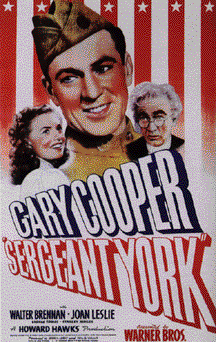
Sergeant York (1941)

Starring a wonderful cast including Gary Cooper, Walter Brennan, and Joan Leslie with director Howard Hawks, this is a feel-good film. Alvin C. York (Cooper) lives in a small town in Tennessee where he works hard but also drinks a lot. Over time however he becomes a devout Christian and falls for a girl named Gracie (Leslie). He is hoping to get married and own a piece of bottom farm land. World War I begins and after a great conflict inside of himself, Alvin decides to go fight. While there he proves his valor, helping to capture 132 German soldiers almost single-handed.  He returns home a great hero and is reunited with his family and Gracie. Despite being a great war picture, this is also a very nice biography of a simple yet religious man who tried to live his life to the best of his abilities.

4/5 Stars

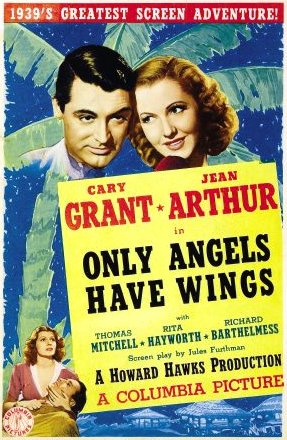
Only Angels Have Wings (1939)

a4eff-only_angels_have_wings_posterStarring Cary Grant and Jean Arthur with a cast including Thomas Mitchell, Rita Hayworth, and Noah Beery Jr., with director Howard Hawks, the film follows pilots who fly mail throughout South America. Grant is the head of the dangerous operation and it becomes apparent to Arthur that he is callous, after a great tragedy strikes. However, she still stays out of interest in him. Things get complicated when the new pilot arrives and he carries a past that puts him at odds with everyone. It doesn’t help that his wife (Hayworth) was the former girl of Grant. In order to keep the operation going, Grant is forced to send out this Macpherson as well as his best friend “The Kid” (Mitchell) into a large storm. Needless to say that are not able to make it. Arthur is about to leave after this second disaster, but beforehand she says goodbye to the saddened Grant. He soon peps up when the weather clears and then prepares to fly again. Arthur at first feels rejected but with a flip of a coin she realizes his love for her. This is certainly a tragic picture, but good nonetheless.

4/5 Stars

Where the Sidewalk Ends (1950) – Film-Noir


*May Contain Spoilers
Starring Dana Andrews and Gene Tierney with Karl Malden and director Otto Preminger, this film follows a ruthless police detective. Mark Dixon is notorious for his strong armed tactics and he is given orders to cool it. That same evening a mobster holds a crap game and things blow up when Tierney’s estrange husband fights the man on a lucky streak. The police catch wind of it and arrive finding the man dead with the husband gone. Dixon finds the husband and tries interrogating him but instead he accidentally kills the man. He must elaborately cover his tracks and when the police gather evidence it all point to Tierney’s amiable father. Dixon knows the truth and as he falls for Tierney’s character he tries to help her father’s case. In a last ditch effort he writes a letter of confession and tracks down the mobster to face death and close the case. However, he gets out alive and everything turns out fine except for his conscience. He has the letter opened and the truth comes out. Andrews and Tierney were paired again after Laura and I have to say I really enjoyed this film because of the tragic hero Andrews portrays.

4/5 Stars

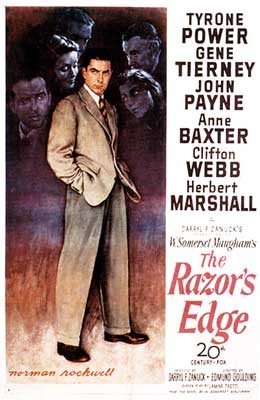
The Razor’s Edge (1946)

06cc8-razors_edgeAdapted from the novel by Somerset Maugham, this drama films stars Tyrone Power, Gene Tierney, John Payne, Anne Baxter, Clifton Webb, and Herbert Marshall. The film opens after WW I with an air force vet who is engaged to a young socialite. They are in love and yet he wants to discover the meaning of life before he settles down. She reluctantly lets him go to Paris while she remains in the states. While Larry lives in Paris and travels to the Himalayas their childhood friend Sophie gets in a car accident which kills her husband and baby. Isabel had tried one last time to win Larry back but with that not working she decides to marry the affluent Grey instead. Soon we learn that Grey lost everything in the Crash and he had a nervous breakdown. In Paris Maugham meets his old acquaintances and Larry helps Grey with his problem. They then encounter a drunken Sophie in a Parisian night club. Larry also helps her and decides to marry her. Isabel will have none of it and she leads Sophie back into alcoholism only for us to find out later that she was murdered later on. With Elliot on his deathbed Larry also does him a favor and afterward he correctly ascertains that Isabel led Sophie to drink. He moves on content and she can only be consoled by Maugham. Some interesting questions were brought up but it doesn’t seem that Larry figured everything out completely.

4/5 Stars

Review: Casablanca (1942)

It was over 70 years ago that Casablanca hit the silver screen for the first time. All the main players are dead and gone now. The Golden Age of Hollywood, where pictures were being churned out with factory-like efficiency, has given way to a modern era of blockbusters. To borrow a quote from the movie, it doesn’t seem that one little film would “amount to a hill of beans” in our present world. Still, somehow Casablanca is beloved to this day, despite the numerous other films that have undoubtedly entered the black hole of film oblivion. It seemingly will not die and for good reason.

Considered one of the greatest films of all time, this well-loved classic deserves to be here. It is the hallmark of Humphrey Bogart and Ingrid Bergman’s careers. It also has one of the greatest scripts of all time, and it has achieved legendary status over the years. Many consider it purely the best film ever made and in all honesty, I would never try to refute that.

The film opens quickly and we are immersed in a world that is at the height of the Nazi terror, and many people are fleeing Europe by way of Casablanca. It is a treacherous place full of pickpockets, corrupt authorities, refugees, and naive tourists as well. Two German couriers have been murdered and some invaluable letters of transit have been stolen. That’s when we are first introduced to Rick’s Café Americain and its cynical proprietor Rick Blaine (Bogart).

A shady fellow named Ugarte (Peter Lorre) comes to Rick with the letters and asks Blaine to keep them for him. However, later that night Ugarte is taken into custody, and things begin to get even more complicated. Wanted resistance leader Victor Laszlo (Paul Henreid) is now in Casablanca, however, a Major Strasser has arrived from Germany to take him in. To top it off, Laszlo’s wife Ilsa (Bergman) was Blaine’s old flame in Paris and, needless to say, it didn’t end well.

Laszlo desperately needs the letters of transit to escape, and he inquires about them. Soon he is led to Blaine, but as Rick often admits he sticks his neck out for nobody. Knowing all too well that he is in danger, Laszlo still shows his defiance against his enemies by leading the people in a round of “La Marseillaise” and as a result, Rick’s is shut down.

All the memories of Paris begin flooding back, and then Ilsa confronts Rick in order to get the letters. This is possibly the most critical point in the film because this tense altercation ultimately renews the relationship between Rick and Ilsa. Rick asks her to trust him, and he begins to take things into his own hands. The results of his actions created one of the great romantic and cinematic moments in the history of film. The whole film leading up to this point hints at it, but Rick truly is a sentimentalist at heart. He can live with the notion that they will always have Paris and that leads him to commit a selfless act of love.

This film holds such a tremendous presence in movie history, and upon seeing the movie it makes complete sense what all the hype is about. What more could you want than Bogey, Bergman, Casablanca, and some of the greatest quotes ever uttered? Do not forget the corrupt, but nevertheless lovable French Captain Louis (Claude Rains), who delivers some terribly witty lines. Honestly, he may be my favorite character in the whole film, and that’s saying a lot!  Then, of course, there is the immortal tune of “As Time Goes By,” sung by Dooley Wilson which will forever be ingrained in film lore.

However, you also gain an appreciation for the other interesting characters of Casablanca, some comical, some sympathetic, and others despicable. We have a rogue gallery of everybody under the sun from Peter Lorre, Sidney Greenstreet, German soldiers, various guests, and all the staff at Rick’s Place. This movie has conflict and the uncertainty of war in practically every scene because at the time World War II was in full force. There are a broken romance and a forlorn hero who shows his courage in the end. As an audience, we come to realize the transformation of Rick into a truly great man. Ilsa on her part has the most radiant face I have ever seen.

It is wonderful that Casablanca succeeds as entertainment despite the fact that it is not modern. In fact, part of its charm is the black-and-white cinematography that helps make Rick’s Café so atmospheric. It effectively makes each interior shot moodi34 and every romantic scene even more striking. I am very doubtful that they would ever be able to pull this film off in color. It just wouldn’t work.

You do not need explosions and violence either, only great characters and a story with both drama and humor to reel the audience in. Up until the final moments of the movie you are captivated the entire time. Then, fittingly, you are left with the two men walking off into the night with the words, “Louis, I think this is the beginning of a beautiful friendship.”

In fact, with this film, my thoughts always go back to the script. Lines like “Here’s looking at you kid,” “We’ll always have Paris,” and “Round up the usual suspects” are so rampant that you cannot possibly remember them all, and I doubt there will ever be another film that is so immersed in American cultural lexicon. Still, many of my favorite lines in the film are those that get overshadowed by the more famous ones. That is the sign of an amazing film that never grows old. Even those who have not seen this classic film like to think they have, because the influence of Casablanca reaches everywhere. I guess I’m rather an idealist myself, so I would like to think that even if 70 more years pass, we’ll always have Casablanca.

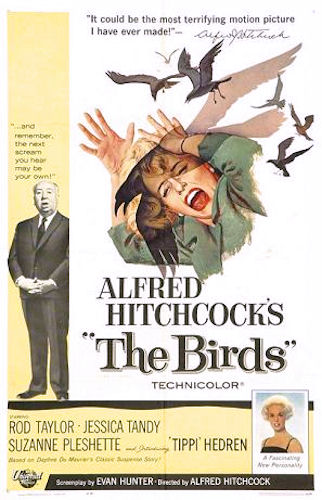
The Birds (1963) – Alfred Hitchcock

ebc31-the_birds_original_posterDirected by Alfred Hitchcock and starring Tippi Hedren, Rod Taylor, and Suzanne Pleshette, this film follows the journey of a rich woman who travels to Bodega Bay in order to visit a man who intrigues her. This love story is already odd to begin with and then add thousands of berserk birds to create far more chaos. Everything is innocent enough at first but Hedren gets attacked by a seagull. Everyone brushes it off but the next day at a birthday party a wave of birds attack. A couple of deaths and many injuries occur causing tumult all over the bay. The birds keep on attacking in cycles so the citizens must either try and flee or barricade themselves in their homes. Soon the threat of the birds seems overwhelming and Hedren and her new relations must fight to survive. Although this film ends with the family finally escaping in Hedren’s Ashton Martin Coup, the birds still sit there as ominously as ever. With the use of special effects and no score, this film sends shivers down the spine. However do not think it is just a horror flick. Much like Psycho it is also a very well made film.

4.5/5 Stars


The Wrong Man (1956) – Alfred Hitchcock

9c899-the-wrong-man-posterDirected by Alfred Hitchcock and starring Henry Fonda and Vera Miles, this film, based on a true story, is about an innocent man who is falsely accused of armed robbery. Manny is an unassuming musician who lives with his family in New York and barely scrapes by paying the bills. Unfortunately he closely resembles another man who held up a local insurance office. The police are called and then a few witnesses label Manny as the culprit. A coincidence on a writing sample seem to solidify his guilt and so he is jailed. Manny’s wife and family scrounge up the money for bail and a lawyer is found to represent him. Manny tries to prove he was on vacation during the incident but his three acquaintances are either dead or cannot be found. However, Manny has another alibi that his lawyer thinks may stand up in court. At the same time Rose begins to blame herself and her mental health deteriorates forcing Manny to put her in a sanitarium. His first appearance ends in a mistrial but Manny is still in despair. Finally good fortune strikes him when the real robber is finally caught. Manny is free but not without horrible consequences. I have to say Fonda is always so sympathetic in these type of roles and Miles has a good dramatic performance. Although it is lesser known, this film shows the diversity of Hitchcock. Here he essentially makes a documentary and it is just as powerful as many of his other great films in its own way.

4/5 Stars

Spellbound (1945) – Alfred Hitchcock

Directed by Alfred Hitchcock and starring Gregory Peck and Ingrid Bergman, the film follows the complicated story of an intelligent lady doctor skilled in psychoanalysis. Bergman’s character is very focused on her work and often withdrawn. That soon changes when she meets the new doctor (Peck) whom she falls for. However, soon Bergman realizes he is not the real doctor and further uncovers his state of amnesia used to forget his past. Trying to keep him out of the hands of the police, she takes Peck to her former colleague and they try to delve into his dreams. When Bergman finally seems to have all the answers unexpected complications arise. Now she must save her patient and lover before it is too late. Hitchcock’s directing, a great score, collaboration with Salvidor Dali, and good acting make this film worth seeing. Michael Chekhov is certainly good for a laugh or two as well.

4/5 Stars

The Great Dictator (1940)

ac211-the_great_dictatorStarring Charlie Chaplin with Paulette Goddard, this satire blatantly critiques Hitler and the Nazis. The film opens during WWI where a little solider (Chaplin) saves an important military man. However, as a result he lands in a hospital with amnesia. All the while the power hungry dictator of Tomania, Adenoid Hynkel (also Chaplin) is on the rise. The man with amnesia returns to his barber shop in the Jewish ghetto and there he catches the eye of a beautiful girl Hannah. However, as Jews they are not safe, and even when things start improving, quickly Hynkel puts down his iron fist. The barber and another dissident are imprisoned, Hannah is in trouble, and Hynkel is ironing out his differences with Benzino Napaloni. However, after a gutsy escape, the barber poses as Hynkel and makes an impassioned plea to the people.

I see this film as a drama full of pathos. It is important to realize that is is not trying to make light of the situation but it is in fact condemning what Hitler was doing at the time. I think that is part of the brilliance and universality of Chaplin’s films. He could balance drama and comedy so aptly, making it possible for him to tackle this controversial topic head on. Furthermore, even though this was his first true talkie he still kept one foot in the silent age in his portrayal of the barber (very similar to the Tramp), and yet he also acknowledged the very present danger of Hitler. This film has some wonderful moments, but I think the two that really stick out are the opening speech by Hynkel which blatantly derides Hitler’s mannerisms and rhetoric. Then, in a complete 360, Chaplin gives his powerful speech aimed to rally mankind. Overall, it is a stellar duel performance from Chaplin and Goddard is as radiant as ever. That mustache certainly did not hurt the film either!

5/5 Stars