Patton (1970)

Starring George C. Scott and Karl Malden, the film chronicles the exploits and controversy surrounding the great World War II general. Gaining fame  in Africa, Patton would move on to Sicily, and finally march toward Berlin. Patton was a colorful character who was highly religious, a war romantic, and he also had a big mouth. Despite often being tough and unpopular, over time Patton did garner the respect of many an aid, ally, and even enemy. His heroic 3rd army became famous for their exploits all across Europe. By the end of the war, Patton came out a very complex hero from a former age. The reason this film is good not only rest on it being a war movie but also based on character development. George C. Scott does a wonderful job of portraying the larger-than-life persona of Patton.

4.5/5 Stars

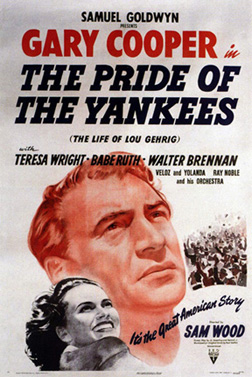
The Pride of the Yankees (1942)


Starring Gary Cooper as Lou Gehrig and Teresa Wright as his wife, this movie honors Gehrig’s life after a tragic death from ALS. From the time he was a boy, Lou could play ball but his immigrant mother wants him to become an engineer. The quiet, young man goes to Columbia and plays some ball. There he is seen by the Yankees who agree to sign him. Despite her disapproval at first his mom becomes his biggest fan. With the Yankees Lou seems slightly out of place being an introvert. Pretty soon he meets Eleanor Twitchell (Wright) however and then gains a spot as the starting first baseman. The two of them fall in love and get married as Gehrig flourishes in the shadow of Babe Ruth. With his career still going strong, Gehrig becomes captain and plays 2,000 straight games. It cruelly comes to an end when he begins feeling weak and is diagnosed with ALS. His career is over and yet in his farewell speech Gehrig gratefully considers himself the luckiest man on the face of the earth. He walked out of the limelight and died soon after, dearly missed. This is one of those truly moving films.

“I consider myself the luckiest man on the face of the earth.” You just cannot make up stuff like that. Here’s to you Lou!

4.5/5 Stars

Scarlet Street (1945) – Film-Noir

Similar to Woman in the Window, this film-noir was directed by Fritz Lang and it stars Edward G. Robinson, Joan Bennett, and Dan Duryea. Chris Cross is a shy employee who has been working for the same man 25 years. While walking home Chris rescues a beautiful woman from an assailant, not knowing it is her brutish boyfriend. Amused Kitty agrees to have coffee and Chris who is an amateur artist, begins talking art, but Kitty gets the idea he is a wealthy painter. Because Chris is stuck in a hopeless marriage he becomes infatuated with kitty and she takes full advantage. Chris scrounges for money to pay Kitty’s rent and unbeknownst to him, Kitty’s boyfriend tries to sell the artist’s work. A critic is impressed and so Kitty masquerades as the artist. Chris finds out eventually and confronts her but the conniving femme fatale manipulates him again. Chris is delighted his work is appreciated and he is content with Kitty continuing to take the credit. An unexpected turn of events mean he can leave his wife and marry Kitty finally. However, he finds her with Johnny and after his genuine proposal she belittles him.An enraged Chris commits murder but it is pinned on Johnny. A miserable wanders the streets without a job or recognition for his art. Furthermore, he must live with his guilty conscience tormenting him until the end of his days. Woman in the Window is good but this film is more biting and powerful when it is all said and done.

4/5 Stars

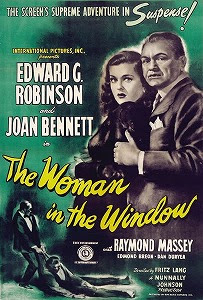
The Woman in the Window (1944) – Film-Noir

Starring Edward G. Robinson and Joan Bennett, this film-noir involves an ordinary psychology professor and a beautiful woman. The story begins at the club where the professor and his friends begin to discuss an enchanting portrait of a woman in a store window. He stays behind for a while longer and before he leaves he takes one last look at the painting. And there he meets the woman herself who then invites him over for a drink. However, her angry boyfriend comes by and he is left dead after a scuffle. Now the two perpetrators must cover up their murder and dispose of the body. That task goes to the professor and he naively dumps it out in the country leaving behind numerous clues. One of the professor’s friends is the district attorney and so he finds himself invited back to the scene of the crime. The professor is not suspected but the woman is blackmailed by a low life ex-cop who threatens to expose them if he doesn’t get his money. Much to the woman’s relief the blackmailer is killed but it comes too late for the professor. Or does it? This noir directed by Fritz Lang focuses on a mysterious woman and psychology. It also has one of the most abrupt, out of the blue endings. Every movie should not be resolved this way but I rather liked it one time around.

4/5 Stars

The Big Heat (1953) – Film-Noir

*Contains Spoilers

Starring Glen Ford, Gloria Grahame, and Lee Marvin, with direction by Fritz Lang, the film follows an everyday cop named Dave Bannion (Ford). This film-noir begins with a mysterious suicide of a cop. Soon Bannion is on the case trying to put the facts together and then everything heats up. First, a young woman he talked with is found beaten to death, then his wife is brutally killed by a car bomb. Enraged by the death of his loved one, Bannion obsessively seeks justice. Everything becomes clear when he comes to the realization that one man controls the town through his influence and strong-armed tactics. With his badge taken away, Bannion meets Grahame’s character and she falls for him. However, her thug boyfriend (Marvin) scalds her face and so she becomes determined to help Bannion and she even commits murder. Fatally wounded by the thug, she dies but her actions close the case and bring along justice. Fittingly Bannion is promoted to sergeant by the end of the film and starts on a new case.

4.5/5 Stars

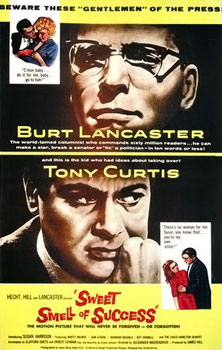
The Sweet Smell of Success (1957) – Film-Noir

Starring Burt Lancaster and Tony Curtis, this film has memorable dialogue and chilling performances. Curtis is Sydney Falco, a greedy and conniving press agent who is constantly trying to get on the good side of influential people. His main target is the renowned if not ruthless gossip columnist J.J. Hunsecker (Lancaster). Falco bargains for publicity he desperately needs in exchange fro breaking up the romance of Hunsecker’s kid sister. The plan seems to work just as Falco foresaw, however a heated confrontation leads to Hunsecker seeking revenge on his sister’s boyfriend. Ruthlessly he has the man framed with the help of a reluctant Falco. Finally, Falco has had enough but Hunsecker turns on him too in order to protect his image and his sister. As the film closes, Hunsecker’s almost suicidal sister leaves to go back to her boyfriend and he is all alone. Lancaster and Curtis both give performances that brim with corruption and sleaze. The score and the New York atmosphere also help to bring the film alive.

4.5/5 Stars

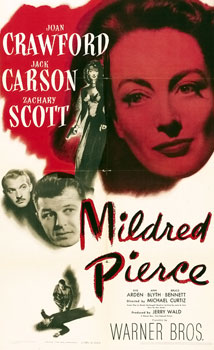
Mildred Pierce (1945) – Film-Noir

Starring Joan Crawford, this classic film noir is intriguing because it revolves around a successful woman. The film begins with a murder and Pierce is taken in for questioning. From that point on she tells the story of her life with her first husband and two daughters. However, Pierce was in conflict with her husband about their spoiled daughter Veda and they split. She was forced to go it alone in the business world and make something of herself. However, her spoiled daughter and complex relationships with men made her life painful. She was now a wealthy restaurant owner but Veda no longer loved her. Pierce tried in every way to win back this love However, her efforts were not enough to save Veda from her fate. This film is certainly enjoyable and Crawford does a wonderful job because for once you actually feel sorry for her. She has a solid cast behind her including Ann Blyth, Eve Arden, and Jack Carson.

4.5/5 Stars

The Killers (1946) – Film-Noir

Starring Burt Lancaster in his debut as well as Ava Garner, the film begins with two gunmen killing “The Swede” (Lancaster) in a small town. Interested in the mystery, an insurance investigator named Reardon (Edmund O’Brien) tries to piece together the past of the dead man. He works to gather more information and talks to “The Swede’s” former friend as well as a hotel worker, and a past cell mate. Through a series of flashbacks Reardon slowly strings together the past including “The Swede’s” boxing career, his time in prison, and especially an alluring woman, Kitty Collins (Gardner).In the climatic scene Reardon finally meets the beautiful Kitty. Only after a series of events and her quick getaway does he grasp the whole truth. Kitty was a deadly double crosser. However, in a cruel twist her partner in crime is killed and her fate is sealed. This is an exciting film noir with solid acting and a great style of storytelling. This was my first experience with director Robert Siomak, and I must say I was quite impressed.

4.5/5 Stars

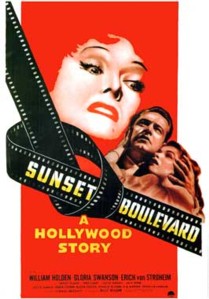
Sunset Boulevard (1950) – Film-Noir

This is a great film-noir but more importantly it serves as a biting picture of the Hollywood lifestyle . Billy Wilder created a very interesting film that is well worth watching. It puts a very contrasting pair together and delivers the tale with a exceptional style of storytelling.

*May Contain Spoilers

In this film starring William Holden and Gloria Swanson (real-life silent film star) a down-on-his-luck writer, strictly by chance, finds himself living with a forgotten film actress. From the very beginning he finds her eccentric and her mansion chilling. All the same he agrees to live there in order to edit her movie script and earn some much needed money. Soon she grows accustomed and dependent on him since her only other companion is a butler. Hoping to make a comeback she goes to director Cecil B. Demille but it becomes evident to those around her that things will not work out. At the same time the young writer begins to distance himself as he begins to fall for a young woman writer he has been working for. In a chilling ending someone dies and another goes seemingly mad because the tension has grown too great. This film is very well done from the flashback and narration at the beginning to its critique of Hollywood and the parallelism with real events.

5/5 Stars


Touch of Evil (1958) – Film-Noir

92b8e-touchofevilStarring Charlton Heston, Janet Leigh, and Orson Welles, this film is one of the last examples of what is considered true film-noir. In a small, dangerous, run down, border town, a mysterious car bombing murder takes place. A Mexican investigator who is a newlywed (Heston) and a hardened American policeman (Welles) join forces on the case. However, soon the case becomes complicated with corruption, kidnapping, and plotting. With his wife in danger, Heston must save her while trying to crack the mystery. Only after some time does he realize the man with the touch of evil. The protagonist wins but that does not mean there is not tragedy as well. Orson Welles does it again with this intriguing film. The opening shot alone shows the brilliance of Welles. This film is one worth seeing, showcasing director Welles and good acting by the entire cast.

4.5/5 Stars