It Started With Eve (1941)

it started with eve 1.png

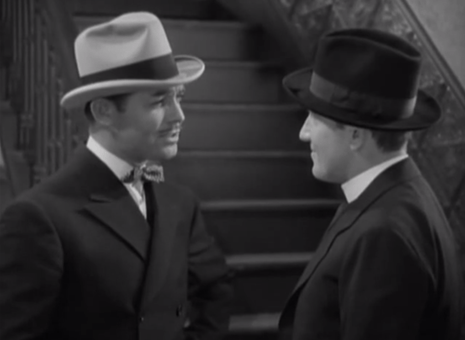
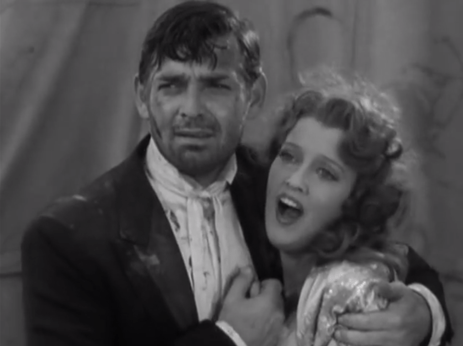
We enter a newsroom that feels like it could be ripped out of His Girl Friday (1940). The editor is lining up his copy for the following day with a big front-page spread on the renowned millionaire Jonathan Reynolds (Charles Laughton). They just need him to die and they can print it.

Of course, at this point, it looks like it’s all but in the books. He’s a very sick man, on his deathbed, straining at what look to be his final gasps of air. His son (Robert Cummings) is rushing away from his vacation to be at his father’s side before it’s too late. The doctor fears the worst but his son makes it back from Mexico City in time to catch his father.

They share some tearful exchanges. Then, comes the fateful moment where his dad asks to meet his new fiancee. Wanting to honor his father’s last wish, Johnny goes pell-mell to his fiancee’s hotel but she can’t be found anywhere and he tries everything.

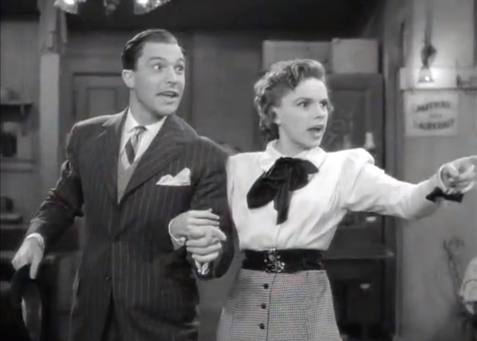
In a frantic moment of duress, the man makes a decision that will forever alter the course of his life. A hatcheck girl at the hotel (Deanna Durbin) becomes the perfect stand-in for his fiancee on a dime.

Frantic, he promises her 50 bucks and takes her to his father’s bedside. They share a poignant exchange and Johnny thanks her for her services and thinks that is the end of it — of his father and his relationship with this woman — but he’s terribly mistaken on both accounts.

Against all medical opinions of the family doctor (Walter Catlett), Mr. Reynolds makes a miraculous recovery and is back to his old ways craving cigars and steak for breakfast. It’s joyous news until he wants to have breakfast with Gloria Pennington whose actual name is Anne Terry.

Now his son is in a jam and he pulls Anne away from her train to Ohio to keep his father happy by maintaining the charade. Now he’s in deeper than he wants with one “fiancee” hitting it off with his father and the other with her mother waiting to be introduced to Mr. Reynolds. Needless to say, the local bishop (Guy Kibbee) gets the wrong idea about the boy he has known from youth who has become a degenerate philanderer supposedly keeping company with two different women.

Johnny could care less. He’s still in a bind and his main goal is to get everything patched up by paying off this girl again and enlisting the help of the doctor to introduce his fiancee into their home very naturally before the big party his father is throwing. It’s easy enough to tell his father that they have a lover’s quarrel and the “engagement” is off.

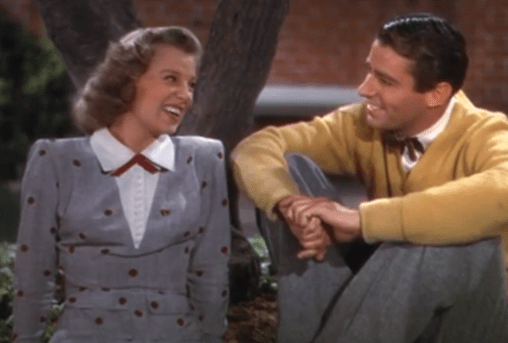
And yet, Anne doesn’t let it go that easily and she returns to profess the error in her ways and make up. Because now she has a larger stake in this new relationship. She’s a struggling musician who has heaps of talent. It’s just that she’s never gotten a chance to share it with someone important. This is her one shot at a big break. But far from being an opportunistic girl, she also adores this man and to some extent likes his son for a certain amount of sensitivity that he has.

Durbin and Laughton are brilliant fun together because he remains the crazy glue that holds this “romance” together. While things look like they have run their course and Johnny has salvaged everything the way they were originally meant to be, Mr. Reynolds goes off script and does the unanticipated, he drops everything at his gathering to see Ms. Terry.

But of course, we already know they aren’t a real couple and so it makes for an initially awkward and then a surprisingly jovial evening, finished off with a lively round of the conga. Mr. Reynolds succeeds in almost giving his good doctor a heart attack and sends his son for a real loop. In another fit of Deja Vu, Johnny races after Anne’s departing train to catch up with her once more. This time for good.

Charles Laughton is undoubtedly the M.V.P. of the picture providing a delightfully grouchy yet lovable turn hidden behind a mustache and a happy old boy persona which channels a bit of a naughty schoolboy at that.

Cummings has a knack for the clumsy, flustered comedy that comes as a result of his initial bumblings. He and Durbin work through the hilarious miscommunications that ensue beautifully as standard procedure in such a screwball musical. Instead of kissing like normal people they giggle, cackle, pinch, bite and do about everything else including play fight around the interior study. But if that isn’t love then I don’t know what is.

4/5 Stars


Three Smart Girls Grow Up (1939)

Three_Smart_Girls_Grow_Up_poster.jpgThe Universal dream team of Deanna Durbin, producer Joe Pasternak, and director Henry Koster are back at it again in this follow up to the wildly popular comedy that propelled Durbin to international stardom.
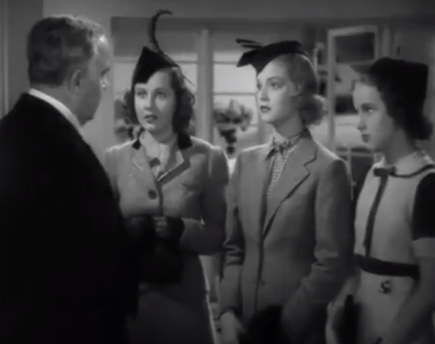
The Craig sisters are back too and this one begins with a unique and rather hilarious opening title sequence as our three girls now grown up, as the title suggests, prepare their salutations for meeting the governor.

Most things haven’t changed as Penny (Durbin) is precocious as ever. The family seems joyous given the previous film reunited their estranged parents once more. But for some reason, it seems the men they were engaged to didn’t remain (conveniently for the sake of the sequel).

So the film proposes another slightly maudlin very straightforward problem that Penny puts it upon herself to solve: Her big sister is in love with one man, the young man who is just recently engaged to be married to their other sister. There’s nothing for it but to find another man who will be a distraction. Never one to be outwitted, Penny introduces an eligible man into the equation, an older musician (Robert Cummings) from the conservatory she practices at under her teacher (Felix Bressart).  But her concerned parents get the wrong idea with her bringing an older man around the house for dinner.

They forbid their daughter from going to her music lessons now. By the time she figures out what has happened, the fateful day of the wedding is almost upon them and so she does the only thing she can think of — go to her father — the same father who has been drowning in work as of late. Like any good father, he comes in clutch when it counts. The happy ending kept fully intact.

Ironically, Robert Cummings makes a passing remark about how he has no girlfriend and he’s waiting for Penny to grow up. Funny because he and Durbin would be paired in It Started With Eve (1941) just two years later as romantic interests.

Durban, on her part, was christened “Little Miss Fix-It” for these roles and though she was beloved for such fare there’s no begrudging her for wanting more meatier and mature parts. By and large, she wasn’t all that successful in getting the type of roles she wanted and it led to her retirement from acting in 1949. She would never make another picture after that and proceeded to live a life of relative seclusion with her husband in France.

It’s easy in this specific instance to make parallels with Greta Garbo’s own trajectory from top of the world to self-prescribed anonymity.  Except Durbin did it at an even younger age. There’s no overstating her importance to an entire generation of filmgoers. There’s no greater compliment than the attributed fact that Winston Churchill so loved Durbin’s films he would play them following British victories during the war years. She certainly does give you something to stand up and cheer about with her voice and a sparkling countenance alone.

3/5 Stars

Three Smart Girls (1936)

three smart girls 1

Here is a comedy born of a certain time and age when they made such trifles. It’s the kind of plot where you can read it off in a single sentence but it’s further cushioned by cutesy moments and musical asides. Where growing girls say “Mummy” and “Daddy,” always fussing and screeching and bickering over this or that.

It could all get tiresome and too sugary if it weren’t redeemed by how very pleasant it is in reflecting adolescence. Yes, you could even call it absolute claptrap but there’s something special thrown into the concoction: Her name is Deanna Durbin.

Perhaps I am overstating her significance and making her stake larger than it possibly could be but I’d like to think on the contrary. Deanna Durbin is presented as “Universal’s newest discovery” and what a find she was. Beginning a run of many successful box office hits continuing up on through the war years, she was a beloved part of Americana.

Here was a teenage girl who with a voice and a carefully groomed persona helped salvage an entire studio and became so well-known and admired that by 1941 she would be the highest paid woman in America and the entire world, bar none, at the age of 21 (Look it up for yourself but don’t quote me).

Three Smart Girls is a film that means the very best and Henry Koster guides it along this path of sunshine and cheerfulness. There are numerous moments that say as much as Penny (Durbin) floats along with her two sisters (Barbara Read and Nan Grey) on a lake riding lazily on their sailboat in Switzerland while she knocks out a tune. Maybe it’s the girls squealing as they make use of their father’s exercise equipment and we watch Durbin repeatedly swing toward the camera until her face completely fills up the frame.

But I’ve put it off long enough. Here is my one sentence of exposition. The Three Craig girls make it their mission to go to New York and break of their father’s (Charles Winninger) engagement to a young gold digger so he can get back with their mother (Nella Walker). It’s a noble project and it also has the touches of an early Parent Trap (1961) which takes obvious inspiration from this picture.

The girls bring their flurry of teenage drama into their father’s bachelor lifestyle as well as subsequent heartbreak and tears that do finally give way to marital bliss (of course they do).

There seems to be a paradox to Deanna Durbin’s appeal. She had the feisty sass of a younger girl and the voice of an older one that sweeps you off your feet. It’s the kind of voice that I must admit sounds dubbed at times. That cannot conceivably be her singing!

She makes a line of hardened cops do a double take when she breaks out into an opera number in the police station trying to pull off a little white lie that’s she’s a Parisian songstress. It almost works too.

Ray Milland is wonderfully witty as the rich young gentleman who finds himself pulled into the girl’s charade on a miscommunication. In fact, it’s easy to prefer him in these lighter roles to his more dramatic turns that sometimes leave him looking like a stuffy cad. He can be quite charming actually. Mischa Auer also shows up but unfortunately isn’t given much to do.

But in the end, this evolved very much into Durbin’s film anyways and she does well to oblige the audience while her sisters are happily saddled with eligible young men and her parents get back together. They’re all a happy family again and there Penny is standing at the center of it all smiling broadly.

3.5/5 Stars

Broadway Melody of 1940 (1940)

Broadway_Melody_of_1940_Poster.jpg“The more you know about women the less you know about women.” It’s the story of my life and also a marvelous entry point for this film because it really is a throwaway line. It’s referred to several times thenceforward but really means nothing more. Anyways, if we came to this film simply for the plot it would have been buried under heaps of other more elegant or frenetic comedies over the years. But the reason to revisit this one for all those eager thespians out there is solely for the dancing and what dancing it is.

Don’t get me wrong. It would be tantamount to cinematic blasphemy to say that Fred Astaire belonged beside anyone else rather than Ginger Rogers on the dance floor but maybe it’s the novelty of the situation that makes me quite thoroughly enjoy this effort that paired him with his contemporary, the premiere dancing star Eleanor Powell.

Though working at a different studio now  (MGM instead of RKO), the plotline could have easily followed in the footsteps of many of Astaire’s earlier pictures. It’s pure cotton candy fluff about mistaken identity since he gives the name of his best buddy to a man he thinks is a collector. Is he surprised when he finds out days later that the man actually had connections with a big stage production starring the one and only Clare Bennett?  By throwing out the name of his chum King (George Murphy), he unwittingly paid his best friend the biggest favor of his life and he takes it in stride willing to sink into the background.

Still, he can’t help but harbor a crush for the divine Ms. Bennett and he starts getting a little peeved with how the fame is going to King’s head which leads him to get pig-headed and worse yet completely swacked before his grand opening. Obviously, someone else needs to fill in and wouldn’t you know it, we just happen to have Fred Astaire waiting behind the curtain to step in. The rest you can probably figure out for yourself. Meanwhile, Frank Morgan and Florence Rice appear intermittently providing a bit of comic background noise to fill in the idle moments with some mild buffoonery.

But the dancing, the dancing is as sublime as it’s ever been and it’s breathtaking watching Powell’s solo numbers as well as some of the other stunts, some comical and others mindboggling for their precision (Plate throwing and ball balancing come to mind). A few Cole Porter tunes still have their allure namely the famed “Begin the Beguine” number as well as the peppy “I’ve Got My Eyes on You” elevated still further by the dancing that goes with them.

Watching Astaire and Powell is enough. Because dancing done well by Astaire, Rogers, Kelly, Cagney, Powell, O’Connor, Charisse, any of those names, transcends the plotlines they find themselves in and captures us in a moment of sheer euphoric joy. This is coming from a man with two feet so far left that they’re practically right, so perhaps I’m too easily impressed, but I’d like to believe that every time they thrill me with their taps I’m getting my socks blown off by something sensational. Others can judge it as they may but I’ve said my peace.

3.5/5 Stars

100 Men and a Girl (1937)

one girl and 100 men.png

It’s fascinating how history works. Deanna Durbin and Judy Garland came up at the same time. In their day, stars were groomed from an early age and MGM had both the starlets under contract. But instead of holding onto both talents it turned out that Garland remained and Durbin signed a new agreement with Universal.

The conventional wisdom was that you only needed one young singing girl at a studio. That niche was filled. Of course, that proved to be far from the truth as Durbin became a smash hit in her own right rivaling Garland.

100 Men and a Girl is only one film in a long list of successful outings she had in the 1930s starting with Three Smart Girls (1936). Most of these pictures were directed by Henry Koster and proved very popular with audiences.

This particular one surrounds Durbin with players including Adolph Menjou and has some My Man Godfrey (1936) castmates carried over from the previous year. There’s the inclusion of flabbergasted Billy Gilbert as the easily duped funnyman and other crucial character actors like Mischa Auer and Frank Jenks taking up posts as a flutist and a stymied cabbie respectively.

But front and center and most agreeable of everyone is this pleasant girl who unwittingly finds herself in high society and taken under the wing of a bubbly socialite (Alice Brady), who finds this girl’s demeanor charming perhaps for the very fact that she’s so sweet and well, a frantic force of nature. It’s delightfully refreshing and different from the snooty company the lady is used to having in her presence.

But Patsy Cardell can also sing quite stupendously and that’s to her credit. I’m hardly musically inclined but Durbin even at this age hardly seems a show tunes singer, sweetly navigating the utmost of classical compositions with a voice that feels beyond her years. My personal tastes are simpler but there’s no discounting her vocal abilities.

Still, the film is born out of an admittedly absurd idea and the light bulb flashes in a rapid burst of inspiration. Patsy’s father (Menjou) is out of work and so are 100 of his fellow musicians. What should she do? Starting a symphony orchestra is what she should do! It’s as clear as day and she motors forward determined to make her idea turn into something tangible with the promise of backing from Mrs. Frost (Brady).

The wind is in her sails and she’s not about to allow logistics or the scorn of others uproot her vision. Her goal is to get her daddy on Mr. John R. Frost’s radio show. It’s just what her father needs to get back to work. Presto! This is a film plot that might as well have gotten resolved with a puff of smoke. Just like that. Instead, she is crushed by the curmudgeon husband (Eugene Pallette), his wife now off in Europe out of sight. So Patsy has no recourse to go to the top and famed conductor Leopold Stokowski (playing himself).

The rest of the story relies on a number of convenient happenstances. False hopes and crushed dreams become real hopes and true dreams. Although it’s a pure pipe dream of a film, sometimes that’s just what we need whether we’re still wrangling with the Great Depression or in the here and now 80 years onward. Because films like this that are ethereal, fluffy, and light still give us something.

Durbin holds her own with cheerfulness and a certain amount of sass that doesn’t compromise her basic principles. She was instantly likable in her day and still much the same today.

Henry Koster will never get any respect for the kind of pictures that he made but that’s okay because he made films that were crafted with a genuine heart. That speaks to people in ways that other types of films can’t seem to manage. True, this picture can hardly claim the title of an artistic masterpiece for critics to fawn over and dissect to death with their immaculate vocabulary and academic analyses. That too is okay. Here is a film that’s wacky, fun, and it’s okay with being just that.

Deanna Durbin was credited with saving her studio from the pits of bankruptcy during the depression years with her voice and her spirit and a certain candor that made her a beloved girl-next-door icon for a generation. She was crystallized in that image and never quite broke out like she probably would have liked.

She also never saw the same acclaim from modern generations like a Judy Garland since she didn’t have a film like The Wizard of Oz (1939) for folks to rally around but in her time she was quite the attraction. All told, finding her again today is still a lovely revelation. She remains enjoyable to watch even for nostalgia’s sake. Sometimes that’s enough.

3.5/5 Stars

Silk Stockings (1957)

silk stockings 1.png

In full disclosure, though I admire Ernst Lubitsch’s directorial eye and Billy Wilder’s trenchant wit, the Ninotchka (1939) premise alone never intrigued me. But as with all the great pictures, it’s not necessarily the main conceit but the execution of the story with its own unique digressions which matters most.

That’s why having screen goddess Greta Garbo paired with the two men mentioned above is of note. They ultimately created something delightful together. And as we draw the line all the way to Silk Stockings almost two decades later, the names attached are equally important.

We can probably start with Fred Astaire who was in a period in his career that constantly seemed to fluctuate between retirement and flurries of inspired activity. In this particular case, he would follow Silk Stockings out into the theaters with a second success in Funny Face (1957) pairing him with Audrey Hepburn for the first and only time.

Though he had his initial misgivings about the material and his director, Rouben Marmoulian proved to have quite the success with Silk Stockings, which would subsequently be his last effort in a generally underrated career. He took the successful stage play and transferred it to the screen, this collaboration even featured several more tunes from Cole Porter’s repertoire while writers such as Leonard Gershe (who had already penned Funny Face) and industry veteran Harry Kurnitz worked on the script.

Then, Cyd Charisse had the seemingly insurmountable task of inheriting the role owned by a larger-than-life star if there ever was one — Garbo herself. And yet maybe it’s a reflection of my own predilections in performers but I rather like Charisse in the part not because of the acting per se but for the moments where she’s able to shed the role and become the sentient ever dynamic being she is as a dancer.

The ball starts rolling when an American film producer, Steve Canfield (Astaire) tries to coax a brilliant Russian composer named Boroff (Wim Sonneveld) to compose the score for his next film. Simultaneously three of his countrymen have been enlisted as emissaries on Parisian soil to bring him back home before he gets polluted by capitalist dogma any further. The oafish louts are eclectic talents as diverse as Peter Lorre, Jules Munshin, and Joseph Buloff.

Of course, if you know anything of Ninochtka (1939) or retrospectively, Wilder’s similar One, Two, Three (1961) you’ll know that they too get seduced by the decadence of capitalism to humorous ends. It seems there is only one person who will not fail in her mission, that is Ninotchka (Cyd Charisse), an austere devotee of the party whose only interest is observing French trivialities on a purely academic basis while making sure her comrades remain diligent in their duties. She’s a tough case to crack. It’s bound to take time and yet at some point, Canfield gets to her with a little help from “The City of Lights.”

Janis Paige enters and wows the reporters and everyone else with a tornado of flirtatious vivacity captured in the number “Glorious Technicolor Stereophonic Sound.” Like It’s Always Fair Weather (1954) before it, the musical number manages a few jabs at the direction the industry was heading with the advent and subsequent cultural boom of television. And yet in his shrewdness, Astaire lobbied for the picture to be shot a very specific way and sure enough, it got made in Cinemascope and Eastmancolor with Stereophonic Sound.

silk stockings 2.png

After shedding her dour exterior, Cyd Charisse gets arguably her finest starring spot in any film, playing opposite Astaire again following The Band Wagon (1953) and despite the constraints of her character, she fairly rapidly transforms into the free-flowing, immaculately graceful spirit we know her to be.

Fittingly, Charisse earns the film’s most emblematic scene where she exquisitely dons her first pair of silk stockings along with an entire wardrobe as she goes through her ideological transformation which subsequently transforms her very movements with carefree ease. She brings it to life moment by moment so effortlessly. In “Fated to Be Mates,”  Astaire and Charisse are featured together at their most lively as the leading man leads his partner in twirling carries and their dance devolves into a show verging on parkour and gymnastics.

Along with the amorous “All of You” to instigate his relationship with his repeatedly aloof leading lady, Astaire gets another contemporary showcase that simultaneously alludes to his rich legacy in the industry. “Ritz Roll and Rock” perfectly encapsulates this performer-extraordinaire who came out of a certain era and yet never seems outmoded even in the latest music craze.

He went out on top and continued to perform at that same level to the very end. Not every leading man can say that. Of course, the exclamation point at the end is the smashing of his top hat for all posterity. As we’ve all probably noted over the years, it’s a bit of a moniker for him and fittingly when he’s gone, it’s retired too. No one else deserves to wear the crown of the king.

3.5/5 Stars

NOTE: My entry in The FRED & GINGER BLOGATHON !


Les Girls (1957)

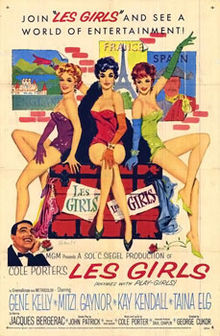
220px-Les_Girls.jpgClassic Hollywood musicals usually have a very common framework that they rarely seem to deviate from. There’s almost an accepted unwritten rule that they will function like so. Typically, there is an overarching story being told and yet the narrative is conveniently broken up by song and dance routines that not only provide immeasurable entertainment value and give an excuse for talented performers to strut their stuff but also serve to move our movie forward comedically, romantically, dramatically, whatever it may be.

Thus, Les Girls is a generally absorbing musical simply in terms of its mechanics. They stray slightly from the set formula. It’s a bit of a Rashomon (1950) plotting device. If you will recall, Akira Kurosawa’s film famously told the same turn of events three times over from three differing perspectives. That’s what happens here, in a sense, with the action being set partially in a courtroom (a first for a musical) and then the rest on the road with theater performers.

It all comes into being because of a libel suit that has broken out between two former colleagues who used to be a part of Barry Nichols’ Les Girls act that was a smashing success in its day. But following the publishing of a tell-all memoir and suggestion of a supposed suicide attempt, blood is boiling between Frenchwoman Angele Ducros (Taina Elg) and British-born Sybil Wren (Kay Kendall) who had the gall to publish such a story.

Of course, there are actually three ladies in question, the third being the peppy American Joy Henderson (Mitzi Gaynor) who rounds out the act and, of course, Barry finds himself romantically linked to each one though he specifically makes a habit of never falling in love with his fellow dancers. It proves a hard rule for him to keep but for the audience, it gives us a good excuse to see Gene Kelly share at least one moment on the dance floor with each of his talented costars individually.

This proved to be the final film score of America’s beloved songsmith Cole Porter and he provides a few moderately memorable numbers including the title track. Kay Kendall is thoroughly convivial to watch as a comedienne and performer throughout with her number “You’re Just Too, Too” being one of the most playful in the picture.

Meanwhile, the final number with Kelly and Gaynor is a blast full of romance around table and chairs. But the real kicker is feisty Mitzi Gaynor letting Kelly have it over the head with a picture frame, deservedly so, I might add. But in the end it all comes to naught, the court case is dropped and we are left with an open ending that’s winking at us. At least everyone’s happy.

Though he is not often remembered as a musical director, in some sense, George Cukor seems well within his element with the material at hand always adept at bringing together stories of behind the scenes antics and goings on between women and their men. That’s precisely what we have here.

This would prove to be Gene Kelly’s final film with MGM after an illustrious run. You also get the sense that perhaps this character is closer to the real Gene Kelly — the man who was constantly called a perfectionist and recounted later by Esther Williams to be a terror to work with. And here he still has a dose of his winning charm but there are also signs of that dancing slave driver working his girls to the bone and unwittingly romancing them at the same time. Still, there’s no doubting his inspired screen presence that underlines nearly every picture he was ever in.

It’s true that a previous iteration of the film was to have included Cyd Charisse, Leslie Caron, and Jean Simmons. That would have been an interesting combination to be sure but what we got here instead is still a stunning and at times thoroughly unconventional musical.

3.5/5 Stars


Take Me out to The Ball Game (1949)

Take_Me_Out_To_The_Ballgame_(MGM_film).jpgThere’s something perfectly in sync between Gene Kelly and Donald O’Connor so I could never choose another duo over them but Kelly and Frank Sinatra are such wonderful entertainers that they help make this period baseball number a real musical classic even if it has to fall in line behind a row of other quality contenders.

It’s easy to half expect to see Stanley Donen’s name on the marquee as director in part because of his prestigious partnership with Kelly but instead, we get an equally renowned name in Busby Berkeley. In fact, at this time Berkeley was a veteran of musicals. However, it’s true that Donen did help with crafting the narrative on this one with Kelly and would pick up directing duties with On the Town (1949).

America’s original Pasttime (before being challenged by Basketball and Football) is ripe for a musical homage as MGM seemed to take aim at all the popular arenas of entertainment. Set during the golden years of baseball, this story, in particular, takes interest in the fictional Wolves who share some resemblance to the famed Cubs of the early 1900s with the double-play combination of Joe Tinker, Johnny Evers, and Frank Chance. In this film, the archetypal slogan, “Tinkers to Evers to Chance” is adapted into a giddy tune “O’Brien to Ryan to Goldberg” with the trio of Kelly, Sinatra, and Jules Munshin taking the leads.

Esther Williams even gets her obligatory dip in the pool while still showing her prowess as a baseball player, a desirable heartthrob, and a club owner with a certain amount of business acumen. Because she really is at the core of the story’s plot.

You see the boys, O’Brien and Ryan, are having a grand old time coming off a stint in vaudeville during the offseason and now spring training is upon them and they are reunited with their clubmates along with the scintillating prospect of another league pennant. That is until they find out that they’re under new ownership, and they suspect it’s a stuffy nobody named K.C. Higgins.

Are they surprised with what meets their eyes? K.C. Higgins turns out to be a “she” instead of a “he” and a very attractive one at that. But that doesn’t detract from the bottom line. She’s a woman who expects that she knows the game better than they do. Thus, it’s a slight musical riff on the old battle of the sexes dilemma.

Their plan of action entails setting up their buddy Denny (Sinatra) with Ms. Catherine so they can keep her occupied and off their backs. Kelly is the fast-moving playboy ballplayer who also has a complicated relationship with Katherine Catherine (that’s what K.C. stands for). While the forward Shirley Delwyn (Betty Garret) is out to snag herself a man and sets her sights on poor helpless Dennis.

There’s a bit of a black sox scandal type thread that’s grafted in at the end with Edward Arnold playing his usual corrupt businessman who is looking to ruin O’Brien’s reputation and make a killing off betting against the Wolves. Thank goodness in this case Kenesaw Mountain Landis does not come in and expulse Gene Kelly who instead is allowed to dance another day this time with all his costars.

Aside from singing the game’s most revered song on screen, (which is a relief given its name), the film also has adequate room for some of the other important aspects of baseball namely antagonizing umpires, trash talk, clowning, and brawls. After all, what would America’s game be without those finer points?

Gene Kelly even gets around to putting another feather in his dancing cap with an Irish jig proving him to be yet again a master showman and virtuoso performer on taps. He’s also probably the first baseball player in history who carried two careers as a ballplayer by day and a hoofer by night. All in all, this was the kind of Technicolor spectacle that MGM was accustomed to offering up in the 40s and 50s and it’s satisfying stuff, if not quite their best.

3.5/5 Stars

Review Yankee Doodle Dandy (1942)

James_Cagney_in_Yankee_Doodle_Dandy_trailer“My father thanks you, My Mother Thanks you, My Sister Thanks you, and I Thank you.” – James Cagney as George M. Cohan

I write this on Yankee Doodle Dandy’s 75 Anniversary on Memorial Day and I can say with much regret in my heart that it’s probably not nearly as resonant now as it was back in 1942. Perhaps, as it should be, because we are not living in the thick of WWII in a recently post-Pearl Harbor society. This was a film meant for a very particular cultural moment and it functions as such.

We look at the musical numbers and some are impressive routines with a full array of song and dance sprinkled throughout but there’s nothing outstandingly eye-popping about any of it. It’s true that this musical biography does suffer from a bit of Biopic Syndrome. By now we have been inundated with so many renditions that this version of George M. Cohan’s life is hardly revolutionary.

At best it’s a beaming tribute to an American icon with a bit of palatable wartime propaganda that never does anything unusual nor does it attempt to. At worst you could call Yankee Doodle Dandy overlong with a stiff script that lacks a lot of invention and shows more and more chinks in its armor over the excessive run time. But like Cohan himself, it’s an unabashed flag-waver and in that arena alone it does do some justice to its hero.

Certainly, none of these initial assessments can take away from the great appeal of the main players. More on James Cagney later but for now let’s just say he is incomparable and leave it at that. But we also have the estimable Walter Huston who had a notable career in his own right before being slightly overshadowed by his son John. In Yankee Doodle Dandy he plays the patriarch of the Cohan family, married to a lovely and talented woman (Rosemary De Camp) who is his partner and equal in both wedded life and on the stage. They are loyal All-Americans and they raise up their son and daughter to love their line of work and their country just as they do.

Thus, the Cohans are born as a collective entity, precocious Josie (Jeanne Cagney) and her ever cocksure brother George (James Cagney) who has a big head to go along with a load of talent. While his attitude gets him ostracized, his persistence as a songwriter ultimately earns him success after he unwittingly joins forces with another struggling writer Sam Harris (Richard Whorf). Somehow together they find a winning formula that for decades thenceforth makes George M. Cohan into a household name and subsequently an American legend. He is the undisputed king of unabashed, feel-good, good old-fashioned entertainment.

America’s favorite wartime ingenue Joan Leslie falls easily into the role of the love of George’s life, Mary, the impressionable young gal who fell for him at an early age and stayed by his side as the years rolled ever onward. Everything else changed but her love and faithfulness remained steadfast. With Mary by his side, she sees him through a string of successes, a few minor failures, the birth of WWI with the sinking of the Lusitania, and even the inevitable deaths of his kin. When it’s all said and done, he’s christened by FDR himself with a Congressional Medal as one of the great patriots capable of catalyzing the American Public with nationalistic fervor. So he serves a very important purpose on the Homefront.

The fact that Cohan’s life was practically born and lived out on the stage makes it perfectly suited for a musical adaptation allowing Michael Curtiz to seamlessly segue between vaudeville and Broadway routines and the formative moments that make up George’s life. They all fit together in a fairly straightforward manner that nevertheless is bolstered above all by the talent.

But the opening and closing framing device is unforgivably corny and is probably hampered most by a President Roosevelt lookalike who is so artificial it makes the genuine vivacity of James Cagney all the more disarming. It works the other way too. Cagney feels like he’s acting opposite a lifeless mannequin. And it’s true that as he always seemed to have the habit of doing Jimmy Cagney steals the whole picture.

He had left the gangster fare that had made him famous behind and in pictures such as Strawberry Blonde (1941) and Yankee Doodle Dandy he was given a true chance to strut his stuff and what dynamic stuff it is. Now I’m not much of a dance connoisseur so I have no reference point on where Cagney’s dancing could possibly begin to stack up to the likes of Astaire or Kelly, men who also performed their own choreography. Still, if anything, Cagney’s feet are constantly lively and self-assured as is his entire performance.

He seems like the perfect man to embody Cohan himself an Irish-American who started out as a song and dance man on the stage and whose blood ran red, white, and blue. First and foremost, he is a performer and his performance turns Yankee Doodle into something special, despite its various shortcomings.

Curtiz is a highly capable director but Cagney is the one we have to thank. Because while the film is never daring he always is and my estimation of him grows exponentially every time I see him act. Some performers have the knack of making every scene they’re in better by doing something exceptional that you remember — something that really catches your eye whether minor or grandiose. You only have to watch him tap his way down the White House stairwell to know James Cagney is one of the special ones, no question.

4/5 Stars

Bye Bye Birdie (1963)

bye bye birdie 1.png

Bye Bye Birdie has sunshiny singalong written all over it even before we know the premise. The fact that it’s about the frenzy following the draft notice of a beloved hunky teenage heartthrob Conrad Birdie (a knowing amalgamation of Conway Twitty and Elvis) doesn’t help its case much. It can be rather annoying for the complete and utter squareness of every successive moment. That is true.

But on the whole, that overwhelming peppiness bowls you over with its sheer gaiety and the fervor of teenybopper spirit. So yes, at times it’s nearly suffocating and still intoxicating due to that same excessively sweet 1960s optimism.

Birdie’s unfortunate fate creates the spectacle. In its wake is left a war zone of swooning girls who go absolutely gaga after a particularly spectacular performance. But that’s just the beginning. To set the stage we must look first to a biochemist turned composer named Albert Peterson (Dick Van Dyke) who after 6 years of fruitless toil is looking to leave the business.

But his gal, the chipper Rosie DeLeon (Janet Leigh), hanging onto the hope that he will one day propose marriage, brings a brilliant idea before America’s greatest variety show icon Ed Sullivan himself. Her idea: To have the beloved Birdie kiss an All-American girl as a symbolic gesture of his goodwill towards his booming fan base. Ed, of course, eats it up, and her Albert will pen the song to be heard by millions across the country that fateful Sunday night.

bye bye birdie 2.png

All that’s left is to find the girl and by the most coincidental circumstances the lucky tween winds up being Ohio’s own Kim McAfee (Ann-Margret). Her best boy Hugo (Bobby Rydell) has just “pinned her” and she sits chatting away on the telephone but it’s peanuts compared to the meteor that strikes her household that evening. Soon the whole student body and her family get carried away in the excitement promising them eternal bliss and stardom on the biggest stage imaginable.

The adolescent masses continue going baddie — namely those of the feminine persuasion — while the boys hate Birdie’s guts for stealing away their dates. In the end, Kim and her family, Albert and Rosie are on the brink of getting pushed off of Sullivan. It all seems for naught until some quick thinking gets them the outcome they were long hoping for. The Russian Ballet gets truncated to put it lightly.

What matters is that everyone gets a happy ending. Each person winds up with their respective significant other and just as it opened, Bye Bye Birdie goes out with Ann-Margret belting out the title chorus with a charisma that conquered many a young heart.

What the screen adaptation does well is act as a fitting forerunner for another cultural explosion that would occur on Ed Sullivan’s Show only a year later. In fact, Birdiemania looks strangely familiar and perfectly personifies the older generations befuddlement with their crazy kids. Paul Lynde is the perfectly idiosyncratic father figure to reflect the changing times.

Meanwhile, Janet Leigh seems to relish an opportunity to tap into one of her more ditzy personalities as Rosie DeLeon. While new to film, the beloved Dick Van Dyke struts his physical comedy and provides a charming performance of “Put on a Happy Face.”

Director George Sidney comes in with an innate understanding that musicals are a communal event and just as importantly with the realization that he had a star on his hands in Ann-Margret. If this story was on the stage, Van Dyke and Leigh would have been the stars and they did indeed have top billing. Still, with the purposeful framing device he chose and the many close-ups and set ups he picked Sidney made this Ann-Margret’s picture no question. She obliges by lighting up the screen with that unparalleled mixture of perky sensuality and early 60s innocence.

It’s all so cute and fluffy and sweetly sincere it’s almost difficult to sense the satire sitting there. But I would like to think that it’s purposefully here from the cameos of Ed Sullivan and John Daly to every other spastic characterization. My only hangup is that instead of Elvis Presley himself we got Jesse Pearson. No offense whatsoever, but he’s not exactly the King and besides having Elvis in the picture would have only accentuated the irony of the whole ordeal. Still, fans can still find solace in the fact that there’s Viva Las Vegas.

3.5/5 Stars