
Phoenix (2014)

Phoenix_(2014_film)_POSTER

Speak low when you speak, love
Our summer day withers away too soon, too soon
Speak low when you speak, love
Our moment is swift
Like ships adrift we’re swept apart too soon
~ Speak Low (1943)

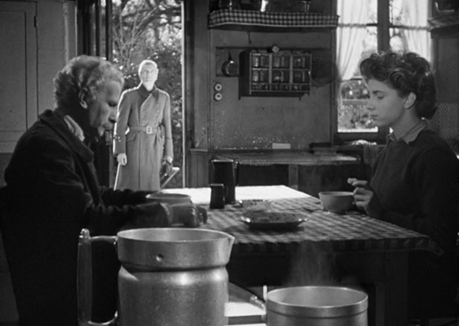
Anyone who’s watched a Christian Petzold film already knows that he crafts fascinating almost spellbinding films and that quality rests greatly on the laurels of Nina Hoss. Phoenix is yet another film that is a mesmerizing enigma.

It’s positively entrancing with its pacing — where you almost get lost within its minutes. Because although time never moves fast you quickly lose track as the mind is soon overwhelmed with a plethora of questions. In fact, all the time while you’re watching it all you can do is question. Implausibilities all but fade away in the presence of such uncertainty. If anything they get lost in the rubble.

It feels as if we’re trying to construct our own truth, which is almost maddeningly impossible because none of these characters seem ready to divulge any information. The past is a black shroud that everyone is reluctant to talk about. It makes sense because that soon after what do you say about the Holocaust? How do you cope or even begin to acknowledge the horrors that went on? It’s only 50, 60, 70 years later that we’ve finally been able to broach the subject as outsiders — people who did not experience those events firsthand. It’s easier for us to try and talk about it because we can never fully comprehend the climate. What would we have done? What would have happened to us? What would our lives have looked like in the aftermath?

The characters in Phoenix are beings in that post-war wasteland with specters hanging over them, and lives scarred by pain and suffering. They’re trying to salvage their existences the best they can, but they’re hardly existing as they did before the war. But allow me to backtrack for a moment.

Nelly (Nina Hoss) is physically maimed so horribly that her face is constantly covered in bloody bandages. Petzold does us a favor by not showing her visage before she gets reconstructive surgery. Like the shadow of the Holocaust, we are forced to imagine it on our own which is far more powerful. This is what her face looks like and this is perhaps how it happened.

What we do know is that she was arrested on October 4th, 1944 and her husband Johnny was as well. But Nelly’s faithful friend and guardian angel Lene says that he betrayed her. That’s what she believes, and yet upon hearing this news it hardly alters Nelly’s response. She’s still intent on finding him and picking up all the pieces. When she has a little more strength she begins wandering about the American sector looking for any signs of her former beau.

It turns out that Johnny works as a waiter in a cabaret Hall called Phoenix. When he first sets eyes on Nelly — it’s not his wife that he sees, but a wonderful impostor. She’s a woman who is strikingly similar, but her face is different. She’s the perfect accomplice as Johnny, or Johannes as he now goes tries to secure his dead wife’s assets.

What follows is his mission to make her into his old wife.  In many ways, it works as an inversion of the Vertigo conundrum. He thinks he’s making this woman into his deceased wife, and he coaches, dresses, and shapes her more in the image of Nelly. However, this hardly feels like an obsessive desire of dashed love, but a project to get him closer to his final goal. It’s not that sentimental, but Nelly follows along with the whole thing benevolently. To be close to Johnny is enough. But how does she even begin to break the news? Perhaps most frightening of all what will Johnny’s reaction be? After all, the wartime has changed them both.

So if you want to break it down to its most basic roots, Phoenix feels rather like a Holocaust film meeting Vertigo. But in essence, it defies that type of simple categorization. It lacks the odious horror of flashbacks and the glossy Hollywood production values of the latter. It fills its own niche altogether that even channels some of the darkness of noir. And there is no cathartic moment of emotional release. Instead, we are forced to watch as the characters bury their thoughts and feelings deeper and deeper. Perhaps they lie there somewhere under the surface. However, these are not histrionic people. They feel common and every day led by the performances of Hoss and Ronald Zehrfeld.

In this way, the performances are muted and repressed. In fact, there is little headway in the film and few epiphanies until the very end. That’s when for a few brief solitary moments things fall into place. We don’t know what will happen afterward, and in a way, we are suspended in the moment — left to ponder so many things. You could either make the case that Phoenix has shallow characters, or that there is so much depth within them that we cannot even begin to understand — like icebergs still partially submerged.

Many wonderful films lose so much of their magic because they dispel too much — give away too many of their hard-fought secrets. But Phoenix makes us work through everything, and it can be hard going certainly, and yet it is a thoroughly gratifying experience. We watch movies to be moved. We watch movies to be perplexed. We watch movies to acknowledge our wonderment in the human condition because it is a complex quandary that continually reveals new bits of enlightenment. Phoenix might leave us with more riddles than answers, and we should be content in that reality. That’s part of the magic.Like the mythical Phoenix of old, in a way, these characters try and die to their old selves, and rise out of the ashes a new.  Life is never that easy — always being clouded by doubts as our pasts come back to haunt us. It’s how we deal with that past that matters most.

4.5/5 Stars
The Battle of Algiers (1966)

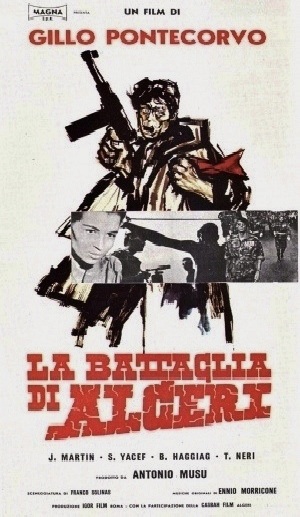
The_Battle_of_Algiers_posterBeing rather oblivious to the relations between France and Algeria as well as the battle of Algiers, this documentary-style film proved to be an enlightening and thoroughly engaging historical exercise. I certainly cannot corroborate all the facts, but the reality is, The Battle of Algiers is one of the most well-paced films that I have ever seen coming out of Europe. There is a great deal of drama, harrowing intensity, and it all brings up numerous political questions that parallel the world we live in even to this day.

It’s the story of 1950s Algeria and specifically the Casbah Muslim district of the city. It is there between 1954 to 1957 that the National Liberation Front waged war against their perceived oppressors from France. And they certainly had a point that imperialism has left an indelible mark on them. However, their own strategies include bombings and assassination that utilize civilians and people loyal to the front. You don’t know when the next attack will come, and they sweep across the land like wildfire. The leaders of the FLN include the fiery Ali la Pointe and El-hadi Jafar, who recruited la Pointe early on. A Lieutenant Colonel named Mathieu is brought in to bring down the enemy, but it proves to be a difficult task since the FLN, much like a tapeworm, will never die until the head is destroyed. Otherwise, it’s extremities will keep rebuilding in the form of loyal underlings.

The film is rather shocking in its straightforward depiction of violence, whether it be bombed buildings, gunfights in the streets, or French authorities being gunned down by insurgents. Somehow these images feel still very relevant to the contemporary age. You have the imperialists clashing horns with the locals. There’s racial profiling. Women and children are involved in the violence just as much as anyone else, and destruction pervades the public squares. There is no refuge from bomb or evil. Anyone coming around a corner could be carrying a bomb or looking to shoot you when you least expect it. Really it is amazing that a film like this was even made, and it was undoubtedly a lightning rod for controversy.

In the film’s epilogue, the unrest continues and it is finally noted that Algeria did eventually receive their independence. The French may have won the battle, but they ultimately lost the war. The audience is left to develop their own opinions about this conclusion. As for me, I find Gillo Pontecorvo’s film fascinating, because he takes a point of view that does not seem especially biased. This is not noticeably propaganda in its depiction, but instead, it is a thought-provoking document of civil unrest developing questions on war and race relations. Maybe we can even learn something from it as well in this modern age that still includes so much human conflict.

5/5 Stars

All Quiet on the Western Front (1930)

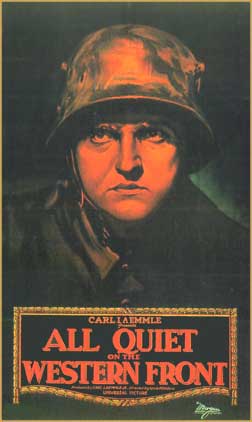
c7ab8-all_quiet_on_the_western_front_1930_film_posterDirected by Lewis Millstone and starring an ensemble cast headed by Lew Ayres, this archetypal anti-war film based on the novel of the same name, begins with a group of school boys during the dawn of WWI. This group of patriotic German youth is hungry for adventure and the glories of war. 

Then they arrive and begin their training which causes them to despise their commanding officer and they also lose some enthusiasm. It gets worse when they head to a combat zone and join a company of veteran soldiers without any food to eat. They finally head to the front and after a day in the trenches their number is fewer. 

Trench warfare proves to be hardly as glamorous as it seems with constant bombardment, rats, lack of food, and most of all the shedding of blood. One of their pals loses his leg and his boots, then slowly more get knocked off or wounded. Now Paul is one of the only ones left but after a bout of hand to hand combat with a French soldier he becomes even more disillusioned. Paul too gets wounded and is sent home on furlough to his family but he finds his friends and family have no concept of the gritty, grimy reality of war. He returns to the lines one more time and a few of his old comrades are still alive. 

However, in a fateful moment Paul reaches out for a butterfly in his trench and just like that he is dead. The last of this school room full of young, naïve boys is now dead or injured. That is the horrible scar left by not only by WWI but any such conflict. 

Despite the fact that all the main German characters are played by Americans, this film has a sharp sense of realism that extends all the way through the film. Even though many of these young actors were unknowns and are not well known today, together they made a powerful ensemble. The themes of this film were so powerful in fact that it was banned in Germany.

5/5 Stars

Heaven Knows, Mr. Allison (1957)

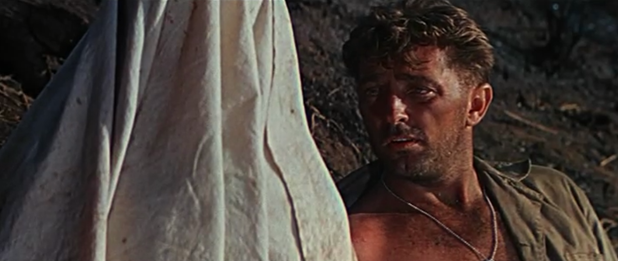
heavenknows3From John Huston comes another film about a woman of principle and a man who seems to be everything she is not. This time instead of Katharine Hepburn and Humphrey Bogart aboard The African Queen in WWI, we have Deborah Kerr and Robert Mitchum stuck on a deserted island together during WWII.

Kerr is Sister Angela who was on the island only a few days with a priest before he passed away. Now she is alone taking care of herself in solitude. That is until castaway Marine Mr. Allison washes up on her shore in a raft. For a time it is just the two of them as the Sister offers the marine food after his long, arduous journey. But after getting rest and some nourishment, he returns the favor proving his resourcefulness at scrounging up food on the island. For a while, they live in relative ease like this.

But they are reminded that the war is still going when the Japanese set up camp on the island. The unlikely pair finds themselves living in a cave together. Allison invades the camp on the sly to acquire food for them, and they continue to manage in hiding. Once the enemy is gone, the exuberant marine gets drunk on some sake and professes his love to the novice nun. Although the situation had never quite been awkward up to that point, it quickly becomes so. Sister Angela, in a tizzy, flees out in the pouring rain and winds up getting sick as a result.

heavenknows5To add to the predicament, the Japanese forces return, and back to the cave, it is. This time Mr. Allison must kill a soldier in order to get a blanket for Sister Angela. Soon the Japanese are burning the underbrush in pursuit of the culprit. It’s dire straights certainly, but then help comes.

Mr. Allison once again proves himself and regains the faith and admiration of Sister Angela. Once the marines roll in Mr. Allison is able to leave the island on a stretcher with the faithful novice by his side. They are a strange pair, but their relationship makes this story actually engaging. In a way, the life of a marine and a nun have some similarities, although they fall at completely different ends of the spectrum. In the same way, Mitchum and Kerr are adept at playing their roles to that degree. Allison is rough around the edges, a Joe Palooka type, and yet he means well. The nun is devoted to her calling, proper, and it never seems as if she could ever approve of Mr. Allison. And yet, in the midst of all the divides that seem in place, a true bond forms. It’s an entertaining relationship and these two stars,  led by John Huston’s direction, made it thoroughly enjoyable.

4/5 Stars

They Were Expendable (1945)

They_Were_Expendable_posterThere’s nothing very intriguing about a film entitled They Were Expendable. In essence, we already know what the conclusion of the film is, however it is important to understand the context of when this John Ford World War II docudrama was coming out. In 1945 the Nazis and Japanese had finally been quelled, and the Allies could look back at the sacrifices that had been made.

One such example was in the Philippines after Pearl Harbor. Despite being undermanned and without much support, the brave men in the navy wreaked havoc against the enemy trying to hold onto their strongholds as long as possible before being forced to evacuate. It is far from a glamorous moment in the war because the war seemed to favor Japan and our forces were made to flee. However, in those moments of distress and tragedy, bravery seemed to flourish and our resolve only greatened. General Douglas MacArthur summed up the sentiments of every man when he promised, “I shall return.”

That being said, John Ford’s They Were Expendable is not always easy to follow; it can feel slow and deliberate, however, it exudes a gritty realism that is hard not to appreciate. It certainly is patriotic, but it does not often over sentimentalize war with high drama. We see it for what it often is. It means smoke, explosions, shipwrecks, death. It means breaking apart friends, crews, and men and women who care about each other.

Part of that realism is probably helped by Ford’s work filming a documentary of the Battle of Midway and lead Robert Montgomery (who plays Lt. Brickley) also fought on a P.T. boat during the war. Although he was not ever in the military, John Wayne always has a knack for reflecting American ideals of grit and determination. That’s why he was made for westerns as well as war films. This time around playing the fiery but loyal Lt. Rusty Ryan. Donna Reed on her part has a rather small role, and yet it is an integral part because she represents the brave nurses who support the military. She is the lifter of morale, the girl next door, all these ideals that fit this pretty young lady from Iowa. It’s hard to know if she’s just playing herself or not.

At times it’s a hard film to follow because it often seems to jump or skip events. Maybe it happens in an attempt to cover more story or maybe Ford did not want to hold his viewer’s hand, I’m not sure. I do know that I am far less of an informed viewer about this time period or this moment in World War II history. It often seems like most of the limelight is given to mainland Europe and not the Pacific.

As much as I was drawing connections and finding similarities, this film is far from McHale’s Navy. The story is far more somber, more realistic, and at times depressing to watch. It’s the kind of film that could only be made after we had won. It affirms our American resolve and honors those who paid the ultimate sacrifice. That and the film’s beautiful low lit images make it worth watching. The cinematography makes numerous scenes far more interesting by layering characters in darkness and accentuating the shadows in a hospital corridor for instance. Rather than making everything feel stylized, it only helps to augment the realism that makes They Were Expendable a worthy testament of WWII.

3.5/5 Stars

Edge of Tomorrow (2014)

24f4a-edgeoftomorrow1

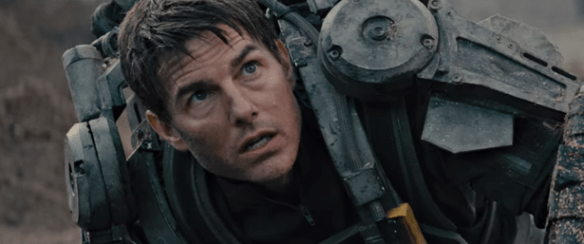
Time loops are fun. Scratch that. They’re fun to think about and to watch as an audience in the comfort of an armchair, but they get old real fast for movie characters. Just ask public affairs officer-turned-time looper William Cage (Tom Cruise).

He’s an indolent former advertising agent who wants no part of the actual fighting that is taking place in Europe with a mysterious alien army of so-called Mimics. In his attempts to avoid combat, he ends up handcuffed, stripped of his rank of Major, and shipped off to a base at Heathrow. His worst nightmare is becoming reality as he is quickly thrown into the front lines where he is headed to face the enemy without any training. He is an absolute pitiful mess and his platoon mates spare him no mercy. After all, he’s a sniveling complainer.

He’s just as incompetent on the battlefield, and it becomes obvious he’s not going to last long (There’s potential for a very short movie). But before he gets killed by one of the aliens, its blood covers him. Did you get that? Although seemingly insignificant the whole film soon hinges on this fact.

Where does he wake up? No not hell or heaven, but back at Heathrow airport, handcuffs and all, with a superior yelling at him yet again. He’s back in this nightmare once more and it continues for the rest of the film.

Honestly, Edge of Tomorrow is an awful name for this film. The tagline Live. Die. Repeat. is a little closer. At least it gets at the heart of what this sci-fi tale is about. In a similar vein as Phil Connors in Groundhog Day, Cage first gets acclimated to his new ability to experience a moment in time. He learns how to manipulate and navigate it to help himself, but as would be expected it gets tiresome and monotonous. With great power comes great responsibility, difficulty, and fatigue.

Live. Die. Repeat. Live. Die. Repeat. Slowly but surely Cage makes it farther and father against the mimics joining forces with famed soldier Rita Vrataski who is the poster girl for this noble war (Emily Blunt). Her early advice, “Come find me when you wake up,” is the strangest of greetings, but it starts the ball rolling. In a world where humanity is continually walking into an ambush, they are the only two who comprehend what is happening. Vrataski knows because she used to have Cage’s ability but lost it, so he is the new hope. Live. Die. Repeat. Live. Die. Repeat. She shapes him into a more efficient fighter over numerous time loops and gives him more insight into their enemy. He’s getting sick and tired of getting killed too. Live. Die. Repeat. etc.

He starts seeing visions of the Omega (the nucleus of the mimic), but they soon realize that the mimic is leading them on. Live. Die. Repeat. By this point, Cage has gone through so much with Vrataski and he cannot bear to see her continually dying. They finally locate the whereabouts of the Omega but after numerous failures, they finally run out of second chances. Cage loses his ability to loop, like Vrataski before him, needing a blood transfusion to pull through. Live or Die. No repeat this time.

Thus, begins their descent into the throes of their foe towards the Louvre where the Omega is. However, this time Cage convinces his squad to help and they prove their worth. An alpha comes after Cage and Vrataski as he blows up the Omega with a pack of grenades. There’s an instant of doubt, an uneasy feeling. Live. Die. Repeat…

Except now Major William Cage is back on the helicopter. No stripping of rank, no orders to the front lines, and with a newly weakened enemy. The nightmare is over so it seems and Cage is twice the man he was before. Only one thing matters. You guessed it. He goes looking for Sergeant Vrataski and sure enough there she is where he always found her before. She greets him with the same curtness as he smiles knowingly and most definitely with relief. For the last time or the first, depending on how you see it.

Quick cut to credits and “Love Me Again” by John Newman and it’s all over. It’s an ending that we hate as an audience, but it is the right one. As far as modern sci-fi films go, this one reminded me a bit of Source Code and Looper. Similarly, once you bought into the premise and invested in the setup, it proved to be a smart and entertaining ride.

Tom Cruise proved he can still do action movies and Emily Blunt carried the film with a toughness that would have made Ellen Ripley proud. This may be summer blockbuster material, but it’s also a worthwhile trip that takes us for a loop. Awful pun intended.

4/5 Stars

Kelly’s Heroes (1970)

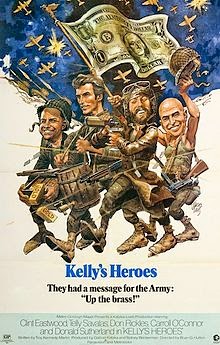
89761-kellyKelly’s Heroes suffers from the same deliberate pacing problem that The Dirty Dozen has. However, if you accept that and accept that this is not your typical war film, you will learn to enjoy it. With a name that hearkens back to Hogan’s Heroes, Clint Eastwood plays Kelly, a man intent on going behind enemy lines to grab his weight in gold bars during WWII.

The lure of gold proves tempting enough to bring many men on board for this ludicrous mission. Among the gang you have Telly Savalas, the always whining Don Rickles,  Donald Sutherland, Gavin Macleod, and Stuart Margolin. Overall the cast was a fun mix of stars of the big and small screens. Do not assume that this is simply a comedy. It has its fair share of explosions and drama. In other words this film has Don Rickles (comedy) sure, but it has Clint Eastwood (action) to bring it back.

All in all Kelly’s Hereos is a decently fun romp right up there with The Dirty Dozen and Where Eagles Dare.

3.5/5 Stars

Le Silence de la mer (1949)

f9677-lesilence1Out of the many titans of French film, I found a personal favorite in Jean-Pierre Melville. Aside from changing his name in honor of the American author who wrote about the great white whale, Melville was also a member of the French Resistance during WWII. Thus, he seems to be the perfect man to helm a film based on a novel that was secretly published during the Nazi occupation. You would think that it would be brimming with political agenda and underhanded controversy.

Instead, Melville gifts us a nuanced and sympathetic film about a German Lieutenant who is quartered in the home of a French gentleman and his young niece. In many ways, much of the story plays out as an extended monologue rattled off by Werner von Ebrennac, and it becomes the perfect narrative device for an intimate character study. He is met by silence and passive aggression from his hosts, who hate his guts and the situation they have been placed in. He represents everything they despise, and his mere presence also reminds them of the shameful fact that France has fallen.

And yet he is far from the stereotype, and Melville never allows this German Lieutenant to succumb to our preconceptions. This has to be one of the most sympathetic depictions of a German soldier ever seen captured on film. It turns out that Ebrennac is a perfect gentleman, cultured in literature (Moliere, Rascine, Cervantes, Dante, Shakespeare, and Goethe), and a seasoned musician. His head is full of romantic ideals about the reviving of France as it is taken under the wing of its new conqueror.

His words are always met with a quiet contempt as uncle and niece continually sit reading and knitting. It never seems to change or stop. There is never a change in temperate or a word spoken. Just the words of Ebrennac every evening after he gets back and the voice-over of the older gentlemen constantly illuminates us about the unspoken workings of his mind.

Soon, however, the Lieutenant learns the reality of the war from Treblinka to the Nazi ideology pervading the psyche of all the German military. Friends have been brainwashed, and his view of the German war is completely dashed. There is nothing left to do but apply for a transfer and resign himself to the hell that has been created. Uncle and niece reluctantly bid farewell to a man who was the exception.

This was Jean-Pierre Melville’s first feature, but I really enjoyed it as simple as it is. He seems to understand the ambiguities of war. It often is difficult to decipher who is in the right or the wrong. Germany was the odious villain and France the obvious victim. However, in this domestic drama the tables are seemingly switched in stark contrast.

4/5 Stars

Paths of Glory (1957)

87e30-pathsofgloryposterStarring Kirk Douglas and directed by Stanley Kubrick, this war film with a twist follows a French Colonel Dax (Kirk Douglas) and his men during World War I. He is ordered to take part in a suicide mission by a general and everything soon goes awry. After they unsuccessfully go through with the mission , three of Dax’s men find themselves being court martialed as examples for supposed cowardliness. Despite a defense by Dax in court, the three men are found guilty and later executed by firing squad. This and other events cause Dax to openly question the decisions of his superiors. In a very touching final scene there seems to be a questioning of the inhumanity of war. In one of his earlier films Kubrick delivers a poignant piece.
 
4/5 Stars

Good Morning Vietnam (1987)

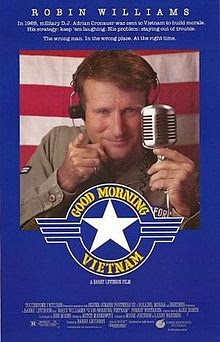
4eba0-good_morning2c_vietnamGoooooooood Mooooooorning Viiieeetnammm! I’m a little late to the party I know, but I wanted to take a look at a film that in many ways personifies Robin Williams. In the last months, I have gotten to read a lot on William’s as a comic and as an actor. When I watch this film which showcases his many skills, I am especially drawn to what I call his bipolar comedy. Let me explain. On the surface, he seems like a pleasant-faced average Joe with a little twinkle in his eye. Maybe there are even moments of emotion or sadness that make their way out. Then, bing pow! The lights go on, the sirens sound, and all chaos breaks loose.

Adrian Cronauer is the perfect embodiment of William’s quick wit and off the wall antics. He has a constant supply of new voices and old reliable ones, not to mention cultural and political jokes. It all gets thrown in so fast you hardly get to bat an eye, and he does it all with that rye smile and one defiant attitude.

This is yet another nostalgic 1980s classic directed by Barry Levinson. The story begins in 1965 with the jockey getting shipped in from Crete, and soon he is the hero of all the underlings especially his young compatriot Private Garlick (Forrest Whitaker). Immediately the power dynamic is rather odd. The General overseeing everything loves his zany, sometimes crass, take on comedy. His two immediate superiors are less than pleased with his early showings of insubordination. If the General is any indication, Cronauer’s mix of humor, (censored) news updates and groovy rock n’ roll prove insanely popular.

In his spare time, Cronauer pursues a young Vietnamese girl while teaching an English class to locals. They soon enjoy his more slang-based approach to English, and he befriends a boy named Tuan. He also has some time to start a brawl at a local hangout and eventually see it blown to smithereens. It’s after this one occasion where he gets fed up with the censors controlling what he says because it doesn’t seem right. It seems too regular army, and he is certainly not that. Cronauer is suspended but during his hiatus, he gains a new found zeal performing for the boys in the field.

Due to popular demand, he gets reinstate,d but his superior, who has always had it in for him, connects him with a wanted South Vietnamese terrorist, and Cronauer soon gets the boot with an honorable discharge. The former disc jockey realizes Tuan lied to him all along, but after confronting the boy he fulfills one last commitment with his English class. Cronauer flies off into the wild blue yonder, but not without leaving a gift with Garlick for all the boys. Gooooodbyeeee Vietnaaaam!

This was a grade A performance by Robin Williams and the soundtrack was absolutely superb, full of big and small hits alike. Louis Armstrong’s “What a Wonderful World” was especially impactful due to the images that were juxtaposed with it. Furthermore, just as much of what Cronauer was lost to his students, I feel like many of his cultural quips might get lost to newer generations. I sincerely hope they do not and his political commentary will always swirl around like any of the controversy surrounding Vietnam. The magic of the character is his ability to make men laugh despite their circumstances. The magic of Robin Williams is that he was a man who made us laugh in all circumstances.

4/5 Stars