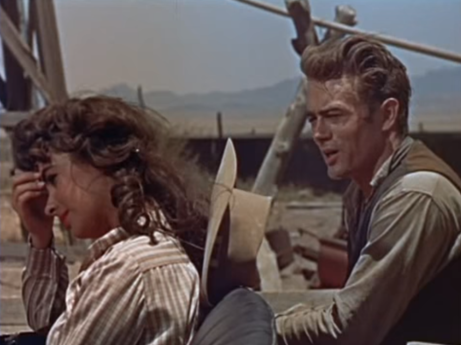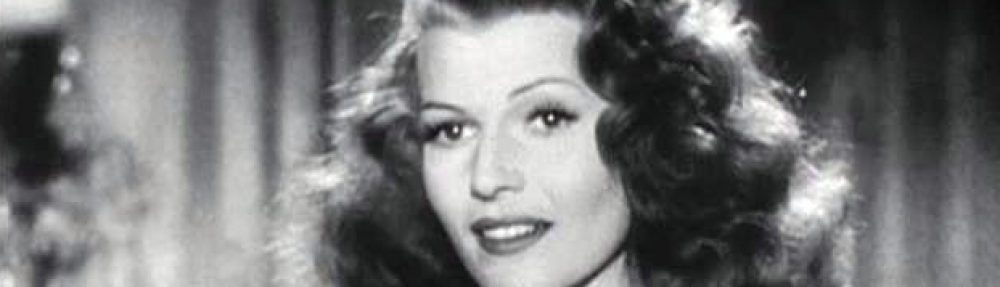
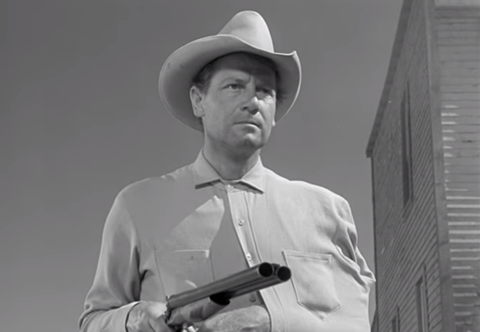
Ramrod (1947)

ramrod 1

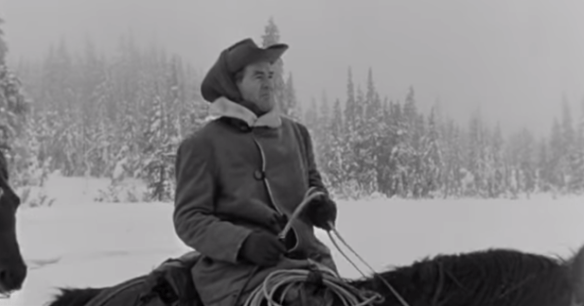
Right away, in the very first moments, we know something’s amiss when the driver of a passing wagon notes to the woman at his side that they just passed her father…and they proceed to keep going without even a word of greeting.

It’s true that Ramrod is a riff on the age-old family feud but it involves several other men who are tied up in it too. Frank Ivey (Preston Foster) plays god where nothing and no one sees the light of day without his say so. Because remember these are the days when whoever had the most firepower and the ability to lean on others was king.

True, the sheriff (Donald Crisp) has a duty to uphold the peace but his jurisdiction and authority can only reach so far. One man against an entire posse doesn’t amount to much. Important to this story is that the old man from the opening scene, Ben Dickason (Charles Ruggles), has long sided in all of his affairs with Ivey. He’s even told his daughter to marry him and he does it again when the bully runs her latest beau out of town.

But Connie Dickason (Veronica Lake) is resolute and not about to let anyone push her around and so she decides to take the land bequeathed to her and try and make a go of it as a cattle rancher. She knows its an uphill battle in opposition to Ivey but one key to the enterprise is Dave Nash (Joel McCrea) who finds himself all of the sudden on the wrong side of Ivey as well. Now he has a reason to take up an offer from Connie becoming the ramrod of her outfit.

Soon he assembles a workforce including his pal Bill Schell (Don DeFore) to see the game through by legal means playing by the rules because the local sheriff is a buddy and Dave is not about to put his friend in a compromising position. He respects him too much. Others are not so valiant. For all intent and purposes, total war has begun.

First Connie’s homestead is razed to the ground, a cowhand is given a going over, and another man is gunned down in retaliation. Both sides have blood on their hands’ thanks to this eye for an eye mentality that continues to escalate matters. A herd of cattle is stampeded. The sheriff gets it for attempting to enact justice. Dominoes continue to tumble with each subsequent shotgun blast of malice.

Dave winds up as a fugitive for avenging his friend’s death by gunning down his purported killer. He finds himself wounded and trying to sneak past the searching eyes of Ivey. They manage to get him away to a secluded cave but even their his safety is put in jeopardy by — you guessed it — Connie Dickason. She has her meddling hands in many things.

ramrod 2

The one person who won’t let him down, despite a myriad of faults, is Bill and he devises a plan to draw the enemy away from his friend by acting as a decoy. The posse winds into the mountain crags to gun Dave down for good; they fail to comprehend who they are actually dealing with.

With her then-husband directing, it makes sense that the film provided a prominent berth for Lake. It’s a juicy role full of a mixture of innocent intentions and conniving. There’s absolutely no question about it; it’s another femme fatale role as she plays a “man’s game” by pitting all the men in her life against each other to get her way so she can pick up the pieces. In totality, it’s a nifty bit of maneuvering to get the desired results, successfully pouting her way to the top. But a curious counterpoint is Rose (Arlene Whelan) who is without question the guardian angel of the picture tugging at Daves heartstrings while Connie continually entangles him.

Retroactively it’s seamlessly easy to label this a noir-western sharing company with such hybrids as Pursued (1947) and Yellow Sky (1948). This breed of western is dark and brooding, concerned with psychological warfare as much as it is rough and tumble enforcement of justice. We half expect Ramrod to cram itself down our throats and it might as well with all that goes down.

The cast is steady with a plethora of recognizable character actors including Charles Ruggles and the diplomatic hand of Donald Crisp. Don DeFore as the bright-eyed ranch hand nevertheless knows how to hold a grudge with the best of them. You’ve never seen him so grungy. Lloyd Bridges fills a near bit part as a hot-headed heavy as usual while the scapegoat Virg is portrayed by Wally Cassell (Cassell lived to the ripe, old age of 103). With the reteaming of Lake and McCrea we had a reunion of Sullivan’s Travels (1941) and yet the reason it didn’t happen earlier was McCrea was not all that fond of his leading lady. By no means does that detract from this minor western success.

3.5/5 Stars
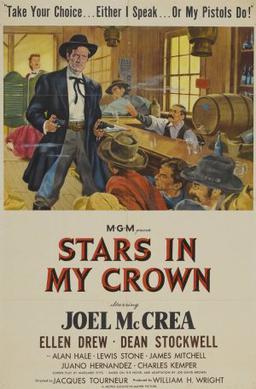
Stars in My Crown (1950)

StarsInMyCrown.jpg

It speaks not only to the man but to this film, that Joel McCrea rated Stars in My Crown among his personal favorites. (Hint: It’s not because of the imminent reunion of two cast members in Gunsmoke). The story is framed by the nostalgic recollections of an old man and it’s a singular story in the way that one life is a story. There are constant offshoots, revelations, and daily interactions with other human narratives.

John’s life (Dean Stockwell) could have been very different; it could have been drama because he was orphaned at a young age. Except he had Parson Gray (McCrea) and Mrs. Gray (Ellen Drew). Much like this film, his life was generally a joyous affair growing up as a young lad. Certainly, it was not without its roadblocks, disagreements, or minor quarrels but what remains is generally uplifting and good.

Stars in My Crown for much of its run is a vignette-driven tale but that proves to be the utmost blessing for this particular film. That inevitably brings us to Joel McCrea and why he must have relished this part. He’s a man of faith and no shame-faced Christian. There’s no denying his spiritual leanings. Still, while he’s not a spineless pushover, there’s not a condemning word that leaves his mouth either.

What keeps him upright and a pillar of the community is a quiet boldness and a genuine care for his parishioners. But that means not simply calling on the people who enter into his church on Sundays. I’ve heard it said before that it’s easy for anyone to love people who are just like them or who they like already.

What’s truly a test of someone’s heart is whether or not they are willing to reach out to those who seem alien and contrary to their station in life. The Parson is such a man. Not only does he care for the physically sick or the self-proclaimed churchgoers who are sick in the soul, he is there for those on the fringes too.

He faithfully calls on his boisterous war buddy (Alan Hale Sr. in his final role) who is larger-than-life with a strapping clan of sons (including James Arness) and a penchant for joking about religion. He’s waiting for the Parson to get God to plow his fields for him.

The good-natured Gray gently ribs him about his coming to church. But what strikes me is the worth he sees in his friend. In one resounding instance, when the local gamekeeper Famous (Juano Hernandez) has his land trampled by local bigots, it’s not the Christian folk but Jed who immediately comes to his aid. His beneficiary rightfully proclaims with all candor, “You’re a real Christian.”

Parson Gray’s rounds never seem to cease though in one instance they meet with opposition. Dr. Harris (Lewis Stone) has long been the town’s apothecary but with his ailing health, his intelligent yet rather brusque son (James Mitchell) is taking over the family business. Though more than capable, what the younger fellow is lacking is a genial bedside manner, at least upon first glance.

He does show a certain sensitivity to the local school teacher (Amanda Blake) and the certain tightness in Mitchell’s voice is stellar for articulating the feelings of a man who is hardly unfeeling — he just has trouble opening up. In fact, he’s adamant that the religious leader stays out of his way because he sees no place for such ritualism when he has practical science to help people.

The days roll ever onward with young boys lazily kicked back in a hay wagon surmising what they’d do if they were God. Namely, have it always be summer. Even Christmas would be in summer. Another time a Medicine Man (Charles Kemper) and his Carnival Show pay a visit and bring the town out of the woodwork for an evening of magic tricks and showmanship.

Then come the bad times when the typhoid hits and people are dropping like flies. First, John is sick then a whole host of others. The Doctor criticizes Gray for potentially infecting the entire population of school children and for the first time in a long time we see the normally even-tempered man angered.

However, the Parson is man enough to consider that he’s wrong because he very well could have been. He’s also humble enough to give the doctor room to work. For the sake of the people, he becomes isolated and as a result poor, bereft of his usual resources. Because all he had was out of charity and the tangible blessings of those around him.

He even goes so far as closing the church for the first Sunday service as far back as anyone can remember. It soon becomes evident how very humble and meager his portion is without the bulwark of community around him.

But it’s one of those things, out of the Parson’s seemingly selfless act comes a reciprocal act from the young doctor — the man who shed his rough exterior and became one with the people knowing full well all their suffering as well as their joys. It was this chance in the trenches with the lack of the sleep and onslaught of the slow fever where he realized there was a need for something else that he never thought was lacking before. If Ordet (1955) has the most striking resurrection scene that I can recall perhaps Stars in My Crown has the most gorgeously understated.

The final stand that the Parson is compelled to take is also weighty with significance. The townsfolk have repeatedly threatened Famous and now they’ve reached the end of the road. Stringing him up and taking his property is all that’s left to do.

When they leave that burning cross and the note, cloaked in white like cowards, it somehow brought the same realization that floods over me far too often. In some ways, this film is meant to be so archaic, reminiscent of a bygone era far removed from our present. And yet as much as we might try and move away, it sadly remains relevant.

So the Parson goes to Famous’s home alone knowing what is coming for them. He forgoes the guns of his good buddy Jed. That’s not his way now. Instead, he speaks to them resolutely as they get ready to take Famous away. He confronts them with the man’s own words and in the most piercingly moving moment of the entire picture we see how one man can be so selfless in the face of so much hatred. He can boast so many riches even if his worldly possessions seem totally inconsequential. His character speaks for itself.

Years later Atticus Finch would have a confrontation akin to this one and yet it came to an impasse. Here the Parson is able to speak the truth into each of these men’s lives and make them human again. All thanks to Famous.

So while the picture might fall too easily back into place (Klansman aren’t rooted out forthwith for instance) there’s no begrudging such a gentle and virtuous film its closure. Because these are as much the fond memories of a young boy grown old as they are the tale of one man who left an indelible impact on a life and on a community. I’m reminded that perhaps a church is not so much a building as it is a people. Though the picture is capped by the proud moment where the Parson sees his old war buddy welcomed into the fold, I would like to think he doesn’t see that as the ultimate victory.

If anything his life reflects the outpouring of an existence lived outside of the Sunday framework. He does not have compartmentalized faith — the kind of religiosity that makes people hypocritical and prideful. I can respect a man like that even if he doesn’t pack a gun.

4.5/5 Stars

I am thinking today of that beautiful land
I shall reach when the sun goeth down;
When through wonderful grace by my Savior I stand,
Will there be any stars in my crown?

Will there be any stars, any stars in my crown
When at evening the sun goeth down?
When I wake with the blest in the mansions of rest
Will there be any stars in my crown?

In the strength of the Lord let me labor and pray,
Let me watch as a winner of souls,
That bright stars may be mine in the glorious day,
When His praise like the sea billow rolls.

O what joy it will be when His face I behold,
Living gems at his feet to lay down!
It would sweeten my bliss in the city of gold,
Should there be any stars in my crown.

Day of the Outlaw (1959)

day of the outlaw 1.png

Filmed in Central Oregon on the eve of winter, Day of The Outlaw displays gorgeously fluffy photography as the snow covers the ground. With the leading part anchored by Robert Ryan, I could not but help recall his portrayal in Nicholas Ray’s On Dangerous Ground (1951), another project that made liberal use of immaculate winter exteriors. Likewise, that was only the backdrop for a tough and unfeeling world.

In this particular instance, Andre De Toth’s picture has grudges burning deep under the surface making relationships generally contentious. The story is as old as the western itself. At least its central themes make themselves known straight away. The conflict is between homesteaders and cattle ranchers embodied by two men. The aptly named town of Bitters, Wyoming has recently seen more folks settling down there. One of them named Hal Crane is intent on putting up barbed wire fencing to measure off the land for his new homestead for he and his wife.

As always, there are two sides to every field and the epically named Blaise Starrett (Ryan) is vehemently against the wire being put up because it will keep his cattle from roaming free across the land. He hasn’t minced words about what he’ll do if Crane tries it. He’s equally bitter, and he has some right to be because the way he sees it, he was one of the men who tamed the land with blood, sweat, and tears. The farmers are the ones who settled down in his shadow and now look to shoulder their way into what he has made.

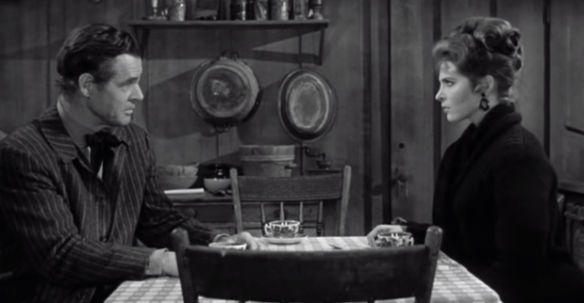
However, what makes the story even more embittering is the fact that Blaise once had a thing for the other man’s wife, Helen (Tina Louise). We witness them as they meet in the general store. And at first, they give off nothing away. All that’s there is seemingly a mutual distaste. But they sit down to a nice neighborly cup of coffee alone and something else becomes evident.

She starts the conversation and makes a cold observation, “You want another man’s wife but the man has to be dead before you take her.” It’s obviously a twisted David & Bathsheba triangle. It’s about to come to its boiling point when the two men look to have it out in the local bar. Finally, a moment of violent catharsis is at hand as a lone bottle rolls down the bar to an inevitable end.

day of the outlaw 2.png

But in a bit of serendipitous (or not so serendipitous timing) they’re bloodbath gets postponed by the entrance of a band of renegades who have just ridden into town fleeing the Cavalry for some unnamed crimes. Time to put all that we assumed the film to be about on hold and do an about-face.

Their fearless leader, a former Union officer Jack Bruhn (Burl Ives) is a surprisingly honorable man who vows to the people of Bitters that no harm will come to their women. He also forebays his men ffrom drinking, commanding the proprietor to get them some grub and lock away his liquor. Ives had a key role in the William Wyler western epic from the year prior The Big Country (1958). His performance here is fascinating for its nuance.

Jack Lambert is the quintessential baddy in my book right up there with Lee Van Cleef and he shows up in fine form here joined by a crew of other sneering malcontents just waiting to go crazy. You can see the pressure rising yet again. However, the fact that much of the film is confined to interiors makes the moments that we break out into the open that much more impactful and the imagery is equally rewarding.

One particular highlight is a fist fight in the muddy slush where Blaise puts up a good struggle but ultimately gets wailed on as an example to everyone else. Simultaneously the women folk fear for their well-being trying to make a break for it and a little boy is taken as a hostage. Another sequence involves a whirling dance hall gathering of forced fun. Bruhn’s men get riled up with the ladies but as their leader sees it, this is a safety valve to blow off steam, far better than more sordid alternatives.

Everyone knows this cannot go on forever and so Starrett agrees to lead them in their escape — a heroic act to remove the men from the town he helped civilize. The final ascent into the mountains to traverse a tortuous path through to the other side proves treacherous on multiple accounts.  While the ending might be yet another slow burn, it does the picture justice even if a fuller, happier ending would have been appreciated by contemporary audiences. We are given enough.

The picture successfully suggests that Tina Louise is far more than Ginger in Gilligan’s Island. She certainly leaves an impression. At first, I didn’t realize David Nelson was even in the picture. Besides, his brother was the true matinee idol and yet to watch him in this oater you see the tender-hearted candor in the older Nelson. Perhaps his father was trying to make both of his sons into western heroes in Rio Bravo (1959) and Day of the Outlaw respectively. Though this outing hardly gets as much respect, it’s nearly as entertaining.

Phillip Yordan’s work on the script does a fine job of creating numerous points of contention that get placed right on top of each other, tweaking the expectations of the audience nicely. What looks like a straightforward feud over a woman soon becomes far more volatile as old enemies must join forces to protect their town against the invaders. And yet the invaders are led by a man who has a sense of conscience. So the ticking time bombs are set off with his cronies hemming and hawing, private resentment still lingering under the surface, and a gunshot wound sustained by Bruhl threatening to put him out of commission permanently.

Day of the Outlaw is a genuinely satiating effort from De Toth that brims with brooding energy supplied by the perennial outsider Robert Ryan and aided by gorgeous snowscapes and a script brought to life by an engaging ensemble. If there is any one thing that hampers the picture, it could probably be chocked down to budget restraints. The production ran out of money in the end and so De Toth wrapped up filming prematurely.

That’s what makes it even more phenomenal the movie boasts undisputed quality as a truly unheralded western classic. Just as my estimation of Robert Ryan rises after every subsequent performance displaying his at times tortured and dogged resolve, I have a newfound respect for Tina Louise and their director. This would be Andre De Toth’s final time helming a western and there’s little doubt he went out with a winner.

4/5 Stars

Tall In The Saddle (1944)

tall in the saddle 1.png

“Boy oh, boy has somebody come to town!” – Gabby Hayes

How else is there to describe Gabby Hayes except for a cantankerous old cuss? When we first set eyes on him he’s berating his old mare for making him spill his liquor although he’s already swigged down quite the snootful.

Even Walter Brennan who was often cast in similar roles showed some diversity in performances during his early years (maybe Hayes did too) but Gabby will always be such a lovable coot in my eyes. Because, you see, if you grow up on westerns of the B variety with the likes of Gene Autry and especially Roy Rogers, Gabby Hayes was a mainstay of the genre as far as sidekicks go. I was fond of Smiley Burnette and Slim Pickens but no one holds a candle to Hayes.

He makes us chuckle along with the tall handsome stranger who’s just witnessed the same events. Before ever interacting we know they will wind up good friends. They hold a mutual admiration for each other.

The man named Rocklin, played by Marion Morrison and known to the world as John Wayne, rides shotgun on the stage headed for the town of Santa Inez. The coach’s other occupants are a terribly irksome old crone and her demure young niece who are heading to the same town for some business. Rocklin has come for the prospect of work.

However, he finds out the man who paid for his train passage was killed and his holdings have passed on to the very same young lady in the stage except her peevish aunt is not about to allow her to conduct her own affairs.

Rocklin seems to have little reason to stay and yet he does. He gets into a tussle with a young hot-head over a poker hand. Then, the next day he gets a faceful from strong-willed Arly Harolday (Ella Raines); she comes into town to get this brazen newcomer to hand the money over.

How can you not love John Wayne? His lady costar confronts him, guns-drawn and shrilling at him to stop and turn around but he just keeps on walking nonchalantly as she fires a hail of bullets all around. He pushes the saloon’s door open and saunters up to the bar, nice as you please.

The next such moment could have easily been a climax — as a gun duel looks all but imminent. Wayne cuts a business proposition short and proceeds to clock hulking George Clews over the head with the butt of his revolver before going back inside to return to his conversation. He subsequently gets hired on as Topaz ranch foreman.

tall in the saddle 2.png

As he so eloquently puts it, “No women is going to get me hogtied and branded.” However, that does not account for the power-hungry land grabs and the shooting of men in the backs that’s being orchestrated. Wayne must navigate with his own brand of sleuthing. A later highlight follows our hero destroying an entire office space having it out with his old football chum Ward Bond, playing a local judge.

While there’s nothing especially novel about the yarn spinning, there’s nevertheless something comforting in this as Paul Fix pulls double duty as co-scriptwriter (with Michael Hogan) and also portraying the thug Bob Clews.

It does feature two formidable female characters, one in Raines whose fiery pistol-packing showcases her own charisma opposite Wayne, while Audrey Long, who plays the reticent Easterner, proves to have enough intuition to see the picture to its conclusion. Because it must end with Wayne a wanted man, a posse coming to get him, and two guns looking to finish him off. But he has some corruption to thwart and let me assure you he puts an end to it just as assuredly as he nabs the girl — I’ll let you be the judge which one it ends up being.

Search for an underlying moral and you might not discover anything outright. What you will receive for your trouble is a good ol’ fashioned western vehicle for John Wayne that he tackles with his usual fearless gumption. Despite his rediscovery in Stagecoach in 1939, that didn’t mean that The Duke had quite risen above B fair completely. For what it’s worth, Tall in the Saddle does the low budget genre justice.  Besides Duke would get plenty of other quality movies in the future.

This is an unnecessary aside but whenever I hear John Wayne speak Spanish it always seems to add another layer of authenticity to his persona. He once said that he’d want to be remembered by the phrase, “Feo, fuerte y formal.” He was ugly, strong, and had dignity. Sounds about right.

3.5/5 Stars

Big Jake (1971)

Big_jake_ver2.jpg

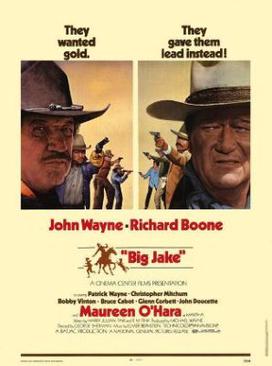
The film has an opening gambit that nearly feels unbecoming of a John Wayne picture and yet there’s something simultaneously quite riveting about it. You can’t quite take your eyes off of it, waiting to see what will come to pass.

Our narrator sets the scene in 1909 where, while the East is rising in a constant deluge of modernization, the West is still as ornery as ever. What follows is a full display of that reality as a band of thugs led by John Fain (Richard Boone) rides into a sprawling ranch with one thing on their minds.

There’s a sense that this late-period work from veteran director George Sherman, his last film, in fact, is well aware of Butch Cassidy and The Sundance Kid (1969) and The Wild Bunch (1969) generation and it readily ups the violent content. Although it is a modern western in this sense, there are still blatant signs of not only antiquity but the deep-rooted hierarchy of the West along ethnic lines.

With his good buddy from the early days behind the camera, John Wayne has another personal vehicle on his hands. There’s no doubting the centrality of his presence on the plot even if his entrance is delayed. The stock company is rich and deep as per usual but there is a myriad of young guns too and Duke had a habit of making his work a family affair.

Bobby Vinton gets a near token cameo while little Ethan Wayne becomes crucial to keeping the plot chugging forward as the thugs run off with the boy expecting a ransom in return for his life. Duke’s other two grown sons are played by Patrick Wayne and Bob Mitchum’s boy Christopher. Though not quite family, Maureen O’Hara makes a lovely appearance as the strong-willed ranch matriarch who has long been estranged from her husband Jake McCandles. The scenes with her longtime costar end in a blink of an eye but with such a meaningful cinematic history together they leave the necessary impression.

Like most of these later works, similar to a McClintock! (1963), Big Jake is unequivocally a must-see for the John Wayne faithful — people who could watch him in just about anything will find time to be heartily entertained.

It’s somewhat of a menacing western drama but there’s still ample room for a cheeky and rip-roaring good time. Big Jake, though more violent than some of Duke’s predecessors nevertheless has his mark of approval all over it. There are falls in the mud. He gets plenty of time to smack his sons around and also receives his share of wallops as retribution. Pulling buckshot out of backsides and dousing them with whiskey is all in a day’s work. And Duke is as vociferous as ever.

That’s what will get people to stay. Because it’s one thing about John Wayne that is rather refreshing. Like him or not, you know full-well where he stands and how he’s going to play it. Larger-than-life and tough-as-nails but with unquestioned integrity. I’m drawn to that like many others because I come from a wishy-washy generation. But far more than that, even if I don’t necessarily agree with everything he does, the Duke never seems to do something purely out of spite. Instead, he has some deep-seated convictions.

He plays Big Jake McCandles with his typical presence that knows few equals in terms of longevity or sheer durability. Wayne certainly understands how to command a room and while everyone else tries to upstage him no one has the gumption. Richard Boone is probably the only old-timer who has the wiles and the pedigree to try to steal his spotlight and he’s, of course, the ringleader of our villains.

Despite being a man who left his family long ago, McCandles returns on a moment’s notice to rescue his kidnapped grandson. He’s a no-good old coot but there is that aforementioned sense of moral integrity. He’s has a funny way of showing it but he cares about family.

The truth is, he sees out his objective with his typical dogged resilience laced with worldly wisdom and tenacity. The conflict spawns from one son who is rightfully bitter and another son who seems like he’s traded out the past for new-fangled gadgetry. In the end, it seems the tried-and-true methods prove most effective. Wayne is joined in the task at hand by his feisty canine named “Dog” and a veteran Apache tracker named Sam.

Elmer Bernstein’s scoring automatically evokes layers upon layers of added richness from any western scenery and he’s somehow able to perfect everything that is resplendent and majestic about this way of life. There’s a deep abiding understanding of what The West meant and what men stood for.

Their final destination comes in a bustling boom town with thugs milling about and everyone looking to get a hand in on the cash payload that the McCandles have hauled around in order to save their young kin.

We know it’s only a matter of time before things come to a head. Of course, Duke gives it a bit of a kick in the rear by instigating barroom brawls to rile up the masses as a quality distraction. The resulting payoffs are as expected and gut-bustingly uproarious. And of course, John Wayne gets the last laugh of all from inside the shower stall of a barbershop followed by a final showdown where every member of the McCandle clan gets their own chance at redemption.

There’s nothing cutting edge here but this is a story of the dwindling West and so when that’s what your story is about, I think it can be said that Big Jake succeeds in these modest regards. After all, it’s a self-selecting film because anyone who wants to see it will be satiated and anyone else probably won’t search it out anyway. John Wayne has that influence on people even today.

3.5/5 Stars

The Virginian (1929)

220px-Poster_-_Virginian,_The_(1929)_01.jpgThough the image quality of the print I saw hardly stands the test of time, there’s something almost modern about The Virginian’s characterizations or at least what it deems interesting to show.
There’s actually a layering of tones and a fluctuation in the moral dilemma at its core that feel a great deal more nuanced than a cut-and-dry shoot ’em up western beholden to the stereotypes that the genre was founded on.

In Victor Fleming’s hands, The Virginian was not only a western but an early talkie extending the possibilities of the medium. It’s true that at this point there was a lot of pioneering still to do in film as there had been in the West.

One aspect this picture took advantage of in particular was exterior shooting which gives the West an almost palpable nature because we see the dust swirling up from the feet of the cattle, we hear the constant chorus of animal sounds, and the expanse of the prairie is daunting but also starkly majestic.

Beyond genre conventions, it’s indubitably a seminal picture since we get the overwhelming sense that we are seeing a persona coming into his own — the crystallized image of stalwart Americana — Gary Cooper. Although he was a minor star and this was not only his first starring role in a western but also his first talkie, soon enough he would be one of the most beloved actors of his day.

True, he also made many pictures outside the genre of considerable repute in their own right, and yet there’s no underselling how important the western was in further instilling Cooper’s legacy for generations of faithful fans. His eponymous character in The Virginian is an early marker of the mythology of western masculinity that would stretch all the way to High Noon (1952) and Man of the West (1958). In fact, at times this picture, featuring an imminent showdown, looks eerily similar to its future brethren from two decades later.

His cattle foreman character is a man’s man. He’s a plain-speaking, straight-talking man of few words (Yes ma’am, No ma’am), who nevertheless cares deeply about honor and personal integrity. Yet he still gives off the homely qualities of a man of the West. And it’s true that much of this film adaptation of Owen Wister’s novel and subsequent play is concerned with the butting of heads that comes with the clashing cultures between West and East.

On one side you have the Virginian and the rest of the townsfolk and on the other is the new schoolmarm, Molly Stark Wood (Mary Brian), who causes quite a stir among the men in town and is a welcomed bit of civility to everyone else.

There is a sense that she can help tame this uncivilized world that lacks manners, education, and law and order. The themes would crop again and again most notably in Ford’s own moody rumination The Man Who Shot Liberty Valance (1962). But here there’s an oddly good-natured comedy streak. It’s not all horse opera.

The Virginian and his old pal Steve have a fine time switching the babies about to be christened by the parson which causes quite the hubbub. But the two men also jockey for the new gal’s affection in all matter of things. Looking to carry her bags or get a dance with her at the community gathering.

The Virginian and Molly even conduct a discourse on Romeo and Juliet which proves to be an enlightening distillation of their two differing perspectives. All of this is fine and dandy. Even the swapping of infants like a pair of regular cow rustlers feels innocent enough. But there’s another side of this world as well.

The main antagonist named Trampas (Walter Huston) wears black and yet he’s more of a cunning thief than an ornery devil, all guns a blazing. He’s more apt to shoot a man in the back when he’s not looking like a coward than actually face him man to man.

He also happens to be a cattle rustler himself and he’s pulled Steve in with him because it’s a pretty easy business. Lots of reward for little risk. Except if and when you get caught there are no two ways about it. The law of the land says you’ll be strung up even if you’re a friend.

And so The Virginian doesn’t shy away from the harsher realities of this lifestyle whether it be hangings or the prevalence of gun duels. It’s a part of the life but also so at odds with what is considered respectable in other parts of the world. Thus, not only the schoolmarm, but the audience, and really everyone else involved must grapple with what is right and what is wrong and how we reconcile those perceived differences.

4/5 Stars

“When you call me that, smile!” – The Virginian

Pursued (1947)

pursued 1.png

A film like the Searchers (1956) or even The Bravados (1958) frames the western as a tale of vengeance, where a vendetta is carried out from start to finish, only to get twisted up along the way across moral lines. Pursued is a psychological western that takes up the story from the opposite end of the barrel, as its name implies, though the way it goes about it isn’t altogether straightforward. Such stories very rarely are.

Jeb (Robert Mitchum) is hiding out in a cave as his love Thor (played by Teresa Wright) rides to him. We don’t know their history, why he is there, or who is coming after him. All we know through obvious inference is that all these things must be true.

It’s screenwriter Niven Busch’s ploy to draw us into our story and then he fades into a flashback that carries most of the picture’s weight. As many stories channeling Freudian theories must begin, this one is conceived in childhood.

A young boy remembers glimpses of a horrible event. Bullets flying. A body of a woman crawling towards him as he hides under a bed. And this woman (Judith Anderson) would become his adopted mother as her two own kids become rather like his siblings. Thor and Jeb get on well enough but from their boyhood, there has always been an unresolved conflict between Jeb and Adam. The animosity stems from the fact Adam will always see the other as not a true part of his family and Jeb lives with a bit of a chip on his shoulder, understandable or not.

For the sake of their mother and their sister, they begrudgingly tolerate each other and that’s the extent of it. When the Spanish-American War erupts one of them must go and so they decide it in the most arbitrary way possible. With a coin flip. Jeb loses and goes off to be a war hero.

When the family finally reunites and gathers around to sing “Danny Boy” to the tune of Londonderry Aire, there is a sensitivity we feel unaccustomed to, since the rest of the story is brusque and distant nearly scene after scene.

While in its opening moments it began as a story of hospitality and family, Pursued really starts falling apart and allows its core themes to exert their full presence. It’s in these moments where we begin to see hints of a story playing out not unlike a crazed version of the prodigal son.

On another coin flip, Jeb loses out on his piece of the ranch and after having it out with Adam turns to his buddy (Alan Hale Sr.) at a gambling house. He is brought on as part of the operation. Meanwhile, the jealous older brother character begrudges the fact his mother will give Jeb an equal inheritance so he is looking to avenge this personal affront. It doesn’t end peaceably.

At his ensuing trial, Jeb’s life is on the line but even though he gets away scot-free, his relations with his surrogate family will never be the same. And it’s only made worse with every subsequent moment including a town dance where Thor’s latest beau (Harry Carey Jr.) is egged on to confront Jeb.

Dean Jagger makes a nuisance of himself hanging over the entire picture menacingly, but it does feel like his talents are generally wasted. Because when everyone else is gone, the most traumatized parties are Mitchum, Wright, and Anderson.

However, this noir western is a genre-bender blessed by the beautiful black and white imagery of James Wong Howe matched with the direction of that old Warner Bros. vet Raoul Walsh. Whether it’s the distant silhouette of Robert Mitchum illuminated in the doorway at night or the sheer magnitude of the cliffs and crags as they frame insignificant riders galloping by on their horses, the images are undeniably evocative.

There’s nothing all that surprising or thematically interesting about the film’s content initially. Still, this is not a full denunciation of the picture outright. Because the way it plays out does become marginally more intriguing as Mitchum comes under attack and finds himself becoming more abhorred by the minute.

I must admit it’s hard to buy sweet, innocent Teresa Wright could be vindictive at all. However, what the two stars breed is the most detached married life known to man. It’s a tribute to both of them. But they can’t stay that way forever.

What does remain is the fact Mitchum has been hounded his whole life by some unnameable specter hanging over him, and the picture has been hemming and hawing for a final showdown all along. It finally comes, though the ones who take a stand are not who we might expect.

The psychology puzzle of it all is up for debate — how memories come flooding back at just the right moment or how people can love someone and them turn around and hate them and then love them again almost on a dime.

But this does not completely neutralize Pursued which still deserves a reputation as a brooding and atmospheric take on the West. It’s not as mentally stimulating as might have been warranted but with the cast of Robert Mitchum and Teresa Wright, even ill-fit as they may seem, this oater still comes as a fairly easy recommendation.

3.5/5 Stars

Johnny Guitar (1954)

johnny guitar 1.png

“I’m a stranger here myself.” ~ Sterling Hayden as Johnny Guitar

In watching even only a handful of Nicholas Ray films, it’s possible to discern fairly quickly that his films are often about the marginalized outsiders. Rebel Without a Cause (1955) is the most iconic example but this theme goes a lot further than that single movies. He even plays with the same ideas in Johnny Guitar his extraordinarily distinctive western from 1954.

There are other westerns that open like this. A stranger (Sterling Hayden) riding through the mountains and making his way to the nearest town. He overlooks a stagecoach robbery going down and miners blasting away at a mountain with dynamite. There must be a purpose to it all but the significance fails to resonate quite yet.

He goes to the local watering hole: Vienna’s. Except there’s no one there. It’s a ghost town. There are only a few solitary figures working the roulette wheels and the bar. No one else. But still, the stranger walks in as if he’s meant to be there. We don’t know why yet.

By all accounts, Sterling Hayden wasn’t much a cowboy but he had the presence of one. In the movies sometimes that’s enough. Here’s the eponymous Johnny Guitar, the man with his instrument strapped to his shoulder with little stake in the local goings-on.

Namely, the grudge match brewing between the hotel’s fierce proprietress Vienna (the always cutthroat Joan Crawford) and fiery western lass Emma Small (Mercedes McCambridge) who packs a whole posse of cattlemen including ornery John McIvers (the venerable Ward Bond). It doesn’t help matters that Vienna opens her doors to the despised Dancin’ Kid (Scott Brady) and his cronies.

We, like Johnny, have no particular stake in their quarrel though there is a sense of some past grievances. In fact, everyone seems to have a history but we are hardly ever given a nibble, never through flashback and rarely in exposition.

Nicholas Ray creates a gorgeous world in color that showcases some of the most attractive imagery of the West in Classic Hollywood on par with The Searchers (1956) and Rio Bravo (1959). And it boasts an equally colorful array of characters including quality supporting cast members like Bond, Ben Cooper, Ernest Borgnine, Royal Dano, John Carradine, Frank Ferguson, and Paul Fix.

But the subversion of all norms begins with Joan Crawford, the woman who loves the sound of the roulette wheels spinning, ever severe, packing a six-shooter in her blue jeans. While the TruColor does much to enhance not only the scenery but her performance as her piercing eyes burn through everyone she stares down. Johhny Guitar might be in our title but Vienna is our undisputed star.

The relish of the film is perfectly rendered by the complete lack of clarity initially. It’s trying to get a line on everyone in an attempt to understand what’s going on as their allegiances are made fairly evident. It’s a matter of picking a side. But the sides are incredibly difficult to decipher. In fact, even in her moments of complete innocence, it helps her character that Crawford very rarely comes off as a sympathetic person — in reality or on the screen. So if she’s our protagonist then we’re in for a tough outing.

Of course, the feud that’s central to the tale was also twofold unraveling on both sides of the camera. Mercedes McCambridge and Joan Crawford loathed each other to put it lightly. They probably wanted to tear each other’s hair out and while not the most benevolent of relationships, it undoubtedly stoked the fires of the film’s drama. In fact, it seems like there weren’t many people who did like working with Crawford. Hayden never wanted to be in another picture with her again either. Still, once more, it all functions in front of the camera exquisitely.

There’s certainly some truth in drawing up parallels with George Stevens’ Shane (1953) but the moral lines are a lot more jumbled and the intentions of the plot far less direct. Shane is a success because it’s a fine piece of classical storytelling still underlined with an imminent threat. Johnny Guitar is beguiling because it breaks with all the conventions of the West while still carrying its own amount of subtext that’s hard to figure.

Should we even care that the posse gets these men? But you see, that’s nearly beside the point. It’s not about right or wrong but this muddled center controlled by Joan Crawford and Sterling Hayden. The man and the woman with a bit of a past but not enough that they will fall into each other’s arms and live a faithful life at one another’s side. That’s just not in their nature. Still, riding the fence proves to be a taxing ordeal.

We witness the most peculiar bank robbery as far back as I can remember committed by the local outlaws who until they ran off with the loot hadn’t exactly done anything wrong, in spite of being despised by a whole town. In other words, they played the roles expected of them. Then, a pair of hangings takes place but instead of your typical unrepentant criminals being strung up, you have a kid and a woman both ending up with a rope around their necks. The enforcers’ stomachs begin to churn uneasily. This isn’t how mob justice is supposed to work.

Subsequently, the battle to subdue the frontier is brought home with the most unconventional showdown in the western canon that’s fundamentally also one of the most stunning. It blows up in your face and then leaves you questioning this entire ordeal.

Peggy Lee’s title track is used to sing them out as one final note in this dazzling western courtesy of Nicholas Ray; dazzling for the very reason that it does everything contrary to what we have learned. It continually makes a conscious choice to upend the accepted script attached to the mythology of the West, rewriting its own narrative full of vivid imagery and equally blistering outcomes.

4.5/5 Stars

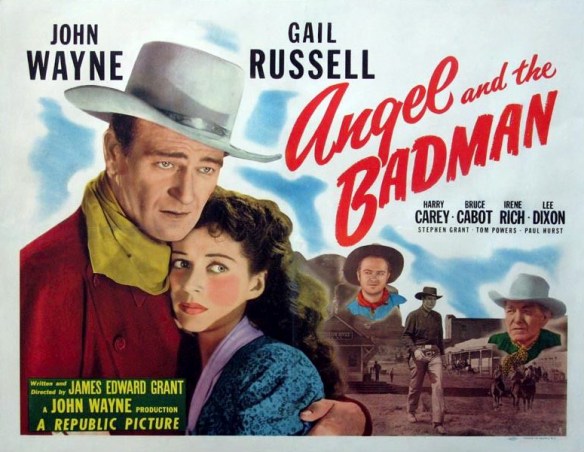
Angel and the Badman (1947)

Angel_badman.jpg

With John Wayne partnered with his longtime collaborator James Edward Grant (Hondo, McClintock!) it’s easy to see Angel and the Badman as an early vehicle for his conservative ideals but far from being heavy-handed, it goes down as a solid B-picture with a surprisingly unique perspective on the West.

In this instance, the western is used to construct a fairly simple parable that plays out over the frontier using figures that we know well from every cowboy picture we’ve ever seen.  The outlaws and the homesteaders, the sheriffs and the doctors, they’re all present.

But underlying their every interaction is a certain purpose. It’s not simply to entertain — though the film is adequate in that department and has it’s share of gunfights and showdowns. It foregoes most of the normal set pieces to carry out its main objective as a moral tale. Still, these established figures help draw up the themes by the very way they see the world.

Quirt Evans (John Wayne) has and always will be an outlaw as preordained by society until the fateful day when he finds sanctuary in the home of a Quaker family after incurring a wound. They take care of him and nurse him back to health but above all, they give him the benefit of the doubt — that he is not too far gone and he still has more than a fair chance to redeem his life if he so chooses.

The local apothecary functions as the main counterpoint to our angelic first family. He is very rational-minded, devoted to scientific thought and his cynicism leads him to begrudgingly patch up the outlaw all the while grumbling under his breath. It’s telling though that he holds this overtly religious family in high regard. But nevertheless, the parameters have been set. We must sit back and find out where John Wayne falls within the frames of this corral.

It’s true that he’s saddled with a past full of womanizing, guns, greed, and every other sin known to man. In fact, the local sheriff is bent on hanging a rope around his neck but the old veteran (Harry Carey) is a sly fellow ready to bide his time and let Quirk slip up somehow.

The main point of contention is a payload of gold that a band of glowering thugs is intent on getting a handle on. Quirt is all that stands between them and the prize but even in his injured state he still packs a gun — the bullets inside and his stellar marksmanship being the key deciding factors.

Playing against this very storyline is a parallel thread that bears equal importance if not more. Penelope Worth (Gail Russell) is the daughter of this Quaker family and she is tasked with taking care of this formidable outlaw. In any other scenario, they would be oil and water. Their lives and personalities should never mix and yet in this romance, they ultimately do. True, his lawless lifestyle chafes against the worldview of these religious Quakers who promote an existence of good will and pacifism. Still, people can change.

John Wayne notably disliked High Noon (1952) and his most famous denouncement of the picture can be seen in Rio Bravo (1959), viewed by many as a cinematic answer to its predecessor. However, in this earlier film, you see in Wayne’s character a man who also falls for a Quaker much like Will Kane (Cooper) does in High Noon. But here he comes from the wrong side of the law. Still, she redeems his very nature and far from throwing off the perceived shackles of her beliefs or simply tolerating them to stick to what he knows best (namely gunplay and showdowns) he does the fairly brazen thing and wholeheartedly embraces her way of life. Because he loves her.

It begs the question, which outcome is more believable: The sheriff who went against his wife’s pleas so he could uphold his personal convictions or the outlaw who gave up his old way of life even in the face of death because he was transformed by the love and lifestyle of his woman? Rather than drawing up which one is better exactly, it might suffice to say that Angel and the Badman, while lesser known, is still a diverting western with its own moral dilemma because westerns are and always have been horse operas.

3.5/5 Stars

Review: Giant (1956)

giant 1.png

People might come to Giant for James Dean. They might come seeking out the final film in George Stevens unofficial American Trilogy (including A Place in the Sun and Shane).  Maybe it’s even the promise of a sprawling epic of monumental length and scope that turns out to be both a blessing and a curse by most accounts.

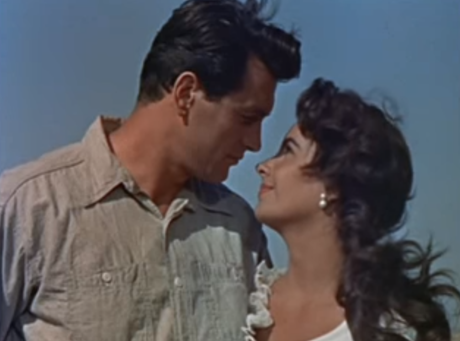
But this adaptation of Edna Ferber’s novel, despite all of this, is really a film about marriage and family in a world that’s constantly changing. Rock Hudson is a towering giant in his own right turning in a performance that works as quintessential Texan Jordan “Bic” Benedict. Elizabeth Taylor proves that far from a one-dimensional classical beauty, she has acting prowess as well delivering a spirited showing that gels with Hudson for the very fact that it often chafes against his characterization. Meaning they’re believable as husband and wife.

James Dean plays their marginalized ranch hand Jett Rink who is nevertheless treated well by Bic’s  hardy sister Luz (Mercedes McCambridge) as well as Leslie while harboring a life long feud with Bic over the ensuing years.

Time turns this story into a battleground of two dueling giants. One a life long rancher of great stature. The other a modern figure blessed with a meteoric rise as an oil magnate. Their resentment carries through the generations as much as their differing fields reflect the sign of the times. The tectonics shift as the old guard of the Texas plains is replaced with a new breed of powerful men.

Of course, Dean’s performance is the stuff of legend and there’s an idiosyncratic, grumbling magnetism about it as only he could do. This isn’t Brando and it’s not even Monty Clift who previously played opposite Elizabeth Taylor in Stevens’ earlier picture. It’s James Dean showcasing his personal flare.

The final moments of his “Last Supper,” after his subsequent rise to glory, are devastatingly pathetic. The mighty oil tycoon of Jetexas falls into utter disgrace crashing to the floor of the empty banquet hall with a clatter. Rolling around in a drunken stupor, making a shambles of his grand exhibition of wealth, and simultaneously concluding Dean’s last scene in front of an audience.

His life would be taken even before Giant finished filming, some of his last scenes of dialogue being reread by close friend Nick Adams, his temperamental nature and habit of mumbling lines impacting the production even after his passing. Still, George Stevens himself, despite the insurmountable hell he was put through, and the hits his shooting schedule took, even admitted that Dean was something special.

You might not like him but all of us seem to gravitate to him for some inexplicable reason. He carries our gaze with his ticks and his delivery. It’s as if he forces us to take heed even out of a necessity to understand him, his head downcast, his hands fidgeting and such, all a ploy to carry our attention. It generally works.

giant 2.png

Yes, we lost him so young but the beauty of Giant’s epic stature is that in cinematic terms Dean was blessed with a full life. We saw him as a fiery youth in East of Eden (1954) and Rebel Without a Cause (1955) and in Giant he evolved into an equally tortured man who grew old before our eyes. That’s the magic of the movies. But sometimes it’s so easy to have his legend overshadow all others.

The latter half of the film is really about the Benedict family evolving with the maturation of their children. Dean is worth a closer look certainly, but I’m inclined to enjoy the performances of Carroll Baker and Dennis Hopper nearly as much if only for the simple fact that they’re less heralded.

Baker is the daughter caught in the throes of romance and decadence who finds Jett Rink more fun partly for the very fact that her stuffy parents abhor what he has become. Meanwhile, Hopper brings a surprisingly earnest candor as the Benedict’s eldest son with aspirations to be a doctor instead of a rancher, pushing against family tradition, subsequently marrying a Mexican-American bride, and facing the unfortunate ostracization that comes with such a life.

Some of the most evocative scenes are actually held between Hudson and Taylor. To most, their careers were known for personal lives exploited by tabloids. They don’t get the same adulation as Dean as actors. Still, in this film, they do something quite spectacular in a more unassuming way. They quite authentically reflect the life of a married couple as their romance and life together waxes and wanes over the years. That includes Jett Rink’s onslaught and the trials with kids but, at the core it’s just the two of them, grappling with it together.

Because this is a film that unfolds over decades we come to appreciate the changes that come over the characters and not so much the makeup or touches of gray. More important are the strides they make in their lives or even how they remain the same.

They model what it is to be young and in love, to quarrel and bicker and to make up and to be diplomatic and to have dreams and aspirations and to want the best for your children and at the same time hold grudges and feel like the ones you love are purposely trying to undermine you.

To begin with, this is a fairy tale romance of opposites. Hudson is the formidable Texan bred as a rancher and he comes to the upper echelons of eastern society looking for a stallion and he comes back with a bride instead.

She comes to his country initially welcomed and then feeling like an outsider in a land that is so set in its ways. Men and woman are expected to exist in certain spheres. White folks don’t fraternize with Mexicans. And cattle barons tame their land and breed their stock like their fathers before them. It’s tradition and they stick to it. Bic Benedict is raised in that Texas tradition dating all the way back to the Alamo, his stock proud, fiery, and tough.

Still, his wife Leslie is just as audacious but in different ways, testing his sensibilities and testing the matrimonial bonds of their marriage. She rather comically proposes her own marriage, looks to break up the boy’s club mentality that dictates the culture, and tramples over the de facto laws of the land in favor of goodwill to all. That means if a baby is sick, she fetches a doctor. The color of its skin makes no difference. In that atmosphere, it’s radical that she extends kindness to everyone, not simply her own “kind” as it were, whether divided by class or racial barriers. Ultimately, it’s a testament to the sorry state of affairs but also of her personal convictions and they bleed into the rest of her family.

The final showcase comes not in his front and center bout with Jett Rink because although we’ve been expecting it for decades, as such it never comes. Jett’s not worth it anymore. Instead, Bic’s shining moment comes in, of all places, a roadside diner. He’s not as strapping as he used to be and he gets wailed on something awful. But in this moment as he’s duking it out with a local bigot, the platform that he stands on is not simply about his family name or his own personal honor as a Benedict but along the planes of what is morally right and wrong.

Rejecting service to people based on the color of their skin is inherently wrong. Disrespecting people of other races can and never should be accepted. Years before he would have never taken a stand on such touchy issues but he’s matured in that regard and his wife falls in love with him all over again. She sees first hand why she grew to love this man.

He lies there on the floor heaving and bloodied with food flung all around him the oddly upbeat throngs of “Yellow Rose of Texas” still whirring on the jukebox but ironically Leslie has never been more proud of her man. It’s that paradoxical maxim written about many times. Blessed are those who are persecuted for doing good.

Most modern viewers will honestly thank their lucky stars that they don’t make epics like this. But there’s something fleetingly enchanting about these old-time vehicles that managed to encompass so much space with grandiose ambitions and awesome imagery full of million dollar skies and fluffy clouds as far as the eye can see.

The West is dead as is the American genre. The stars as we knew them are no more. We are still a nation struggling with issues of race and class. Love and marriage. That mixture of nostalgia and timelessness still makes Giant a draw.  George Stevens is one of The Great American Directors and though Shane (1953) will remain his unassuming masterpiece, Giant deserves at the very least a modicum amount of respect as a dying breed of American epic.

4.5/5 Stars

Note: Entry in The Elizabeth Taylor Blogathon!