Divorce Italian Style (1961)

Divorceitalian.jpgI never thought I’d get so fed up with hearing the name “Fefe.” But it’s true. There’s a first time for everything. In fact, Fefe is the name of our main character played so magnificently by Italian icon Marcello Mastroianni. In my very narrow view, he still very much epitomizes Italian cinema for me.

As for the film, a Sicilian Baron Ferdinando finds himself in rather an unfortunate conundrum — at least from his point of view. He relates through voice-over his family dynamic, with his parents, his soon to be engaged sister, his doting wife (Daniela Rocca), and of course his beautiful ingenue cousin Angela (Stefania Sandrelli). Aside from not being particularly enthralled with married life, the bigger problem is that Ferdinando is infatuated with Angela. He can’t take his eyes off her.

For those who are paying attention this comedy from director Pietro Germi, at times feels strikingly similar to the screwball comedies of Classic Hollywood where men such as Preston Sturges made light work of society by skirting censorship and building a barrage of gags almost to the point of being incomprehensible. But they might also conjure up comparisons with the darkly funny Ealing comedies out of England. And it’s true that films like Divorce Italian Style also carry a very particular name, “Commedia all’italiana” or comedy in the Italian way.

What becomes evident in a film such as Divorce Italian Style is the pointed attack on Italian social mores — the very framework that the culture is built on — and all involved are poking fun. Morality, class distinction, even the institution of marriage, are all dissected satirically as our protagonist goes through his life dreaming of knocking his wife off and living happily ever after with Angela — a girl that shares his affection — if only society didn’t say otherwise (she gets whisked to a life in a convent to maintain her purity).  Not to be deterred, the Baron attempts to hitch his wife up with a suitable suitor and as the shameful scandal finally breaks over his wife, he secretly jumps for joy. He’s getting a step closer to what he wants.

Meanwhile, the men about town all ogle at every girl that happens to walk by. Fefe’s old man is constantly harassing the maid, and more than once he walks in on his sister and her beau making out passionately.  There’s even a theatrical screening of Fellini’s La Dolce Vita (also starring Mastroianni) which literally seems to break any form of censorship in the town. The crowds flock to it joyously — men and women alike — because they want to see the lavish romance projected up onto the screen.

Mastroianni is not surprisingly a long way off from his debonair lovers taken the likes of La Dolce Vita, La Notte or 8 and 1/2. He goes through the film with a certain comedic despondency. He’s hardly a real figure. Comic and dismal with overblown ideas of how to make his existence invariably better. It’s quite a display because while it’s easy to laugh it’s also rather pitiful.

So Divorce Italian Style is perhaps even more audacious than the screwball comedies of the 30s and 40s. Because it gives the plotting Fefe the “happy” ending he was hoping for. It actually gives it to him, but the comic (or sad) thing, in the end, is that his girl is already playing footsies with another man. You see if we look at what is going on here,  he’s never going to find contentment. The ultimate irony, if there was a sequel, is that it would probably show Fefe actually trying to kill his wife because she’s cheating on him. Then it wouldn’t be so funny.

Yes, the strict societal pressures put on the members of this Sicilian community undoubtedly deserve to be questioned. There is so much obvious hypocrisy bubbling up through the layers of society and it makes for provocative comedy. But also there’s something to be said for living life under some sort of moral framework. Otherwise, life is purely about our pleasures, what makes us feel good, what our desires are and oftentimes those fail to regard what is beneficial for others. Needless to say, I’m partial to “Marriage,” not “Divorce” Italian Style — or any other way for that matter. However, I won’t even try to tackle the whole marrying your cousin thing. This is a comedy after all and Stefania Sandrelli is quite pretty. I don’t blame “Fefe” too much. He’s only human.

4/5 Stars

Solaris (1972)

solaris 1.png

Now I can finally say that I have entered the cinematic world of Andrei Tarkovsky and I am better for it. Solaris somehow traces the lines of a paradox rather remarkably. It’s a sprawling epic of nearly 3 hours and yet hardly ever feels overlong. It moves through its rhythms contemplatively but never feels too slow. And though it’s a sci-fi story, it never loses sight of its human components which remain its guiding light to the end.

To Tarkovsky’s credit, he’s able to retain the film’s continual ability to mesmerize again and again and he never lets up. I know for certain viewers this will be dull monotony–even for me at times–but for others, it’s pure magic. Repeatably fascinating for both its enigmatic mysteries and revelations. Because it delivers both up willingly to the engaged viewer.

Like any master painter, Tarkovsky begins the film by laying down his base coats. We’re introduced to enigmatic psychologist Kris Kelvin while simultaneously accustoming ourselves to the director’s naturalistic imagery — glossy and distinct. It’s in these opening moments at the home of his father back on earth where the audience gains more insight and Kris prepares himself to mount a journey to the space station orbiting the planet Solaris. Only three crew members still survive there and the psychologist is being sent to check in on them and continue to expand the reaches of human knowledge. That’s the idea at least.

However, when Kris gets to the space station it’s far from welcoming, austere and dilapidated thanks to poor upkeep. Now only two crew members remain, the curiously odd Dr. Snaut and the cold cynic Dr. Sartorious. Both men will give Kris very little information about the general state of affairs. And he only learns later that his colleague Gibarian committed suicide for some inexplicable reason.

But the film enters its most perplexing stages when Kris receives a visit from a mysterious woman — her name is Hari and for reasons unknown to us, Kris is very close to her. And his emotional state from that time forth is constantly being manipulated by the presence of this special visitor. He’s frightened of her. Then in love and completely devoted to her well-being. And despite the adamant insistence of his colleagues, he will not believe her to be an apparition. He holds onto the fact that this woman in front of him who is constantly self-destructive and in the same instance totally devoted to him, is the woman he knows and loves. But the question is not so much whether or not that is true, but what Kelvin will do with all that has been thrust upon him as a result.

On the whole, Solaris is a visual treat but not due to grandiose visions of space.  Instead, Tarkovsky blends color and sepia footage into a patchwork while juxtaposing the environmental beauty of underwater vegetation with the dour interiors of the space station. And the suspension of disbelief is maintained through the use of simple special effects and the underlying fact that this film is not really reliant on pyrotechnics of any kind. It’s about people. An equally remarkable observation is the fact that Tarkovsky seems to be self-assured enough to have his characters play their roles with relative restraint. Numerous times they face away from the camera. In other films, directors would be afraid of such a tactic, but here it only works to heighten the amount of intrigue.

It’s a philosophical and psychological study that happens to take place on a space station. And that’s really like any of the great sci-fi movies of our times. They’re not really about science-fiction or technology or robots or any of that. They’re only another mode to tell the most human of narratives even in the outer reaches of the galaxy or in futuristic worlds.

It’s also highly reductive to call this Tarkovsky’s 2001. In deference to both films really. In fact, the director did not see Kubrick’s film until well afterward and I think I too would side with his conclusion that 2001 is a little bit too “sterile.” While 2001 is a decidedly grand narrative of exploration and technological advancement, you can easily make the case that Solaris is a film most precisely about the incredibly human emotion of love. Although it’s also about the human search for some kind of truth much in the same way as its predecessor, it’s also far more personal. Solaris feels more intimate and true — perhaps even more closely tied to some of Ridley Scott’s themes in Blade Runner. Particularly his examination on what exactly separates man and machine when they share striking similarities.

As far as sound goes, there is a score to Solaris, but Tarkovsky only utilizes it at the precise moments, more often than not foregoing typical music for either electronic distortions or perhaps even more boldly complete silence. He also gives nods to the great Flemish master Pieter Bruegel using his work in the set designs inside the space station.

Truthfully, it’s easy to peg Solaris as a pessimistic movie but it’s as preoccupied with morality as it is with the pursuit of knowledge. It’s as much about the innate human desire for love as it is psychological torment. And its ending strikes a note of poignancy and bitter despair in the same instance.  But if you want profound cinema that stays with you and marinates in your mind then look no further. I will certainly be returning to Tarkovsky sooner rather than later.

5/5 Stars

E.T. The Extra-Terrestrial (1982)

e-t-the-extra-terrestrial

I remember the first time seeing  E.T. and enjoying it immensely, though it never floored me. I felt the same thing this time around for no particularly justifiable reason. Good but, in my estimation, not great, whatever that means because those terms are equally murky. Still, the fact that there had been little change in some ways made me feel uneasy. What was I not seeing?

But then thinking about it more I latched on to this idea that made me appreciate E.T. far more than I had before. Like an epiphany, it came to me what this film really is. It’s a childlike fantasy full of personal notes from a director who just happens to be Steven Spielberg. That’s not much of a discovery, but the implications are great.

The story of young Elliott (Henry Thomas) and his chance encounter and befriending of E.T. is rather like a boy and his dog story. Except both characters are going through almost parallel situations and Spielberg takes it to the literal extreme. They actually feel each other in a sense. They are perfectly empathetic towards one another.  With E.T. the motives are most obvious. His ultimate goal is to “phone home” so that he might be reunited with those that he calls family. For Elliott, it’s also about home. His home life is a bit fragmented with a father who is vaguely mentioned to be in Mexico (although that’s probably not the case) and siblings who quarrel like siblings usually do.

However, it also struck me how this family really does care about each other. Little Gerty –a beyond memorable Drew Barrymore–is the quintessential 5-year-old sister. First frightened of, then intrigued by and finally faithfully devoted to E.T. And the older brother Michael teases his siblings as has always been the case since the beginning of time but he too invests himself in this adventure. Certainly, it’s out of charity towards this visitor from outer space but it’s undoubtedly also an extension of the affection he has for his little brother.

It’s also peculiar that almost all the secondary characters are very ill-defined and the antagonistic forces attempting to impede E.T. and Elliott are even vaguer. At first, this felt wrong in some regards– a potential sign of poor storytelling. But once more I was brought back to the unmistakable idea that this film really is a boyhood dreamscape. This is Elliott’s story and if it’s Elliott’s story, it’s even more so Spielberg’s own meditation on adolescence and his own childhood. The narrative is even said to have been inspired by his own imaginary friend as a child and his own dealings with a split household. And there’s also a hint of the Wizard of Oz here. There’s no place like home.

Thus, what becomes undeniably important is this dynamic relationship between this boy and his newfound friend who just happens to be from outer space. It’s quite simple. It’s childlike really. And that is and forever will be the beauty and allure that comes from this film. Families can watch it. Kids can marvel at it. Parents can soak it up. Because just as it is about a family–dysfunctional as they may be in their suburban life–it is also for families.

There’s the sheer mayhem of the shrimpy kid grabbing a kiss from the pretty girl in class as hordes of frogs hop by. The iconic magic of Elliott and his friends soaring through the sky on their bicycles, John Williams’ score dancing majestically in the background again and again. Even the fact that this extra-terrestrial goes from death to life is strikingly analogous to the archetypal biblical narrative that permeates our culture. It’s all spectacularly remarkable but rather than be skeptical we acknowledge it with almost wide-eyed wonderment, accepting it, accepting these people that we meet. And watching E.T. ascend back into the atmosphere with true awe.

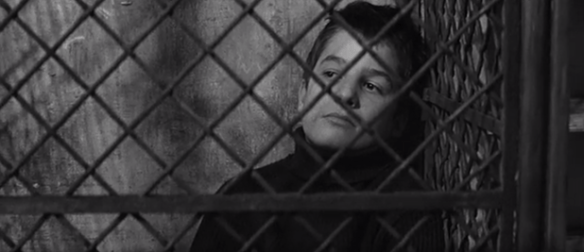
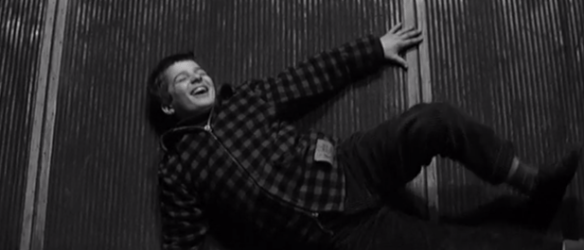
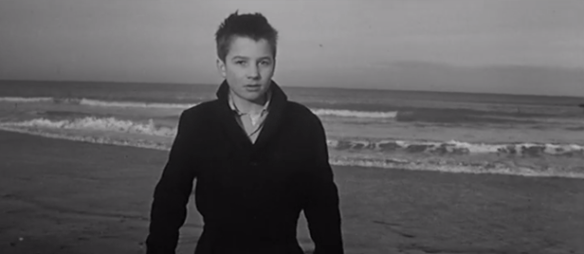
I find it fascinating that only a few years earlier Spielberg was inspired to put Francois Truffaut in Close Encounters. In E.T. I see his closest approximation of the French director’s own thematic elements. To put it in terms of homage. E.T. is Spielberg’s version of 400 Blows, granted featuring space aliens, Star Wars, cultural references and so on, but they’re not all that different. They really are about the same core issues. It takes until after 400 Blows for Antoine Doinel to find love and intimate relationship with his wife. For Elliot, it comes with family, his brother and sister, and mother, and of course, with E.T. This is what has a lasting impact on Elliott and I could guess, with Steven Spielberg as well. But the audience gets to be a part of it too, an equally important  piece in this trinity.

4.5/5 Stars

A Clockwork Orange (1971)


a-clockwork-orange-1“He will be your true Christian: ready to turn the other cheek, ready to be crucified rather than crucify” ~ Minister of The Interior

Anthony Burgess’s A Clockwork Orange began as a troubling book and it becomes perhaps an even more troubling film full of volatility placed in the hands of Stanley Kubrick.

At its core are many deep-rooted issues of violence, morality, and free will all coming to the fore because of one teenage hoodlum and his rehabilitation from a life of savage juvenile delinquency.

Whereas Burgess created this parable in all sincerity to consider these very issues of morality, it’s easy to get the sense that Kubrick simply found this moral conundrum a fascinating exercise in itself. You only have to look at Dr. Strangelove to see his proclivity towards wicked wit or only to venture with 2001 to observe his penchant for deep philosophical paradigms wrapped up in the science fiction.

A Clockwork Orange has all of that and it’s a perturbing practice in both satire and science fiction. It hums with classical music and synths, shot with distorting wide-angle lenses, while also modeling Kubrick’s perfectionist tendencies.

Malcolm McDowell’s voice-overs as the main hoodlum Alex DeLarge are a major component of the film’s structure, recalling the phraseology and world developed in Burgess’s original source material. For instance, Beethoven becomes Ludwig Van. Droogs are friends. Horrorshow is good or well. Then, Ultraviolence and the old in-out don’t need much explanation.

In fact, during the course of this film, Alex takes part in equal measures of both, causing havoc with his friends and bedding a pair of girls. There is seemingly no end to his depravity and the fascinating part is that he seems to enjoy it all.

That is, until, the government steps in to reform him. Alex is sent from prison to the Ludovico Medical Facility where he is to be issued a new variation of aversion therapy. And this is where, rather ironically, the famed sequence of Malcolm McDowell, eyes wide, screaming at the images passed in front of him entered the public consciousness. His corneas actually getting scratched in the process and the images forever ingrained in our society from that point forward.

But all of this early depravity, followed by his rehabilitation are only the beginning.  And it’s in these interludes that Kubrick tries to impress upon us the idea of Alex being our hero. It’s a difficult thought to deal with. But that’s of little consequence compared to the moral issues that hang in the balance here.

You cannot watch this film and not only feel somewhat dirtied but also saddened at what man is capable of doing. And it’s not only in the case of one man to another, or a small group to another. But, in this case, an entire bureaucracy of people systematically ridding their streets of crime. It’s a strange question maybe, but the question must still be asked, at what cost is all of this? It deserves our attention.

And to try and tease out some answers it seems crucial to look back to Burgess because although these are questions that undoubtedly intrigued Kubrick as well, but it was Burgess who first brought them to the fore. In this case, the author’s own religious background seems to have telling implications for this moral tale that he wove. He intended A Clockwork Orange to be a parable of what defines free will and forgiveness from a Christian perspective in particular.

What is goodness or forgiveness if we lose our free will — if we are only machines — functioning without beating hearts and all that is human within us. What kind of good would the greatest act of love in the universe be if it was done out of compulsion — not genuine love and charity?

In the case of Alex DeLarge, he no longers craves ultraviolence or his former lustful desires for women, but it has nothing to do with a change of heart. He’s simply learned to be repulsed by them. Kubrick’s picture is darkly perverse and the film ends not with the promise of the novel but a thoroughly downbeat ending that rings hollow.  It becomes obvious that Alex’s core desires have hardly changed. He’s simply been conditioned to know what is “good” and “bad.” That’s perhaps an even more terrifying reality than one of violence and evil.

The story goes that when Gene Kelly crossed paths with Malcolm McDowell he coldly walked away because it was in this film that his iconic tune “Singin’ in the Rain” was notoriously tarnished. But really this entire film is a dark blot and it’s truly horribly dismal to watch at times.  I cannot even manage to watch it in its entirety. Not simply for its graphic nature, but the tone that it endows. While Alex DeLarge is far from a sympathetic protagonist, it’s hard not to pity him — poor fool that he is.

3.5/5 Stars

4 Star Double Feature – Coming of Age Flicks

Starter for 10 (2006)

The cast boasts the likes of James McAvoy, Benedict Cumberbatch, Rebecca Hall, Alice Eve, and even James Corden all in one film together! The year is 1985 and Brian is off to his first year at university which turns into a formative moment in his life of new experiences, romantic entanglements, and, yes, even trivia. He’s really good at trivia. But sometimes being good at trivia still cannot prepare you for the things that life throws at you. That’s what makes life, life and not a game show as he finds out.

Sing Street (2016)

Also set in 1985 but in this case in Dublin, Sing Street is a high school coming of age story about a boy who forms a band to get a girl. It’s a simple premise but John Carney’s film explores much of the turbulence as well as the glories of that time in life. It’s about love and music and personal exploration. It also happens to be a darn good musical with a steady stream of catchy 80s tunes both real and fictional.

Tokyo Drifter (1966)

tokyo-drifter-1

Seijun Suzuki’s Tokyo Drifter is a paramount attraction of 60s camp packaged in a yakuza   B-film. It opens with highly stylized black and white imagery injected with almost psychedelic shades of color that never again leave the film’s palette. Its setting is Tokyo, Japan — but far different than any Tokyo humanity has actually seen in recent history. As such it does not exist and never has. Only in the mind of the director. It’s a swinging place of ultra-cool yakuza, jazzy vibes, and a fantastical atmosphere. Oddly indicative of the shoestring budget it was hewn from and still somehow invariably engaging.

tokyo drifter 2.png

We spend much of the film following in the footsteps of our eponymous lead Phoenix Tetsu (Tetsuya Watari), a yakuza hitman whose every effort to go straight is being challenged and impeded on all sides. He cannot escape the life that defines him and finds himself continually caught in a web of yakuza gang wars that will not give him a moment’s peace. There are gunfights, brawls, even a bit of swordplay. He has a romantic flame, a sullen nightclub singer who serenades the world with her melancholy tunes, but even she cannot redeem his existence. There are always hitmen either after his life or looking to drag him back into the fray that he threw off.

But going into plot points and character arcs already strays too far from what makes this film enjoyable. There’s often the heightened tension found in many of Sergio Leone’s greatest Spaghetti Westerns here, employing many of the same stylized characterizations. The fact that our main protagonist announces himself through song and whistling strangely feels reminiscent to “Harmonica” (Charles Bronson) in Once Upon a Time in the West. But this is a different beast. Rambunctious, chaotic and vibrant as it is.

tokyo drifter 3.png

Once more Suzuki is gifted in taking the mediocre — a narrative with very little to it — then instilling it with all sorts of energy similar to other inspired mavericks like Sam Fuller. But by the end, he’s transformed the narrative into an incomprehensible bedlam blessed with his own wickedly stylish aesthetic. There are sweet suits and shiny wheels. Nothing feels the least bit realistic. And it’s filled to the gills with surrealist situations conceived out of Suzuki’s own whimsical vision. Still, all the while it’s influenced by pop art and to some degree Technicolor musicals of the 1950s. It’s a sight to be sure, leaving its indelible mark on the b film niche. If anyone says low budget gangster flicks are the dregs of cinema, they’ve obviously never been acquainted with Seijun Suzuki

3.5/5 Stars

Tarzan The Ape Man (1932)

tarzan the ape man 1Despite being dated and marred by the imprint of imperialism, this initial entry of the well-remembered Tarzan serial of the 1930s and 4os, based on the works of Edgar Rice Boroughs, is a surprisingly gripping pre-code tale of perilous adventure.

It feels a bit like a jungle cruise, a big game hunting African safari and a bit of Gunga Din all rolled into one. And it has many of those exotic adventure elements, set in the Jungles of Africa (though filmed in Florida, near Toluca Lake in Los Angeles, and on the MGM backlot). Perhaps it’s not Heart of Darkness, but buried in there somewhere is a great deal of commentary about that time and place. In fact, it doesn’t just bring to mind the work of Conrad but other Anglos like Rudyard Kipling, a staunch proponent of the prevailing philosophy of the White Man’s Burden. However, at least this film’s adventure makes no pretense as a mission of mercy. The expedition led by one James Parker (C. Aubrey Smith) is interested in the procurement of ivory pure and simple.

Political undertones aside, Tarzan The Ape Man is stirring good fun in the same vein as King Kong and other thrilling adventure dramas of the 1930s. It boasts treacherous mountain cliffs, murky depths full of hippopotamus and crocodiles and numerous tribes of natives residing in the dark recesses of the countryside.

But if those were the only draw of Tarzan, it seems that this film too would have faded into oblivion for its rather antiquated portrayal of a bygone era. But then we hear the first notes of the unmistakable, piercing cry of the ape-man.  That iconic sound that introduces us to the famed jungle hero is the stuff of legend and rather like the famed Wilhelm Scream years later, it’s taken on a life of its own.

tarzan the ape man 2Furthermore, Johnny Weissmuller is not even the first Tarzan (purportedly the sixth incarnation) but he outshines all his predecessors who have been lost to history. It helped that he remains one of the most iconic Olympians and American swimmers of the 20th century, winning 5 Gold Medals. And he shows his prowess not only swinging from the treetops but in his true element,  gliding through the water.

Maureen O’Sullivan displays a certain amount of pluckiness while at the same time being feminine and fearful. Tarzan at first is a creature to be feared but she soon learns to trust him as he fights jaguars, lions,  and even apes to keep her safe. There’s the question of whether or not Jane Parker suffers from Stockholm Syndrome after spending so much time with this savage jungle man. But over time it does become apparent that she truly does love this chiseled man who is still much more naive and innocent than anyone she has ever known.

Back projections always make me cringe, still, the complete lack of CGI always brings a smile to my face. The elephants, lions, and tigers more often than not are the real thing and the scenes benefit from that, despite other instances that do look decidedly fake. More often than not those small details become overshadowed by the more impressive ones, namely the scenes of the elephants rampaging through the village or Tarzan duking it out with a few lions, despite his injuries. There’s something almost unsettling yet thrilling about it all for the simple assurance we have that it is essentially “real.”

But the final question remains, What’s worse, the black face and portrayal of the colonist tendencies (which were still a present reality) in this film or the modern Disney adaptation’s complete removal of any African characters. Either way, both are important talking points and, in both cases, Tarzan remains a perennially enjoyable hero, no matter the problems that still swirl around him.

3.5/5 Stars


Chimes at Midnight (1965)

chimes of midnight 1“There live not three good men unhanged in England. And one of them is fat and grows old.”

It seems Orson Welles never did anything on a cursory level. There’s always a gravitas — the unique personality of the man displayed in his work whether it is behind the camera or in front of it. But in the same breath, he never takes himself too seriously. And it’s no different in his orchestration and portrayal of the character Falstaff in Chimes at Midnight. It’s easy to argue that Charles Foster Kane was more memorable, Harry Lime was more beloved, and Hank Quinlan more remembered, but truly Shakespeare’s Falstaff just might be Orson Welles’s greatest role. At the very least his most underappreciated role for the very fact that far too few people have seen it.

He’s blustering and rotund, filling up the frame not only with his girth but with his witticisms and tall tales. But as much as this is a comic tale of farcical proportions, it’s also a storyline of tragedy and betrayal.

Being woefully under-read when it comes to Shakespeare, it was hard to come into this story because I had very meager reference points. However, Welles fuses together fragments of four narratives into an epic tale of his own creation, so prior knowledge perhaps was not admissible. The works he picked from include Henry IV Part 1 and 2, Richard II, Henry V, and The Merry Wives of Windsor.

Still, when I do get in such a state of disarray, I have learned not to fret and to simply sit back and partake of what is offered me. With Welles, this is not a difficult task at all because of what he gives the viewer. It’s always spectacular, grandiose, and richly wrought in some way, shape, or form. And for Welles the impresario, the Bard is a source of inspiration that is truly worthy of him, or you could say it the other way around even. He is worthy of the Bard.

chimes of midnight 2The triangle with Prince Hal (Keith Baxter) vying for the affection of his father King Henry IV (John Gielgud), while simultaneously holding onto his relationship with Falstaff is an integral element of what this film is digging around at. But there’s so much more there for eager eyes.

Once more, rather like The Trial, it’s easy to marvel at the restrictions that Welles faced and what he still accomplished within that forced economy. He took the Spanish countryside, a budget of less than $1 million, and crafted a work that is often considered the best Shakespearian adaptation ever and some say even the best of Welles. If the man himself was any indication, then maybe so, because he was fond of this work in particular.

From an audience’s point of view, he does some truly spectacular things. Despite the poor sound quality really throughout the entire film, the interiors of the castle are expressive in the same way The Trial’s cavernous alcoves were. Equally telling are Welles’ trademark low angles.  But Chimes at Midnight also spends more time outdoors, the most spectacular scene being the battle sequence portraying the Battle of Shrewsbury.

Welles uses every imaginable trick in the book to make 18o extras and the Spanish countryside work for him to the nth degree. It develops one of the most dynamic, perturbingly chaotic war zones ever through cross-editing, trick shots, speed changes, and an elaborate patchwork of images that turns war into something unfathomably ugly. His smoke and mirror techniques matched with the chaotic clashing of metal, weaponry, bodies, and jarring visuals is a superb showcase of a truly inspired filmmaker. Because the images are so evocative, adding to something far greater than their individual parts.

chimes of midnight 3And it’s only one high point. Aside from Welles’s towering performance, Jeanne Moreau stands out in her integral role as Doll Tearsheet, the aged knight’s bipolar lover who clings to him faithfully. The cast is rounded out by other notable individuals like John Gielgud, Margaret Rutherford, and Fernando Rey.

Honestly, few others can hold a candle to Falstaff. A great deal of that lies in the similarities between the character and the man playing him. He’s portly,  speaks in rich tones with tremendous wit but the bottom line is that he is met with tremendous disappointment, despite the towering heights of his reputation. He’s constantly short on funds trying to get what he needs from the relationships he’s cultivated with the people around him. However,  in the end, he wasn’t so lucky and the same could be said of Welles. Although Falstaff was exiled from the King’s presence, whereas Welles put himself through a self-made exile of his own. Still, he managed to come out with a work as stunning as Chimes at Midnight. That in itself is a tail worth noting about a man who was larger than life in his own respect. This is a miracle of a film not because it is perfect. It’s far from it, but it has so many remarkable moments in spite of its circumstances. It deserves to be seen by more people.

4.5/5 Stars

La Ronde (1950)

LarondeposterIf you know anything about director Max Ophuls you might realize his preoccupation with the cycling of time and storyline, even in visual terms. He initiates La Ronde with a lengthy opening shot that, of course, involves stairs (one of his trademarks), and the introduction of our narrative by a man who sees the world “in the round.” He brings our story to its proceedings, introducing us to the Vienna of 1900. It’s the age of the waltz and love is in the air — making its rounds. It’s meta in nature and a bit pretentious but do we mind this jaunt? Hardly.

It’s many vignettes of love and romance take us through drawing rooms and bedrooms, past bacchanalian gardens and statues involving a menagerie of figures from prostitutes and soldiers to poets and actresses. By the standards of the 1950s, it’s a highly overt and provocative film — even cheeky. And despite being set in Austria, it undoubtedly brings to mind the Rococo work of the likes of Fragonard or even Watteau’s “Embarkation for Cythera.”

Ophuls seems fascinated with the metaphor of carousels because, in a way, everything turns. Life is constantly of a cyclical nature just as film and the stories it tells always fluctuate from high to low and so on.

When I began my fledgling investigation of world cinema Simone Signoret and Simone Simon were two names that I egregiously intertwined. Now, forced to confront my confusion, I can say definitely that there is a clear distinction in my mind. They stand alone and really this is a film with some of France’s greatest female icons with Danielle Darreiux being another name of note.

However, this is hardly a story about a certain character, but more the themes running through the story and it gives Ophuls the means to exert his artistic mores. His shot lengths indicate just how assured he was in his work — commanding every detail.

When you think he’s going to fall back on a cut and move on, he finds yet another way to keep the shot going. It really is remarkable and it becomes noticeable just how continuous this film is at times. He’s also very much in his element with figures pirouetting on the dance floor. It’s only matched by the elegantly whimsical refrains of the score.

La Ronde actually brought to mind the biblical allusion from Ecclesiastes sung about so iconically by the Byrds. There is a season turn, turn, turn. Except in Ophuls’ case, he seems only interested in the idea of this carousel of romantic encounters. He never actually looks at the inverse of these fluffy tete-a-tetes — what happens when people are alone or their hearts are broken.

It’s very convenient actually, and it allows the film to maintain it’s light, airy quality. For instance, it never looks at the underlining issues that become apparent in a film like A Brief Encounter (1945). Still, I suppose its exquisite elegance and manners are meant to cover up the more base qualities of mankind. In the end, everything goes round and round. Whether or not there is a purpose to it all is for the viewer to decide.

4/5 Stars

The Bicycle Thief (1948)

Enzo_Staiola_in_Bicycle_ThievesThe original title in Italian is Ladri di biclette and I’ve seen it translated different ways namely Bicycle Thieves or The Bicycle Thief. Personally, the latter seems more powerful because it develops the ambiguity of the film right in the title. It’s only until later when all the implications truly sink in.

Vittorio De Sica’s film is unequivocally emblematic of the neorealist movement.The most notable traits are the images taken straight off the streets of Rome, depressed and forlorn as they are. The setting truly does act as another character, adding a depth to the film that cannot be fabricated. You can’t fake some of these scenes either whether it’s Antonio scavenging for his bike in the pouring rain or the sheer mass of humanity that is found in places like the Piazza Vittorio.

It’s all there out in the open, with an apparent authenticity. In its simplicity, it feels like a real story with real people. This too is aided by De Sica casting non-actors in the main roles. In fact, Lamberto Maggiorani’s gaunt face is somewhat unremarkable (sharing some resemblance to Robert Duvall). Put him next to a poster of Rita Hayworth and it becomes even more evident. Still, he too feels human in a way that Hollywood stars just cannot quite pull off. It’s easy to believe him and invest in his story.

The same goes for his young son Bruno. He’s one of the cutest precocious kids you’ve ever seen, reminiscent of Jackie Coogan in Chaplin’s The Kid. But it’s also his point of view that makes this film even more tragic later on. This father-son relationship has weight to it.

And that makes Antonio’s dilemma that much more perturbing and ultimately so traumatic for the audience. De Sica’s film is so humble and yet its depths are ripe with so many universal truths and moments of sincerity.

Here is a man trying to provide for his family. His wife, his son, and his baby. Work is hard to come by in the post-war years. Any opportunity is a good one and Antonio gets that. But he needs a bike. His wife sacrifices her sheets so he can get his bike — so he can maintain their whole livelihood as a family.

That’s why it’s so crushing. Everything hangs in the balance of this unfortunate but seemingly mundane event. When Antonio’s bike is stolen it truly means tragedy because there is no lifeline, no direction to turn.

And he does his best to recover his stolen property. Going to the authorities, rounding up his friends to search for it, even tracking down the boy who undoubtedly nicked his bike, but none of it leads to a successful conclusion.

Another day finished with no hope for tomorrow, no money to bring home to his family so they can eat and live. He’s got nothing — a reality that’s made painfully obvious when he and Bruno sit down for dinner at a restaurant. They eat a meager meal as those just behind them gorge on a full buffet of courses. Bruno eyes them longingly and his father tries to lift his spirits, secretly knowing that he can never offer that to his boy.

It puts his lot into a jarring perspective, suggesting the state of the affairs in Italy. But what makes the Bicycle Thief truly timeless is not its scope or what it says on a grand, majestic scale. It’s an intimate film and perhaps the most personal story ever put to film. In a matter of a few moments, it says more with the moral dilemma of Antonio than many lesser films conjure up in a couple hours.

And because this is not a Classical Hollywood film, it does not sell out to its audience. There is no obligation to the viewer to keep them from being downtrodden — because that might rub them the wrong way and actually evoke a searing response. But there can be beauty in that and De Sica’s film is certainly beautiful for precisely those reasons.

It feels real, it feels honest, and rather than sugar coating the world, it draws up a reality that is almost as old as the world itself. So yes, this film is so-called “Neorealist” and yes, it most certainly makes good use of its contemporary setting of Rome in the 1940s. But if any film can claim timelessness Bicycle Thief might just be the best bet because at its core are the type of issues that are not unique to time, space, language, or any other man-made barrier. Every person knows what it means to steal — to battle with their conscience — upending the moral framework that guides their lives. That hasn’t changed even if the context has and that makes The Bicycle Thief continually relevant.

It ambushes us with the same emotional wallop each and every time. I mentioned Chaplin before briefly, but it didn’t occur to me until some time later that we leave our characters walking off into the sunset rather like Chaplin’s Little Tramp, except it’s a very sad sunset indeed.

5/5 Stars