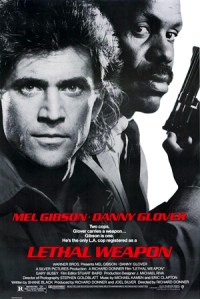
Lethal Weapon (1987)

Lethal_weapon1Richard Donner (Superman) has an understanding of the balance of grand spectacle and more subtle moments. The opening aerial shot and the tenuous desert rendezvous with a helicopter churning up sand capture our attention. But it’s the little bits of humor and vulnerability that make the showmanship of Lethal Weapon ultimately worth it. There’s a vibrancy that runs through Shane Black’s script in both the action sequences and character-driven moments.

It’s the quintessential buddy cop action film that in many ways defines the ’80s and that’s because it has a different slant. That’s part of the secret to its success. The main man (Danny Glover) is different and it’s not simply because he’s African-American. His family holds an important place in his life and he’s a genuine person — not an action hero. His partner in crime (Mel Gibson) also has his own deal. We meet Riggs in an abandoned trailer with bedhead, smoking and drinking a beer before he’s even awake. The loss of his wife causes him to contemplate suicide and everyone on the force questions his sanity. But when duty calls these two men are thrown together and out of their initial incompatibility comes mutual respect and genuine fun. As an audience, we enjoy watching them together.

What sets Lethal Weapon apart is how the violence is almost a side thought because what really matters are the characters and their relationships. Friends and family are important. Certainly, there are profane moments but they come in moments of extreme provocation. There’s even gratuitous violence at times but there’s consequence to it, more often than not.

Those in trouble are not simply damsels in distress because most everyone is in the same boat. Martin and Roger both are put in danger, captured and tortured. They don’t just dispense retribution. Their lives and families are put on the line too. However, it’s easy to point out the fact that some characters are killed, most notably in the opening moments, and they feel like mere plot points. For such reasons, the film’s certainly not perfect.

Also, its final moments are admittedly out there. It could be a scene out of Mad Max as Mel Gibson battles in the deluge of a spewing fire hydrant nearly to the death. The question is why, can’t they just arrest the culprit? It’s this scene that allows the character of Riggs to get his desired resolution. In fact, both he and Roger Murtaugh earn a bit of satisfaction as they rise up above the tumult. They are a pair of lethal weapons. But what matters most is that after a hard days work they can get together for a mediocre Christmas dinner. That’s true friendship.

3.5/5 Stars

Gentlemen Prefer Blondes (1953)

Gentlemen_Prefer_Blondes_(1953)_film_poster“I can be smart when it’s important, but most men don’t like it.” ~ Marilyn Monroe as Lorelei

Marilyn Monroe and Jane Russell together. It’s a crackerjack combination and Howard Hawks milks it for all its worth. There’s streetwise Dorothy  (Jane Russell) wooing all the boys from here to kingdom come. She cares about more than just money, especially when it entails having fun. Her other half is the vivacious bubble-headed beauty Lorelei like only Monroe could pull off. She’s the girl looking to get hitched with her bookish millionaire and she’s not afraid to admit that his money sweetens the pot. It certainly doesn’t hurt (Don’t you know that a rich man is like a pretty girl? You don’t marry her just because she’s pretty. But, my goodness, doesn’t it help?).

Time and time again words and bits of dialogue leave her lips that are almost astonishing. She delivers them with such a fluid air of seriousness that they force a double take and each and every time she has the audience in the palm of her hand. We think she’s dumb, but whether it’s the just the persona she puts on or a bit of Marilyn Monroe herself, she is extremely intelligent. If nothing else she knows how to captivate an audience, not letting them soon forget her magnetic performance.

If she had been playing against anything else Jane Russell would have been the primary attraction and she’s always wry and lovely, but with Monroe in the equation, they develop into a dynamic duo, leaving a wake of hapless boys behind them. There’s the old playboy Piggy (Charles Coburn) with a tiara Lorelei has ambitions for, the hired private investigator Ernie Malone (Elliot Reid) who finds himself falling for Dorothy, the diminutive Mr. Spofford and, of course, the hapless Gus (Tommy Noonan).

It can be easy to write Gentlemen Prefer Blondes off as a superficial musical — a provocative color extravaganza aboard an ocean liner. After all, it’s a story complete with pools, water slides, romance and a whole squad of athletes with bulging biceps. But it is a genuinely enjoyable film with Howard Hawks once more showing his aptitude for skirting between genres, this case indulging in musical comedy.

The sparkling and most remembered number is, of course, Monroe’s sultry turn in “Diamonds are a Girl’s Best Friend,” clothed in velvety pink,  but really for the entire running time of the film, Monroe and her costar are continually strutting and snapping their way into the hearts of everyone they cross paths with. A final comedic twist of an ending, playing off the comedic dynamic of the film’s pair of heroines, gives Jane Russell an equal chance to show off her star power. This truly is a team effort, even if gentlemen circa the 1950s were discriminatory towards all non-blondes.  Obviously, this film and my commentary are not meant to be taken too seriously. Still, they can be enjoyable. At least in the case of this film. My commentary, not so much.

3.5/5 Stars

The Snake Pit (1948)

Snakepit1948_62862nThere is a lineage of psychological dramas most notably including the likes of Shock Corridor and One Flew Over the Cuckoos Nest. But one of their primary predecessors was The Snake Pit which is a haunting, inscrutable and thought-provoking film in its own right.

But rather than trying to sum it up with words, it’s necessary to look deeper at what makes this such a potent film and it begins most obviously with Olivia De Havilland. She undoubtedly gives the best performance of her career — in so many ways drifting so effortlessly across the emotional spectrum. She’s either sane or “crazy” with fits of paranoia and inner turmoil, voices sounding off in her head and the like. But the most beautiful things are the moments when all the drama derives from the look on her face, a furrowed brow or a panic-stricken reaction we cannot fully understand.

That’s why it takes us the entire film to comprehend what is actually happening and it’s wonderful that we enter her story while she is in a sanitarium. Why and how she got there we don’t know right away, so as an audience there’s a similar sense of disorientation. Several reliable points of reference exist early on. Those being the genial Dr. Kik (Leo Genn)and Virginia’s concerned husband Robert (Mark Stevens) who visits her during every possible hour.

The film does intermittently feel disjointed but that hardly seems due to faulty storytelling and more a convention of Virginia’s narrative. It all comes to us in incoherent bits. In reality, months have passed but her memory is poor, causing her to lose track of the days. She drifts in and out of different wards and soon forgets the people and places that have been there all along. Furthermore, her progress waxes and wanes, with special visits from her husband and the faint chance of being released. Then in her darkest moments come electroshock therapy and even a straight jacket confining her in the depths of the sanitarium.

Anatole Litvak would hardly be considered an auteur but he still finds a way to heighten the tension with whip pans and nightmarish imagery when necessary. A pounding score adds yet another layer of anxiety reverberating with a vengeance, most memorably to simulate the jolts of electroshock therapy. But the greatest compliment that I have for his film is that it knows when to simply sit back and watch, like many of the great Classical Hollywood films. It lets its story, actors, and script all work and, in this case, they develop something with lasting depth.

Earlier I alluded to  The Snake Pit being part of a lineage including Shock Corridor and One Flew Over the Cuckoo’s Nest. It contains similarly shocking revelations about the reality behind sanitarium walls except they feel more realistic than the former film. Furthermore, De Havilland is surrounded by a wide array of odd bodies and patients with all sorts of psychoses rather like Randle McMurphy. But although there are some antagonistic people, her problems stem partially from the system around her and mostly from the pain buried deep within her own past.

It’s Dr. Kik who is able to dredge up the truth hidden inside of her over time. His calming, reassuring voice balanced with his psychoanalytic practices are able to work on Virginia’s psyche systematically. But in the same instance, it’s easy for her to get lost among the masses. Nurses do their jobs, doctors pass verdicts but they’re woefully understaffed and overworked.

The film’s resolution is actually hidden within its title. Because like the madmen of old, Virginia was thrown into a snake pit of her own that, far from driving her crazy, revealed to her that she must, in fact, be sane — at least compared to many of those around her. It’s up to the viewer to decide, aside from the happy denouement, if this is a troubling conclusion that the film comes to or not.

However, it’s paramount to note The Snake Pit’s conclusion on personal trauma and mental illness, based on childhood experiences. A lot of Virginia’s struggles came out of guilt and dysfunctional relationships with her parents. Yes, this is the punchline of the movie, but I only say this to point out how frightening or more precisely, how universal that revelation make this movie. Virginia’s parents weren’t altogether bad people and the reality is that all of us will face personal tragedy. We will have our share of guilty consciences too.

It’s how we cope with those things that matter most because it’s going to happen. We can hide it but we can’t escape it. All of us are broken in one way or another — even if we don’t want to admit it. That’s part of what The Snake Pit begins to bring to light.

4/5 Stars

4 Living Legends Part 3 (sort of)

800px-dorothy_malone_-_written_on_the_wind_-_studio_publicity_photoFor my ongoing series of living legends, I chose 5 individuals actually who in some way had an impact on the film industry as we know it today. Without further ado, here are a handful of living legends.

Gene Reynolds (1923-)

So Gene Reynolds began as a child actor back in the 1930s first appearing ni the Our Gang shorts and also making appearances in films such as Captains Courageous and Boys Town. Truth be told, I have yet to see one of his early performances. It’s unforgivable I know. However, Reynolds also had a great affect on me because of the many television shows he created/directed/produced later in his career. The list begins most prominently with MASH which he co-created but also Leave it to Beaver, The Andy Griffith Show, Hogan’s Heroes, and Lou Grant.

Billy & Garry Watson (1923 and 1928)

Okay, so this entry is a little unique because Billy and Garry Watson are hardly known on their own but as two parts in an acting entity, The Watson Family. If the name doesn’t ring a bell, that’s not necessarily unbelievable, but this group of siblings shared the screen with many of the great stars of the 1930s. Their film credits include the likes of Showboat, Young Mr. Lincoln, and perhaps most memorably, Mr. Smith Goes to Washington.

Lola Albright (1924-)

Lola Albright had a long and varied career in both film and television. Perhaps her most memorable role was opposite Kirk Douglas in Champion (1949) as one of his many flings on his way to the top of the boxing world. However, with the popularity of television, she also took many guests spots and even had a stint filling in for Dorothy Malone on Peyton Place.

Dorothy Malone (1925-)

Dorothy Malone will best be remembered for her work in some of Douglas Sirk’s greatest melodramas including Written on the Wind and The Tarnished Angels. She also took on a particularly memorable cameo opposite Humphrey Bogart in The Big Sleep. She too dabbled in television with her most prominent role being that of Constance Mackenzie on the syndicated television version of Peyton Place.

4 Star Films’ Favorite Movies: 21-25

somelikeithot2

One of the reasons film is so engaging and fascinating is the discussion that it evokes from all people. Every person, no matter their age or knowledge, can have their own subjective opinion on a film and why they liked it, or better yet why they hated it so much that they wanted to throw up.

But I’m going to cut the discussion short and put my cinematic life on the line by being completely vulnerable with some of my admittedly subjective picks for my favorite movies. Any agreement is highly encouraged. All dissenting opinions will be disregarded without a thought. Enjoy #21-#25 in this ongoing series:

21. It’s a Mad Mad Mad Mad World (1963)

This first title was love at first sight. All the things I love about a great comedy. Completely lacking sophistication and full of hilarious insanity. Also, Mad…World has arguably the greatest ensemble every assembled for one film. Everyone shows up for the party and it’s wonderful. Jonathan Winters was my favorite discovery from this film because he truly was a comic gem of a man.

22. Some Like it Hot (1959)

Jack Lemmon will always and forever be one of my favorite actors. Maybe it’s because he reminds me of my Grandpa because my Grandpa is a funny man. But that’s neither here nor there. Some Like it Hot stems from the genius of Billy Wilder, always ready with a funny storyline (two cross-dressing musicians fleeing Chicago gangsters) and a rapier wit. Of course, there’s Tony Curtis and Marilyn Monroe too, and the Hotel Del Coronado makes a memorable appearance filling in for Florida. Boy, oh boy, am I a boy!

23. The Young Girls of Rochefort (1967)

Now this one might seem kind of random. But I quickly fell in love with the fateful whimsy of Jacques Demy. His love of American musicals is evident with the casting of both Gene Kelly and George Chakiris, but this is also undeniably a French production starring sisters Catherine Deneuve and Francoise Dorleac. Michel Legrand’s music is surprisingly catchy and the fact that the film’s exposition is all given through song intrigued me from the beginning.

24. Laura

Film-Noir became a favorite genre, movement, style (whatever you want to call it) early on and Laura was one of the reasons why. I think I was smitten with Laura (Gene Tierney) much like our protagonists, and the film’s core mystery was gripping in more ways than one. David Raksin’s haunting score adds yet another layer to the drama as does Otto Preminger’s direction through the film’s interiors.

25. To Kill a Mockingbird

By now Harper Lee’s novel and Gregory Peck’s portrayal of Atticus Finch are almost intertwined in my mind, so much so, it becomes difficult to separate the two. And since I loved the book growing up, it’s only fitting that the film adaption would also hold a special place. Its set of sentiment and moral uprightness is hard for me to disregard, even when I’m at my most cynical. Mary Badham does a wonderful job as does Brock Peters — the perfect foils for Peck’s monumental portrayal.

The Father of the Bride (1950)

FatheroftheBride1950I’ve seen both versions of Father of the Bride and Steve Martin is fine and dandy but there is no better lovable curmudgeon than Spencer Tracy and he dons the role of the protective and skeptical father so effortlessly.

Furthermore, all down the line this production is an impressive gathering of talent with a radiantly young Elizabeth Taylor embodying the role of Kay, Joan Bennett leaving behind femme fatale roles for that of the level-headed mother and, of course, Vincente Minnelli positioned behind the camera. All in all, it’s a delightful light comedy that also finds time to say something heartfelt about the relationships of parents and their children, especially between fathers and daughters.

It’s rather like sitting back for story time as Tracy struggles with his shoes and begins to regale us with the recent happenings — the events that left his stately home looking like a hurricane disaster zone. It was all as a result of his daughter’s wedding. The event that is bound to challenge his sanity and bankrupt him in the process. But it’s for his “Kitten” so he’s willing to go through it out of his unwavering love for her.

First, he’s dubious of his future son-in-law, cringing at the thought as he shuffles through his memories of Kay’s many beaus. In his estimation, none of them was a winner, but then again, no one is good enough for his daughter. He’s not too excited about giving his daughter away nor by the prospect of supporting her good for nothing husband either. I’m sure most every father has the same conundrum to wrestle with. And it’s important to note that it’s played for comedic effect but never in a way that belittles these characters.

Minnelli was always a master of the color medium but here he still takes on the important role guiding us through the comedic moments with a deft touch and allowing us to track with the mayhem at large when necessary.

There are also some wonderful spots for veteran supporting players like the overly stuffy wedding coordinator Leo G. Carroll and the charmingly enthusiastic Melville Cooper as he guides the wedding rehearsal with a chaotic vigor.  Then, of course, there’s the prospective groom Buckley, played by the always affable everyman Don Taylor.

But everything must return to Tracy and Taylor because they are the nucleus of the storyline and as such, they work well together. Admittedly, Taylor might feel slightly out of place in such a family, but she is Elizabeth Taylor and she’s captivating all the same. Putting her together with Tracy means a lot of poignant sequences. Those moments where he comforts her, encourages her over a midnight snack at the dining room table, and finally, willingly gives her up to the man she has chosen to have and to hold for the rest of her life. To its credit, the film strikes a fine balance between comedy and heart always returning to this father-daughter relationship.

3.5/5 Stars

Review: The Adventures of Robin Hood (1938)

the adventures of robin hood 1As a young boy, no hero was greater in my mind’s eye than Robin Hood and only Star Wars held a more honored spot in my childhood imagination. Because, to this day, Robin of Locksley remains the quintessential hero of mythical lore. Part historical truth mostly canonized myth and that’s the beauty of him. We can believe in him — see how he was in so many ways real but in the same instance larger than life.

To his credit, Erroll Flynn does a surprisingly phenomenal job in portraying the legendary outlaw in Lincoln green with a bit of British (Australian…) cheekiness, as well as bravado and charm. In fact, the film is full of so many wonderful elements from its engaging action sequences full of timeless spectacle and a plethora of characters who come right off the pages of the greatest Robin Hood narratives. Will Scarlett, Much the Miller, Friar Tuck and of course Little John still hold a great deal of esteem in my heart. While there are no men more villainous and corrupted than the likes of Prince John (Claude Rains), The Sheriff of Nottingham (Melville Cooper) and Guy of Gisbourne (Basil Rathbone).

Meanwhile, Michael Curtiz took the reigns of the film and makes it a lively swashbuckler that revels in a sense of good fun and that starts with Flynn’s performance radiating out from there. While this early use of three-strip Technicolor only serves to add yet another layer of elegance and vibrancy to the film’s look. It truly was made for color and every shade of Lincoln green and every bit of medieval opulence proves to be a feather in the film’s cap. It looks absolutely stunning and the same goes for young Olivia De Havilland as Maid Marian.

Olivia_de_Havilland_and_Errol_Flynn_in_The_Adventures_of_Robin_Hood_trailerFrom what I know from Robin Hood folklore, specifically Howard Pyle’s seminal edition, the film is surprisingly true to many of the origin stories and tales that have long since proliferated. As an audience, we become privy to the first meetings of Robin and the formidable Little John (Alan Hale) who lays him out in the local stream after a bout with quarterstaffs. Then, in another instance, Robin provokes the portly Friar Tuck (Eugene Palette) who happens to be a master swordsman and a lover of good food and drink. Still, other vignettes include Robin’s successful masquerade as a lowly archer who wins the grand prize at the Sheriff of Nottingham’s Archery Tournament.

Of course, the most thrilling set pieces occur in Nottingham Castle, initially when Robin brazenly drops in on Prince John and his cronies bearing a deer over his shoulders. Admittedly I have Star Wars on the mind, but this sequence is rather reminiscent of Luke wandering into Jabba’s Palace.

Then, the climax comes later with the return of King Richard and Robin’s assault on the castle full of stellar swordplay and general chaos. The duel between Flynn and Basil Rathbone is especially thrilling and it holds up well even today because there is something so satisfying in watching them thrust and feint back and forth.

the adventures of robin hood 2For me, the reason very few heroes surpass Robin Hood is based on his innumerable qualities. He’s a superior fighter with bow, sword or staff. He’s blessed with a wonderful wit and impressive leadership capabilities. He wins over the girl with his charm. He gets to live out in the forest with his best friends, eating great food. But most of all, he’s a rebel with a heart of gold, robbing the rich to feed the poor.

He’s an embodiment of all things that a little boy dreams of as a kid and in many ways, he’s a fairy tale, but the kind of fairy tale that a boy readily conjures up in his own imagination. The villains are formidable and the action is unmistakable, but it’s all in good fun. That’s why the Adventures of Robin Hood remains an enduring folk tale of the cinema. Its hero transcends a single medium. Because he lives in the heart of many a young lad long after the title credits have rolled.

5/5 Stars

The Strange Affair of Uncle Harry (1945)

the strange affair of uncle harry 1It’s a B-picture title to be sure but with Robert Siodmak and such an ensemble, this is an enticing noir all the same. The well-to-do Quincy family of small-town America are an odd bunch, still holding onto their surname with pride as they slowly drift further and further into obscurity within the walls of their old mansion.

George Sanders is always a perennial favorite due to his dry wit and often snooty manner but here as Harry, we see him as all those things yet also trapped by his circumstances. Ella Raines, unfortunately, one of the often forgotten starlets of the 1940s, plays his savior in a sense and when she comes into his life there’s a chance to shake up all that is monotonous and stuffy about his existence.

Because he is constrained by his family name and a pair of sisters who rely on him continually for moral and emotional support. The eccentric Hester is always carrying an accusatory tone towards the housekeeper and getting bent out of shape about small trifles.

the strange affair of uncle harry 2The dominating sister Letty, played by Geraldine Fitzgerald, is more aloof in her ways, veiling everything with a conviction that what she does, she does for the good of her brother. But it’s all really due to the fact that she cannot bear to let him go. In this way, she’s constantly controlling his life and undermining his happiness. She’s hardly your typical femme fatale, more cultured and refined than most, but there’s still something exacting about her.

It’s when the tempered exterior and well-mannered formalities begin to crumble that her ulterior motives become more evident. Feigning illness just to keep him on a string and buying poison for some nefarious purpose. This unnerving dynamic between siblings becomes more tenuous for Harry,  accentuated by the fact that Letty, as played by Geraldine Fitzgerald, is quite attractive.

As far as the ending, there could have been five different outcomes and the one chosen fits the expectations of the contemporary audiences and the censorship board. Frankly, the affability of Ella Raines makes me want to enjoy this denouement, but my appreciation for film-noir makes me realize that this story deserved a dark turn to hammer home a genuinely twisted little picture. Still, Robert Siodmak is time after time one of the most interesting craftsmen of film-noir big and small. So it is with this morsel. Above all, I gained a newfound appreciation for the noteworthy work of Fitzgerald in particular.

3.5/5 Stars

La Belle et la Bete (1946)

La_Belle_et_la_Bête_film.jpgChildren believe what we tell them. They have complete faith in us. They believe that a rose plucked from a garden can plunge a family into conflict. They believe that the hands of a human beast will smoke when he slays a victim, and that this will cause him shame when a young maiden takes up residence in his home. They believe a thousand other simple things. – Jean Cocteau 

From the outset director Jean Cocteau entreats his audience to have a “childlike sympathy” and as a viewer, you do well to heed his advice. Because, that posture is exactly what becomes the guiding force behind this entire fairy tale that he has developed, in some ways so planted in reality and in others very much the purest of fantasy stories.

Though simple, the film’s special effects are surprisingly mesmerizing with magically opening doors, mirrors and human columns spewing smoke. You half expect to see strings or some other obvious cue to signal that this is all a facade, all hokey tricks, but a moment like that is never obvious. The film maintains much of its magic even after 70 years.

The Beast’s castle shines with the opulence of goblets and jewel, while the farmhouse of Belle and her family is humble, characterized after the artistic works of the great Flemish master Jan Vermeer.The atmosphere is equally gripping and Cocteau stages some of his shots in invariably interesting ways interrupting the plane of view with candles, smoke and anything else that suits his fancy. And that’s the beautiful things about fairy tales. You are not tied down to any sort of logic or narrative convention. His film is free-flowing, pacing itself as it sees fit. Even it’s ending is enduringly perplexing, hardly as straightforward as a Disney adaptation, but there is still immense power in that.

There are also an equal number of familiar reference points like evil sisters, who are blinded by their own avarice and then, of course, their humble sister, Belle, played so exquisitely pure by Josette Day. Her face beams with a radiance not often equaled and whether clothed in rags or the finest robes, it’s her humble elegance that shines through.

But it’s Jean Marais’s performance that is perhaps even more noteworthy if that were possible as he takes on a dual role. The first is more obvious, as Avenot, the man that Belle secretly loves, but it looks like it will never be due to their circumstances. However, Marais also takes on the monumental role of the beast and hidden behind tireless amounts of makeup and fur, it’s easy to lose him in the role. What would have been lost if he was animated or computer-generated, is betrayed in how he carries himself and even how he talks at points. Certainly, he is a creature prone to barbarism and violence, but innate in a performance such as this are those human characteristics. Thus, the perfect fairy-tale ending that we all know by now — probably thanks to Disney — is also a striking reminder. Yes, the fate of the prince of becoming a beast was due to spells and incantations, but we can just as easily be beasts now.

Without trying to go too far with the idea, it’s easy to recognize moments when we act almost inhuman. In fact, that’s the constant struggle of mankind, fighting against our more animalistic desires to do what we actually perceive to be upright. So you see, the Beast is not just a fairy story or the Beast is not simply someone else acting out in a horrid way, but the Beast can just as easily be you and me. In Cocteau’s film, a lot is made of the mystical mirror. Belle looks absolutely divine under its gaze but her sisters show up as an old woman and then a cackling monkey. If each one of us was to peer into that same mirror what would we show up as? What characterizes our lives? Beauty or bestiality? If this story is any indication, at least there is a chance at redemption. But that’s enough of that. La Belle et la Bete is a sublime fantasy deserving airtime alongside Disney’s more well-known adaptation.

4.5/5 Stars

Rogue One (2016)

Rogue_One,_A_Star_Wars_Story_poster.pngFor so many, there is a deep connection to Star Wars that started at an early age. As I have alluded to on numerous occasions, I am no different. And if I feel that way about even the prequels, it’s exponentially greater for the original trilogy, as I can imagine it is for legions of others. Thus, when I watch Rogue One I do not linger on its shortcomings, though they most certainly exist, instead, I’m fixated on that very same suspension of disbelief that overtakes me every time I enter that world, a long time ago in a galaxy far, far away.

If Rogue One had been an unredeemable, thoroughly bad film I would have been the first to say so. Perhaps it sounds crazy (or to fans maybe not so much) but I am deeply protective of Star Wars. I only want fanservice if it’s logical, fits the parameters of the world, and so on. I’m not a voracious fact checker of every Star Wars Wookieepedia page known to man and yet I might as well be. I was one of those who was deeply defensive when Disney looked to shake up George Lucas’s original canon. Though I digress…

But even as it stands as a mediocre story with vague contours at times, Gareth Edward’s Rogue One is propelled by fun characters, space opera entertainment, and, of course, A New Hope nostalgia. For those very reasons, it’s invariably easy to lend a heavy dose of grace to this standalone entry. And that’s what I will do.

We are introduced to Jyn Erso at an early age which gives context to her later exploits. In fact, when the story flashes forward after traumatic beginnings she (Felicity Jones) is a prisoner — not on behalf of the Rebel cause — and she has no plan to help the Rebels anytime soon. But in this way, she becomes one of their unassuming champions receiving news from her father (Mads Mikkelson) that the Death Star must be destroyed and she must spread the word.

It leads her to join forces with Rebel scoundrel Cassian Andor (Diego Luna) and his sarcastic droid co-pilot K2SO (voiced by Alan Tudyk). The bottom line is that all the various trips to planets and skirmishes with the Empire lead to a final showdown on the planet of Scariff where the ragtag group of Rebels lands a sneak attack on their unsuspecting enemy led by Imperial Director Krennic (Ben Mendelson). Meanwhile, a space battle erupts in the skies above and Jyn looks to transmit the vital plans to the Death Star before it is too late — so that hope might live on in the galaxy — and she does.

Not surprisingly, Rogue One has its share of callbacks involving the likes of Ponda Baba, Mon Mothma, and Bail Organa all returning to the Star Wars cinematic universe. And unused footage from the original film of Gold Leader exchanging callsigns is repurposed in the final offensive sequence as well. Although Grand Moth Tarkin and Princess Leia (the late Peter Cushing and Carrie Fisher returning from 1976) somehow look like carbon copies of their prior selves, they nevertheless sound vaguely different, giving off this peculiar sensation that they are CGI constructions and not the real thing. Still, it’s a remarkably impressive piece of work.

Obviously, the main objective of Rogue One is simple from a narrative perspective. The Rebels must obtain the plans to the Empire’s Death Star because without those, A New Hope would not be possible. But in order to get there, there are other necessary outcomes that feel a touch more suspect. I can see the need for finding Jyn’s father since his work is so critical to the Rebellion’s objective. However, the idea of a main switch to open up communication, her father’s hologram, Jyn’s final push to broadcast the vital schematics by reaching an antenna, and yes, even Kyber crystals, all seem like easy fixes to explain away the need for certain plot outcomes. I am, however, still trying to come up with an explanation how that is any different than the Force, aside from the very fact that its balance is crucial to the entire galaxy. I’ll get back to you on that one…

Furthermore, the idea of hope comes center stage in Rogue One. In fact,  even despite the influences of eastern monism, Star Wars’ mythology reminds me of the Biblical text that reads like so, “We rejoice in our sufferings, knowing that suffering produces endurance, and endurance produces character, and character produces hope, and hope does not put us to shame.” The same could be said of the Rebels. And people might scoff but in its resolution, the film even takes a page out of Shakespeare’s Hamlet. That’s what makes this idea of hope so important because there could very easily be none at all with so much death and destruction.

My loyalty towards the franchise (more so than DC or Marvel or Star Trek) makes me also fear the continued mechanization of this world into a continuing box office cash cow. With film after film, story after story, it’s indubitable that Star Wars too will lose its allure. It will be run into the ground or become besmirched by some egregious plot hole, discontinuity, or for some far worse fates like the return of another Jar Jar Binks.

That is my major concern with Rogue One because with the absence of an opening crawl, what it really did was signal a changing of the times, a new seed has been planted as the extended Star Wars universe continues to germinate and grow. Time will indicate if it flourishes or sucks all the nutrients out of the vibrant creations that were given so much vigor by the likes of George Lucas, Mark Hamill, Carrie Fisher, Harrison Ford, John Williams, and so many others. Only then will we see if this franchise is one with the force and the force is in it. Because with so many films, it’s difficult not to falter. Being both critical and an avid fan, I care all the more deeply about its fate. But for the time being, enjoy Rogue One and afterward slip in A New Hope again to be reminded exactly why Star Wars remains a cultural landmark.

4/5 Stars