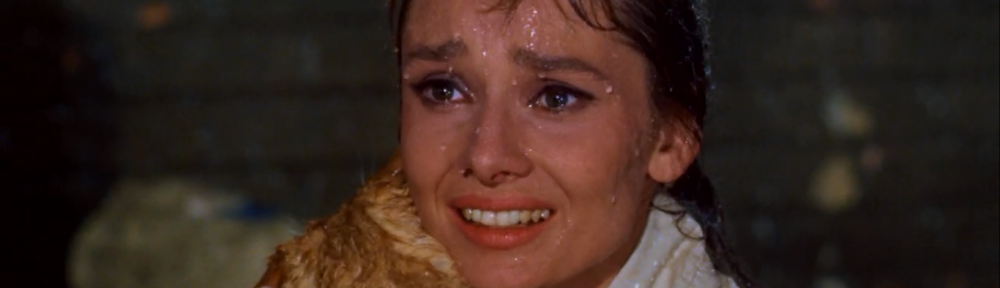
 Children believe what we tell them. They have complete faith in us. They believe that a rose plucked from a garden can plunge a family into conflict. They believe that the hands of a human beast will smoke when he slays a victim, and that this will cause him shame when a young maiden takes up residence in his home. They believe a thousand other simple things. – Jean Cocteau
From the outset director Jean Cocteau entreats his audience to have a “childlike sympathy” and as a viewer, you do well to heed his advice. Because, that posture is exactly what becomes the guiding force behind this entire fairy tale that he has developed, in some ways so planted in reality and in others very much the purest of fantasy stories.
Though simple, the film’s special effects are surprisingly mesmerizing with magically opening doors, mirrors and human columns spewing smoke. You half expect to see strings or some other obvious cue to signal that this is all a facade, all hokey tricks, but a moment like that is never obvious. The film maintains much of its magic even after 70 years.
The Beast’s castle shines with the opulence of goblets and jewel, while the farmhouse of Belle and her family is humble, characterized after the artistic works of the great Flemish master Jan Vermeer.The atmosphere is equally gripping and Cocteau stages some of his shots in invariably interesting ways interrupting the plane of view with candles, smoke and anything else that suits his fancy. And that’s the beautiful things about fairy tales. You are not tied down to any sort of logic or narrative convention. His film is free-flowing, pacing itself as it sees fit. Even it’s ending is enduringly perplexing, hardly as straightforward as a Disney adaptation, but there is still immense power in that.
There are also an equal number of familiar reference points like evil sisters, who are blinded by their own avarice and then, of course, their humble sister, Belle, played so exquisitely pure by Josette Day. Her face beams with a radiance not often equaled and whether clothed in rags or the finest robes, it’s her humble elegance that shines through.
But it’s Jean Marais’s performance that is perhaps even more noteworthy if that were possible as he takes on a dual role. The first is more obvious, as Avenot, the man that Belle secretly loves, but it looks like it will never be due to their circumstances. However, Marais also takes on the monumental role of the beast and hidden behind tireless amounts of makeup and fur, it’s easy to lose him in the role. What would have been lost if he was animated or computer-generated, is betrayed in how he carries himself and even how he talks at points. Certainly, he is a creature prone to barbarism and violence, but innate in a performance such as this are those human characteristics. Thus, the perfect fairy-tale ending that we all know by now — probably thanks to Disney — is also a striking reminder. Yes, the fate of the prince of becoming a beast was due to spells and incantations, but we can just as easily be beasts now.
Without trying to go too far with the idea, it’s easy to recognize moments when we act almost inhuman. In fact, that’s the constant struggle of mankind, fighting against our more animalistic desires to do what we actually perceive to be upright. So you see, the Beast is not just a fairy story or the Beast is not simply someone else acting out in a horrid way, but the Beast can just as easily be you and me. In Cocteau’s film, a lot is made of the mystical mirror. Belle looks absolutely divine under its gaze but her sisters show up as an old woman and then a cackling monkey. If each one of us was to peer into that same mirror what would we show up as? What characterizes our lives? Beauty or bestiality? If this story is any indication, at least there is a chance at redemption. But that’s enough of that. La Belle et la Bete is a sublime fantasy deserving airtime alongside Disney’s more well-known adaptation.
4.5/5 Stars
 For so many, there is a deep connection to Star Wars that started at an early age. As I have alluded to on numerous occasions, I am no different. And if I feel that way about even the prequels, it’s exponentially greater for the original trilogy, as I can imagine it is for legions of others. Thus, when I watch Rogue One I do not linger on its shortcomings, though they most certainly exist, instead, I’m fixated on that very same suspension of disbelief that overtakes me every time I enter that world, a long time ago in a galaxy far, far away.
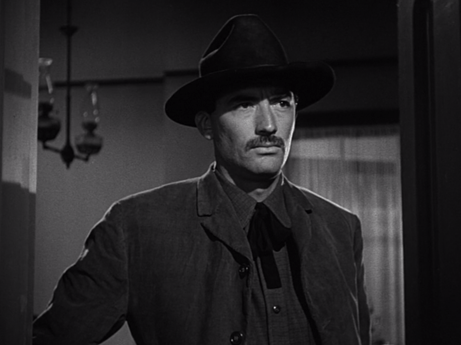 “Ringo don’t look so tough to me.”
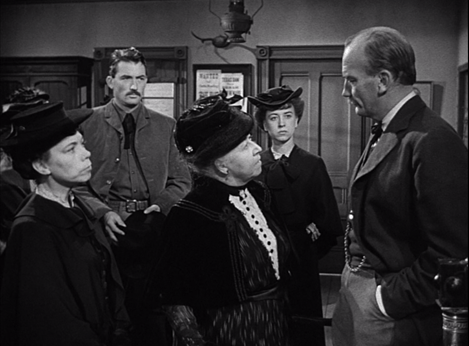 Of all men to understand Ringo, you would think that the local Marshall (Millard Mitchell) would be the last, but he happens to be an old friend of the gunman. They used to run in the same circles before Mark softened up. His life mellowed out, while Ringo’s reputation continued to build.
 The main reason Ringo stays in a town that doesn’t want him is all because of a girl (Helen Westcott). He waits and waits, biding his time, for any word from her, and finally, it comes. He gets his wish to see her and his son in private. These scenes behind closed doors are surprisingly intimate, casting the old gunman in an utterly different light.
 Saying that Phil Karlson has a penchant for gritty crime dramas is a gross understatement. And yet here again is one of those real tough-guy numbers he was known for, where all you have to do is follow the trail of cigarette smoke and every punch is palpable–coming right off the screen and practically walloping you across the face.
 “Things are only as meaningful as the meaning that we allow them to have.” ~ Beverly
 The fact that Miracle on 34th Street and this film came out the same year seems to suggest that there was something special in the air of New York City that year. It was a magical place, specifically during the Christmas season with Santa Claus going on trial and winning, while tramps helped reform millionaires. Admittedly, It Happened on Fifth Avenue is one of those films that could easily come under fire for its implausible plot, its unabashed sentiment, and any number of other things.
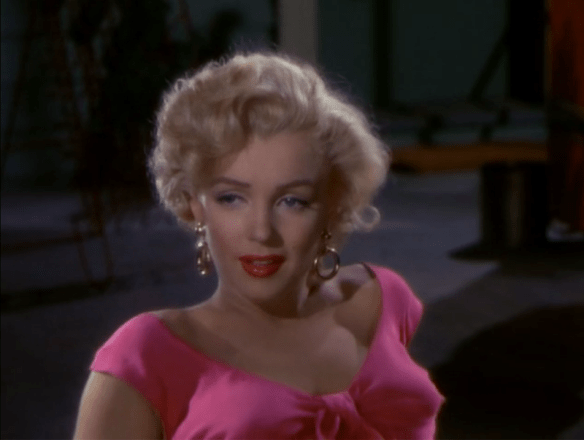 Rainbows, the soft misting of waterfalls, and honeymooning couples going through the tunnel of love. It hardly feels threatening at all, but that’s what makes film-noir so delicious. As the film style most reflective of the human condition, it proves that the dark proclivities and jealousies of the human heart can crop of anywhere–even a gorgeous tourist trap like Niagara Falls.
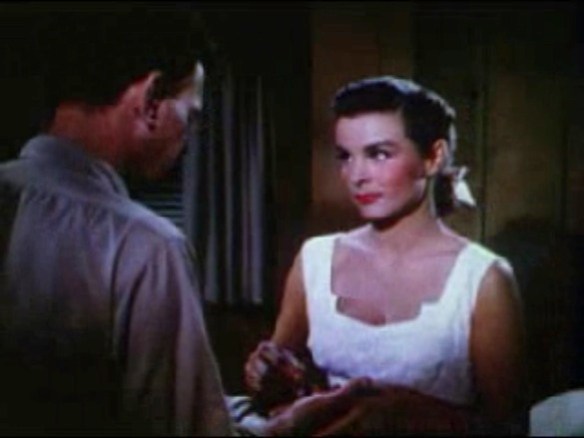 Without a question, Jean Peters becomes our favorite character as Polly, and it was an eye-opening for me personally to see her in a role so vastly different than Pickup on South Street. I had pigeon-holed her, rather erroneously as such a character, but Niagara shows a more tempered side to her persona that felt more representative of her as an actress. Max Showalter plays her husband, the genial and oblivious Ray Cutler, who takes his lovely wife on a long overdue honeymoon, only to have it totally ravaged thanks to the Loomises.
 I find that many of the best Christmas movies aren’t really about Christmas at all — at least not in the conventional sense that we’re so used to. Not trees or presents or lights or even holiday sentiment although those might all be there.
 “Heathens are not always low just as Christians are not always high.” – Gregory Peck as Father Chilsum
